

Saved Bookmarks
This section includes 7 InterviewSolutions, each offering curated multiple-choice questions to sharpen your Current Affairs knowledge and support exam preparation. Choose a topic below to get started.
| 1. |
Give the structures of the compounds which on reductive ozonolysis give : (i)propane-1,3-dial(ii)glyoxal and formaldehyde (iii)acetaldehyde, formaldehyde and carbon dioxide. |
Answer» Solution :(i)Since reductive ozonolysis gives only one product i.e., propane-1,3-dial , therefore , the compound must be a cyclic alkene , i.e., cyclopropene, 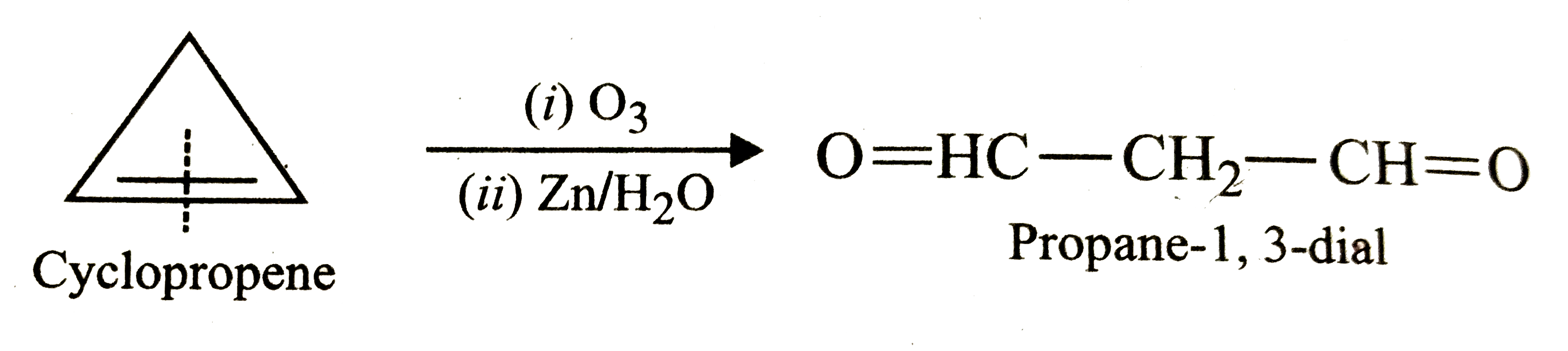 (ii)Since TWO products , i.e., glyoxal and formaldehyde are obtained , therefore , the compound must be acyclic. Further, since glyoxal (OCH-CHO) contains two aldehyde groups , therefore, on either side, there must a=`CH_2` group. Thus , the compound is 1,3-butadiene `underset"1,3-Butadiene"(CH_2=CH-CH=CH_2)underset((ii)Zn//H_2O)overset((i)O_3)to underset"Formaldehyde"(HCHO)+underset"Glyoxal"(OCH-CHO)+HCHO` (iii)Formation of `CO_2` indicates that on either side of this carbon, there is a DOUBLE BOND. Since `CH_3CHO` and HCHO are the two aldehyde obtained, therefore , this carbon is attached to `CH_3CH`= group on one side and `CH_2`=group on the other side. Therefore, the compound is 1,2-butadiene. `underset"1,2-Butadiene"(CH_3CH=C=CH_2)underset((ii)H_2O)overset((i)O_3)to underset"Glyoxal"(CH_3CHO)+O=C=O + underset"Formaldehyde""HCHO"` |
|
| 2. |
Give the structures of the alkene (C_4H_8) which adds on HBr in the presence and in the absence of peroxide to give the same product , C_4H_9Br |
|
Answer» Solution :2-Butene being SYMMETRICAL GIVES the same PRODUCT i.e., 2-bromobutane. `underset"2-Butene"(CH_3-CH=CH-CH_3) underset"or HBR/RCOOR"overset"HBr"to CH_3-undersetunderset(Br)|CH-CH_2CH_3` |
|
| 3. |
Give the structure of the 5-Oxohexanoic acid |
|
Answer» |
|
| 4. |
Give the structure of the 3,4-Dimethylphenol |
|
Answer» |
|
| 5. |
Give the structure of the 2,2-Dimethyl propane |
|
Answer» |
|
| 6. |
Give the structure of the 2-Methyl buta-1,3-diene |
|
Answer» |
|
| 7. |
Describe the structures of olfactory receptors. |
Answer» SOLUTION :
|
|
| 8. |
Give the structures for the following compound Acctaldehyde |
|
Answer» Solution :STRUCTURES : `CH_(3)-CHO`ACETALDEHYDE |
|
| 9. |
Give the structures for the following compound 3-chlorobutanol |
Answer» SOLUTION :STRUCTURES :
|
|
| 10. |
Give the structure of the product that would be formed when trans-1-bromo-3-methylcyclobutane undergoes as S_(N)2 reaction with NaI. |
Answer» Solution :First, write the formulas for the REACTANTS and IDENTIFY the nucleophile, the substrate, and the leaving group. Then, recognizing that the nucleophile will attack the back side of the substrate carbon atom that BEARS the leaving group. causing an inversion of CONFIGURATION at that carbon, write the structure of the product. 
|
|
| 11. |
Give the structure of sulphur tetrafluoride . |
| Answer» Solution :TRIGONAL bipyramidal with an EQUATORIAL position occupied by a LONE pair (HYBRIDISATION involved is `SP^(3)` d) | |
| 12. |
Give the structure of orbit picture of ethene show (i) sigma-bond (ii) pi-bond (iii) Give the number of sigma and pi-bond. (iv) Write the dihybridisation. |
Answer» Solution : (i) Orbital picture of only 1 BOND of ethene :  (ii) Orbital picture of ethene : In given picture figure (a) `pi`-bond (B) `pi`-electron cloud (c) Bond LENGTH andbond angle.  (iii) In ethene `sigma` and `pi` bond : There are 5 `sigma`-bond. In which their are `4C-H sigma`-bond and `C-C sigma` bond. Ethene has `1pi`-bond. because their is DOUBLE bond.  In ethene, their are 4C-H `sigma`-bond, carbon is `sp^(2)` hybridised DUE to the overlapping of orbitals. In ethene, sp-orbitals of carbon over laps with each other and forms `pi`-bond. In ethene molecule 2p-2p orbitals arranged parallel and perpendicular to plane of H-C-C-H between two carbons and forms one `pi`-bonds. |
|
| 13. |
Give the structure of isobutyl, isopropyl and isopentyl. |
|
Answer» Solution :(i) Isobutyl `(C_(4)H_(9)^(-))` : `(CH_(3))_(2)CHCH_(2)^(-)` OR `CH_(3)-overset(CH_(3))overset(|)(CH)-CH_(2)-` (II) Isopropyl `(C_(3)H_(7)^(-))` : `(CH_(3))_(2)CH-` OR `CH_(3)-overset(CH_(3))overset(|)(CH)-` OR `CH_(3)-underset(|)(CH)-CH_(3)` (iii) Isopentyl `(C_(5)H_(11)^(-))` : `(CH_(3))_(2)CHCH_(2)CH_(2)-` OR `CH_(3)-overset(CH_(3))overset(|)(CH)-CH_(2)-CH_(2)-` |
|
| 14. |
Give the structure of following: (i) 4-(1, 1-dimethyl propyl)-3-ethyl -4, 7-dimethyldecane (ii) 5-(1-methylbutyl)-7-(2-methylbutyl) undecane |
|
Answer» Solution :(i) `overset(1)(CH_(3)) overset(2)(CH_(2)) - underset(underset(C_(2)H_(5))(|))overset(3)(CH)- underset(underset(CH_(3))(|))overset(overset(H_(3)C - overset(overset(CH_(3))(1|))(C)- overset(2)(CH_(2))-overset(3)(CH_(3)))(4|))(C )- overset(5)(CH_(2))- overset(6)(C )H_(2)- underset(underset(CH_(3))(|))overset(7)(C )H- overset(8)(C )H_(2)- overset(9)(C )H_(2)- overset(10)(C )H_(3)` (ii) `overset(1)(C )H_(3)- overset(2)(C )H_(2)- overset(3)(C )H_(2) - overset(4)(C )H_(2) - underset(underset(H_(3)C- CH-CH_(2)CH_(2)CH_(3))(|))overset(5)(C H)- overset(6)(C )H_(2) - overset(overset(overset(1)(C )H_(2)- overset(overset(CH_(3))(2|))(C )H- overset(3)(C )H_(2)- overset(4)(C )H_(3))(7|))(CH)- overset(8)(C )H_(2)- overset(9)(C )H_(2)- overset(10)(C )H_(2)- overset(11)(C )H_(3)` |
|
| 16. |
Give the structure of chain isomers and their names of C_(6)H_(14) molecular formula and has only methyl group. |
| Answer» Solution :`{:(,"STRUCTURE","Name"),((i),CH_(3)-underset(CH_(3))underset(|)(CH)-CH_(2)-CH_(3),"2-methylpentane"),((II), CH_(3)-CH_(2)-underset(CH_(3))underset(|)(CH)-CH_(2)-CH_(3),"3-methylpentane"):}` | |
| 17. |
Give the structure of chain isomers and their IUPAC names of C_(6)H_(14) molecular formula and has two methyl group. |
| Answer» Solution :`underset("2,2-Dimethylbutane")(H_(3)C-underset(CH_(2))underset(|)OVERSET(CH_(3))overset(|)(C)-CH_(2)-CH_(3))` (ii) `underset("2,3-Dimethylbutane")(H_(3)C-underset(CH_(3))underset(|)(CH)-underset(CH_(3))underset(|)(CH)-CH_(3))` | |
| 18. |
Give the structure of alkene having double bond. |
|
Answer» Solution :Carbon-carbon double bond in alkenes consists one one `SIGMA`- bond and other `pi`-bond. `sigma`-bond is formed by over lapping of `sp^(2) - sp^(2)` hybridization. `pi`-bond is formed by ouverlaping of 2p-2p hybridization.  1 Double bond `= (1 sigma + 1 pi "bond")` `(sigma-"bond ethanlpy " = 397 kJ mol^(-1))` `(pi-"bond enthalpy "= 284 kJ mol^(-1))` `sigma` between 2 carbon : (i) Double bond has `1 sigma`-bond between carbon atoms and they has `sp^(2)` hybridization. (ii) Enthalpy of `sigma`-bond is `397 kJ mol^(-1)`. `pi`-bond between 2 carbon : (i) Two carbon atoms has `pi`-bond between them and they has overlapng of 2p orbital. (ii) Weak `pi` bond has enthalpy is `284 kJ mol^(-1)`. As `pi` is weaker bond, therefore alkene has more reactiving than that of alkane. In alkane, carbon-carbon bond length is (134 PM) shorter than C-C SINGLE bond is (154 pm). Therefore double bond is more stronger than single bond. |
|
| 19. |
Give the structure, formula and names of 1 to 4 carbon alkynes. |
Answer» Solution : Note :(i0 ALKYNE compound which possess ONE CARBON has molecular formula CH which is not possible. `(C_(n)H_(2n-2))`. (ii) But-1-yne and but-2-yne are TWO possible position isomers for alkyne having 4 carbon. |
|
| 20. |
Give the structural formule and IUPAC names of the following compounds : |
Answer» SOLUTION :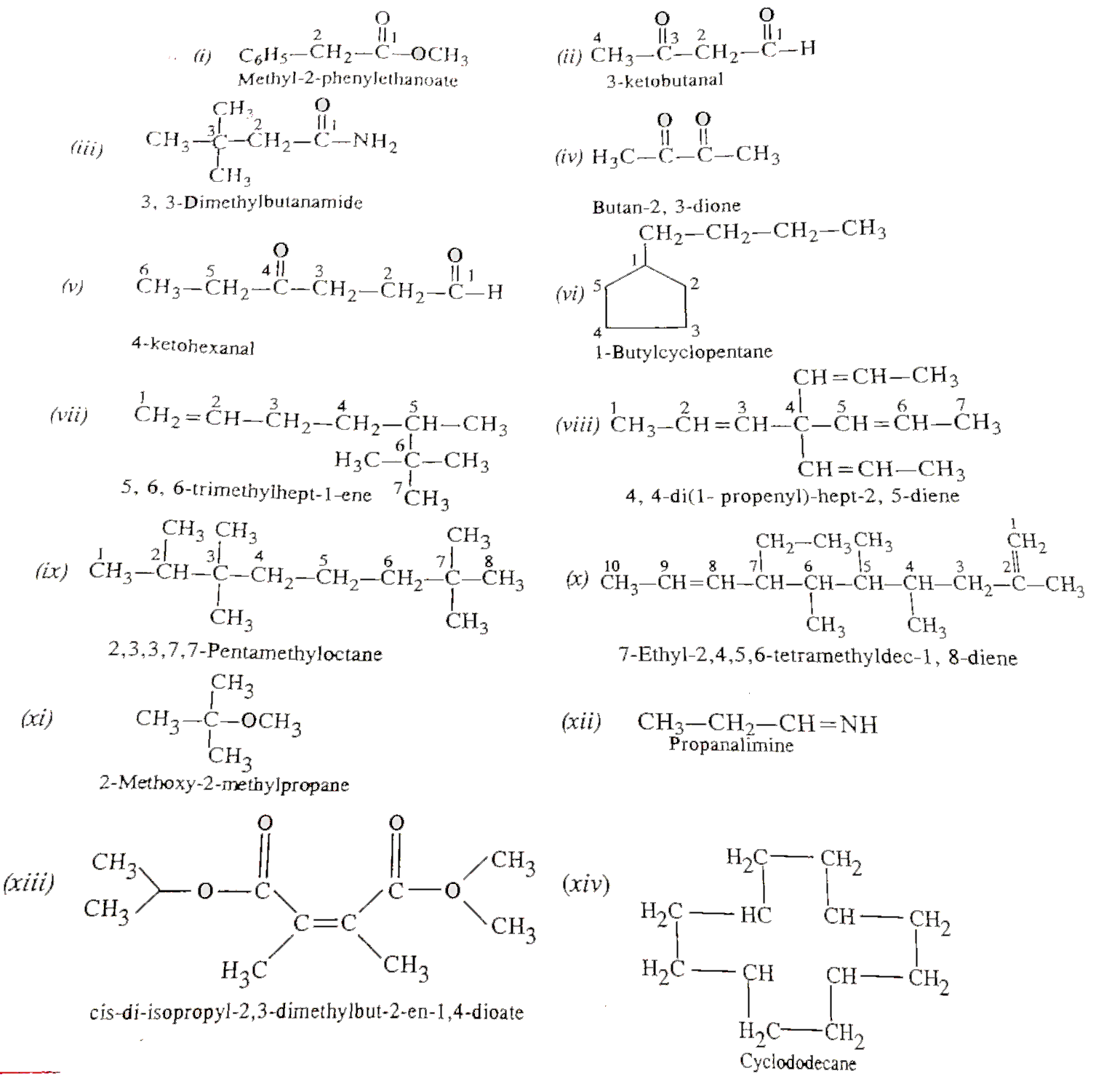
|
|
| 21. |
Give the structure and IUPAC name : (a) Vinyl chloride (b) Vinyl cyanide (c) Glyoxal(d) Silver acetilide (e) Diacetyl(f) Glycol |
Answer» SOLUTION :
|
|
| 22. |
Give the structural formula for the following compounds. (a) m - dinitrobenzene (b) p - dichlorobenzene (c) 1, 3, 5, lri-methyl Benzene |
Answer» SOLUTION :
|
|
| 23. |
Give the structural formula for the following compounds .(a) m- dinitrobenzene(b) P-dichlorobenzene (c)1, 3, 5, Tri-methyl Benzene |
Answer» SOLUTION :
|
|
| 24. |
Give the structural formula and IUPAC names of the following compounds. |
Answer» SOLUTION :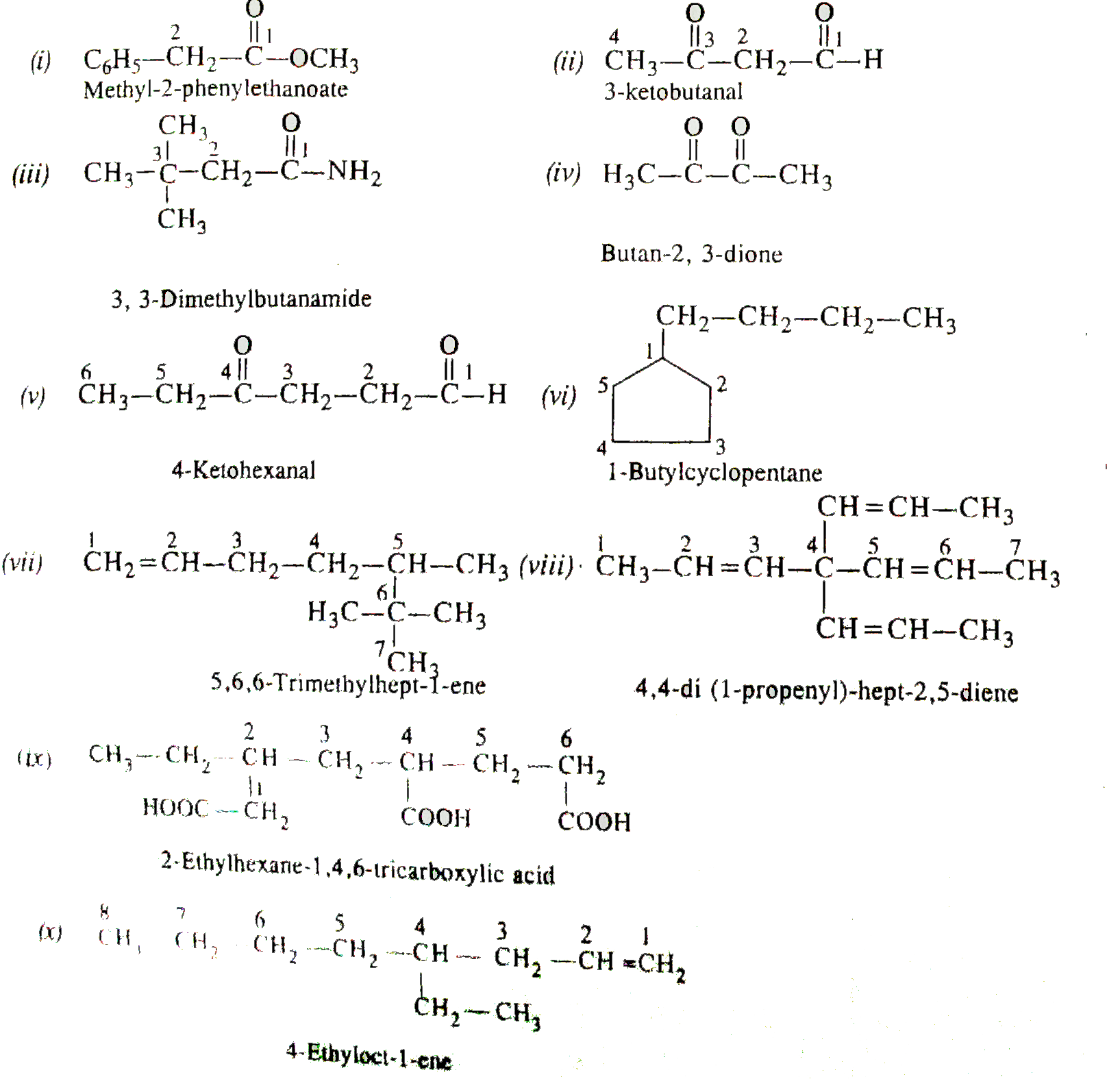
|
|
| 25. |
Give the structural features of modern periodic law. |
|
Answer» Solution :(i) According to the recommendation of IUPAC , the groups are numbered from 1 to 18 A (ii)There are 18 vertical colounms which constitute 18 groups or FAMILIES. (iii)There are 7 horizontal rows of the periodic table know as periods . (iv)The first period contains TWO elements . One present in first group and the other in 18 thgroup (v)Second andthird periods contain 8 elements in each . (vi) Fourth and fifth periods are completely filled as they contain 18 elements in each . (vii) The sixth period contains 32 elements . The seventh is incomplete. Fourteen elementsof both sixth and seventh periods are PLACED in SEPARATE panels at the bottom of the table. (viii)This periodic table is important and useful because we can predict the properties of any ELEMENT using periodic trend. |
|
| 26. |
Discuss the structural elucidation of benzene. |
|
Answer» Solution :(1) From elemental analysis and molecular mass determination,the molecular FORMULA of benzene is found to be `C_(6)H_(6)`. (2) On the basis of molecular formula benzene is highly unsaturated compound. (3) Benzene does not show alkene propeties. Benzene is quite stable. It does not decolourise cold aqueous solution of potassium paramanganate. (4) Benzene shows cyclic structure. (a) Benzene contains three double bonds. Benzene adds three moles of hydrogen in presence of nikel catalyst to form cyclohexane. `C_(6)H_(6) + 3H_(2) underset(" " Ni" ")overset(180^(@)C)(rarr) C_(6) H_(12)` (b) All the six hydrgoen atoms in benzene are identical - benzene reacts with bromine in presence of `FeBr_(3)` catalyst to form monobromobenzene. `C_(6)H_(6) + Br_(2) overset(FeBr_(3)) (rarr) C_(6) H_(5) Br + HBr` (5) Kekule propose benzene is planar ring structure with alternate single and double bonds.  (6) To overcome this drawback, Kekule suggested that benzene is a mixture of two forms, which are in rapied OSCILLATION.  (7) It is found that the bond length in benzene is same for fill C - C bonds (o.139 NM). this lies between C - C single bond (0.154 nm) and C- C double bond length (0.314 nm). (8) Resonance structure:Resonance hybrid is more stable than structure 1 and 2 . the stability of benzene DUE to resonance is so great that `pi` bonds of the molecule will normally resist breaking this explain the stability of benzene. 
|
|
| 27. |
Give the stability order of following radicals : |
|
Answer» `III GT IV gt II gt I` |
|
| 28. |
Give the significance of a 'lattice point'. |
| Answer» SOLUTION :Each lattice POINT represents one constituent particle of the SOLID. This constituent particle MAY be an atom, a molecule (group of ATOMS) or an ion | |
| 29. |
Give the significance of a 'lattice point' ? |
| Answer» Solution :Each lattic POINT REPRESENTS ONE CONSITUENT particle of the solid. The constituent particle may be an atom, a molecule (GROUP of atoms)or an ion. | |
| 30. |
Give the shape with electron pair in H_(2) O, NH_(2), SO_(2). |
Answer» SOLUTION :
|
|
| 31. |
Give the shape of molecule in which only bonding pair is present. |
|
Answer» Solution :For the prediction of GEOMETRICAL shapes of molecules with the help of VSEPR theory, it is CONVENIENT to divide molecules into two categories as (i) Molecules in which the central atom has no lone pair and (II) Molecules in which the central atom has one or more lone pairs. The following table shows the arrangement of electron pair about a central atom A (without any lone pairs) and geometries of some molecules/ions of the TYPE AB. 
|
|
| 32. |
Give the shape of NH_4^+ |
| Answer» SOLUTION :TETRAHEDRAL | |
| 33. |
Give the Rydberg equation where R is Rydberg constant? |
| Answer» SOLUTION :`barv=1/lamda=R(1/(n_(1)^(2))-1/(n_(2)^(2)))` | |
| 34. |
Give the rules for the calculation of oxidation number. |
|
Answer» Solution :In elements, in the FREE or the uncombined state, each atom bears an oxidation number of zero. E.g., `H_(2),O_(2),Cl_(2),N_(2),Na,Mg,Al,S_(8),P_(4)` has oxidation number zero. For ions composed of only atom, the oxidation number is equal to the charge on the ION. `Na^(+)` ion has an oxidation number = +1 `Mg^(+2)` ion has an oxidation number = +2 `Al^(+3)` ion has an oxidation number = +3 `Cl^(-)` ion has an oxidation number = -1 `O^(-2)` ion has an oxidation number = -2 `F^(-)` ion has an oxidation number = -1 Compounds of all alkali metals have +1 oxidation number and all alkaline earth metals have oxidation number +2. e.g., `Na^(+),K^(+),CS^(+),Rb^(+),Li^(+)andMg^(+2),Ca^(+2),Be^(+2),Sr^(+2)` The oxidation number of OXYGEN in most compounds is -2. e.g., `H_(2)OtoO^(-2)" ",CuOtoO^(-2)` Exception : While in peroxide compounds each oxygen atom is assigned an oxidation number of -1. e.g., `H_(2)O_(2)toO^(-1),Na_(2)O_(2)toO^(-1),BaO_(2)toO^(-1)` Oxidation number of oxygen in superoxide compounds is `-1/2`. e.g., `KO_(2)toO^(-1/2)" ",RbO_(2)toO^(-1/2)` When oxygen is bonded to fluorine, the oxidation number of oxygen is +2 and +1. e.g., `OF_(2)toO^(+2)" ",O_(2)F_(2)toO^(+1)` The oxidation number of hydrogen is +1. When it bonded to metals, in binary compounds its oxidation number is -1. e.g., `LiHtoH^(-1)" ",NaHtoH^(-1)" ",CaH_(2)toH^(-1)` In all its compounds, fluorine has oxidation number of -1. Other halogens (Cl, Br, I) also have an oxidation number of -1. Halogens combined with oxygen for in oxoacids and oxoanions has POSITIVE oxidation numbers. e.g., : `HCl toCl^(+1)" ",HClO_(2)toCl^(+3)` `HClO_(3)toCl^(+5)" ",HClO_(4)toCl^(+7)` `Cl_(2)O_(7)toCl^(+7)" ",Cl_(2)O_(3)toCl^(+3)` The algebraic sum of the oxidation number of all the atoms in a COMPOUND must be zero. In polyatomic ion the algebraic sum of all the oxidation number of atoms of the ion must equal the charge on the ion. Thus, the sum of oxidation number of three oxygen atoms and one carbon atom is the carbonate ion `(CO_(3))^(-2)` must equal -2. |
|
| 35. |
Give the rule for IUPAC nomenclature for branched compounds. Explain with example |
|
Answer» Solution :Branch containing alkane compounds are available in large amount. The nomination of such compounds are as follows: Rule-1: First of all, the longest carbon chain in the molecule is identified. And this longest carbon chain is known as .Parent chain.. Example: In the example (I) given below, the longest chain has nine carbons and it is considered as the parent or root chain. Selection of parent chain as shown in (II) is not correct because it has only eight carbons. (I) `overset(1)(C ) H_(3) - underset(underset(CH_(3))(|))overset(2)(CH) - overset(3)(CH_(2)) - overset(4)(CH_(2)) - overset(5)(CH_(2)) - underset(underset(underset(7)(C )H_(2) underset(8)(C )H_(2))(|))overset(6)(CH) - CH_(2) - CH_(2) - CH_(3)` Parent chain is of 8 carbon (II) `underset("Parent chain is of 9 carbon")(overset(1)(C )H_(3) - underset(underset(CH_(3))(|))overset(2)(CH) - overset(3)(CH_(2)) - overset(4)(CH_(2))- overset(5)(CH_(2)) - underset(underset(CH_(2)CH_(3))(|))overset(6)(CH) - overset(7)(CH_(2)) - overset(8)(CH_(2)) - overset(9)(CH_(3)))` so as per the rule -I parent chain of (II) is correct Rule 2: The carbon atoms of the parent chain are numbered to identify the parent alkane and to locate the positions of the carbon atoms at which branching takes place due to the substitution of alkyl group in place of hydrogen atoms. The numbering is done in such a way that the branched carbon atoms get the lowest possible numbers: (a) `overset(1)(C ) - underset(|)overset(2)(C )- overset(3)(C )- overset(4)(C )- overset(5)(C )- underset(underset(C - C)(|))overset(6)(C )- overset(7)(C )- overset(8)(C )- overset(9)(C )` Started no. 1 from left end there is branching at carbon atom `C_(2) and C_(6)` (b) `overset(9)(C )- underset(|)overset(8)(C )- overset(7)(C )- overset(6)(C )- overset(5)(C )- underset(underset(C-C)(|))overset(4)(C )- overset(3)(C )- overset(2)(C )- overset(1)(C )` Thus, the numbering in the above example should be from left to right (branching at carbon atoms `C_(2) and C_(6)`) and not from right to left (giving numbers `C_(4) and C_(8)` to the carbon atoms at which branches are attached). Rule-3: The names of alkyl groups attached as a branch are then prefixed to the name of the parent alkane. The position of the substituents is indicated by the appropriate numbers. If different alkyl groups are present, they are listed in alphabetical order. Thus, name for the compound shown above is: 6-ethyl-2-methylnonane. Note: The numbers are separated from the groups by hyphens and there is no break between methyl and nonane. `overset(1)(CH_(3)) - underset(underset(CH_(3))(|))overset(2)(CH)- overset(3)(CH_(2)) - overset(4)(CH_(2)) - overset(5)(CH_(2)) - underset(underset(CH_(2)CH_(3))(|))overset(6)(CH)- overset(7)(CH_(2)) - overset(8)(CH_(2)) - overset(9)(CH_(2))` Note (i) According to parent longest carbon chain, it is nonane (ii) The no .1 is taken at left side, the lowest get of locants become 2. (iii) Base of alphabetical order methyl is written after or ethyl. The dash (-) is put between no. and words, and no space between nonane and prefixes i.e., become one word name. Rule-4: If two or more IDENTICAL substituent groups are present then the numbers are separated by commas. The names ofidentical substituents are not repeated, instead prefixes such as di (for 2), tri (for 3), tetra (for 4) penta (for 5), hexa (for 6)etc. are used. While writting the name of the substituents in alphabetical order, these prefixed, however, are not considered. Thus, the following compounds are named as: (i) `underset("2, 4-Dimethylpentane")(overset(1)(CH_(3)) - overset(overset(CH_(3))(2|))(CH) - overset(3)(CH_(2)) - overset(overset(CH_(3))(4|))(CH) - overset(5)(CH_(3)))` (ii) `underset("2, 2, 4-Trimethylpentane")(overset(1)(CH_(3)) - underset(underset(CH_(3))(|))overset(overset(CH_(3))(2|))(C )- overset(3)(CH_(2)) - overset(overset(CH_(3))(4|))(CH) - overset(5)(CH_(3)))` (iii) `underset("3-Ethyl-4, 4-dimethylheptane")(overset(1)(CH_(3))- overset(2)(CH_(2)) - overset(overset(H_(3)CH_(2)C)(3|))(CH) - underset(underset(CH_(3))(|))overset(overset(CH_(3))(4|))(C )- overset(5)(CH_(2)) - overset(6)(CH_(2)) - overset(7)CH_(3))` To indicate two same `-CH_(3)`, put .di. and for position 2, 4- The coma is present between 2 and 4 In (ii) coma is present between 2, 2,4- In (iii), according to alphabet ethyl is after methyl but dimethyl (D) is not written first. Rule-5: If the two substituents are found in equivalent positions, the lower number is given to the one coming first in the alphabetical listing. Thus, the example are: (i)`underset("Name: 3-ethyl-6-methyloctane")(overset(1)(CH_(3)) - overset(2)(CH_(2)) - underset(underset(CH_(2)CH_(3))(|))overset(3)(CH)- overset(4)(CH_(2)) - overset(5)(CH_(2)) - underset(underset(CH_(3))(|))overset(6)(CH)- overset(7)(CH_(2)) - overset(8)(CH_(3)))` (ii) `underset("or 6 ethyl-3-methyloctane")(overset(8)(CH_(3))-overset(7)(CH_(2))- underset(underset(CH_(2)CH_(3))(|))overset(6)(CH)- overset(5)(CH_(2))- overset(4)(CH_(2)) - underset(underset(CH_(3))(|))overset(3)(CH) - overset(2)(CH_(2)) - overset(1)(CH_(3)))` In (i) according to alphabet, methyl is come after ethyl and ethyl get less number. `:.` (i) is correct number and name. Rule-6 : The branched alkyl groups can be named by following the above mentioned procedures. However, the carbon atom of the branch that attached to the root alkane is numbered 1 as exemplified below `overset(4)(CH_(3))-underset(underset(CH_(3))(|))overset(3)(CH)- overset(2)(CH_(2)) - underset(underset(CH_(3))(|))overset(1)(CH)-` The name of such branched chain alkyl group is placed in parenthesis while naming the compound. While writing the trivial names of substituents. in alphabetical order, the prefixes iso- and neo-are considered to be the part of the FUNDAMENTAL name of alkyl group. The prefixes sec- and tert- are not considered to be the part of the fundamental name. The use of iso and related common prefixes for naming alkyl groups is also allowed by the IUPAC, NOMENCLATURE as long as these are not further substituted. In multisubstituted compounds, the following rules may also be remembered: if there happends to be two CHAINS of equal size, then that chain is to be selected which contains more number of side chains. After selection of the chain, numbering is to be done from the end closer to the substituent Example : (a) RIght order:  Name: 5-(2-Ethyl butyl) -3,3-dimethyldecane Name: 5-(2-Ethyl butyl) -3,3-dimethyldecane (b) Right order: `{:(overset(10)(CH_(3))- overset(9)(CH_(2))- overset(8)(CH_(2)) - overset(7)(CH_(2)) - overset(6)(CH_(2)) - overset(5)(CH)- overset(4)(CH_(2)) - overset(overset(CH_(2)- CH_(3))(3|))(CH) - overset(2)(CH_(2)) - overset(1)(CH_(3))),("1|"),(""CH_(2)),("2|"),(""H_(2)C- C- CH_(3)),("3|"),(""CH_(2)- overset(4)(CH)_(3)):}`Name: 5- (2, 2-Dimethylbutyl)-3-ethyldecane In (a) and (b) both `C_(6)H_(13)` substituent is with `C_(5)` and with all these longest chain with ten carbon is decane. As per (a) the order is correct, as substituent is at on least order 2 carbon. While in (b) order is 3. |
|
| 36. |
Give the resonating structures of NO_(2)andN_(2)O_(5). |
Answer» Solution :Resonating STRUCTURES of `NO_(2)` are  Resonating structures of `N_(2)O_(5)` are : 
|
|
| 37. |
Give the reason for the following: The first ionisation enthalpy of oxygen is smaller compared to nitrogen. |
|
Answer» Solution :`O- 1s^2 2s^2 2p^4` `N- 1s^2 2s^2 2p^3` Nitrogen has EXTRA stabillity of HALF filled ELECTRONIC configuration. therefore `1E_1` of OXYGEN is less than nitrogen. |
|
| 38. |
Give the reason for the following:Phosphorus froms PCl_5 whille nitrogen cannot from NCl_5 |
| Answer» SOLUTION :NITROGEN has no d-orbitals in its VALENCE SHELL. It cannot expand its covalency beyond four and hence cannot from pentahalides. But phosphorus has vacant d-orbitals in its valence shell.hence it can expand its covalency beyond four and forms penthalides. | |
| 39. |
Give the requirements for formation of pi bonds and explain active centre |
|
Answer» <P> Solution :In a `pi` (pi) bond formation parallel orientation of the two p-ORBITALS on adjacent atoms is necessary for a proper SIDEWAYS overlap EG. For the formation of `pi` bond in `H_(2)C= CH_(2)`.All the atoms must be in the same plane. The p orbitals are mutually parallel. Both the p orbitals are perpendicular to the pane of the molecule. Effect on rotation on C-C bond: In `CH_(2)= CH_(2)`, the rotation of one `CH_(2)` fragment with respect to other interferes with maximum overlap of p orbitals and , therefore, such rotation about carbon-carbon DOUBLE bond (C = C) is restricted. Availability of electron by `pi` bond and reactive centres of reactions: The electron charge cloud of the `pi` bond is located above and below the plane of bonding atoms. This results in the electrons being easily available to the attacking reagents. In general `pi` bonds provide the most reactive centres in the molecules containing multiple bonds |
|
| 40. |
Give the relationship between pressure and density of gas. |
| Answer» SOLUTION :Because of SURFACE tension the molecules tend to MINIMISE the surface AREA, and sphere has MINIMUM surface area. | |
| 41. |
Give the requirement to form hybridization. |
|
Answer» Solution :The orbitals present in the valence shell of the atom are hybridised. The orbitals undergoing hybridization should have ALMOST equal energy. PROMOTION of electron is not essential condition PRIOR to hybridization. It is not necessary that only HALF filled orbitals participate in hybridization. In some cases even filled orbitals of valence shell take part in hybridization. |
|
| 42. |
Give the relationship between molecular mass and density of a gas. |
|
Answer» |
|
| 43. |
Give the relationship between K_(p) and K_(c) for the following cases with example. Deltan_(g)=-"ve" |
|
Answer» Solution :When `Deltan_(G)=-"ve"` `K_(P)=K_(c)(RT)^(-"ve")` `K_(P)ltK_(c)` Example : `2H_(2)(g)+O_(2)(g)hArr2H_(2)O(g)` `2SO_(2)(g)+O_(2)(g)hArr2SO_(3)(g)` |
|
| 44. |
Give the relationship between K_(p) and K_(c) for the following cases with example. Deltan_(g)=0 |
|
Answer» <P> SOLUTION :When `Deltan_(g)=0``K_(P)=K_(C)(RT)^(0)=K_(c)` Example : `H_(2)(g)+I_(2)(g)hArr2HI(g)` `N_(2)(g)+O_(2)(g)hArr2NO(g)` |
|
| 45. |
Give the relationship between K_(p) and K_(c) for the following cases with example. Deltan_(g)=+"ve" |
|
Answer» <P> Solution :When `Deltan_(g)=+"ve"``K_(P)=K_(C)(RT)^(+"ve")` `K_(P)gtK_(c)` Example : `2NH_(3)(g)hArrN_(2)(g)+3H_(2)(g)` `PCl_(5)(g)hArrPCl_(3)(g)+Cl_(2)(g)` |
|
| 46. |
Give the relation between Kp and Kc for the be equilibrium N_(2)(g)+3H_(2)(g)hArr2NH_(3)(g) |
|
Answer» |
|
| 47. |
Givethe relationbetween energyof orbitaland atomicnumberis sameenergylevel ? |
|
Answer» SOLUTION :In samesubshellas the atomicnumber `(Z_(EFF))` energydecrease . E.g. ENERGYOF 2sorbitalsof He,Be,Mg`E_(2) (He ) ltE_(2)(Be) lt E_(2) ( mg)` |
|
| 48. |
Givethe reasonfor the formation of spectrum . |
| Answer» SOLUTION :When abeamof lightchangethe MEDIUM severationof differentiontake place.thewavewhichhas shortwavelengthteriatemoreso thespectrumfrom. Inspectrumbeamoflightin INDIFFERENT SERIESOF COLOUR. | |
| 49. |
Define relative lowering of vapour pressure. |
| Answer» Solution :NaCl is NON volatile solute. When a non volatile is DISSOLVED in pure SOLVENT, the vapour pressure of pure solvent will DECRESE. In such solution. Vapour pressure of the solution will depend only on the solvent MOLECULES as the solute is non-volatile. | |
| 50. |
Give the reaction of methane by steam |
|
Answer» Solution :Methane reacts with STEAM at 1273 K in the presence of nickel catalyt to form carbon MONOXIDE and dihydrogen. This method is used for INDUSTRIAL preparation of dihydrogen gas. `UNDERSET("Methane")(CH_(4(G)))+underset("Steam")(H_(2)O_((g))) underset(1273 K)overset(Ni)rarr underset("monoxide")underset("Carbon")(CO_((g))) + underset("Dihydrogen")(3H_(2(g)))` |
|