

Saved Bookmarks
This section includes 7 InterviewSolutions, each offering curated multiple-choice questions to sharpen your Current Affairs knowledge and support exam preparation. Choose a topic below to get started.
| 1. |
H_(2)COH-CH_(2)OH on heating with periodic acid gives |
|
Answer» `._(H)^(H)gtC=O` |
|
| 2. |
H_2CO_3ionises in two stages as represented below H_2CO_3 +H_2O hArr H_3O^(+) +HCO_3^(-), HCO_3^(-)+H_2O hArr H_3O^(+)CO_3^(2-)the no. of conjugate acid -base pairs in the above reaction are |
|
Answer» 2 |
|
| 3. |
"Asparticacid + A"overset("Transaminase")rarr" B + Glutamic acid" In the above reaction A and B respectively, |
|
Answer» 2 |
|
| 4. |
H_(2)C_(2)O_(4).2H_(2)O (Mol wt =126) can be oxidised intoCO_(2) by acidified KMnO_(4). 6.3 gms of oxalic acid can not be oxidised |
|
Answer» 3.16 gms of `KMnO_(4)` `(6.3)(126)xx2=Mxx5` Moles of `KMnO_(4)=0.02=3.16g=0.2xx0.1M` |
|
| 5. |
H_(2)C_(2)O_(4) and KHC_(2)O_(4) behave both as acids and reductants. Amongst the following, the true statement(s) is/are |
|
Answer» Equal volumes of 1 M solution of each is oxidised by equal volumes of 1 M `KMnO_(4)` Eq. HCl = `(1)/(2)` eq `NC_(2)CO_(3)` `(x xx0.05)/(1000)=(1)/(2)xx(0.050xx40xx2)/(1000)impliesx=40ml` In the SECOND titration Eq of HCl = Eq `NC_(2)CO_(3)+` Eq `NKHCO_(3)` `(yxx0.05)/(1000)=(40xx0.05xx2)/(1000)+(40xx0.05xx1)/(1000)` `y=120implies y-x=80` |
|
| 6. |
H_(2)C_(2)O_(4) acts as an acid as well as an oxidising agent. The correct statements (s) about H_(2)C_(2)O_(4) is (are): |
|
Answer» It FORMS two series of salts |
|
| 7. |
H_(2)C_(2)O_(4)*2H_(2)O its molecular mass ........... |
|
Answer» 90 u `=6(1)+2(12)+6(16)=126u` |
|
| 8. |
H_(2)C = O or CH_(3)CN acts as a nucleophile as well as an electrophile. Explain |
|
Answer» Solution :SINCE both O and N are more ELECTRONEGATIVE than C, therefore, C carries a small +ve CHARGE and, O and N carry a small -ve charge. In other words, both act as an ELECTROPHILE due to the presence of a partial +ve charge on C and act as a nucleophile due to the presence of a partial -ve charge on O or the N. 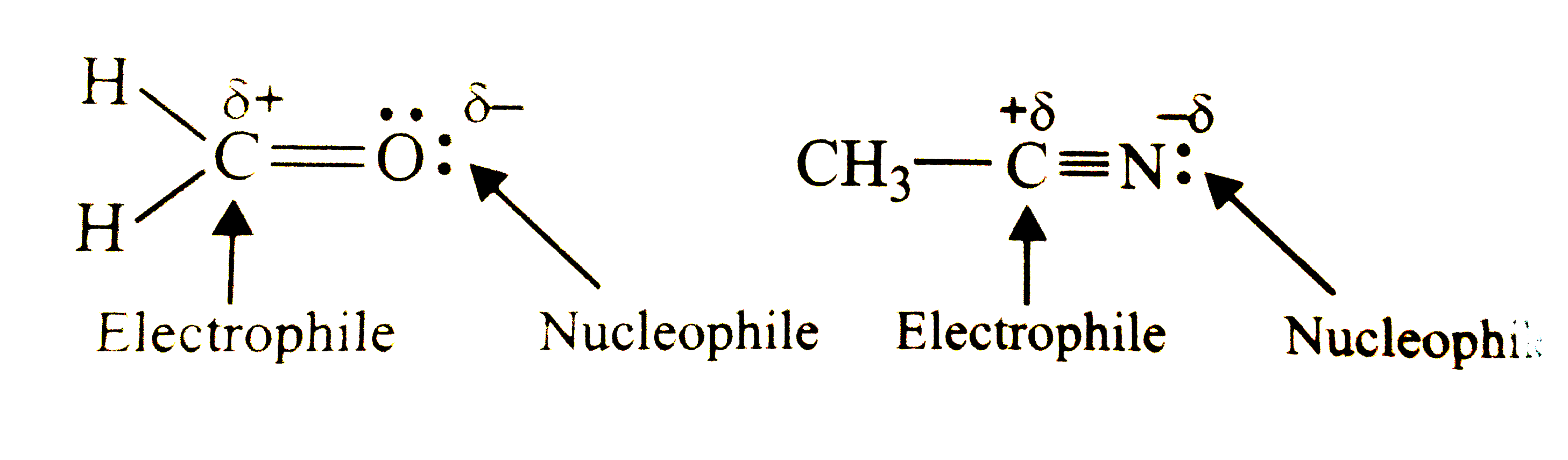
|
|
| 9. |
H_(2)C = CH- CH_(2) -underset(CH_(2)) underset("||")C-overset(+)CH_(2) Resonance hybrid of the carbocation is |
|
Answer» `H_(2)overset(delta+)C=CH=overset(delta+)CH_(2)=underset(delta+)underset(CH_(2))underset("||")C= overset(delta+)(CH_(2))` |
|
| 10. |
H_2C = CH_2 + CO + H_2 underset(100^(@)C , " high " P)overset(Co_2(CO)_8)to |
|
Answer»
|
|
| 11. |
H_2Ais a weak diptotic acid . IF the pH of 0.1 MH_2Asolution is 3 and concentration of A^(2)is 10 ^(-12)"at "25 ^(@) CSelect correct statement (s) |
|
Answer» `[H^(+) ]_("total")~~[H^(+) ]` from first step ionization of acid `H_2A ` ` K_(a_1) =10 ^(-5) rArr [A^(-2) ]=K_(a_2) rArr P^(K_(a2 )) = 12 ` ` P^(K_(a2))-P^(K_(a3)) = 7 ` |
|
| 12. |
What is the concentration of CN^(-)ions in a solution with 0.1M HCland 0.01M HCN where K_a of HCN is 10 ^(-6)? |
|
Answer» `[H^(+) ]_("total")~~[H^(+) ]` from first step ionization of acid `H_2A ` ` K_(a_1) =10 ^(-5) rArr [A^(-2) ]=K_(a_2) rArr P^(K_(A2 )) = 12 ` ` P^(K_(a2))-P^(K_(A3)) = 7 ` |
|
| 13. |
H_(2) will not reduce which of the following oxide ? |
|
Answer» Aluminium oxide |
|
| 14. |
H_(2) SO_(2) solution (20 mL) reacts quantitatively with a solution of KMnO_(4) (20 mL) acidified is just dilute H_(2) SO_(4). The same volume of the KMnO_(4) solution is just decolourised by 10 mL of MnSO_(4) in neutral medium. simulataneously forming a dark brown precipitate of hydrated MnO_(2). The brown precipitate is dissolved in 10 mL of 0.2 M sodium oxalate under boiling condition in the presence of dilute H_(2) SO_(4). Write the balanced equations involved in the reactions and calculate the molarity of H_(2) O_(2) solution. |
|
Answer» Solution :Take the balanced equations as follows: `2MnO_(4)^(ɵ) + 6 H^(o+) + 5 H_(2) O_(2) RARR 2 Mn^(2+) + 8 H_(2) O + 5 O_(2)` `2 MnO_(4)^(ɵ) + 2 Mn^(2+) rarr 5 MnO_(2)` `MnO_(2) + C_(2) O_(4)^(2-) + 4 H^(o+) rarr Mn^(2+) + 2 H_(2) O + 2CO_(2)` To find molarity of `H_(2) O_(2)` GIVEN: `20 mL H_(2) O_(2) -= 20 mL KMnO_(4)//H^(o+)` `20 mL KMnO_(4) -= mL MnSO_(4) rarr MnO_(2)` `MnO_(2) -= 10 mL (0.2 M) Na_(2) C_(2) O_(4)` From stoichiometry of above reactions: 1 mmol of `Na_(2) C_(2) O_(4) -= 1 mmol MnO_(2)` `IMPLIES 0.2 XX 10 mmol of Na_(2) C_(2) O_(4) -= 2 mmol of MnO_(2)` Also, 5 mmol of `MnO_(2) -= 3 mmol of Mn^(2+)` `implies 2 mmol of MnO_(2) -= (3)/(5) xx 2` `-= (6)/(5) mmol of Mn^(2+) (MnSO_(4))` Also, 3 mmol of `MnSO_(4) -= 2 mmol KMnO_(4)` `implies (6)/(5) mmol of MnSO_(4) -= (2)/(3) xx (6)/(5) = mmol KMnO_(4)` Now same amount of `KMnO_(4)` reacts completely with `H_(2) O_(2)`. `2 mmol of H_(2) SO_(4) -= 5 mmol of H_(2) O_(2)` `implies 2 mmol of KMnO_(4) -= (5)/(2) xx (4)/(5) = 2 mmol of H_(2) O_(2)` Now mmol of `H_(2) O_(2) = MV_(mL)`. `implies 2 = M xx 20 implies M = 0.1` |
|
| 15. |
H_(2) + S hArr H_(2) S + energy In this reversible reaction , select the factor which will shift the equilibrium to the right . |
|
Answer» adding heat |
|
| 16. |
p^(I) of H_(3)overset(o+)(N)-CH_(2)-COOK is 5H_(3)overset(o+)(N)CH_(2)COOH hArr H_(2)NCH_(2)COO^(-)+H^(+)K_(a)=10^(-4)H_(2)overset(o+)(N)CH_(2)COO^(-)hArr H_(2)NCH_(2)COO^(-)+H^(+)K_(a)=10^(-X) What is x ? |
|
Answer» `x+y` `PH= ( pK_1 + pK_2)/( 2 )=(x+y)/(2) ` |
|
| 17. |
H_2 O+H_3 PO_3 hArr H_3O^(+) +H_2O PO_3^(-),pK_1 = x H_2O+H_2PO_3 hArr H_3 O^(+)HPO_3 ^(-2), pK_2 =y Hence , pH of 0.01 M NaH_2 PO_3 is : |
|
Answer» `x+y` `PH= ( pK_1 + pK_2)/( 2 )=(x+y)/(2) ` |
|
| 18. |
Hmlocule has two elections and two nuclei. In which form of hydrogen the spin of electrons and also the spin of nuclei are in opposite directions |
|
Answer» Orhohydrogen |
|
| 19. |
H_(2) gas is mixed with air at 25^(@)C under a pressure of 1 atmosphere and exploded in a closed vessel. The heat of the reaction, H_(2(g))+(1)/(2)O_(2(g))rarrH_(2)O_((v)) at constant volume, DeltaU_("298 K")=-"240.60 kJ mol"^(-1) and C_(V) values for GH_(2)O vapour and N_(2) in the temperature range "298 Kand 3200 K are 39.06 JK"^(-1)"mol"^(-1) and "26.40 JK"^(-1)"mol"^(-1) respectively. The explosion temperature under adiabatic conditions is (Given : n_(N_(2))=2) |
|
Answer» 2900 K `DeltaU=DeltaU_("heating")+DeltaU_("298 K")=0` or `DeltaY_("heating")=-DeltaU_(298K)` `=int_(298K)^(T_(F))n SigmaC_(v)dT=+240.60" kJ mol"^(-1)` `SigmanC_(v)=n.C_(v(H_(2)O_((v)))+nC_(v(V_(2(g))))` `=(39.06+2xx26.40)=91.86JK^(-1)mol^(-1)` by using the value of `SigmanC_(v)` in the above equation `(91.86)(T_(f)-298)=240600"J mol"^(-1)` `T_(f)-298=(240600)/(91.86)=2619K` `T_(f)=2619+298=2917K` |
|
| 20. |
H_(2) gas is not liberated at both cathode and anode by electrolysis of which of the following aqueous solution? |
|
Answer» NaH |
|
| 21. |
H_(2) gas is liberated when H_(2)O_(2) reacts with |
| Answer» Solution :`H_(2)O_(3)+2HCHO to 2HCOOH+H_(2)` | |
| 22. |
H_(2)+Cl_(2)to 2HCl,Delta H_(1),N_(2) +3H_(2)to 2NH_(3), DeltaH_(2)" and "NH_(3)+3Cl_(2)to NCl_(3)+3HCl,DeltaH_(3) Then calculate the heat of formation of nitrogen trichloride. |
|
Answer» |
|
| 23. |
H_(2(g)) + 1/2O_(2(g)) rarr H_2O_((l)) , DeltaH = -286.2KJ H_2O_((l)) rarr H_((aq))^(+) + OH_((aq))^(-) , DeltaH = +57.3 KJ Enthalpy of ionization OH^(-) in aqueons solution is |
|
Answer» `-228.5KJ` |
|
| 24. |
H_2 + CO + R - CH = CH_2to R -CH_2-CH_2 -CHO This reaction is known as |
|
Answer» HYDROGENATION |
|
| 25. |
H_2 + Cl_2 rarr 2HCl , DeltaH_1, N_2 + 3H_2 rarr 2NH_3, DeltaH_2 and NH_3 + 3Cl_2 rarr NCl_3 + 3HCI, DeltaH_3. Then calculate the heat of formation of nitrogen trichloride. |
|
Answer» |
|
| 26. |
N_(2) + 3H_(2) rarr 2NH_(3), Delta H = - 46K. Cals. From the above reaction, heat of formation of ammonia is |
| Answer» SOLUTION :`Delta H _(3) + Delta H _(2) // 2-3 Delta H _(1) //2` | |
| 27. |
H_(2)" & "D_(2) do not differ in |
|
Answer» FREEZING point |
|
| 28. |
H-undersetunderset(O)("||")C-CNin IUPAC called :- |
|
Answer» CYANO methanal |
|
| 29. |
H-underset(H)underset(|)(H)overset((a))(……….)Hoverset((b))(-)underset(H)underset(|)(O)….H-underset(H)underset(|)(O) Here a and b are hydrogen bond and covalent bonds , their lengths are |
|
Answer» `0.97 A^@ ,0.97 A^@` |
|
| 30. |
H^(+)+OH^(-)to H_(2)O,DeltaH^(@)=-57Kj//mol DeltaH_("ionistion")^(@)[HCN]=45KJ//mol If 200mL of (1)/(10)M Ba(OH)_(2)solution is mixed in 500mL Of (1)/(10) M HCN solution ,then ,heat evolved will be : |
|
Answer» 600 Joule |
|
| 31. |
H^(+) + OH^(-1) to H_(2) O + 13.7 K Cal calculate the enthalpy of neutrilisation reaction of 1 mole H_(2) SO_(4) with base. |
|
Answer» `13.7` K. CAL |
|
| 32. |
'H', 'M' and 'Q' are the aq chlorides of the element 'X', 'Y' and 'Z' respectively. 'X', 'Y' and 'Z' are in the same period of the periodic table. 'Q' gives a white ppt with NaOH but this white ppt dissolves as more NaOH is added. When NaOH is added to 'M' a white ppt forms which does not dissolve when base is added. H does not gives a ppt with NaOH. Which of the following statement are correct? I. The three element are metals II. The electronegativity values decreases from 'X' to 'Y' to 'Z' III. 'X', 'Y'and 'Z' could be Na, Mg and Al IV. The first ionisation energy increases from 'X' to 'Y' to 'Z'. |
|
Answer» I, II, III |
|
| 33. |
H^(-) is aLewis base. Give reason. |
|
Answer» |
|
| 34. |
H^(+) ions in aqueous solutions exist as ..........ions. |
|
Answer» |
|
| 35. |
H-H, X-X and H-X bond energies are 104 Kcal/mole 60Kcal/mole and 101Kcal/ mole. Assuming the electronegativity of hydrogen to be 2.1 the electronegativity of unkonwn element X is (sqrt(19)= 4.36) |
|
Answer» 3.5 |
|
| 36. |
H-atoms in ground state (13.6 eV) are excited by monochromatic radiation of photon of energy 12.1 eV. Find the number of spectral lines emitted in H-atom. |
|
Answer» 2 |
|
| 37. |
H_((aq))^(+) + OH_((aq))^(-) rarr H_(2)O_((l)) , Delta H = -ve and Delta G= -ve then the reaction is |
|
Answer» Spontaneous and instantaneous |
|
| 38. |
H_(2)SO_(4)(aq)+2NaOH_((aq))to Na_(2)SO_(4)(aq) +2H_(2)O_((l)). Suggest the hest of this reaction. |
|
Answer» SOLUTION :For the FORMATION of one mole of WATER, heat evolved =` 57.3kJ. `For 2 moles of water formed, heat evolved `= 2 xx 57 .3 KJ = 114 .6 KJ.` The heat of reaction is `=- 114.6 KJ.` |
|
| 39. |
H_(2)SO_(4(aq)) + 2KOH_((aq)) rarr K_(2)SO_(4(aq)) + 2H_(2)O_((l)), Delta H for the above reaction is |
|
Answer» `-13.7`K.Cal |
|
| 40. |
[H^+]=1.41xx10^(-3) M in 0.08 M solution of HOCl . Then what is the percentage of dissociation of it ? |
|
Answer» Solution :`{:(,HOCl HARR, H^(+) + , OCl^(-)),(,"0.08 M" ,,),("At equili.",(0.08 - C alpha),c alpha,c alpha),(,=0.08 M,=1.41xx10^(-3)M,):}` % of DISSOCIATION = `"dissociated [HOCl]"/"Initial [HOCl]"XX100` `=(1.41xx10^(-3))/0.08xx100`=1.766% OR `c alpha=1.41xx10^(-3)` So, `alpha (1.41xx10^(-3))/c` `=(1.41xx10^(-3))/0.08`=0.017625 % of dissociation = `100 alpha`= 100 x 0.017625 =1.7662% `approx` 1.77% |
|
| 41. |
H_2 + Cl_2 rarr 2HCl + 44 K.Cal. Heat of formation of HCl is |
|
Answer» `-44 K.Cal` |
|
| 42. |
Gypsum on heating gives : |
|
Answer» `CaSO_(4)(1)/(2)H_(2)O` `CaSO_(4).2H_(2)Ooverset(gt200^(@)C)rarrunderset("DEAD BURNT GYPSUM")(CaSO_(4))+2H_(2)O` |
|
| 43. |
Gypsum on heating to 390 K gives |
|
Answer» `CaSO_(4) . 2H_(2)O` |
|
| 44. |
Gypsum on heating to 390 K gives..... |
|
Answer» `CaSO_(4) 2H_(2)O` |
|
| 45. |
Gypsum on heating at higher than 473 K gives anhydrous CaSO_(4), which is known as … |
| Answer» Answer :D | |
| 46. |
Gypsum on heating beyond 200^(@)C. Gives |
|
Answer» LIME |
|
| 47. |
Gypsum is heated to 190^(@)C.The percentage loss in it's weight is |
|
Answer» 26.4% |
|
| 48. |
Gypsum is used in ___________ |
|
Answer» PLASTER board |
|
| 49. |
Gypsum is a hydrate of calcium sulphate 1.0 g of the sample contains 0.791 g of CaSO_(4). How many of CaSO_(4) are there in the sample ? Assuming that the rest of sample is water, how many moles of water are there in the sample ? Show that the result is in consistent with the formula CaSO_(4).2H_(2)O |
|
Answer» Solution :Mass of `CaSO_(4)=40 +32 + 64 = 136 "g mol"^(-1)` Molar mass of `CaSO_(4)=40+32+64=136 "g mol"^(-1)` Mass of water present in 1.0 g of the sample `= 1.0 - 0.791 = 0.209 g` Moles of `CaSO_(4)=("Mass of "CaSO_(4))/("Molar mass")=((0.791g))/((136"g mol"^(-1)))=5.816xx10^(-3)mol` Moles of water `= ("Mass of water")/("Molar mass")=((0.209g))/((18 gmol^(-1)))=11.6xx10^(-3)mol` Ratio of `CaSO_(4) : H_(2)O = 5.816 xx 10^(-3) : 11.6 xx 10^(-3) = 1:2` `:.` Molecular formula of HYDRATED salt `= CaSO_(4).2H_(2)O`. |
|
| 50. |
Groups from 13 to 18 in the periodic table are called p-block elements. Give reason. |
|
Answer» SOLUTION :(i) The elements whose last electron enters into the p-orbital of the outermost SHELL are having similar properties and thus form a GROUP. The .np orbital of these elements is being progressively filled. Hence, these elements are named as p-block elements. (ii) The groups of `13^(th)` to `18^(th)` in the periodic table BELONGS to p-block. |
|


