

Saved Bookmarks
This section includes 7 InterviewSolutions, each offering curated multiple-choice questions to sharpen your Current Affairs knowledge and support exam preparation. Choose a topic below to get started.
| 1. |
Howwill you prepare propane from chloropropane |
|
Answer» Solution :Nascent hydrogenreactswithchloropropaneto givepropane. `CH_(5) - CH_(2)-CIunderset(2) OVERSET([H_(2)] Zn HCI)(to)CH_(3)- CH_(3)- CH_(3)` |
|
| 2. |
How will you prepare n-propyl iodide from n-propyl bromide? |
|
Answer» SOLUTION :Finkelstein reaction : n-propyl bromide on heating with a concentrated solution of sodium iodide in dry acetone GIVES I-propyl iodide. This`S_(N^2)`reaction is called Finkelstein reaction. `underset("n - propyl bromide")(CH_3 - CH_2 - CH_2Br+ NAL) overset("Acetone")to underset("n - propyl iodide")(CH_3 - CH_2 - CH_2I) + NABR` |
|
| 3. |
Howwill you preparemethane form grignard reagent |
|
Answer» SOLUTION :Methylmagnesiumchloridereactswithwaterto givemethane `CH_(3)Mg CI+ H_(2) O toCH_(4)+ MgCI(OH)` |
|
| 4. |
How will you prepare (i) cis-pent-2-ene and trans-pent-2-ene by starting with ethyne ? |
Answer» SOLUTION :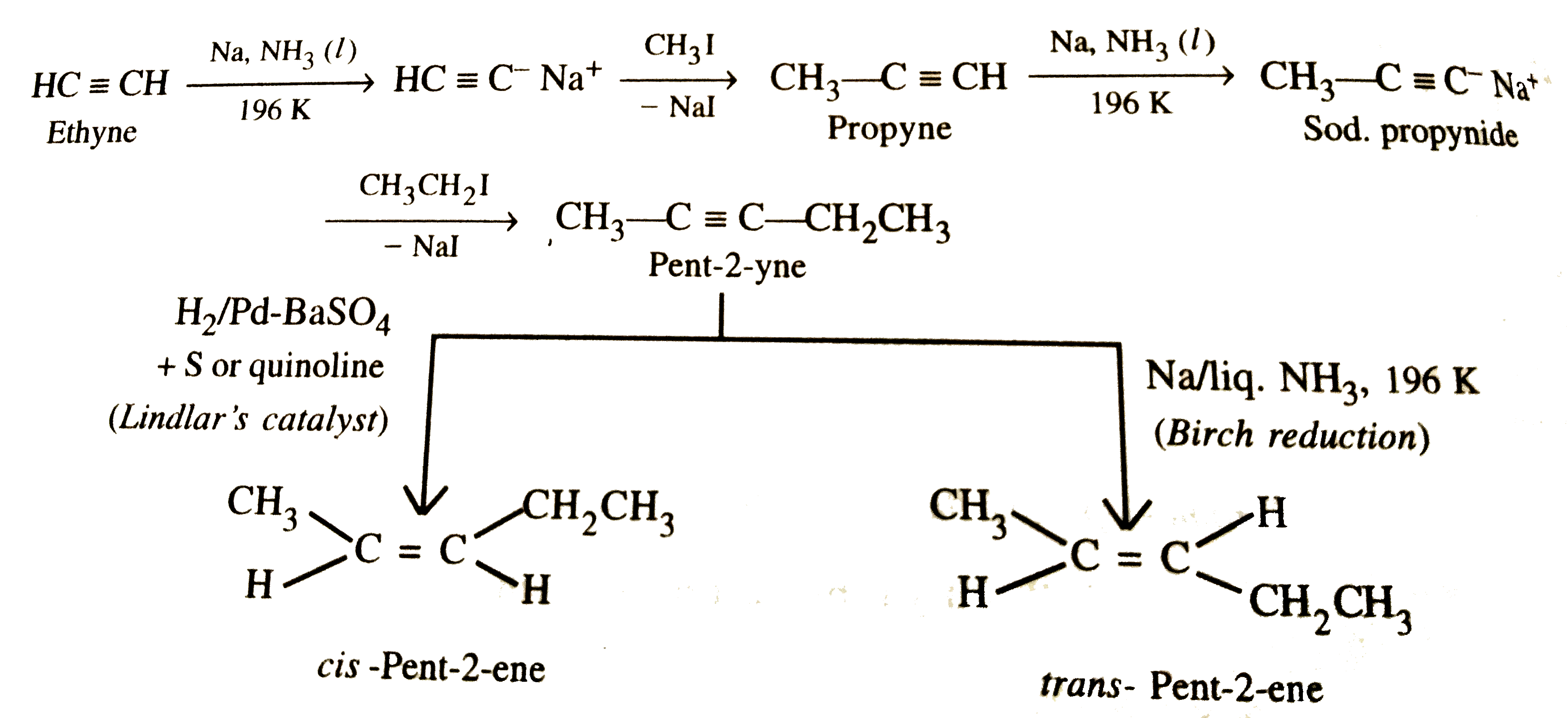
|
|
| 5. |
How will you prepare Lassaigne's extract? |
|
Answer» Solution :Lassagine.s extract preparation: (i) A small piece of Na dried by pressing between the folds of filter paper is taken in a FUSION tube and it is gently heated. When it melts to a shining globule, a PINCH of organic compound is added. (ii) The tube is heated till REACTION ceases and become red hot. Then it is plunged in 50 ML of distilled water taken in a china dish and the bottom of the tube is broken by striking it against the dish. (iii) The contents of the dish is boiled for 10 minutes and then it is FILTERED. The filtrate is known as Lassaigne.s extract. |
|
| 6. |
How will you prepare iodobenzene ? |
| Answer» Solution :`underset("Benzene diazonium chloride") (C_(6) H_(5) N_(2) Cl) + KI OVERSET("Warm") (to) underset("Iodo benzene") (C_(6) H_(5) I) + KCL + N_(2) uarr` | |
| 7. |
How will you prepare ethylidene dichloride from acetylene ? |
| Answer» Solution :`underset("ACETYLENE") (HC-= CH) + HCl to CH_(2)= underset(Cl)underset(|)(C)H overset(HCl) (to) underset("Ethylidene dichloride") (CH_(3) - CH Cl_(2))` | |
| 8. |
How will you prepare ethyl lithium ? |
|
Answer» Solution : When bromoethane is treated with an active metal like lithium in the presence of dry ether, then ETHYL lithium will be FORMED. `UNDERSET("Bromo ethane ") (CH_(3) CH_(2) Br) + 2 Li overset("dry ether") (to) underset("Ethyl lithium") (CH_(3) CH_(2) Li) + LIBR` |
|
| 9. |
How will you prepare ethene form ethanol |
|
Answer» SOLUTION :whenethanol isbeatedat `430 k` -440 kwith excessconc. `H_(2) SO_(4)` a molecule ofwaterfromalcoholis removedand ethaneor ethylene isformed `CH_(2)H_(5) OHoverset( con.H_(2) 5O_(2))(to)CH_(2)=CH_(2)+ H_(2)O` |
|
| 10. |
How will you prepare ethaneby kolbe electrolytic method |
Answer» Solution :When an AQUEOUS solution of potassiumsuccinate is electrtolysed between two PLATINUM electrodes ETHENE is PRODUCED at the anode 
|
|
| 11. |
How will you prepare carbon tetrachloride ? |
|
Answer» Solution :The REACTION of methane with excess of chlorine in the presence of sunlight gives carbon tetrachloride as major product . `underset("Methane") (CH_(4)) + overset(hv)(to) underset("Carbon tetrachloride") (C Cl_(4) + 4HCL) ` |
|
| 12. |
How will you prepare benzene from ? (i) Phenol, (ii) Benzoic acid, (iii) Acetylene, (iv) Benzene sulphonic acid, (v) Aniline, (vi) Nitrobenzene, (vii) Toluene, (viii) Chlorobenzene. |
|
Answer» `(##GRB_ORG_CHM_P1_C08_E01_004_S02##)` |
|
| 13. |
How will you prepare benzene from coal tar? |
| Answer» SOLUTION :Coaltaris a viscous liquidobtainedbythe pyrolsisof COAL. Duringfractionaldistillation, coaltar isheatedanddistillsaways itsvolatilecompounds , namelybenzene , toluene, xylenein thetemperaturerangeoftoluenexylenein thetemperaturerange of350 K to443 Kthesevapoursarecollectedat theupperpart of thefractionatingcolumn . | |
| 14. |
How will youprepare acetylene form calcium carbide |
|
Answer» Solution :Acetylenecan bemanufacturedin largescaleby ACTIONOF calciumcarbidewith water `CaC_(2) + 2H_(2) O toCH= CH+ CA(OH)_(2)` |
|
| 15. |
How will youprepareacetyene from potassiummaleate |
Answer» SOLUTION :ELECTROLYSISOF potaassium maleate YIELDS acetylene this is one of kolbe electrolytic reaction 
|
|
| 16. |
How will you prepare a standard solution ? |
|
Answer» Solution :A standard solution or a STOCK solution is a solution whose concentration is accurately known. A standard solution on REQUIRED concentration can be prepared by DISSOLVING a required amount of a solute in a suitable amount of solvent. It is does by transformaing a known amount of slute to a standard flask of definite volume A small amount of water is added to the flask and shaken well to dissolve the salt. Then water is added to the flask to bring the solution LEVEL to the MARK indicated at the top end of the flask. The flask is stoppered and shaken well to make concentration uniform. |
|
| 17. |
How will you prepare a pure sample of propane ? |
|
Answer» SOLUTION :PROPANE is an UNSYMMETRICAL alkane, it cannot be prepared by Wurtz reaction. However, it can be easily prepared by Corey-House reaction as shown below : `underset"ETHYL bromide"(CH_3CH_2)-Br+2Li overset"Dry ether"to underset"Ethyllithum"(CH_3CH_2-Li+LiBr)` `2CH_3CH_2-Li+CuI overset"Dry ether " to underset"Lithium diethylcopper"((CH_3CH_2)_2CuLi)+LiI` 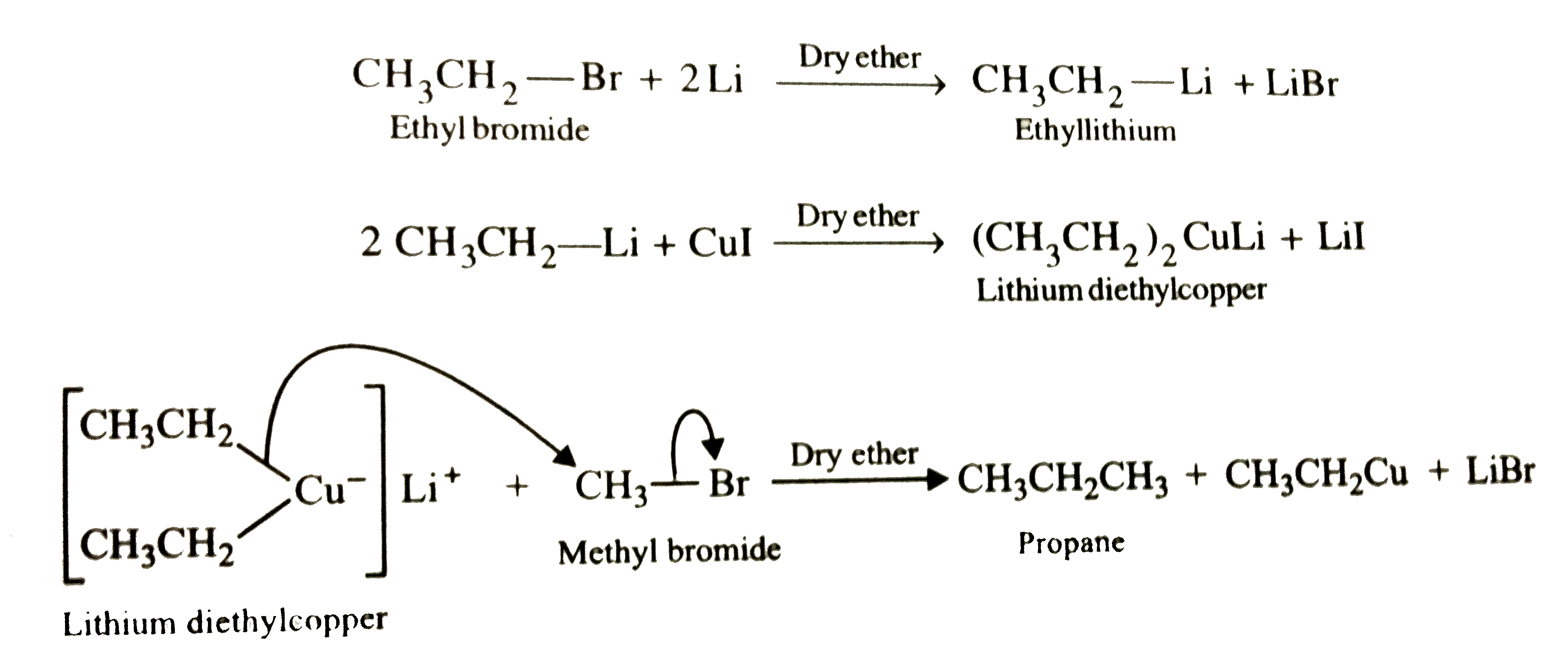
|
|
| 18. |
How will you prepare 3-methylbut-1-yne by starting with ethyne ? |
Answer» SOLUTION :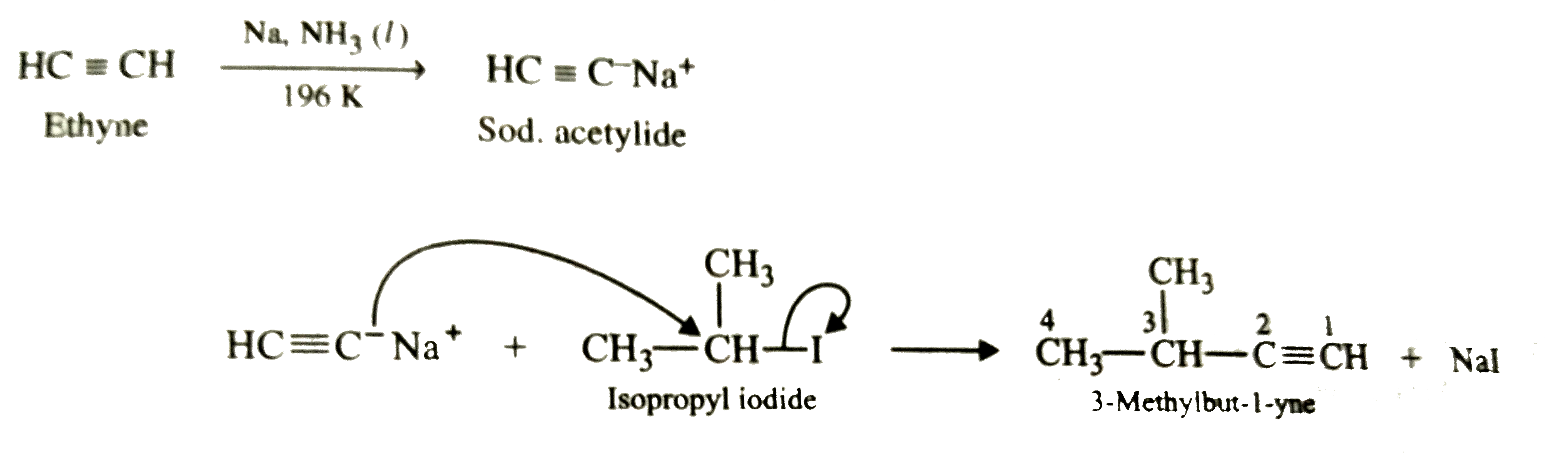
|
|
| 19. |
How will you obtain the following compounds from benzene ? (a) p-Beromobenzoic aicd (b) m-Chlorophenol ( c) 2-Phenyl ethanoic acid (d) 4-Methyl-l-n-propylbenzene ( e) O-chlorotuene (f) Phenyl ethyne (g) i-Ethyl-4-methylbenzene (h) 2-Methyl-5-nitrophenol (i) m-Nitrochlorobenzene (j) p-Nitrochlorobenzene (k) Benzyl alcohol (L) Phenol (m) m-Dichlorobenzene (n) 1,3,5-Trinitrobenzene (TNB) (o) p-Nitrobenzaldehyde. |
|
Answer» `(##GRB_ORG_CHM_P1_C08_E01_012_S02##)` `(##GRB_ORG_CHM_P1_C08_E01_012_S03##)` `(##GRB_ORG_CHM_P1_C08_E01_012_S04##)` |
|
| 20. |
How will you obtain phosphine from phosphorus? |
|
Answer» Solution :Phosphine is produced when white phosphorus in HEATED with a concentrated solution of NaOH in an inert atmosphere of `CO_(2)` or oil GAS. `P_(4)(s)3NaOH(aq)+3H_(3)O(l)underset(Delta)overset(CO_(2)atm.)tounderset("Phosphine")(PH_(3)(G))+underset("Sod. hypophosphite")(3NaH_(2)PO_(2))(aq)` |
|
| 21. |
How will you get the following product with the given reactants ?Benzene toToluene |
| Answer» SOLUTION :`underset("Benzene chloromethane")(C_(6)H_(6)+CH_(6)Cl)overset("anhydrous" AlCl_(3))tounderset("toluene")(C_(6)H_(5)CH_(3))+HCL` | |
| 22. |
How will you get the following products with the given reactants ? (A) Acetylene rarr Benzene (B) Phenol rarr Benzene (c) Benzene rarr Tolune (ii) Write any two different componets you get during fractional distillation of Coal Tar at any two different temperature . |
Answer» Solution : `underset("(Phenol)")(C_(6)H_(5)OH)+Zn overset(Delta)underset("Dry distillation")rarr underset("(Benzene)")(C_6H_6)+ZnO` ( C) `underset("Benzene")(C_(6)H_(6))+CH_(3)Cl overset("anhydrous"AlCl_3)rarrunderset("(Toluene)")(C_(6)H_(5)CH_3)+HCl` Coal tar is a viscous liquid obtained by the pyrolysis of coal. During fractional distillation, coal tar is heated and ~istills away its volatile compounds, namely, benzene, toluene, xylene in the temperature range of 350 K to 443 K. These vapurs are collected at the upper part of the fractionating COLUMN. 
|
|
| 23. |
How will you get the following product with the given reactants ?Phenol to Benzene |
| Answer» SOLUTION :`UNDERSET("Phenol")(C_(6)H_(5)OH)+Zntounderset("BENZENE")(C_(6)H_(6))+ZnO` | |
| 24. |
How will you get the following product with the given reactants ?Acetyleneto Benzene |
Answer» SOLUTION :`3 CH-= CHunderset(873K)OVERSET("Red Hot Iorn TUBE")to`
|
|
| 25. |
How will you get benzene from chlorobenzene ? |
|
Answer» Solution :Chlorobenzene is reduced with Ni-Al Alloy in the presence of NAOH to give benzene . `underset("Chlorobenzene") (C_(6) H_(5) CL) + 2 (H) OVERSET(Ni-Al)underset(NaOH)(to) underset("Benzene") (C_(6) H_(6)) + HCl` |
|
| 26. |
How will you get acetone from methyl magnesium iodide ? |
Answer» SOLUTION :
|
|
| 27. |
How will you further sub divide the lowest layer of atmosphere ? |
|
Answer» Solution :The lowest layer of the atmosphere is called the troposhere and it extends from 0-10 km from the earth surface. About 80% of the mass of the atmosphere is in this layer. This troposphere in further DIVIDED as follows. (i) Hydrosphere `:` Hydrosphere includes all types of water source like oceans, seas, rivers, LAKES, streams, underground water, polar icecaps, clouds ETC. It covers about 75% of the earth's surface.Hence the earth is called as a blue planet. (ii) Lithosphere `:` Lithosphere includes SOIL, rocks and mountains which are solid components of earth. (iii) Biosphere `:` It includes the lithosphere hydrosphere and atmosphere intergrating the living organism present in the lithosphere hydrosphere and atmosphere. |
|
| 28. |
How will you explain the directive influence of (i)-CH=CH_2 and(ii) -C Cl_3 group when attached to the benzene ring ? |
Answer» Solution :(i)Stability of the carbocation INTERMEDIATE can be used to explain the o,p-directing influence of the `-CH=CH_2` as follows : 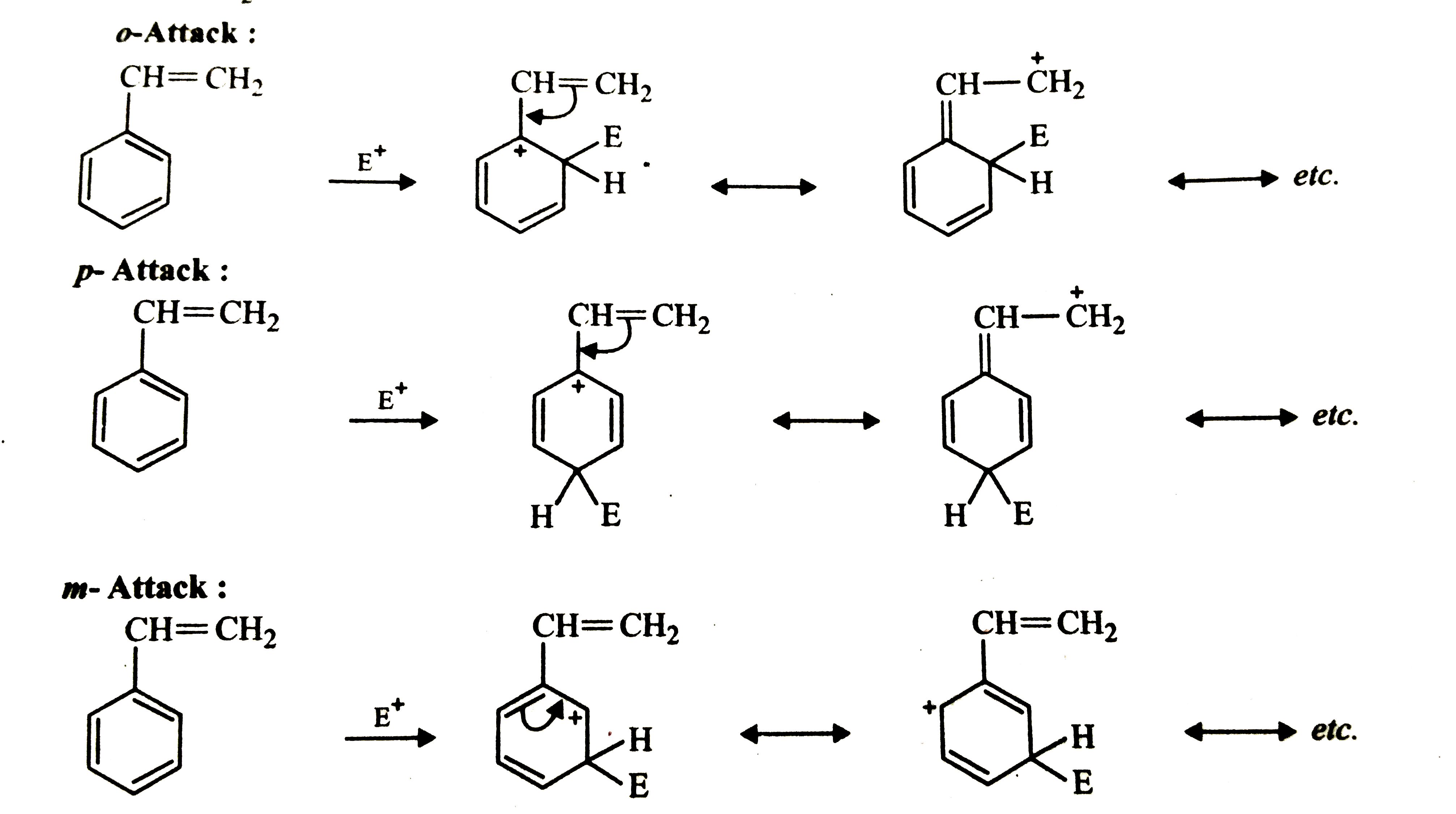 Only carbocations resulting from o- and p-substitution are STABILIZED by spreading the charge on the side chain while each such type of stabilization is not possible in case of m-substitution. Thus, `-CH=CH_2` GROUP is o,p-directing . Similarly, we can explain the directive influence of `C_6H_5` group which is also o,p-directing. (ii)Hyperconjugation effect can be used to explain the directive influence of `C Cl_3` group as DISCUSSED below . 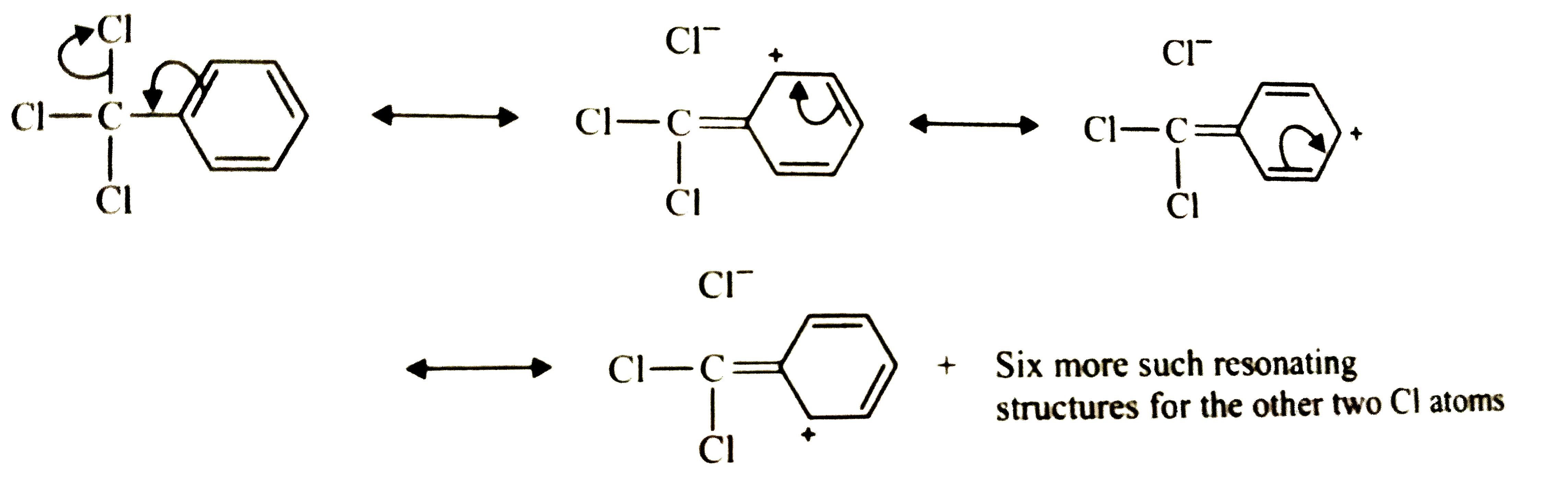 Due to the presence of +ve charge at o- and p-positions , the ELECTRON density is comparatively more at m-positions. Therefore , `-C Cl_3` is a m-directing group. |
|
| 29. |
How will you estimate phosphorous in an organic compound? |
|
Answer» Solution :Carius method: Procedure: A known mass of organic compound (wg) containing PHOSPHORUS is heated with fuming `HNO_(3)` in a sealed TUBE where C is converted into `CO_(2)` and H to `H_(2)O`. PHOSPHOROUS present in the organic compound is oxidised to phosphoric acid which is precipitated as AMMONIUM phospho molybdate by heating with CONC. `HNO_(3)` and by adding ammonium molybdate. `H_(3)PO_(4) + 12 (NH_(4))_(2)MoO_(4) + 21 HNO_(3) overset(Delta)rarr(NH_(4))PO_(4).12 MoO_(3) +21NH_(4)NO_(3) + 12H_(2)O` The precipitate of ammonium phrospho molybdate is filtered, washed, dried and weighed. Calculation: Mass of organic compound=W g Mass of ammonium phospho molybdate= x g Molar mass ammonium phospho molybdate= 1877 g 1877 g of ammonium phospho molybdate contains 31 g of phosphorous `:. "x g of ammonium phospho molybdate contain"=(31)/(1887) xx x "g of phosphorous"` `:. "% of phosphorous"=((31)/(1887) xx (x)/(w) xx 100)% "of phosphorous"` In an alternate nethod, phosphoric acid is precipitated as magnesium-ammoniumphosphate by adding magnesia mixture. The ppt. is washed dried and ignited to get magnesium pyrophosphate which is washed, dried and weighed. Weight of magnesium pyrophosphate= y g Molar mass of magnesium pyrophosphate = 222 g 222 g of magnesium pyrophosphate contains 62g of P `:. "y g of magnesium pyrophosphate contain" = (62)/(222) xx y "g of P"` `"% of phospłorous" = ((62)/(222) xx (y)/(w) xx 100)%` |
|
| 30. |
How will you distingusih 1-butane and 2-butne ? |
|
Answer» Solution :`CH_3-underset("1-butyne")(CH_2)-c-=CH ` `CH_3-underset("2-butyne")(C )-=C-CH_(3)` In 1-butyne, terminal carbon atom contains atom one acidic hydrogen, THEREFORE it will react with silver NITRATE in the presence of AMMONIUM hydroxide to give silver butynide. Wheras 2-butyne does not undrego such type of the reaction, because of the absence of acidic hydrogen. (i) `CH_3-underset("1-butyne")(CH_(2))-C-=CH+2AgNO_(3)+2NH_(4)OHtoCH_(3)-CH_(2)-underset("Silver butynide")(CH_(2))-C C-=C-Agdarr+2NH_(4)NO_(3)+2H_(2)O` `underset("2-butyne")(CH_(3)-C-=C-CH_(3)+2AgNO_(3)+2NH_(4)OHtoNo` reaction |
|
| 31. |
How will you distinguish between the two geometrical isomers of 1.2-dichloroethene from their boiling points? |
|
Answer» SOLUTION :The 2geometrical isomers of 1,2 dichloroethane are cis- 1,2dichloroethane and trans-1,2 dichloroethene. Cis-1,2 dichloroethene has a definite dipole moment `(mu NE0)` whereas the dipole moment of trans-1,2 dichloroethene is found to be zero `(mu=0)`. the cis isomer is hightly polar indicating strong dipole-dipole attractive forces AMONG the molecules. hence a LARGE amount of energy is required to separate the molecules from each other, therefore boiling point of cis-1,2 dichloroethene is HIGHER than the trans-isomer. 
|
|
| 32. |
How will you distinguish pentane from 1-pentene ? |
Answer» SOLUTION : Pentane can be distinguished from 1-pentene by Baeyer.s TEST. Pentane does not decolourise Baeyer.s reagent, whereas 1-pentene discharges the PURPLE COLOUR of Baeyer.s reagent.
|
|
| 33. |
How will you distinguish between the following pairs of terms(i) Hexagonal close packing and cubic close packing (ii) Crystal lattice and unit cell (iii)Tetrahedral void and octahedral void. |
| Answer» Solution :Hexagonal CLOSE PACKING is ABAB…... type WHEREAS CUBIC close packing is ABC ABC…... type. | |
| 34. |
How will you distinguish between the folloWing pair of compounds: (i) Chloroform and carbon tetrachloride, (ii) Benzyl alcohol and chlorobenzene. |
|
Answer» SOLUTION :(i)On heating chloroform and carbon tetrachloride with aniline with ethanoic acid and POTASSIUM hydroxide SEPARATELY, chloroform forms a pungent smelling isocyanide compound but carbon tetrachloride does not form this compound. (ii) On adding sodium hydroxide and silver nitrate to both the COMPOUNDS. benzyl chloride forms a white precipitate but chlorobenzene does not form any white precipitate. |
|
| 35. |
How will you distinguish between (i) Na_(2)CO_(3) and NaHCO_(3) and (ii) LiNO_(3) and KNO_(3) ? |
|
Answer» Solution :(i) `NaHCO_(3)` on heating DECOMPOSES to produce `CO_(2)` GAS which turns lime water milky `2 NaHCO_(3) overset(Delta)(to) Na_(2)CO_(3) + CO_(2) + H_(2)O` `Na_(2)CO_(3)` , however , is stable to heat . (ii) `LiNO_(3)` on heating gives reddish brown vapours of `NO_(2)` whereas `KNO_(3)` on decomposition gives colourless `O_(2) ` gas . `4 LiNO_(3) overset(Delta)(to) 2Li_(2)O + 4NO_(2) + O_(2) "" , 2 KNO_(3) overset(Delta)(to) 2 KNO_(2) + O_(2)` |
|
| 36. |
How will you distinguish between (i) magnesium and calcium (ii) Na_(2)SO_(4) and BaSO_(4) |
|
Answer» Solution :(i) Calcium when heated imparts brick RED colour to the flame but MAGNESIUM does not . (ii) `Na_(2)SO_(4)` is SOLUBLE in water but `BaSO_(4)` is insoluble . |
|
| 37. |
How will you distinguish between : (i) Ethylbenzene and o-xylene ? (ii) Ethylbenzene and styrene ? (iii) Phenytl acetylene and styrene ? (iv) Benzene and toluene ? |
Answer» Solution :(i) Ethylbenzene gives benzoic acid on OXIDATION with `KMnO_(4)` while o-xylene gives phthalic acid. 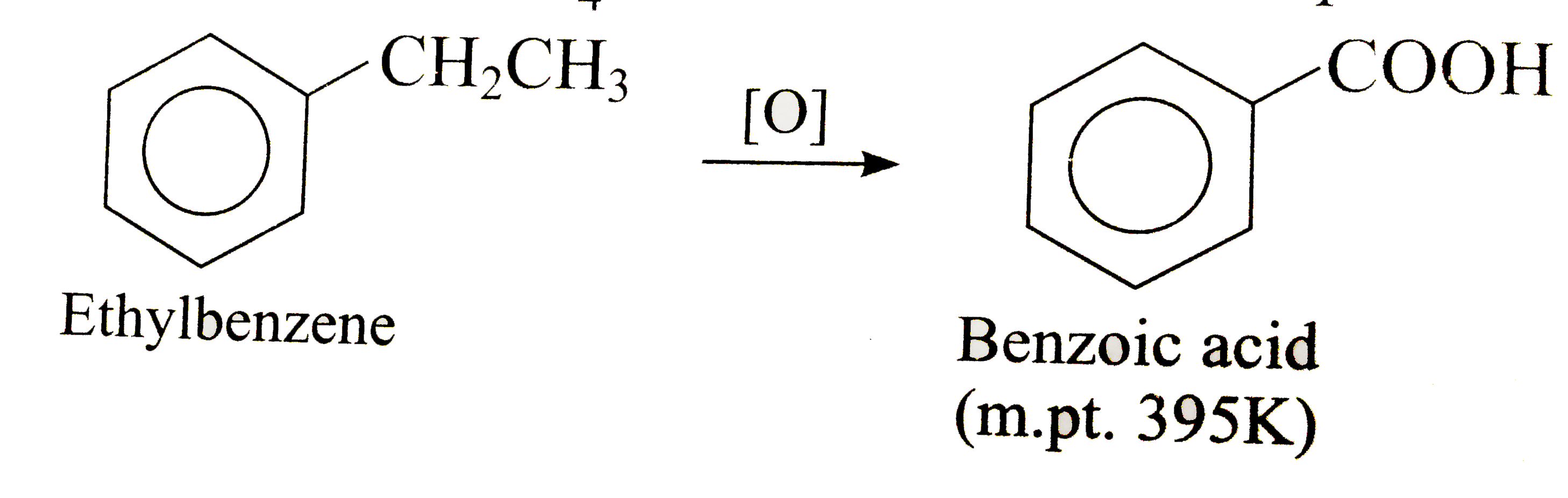 (II) Styrene, Having a double bound in the side-chain, gives the following two tests : (a) It decolourises purple colour of dilute cold `KMnO_(4)` solution. BROWN precipitate of `MnO_(2)` is formed. This test is not GIVEN by ethylbenzene. 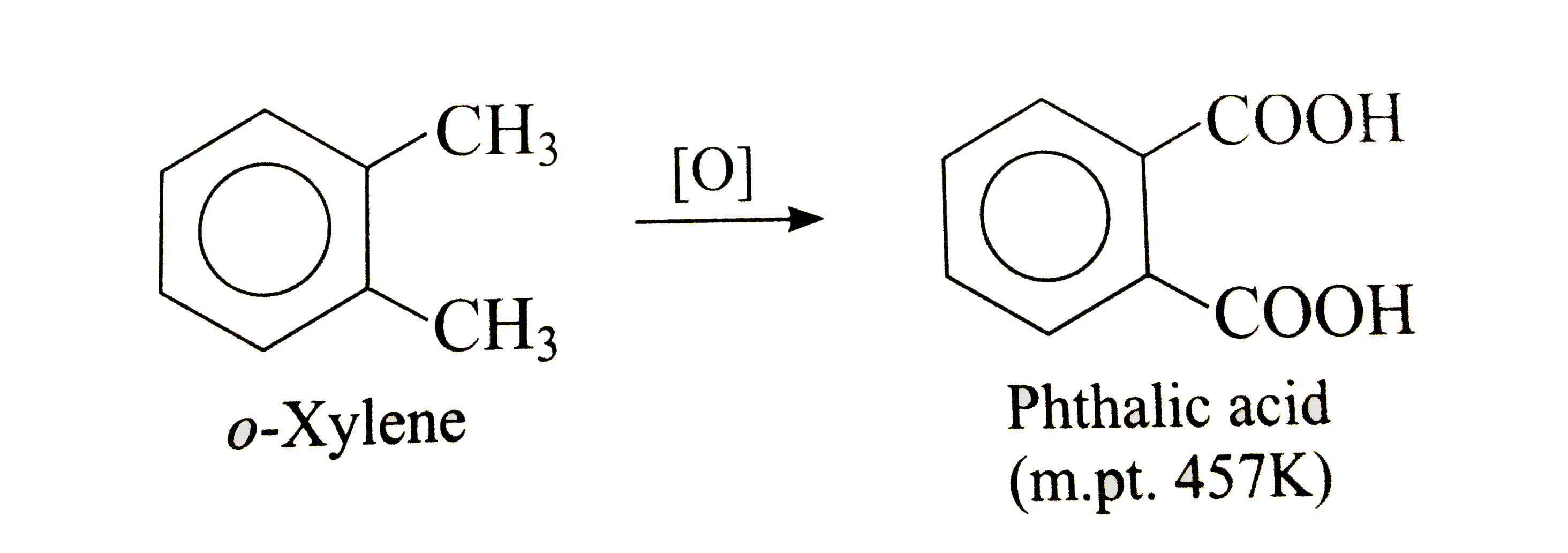 (b) Styrene repidly dicolourises red colour of bromine in `C CI_(4)`. Ethylbenzene does not decolourise under this condition. `C_(6)H_(5)CH=CH_(2)+Br_(2)tounderset("Coloureless")(C_(6)H_(5)CHBrCH_(2)Br)` However, ethylbenzene reacts wiith bromine at thgh temperature or in presence of UV LIGHT. (iii) Phenyl acetylene gives a precipitate with ammoniacal silver nitrate solution. Styrene does not react. `C_(6)H_(5)-C-=CH+AgNO_(3)+NH_(4)OHtounderset(("ppt"))(C_(6)H_(5)-C-=Ag+NH_(4)NO_(3)+H_(2)O)` (iv) Toluene is easily oxidised to benzaldegyde with `CrO_(2)CI_(2)` or benzoic acid with `KMnO_(4)`. 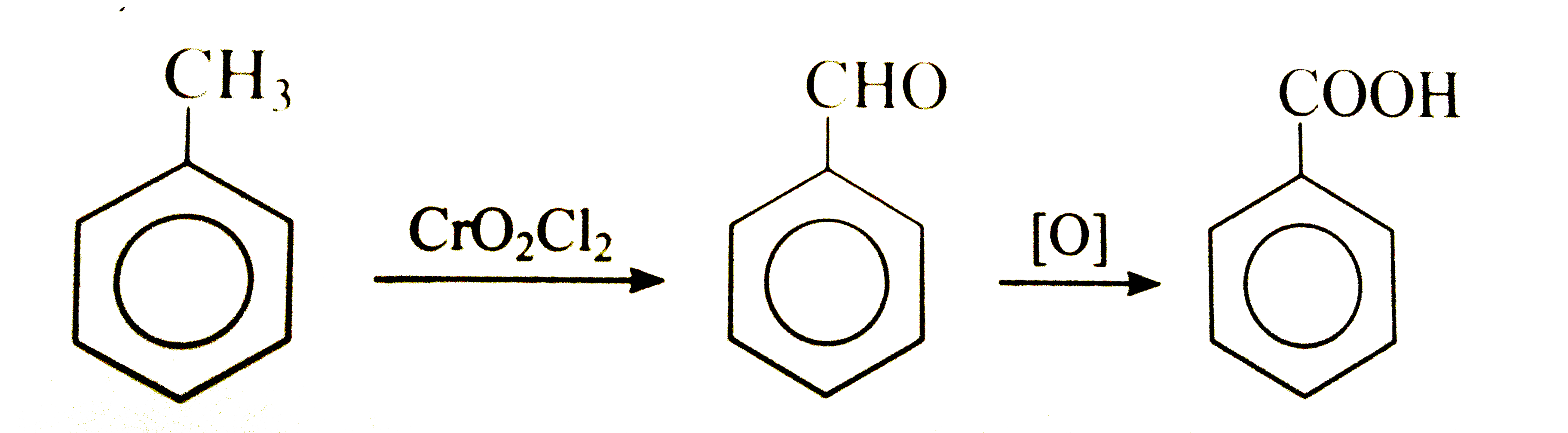 Benzene is quite stable and does not undergo oxidation with `CrO_(2)CI_(2)" or "KMnO_(4)`. |
|
| 38. |
How will you distinguish between : (i) Benzene and toluene ? (ii) Ethyl benzene and o-xylene ? (iii) Ethyl benzene and styrene ? (iv) Phenyl acetylene and styrene ? |
|
Answer» `(##GRB_ORG_CHM_P1_C08_E01_011_S01##)` and toluene can also be easily oxidised to benzaldehyde with `CrO_(2)-CI_(2)`. `(##GRB_ORG_CHM_P1_C08_E01_011_S02##)` But benzen is quite stable and does not undergo oxidation with `CrO_(2)CI_(2)" or "KMnO_(4)`. (ii) Ethyl benzene gives benzoic acid on oxidation with acidic `KMnO_(4)`, while o-xylene gives phthalic acid. `(##GRB_ORG_CHM_P1_C08_E01_011_S03##)` (iii) Styrene `(C_(6)H_(5)CH=CH_(2))` or vinyl benzene having a double bond in the side chain, gives the following two tests : (a) It decolourises purple coloure of dilute cld `KmnO_(4)` solution. Brown precipitate of `MnO_(2)` is formed. This test is not given by ethyl benzene. `underset("Syrene")(3C_(6)H_(5)-CH=CH_(2))+2KMnO_(4)+4H_(2)Oto3C_(6)H_(5)-overset(OH)overset(|)(CH)-overset(OH)overset(|)(CH_(2))+2MnO_(2)+2KOH` (b) Styrene repidly decolourises red COLOUR of bromini in `C CI_(4)`. Ethyl benzene does noot decolourise under this condition. `C_(6)H_(5)CH=CH_(2)+Br_(2)toC_(6)H_(5)-overset(Br)overset(|)underset("Colourless")(CH)-overset(Br)overset(|)(CH_(2))` However, ethyl benzene reacts with bromine at high temperature or in presence of UV light. (vi) Phenyl acetylene `(C_(6)H_(5)-C-=CH)` give a precipitate with ammoniacal silver nitrate solution (due to acidic H-atom). Styrene does not react. `C_(6)underset("Phenyl acetylene")(H_(5)-C-=C-H)+AgNO_(3)+NH_(4)OHtoC_(6)H_(5)-C-=Ag+NH_(4)NO_(3)+H_(2)O` |
|
| 39. |
How will you distinguish between electrophiles and nucleophiles? |
| Answer» Solution :`{: ( "Electrophiles", "NUCLEOPHILES"),( "(i)They are electron deficient.", "They are electron rich.") , ("(II)They are cations. " , "They are ANIONS."),(" (iii)They are lewis acids." ,"They are lewis BASES.") , ( "(iv)Accept an electron pair." , "Donate an electron pair."), ( "(v)Attack on electron rich SITES." , "Attack on deficient sites."):}` | |
| 40. |
How will you distinguish between but-1-yne and but-2-yne ? |
|
Answer» Solution :But-1-yne is a terminal alkyne. THEREFORE, it gives white ppt. of silver but-1-ynide with Tollen's reagent and red ppt. of copper but-1-ynide with AMMONIACAL cuprous chloride. `underset"But-1-yne"(CH_3CH_2C-=CH) + underset"Tollen's reagent"([Ag(NH_3)_2]^(+)OH^-) to underset"Silver but-1-ynide"(CH_3CH_2C-=C-Ag) + 2NH_3+H_2O` `underset"But-1-yne"(CH_3CH_2C-=CH) + underset"Diammine copper (I) hydroxide"(2[CU(NH_3)_2]OH^-) to underset"Copper but-1-ynide (red ppt.)"(CH_3CH_2C-=C-Cu) + 2NH_3+H_2O` But-2-yne, on the other hand , being a non-terminal alkyne does not GIVE these reactions. |
|
| 41. |
How will you distinguish B_(2) from the following species having same bond order: Li_(2),O_(2)^(2-) and F_(2)? |
| Answer» SOLUTION :`B_(2)` is paramagnetic but `Li_(2),O_(2)^(2-) and F_(2)` are diamagnetic. | |
| 42. |
How will you distinguish 1- butyne 2 butyne |
|
Answer» Solution :`CH_(3) -CH_(2)-C = CHCH_(3) - C=C-CH_(3)` In 1- butyneterminalcarbonatomcontainsatomoneacidichydrogenthereforeis willreactwillsilvernitratein thepresenceof ammoniumhydroxideto givesilverbutynideWhereas 2- butyne doesnotundergosuchtypeof thereaction becauseof theabsenceofacidichydrogen `(i) CH_(3)- CH _(2)=C= CH+2AgNO_(3)+ 2NH_(4)OH toCH_(3)-CH_(2) -C =C -AG ` (II) `CH_(3) - C= C - CH_(3) + 2AgNO_(3) + 2NH_(4)OH to` Noreaction |
|
| 43. |
How will you determine the rate of chemical reaction ? |
|
Answer» Solution :SUBSTRATE `to` Rcagent` to ` [ INTERMEDIATE state (and /or ) Transition State ] ` to` Product Many simple steps . Each stop passes through an energy barrier , leading to the formantion of short lived intermediates or transition states . The series of simple steps which collectively represent the chemical CHANGE, from substrate to product is called as the mechanism of the reaction . The slowest STEP in the mechanism DETERMINES the overall rate of the reaction . |
|
| 44. |
How will you detect the presence of carbon and hydrogen in an organic compound? |
|
Answer» SOLUTION :Copper oxide test: (i) The organic substance is mixed with three times its weight of dry copper oxide by grinding. The mixture is placed in a hard glass test tube fitted with a BENT delivery tube. The other end of which is dipping into lime water in an another test tube. The mixture is heated strongly. (II) `2CuO+CrarrCO_(2) +2Cu` `CuO + 2HrarrH_(2)O+ Cu` (iii) Thus if carbon is present, it is oxidised to `CO_(2)` which turns lime water milky. If hydrogen is also present, it will be oxidised to water and CONDENSES in small droplets on the cooler wall of the test tube and inside the bulb. Water is collected on white anhydrous `CuSO_(4)` which turns blue. (iv) This CONFIRMS the presence of C and H in the compound. |
|
| 45. |
How will you detect the oxygen from organic compounds ? |
|
Answer» Solution :i. In the elemental analysis, if the total percentage COMPOSITION is less than 100, then the remaining percentage reveals the presence of oxygen . ii. If the organic compounds contains following functional GROUPS like- OH, -CHO, -COOH etc, SHOWS the presence of oxygen. iii. On heating, if the organic compounds produce water vapour and `CO_(2)` , this also shows the presence of oxygen. |
|
| 46. |
How will you detect phosphorous from organic compounds? |
|
Answer» Solution :i. A solid organic compound is strongly heated with a mixture of `Na_2 CO_3` and `KNO_3` . Phosphorous present in the compound is oxidised to SODIUM PHOSPHATE. II. The residue is extracted with water and boiled with conc. `HNO_3` .A solution of ammonium molybdate is added to this solution. III. A CANARY yellow precipitate shows the presence of phosphorous. |
|
| 47. |
How will you demonstrate that double bonds of benzene are somewhat different from those of olefines ? |
| Answer» Solution :The DOUBLE bonds of olefines DECOLOURIZED `Br_2` in `C Cl_4` and discharge the pink colour of Baeyer's reagent with SIMULTANEOUS formation of a BROWN PPT. of `MnO_2` while those of benzene do not . | |
| 48. |
How will you defect the presence of unsaturation in an organic compound ? |
| Answer» Solution :EITHER by BAEYER's reagent (i.e., cold DILUTE aqueous alkaline `KMnO_4` solution ) or by `Br_2` in `C Cl_4` . | |
| 49. |
How will you detect nitrogen from organic compounds? |
|
Answer» Solution :Detection of Nitrogen: The following REACTIONS are involved in the detection of nitrogen with formation of prussian blue precipitate conforming the presence of nitrogen in an organic compound. (i) `UNDERSET("Sodium")(Na)+underset("From organic compound")(C+N) to underset("Sodium cyanide")(NACN)` (ii) `underset("Ferrous SULPHATE")(FeSO_(4))+underset("Sodium hydroxide")(2NaOH)to underset("Ferrous hydroxide")(Fe(OH)_(2))+Na_(2)SO_(4)` (iii) `6NaCN+Fe(OH)_(2) to underset("sodium ferrocyanide")(Na_(4)[Fe(CN)_(6)]+2NaOH` (iv) `3Na_(4)[Fe(CN)_(6)]+4FeCl_(3)to underset("Ferric ferrocyanide "("Prussian blue precipitate"))(Fe_(4)[Fe(CN)_(6)]darr+12NaCl` |
|
| 50. |
How will you convert the following: (i) Isopropyl chloride to n-propyl chloride (ii) Methyl bromide to ethylamine (iii) Chlorobenzene to benzoic acid (iv) Methyl bromide to acetic acid (v) Propane to allyl chloride (vi) 1-Bromopropane to 2-bromopropane (vii) Propene to propyne (viii) Ethanol to but-1-yne |
Answer» Solution :(i)  <BR> (ii) `underset("Methyl bromide")(CH_(3)Br) overset(KCN)to CH_(3)CN underset(Na // C_(2)H_(5)OH)overset(4[H])to underset("ETHYLAMINE")(CH_(3)CH_(2)NH_(2))` <BR> (ii) `underset("Methyl bromide")(CH_(3)Br) overset(KCN)to CH_(3)CN underset(Na // C_(2)H_(5)OH)overset(4[H])to underset("ETHYLAMINE")(CH_(3)CH_(2)NH_(2))` (iii)  (iv) `CH_(3)Br overset(KCN)to CH_(3)CN overset(H^(+), H_(2)O)to underset("ACETIC acid")(CH_(3)COOH)` (v) `underset("Propane")(CH_(3)CH_(2)CH_(3)) underset(uv)overset(Cl_(2))to CH_(3)underset(Cl)underset(|)CHCH_(3)+CH_(3)CH_(2)CH_(2)Cl overset(alc. KOH)to CH_(3)CH=CH_(2) underset(800 K)overset(Cl_(2))to underset("Allyl chloride")(ClCH_(2)CH=CH_(2))` (VI) `underset("1-Bromopropane")(CH_(3)CH_(2)CH_(2)Br) underset(KBr)overset(alc. KOH)to CH_(3)CH=CH_(2) overset(HBr)to underset("2-Bromoptopane")(CH_(3)underset(Br)underset(|)CH-CH_(3))` (vii) `underset("Propene")(CH_(3)CH=CH_(2)) overset(Br_(2))to CH_(3)underset(Br)underset(|)CH-underset(Br)underset(|)CH_(2) overset(2 alc. KOH)to underset("Propyne")(CH_(3)C-=CH)` (viii) `underset("Ethanol")(CH_(3)CH_(2)OH) overset(SOCl_(2))to CH_(3)CH_(2)Cl overset(HC-=CNa^(+))to underset("But-1-yne")(CH_(3)CH_(2)C-=CH)` |
|