

Saved Bookmarks
This section includes 7 InterviewSolutions, each offering curated multiple-choice questions to sharpen your Current Affairs knowledge and support exam preparation. Choose a topic below to get started.
| 1. |
In calcium fluoride, having the fluorite structure, the corrdination numbers for calcium ion (Ca^(2+))and fluoride ion(F^(-))are |
| Answer» Solution :In `CaF_(2)`, having FLUORITE STRUCTURE, coordination of ` CA^(2+)`,= 8 and that of ` F^(-)` = 4 | |
| 2. |
In calcium fluoride , having the fluorite structure , the coordination numbers for calcium ion (Ca^(2+)) and fluoride ion (F^-) are |
|
Answer» 4 and 2 |
|
| 3. |
In CaF_2 crystal, Ca^(2+) ions are present in FCC arrangment . Calculate the number of F^- ions in the unit cell. |
| Answer» Solution :No. of `CA^(2+)` IONS per UNIT cell =`8xx1/8+6xx1/2=4`. HENCE, no. of `F^-` ions per unit cell = 2 x 4 =8 | |
| 4. |
In CaF_(2) " Crystal ,Ca^(2+)ions are present in FCC arrangement. Calculate the number of F^(-)ions in the unit cell. |
| Answer» Solution :No. of ` Ca^(2+)` IONS PER unit cell = `8xx 1/8 + 6 xx 1/2 = 4` HENCE, no of `F^(-)`ions per unit cell =` 2xx4 =8` | |
| 6. |
In C_(2)H_(5)OH, the bond that undergoes heterolytic cleavage most readily is |
|
Answer» C-C |
|
| 7. |
In C_(2)H_(4) , formation of (C= C) and(C-C) is - 590 kJ // moleand - 331 kJ //molerespectively. What is enthalpy change when ethylene polymerizes to form polythene ? |
|
Answer» `+259 kJ MOL^(-1)` |
|
| 8. |
In C_(2)H_(4) molecule, formation of pi bond is due to the overlapping of ________. |
|
Answer» unhybridised p orbitals of the same CARBON ATOM |
|
| 9. |
In C^(14) isotope the number of nuetrons would be |
|
Answer» 6 |
|
| 10. |
In C+H_(2)OtoCO+H_(2),H_(2)O acts as |
| Answer» Answer :A | |
| 11. |
In Brownian movement of motion, the paths of the particle are |
|
Answer» Linear |
|
| 12. |
In buckminster fullerene, each carbon atom is |
|
Answer» sp - Hydridised |
|
| 13. |
In Buckminster fullerene, the number of six membered and five membered rings respectively are |
|
Answer» 20,12 |
|
| 14. |
In brown ring test for nitrates, Fe^(2+) ion reduces NO_(3)^(-) ion to ………..which subsequently reacts with Fe^(2+) ion to form a brown ring complex having the molecular formula……….. . |
|
Answer» |
|
| 15. |
InBrF_(3)molecule, the lone pairs occupy requatorial position to minize |
|
Answer» LONE PAIR - bond pair repulsion only |
|
| 16. |
In both water and dJmethyl ether (CH_(3) - underset(..)overset(..)(O) - CH_(3)) , oxygen atom is central atom, and has the same hybridization, yet they have different bond angles. Which one has greater bond angle ? Give reason. |
|
Answer» SOLUTION :DIMETHYL ether has greater bond angle than that of water, however in both the molecules central atom oxygen is `sp^(3)` hybridised with two lone PAIRS. In dimethyl ether, bond angle is greater `(111.7^(@))` due to the greater repulsive interaction between the two bulky alkyl (methyl) groups than that between two H-atoms.  The C of `CH_(3)` group is attached to THREE H-atoms through o-bonds and three C-H bond pair of electrons increases the ELECTRONIC charge density on carbon atom. |
|
| 17. |
In both water and diethyl ether, the central atom viz. O-atoms has same hybridisation . Then why have they different bond angles ? Which one has greater bond angle ? |
|
Answer» SOLUTION :The central atom in each case is `sp^(3)` hybridized . Hence , expected bond angle in each sase is `109^(@)28`' . The two pairs present on O-atom repel the bond pairs and hence TEND to reduce the bond angle . However, the greater repulsions between two ethyigroups, in diethyi ether than between the two H-atoms in `H_(2)O` RESULT in greater bond angle `(110^(2))` in diethyi ether than that in `H_(2)O` `(104.5^(@))` . 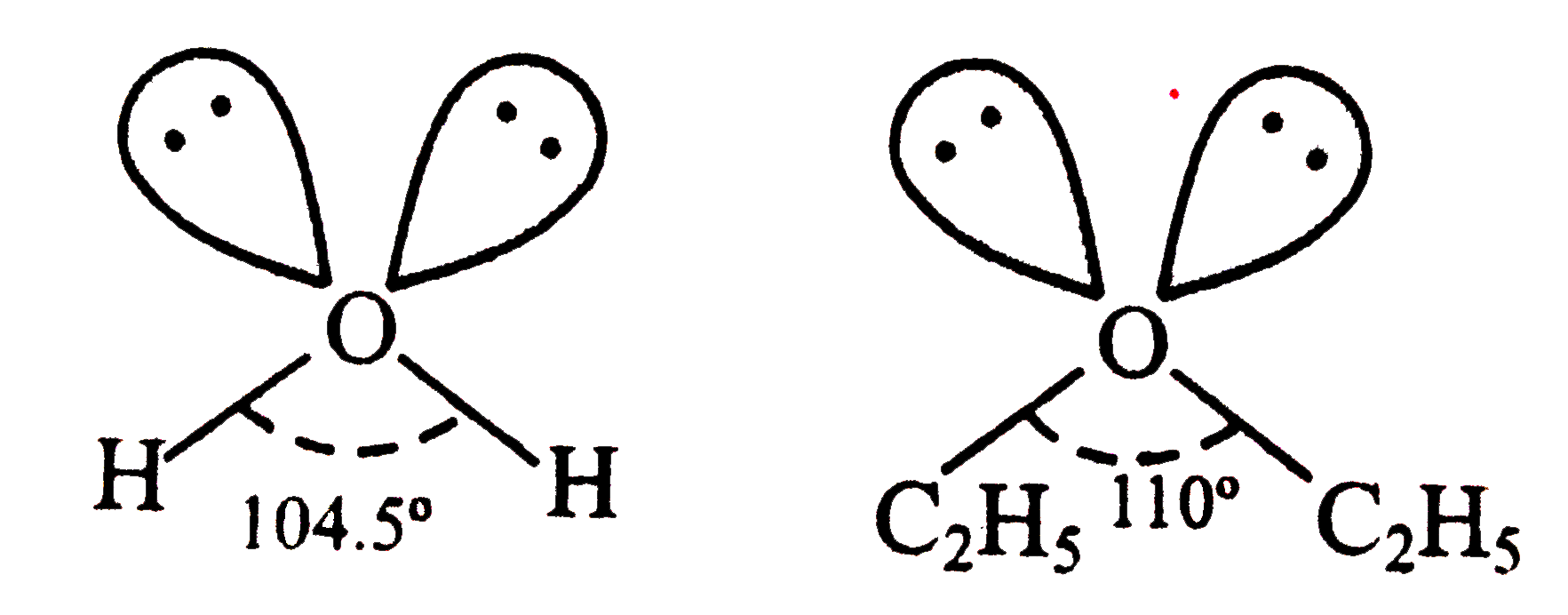
|
|
| 18. |
Inboth water anddimathyl ether (CH_(3) - overset(..) underset(. .)O - CH_(3)),oxygen atom is central atom, and has the same hybridisation, yet they have different bond angles . Which one has greater bond angle ?Given reason , |
|
Answer» Solution :Dimethyl ether gas greater bond ANGLE than of WATER . Reaon . Central atom in both is `sp^(3)` -hybridised with two LONE pairs 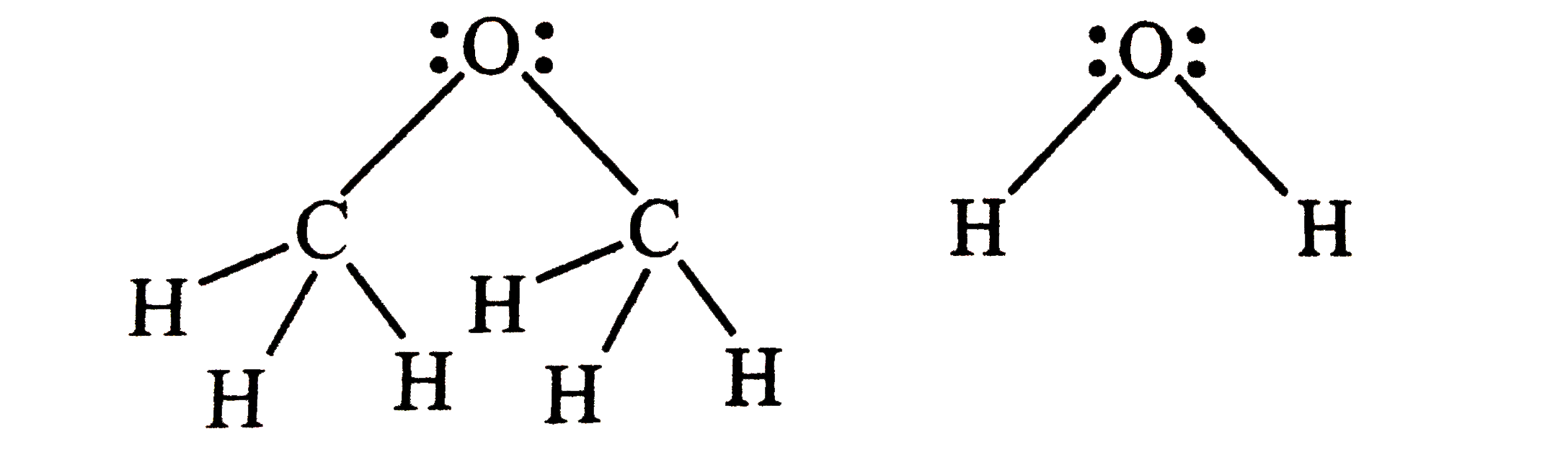 However, ELECTRON density on C of`CH_(3)`group is high because it is attached to three H-atoms `sigma ` - bonds and these electron pairs add to the elecronic charge density on carbon. HENCE , the repulsions betweenltbr. the two methyl groups is more than between two H-atoms. |
|
| 19. |
In Br_(3)O_8 compound , oxidation number of bromine is |
|
Answer» `16//13` |
|
| 20. |
In borax,the number of B-O-B links and B-OHbonds present are, respectively |
|
Answer» FIVE and four |
|
| 21. |
Is boric acid a protic acid ? Explain. |
Answer» Solution :No boric acid is not a PROTIC acid as it does not ionise in water to GIVE a proton `(H^+)` or hydronium `(H_3 O^+)` ion. In contrast, due to small size of boron ATOM and presence of only six electrons in the valence SHELL of boron in the molecule, `H_3BO_3` acts as a Lewis acid. When treated with water , it ACCEPTS a lone pair of electrons from the oxygen atom of the `H_2 O` molecule to form `[B(OH)_4]^-` Due to the release of a proton in the above reaction, it acts as a weak monobasic acid. |
|
| 23. |
In borax (Na_(2)B_(4)O_(7).10H_(2)O) the number of B-OH bonds present is : |
|
Answer» five Thus, NUMBER of `B-OH` BONDS = 4. |
|
| 24. |
In borax bead test which compound is formed ? |
|
Answer» Ortho-borate `underset"ANHYDROUS"(Na_2B_4O_7) oversetDeltato underset"sodium metaborate"(2NaBO_2) + underset"BORIC anhydride"(B_2O_3)` `CuO+B_2O_3 to underset"cupric meta borate (Blue BEED)"(Cu(BO_2)_2)` |
|
| 25. |
In Borax bead test, which compound of the bead reacts with basic radical to fom metaborate ? |
|
Answer» `B_(2)O_3` |
|
| 26. |
In borax bead test, copper forms a ............. coloured bead in oxidising flame and a .............. coloured bead in reducing flame. |
| Answer» SOLUTION :BLUE, RED | |
| 27. |
In Bohr.s model of hydrogen atom, the ratio between the period of revolution of an electron in orbit n=1 to the period of the electron in the orbit n=2 is |
|
Answer» `1:2` |
|
| 28. |
In Bohr's model of hydrogen atom, the period of revolution of an electron in the 1st orbit to that in the 2nd orbit are in the ratio |
|
Answer» `1 : 2` `:. (T_(1))/(T_(2)) = (2pi r_(1))/(v_(1)) xx (v_(2))/(2pi r_(2))= (r_(1))/(r_(2)) .(v_(2))/(v_(1))` But `r_(n) = r_(1) n^(2), " i.e., " r_(2) = r_(1) xx 2^(2) = 4r_(1)` or `r_(1)//r_(2) = 1//4` and `v_(n) = v_(1)//n, " i.e., " v_(2) = v_(1)//2 or v_(2)//v_(1) = 1//2` Hence, `(T_(1))/(T_(2)) = (1)/(4) xx (1)/(2)= (1)/(8), " i.e.," T_(1) : T_(2) = 1 : 8` |
|
| 29. |
In Bohr series of lines of hydrogen spectrum, the third line from the red end corresponds to which one of the following inter - orbit jumps of the electron for Bohr orbits in an atom of hydrogen ? |
|
Answer» `3 rarr 2` |
|
| 30. |
In Bohr model of atom : |
|
Answer» the radius of nth orbit is proportional to `N^(2)` |
|
| 31. |
In Boschis process which als fised for the production of hydrogen |
|
Answer» Producer GAS |
|
| 32. |
In blood plasma, sodium ion is approximately ......... milimole/liter. |
|
Answer» 134 |
|
| 34. |
In Bio-chemical reaction of human body, which pump is important ? |
|
Answer» Na-K |
|
| 35. |
In BF_(3), the B-F bond length is 1.30Å, when BF_(3) is allowed to be treated with mMe_(3)N, it forms an adduct, Me_(3)N to BF_(3), the bond length of B-F in the adduct is |
|
Answer» greaterthan 1.30 Å  , back bonding imparts double bond CHARACTERISTICS. , back bonding imparts double bond CHARACTERISTICS. As `BF_(3)` forms adduct, the backk bonding is not LONGER PRESENT and thus double bond cahracteristic DISAPPEARS. hence, bond becomes a bit longer than earlier (1.30Å). |
|
| 36. |
In between which of the following molecules London force exist a) CO_2, CO_2 ""b) HCI, HCI ""c) HCI, C_6H_6 |
|
Answer» Only a |
|
| 37. |
In between the metals A and B, both form oxide but B also forms nitride, when both are heated in air. A and B are respectively |
|
Answer» `Cs, K` |
|
| 38. |
In benzyne [] intermediate, the triple bond consists of : |
|
Answer» one SP-sp sigme BOND and two p-p pi-BONDS |
|
| 39. |
In benzyl amine amino group is a |
|
Answer» `-I` GROUP  Group is -I group Group is -I group
|
|
| 40. |
In benzene there is |
|
Answer» DELOCALIZATION of PI ELECTRONS |
|
| 41. |
In benzilic acid rearrangement |
|
Answer» Benzil is converted to benzilic ACID |
|
| 42. |
In benzene molecule there are three pi bonds and |
|
Answer» 10 SIGMA BONDS 
|
|
| 43. |
In benzene any one resonance structure is not correct from two given structure ? Why? |
| Answer» SOLUTION :Experimentally benzene has uniform C-C bond distance of 139 pm, a value intermediate between the C-C SINGLE (154 pm) and C= C double (134 pm) bonds. So on the BASE of these the actual structure of benzene is not CONTAINING double and single bond. | |
| 44. |
In below reaction give the names and structures of A and B. (A) overset(NaOH, -H_(2)O)rarr (B) overset(NaOH, CaO, Delta)rarr CH_(3)CH_(3) |
|
Answer» Solution :In these reaction if A and B are follows : `(A) = CH_(3)CH_(2)COOH` and `(B) = CH_(3)CH_(2)COO^(-)NA^(+)` Then no DECARBOXYLATION it gives ETHANE `(CH_(3)CH_(3))` as PRODUCT. 
|
|
| 45. |
In BCl_(3) molecule the Cl-B-Cl bond angle is |
|
Answer» `90^(@)` |
|
| 46. |
In Balmer series of hydrogen atom spectrum which electronic transition causes third line |
|
Answer» Fifth Bohr ORBIT to SECOND ONE |
|
| 47. |
In Balancing the reaction XZn+NO_(3)^(-)+YH^(+) to XZn^(2+) +NH_(4)^(+)+ZH_(2)O, X,Y & Z are |
|
Answer» 4,10,3 |
|
| 48. |
In balancing the half-reaction,S_(2)O_(3)^(2-)rarrS(s) , the number of electrons that must be added is |
|
Answer» 2 on the RIGHT |
|
| 49. |
In asstronomical observations, signals observed from the distant stars are generally weak. If the photon detector receives a total of 3.15 xx 10^(-8)J from the radiations of 600 nm, calculate the number of photons received by the detector. |
|
Answer» Solution :Energy of one photon `= hv = h (c)/(lamda) = ((6.626 XX 10^(-34) Js) (3 xx 10^(8) ms^(-1)))/((600 xx 10^(-9) m)) = 3.313 xx 10^(-19) J` Total energy received `= 3.15 xx 10^(-8) J` No. of PHOTONS received `= (3.15 xx 10^(-18))/(3.313 xx 10^(-19)) = 9..51 ~~ 10` |
|