

Saved Bookmarks
This section includes 7 InterviewSolutions, each offering curated multiple-choice questions to sharpen your Current Affairs knowledge and support exam preparation. Choose a topic below to get started.
| 1. |
In PO_(4)^(3-) ion, the formal charge on the oxygen atom of P-O bond is |
|
Answer» `+1` |
|
| 2. |
In PO_(4)^(3-) ion the formal charge on the oxygen atom of P-O bond is |
|
Answer» `+1` In `PO_(4)^(3-)` ion, FORMAL charge on all O-atom of p - O bond = ` ("Total charge")/("No. of O-atom") = - (3)/(4) = -0.75` |
|
| 3. |
In p=(n/V)RT explain the terms and derive p=cRT. |
|
Answer» Solution :p=PRESSURE Pa, n=number of mole of gas , V=volume of gas `m^3`, T=temp. in KELVIN , R=gas CONSTANT, `n/V`=concentration = c= MOL `m^3` If c=mol `L^(-1)` or mol/`dm^3` and pressure p = bar then p=cRT, here ,R=0.0831 bar L `"mol"^(-1) K^(-1)` |
|
| 4. |
In ....... physical state of BeCl_(2)possess porous structure with chloride bridge. |
|
Answer» SOLID Structure of `BeCl_(2)` in solid state is 
|
|
| 5. |
In physical adsorption, the forces of association are |
|
Answer» ionic |
|
| 6. |
In photoelectric effect the slope of straight line graph between stopping potential (V_(0)) and freqency of incident light (v) gives: |
|
Answer» CHARGE on electron |
|
| 7. |
The photoelectric work function for a metal surface is 4.125eV. The cut -off wavelength for this surface is |
|
Answer» energy of incident photons is 4EV |
|
| 8. |
In photoelectric effect, the kinetic energy of photoelectrons increases linearly with the |
|
Answer» wavelength of INCIDENT light |
|
| 9. |
In pH increase of decrease by adding solution of conjugate acid in silute solution of weak base ? |
| Answer» SOLUTION :DECREASE in PH. | |
| 10. |
In petrochemical industry, alcohols are directly coverted to gasoline by passing over heated:- |
|
Answer» Platinum |
|
| 11. |
In PCl_(5), phosphorus is in sp^(3) d hybridised state but all its five bonds are not equivalent. Justify your answer with reason. |
| Answer» Solution :`PCl_(5)` has trigonal bipyramid geometry. (Fig. 11.35, page 11/134). It has three equatiorial and two axial bonds. SINCE each axial P-Cl bond is repelle by three bond pairs and each erquatorial P-Cl bond is repelled by only two bond pairs, THEREFORE, axial BANDS are longer are longer (240 pm) than equatroial bonds (202 pm). Thus, all the five P-Cl bonds in `PCl_(5)` are not equivalent. | |
| 12. |
In PCl_(5) Bond angle in plane is |
|
Answer» `90^(@)` |
|
| 13. |
In passing chlorine gas through a concentrated solution of alkali we get chloride and chlorate ions obtain balaced chemical equatoin for this reaction |
|
Answer» Solution :Step 1 Write the skeletal eqation for the given reaction `CI_(2)(g)+OH^(-)rarrCI^(-)(aq)+CIO_(3)^(-)(aq)` Step 2 Write the O.N of al the elements above their respective sysmbols  Total increase `=2xx5=10` Total decrease `=2 xx-1=-2` Step 3 Find out hte oxidant and the reductant and split the skeletal Eq (i) in to wo half reactin Here O.N of `CI_(2)(aq) rarr2 CI^(-)(aq)` Step 4 To balce the reduction half EQUATION (ii) (a) Balance all atoms other than O and H Since there are 2 CI atoms on L.H.S of Eq Step 5 To balace the oxidation half Equation (iii) (a) Balance balance all atoms other thna than O and H Since THRE are 2 CI atoms on L.H.S of Eq (iii) and only one one on the R.H.S therefore multiply `CIO_(3)^(-)` ion `CI_(2)(g) rarr 2CIO_(3)^(-)(aq)` (b) Balance oxidation number by adding electrons the O.N of CIin `CI_(2)` o fEq (vi) is zero when on the R.H.S in `CIO_(3)^(-)` it is + 5 Thus each CI atom loss five electrons since there are two CI atoms on R.H.S therefore and `e^(-)` to R.H.S of Eq (vi) we have `CI_(2)(g) rarr 2CIO_(3)^(-)(aq)+10 e^(-)` Step 6 To balance the elctrons gained in eq (v) and lost in Eq (ix) multiple Eq by 5 and add to Eq (ix) we have `5CI_(2)(g)+10 e^(-) rarr 10CI^(-)(aq)` `CI_(2)(g)+12OH^(-)(aq) rarr 2CIO_(3)^(-)(aq)+6H_(2)O(l)+10 e^(-)` This represent the final balanced redox equation |
|
| 14. |
In paraffins, with the increasing molecular weight, it is found that |
|
Answer» Freezing POINT decreases |
|
| 15. |
In paraffins the order of ease of substitution is |
|
Answer» TERTIARY HYDROGEN `gt` Secondary `gt` PRIMARY |
|
| 16. |
In paper chromatography: |
|
Answer» Mobile phase is liquid and STATIONARY phase is solid |
|
| 17. |
In paper chromatography, |
|
Answer» moving phase is liquid and stationary phase is solid |
|
| 18. |
In paper chromatography |
|
Answer» MOBILE phase is LIQUID and stationary phase is solid |
|
| 19. |
In overset(3)(C )H_(3)- overset(2)(C )H_(2) overset(1)(C )H_(2)- Cl, Give the increasing order of inductive effect 1, 2, 3 carbon. |
Answer» SOLUTION :
|
|
| 20. |
In ozonolysis of benzene no ______ ofgyoxal molecules are formed. |
Answer» 
|
|
| 21. |
In our solar system |
|
Answer» density of LARGER planets is more than smaller planets |
|
| 22. |
In Ostwald’s process for the manufacture of nitric acid, the first step involves the oxidation of ammonia gas by oxygen gas to give nitric oxide gas and steam. What is the maximum weight of nitric oxide that can be obtained starting only with 10.00 g. of ammonia and 20.00 g of oxygen ? |
|
Answer» Solution :The balanced CHEMICAL equation for the process is `underset(17xx4=68g)(4NH_(3)(g))+underset(32xx5=160g)(5O_(2)(g))tounderset(30xx4=120g)(4NO(g))+6H_(2)O(g)` ACCORDING to the equation, 68 g of NH3 require 160 g of `O_(2)` for OXIDATION. Therefore, 10 g of `NH_(3)` would require `(160)/(68)xx10=23.53g` of `O_(2)`. Since, the used `O_(2)` is only 20 g. `O_(2)` is the limiting reagent. `:.160g` of `O_(2)` gives N=120g `:.20.00g` of `O_(2)` will GIVE NO `=(120)/(160)xx20.00` 15.00g. |
|
| 23. |
In ostawald 's process for the manufacture of nitirc acid the first step involves the oxidation ammonia gas by oxygen gas to give nitric gasand steam what is the maximum weight nitric oxide that can be obtained starting only with 10.0 g fo ammonia and 20.0 g fo oxygen ? |
|
Answer» Solution :The balanced equation for the REACTION is `4NH_(3)(g)+5O_(2)overset(1100K)underset(pt)rarr 4 NO(g)+6H_(2)O(g)` here 68 g of `NH_(3)` will react with `O_(2)=160 g` `THEREFORE` 10g of `NH_(3)` will react with `O_(2) =160/160xx20-=15g` |
|
| 24. |
In Ostwald.s process for the manufacture of nitric acid, the first step involves the oxidation of ammonia gas by oxygen gas to give nitric oxide gas and steam. What is the maximum weight of nitric oxide that can be obtained starting only with 10.00 g. of ammonia and 20.00 g of oxygen ? |
|
Answer» Solution :Balanced chemical reaction : `UNDERSET(=68gm)(underset(4xx17gm)(4NH_(3(g))))+underset(=160gm)(underset(5xx32gm)(5O_(2(g))))tounderset(=120gm)(underset(4xx30gm)(4NO_((g))))+underset(=108gm)(underset(6xx18gm)(6H_(2)O_((g))))` 68 gm of `NH_(3)` is USED with 160 gm `O_(2)`. `therefore10gmNH_(3)=(10xx190)/68=23.53gm` Here only 20 gm of `O_(2)` is given. Now, 160 gm `O_(2)` GIVES 120 gm NO. `therefore20gmO_(2)=(120xx20)/160=15gm` Therefore, 15 gm of NITRIC acid is OBTAINED. |
|
| 25. |
In organic reactions, sodium in liquid ammonia is used as…… |
|
Answer» Reduction agent |
|
| 26. |
In organic reactions, sodium in liquid ammonia is used as |
|
Answer» REDUCING agent |
|
| 27. |
In organic reactions , metallic lithium in liquid ammonia behaves as |
|
Answer» OXIDISING agent |
|
| 28. |
In organic reaction, metallic sodium in liquid ammonia behaves as |
|
Answer» OXIDISING AGENT |
|
| 29. |
In organic reaction, metalic lithium in liquid ammonia behaves as |
|
Answer» Oxidising AGENT |
|
| 30. |
In organic reaction explain reactant substrate and products obtain from these by common reaction. What is the mechanism of the reaction? |
|
Answer» <P> Solution :In an organic reaction, the organic molecule (also referred as a substrate) reacts with an appropriate attacking reagent and leads to the formation of one or more intermediate (S) and finally products (P).Organic molecule (Substrate)(S) `underset((R ))overset("Reagent")rarr underset(underset("Byproducts(B)")(darr))(["Intermediate"]) rarr` Product (P) Where, S= Substrate, R= Reagent P= Main product, B= BYPRODUCT In= Intermediate product Substrate: Substrate is that reactant which supplies carbon to the new bond. Reagent: The other reactant is called reagent. If both the reactants supply carbon to the new bond then choice is arbitrary and in that case the molecule on which attention is focused is called substrate. Mechanism of reaction: In such a reaction a covalent bond between two carbon atoms or a carbon and some other atom is broken and a new bond is FORMED. A sequential account of each STEP, describing details of electron movement, energetics during bond cleavage and bond formation, and the rates of transformation of reactants into products (kinetics) is referred to as reaction mechanism. Importance of reaction mechanism: The knowledge of reaction mechanism helps in (i) understanding the reactivity of organic COMPOUNDS and (ii) in planing strategy for their synthesis. |
|
| 31. |
In organic quantitative analysis, CuO acts as |
|
Answer» REDUCING agent |
|
| 32. |
In organic compounds, phosphorus is estimated as: |
|
Answer» MAGNESIUM pyrophosphate |
|
| 33. |
In organic compound, what is the effect of hybridisation of carbon on bond legnth and bond enthalpy? |
|
Answer» Solution :If in hybridisation HYBRID orbital contain more s-character then its relation with carbon is- (i) BOND is becomes strong bond enthalpy is high. (II) Bond length is less. (iii) Electronegativity of carbon is more |
|
| 35. |
In order to remove Mg^(2+) and Ca^(+2) from H_(2)O, impure water is treated with sodium tripolyphosephateNa_(5)P_(3)O_(10)+Mg^(+2) rarr Na_(3)MgP_(3)O_(10)+2Na^(+) Na_(3)MgP_(3)O_(10)+Ca^(+2)rarr NaCaMgP_(3)O_(10)+2Na^(+) Selectthe correc statement about treatment of 10 L H_(2)O having 48 ppm of Mg^(+2) and 40 ppm of Ca^(+2) |
|
Answer» <P>In ORDER of remove all `Mg^(+2)`from `H_(2)O` at LEAST 7.36 gm of `Na_(5)P_(3)O_(10)` is required |
|
| 36. |
In order to produce pure dihydrogen gas, which combination is used? |
| Answer» SOLUTION :`Al//KOH` or `Mg//H_(2)SO_(4)` | |
| 37. |
In order to prepare one litre nomal solution of KMnO_(4), how many grams of KMnO_(4) are required if the solution is to be used in acid medium for oxidation ? |
|
Answer» 158 g |
|
| 38. |
In order to prepare alpha-chloroacetyl chloride, the alpha- chloroacetic acid should be made to react with |
|
Answer» KCN |
|
| 39. |
In order to prepare a 1^(@) amine from an alkyl halide simulatneous addition of one CH_(2) group in the carbon chain, the reagent used as source of nitrogen is______________ |
|
Answer» Sodium ammonia `NH_(2)` |
|
| 40. |
In order to preare 1-choropropane ,which of the following reactions can be employed ? |
|
Answer» Prepene and HCL in the presence of peroxide 
|
|
| 41. |
In order to oxidise a mixture of one mole of each ofFeC_(2)O_(4),Fe_(2)(C_(2)O_(4))_(3),FeSO_(4) and Fe_(2)(SO_(4))_(3) in acidic medium, the number of moles of KMnO_(4) required is : |
|
Answer» 2 |
|
| 42. |
In order to oxidise a mixture of one mole of each of FeC_2O_4,Fe_2(C_2O_4)_3,FeSO_4 and Fe_2(SO_4)_3in acidic medium , the number of mole of KMnO_4 required is |
|
Answer» `2` `10Fe^(2+)+2MnO_4^(-) +16H^(+)rarr10Fe^(2+)+2MN^(2+)+8H_2O` `5C_2O_4^(2-)+2MnO_4^(-)+16H^(+)rarr2Mn^(2+)+10CO_2+8H_2O` For 1 mol of `C_2O_4^(2-)` mol of `KMnO_4` is NEEDED For mol of `C_2C_2O_4` , 2/5 mol of `KMnO_4` is needed `:.` For 1 mol of `FeC_2O_4` , moles of `KMnO_4` needed `=2/10+2/5=6/10` `Fe_2(C_2O_4)_3hArr2Fe^(3+)+3C_2O_4^(2-)` For 3 mol of `C_2O_4^(2-)` , moles of `KMnO_4` needed `=3xx2/5=6/5` `Fe^(3+)` is not affected by `KMnO_4` `FeSO_4 hArrFe^(2+)+SO_4^(2-)` 1 mol of `Fe^(2+)` require `KMnO_4=2/10` mol `Fe_2(SO_4)_3` is not affected by `KMnO_4` . TOTAL moles of `KMnO_4` required `=6/10+6/5+2/10=(6+12+2)/10=2` moles |
|
| 43. |
In order to increase the volume of a gas by 10% the pressure of the gas should be |
|
Answer» DECREASED by 10% `V_(2)=V+(10)/(100)V=V+(V)/(10)=(11V)/(10)` `P_(1)V=P_(2)(11V)/(10) or (10)/(11)P_(1)=0.9 P_(1)` `:.` Decrease in pressure=10% |
|
| 44. |
In order to get propane gas which, of the following should be subjected to sodalime decarboxylation? |
|
Answer» SODIUM formate |
|
| 45. |
In order to get maximum calorific output,a burner should have an optimum fuel to oxygen ratio which corresponds to 3 times as much oxygen as is required theoretically for complete combustion of the fuel. A burner which has been adjusted for methane as fuel ( with X litre // hour OF CH_(4) and 6 X litre // hour of O_(2)) is to be readjusted for butane C_(4)H_(10). In order to get same calorific output, what should be the rate of supply of butane and oxygen ? Assume that losses due to incomplete combustion etc., are the same for both fuels and that gases behave ideally. Heat of combustion CH_(4)=809kJ mol^(-1), C_(4)H_(10)=2878kJ mol^(-1) |
|
Answer» Solution :Given, `{:(,CH_(4),+2O_(2),rarr,CO_(2)+2H_(2)O,,DeltaH=-809kJ mol^(-1)),("Initial volume"//hr(i n litre),X,6X,,,):}` Let the temperature be `T` and assume volume of `1 mol e` of a GAS is `V` litre at this condition. `:. V` litre or `1 mol e CH_(4)` GIVES on combustion `=809kJ` `:' X`litre of `CH_(4)` gives energy on combustion `=(809(X))/(V)kJ` `:' 2878kJ` energy is obtained by `1 mol e `or `V` litre `C_(4)H_(10)` `:. (809(X))/(V)kJ` energy is obtained by `=(809(X)xxV)/(Vxx2878)litre C_(4)H_(10)` `=2.81(X) `litre `C_(4)H_(10)` Thus, butane supplied for same calorific output `=0.281(X)`litre `:. C_(4)H_(10)+(13)/(2)O_(2) rarr4CO_(2)+5H_(2)O,DeltaH=-2878kJ//mol` `Vol. ` of `O_(2)`required `=3xxvol. of O_(2)` for combustion of `C_(4)H_(10)` `=3XX(13)/(2)xxvol. of C_(4)H_(10)` `=3xx(13)/(2)xx0.281(X)=5.48(X) litre O_(2)` |
|
| 46. |
In order to get maximum calorific output, a burner should have an optimum fuel value to oxygen ratio which corresponds to 3 times as much oxygen as it required theoretically for complete combustion of the fuel. A burner which has been adjusted for methane as fuel ( with x litre // hourof CH_(4) and 6x litre // hour of O_(2)) is to be readjusted for butane, C_(4)H_(10). In order to get the same calorific output, what should be the rate of supply of butane and oxygen?Assume that the losses due to incomplete combustion etc. are the same for both the fuels and that the gases behave ideally. Heats of combustion : CH_(4) = 809 kJ // mol,C_(4) H_(10) =2878 kJ // mol |
|
Answer» Solution :Calculation of `C_(4)H_(10)` `CH_(4)+ 2O_(2)rarr CO_(2) + 2H_(2)O, DeltaH=- 809 kJ mol^(-1)` Initial volume `//` hr (L) x6x Suppose the volume of 1 mole of the gas under the given conditions is V litre. Thus, V litre(1mole)of `CH_(4)` give energy on combustion `= 809 kJ` `:. ` x litre of `CH_(4)` will give energyon combustion `= (809x)/( V ) kJ` Now, 2878 kJ of energy is OBTAINED from 1 moleor V litre of `C_(4) H_(10)` `:. ( 809x)/( V)kJ`of energy will be obtained from `C_(4)H_(10) = ( 809 x xx V )/( V xx 2878) = 0.281 x ` litre Thus, butane supplied for samecalorific output`= 0.281 x` litre `//` hr. Calculation of`O_(2)` `C_(4)H_(10) + ( 13)/( 2) O_(2) rarr 4CO_(2) + 5H_(2)O , DeltaH = - 2878 kJ mol^(-1)` Volume of `O_(2)` required `= 2 xx` volume of `O_(2)` for combustion of `C_(4)H_(10)`(Given) `= 3 xx ( 13)/(2) xx ` Vol. of `C_(4) H_(10)= 3 xx ( 13)/(2) xx 0.28 x = 5.48 x `litre `//` hr |
|
| 47. |
In order to get Bakelite from phenol which of the following reagent is required ? |
|
Answer» HCHO |
|
| 48. |
In order to get 2-dehydroxybenzaldehyde from phenol, which of the following reagents is required? |
|
Answer» Chloroformic acid `UNDERSET("Phenol")(C_(6)H_(5)OH)+CHCl_(3)+3NaOH` 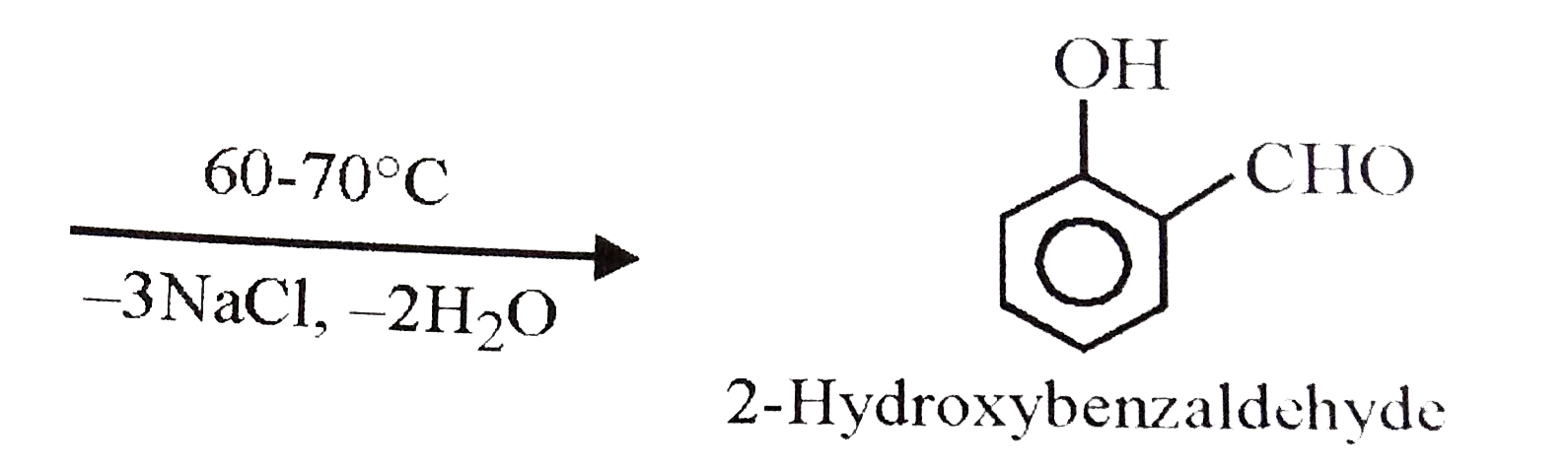
|
|
| 49. |
In order to decompose 9 g of water, 142.5 kJ of heat is required. Hence enthalpy formation of water is _____ |
|
Answer» Solution :`UNDERSET"18 (g)"(H_2O) to H_2 + 1//2O_2` 9g `H_2O` is decomposed by -142.5 KJ amount of heat . `therefore` 18 g of `H_2O` will be decomposed by `142.5/cancel9 xxcancel18^(2)`=+285 kJ `therefore` 18 g of `H_2O` is formed by -285 kJ amount of heat (EVOLUTION of heat =- ve sign) |
|