Saved Bookmarks
This section includes 7 InterviewSolutions, each offering curated multiple-choice questions to sharpen your Current Affairs knowledge and support exam preparation. Choose a topic below to get started.
| 1. |
The quadratic equation ax^(2) + bx + c = 0 has two roots then match the following lists. Find the correct match from List-I to List-II. |
|
Answer» `{:(A,B,C,D),(3,2,4,1):}` |
|
| 2. |
Express the following as trigonometric ratios of some acute angles.sin 1185^@ |
| Answer» SOLUTION :`SIN 1158^@ = SING (13 (pi)/2 + 15^@) = (-1)^((13-1)/2) COS 15^@ = cos 15^@` | |
| 3. |
What is the reflection of the graph of the function y=sin x along the y=x. |
|
Answer» |
|
| 5. |
Show that the expression coses theta(cos theta+3) has no value between (-2sqrt(2)) and 2 sqrt(2) . |
|
Answer» |
|
| 6. |
Let X be a random variable with probability distribution. then E(5X-2)=………. . |
|
Answer» `(9)/(2)` |
|
| 8. |
Show that the semi-vertical angle of the cone of the maximum volume and of given slant height is tan^(-1)sqrt(2). |
|
Answer» |
|
| 9. |
Find the number of proper divisors of 2520 How many of them are divisble by 10. Find their sum? |
|
Answer» |
|
| 10. |
If the normal to the parabola y^(2)=4xat P(1,2) meets the parabola again in Q then Q= |
| Answer» ANSWER :C | |
| 11. |
A company manufactures scooters at two plants, A and B. Plant A produces 80% and plant B produces 20% of the total product. 85% of the scooters produced at plant A and 65% of the scooters produced at plant B are of standard quality. A scooter produced by the company is selected at random and it is found to be of standard quality. What is the probability that it was manufactured at plant A? |
|
Answer» <P> `E_2` =event that the selected scooter is produced at plant B. Then, `P(E_1)=80/100=4/5andP(E_2)=20/100=1/5`. Let E be the event of choosing a scooter which is of standrad quality. Then, `P(E//E_1)=85/100=17/20,and P(E//E_2)=65/100=13/20` PROBABILITYTHAT the selected scooter was produced at plant A, given that it is of Standard quality `=P(E_1//E)` `=(P(E//E_1).P(E_1))/(P(E//E_1).P(E_1)+P(E//E_2).P(E_2))` |
|
| 12. |
If you throw a pair of dice n times, find the probability of getting at least one doublet.[When you get identical members you call it a doublet. You can get a double in six ways: (1,1),(2,2),(3,3),(4,4),(5,5) and (6,6) , thus the probability of getting a doublet is 6/36=1/6, so that the probability of not getting a doublet in one throw is 5/6]. |
|
Answer» Solution :A PAIR od DICE is thrown n times. We get the doublet as (1,1),(2,2),(3,3),(4,4),(5,5),(6,6). `therefore` PROBABILITY of getting a doublet in one throw `=6/36=1/6` `therefore` Probability of not getting a doublet `=1-1/6=5/6` If a pair of dice is known n-times, the probability of not getting a doublet `=(5/6)^n` `therefore` Probability of getting atleast one doublet `=1-(5/6)^n` |
|
| 13. |
If A + B + C = pi/3 then sin ( (pi-6A)/(6) ) + sin ( (pi = 6B)/(6) )+sin C = |
|
Answer» A.`- 1 + 4 COS ( (pi - 6A)/(6) ) + cos ( (pi - 6B)/(12) ) + sin C/2` |
|
| 15. |
A dice marked 1, 2, 3 in red colour and 4, 5, 6 in green colour is tossed. Let A be the event, 'the number is even,' and B be the event, ' the number is marked with red'. Does A and B independent ? |
|
Answer» |
|
| 16. |
Show that tan^(-1)""(1)/(2) + tan^(-1)""(2)/( 11) + tan^(-1)""(4)/(3) = (pi)/(2) |
|
Answer» |
|
| 17. |
A functiong(theta ) = int_(0)^(sin^(2)theta) f(x)dx + int_(0)^(cos^(2)theta) f(x)dxis defined in the interval(- pi/2, pi/2) where f(x) ison increasing function , theng(theta) is increasing in the interval |
|
Answer» `(-pi/2, 0)` |
|
| 18. |
If x and y are digit such that 17! =3556 xy 428096000,then x+y equals |
|
Answer» 15 |
|
| 19. |
Integrate the following functions 1/sqrt(8+3x-x^2) |
|
Answer» Solution :`8+3x-X^2 = 8-(x^2-3x)` `=8-(x^2-3x+9/4-9/4)` =`(41)/4 -(x_3/2)^2` THEREFORE `int 1/SQRT(8+3x-x^2)DX` =`int 1/sqrt((41)/4-(x-3/2)^2 dx` =`sin^-1(x-(3/2)/(sqrt41)/2)+c` =`sin^-1((2x-3)/sqrt(41))+c` |
|
| 21. |
Select the Correct Option If value of cos(sec^-1{:5/3:}) is: |
|
Answer» (5/3) |
|
| 22. |
If sin y= x sin (a+ y) and (dy)/(dx)= (A )/(1 + x^(2)-2x cos a) then the value of A is ……[a]2[b]CosA[c]SinA[d] 1/2 |
|
Answer» 2 |
|
| 23. |
The ratio between the sum of n term of two A.P. s is 3n + 8: 7n + 15. Then find the ratio between their 12 th term |
|
Answer» |
|
| 24. |
Given that the two numbers appearing on throwing two dice are different . Find the probability of the events 'the sum of numbers on the dice is 4' . |
|
Answer» |
|
| 25. |
While travelling through the Syrian Desert, you are in desperate need of water. The owl, still bursting with energy(God knows how) comes flying back to you to tell you that she has located a water faucet nearby. Hearing this, you rush to it, to find a real water cooler. But the problem is, it has seven pieces lying on the ground which have to be fitted to form a rectangle in order to have the faucet working. Which of the following statements are correct about the rectangle formed? |
|
Answer» The corner four pieces are 1,3,5,7 The 7 individual pieces, add up to a total of 28 SQUARES. Therefore, assuming we can indeed formit into a rectangle, it would have to be 7x4 or 14x2 squares in size. I’m using the former case heresimply because it’s a more natural shape, however this proof applies equally as well to the latter.Now imagine that we label each of these squares with a colour - either black or white - suchthat they form a checkerboard pattern as shown beside. Notice that the NUMBER of black squaresmust be equal to the number of white, a property we’ll exploit. So that’s 14 black squares, and 14 white. Looking at each of the pieces individually, the issuewith our assumption quickly appears. As shown beside, for pieces 1-6, the number of black squares within the pieceis equal to the number of white. Clearly which squares are black and which arewhite depends on the actual placement of the piece within the rectangle, but theshapes themselves dictate the count of each colour (since adjacent squares mustbe of different colours). However, piece 7 disrupts the trend. Irrelevant of how it’s located, it must becomprised of 3 squares of one colour, and 1 of the other, a property that ispurely down to its shape. So, taking that into account along with the other 6 pieces, in total they’recomprised of 13 squares of one colour, and 15 of the other, with no assumptionsabout how they’re located within the rectangle. We needed 14 of each, and since we’ve just shown that we can’t get that, our original assumption is overturned and our proof is COMPLETE. 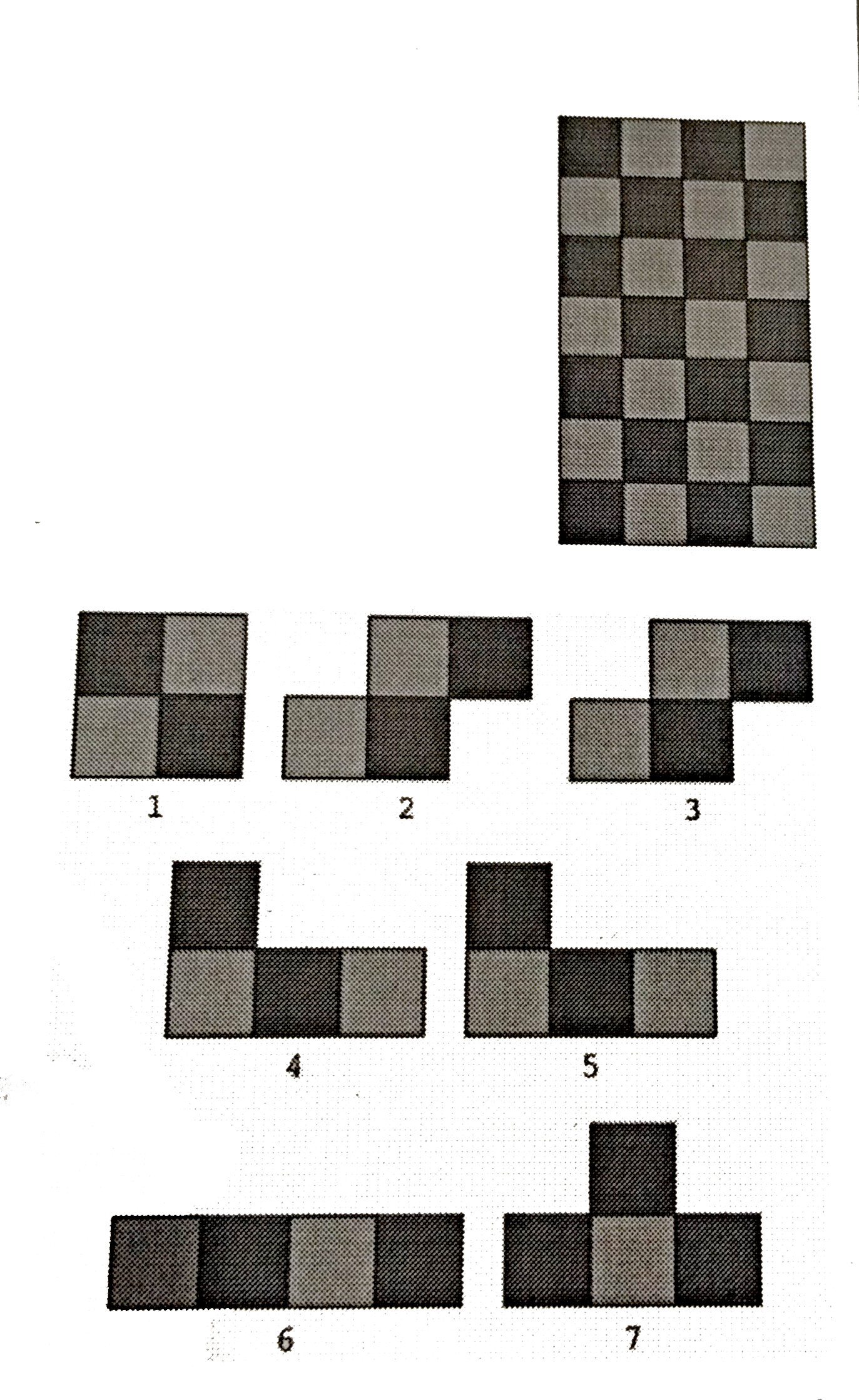
|
|
| 26. |
Let z be a complex number lying oon a circle |z|=sqrt(2) a and b=b_(1)+ib_(2) (any complex number), then The equation of lines passing through the centre of the circle and making an angle (pi)/(4), with the normal at 'b' are |
|
Answer» `Z=+-(lb^(2))/(2a^(2))BAR(z)` |
|
| 27. |
A Function y=f(x) is defined on [0,6] as f(x)= { underset(2 "", ""4le x le6)underset((x-3)^(3)"",""1ltxlt4)(-8x "", ""0lexle1). Show that for the function y=f(x) all thethree conditions of Rolle's theorem are violated on [0,6] but still f(x) vanishes at a point in (0,6) |
| Answer» | |
| 28. |
If the sum of the coefficients in the expansion of (a + b)^(n) is 4096, thenthe greatest coefficient in the expansion is |
|
Answer» 1594 |
|
| 29. |
There are n A.M. s between 3 and 29 such that 6th mean : (n - 1) th mean ::3 :5 then find the value of n. |
|
Answer» |
|
| 30. |
Find the area of the region enclosed between the two circle x^(2) + y^(2) = 4and (x - 2)^(2) + y^(2) = 4. |
|
Answer» |
|
| 31. |
If A=[{:(0,1,2),(2,-3,0),(1,-1,0):}]andf(x)=x^(3)+4x^(2)-x, then find f(A). |
|
Answer» |
|
| 32. |
Find the number of ways of arranging 6 boys and 6 girls around a circle so that no two girls come together |
|
Answer» |
|
| 33. |
A : If the coefficients of 5th, 6th , 7th terms of (1+x)^n are in A.P. then n=7 or 14. R : If the coefficients of rth, (r+1)th, (r+2)th terms of (1+x)^n are in A.P. then n^2-(4r+1) n+4r^2 = 2. |
|
Answer» Both A and R are true and R is the correct EXPLANATION of A |
|
| 34. |
Differentiate tan^(-1) ((sqrt(1+x^(2))-1)/(x)) w.r.t tan^(-1)x, where x ne 0 |
|
Answer» |
|
| 35. |
If bar(z) = 3i + (25)/(z+3i), then |z| cannot exceed |
|
Answer» 3 |
|
| 36. |
Draw the graph of f(x) = sec x + "cosec " x,x in (0, 2pi) - {pi//2, pi, 3pi//2} Also find the values of 'a' for which the equation sec x + "cosec " x = a has two distinct root and four distinct roots. |
|
Answer» Solution :We have `f(x) = sec x + "cosec " x,x in (0, 2PI) - {pi//2, pi, 3pi//2}` CONSIDER each of the intervals `(0, pi//2), (pi//2, pi), (pi, 3pi//2), (3pi//2, 2pi)` For `x in (0, pi//2)` When `x to 0^(+) or x to pi//2^(-), sec x + "cosec " x to oo` ALSO in the `1^(st)` quadrant, sec x + cosec x gt 0 `f'(x) = sec x TAN x - "cosec " x cot x` `f'(pi//4) = 0,` so `x = pi//4` is clearly a point of minima. `f(pi//4) = 2sqrt(2)` For `x in (pi//2, pi)` When `x to pi//2^(+), sec x + "cosec " x to - oo` When `x to pi^(-), sec x + "cosec " x tooo` Also `f'(x) +sec xtan x - "cosec " x cot x gt 0` Hence f(x) is an increasing function. `f(3pi//4) = 0` For `x in (pi, 3pi//2)` When `x to pi^(+), sec x + "cosec " x to-oo` When `x to 3pi//2^(-), sec x + "cosec " x to-oo` `f'(5pi//4) = 0, " so " x = 5pi//4` is clearly a point of maxima. `f(5pi//4) = -2sqrt(2)` For `x in (3pi//2, 2pi)` When,`x to 3pi//2^(+), sec x + "cosec " x tooo` When `x to 2pi^(-), sec x + "cosec " x to-oo` Also `f'(x) +sec xtan x - "cosec " x cot x lt 0` Hence f(x) is a decreasing function. `f(7pi//4) = 0` From the above discussion, the graph of the function is as shown in the following figure. 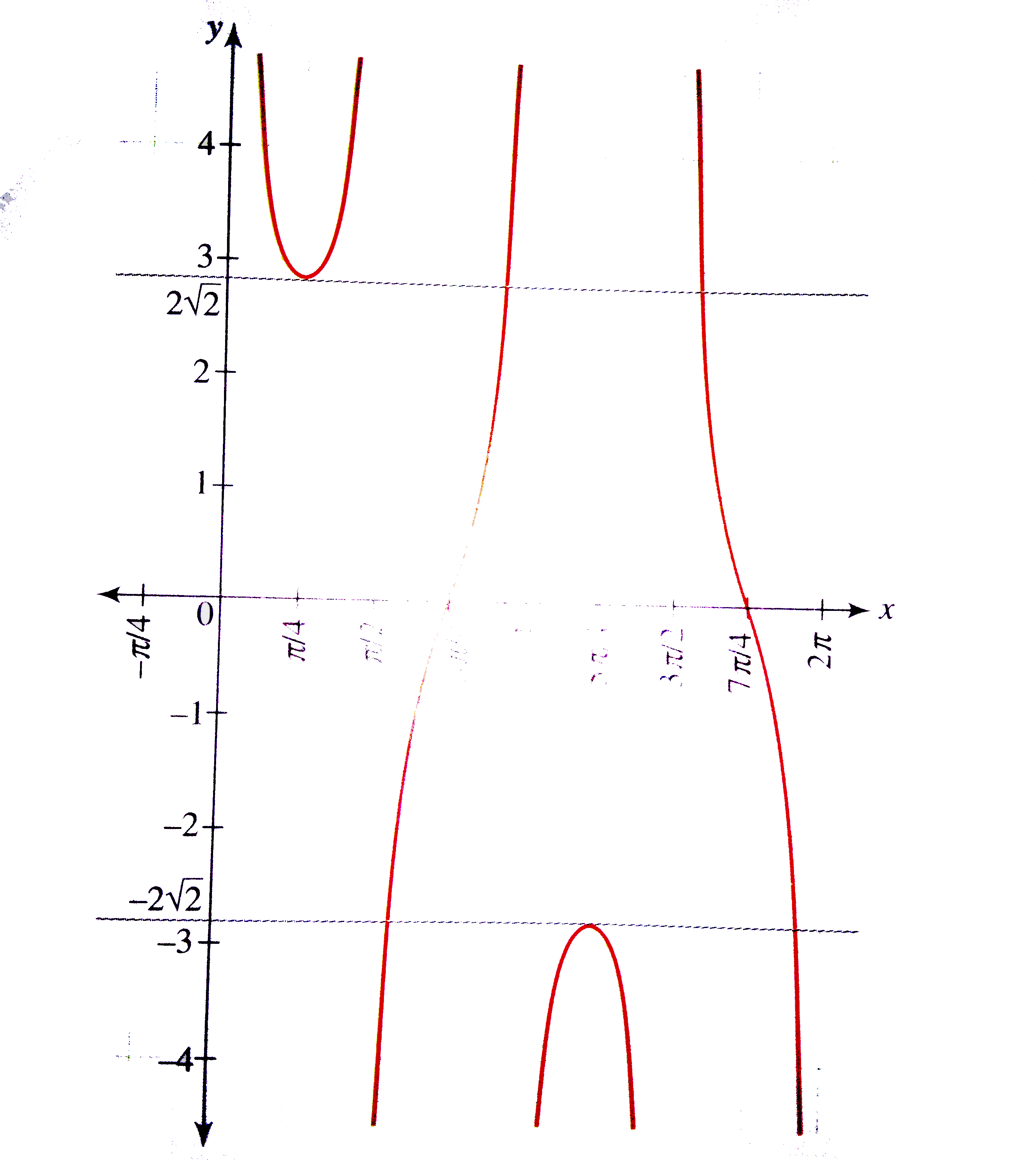
|
|
| 37. |
A circle passes through A(1,1) and touches x-axis then the locus of the other end of the diameter through A is |
|
Answer» `(x+1)^(2)=4Y` |
|
| 38. |
Differentiate.(cos 3x-cosx)/(cos5x-cos3x) |
|
Answer» Solution :`y=(cos3x-cosx)/(cos5x-cos3x)=(-2sin2xcdot sinx)/(-2sin4xcdot SIN2X)` `=(sin2x)/(SIN4X)=1/(2cos2x)` `=1/2sec2x` `thereforedy/dx=1/2sec2xcdottan2xcdot2` `=sec2x TAN 2x` |
|
| 40. |
Find the power of the point P w.r.t the circle S=0 when (i) P(1,2) and S=x^(2)+y^(2)+6x+8y-96 (ii) P(5,-6) and S=x^(2)+y^(2)+8x+12y+15 (iii) P(2,4) and S=x^(2)+y^(2)-4x-6y-12 |
|
Answer» |
|
| 41. |
Solve the following equations : "tan"^(-1)(1-x)/(1+x)=1/2tan^(-1)x,(xgt0) |
|
Answer» |
|
| 42. |
The vertices of a triangle in the argand plane are 3+4i, 4+3i and 2 sqrt6+i, then the distance between the orthocentre and circumstance of the triangle is ______________ |
|
Answer» |
|
| 43. |
The planer region bounded by the parabola y= 2x^(2)+3, the x-axis and the verticals x=0 and x=1 revolves about the y-axis. Compute the volume of the solid of revolution thus generated. |
|
Answer» |
|
| 44. |
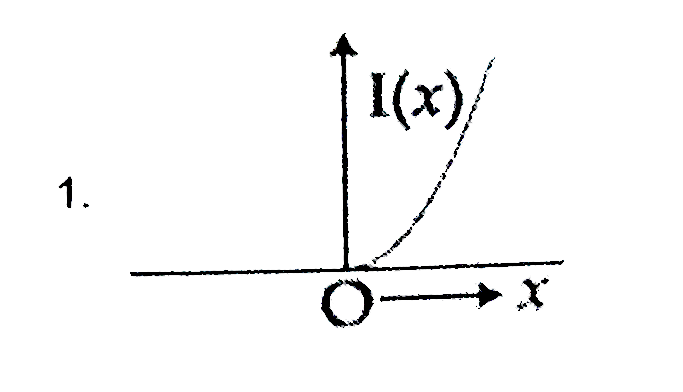
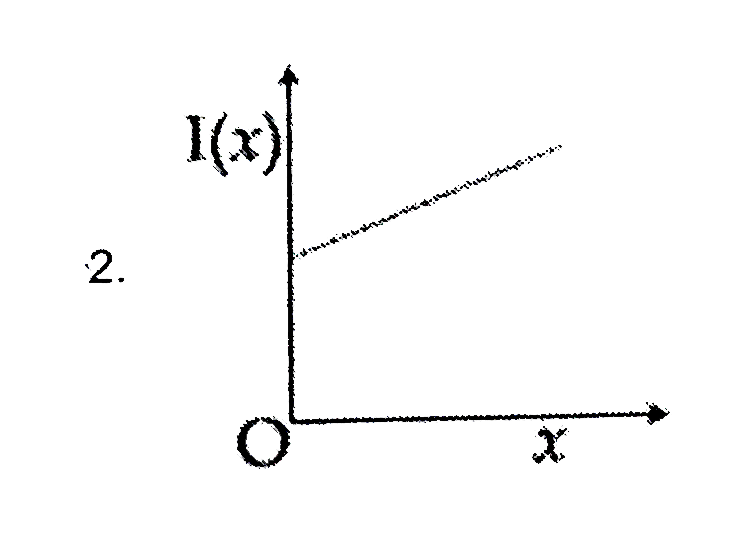
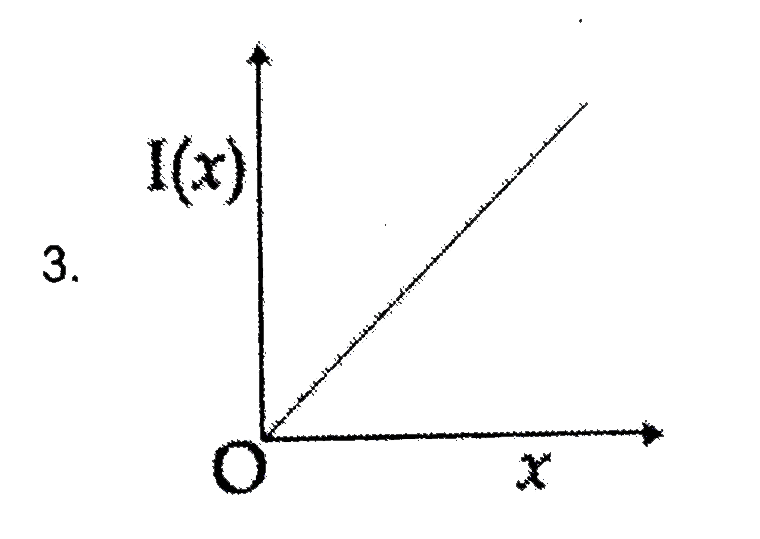
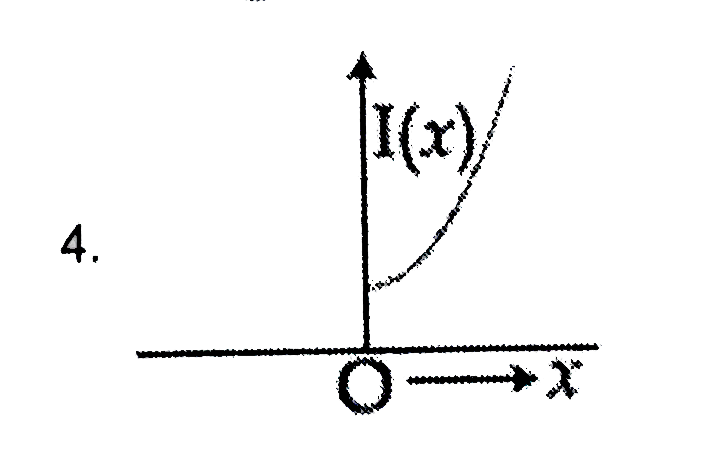
The moment of inertia of a solid sphere, about an axis parallel to its diameter and at a distance of x form it is, 'I(x)'. Which one of the graphs represents the variation of 'I(x) with x correctly ? |
|
Answer»
|
|
| 45. |
If the sum of the roots of the quadratic equation ax^(2)+bx+c=0 is equal to the sum of the squares of their reciprocals, then (a)/(c ), (b)/(a)" and "(c )/(b) are in |
|
Answer» GEOMETRIC progression |
|
| 46. |
If the angle between the lines 2(x+1)=y=z+4 and the plane 2x-y+sqrt(lambda)z+4 is (pi)/(6), then the value of lambda is |
|
Answer» `(135)/(7)` |
|
| 48. |
A curve is represented parametrically by the equations x=e^(1)cost andy=e^(1) sin t, where t is a parameter. Then, If F(t)=int(x+y)dt, then the value of F((pi)/(2))-F(0) is |
|
Answer» 1 |
|
| 49. |
int_(0)^(1)x^(4)(1-x)^(5//2)dx= |
|
Answer» `(284)/(45045)` |
|