

Saved Bookmarks
This section includes 7 InterviewSolutions, each offering curated multiple-choice questions to sharpen your Current Affairs knowledge and support exam preparation. Choose a topic below to get started.
| 1. |
Solve the following systems of linear inequalities graphically : x - y + 1 ge 0, 3x + 4y le 12 , x ge 0 , y ge 0. |
Answer» SOLUTION : 
|
|
| 2. |
Find derivatives of the following functionse^ sqrt(ax) |
|
Answer» SOLUTION :`y = e^ SQRT(AX) dy/DX = e^ sqrt(ax). d/dx (sqrt(ax)) [because d/dx (e^u) = e^u (du)/dx] = e^ sqrt (ax). 1/(2sqrt(ax). d/dx (ax)) [because d/dxsqrt u = 1/(2sqrt u) (du)/dx (e^(sqrt ax).a)/(2sqrt a sqrt x) = (sqrt a. e^ sqrt(ax))/(2 sqrt x)` |
|
| 3. |
Find the pointsof maximaor minima of f(x) =x^(2) (x-2)^(2). |
|
Answer» Solution :`F(x) =x^(2) (x-2)^(2)` `f(x) =4 x(x -1) (x-2)` `f'(x) =0 ""rArr ""x=0,1,2` EXAMINING the sighchange of f'(x) 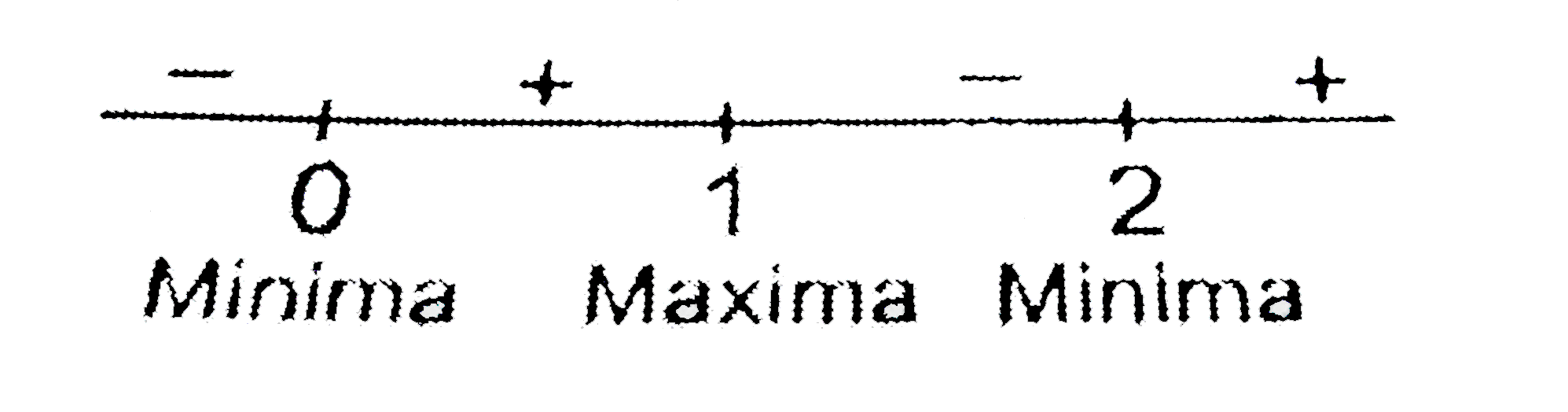 HENCE x=1 is pointof maxima x=0,2 are points of minima. Note: In case of continuous functions points of maxima and minima arealternate.k |
|
| 4. |
Two tailors, A and B earn Rs. 15 and Rs. 20 per day respectively. 'A' can stitch 6 shirts and 4 pants while B can stitch to 10 shirts and 4 pants per day. How many days shall each work if it is desired to produces (at least) 60 shirts and 32 pants at a minimum labour cost ? |
|
Answer» |
|
| 5. |
Match the following {:("List - 1","List - II"),("I) "int_(-1)^(1)x|x|dx,"a) "(pi)/(2)),("II) "int_(0)^((pi)/(2))(1+log((4+3sinx)/(4+3cosx)))dx,"b) "int_(0)^((pi)/(2))f(x)dx),("III) "int_(0)^(a)f(x)dx,"c) "int_(0)^(a)[f(x)+f(-x)]dx),("IV) "int_(-a)^(a)f(x)dx,"d) "0),(,"e) "int_(0)^(a)f(a-x)dx):} |
|
Answer» `{:("I","II","III","IV"),(d,a,E,c):}` |
|
| 6. |
if f(x) ={{:(2x-[x]+ sin (x-[x]),,x ne 0) ,( 0,, x-0):} where[.]denotesthegreatestintegerfunctionthen |
|
Answer» F(X)isdifferentiableat x=0 |
|
| 7. |
By using the properties of definite integrals, evaluate the integrals int_(0)^(pi)log(1+cos x) dx |
|
Answer» |
|
| 8. |
cos (tan^(-1)((3x)/2))is : |
|
Answer» `(3X)/(SQRT(4+9x^(2)))` |
|
| 9. |
If A, B are two events sqch that P( A)ne 0 and P(B|A) = 1, then |
|
Answer» `A SUB B` |
|
| 10. |
I : Two non-zero, non-collinear vectors are linearly independent. II : Any three coplanar vectors are linearly dependent. which one is true? |
|
Answer» only I is TRUE |
|
| 11. |
The sum and product of mean and variance of one binomial distribution is 24 and 128 then parameters of distribution are …………. |
|
Answer» `((1)/(7) + (1)/(8))^(12)` |
|
| 12. |
If p is a point on a hyperbola, then |
|
Answer» the locus of excenter of the circle described opposite to `angleP` for `DeltaPSS'` (S, S" are foci) is tangent at vertex Let (h, K) be the excenter. Then, `h=(ae(ae SEC theta+a)-ae(ae sectheta-a)-2ae(a sec theta))/(2ae(sec theta-1))=-a` ltBrgt `"or"x=-a("for "S'Pgt SP)` ltbRgt Similarly, x = a (for S'P lt SP). THEREFORE, the locus is `x^(2)=a^(2)`  Again, let (h, k) be the excenter opposite `angleS'`. Then , `h=(2a^(2)e sec theta+a^(2)e^(2)sectheta+a^(2)e^(2) sec theta-a^(2)e)/(2a+2ae)` `aesec theta` `"and"k=(2aeb tan theta)/(2a+2ae)` Therefore, the locus is a hyperbola. |
|
| 13. |
24 boys are divided randomly into two equal groups. The probability that two tallest boys are in the different groups is |
|
Answer» `(12)/(23)` |
|
| 14. |
Find the shortest distance between linesvecr=6hati+2hatj+2hatk+lambda (hati-2hatj+2hatk) andvecr=-4hati-hatk+mu(3hati-2hatj-2hatk). |
|
Answer» |
|
| 15. |
Which of the following is a contradiction ? |
|
Answer» <P>(`p^^q)^^ ~(p^^q)` |
|
| 16. |
Find the projection of the vector 7hati+hatj-4hatk on the vector 2hati+6hatj+3hatk. |
|
Answer» |
|
| 17. |
Compound Q ........... |
Answer» 
|
|
| 18. |
If x in (0, pi//2), then : |
|
Answer» `tan X lt x lt SIN x` |
|
| 19. |
The scalar product of the vector hati+hatj+hatk with a unit vector along thesum ofvectors 2hati+4hatj-5hatkandlambdahati+2hatj+3hatkis equal to one . Findthe value of lambda. |
|
Answer» |
|
| 20. |
UsingRolle'stheoremshow thatderivativeof thefunction f(x) ={underset(0 """for"""x=0)(x ins .(pi)/(x) """for"""xgt0). Vanishes at aninfinite set of pointsof theinterval (0.1) |
| Answer» | |
| 21. |
If (1 + omega)^(7) = A + B omega then (A , B) = |
|
Answer» `(1, 1)` |
|
| 22. |
Find the least value of a such that the function f given by f(x) = x^(2) + ax + 1 is increasing on [1, 2]? |
|
Answer» |
|
| 23. |
int sqrt(4-x^(2))dx= |
|
Answer» `(x)/(2) SQRT(4 - x^(2)) - 2 sin^(-1) ((x)/(2)) + C ` |
|
| 25. |
Find the unit vectors perpendicular to the vectors. 2hati-3hatj+hatk,-hati+2hatj-hatk. |
Answer» SOLUTION : =`hati(3-2)-HATJ(-2+1)+hatk(4-3)` = `hati+hatj+hatk` `|VECAXXVECB| = sqrt3` If `hatn` is the unit VECTOR perpendicular to `veca` and `vecb` then. `hatn = +-(vecaxxvecb)/|vecaxxvecb| = +-(hati+hatj+hatk)/sqrt3`. |
|
| 26. |
The value of sin12^(@)sin24^(@)sin48^(@), is |
|
Answer» `cos20^(@)cos40^(@)cos60^(@)cos80^(@)``sin20^(@)SIN40^(@)SIN60^(@)SIN80^(@)` |
|
| 27. |
IfA=[{:(2,-1,3),(4,5,-6):}] and B=[{:(1,2),(3,4),(5,-6):}] then |
|
Answer» only AB is DEFINED |
|
| 28. |
Let R_(1) and R_(2) be the radil of the circles with centres at C_(1) and C_(2). Statement 1: If C_(1)C_(2) le r _(1) + r_(2), then the two circles have two common tangents. Because Statemetn 2: For two common tangents the two circles must intersect in two points. |
|
Answer» Stateme-1 is True, Statement-2 is True, Statemetn-2 is correct explanation for Statement-1 |
|
| 30. |
Inthe givenfigurethe angleat A ispi/2 then thegraphrepresentsthe function |
|
Answer» `y=|2x-4|+4` |
|
| 31. |
Let A and B be two events such that p( bar (AuuB))=1/6, p(AnnB)=1/4 and p( bar A)=1/4, wherebar Astands forthecomplement of the event A. Then the events A and Bare(1) mutually exclusive and independent (2) equally likely but not independent(3) independentbut not equally likely (4)independent and equally likely |
|
Answer» INDEPENDENT but not equally LIKELY |
|
| 32. |
If a set of in parallel lines intersect another set of parallel lines (not parallel to the lines in 1^("st") set) then find the number of parallelograms formed. |
|
Answer» |
|
| 33. |
Cake-A requires 200g of flour and 25g of fat Cake-B requires 100 g of flour and 50 g of fat. Find the maximum number of cakes which can be made from 5 kg of flour and 1 kg of fat. The mathematical form of this LPP is …….. |
|
Answer» |
|
| 34. |
Sand is pouting from a pipe at the rate of 12cm^(3)//s. The falling sand forms a cone on the ground in such a way that the height of the cone is always one - sixth of the radius of the base. How fast is the height of the sand cone increasing when the height is 4 cm ? |
|
Answer» |
|
| 35. |
The rank of the matrix [{:(3, 5, - 1, 4 ), (2, 1, 3, -2), (8, 11 , 1 , 6), (-7, -14, 6, -14):}] |
|
Answer» 1 |
|
| 36. |
Point on the parabola y^(2)=8x the tangent at which makes an angle (pi)/(4) with axis is |
|
Answer» (2,4) |
|
| 37. |
If a function f: [ 0, 27] to R is differentiable then for some 0 lt alpha lt beta lt 3, int_(0)^(27) f(x) dx is equal to |
|
Answer» `3[alpha^(2) F(alpha^3) + BETA^(2) f(beta^3) ]` |
|
| 38. |
Using differentials, find the approximate value of each of the up to 3 places of decimal. (26)^((1)/(3)) |
|
Answer» |
|
| 39. |
A point 'p' moves in xy plane in such a way that [x+y+1]=[x], where [.] represents the greatest integer function, andn in (0, 2). Area of the region representing all possible positions of the point 'p' is equal to : |
| Answer» Answer :A | |
| 40. |
For sets S= { pi, pi^(2) , pi^(3) } and T= {e, e^(2) , e^(3) } if F^(-1) : T to S is defined as F^(-1) = { ( e, pi^(3) ) , (e^(2) , pi^(2) ), (e^(2) , pi)}, then function F=......... |
|
Answer» `{(E^(2) , pi) ,(e^(3) , pi^(2) ) , (e, pi^(3) ) }` |
|
| 41. |
If (1 ^(2) - t _(1)) + (2 ^(2) - t _(2)) + ......+ ( n ^(2) - t _(n))=(1)/(3) n ( n ^(2) -1 ), then t _(n) is |
|
Answer» |
|
| 42. |
If f(x) = tan^(-1) ((2cot^(2)x)/(1 + cos^(2)x)) then d/(dx) (f(f(x))) at x = pi/2 is |
|
Answer» Solution :`f(x) = TAN^(-1)((2cot^2 x)/(1+cos^2 x))` `= tan^(-1)((2 cos^2 x)/(1-cos^4 x))` `=2 tan^(-1)(cos^(2)x)` `f'(x) = (-2)/(1+cos^4 x) [ 2 sin x cos x]` `f'(x) = (4 sin x. Cos x)/(1 + sin^4 x)` `f' ((pi)/2) = 0` `d/(dx) f(f(x)) - f'(f(x)) f'(x)` `d/(dx) f(f(x))` at `(x - pi/2) = f'(f((pi)/2))f'(pi/2) = 0`. |
|
| 43. |
intsin3xcos^2xdx |
|
Answer» SOLUTION :`intsin3xcos^2xdx` =`intsin3x.(1+cos2x)/2dx` =`1/2 INT{sin3x+sin3x.cos2xdx}` =`1/2intsin3x+1/4 int2.sin3x.cos2x.DX` =-1/6cos3x+`1/4 int(sin5x+sinx)dx` =-1/6cos3x-1/20cos5x-1/4cosx+C |
|
| 44. |
If int (cos4x+1)/(cot x - tanx)=Kcos4x+C, then |
|
Answer» K = - 1/2 |
|
| 45. |
Evaluate the following integrals int(xtan^(-1)x)/((1+x^(2))^((3)/(2)))dx |
|
Answer» |
|
| 46. |
If z_(1), z_(2) and z_(3) are three complex numbers such that abs(z_(1)) = abs(z_(2)) = abs(z_(3)) = 1, then abs(z_(1) -z_(2))^(2) + abs(z_(2) -z_(3))^(2) + abs(z_(3) -z_(1))^(2) is less than or equal to |
|
Answer» 6 |
|
| 47. |
If e_(1) and e_(2)are theeccentricites of (x^(2))/(a^(2))+(y^(2))/(b^(2))=1and (x^(2))/(b^(2))+(y^(2))/(a^(2))=1respectively then |
|
Answer» `e_(1)=e_(2)` |
|
| 48. |
If int x^(3) e^(-x) " dx = " - e^(-x) [ ax^(3) + bx^(2) + cx + d]K then (a, b,c,d) = |
|
Answer» |
|
| 49. |
Find the second order derivative of y=Tan^(-1)((2x)/(1-x^(2))). |
|
Answer» |
|