

Saved Bookmarks
This section includes 7 InterviewSolutions, each offering curated multiple-choice questions to sharpen your Current Affairs knowledge and support exam preparation. Choose a topic below to get started.
| 1. |
Integrate the following functions. int(x^(2)-1)/(x^(4)+x^(2)+1)dx |
|
Answer» |
|
| 3. |
Mean of the numbers 1,2,3,…,n with respective weights 1^(2) + 1, 2^(2) + 2, 3^(2) + 3,…,n^(2)+n is |
|
Answer» `(3N+2)/(2)` |
|
| 4. |
The solution of y dx - xdy + 3x^(2) y^(2) e^(x^(3))dx = 0 is |
|
Answer» `(y)/(X) + E^(x^(3)) = C` |
|
| 5. |
If |bar(x)|=|bar(y)|=1 and bar(x)_|_bar(y), then |bar(x)-bar(y)| =…………… |
| Answer» Answer :A | |
| 6. |
Show that the points (1, 2, -1), (2, 5, 1) and (0, -1, -3) are collinear. |
|
Answer» are collinear |
|
| 7. |
obtain the equation of hyperbola in each of the following cases: centre (1,-2) transverse axis parallel to x-axis of length 6 and conjugate axis of length 10. |
|
Answer» Solution :CENTRE (1,-2) transverse axis parallel to x-axisof length 6 conjugate axis of length 10 .`THEREFORE` 2a=6 , 2b=10 `therefore` a=3 , b=5, h=1 , k=-2 `therefore` EQN of the hyperbola `(x-h)^2/a^2-(y-k)^2/b^2=1` or `(x-1)^2/9-(y-2)^2/25=1` |
|
| 8. |
Integration by partial fraction : int(dx)/(x^(4)-1)=....+c |
|
Answer» `(1)/(4)log|(X+1)/(x-1)|` |
|
| 9. |
Find adjoint of each of the matrices{:[( 1,-1,2),( 2,3,5),( -2,0,1) ]:} |
|
Answer» |
|
| 10. |
Using the properties of determinants, prove the following It 2s=a+b+c then |{:(a^2,(s-a)^2,(s-a)^2),((s-b)^2,b^2,(s-b)^2),((s-c)^2,(s-c)^2,c^2):}|=2s^3(s-a)(s-b)(s-c) |
|
Answer» |
|
| 11. |
Find the number of points with integral coordinates that lie in the interior of the region common to the circle x^(2) + y^(2) = 16 and the parabola y^(2) = 4x. |
|
Answer» |
|
| 12. |
Evaluate int{(e^(2logx)+e^(3logx))/(x+x^2)}dx. |
| Answer» SOLUTION :`INT(E^(2Inx)+e3Inx)/(x+x^2)dx=int(e^(Inx^3)+e^(Inx^3))/(x+x^2)dx=int(x^2+x^3)/(x+x^2)dx=intxdx=x^2/2+C` | |
| 13. |
If A(1,1,1),C(2,-1,2)the vector equationof theline vec(AB)is vec(r) = (hat(i) + hat(j) + hat(k)) + t(6hat(i) -3hat(j) + 2hat(k))and d is theshrotest distanceof the point C form vec(AC)then |
|
Answer» `B(6,-3,2)` |
|
| 14. |
Plane meets the coordinateaxes in P,Q,R respectively .If the centroidof trianglePQR is (1,1/2,1/3) , then the equation of plane is . |
|
Answer» `2x+4y+3z=5` |
|
| 15. |
Find the asymptotes of the following curves: f(x) = (x^(2))/(x+1) |
|
Answer» |
|
| 16. |
Evaluate the following definite integrals . int_(0)^(5)(x+1)dx |
|
Answer» |
|
| 17. |
Prove that sum_(k = 1)^(n) k. ""^(k)P_(n + 1) -1. |
|
Answer» <P> |
|
| 18. |
The partial fractions of (1)/(x^(2)(x+2)) are |
|
Answer» `- (1)/(4X)+(1)/(2x^(2))+(1)/(4(x+2))` |
|
| 19. |
Let hata,vecb and vecc be the non-coplanar unit vectors. The angle between hatb and hatc is alpha "between" hatc and hata is beta and "between" hata and hatb is gamma. If A(hatacos alpha),B(hatbcosbeta) and C(hatc cosgamma), then show that in triangle ABC, (|hataxx(hatbxxhatca)|)/(sinA)=(|hatbxx(hatcxxhata)|)/sinB = (|hatcxx(hataxxhatb)|)/sinC=(prod|hataxx(hat xx hatc|))/(sumsin alpha-cosbeta. cos gammahatn_(1)) where hatn_(1)=(hatbxxhatc)/(|hatbxxhatc|),hatn_(2)=(hatcxxhata)/(|hatcxxhata|)and hatn_(3)=(hataxxhatb)/(|hataxxhatb|) |
|
Answer» Solution :From the sine rule, we GET `(AB)/(sin C)=(AC)/(sinB)=(BC)/(sinA)= ((AB)(BC)(CA))/(2DeltaABC)` `BC=|vec(BC)|=|hatc COS gamma=-hatbcosbeta|=|(hata.hatb)hatc-(hatc.hata)hatb|=|(hataxx(hatbxxhatc))|` `AC = |vec(AC)|=|hatbxx(hatcxxhata)|and AB = |vec(AB)|=hatcxx(hataxx hatb)|` `DeltaABC=1/2|vec(BC)xxvec(BA)|` `=1/2 |(hatc cosgamma-hatb cos BETA)xx(hata COSALPHA-hatbcosbeta)|` `=1/2 |(hatc xxhata)cosalpha cosgamma+(hatbxxhatc)cosalphacosbeta+(hata xx hatb)cos beta cos alpha|` `2DeltaABC=|sumhatn_(1)sinalphacosbeta cosgamma|` `(|hataxx(hatbxxhatc)|)/sinA=(|hatbxx(hatcxxhata)|)/sinB=(|hatcxx(hataxxhatb)|)/sin C = (prod|hata xx(hatbxx hatc)|)/(|sum sinalpha COSBETA cosgamma hatn_(1)|)` |
|
| 20. |
Statement 1 The sum of the focal distances of a point on the ellipse 4x^(2)+5y^(2)-16x-30y41=0 is 2sqrt5. Statement 2 The equation 4x^(2)+5y^(2)-16x-30y+41=0 can be expressed as 4(x-2)^(2)+5(y-3)^(2)=20. |
|
Answer» Statement I is true, statement II is true: statement II is a CORRECT explanation for statement I |
|
| 21. |
If a_(1), a_(2) , ……. A_(n) are in H.P., then the expression a_(1)a_(2) + a_(2)a_(3) + ….. + a_(n - 1)a_(n) is equal to |
|
Answer» `N(a_(1) - a_(n))` |
|
| 22. |
int_(0)^(oo) (dx)/((1+x^(2))^(4))= |
|
Answer» `(3pi)/(26)` |
|
| 23. |
If (5z_2)/(11z_1) is purely imaginary, then the value of |(2z_(1)+3z_(2))/(2z_(1)-3z_(2))| is |
| Answer» ANSWER :C | |
| 24. |
Ifalpha , beta , gammaare the rootsof x^4 -4x^2 -x+2=0 find thevaluesofsumalpha^2 betaandsum(1)/(alpha^2) |
|
Answer» |
|
| 26. |
Solve the differential equation y e^(x/y) dx = (x e^(x/y) + y^(2))dy ( y ne 0). |
|
Answer» |
|
| 27. |
Let (S) denotes the number of ordered pairs (x,y) satisfying (1)/(x)+(1)/(y)=(1)/(n),Aax,y,n in N. Q. sum_(r=1)^(10)S(r) equals\ |
|
Answer» 47 `4^(2) to 2^(4)to S(4)=5,5^(2)toS(5)=3,S(6)=9` `S(7)=3,S(8)=7,S(9)=5 and S(10)=9`[from above] `therefore underset(R=1)overset(10(sum)S(r)=S(1)+S(2)+S(3)+S(4)+S(5)+S(6)+S(7)+S(8)+S(9)+S(10)` `=1+3+3+5+3+9+3+7+5+9=48` |
|
| 28. |
Evaluate the following determinates (i) |{:("3","-1","-2"),(0,0,"-1"),(3,"-5","0"):}| |
|
Answer» |
|
| 29. |
The negation of (pvv~q)^^q is |
|
Answer» `(~PVVQ)^^~Q` |
|
| 30. |
y = sin^(-1)(2xsqrt(1 - x^2)), -1/(sqrt2) lt x lt 1/(sqrt2) |
|
Answer» |
|
| 31. |
If 10 person are seated at a round table, then what is the probability that two particular persons sit together? |
|
Answer» Solution :Here, 10 PERSON are seated round table. Total no. of ways in which 10 persons can sit along a round table = (10-1)!=9! `therefore`Total no. of elementary events = 9! Now if we regard two particular person as ONE person, then we will be left with only 9 persons. These 9 persons can be seated along a round table in (9-1)=8! ALSO, those two particular persons can be arranged among themselves in 2! ways `therefore`No. of favourable elementary events = `8!xx2!` THUS, required probability `= (8!xx2!)/(9!)=2/9` |
|
| 32. |
If 1m ((2z+1)/(iz+1))=3, then locus of z is |
|
Answer» A circle |
|
| 33. |
Find the approximate value off(5.001), where f(x) = x^(3) – 7x^2 + 15. |
|
Answer» |
|
| 34. |
Consider the parabola x^(2) +4y = 0. Let P(a,b) be any fixed point inside the parabola and let S be the focus of the parabola. Then the minimum value at SQ +PQ as point Q moves on the parabola is |
|
Answer» `|1 -a|` 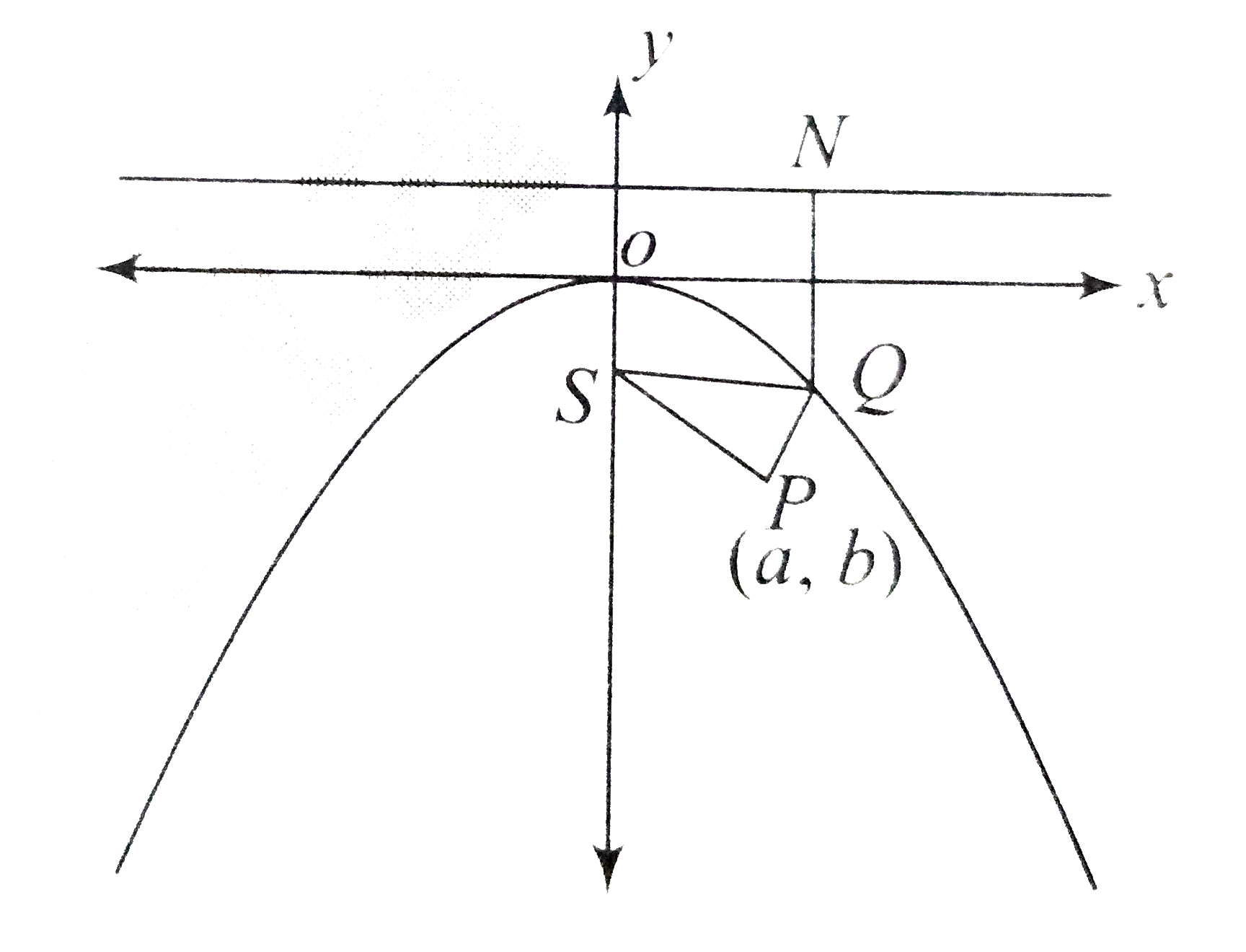 Let the foot of perpendicular from Q to the directrix be N. `SQ + PQ = QN + PQ` is minimum when P, Q and N are COLLINEAR. So, minimum value of `SQ + PQ = PN = 1 -b` |
|
| 35. |
STATEMENT-1: The line 2009x+2010y+2011=0 where 2009a+2011c=0 passes through the point ((a)/(b),(b)/(c )), where abc ne 0. STATEMENT-2: If 2009a+2010+2011c=0, then the straight line ax+by+c=0, abc ne 0 passes through ((2009)/(2011),(2010)/(2011)). |
|
Answer» Statement-1 is TRUE, Statemetn-2 is True, Statemetn-2 is a CORRECT explanation for Statement-5 |
|
| 36. |
Find the rate of change of the area of a circle with respect to its radius r when r=6cm. |
| Answer» | |
| 37. |
Let vec(u),vec(v) and vec(w) be such that |vec(u)|=1,|vec(v)|=2,|vec(w)|=3. If the projection vec(v) along vec(u) is equal to that of vec(w) along vec(u) and vec(v),vec(w) are perpendicular to each orher, then |vec(u)-vec(v)+vec(w)| equals ............... . |
| Answer» Answer :C | |
| 38. |
Sum to n terms the series 1 + (1+ 2) + (1 + 2 + 3) + (1 + 2 + 3 + 4)....... |
|
Answer» |
|
| 39. |
If Nis the setof alllnaturalnumbersthenwhichof the followingis true |
|
Answer» `f(x)= 3X -2` DOESNOT mapN to N |
|
| 40. |
If barx =18, bary=100, Var(X)=196, Var(Y) = 400 and p(X,Y) = 0.8, find the regressionlines. Extimate the value of y when x = 70 and that of x when y = 90. |
|
Answer» |
|
| 41. |
If f'(x)=(2x)/((1+x^(2))^(2)) , find f(x). |
| Answer» | |
| 42. |
Evalute the following integrals int(2x^(2) -3 " sin x " + 5 sqrt(x))dx |
|
Answer» |
|
| 43. |
If 2f''(x)=sinx-49sin7x, find f(x). |
| Answer» | |
| 44. |
If f'(x)=3sinx-4cosx, find f(x). |
| Answer» | |
| 45. |
"Let" f(x) =sqrtx "and" g(x) = 1 -x^2.Find natural domains of f and g. |
|
Answer» Solution :Let `F(X) =sqrtx, G(x) =1 -x^2` `:.` Dom `f=R_+ U_(0) =R_0`,Dom g =R |
|
| 46. |
A and B are two events such that P(A) gt 0, P(B) ne 1 then P(barA|barB) is equal to |
|
Answer» <P>1- P(A|B) |
|
| 47. |
25 ml of a solution containing HCl and H_(2)SO_(4) required 10 ml of 1 M NaOH solution for complete neutralization. 20 ml of the same acid mixture on being treated with excess of AgNO_(3) gives Report your answer as (x+y)xx1000. |
|
Answer» Solution :Let molarity of HCL is x and `H_(2)SO_(4)` is y `{:(m" mole""mmole "),( x xx25""+""2yxx25=10xx1),(""underbrace("")),("" m" mole of "[H^(+)]):}` ApplyingPOAC Applying POAC `(20xxx)/(1000)=(0.1435)/(143.5)=10^(-3)` `x=(1)/(20)=0.05M` `y=(8.75)/(50)=0.175M` ` therefore(x+y)xx1000=(0.05+0.175)xx1000=225` |
|
| 48. |
The number of vectors of unit length perpendicular to the vectors bar(a)=2bar(i)+bar(j)+2bar(k) and bar(b)=bar(j)+bar(k) is …………. |
| Answer» Answer :B | |
| 49. |
Let P, Q, R, S be points on the plane with position vectors -2hat(i)-hat(j),4hat(i),3hat(i)+3hat(j),-3hat(i)+2hat(j) respectively. The quadrilateral PQRS must be a |
|
Answer» PARALLELOGRAM, which is NEITHER a RHOMBUS nor a rectangle |
|
| 50. |
Let A = {1,2,3}. Then number of equivalence relations containing (1,2) is |
|
Answer» 1 |
|