

Saved Bookmarks
This section includes 7 InterviewSolutions, each offering curated multiple-choice questions to sharpen your Current Affairs knowledge and support exam preparation. Choose a topic below to get started.
| 1. |
The sum of the fourth powers of the roots of the equation x^(3)+x+1=0 is |
|
Answer» -2 |
|
| 3. |
The sum of roots of equation 4cos^(3) (Pi + x) – 4cos^(2)(Pi – x) + cos(Pi + x) – 1 = 0 in the interval [0,320] is p Pi. Then p is equal to :- |
|
Answer» `4 cos^(3)x + 4cos^(2)x+cosx+1 = 0` `(4cos^(2)x+1)(cosx+1) = 0` `cos x = -1` `x = (2n -+ 1) Pi` `N = 012 ………….49, 50` `x = Pi, 3 Pi, 5Pi …………… 99 Pi , 101 Pi` `S = Pi + 3 Pi + …………+ 101 Pi` `S = 2601 Pi`. |
|
| 4. |
If the maxtrix [{:(0,a,3),(2,b,-1),(c,1,0):}] is a skewsymmetric matrix , find the values of a,b,andc. |
|
Answer» |
|
| 5. |
d /dx (log ( sqrt(x+ sqrt( x^(2) + a^(2) ))))= |
|
Answer» `SQRT(X^(2) + a^(2) )` |
|
| 6. |
If n is a natural number, then [7 ^(2n)+2^(3(n-1)), 3 ^(n=-1)] is always a multiple of- |
|
Answer» 6 |
|
| 7. |
int(dx)/(2sin2x-3)= |
|
Answer» `(-1)/(sqrt(5))TAN^(-1)((3tanx+2)/(sqrt(5)))+C` |
|
| 8. |
Prove the following : 8sin^4(1/2theta)-8sin^2(1/2theta)+1=cos2theta |
|
Answer» SOLUTION :R.H.S. = `cos2theta=1-2SIN^2theta` =`1-2xx(2sin(theta/2)COS(theta/2))^2` `1-8sin^2(theta/2)cos^2(theta/2)` `1-8sin^2(theta/2)(1-sin^2(theta/2))` `1-8sin^2(theta/2)+8sin^4(theta/2)` = L.H.S. |
|
| 9. |
If n and r are two positive integers such that nger,"then "^(n)C_(r-1)+""^(n)C_(r)= |
|
Answer» `""^(N)C_(n-R)` |
|
| 10. |
If P, Q, R are the mid-point of the sides AB, BC and CA of Delta ABC respectively, then PC-BQ= |
| Answer» ANSWER :A::D | |
| 11. |
If A=[{:(4,3),(2,5):}], find x and y such that A^(2)+xA+yI_(2)=O_(2). Hence, find A^(-1). |
|
Answer» |
|
| 12. |
Express "tan"^(-1)(cosx)/(1-sinx),(-3pi)/2ltxlt(pi)/2 in the simplest form. |
|
Answer» |
|
| 13. |
Let f(x)=x^(2), g(x)="cos" x and alpha,beta (alpha lt beta) be the roots of the equation 18x^(2)-19pi x+pi^(2)=0. Then the area bounded by the curves u="fog"(x), the ordinates x=alpha, x=beta and the X-asis is |
|
Answer» `(1)/(2)(pi-3)` SQ UNITS |
|
| 14. |
A insurancecompanyinsured2000scooterdrivers, 4000cardriversand6000truckdirvers .The probabilityof anaccidentare 0.01 , 0.03and 0.15respectivelyone of theinsuredpersonsmeetswith an accident. Whatis theprobabilitythathe isscooterdiriver? |
|
Answer» |
|
| 15. |
Find the vertex, focus, equation of directrix and axis, of parabolas 3x^(2)-9x+5y |
|
Answer» |
|
| 17. |
A function f is defined on the complex number by f (z) = (a + bi)z, where 'a' and 'b' are positive numbers. This function has the property that the image of each point in the complex plane is equidistant from that point and the origin. Given that |a+bi|=8 and that b^2=u/v where u and v are coprimes . Find value of (u+v) . |
|
Answer» |
|
| 18. |
The symmetrical form of the line x - y + 2z = 5, 3x + y + z = 7 is |
|
Answer» `(4x-11)/(-3)=(4y+9)/(3)=(Z)/(1)` |
|
| 19. |
A chord is drawn through the focus of the parabola y^(2)=6x such that its distance from the vertex of this parabola is (sqrt5)/(2) , then its slope can be |
|
Answer» `( SQRT5)/( 2) ` |
|
| 20. |
Which of the followingis NOT equivalent to (P^^ ~ q) rarr r |
|
Answer» <P>`~ (QV ~p) RARR r` |
|
| 21. |
Match the statements given in List I with the values given in List II. |
|
Answer» `y=|x-1|+|x-2|+x={{:(3-x,, xlt1),(1+x,,1LE xlt2),(3x-3,,xge2):}` `"For "alpha=0, y=3` 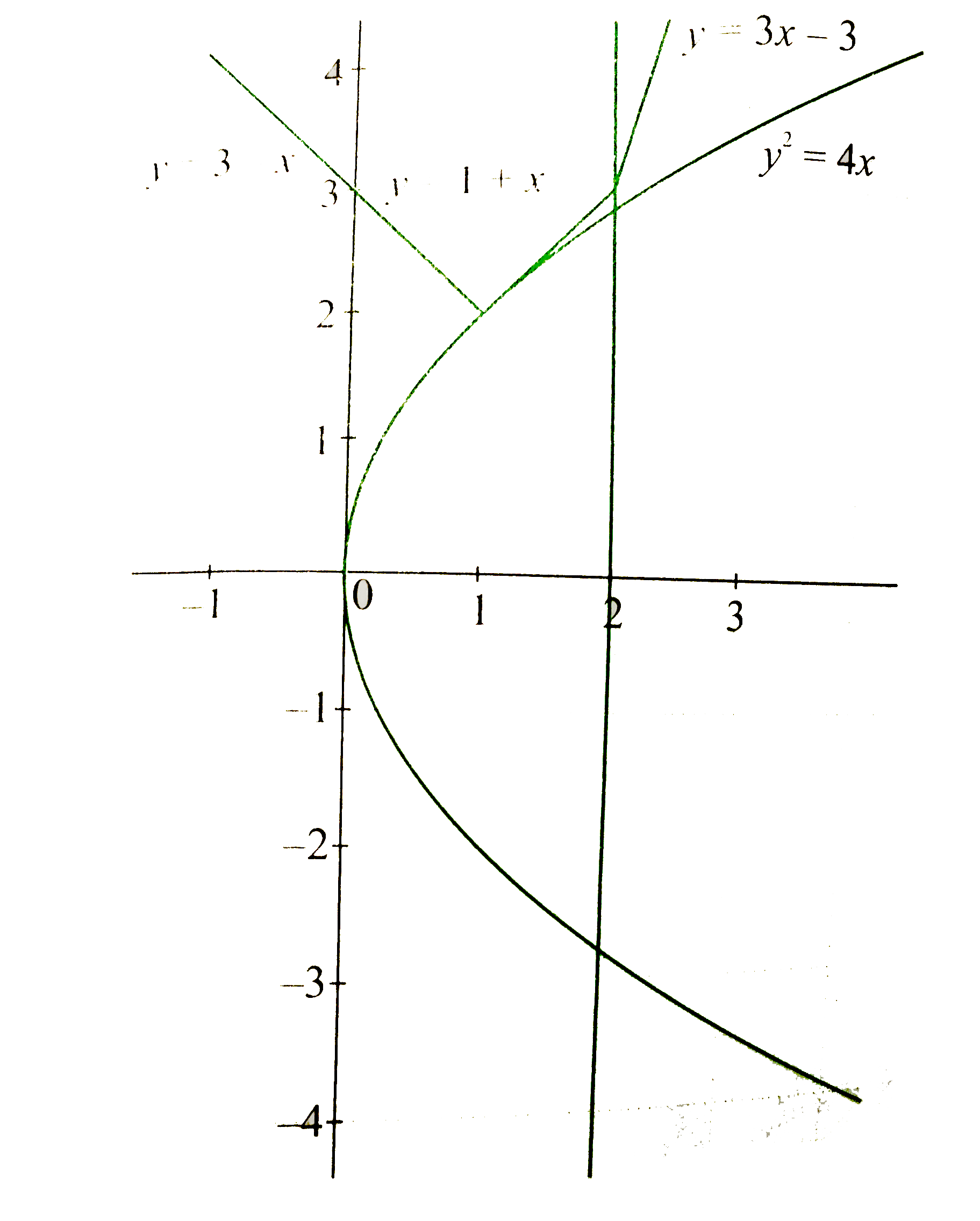 `A=(1)/(2)(2+3)xx1+(1)/(2)(2+3)xx1-overset(2)underset(0)int2sqrt(x)dx` `rArr""A=5-(8)/(3)SQRT(2)` `therefore""F(1)+(8)/(3)sqrt(2)=5` `"For "alpha=0,y=|-1|+|-2|=3` 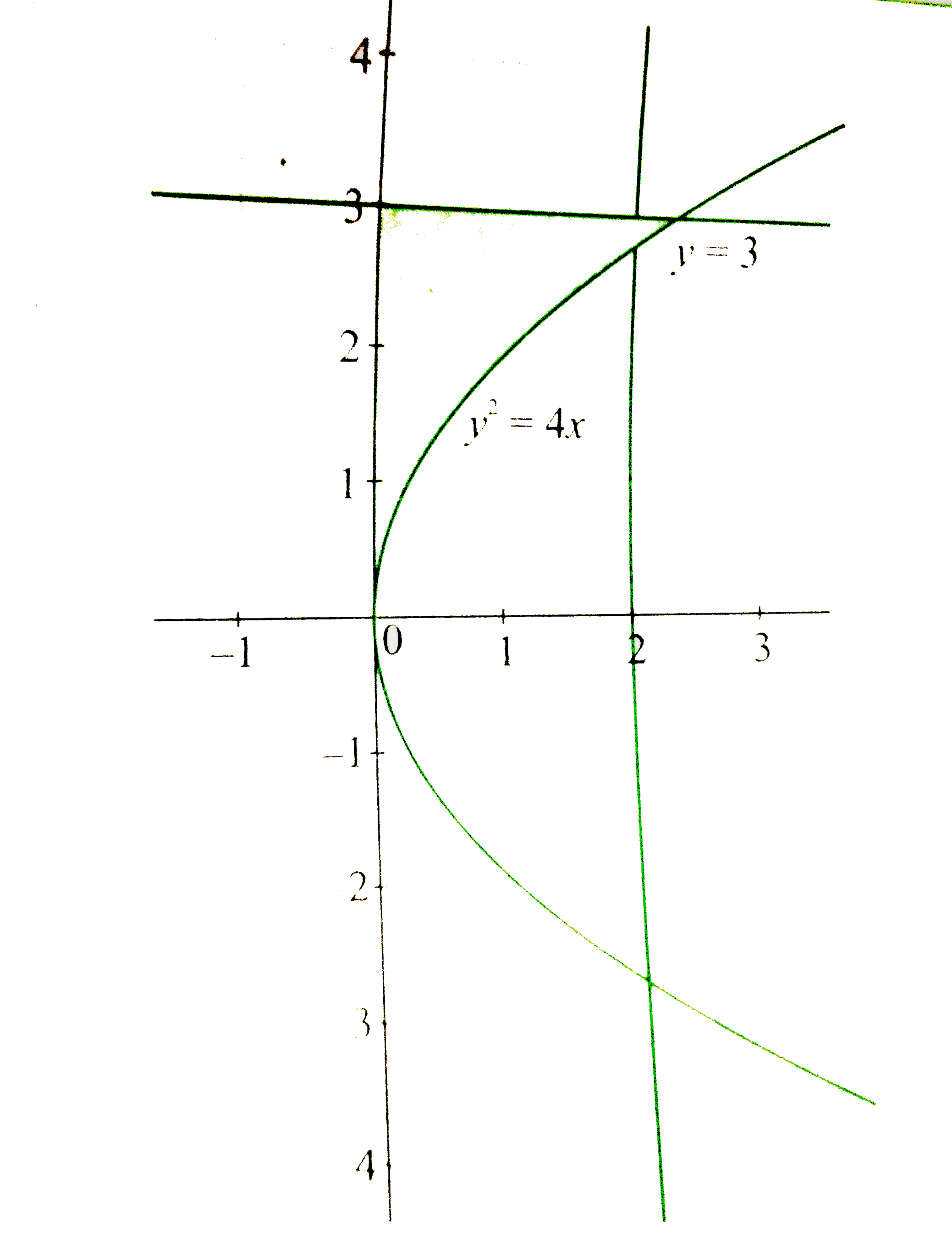 `A=6-overset(2)underset(0)int2sqrt(x)dx` `rArr""A=6-(8)/(3)sqrt(2)` `therefore""F(0)+(8)/(3)sqrt(2)=6` Note : Solutions of the remaining PARTS are given in their respective chapters. |
|
| 22. |
If n=10 , sum_(i=1)^(10) x_(i)=60 and sum_(i=1)^(10) x_(i)^(2)=1000 then find s.d |
|
Answer» |
|
| 23. |
Evaluate the following define integrals as limit of sums : lim_(n rarr oo) sum_(i=1)^(n) (i)/(n^(2)+i^(2)) |
|
Answer» |
|
| 24. |
(d)/(dx) [ 2 cot^(-1) ((sqrt(1+ sin x) + sqrt(1-sin x))/(sqrt(1+ sin x) - sqrt(1-sin x)))]= |
|
Answer» |
|
| 25. |
Let a_(n)=(10^(n))/(n!) for n = 1, 2, 3,… then the greatest value of n for which a_(n) is the greatest is |
|
Answer» 11 |
|
| 26. |
Using the combined method find all roots of the equation f(x) -= x^(3)- 5x+1 =0accurate to three decimal places. |
|
Answer» |
|
| 27. |
If d is the distance between the point of intersection of the lines x^(2)+4xy+ky^(2)-4x-10y+3=0 and the origin and p is the product of the perpendicular distances from the origin to these lines, then d^(2)-20p^(2)= |
|
Answer» 8 |
|
| 28. |
Find number of integral values of k for which the line3x + 4y - k = 0 , lies between the circlesx^2 + y^2 - 2x - 2y + 1 = 0 andx^2 + y^2 - 18 x - 12 y + 113 = 0, without cutting a chord on either of circle. |
|
Answer» `C_(1)M_(1)ger_(1)` `C_(2)M_(2)ger_(2)` `|(3+4-k)/(5)|GE1` `|7-k|ge5""C_(1)" is below the LINE "3x+4y-k=0` `k-7ge5""7-klt0`  `kge12"....(i)"` `|27+25-k|ge10""C_(2)" lies above the line "3x+4y-k=0` `51-k gr10""51-k gt0` `kle41"....(ii)"` From (i) and (ii) `k in [12, 41]"Number of INTEGRAL value = 30"` |
|
| 29. |
Differentiate cos (tan sqrt(x+ 1)) |
|
Answer» |
|
| 30. |
If (sin A-sinC)/(cosC-cosA)=cotB then angles A,B,C arein |
|
Answer» A.P |
|
| 31. |
int(cos3xcos2x+sin3xsin2x)/(1-cos^2)dx |
|
Answer» SOLUTION :`INT(cos3xcos2x+sin3xsin2x)/(1-cos^2)DX` =`INTCOS(3x-2x)/(1-cos^2x)dx` =`intcosx/sin^2xdx=int1/sinx.cosx/sinx dx` =`intcosecx.cotxdx=-cosecx+C` |
|
| 32. |
Let f(x) = 4x^(2)-4ax+a^(2)-2a+2 and the global minimum value of f(x) for x in [0,2] is equal to 3 The values of a for which f(x) is monotonic for x in [0,2] |
|
Answer» `a LE` 0 or a `ge 4` vertex of this parabola is `((a)/(2),2-2a)` caseI:`0 lt a/2 lt 2` In this case f(x) will attain the minium VALUE at `x=a/2` .Thus `f(a/2)^(3)`  or `3=-2a+2 or a =-1/2` (rejected) Case II: `(a)/(2)ge2` In this f(x) attains global minimum value at x =2 thus f(2)=3 `3=16-8a+a^(2)-2a+2 or a =5 pm sqrt(10)` thus `a=5+sqrt(10)` Case III: `(a)/(2)ge0` In this case f(x) attains the global minumum value at x =0 thus f(0)=3 `therefore3=a^(2)-2a+2 or a =1 pm` Thus a =1-`sqrt(2)` Hence the permissibel VALUES of a are `1-sqrt(2) and 2+sqrt(10)` f(x) =`4x^(2)-49x+a^(2)-2a+2`is monotonic in [0,2] Hence the point of minima of funciton should not lie in [0,2] Now f(x) =0 or 8x-4a=0 or x `=a//2` `(a)/(2)in [0,2] or a in [0,4]` For f(x) to be monotomic [0,2], and[0,4] i/e`ale0` or age4` |
|
| 33. |
Area bounded by x ^(2) y ^(2)+ y ^(4)-x ^(2)-5y ^(2)+4=0 is equal to : |
|
Answer» `(4PI)/(2) + SQRT2` |
|
| 34. |
Out of 12 persons sitting at a round table three persons are chosen at random. The probability that no two of them are consecutive is |
|
Answer» `(18)/(55)` |
|
| 36. |
A family of curves whose equation is general solution of a differential equation having order 1 and degree 3, is (g, a, c are arbitrary constants) |
|
Answer» `X^(2) + y^(2) + 2GX + 4Y + 2 =0` |
|
| 37. |
Let us consider the binomial expansion(1 + x)^(n) = sum_(r=0)^(n) a_(r) x^(r) wherea_(4) , a_(5) "and " a_(6)are in AP , ( nlt10 ). Consider another binomial expansion ofA = root (3)(2) + (root(4) (3))^(13n) ,the expansion of A containssome rational termsT_(a1),T_(a2),T_(a3),...,T_(am) (a_(1) lt a_(2) lt a_(3) lt ...lt a_(m)) The value ofsum_(i=1)^(n) a_(i) is |
|
Answer» 63 ` 2. ""^(n)C_(5) = ""^(n)C_(4) + ""^(n)C_(6)` `rArr 2= (""^(n)C_(4))/(""^(n)C_(5)) + (""^(n)C_(6))/(""^(n)C_(5)) = (5)/(n-5 + 1) + (n-6 +1)/(6)` ` rArr 2= (5)/(n-4) + (n-5)/(6)` ` rArr 12 n - 48 = 30 + n^(2) - 9N + 20 ` ` rArr n^(2) - 21 n + 98 = 0 rArr n = 7,14 ` Hence , ` n = 7"" [ because n lt 10]` ALSO , `A = (root(3)(2) + root(4)(3))^(13n) = (2^(1//3) + 3^(1//4))^(91) ` ` therefore T_(r+1) = ""^(91)C_(r) (2^(1//3)) ^(91-r) . (3^(1//4))^(r)` ` = ""^(91)C_(r) . 2^(91-r)/(3)) . 3^(r//4)` ...(i) `sum_(i=1)^(n)a_(i) = sum_(i=1)^(7) a_(i) = a_(1) + a_(2) + a_(3) + ...+ a_(7) ` ` = ""^(7)C_(1) +""^(7)C_(2) + ""^(7)C_(3) + ...+ ""^(7)C_(7) = 2^(7) - 1 = 127` |
|
| 38. |
Integration of some particular functions : int(2x+3)/(3x^(2)+4x+5)dx= plog|3x^(2)+4x+5|+q tan^(-1) ((3x+2)/(sqrt(11)))+c then p^(2)+q^(2)=.... |
|
Answer» `(4)/(11)` |
|
| 39. |
Let us consider the binomial expansion(1 + x)^(n) = sum_(r=0)^(n) a_(r) x^(r) wherea_(4) , a_(5) "and " a_(6)are in AP , ( nlt10 ). Consider another binomial expansion ofA = root (3)(2) + (root(4) (3))^(13n) ,the expansion of A containssome rational termsT_(a1),T_(a2),T_(a3),...,T_(am) (a_(1) lt a_(2) lt a_(3) lt ...lt a_(m)) The value ofa_(m) is |
|
Answer» 87 ` 2. ""^(n)C_(5) = ""^(n)C_(4) + ""^(n)C_(6)` `rArr 2= (""^(n)C_(4))/(""^(n)C_(5)) + (""^(n)C_(6))/(""^(n)C_(5)) = (5)/(n-5 + 1) + (n-6 +1)/(6)` ` rArr 2= (5)/(n-4) + (n-5)/(6)` ` rArr 12 n - 48 = 30 + n^(2) - 9n + 20 ` ` rArr n^(2) - 21 n + 98 = 0 rArr n = 7,14 ` Hence , ` n = 7"" [ because n LT 10]` ALSO , `A = (root(3)(2) + root(4)(3))^(13n) = (2^(1//3) + 3^(1//4))^(91) ` ` therefore T_(r+1) = ""^(91)C_(r) (2^(1//3)) ^(91-r) . (3^(1//4))^(r)` ` = ""^(91)C_(r) . 2^(91-r)/(3) . 3^(r//4)` ...(i) From Eq . (i) , we get ` 0 le r le 91` For rational terms , ` r = 4,16,28,40,52,64,76,88` Rational terms are ` T_(5), T_(17), T_(29), T_(41), T_(53), T_(65), T_(77), T_(89) ` ` therefore a_(m) = 89 ` |
|
| 40. |
Evaluate the following integrals: int_0^1 dx/sqrt(1-x^2) |
|
Answer» SOLUTION :`int_0^1 dx/sqrt(1-x^2) = (sin^-1x)_0^1` =`sin^-1 1-sin^-1 0 = pi/2-0 = pi/2` |
|
| 41. |
If either vector veca=vec0orvecb=vec0,, then veca*vecb=0.But the converes need not be true . Justify your answer with an example. |
|
Answer» |
|
| 42. |
Let us consider the binomial expansion(1 + x)^(n) = sum_(r=0)^(n) a_(r) x^(r) wherea_(4) , a_(5) "and " a_(6)are in AP , ( nlt10 ). Consider another binomial expansion ofA = root (3)(2) + (root(4) (3))^(13n) ,the expansion of A containssome rational termsT_(a1),T_(a2),T_(a3),...,T_(am) (a_(1) lt a_(2) lt a_(3) lt ...lt a_(m)) The common difference of the arithmetic progressiona_(1), a_(2), a_(3),..., a_(m) is |
|
Answer» 6 ` 2. ""^(n)C_(5) = ""^(n)C_(4) + ""^(n)C_(6)` `rArr 2= (""^(n)C_(4))/(""^(n)C_(5)) + (""^(n)C_(6))/(""^(n)C_(5)) = (5)/(n-5 + 1) + (n-6 +1)/(6)` ` rArr 2= (5)/(n-4) + (n-5)/(6)` ` rArr 12 n - 48 = 30 + n^(2) - 9n + 20 ` ` rArr n^(2) - 21 n + 98 = 0 rArr n = 7,14 ` Hence , ` n = 7"" [ because n lt 10]` Also , `A = (root(3)(2) + root(4)(3))^(13n) = (2^(1//3) + 3^(1//4))^(91) ` ` therefore T_(r+1) = ""^(91)C_(r) (2^(1//3)) ^(91-r) . (3^(1//4))^(r)` ` = ""^(91)C_(r) . 2^(91-r)/(3) . 3^(r//4)` ...(i) Also , 5,17,29,41,53,...,89 are in AP with common difference 12 . |
|
| 44. |
Integrate the functions (e^(2x)-e^(-2x))/(e^(2x)+e^(-2x)) |
|
Answer» |
|
| 45. |
If x^(4)(1+y)=1y," then "(dy)/(dx)= |
|
Answer» `(8X^(3))/(1+x^(4))` |
|
| 46. |
Which of the following is not logically equivalent to the proposition? " A real number is either rational or irrational." |
|
Answer» If a number is NEITHER RATIONAL or nor irrational then it is not real |
|
| 47. |
State with reason whether following functions have inverse : h: {2,3,4,5} rarr {7,9,11,13} with h{(2,7),(3,9),(4,11),(5,13)} |
|
Answer» |
|
| 48. |
Given three non-coplanar vectors OA=a, OB=b, OC=c. Let S be the centre of the sphere passing through the points O, A, B, C if OS=x, then |
|
Answer» X must be linear combination of a, b, C |
|
| 49. |
If alpha, beta, gamma are roots ofx^(3) + px^(2) + qx + r = 0then sum alpha^(3) beta^(3) = |
|
Answer» <P>`(q^(2) - 2pr)//r^(2)` |
|
| 50. |
Find the equation of the normal to the curve x^(2) = 4y which passes through the point (1, 2). |
|
Answer» X + y = 3 |
|