

Saved Bookmarks
This section includes 7 InterviewSolutions, each offering curated multiple-choice questions to sharpen your Current Affairs knowledge and support exam preparation. Choose a topic below to get started.
| 1. |
Let A_1,A_2,A_3,….,A_m be the arithmetic means between -2 and 1027 and G_1,G_2,G_3,…., G_n be the gemetric means between 1 and 1024 .The product of gerometric means is 2^(45) and sum of arithmetic means is 1024 xx 171 The n umber of arithmetic means is |
|
Answer» 442 `rArrm((-2+1027)/2)=1025xx171` or m=342 |
|
| 2. |
Let A_1,A_2,A_3,….,A_m be the arithmetic means between -2 and 1027 and G_1,G_2,G_3,…., G_n be the gemetric means between 1 and 1024 .The product of gerometric means is 2^(45) and sum of arithmetic means is 1024 xx 171 The value of Sigma_(r=1)^(n) G_ris |
|
Answer» GIVEN, `2^(5n)=2^(45)rArrn=9` Hence, `r=(1024)^(1/(9+1))=2` `rArrG_(1)=2,r=2` `rArrG_(1)+G_(2)+..+G_(9)=(2xx(2^(9)-1))/(2-1)=1024-2=1022` |
|
| 3. |
I : If a = I +j - k, b = 2i - 3j + 2k, c = 13 I - 7j + 3k then [a b c] = 0 II : If a,b,c are mutually perpendicular unit vector then [a b c]^(2) = 1 |
|
Answer» only I is ture |
|
| 4. |
Evaluate intxsqrt(1 + x - x^(2))dx |
|
Answer» |
|
| 5. |
A box contains 19 screws, 3 of which are defective, Two screws are drawn at random with replacement. Find the probability that neither of the two screws is defective. |
|
Answer» |
|
| 6. |
Using elementary transformation find the inverse of the matrix : A=((1, -3,2),(3, 0, 1),(-2, -1, 0)) |
|
Answer» |
|
| 7. |
Number of ways of forming a committee of 6 members out of 5 Indians. 5 Americans and 5 Australians such that there will be atleast one member from each county in the committee is |
|
Answer» 3375 |
|
| 8. |
bar(a),bar(b) and bar( c ) are three non zero, non planar vectors. bar(p)=bar(a)+bar(b)-2bar( c ),bar(q)=3bar(a)-2bar(b)+bar( c ) and bar( r )=bar(a)-4bar(b)+2bar( c ). The volume of the parallelepiped formed by the vectors bar(a),bar(b) and bar( c ) is V_(1) and the volume of the parallelepiped formed by the vectors bar(p),bar(q) and bar( r ) is V_(2) then V_(2):V_(1) = ............. |
|
Answer» `3:1` |
|
| 9. |
The mid point of the chord 2x+5y=12 of the ellipse 4x^(2) + 5y^(2) = 20 is |
|
Answer» 6,0 |
|
| 12. |
int (x^(2)+1)/(x^(4)+x^(2)+1)dx= |
|
Answer» |
|
| 13. |
Evaluate int(x^(2)-1)/(x^(4)-x^(2)+1)dx |
|
Answer» |
|
| 14. |
If a diameter of a hyperbola meets the hyperbola in real points then |
|
Answer» `3x^(2)+4y^(2)-6x-8y+4=0` |
|
| 15. |
Match the following lists: |
|
Answer» (a) `x^(2)ax+B=0` has ROOT `lapha`. HENCE. `alpha^(2)+aalpha+ b=0""(1)` `x^(2)+px+q=0` has root `-alpha`. Hence, `alpha^(2)-palpha+q=""(2)` ELIMINATING `alpha` from (1) and (2), we get `(q-b)^(2)=(aq+bp)(-p-a)` or `(q-b)^(2)=-(aq+pb)(p+a)` (b) `x^(2)ax+b=0` has root `alpha`. Hence, `alpha^(2)+aalpha+b=0 ""(1)` `x^(2)+px+q=0` has root `1//alpha`. Hence, `qalpha^(2)+palpha+1=0""(2)` Eliminating `alpha` from (1) and (2), we get `(1-bq)^(2)=(a-pb)(p-aq)` (c) `x^(2)+ax+b=0` has roots, `alpha,BETA`. Hence, `alpha^(2)+aalpha+b=0""(1)` `x^(2)+px+q=0` has roots `-2//alpha,gamma`. Hence, `qalpha^(2)-2palpha+4=0""(2)` Eliminating `alpha` from (1) and (2), we et `(4-bq)^(2)=(4a+2pb)(-2p-aq)` (d) `x^(2)+ax+b=0` has roots `alpha,beta`. Hence, `alpha^(2)+aalpha+b=0""(1)` `x^(2)+px+q=0` has roots `-1//2alpha,gamma`. Hence, `4qalpha^(2)-2palpha+1=0""(2)` Elimintaing `alpha` from (1) and (2), we get `(1-4bq)^(2)=(a+2bp)(-2p-4aq)` |
|
| 16. |
For what values of x is the rate of increase of x^(3)-2x^(2)+3x+8 is twice the rate of increase of x.. |
|
Answer» `(-(1)/(3), -3)` |
|
| 17. |
If |z-3+i| = 4 then the locus of z = x +iy is |
|
Answer» `X^(2)+ y^(2) -6 x + 2y - 6 = 0` |
|
| 18. |
Is the function defined by f(x)= |x|, a continuous function? |
|
Answer» |
|
| 19. |
Discuss the continuity of the cosine, cosecant, secant and cotangent functions. |
|
Answer» |
|
| 20. |
(1-omega)(1-omega^2)(1-omega^4)(1-omega^5)=9 |
|
Answer» SOLUTION :L.H.S.`=(1-omega)(1-omega^2)(1-omega^4)(1-omega^5)` `=(1-omega)(1-omega^2)(1-omega)(1-omega^2)` (1-omega)^2(1-omega^2)^2` `={(1-omega)(1-omega^2)}^2` `=(1-omega^2-omega+omega^3)^2` `{3-(omega^2+omega+1)^2` `(3)^2=9=R.H>S` (PROVED) |
|
| 21. |
Show that (vecaxxvecb)^2 = a^2b^2 - (veca.vecb)^2. |
|
Answer» SOLUTION :`vecaxxvecb = ab sinthetahatn` Where a = `|veca|, B = |vecb|` = `THETA` is the angle between two vectors `veca` and `vecb` and `hatn` is the unit vector perpendicular to `veca.vecb`. Now `(vecaxxvecb)^2 = (vecaxxvecb).(vecaxxvecb) = `a^2b^2 sin^2 theta (hatn.hatn)` = `a^2 b^2 sin^2 theta = a^2b^2- a^2b^2 cos^2 theta`. = `a^2b^2-(abcostheta)^2 = a^2b^2-(veca.vecb)^2`. (PROVED) |
|
| 22. |
(1)/(2.3)+(1)/(4.5)+(1)/(6.7)+……oo= |
| Answer» Answer :B | |
| 23. |
The sum to n terms of the series 1+ 5 ((4n +1)/(4n - 3)) + 9 ((4n +1) /( 4n -3)) ^(2) + 13 ((4n +1)/( 4n -3)) ^(3) + ((4n + 1 )/( 4n -3)) ^(2)+ ……. is . |
|
Answer» |
|
| 24. |
For any value oftheta if the straight lines x sin theta + (1-cos theta ) y = a sin theta and xsin theta -(1+ cos theta)y + a sin theta = 0 intersect at P(theta) thenthe locus of P(theta)is a |
|
Answer» STRAIGHT line |
|
| 25. |
If the length of three sides of a trapezium other than base are equal to 10 cm. Than find the area of trapezium when it is maximum. |
|
Answer» |
|
| 26. |
State whether the following statements are true or false . Justify . If ** is commutative binary operation on N, then a"*" (b"*" c)=(c"*"b)"*"a. |
|
Answer» |
|
| 28. |
Consider the lines represented by equation (x^(2) + xy -x) xx (x-y) =0 forming a triangle. Then match the following lists: |
Answer» 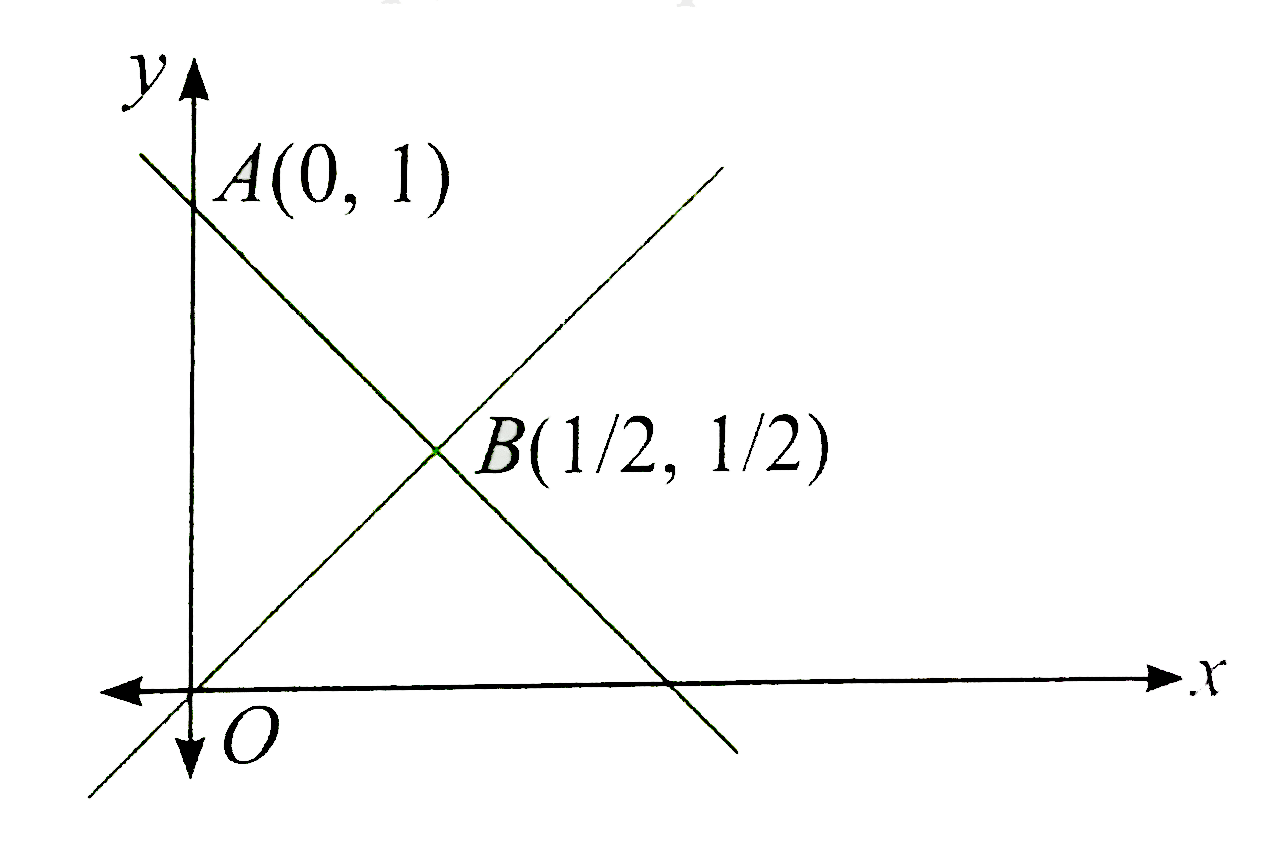 The GIVEN lines are x (x+y-1) (x-y)=0. So, lines x =0, x+y-1=0, and x-y=0 form triangle OAB as shown in the diagram. The triangle is right-angled at pont B. Hence, the orthocenter is (1/2, 1/2). Also, the CIRCUMCENTER is the midpoint of OA which is (0, 1/2). The centroid is `((0+(1//2) +0)/(3), (0+(1//2)+1)/(3)) " or "((1)/(6), (1)/(2))` `"Also, " OA = 1, OB = OC= 1//2sqrt(2).` Hence, the incenter is `((0(1//sqrt(2))(1//2)1+0(1//sqrt(2)))/((1//sqrt(2))+1+(1//sqrt(2))),(0(1//sqrt(2))+(1//2)(1)+1(1//sqrt(2)))/((1//sqrt(2))+1+(1//sqrt(2)))) -= ((1)/(2+2sqrt(2)), (1)/(2))` |
|
| 29. |
Let p, q in R. "If " 3 - sqrt(3) is a root of thequadratic equation x^(2) + px + q = 0 , then |
|
Answer» `p^(2) - 4Q + 12 = 0` |
|
| 30. |
Iff(x)={:{((x -1)/(2x^(2) - 7 x +5) ," for "x ne 1) , (-1/3 , " for "x = 1):} thenf (1)is equal to |
|
Answer» `-1/9` |
|
| 31. |
The probability of three mutually exclusive events A, B and C are given by 2/3, 1/4, 1/6 respectively Is this statement a)True? b)False? c)Cannot be said? d)Data not sufficient? |
| Answer» Answer :B | |
| 32. |
If barb and barc are two non-collinear vectors, then number of solution (x,y) in x,y in [0,10], satisfying the equation bara.[barb+barc] = 5 and bara xx (barb xx barc) = (x^2 -2x+7) barb+(siny)barc is : |
|
Answer» ONE `impliesbara-barc =x^2 - 2x + 7, bara .""barb=-siny` `bara.(barb + barc) = 5` `impliesx^2 - 2x + 7 -siny=5` `implies (x-1)^2 + 1 = sin y` `x=1, y=(4n+1) (pi)/(2) = (pi)/(2),(5pi)/(2)` |
|
| 33. |
Match the relation for derivatives given in List II with the relation given in List I and then choose the correct code. |
|
Answer» <P>`{:(a,b,c,d),(q,p,s,r):}` `"so "y^(2)+(xy-1)y_(1)=0` b. `ysqrt(1-x^(2))=sin^(-1)x` `RARR" "-(yx)/(sqrt(1-x^(2)))+y_(1)sqrt(1-x^(2))=(1)/(sqrt(1-x^(2)))` `"so "-xy+y_(1)(1-x^(2))=1` c. `y^(2)=2x-x^(2)rArr yy_(1)=1-x` `rArr" "y_(1)^(2)+yy_(2)=-1` `"so "(1-x)^(2)/(y^(2))+yy_(2)=-1` `rArr""y^(3)y_(2)=-[1+x^(2)-2x+y^(2)]=-1` d. `y=e^(sqrt(x))+e^(-sqrt(x))` `rArr" "y_(1)=(e^(sqrt(x))-e^(-sqrt(x)))/(2sqrt(x))` `rArr" "y_(1)^(2)x=(e^(sqrt(x))-e^(-sqrt(x)))^(2)=y^(2)-4` `rArr""8y_(1)y_(2)x+4y_(1)^(2)=2yy_(1)` `rArr" "4y_(2)x+2y_(1)=y` `rArr" "xy_(2)-(1)/(2)y_(1)-(1)/(4)y=0` |
|
| 34. |
If 3hat(i)+hat(j)-2hat(k)andhat(i)-3hat(j)+4hat(k) are the diagonals of a parallelogram, then the area of the parallelogram is |
|
Answer» `10sqrt(3)sq.units` |
|
| 36. |
n^(th) term of log_(e )(6//5) is |
|
Answer» `((-1)^(n-1))/(5^(n))` |
|
| 37. |
If the relation R:A rarr B where A={1,2,3,4} and B={1,3,5}is defined by R={(x,y),xlty,x in A,y in B} then ROR^(-1) is |
|
Answer» `{(1,3),(1,5),(2,3),(2,5),(3,5),(4,5)}` |
|
| 38. |
Evaluate the determinants below in examples number 1 and 2 |{:(2,4),(-5,-1):}| |
|
Answer» |
|
| 39. |
A monument ABCD stands at A on a level ground. At a point P on the ground the portions AB, AC, AD subtend alpha, beta, gamma respectivelyl. If AB = a, AC = b, AD = c, AP = x and alpha + beta + gamma = 180^(@) "then x"^(2) is equal to |
|
Answer» `(a)/(a+B+C)` |
|
| 40. |
The logically equivalent statement of p toqis |
|
Answer» <P>`(p ^^ Q) VV ( q to p)` |
|
| 41. |
Show that the position vector of the point P, which divides the line joining the points A and B having position vectors veca and vecb internally in ratio m:n is (mvecb+nveca)/(m+n) |
| Answer» | |
| 42. |
If the mapping f(x) = mx + c, m gt 0maps [-1,1] onto [0,2], thentan ( tan^(-1). 1/7 + cot ^(-1) 8 + cot ^(-1) 18) is equal to |
|
Answer» `F(2/3)` |
|
| 43. |
Solve(dy)/(dx)=(3x+y+4)^(2) |
|
Answer» |
|
| 44. |
Show that the position vector of the point P, which divides the line joining the points A and B having position vector a and b internally in the ratio: m:n is (mvecb + nveca)/(m+n) |
|
Answer» |
|
| 45. |
A factory manufactures two types of screws, A and B. Each type of screw requires the use of two machines, an automatic and a hand operated. It takes 4 minutes on the automatic and 6 minutes on hand operated machines to manufacture a package on screws A, while it takes 6 minutes on automatic and 3 minutes on the hand operated machines to manufacturer a package of screws B. Each machine is available for at the most 4 hours on any day.The manufacturer can sell a package of screws A at a profit of Rs. 7 and screws B at a profit of Rs. 10. Assuming that he can sell all the screws he manufactures, how many packages of each type should the factory owner produce in a day order to maximise his profit? Determine the maximum profit. |
Answer» Solution :Let the manufacturer MAKES `x` packets of screw `A` and `y` packets of screw B per DAY. Then 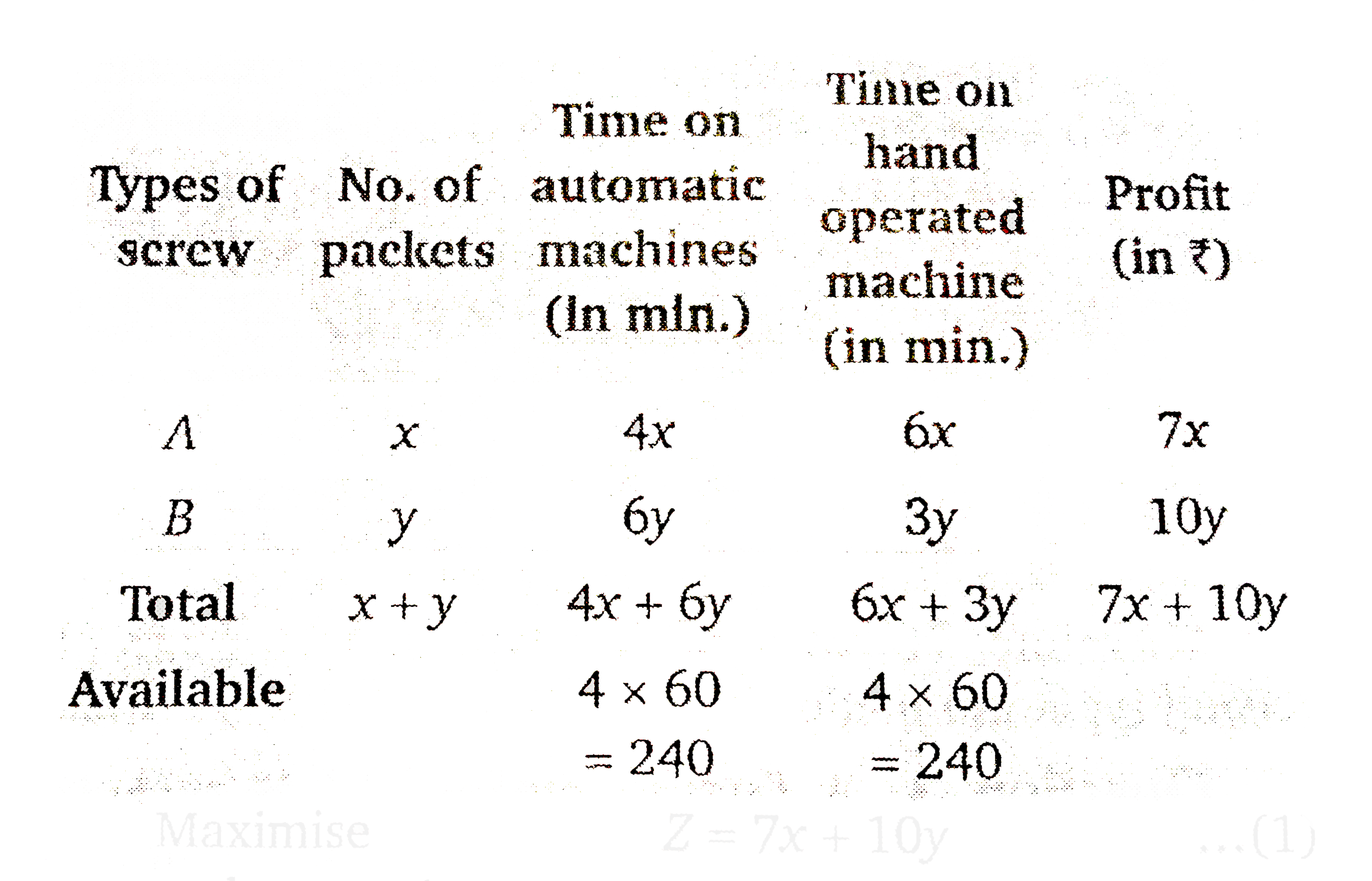 Maximise `Z=7x+10y`………………1 and constraints `4x+6yle240implies2x+3yle120`…………………2 `6x+3yle240implies2x+yle80`.....................3 and `xge0,yge0` 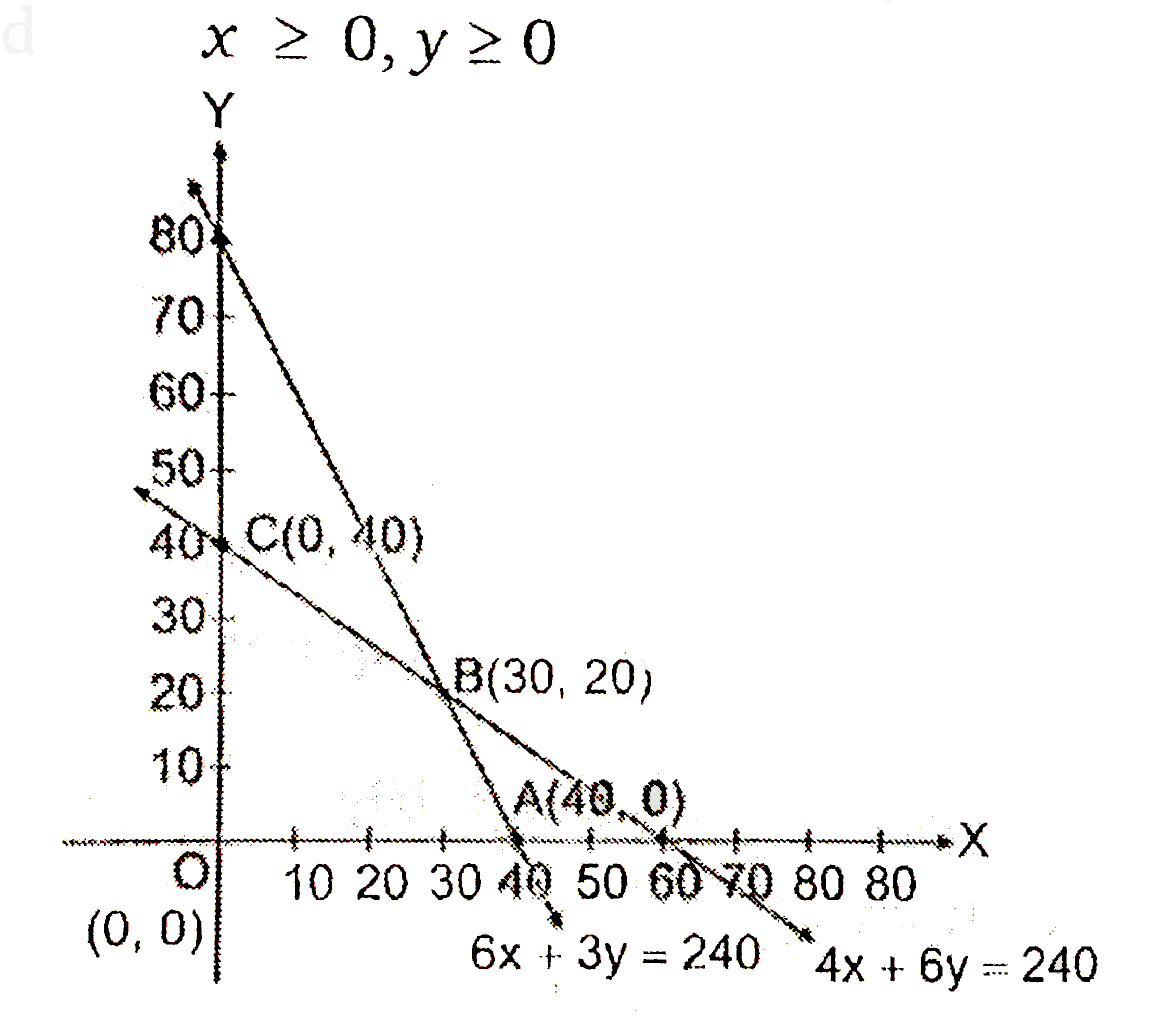 First draw the graph of the line `2x+3y=120` 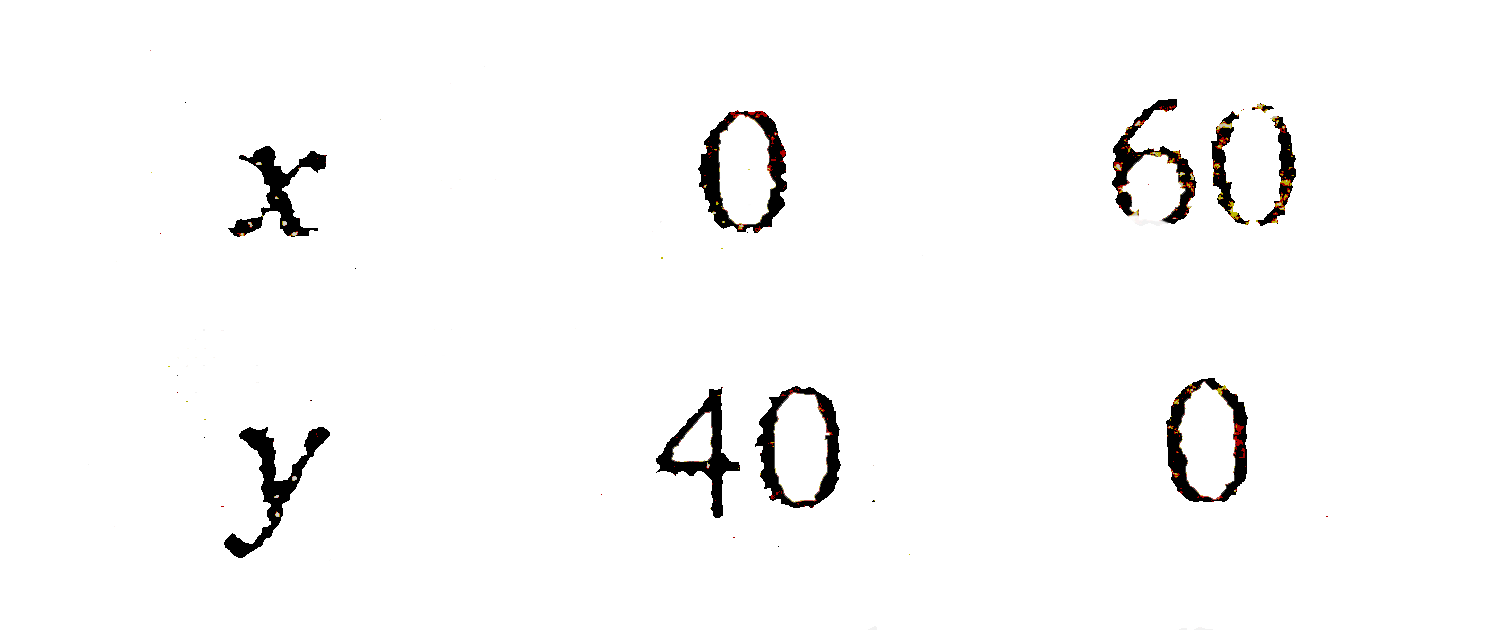 Put `(0,0)` in the INEQUATION `2x+3yle120` `2xx0+3xx0le120` `implies 0le120` (True) Therefore, half plane contains the origin, Now draw the graph of the line `2x+y=80` 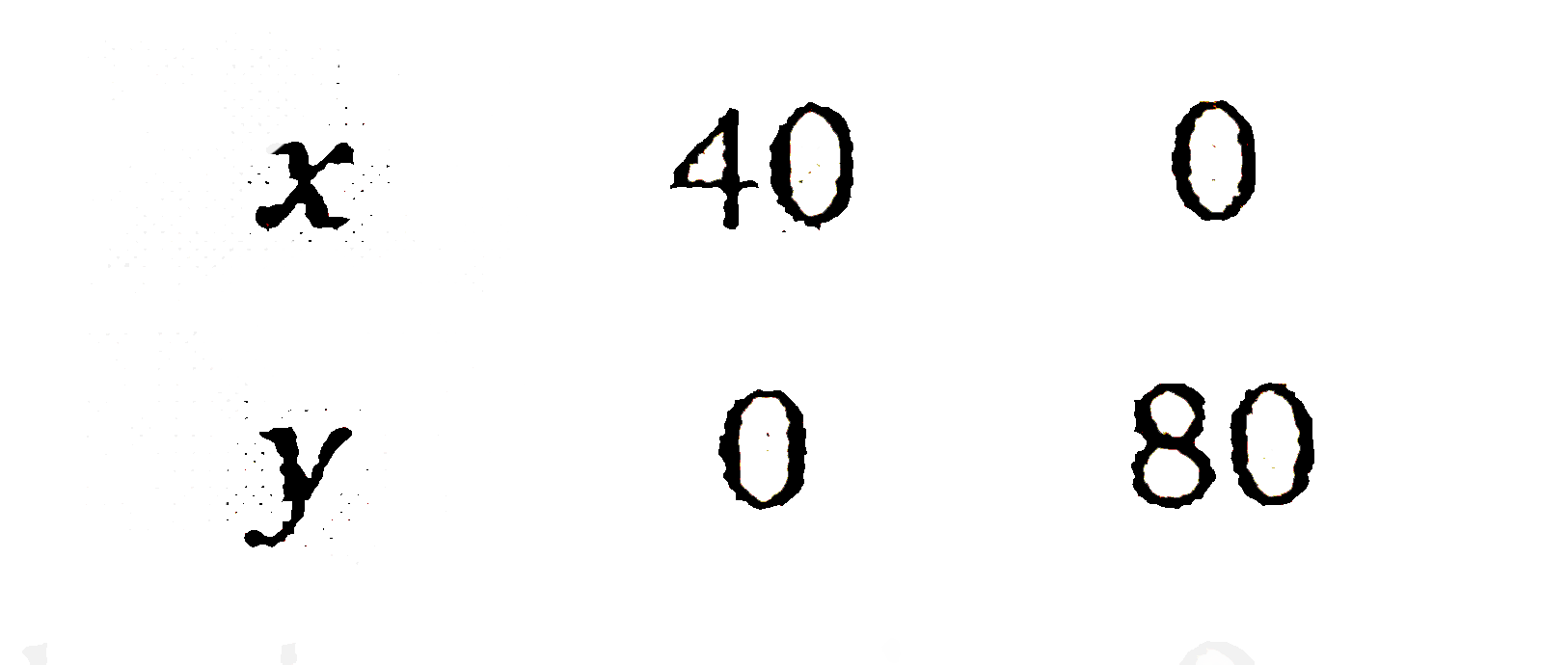 Put `(0,0)` in the inequation `2x+yle80` `2xx0+0le80implies0le80` (True) Therefore half plane contains the origin.Since, `x,yge0`. So the feasible region will be in first quadrant. From EQUATIONS `2x+3y=120` and `2x+y=80` the point of intersection is `B(30,20)`. `:.` Feasible region is OABCE. The vertices of the feasible region are `O(0,0), A(40,0),B(30,20)` and `C(0,40)` we find the value of `Z` at these points.  Therefore, the maximum value of `Z` is RS. 410 at point `B(30,20)`. Therefore, the maximum profit of Rs. 410 will be obtained when the factory produces 30 packets of screw A and 20 packets of screw B per day. |
|
| 46. |
If the square of the length of the tangents from a point P to the circles x^(2)+y^(2)=a^(2), x^(2)+y^(2)=b^(2), x^(2)+y^(2)=c^(2) are in A.P. then a^(2),b^(2),c^(2) are in |
|
Answer» A.P. |
|
| 47. |
Represent graphically : (i) A displacement of 50 km., 30^(@) West of Sout. (ii) A displacement of 70 km., 40^(@) West of North. (iii) A displacement of 50 km., 45^(@) North of East. |
|
Answer» |
|
| 48. |
Two ships A and B are sailing straight away from the foot of a tower OP along routes such that ul(|AOB) is always 120^(@). At a certain instance, the angles of depression of the ships A and B from the top P of the towers are 60^(@) and 30^(@) respectively. The distance between the ships when the height of the tower is 15m is |
|
Answer» `5 SQRT(39)` m |
|