

Saved Bookmarks
This section includes 7 InterviewSolutions, each offering curated multiple-choice questions to sharpen your Current Affairs knowledge and support exam preparation. Choose a topic below to get started.
| 1. |
intcos^4xdx |
|
Answer» SOLUTION :`intcos^4xdx=INT((1+cos2x)/2)^2dx` =`1/4 int(1+2cos2x+cos^2 2X)DX` =`1/4 int(1+2cos2x+(1+cos4x)/2)dx` =`1/4 int(3/2+2cos2x+1/2cos4x)dx` =3x/8+1/4sin2x+1/32sin4x+C |
|
| 3. |
Three friends A, B and C are playing a dice game. The numbers rolled up by them in their first three chances were noted and given by A= {1, 5}, B = {2, 4, 5} and C = {1, 2, 5} as A reaches the cell 'SKIP YOUR NEXT TURN' in second throw. based on the above information, answer the following questions. P(B|C) = |
| Answer» Answer :A | |
| 4. |
Three friends A, B and C are playing a dice game. The numbers rolled up by them in their first three chances were noted and given by A= {1, 5}, B = {2, 4, 5} and C = {1, 2, 5} as A reaches the cell 'SKIP YOUR NEXT TURN' in second throw. based on the above information, answer the following questions. P(A capB|C) = |
| Answer» Answer :D | |
| 5. |
Three friends A, B and C are playing a dice game. The numbers rolled up by them in their first three chances were noted and given by A= {1, 5}, B = {2, 4, 5} and C = {1, 2, 5} as A reaches the cell 'SKIP YOUR NEXT TURN' in second throw. based on the above information, answer the following questions. P(A|B) = |
|
Answer» `(1)/(6)` |
|
| 6. |
Check monotonocity at following points for (i) f(x) =x^(3) -3x +1 =-1,2 (ii) f(x) +|x -1|+2|x-3|-|x+2| "at " x=-2,0,3,5 (iii) f(x) =x^(1//3) """at""" x=0 (iv) f(x)=x^(2) n +(1)/(x^(2)) """at""" x=1,2 (v) f(x) ={underset( 3 sin x , ""x ge0)(x^(3) +2x^(2) 5xgt 0)," at " x=0 |
|
Answer» (ii) at x=-2 decreasing at x=0 decreasing at x=3 neitherincreasing nor decreasing at x=5 increasing (III) STRICTLY increasing at x=0 (IV) Strictly increasing at x=2 neither 1 nor D at x=1 (v) Strictly increasing at x=0 |
|
| 7. |
int_(0)^(pi//2)(sin^(1000)xdx)/(sin^(1000)x+cos^(1000)x) is equal to |
| Answer» Answer :D | |
| 8. |
Write the function tan^(-1)((sqrt(1+x^(2))-1)/x)x ne 0, in the simplest form. |
|
Answer» |
|
| 10. |
Vertify mean value theorem for the following functions: f(x)= x^(2) + 2x+ 3, x in [4, 6] |
|
Answer» |
|
| 11. |
Three friends A, B and C are playing a dice game. The numbers rolled up by them in their first three chances were noted and given by A= {1, 5}, B = {2, 4, 5} and C = {1, 2, 5} as A reaches the cell 'SKIP YOUR NEXT TURN' in second throw. based on the above information, answer the following questions. P(A|C) = |
|
Answer» `(1)/(4)` |
|
| 12. |
Three friends A, B and C are playing a dice game. The numbers rolled up by them in their first three chances were noted and given by A= {1, 5}, B = {2, 4, 5} and C = {1, 2, 5} as A reaches the cell 'SKIP YOUR NEXT TURN' in second throw. based on the above information, answer the following questions. P(A cup B|C) = |
| Answer» Answer :D | |
| 13. |
{:(" "Lt),(x rarr 0):} (int_(0)^(x) sin^(2)t cost dt)/(x^(3))= |
|
Answer» 1 |
|
| 14. |
Determine whethera** b =ma - nb "on" Q + "where" m "and" n in Noperations as defined by * are binary operations on the sets specified in each case. Give reasons if it is not a binary operation. |
|
Answer» Solution :LET a =1, b=2 `m =1, n=3` ` ma -nb =1-6= -5 !in Q^+` `:. A,b in Q^+ IMPLIES a** b in Q^+` ` implies ** "is not a BINARY operation on" Q^+` |
|
| 15. |
A tangenttotheellipsedistancedistancefromthe centreoftheellipsex^(2) +2y^(2) =6 P andQprovethatthetangent at P andQof theellipsex^(2)+ 2y^(2) =6areat rightangles . |
|
Answer» Solution :GIVEN , `x^(2)+ 4y^(2)=4 or(x^(2))/(4)+(y^(2))/(1)=1` Equation of anytangentto theellipseon(i) can bewritten as `(x)/(2)costheta + y sintheta =1` EQUATIONOF second ellipse is 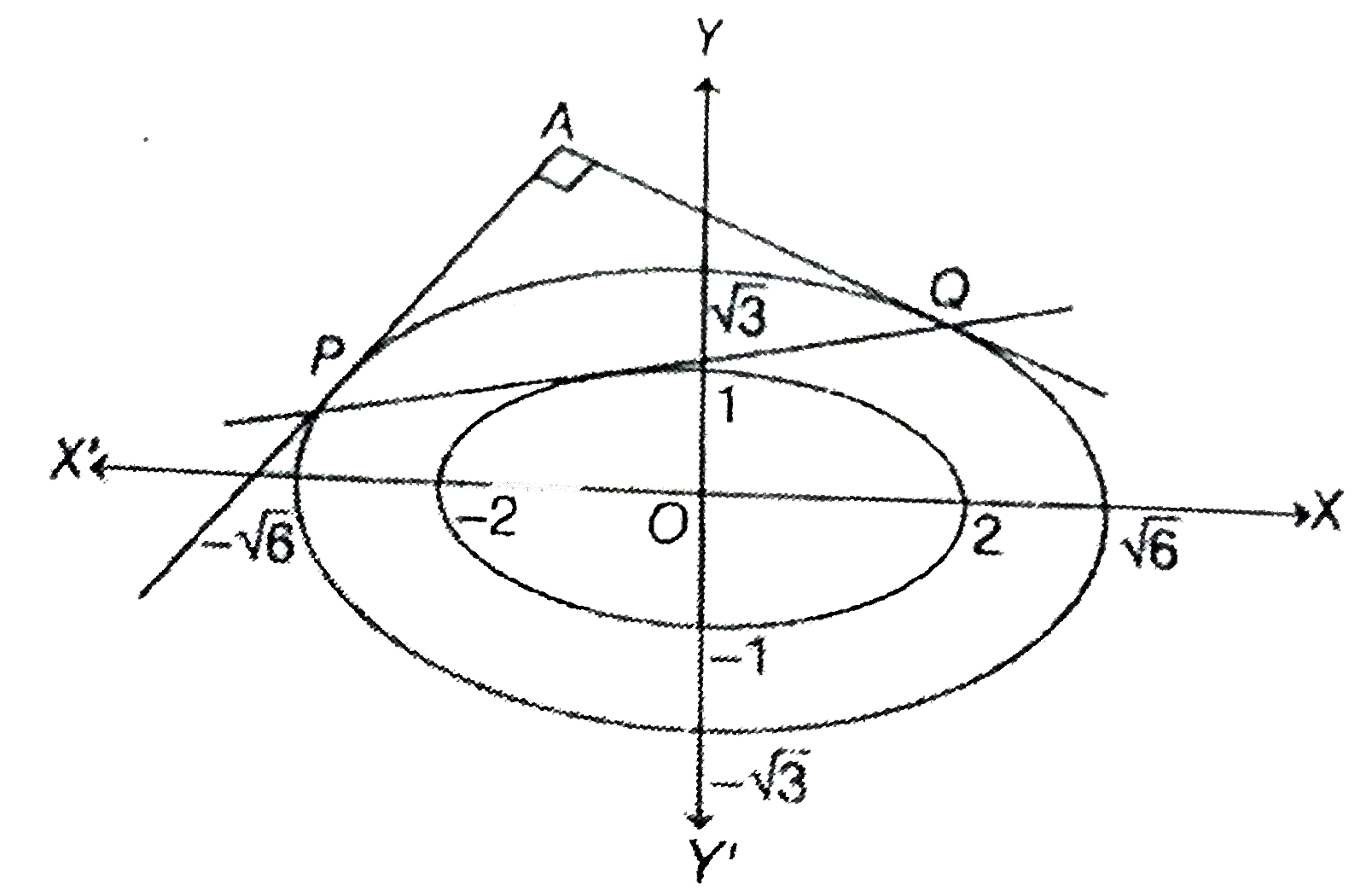 `x^(2)+2y^(2)=6` `implies (x^(2))/(6)+(y^(2))/(3)=1` Supposethe tangent at P andQ meetsat (h,K)Equationof thechordof contactof thetangentsthrough A (h,k) is `(hx)/(6)+(ky)/(3)=1` ButEqs . (iv)and (ii)represent the same STRAIGHTLINE , socomparing Eqs. (iv)adn (ii)we get `(h//6)/( cos theta//2)=(k//3)/( sintheta)=(1)/(1)` `implies h= 3 cos theta andk=3 sintheta` therefore , coordinates of A are( 3 cos,`theta,3 sin theta)` Now , thejointequationof thetangents At A isgivenby `T^(2)=SS_(1)`, `i.e., ((hx)/(6)+(ky)/(3)-1)^(2)=((x^(2))/(6)+(y^(2))/(3)-1)((h^(2))/(6)+(h^(2))/(3)-1)` in Eq. (V)Coefficient of `x^(2)=(h^(2))/(36)-(1)/(6)((h^(2))/(6)+(h^(2))/(3)-1))` `=(h^(2))/(36)-(h^(2))/(36)-(k^(2))/(18)+(1)/(6)=(1)/(6)-(k^(2))/(18)` andcoefficient of `y^(2)=(k^(2))/(9)-(1)/(3)((h^(2))/(6)+(k^(2))/(3)-1)` `=(k^(2))/(9)-(h^(2))/(18)-(k^(2))/(9)+(1)/(3)=-(h^(2))/(18+(1)/(3)` Again , coefficient of `x^(2)+` coefficient of `y^(2)` `=-(1)/(18)(h^(2)+k^(2))+(1)/(6)+(1)/(3)` `=-(1)/(18)( 9 cos ^(2)theta+ 9sin ^(2)theta+(1)/(2)` `=-(9)/(18)+(1)/(2)=0` whichshowsthattwo linesrepresent by Eq. (v)are atrightanglesto eachother. |
|
| 16. |
Number of quadratic equations which are unchanged by squaring their roots is p and the sum of roots of all those quadratic equations is q then |
|
Answer» p = q = 4 |
|
| 17. |
If a, b,c in {1, 2, 3, 4} the number of quadratic equation of the form ax^(2) + bx + c = 0 which have non-real complex roots is : |
|
Answer» 27 |
|
| 19. |
The slope of a chord of the parabola y^(2)=4ax which is normal at one end and which subtends a right angle at the origin is |
| Answer» Answer :B | |
| 20. |
Method of integration by parts : int [sin(logx)+cos(logx)]dx=.... |
|
Answer» `X COS (LOGX)+c` |
|
| 21. |
The transformed equation with integer coefficients and unity for the coefficient of first term, whose roots are multiplied by some constant of those of 3x^(4) - 5x^(3)+ x^(2) - x + 1 = 0 is |
|
Answer» `y^(4) - y^(3) + 3y^(2) - 10y+ 1 = 0` |
|
| 22. |
If hat(i)+2hat(j)+3hat(k)and2hat(i)-hat(j)+4hat(k) are the position vectors of the points A and B, then the position vector of the points of trisection of AB are |
|
Answer» `(4)/(3)hat(i)+hat(J)+(10)/(3)hat(k),(5)/(3)hat(i)+(11)/(3)hat(k)` |
|
| 23. |
Integrate the functions (sin^(-1)x)^(2) |
|
Answer» |
|
| 25. |
The value of ((-1+sqrt(-3))/(2))^(26)+((-1-sqrt(-3))/(2))^(26) is |
| Answer» ANSWER :A | |
| 26. |
Two circles which cut each other orthogonally, pass through the points, (a, 0) and (-a, 0). If both of them touch the line y=mx+c, then c^(2)= |
|
Answer» `a^(2)+m^(2)` |
|
| 27. |
The plane 2x + 3y -2sqrt(3)z + 25 = 0 makes an angle.......with X-axis. |
|
Answer» `sin^(-1) ""(2)/(sqrt(21))` |
|
| 28. |
A: If f (x) = x sin ""((1)/(x)) (x ne 0) and f (0) =0 then f '(0) =0 R: Lt_(x to 0) sin ""((1)/(x)) does not exist |
|
Answer» Both A and R are TRUE R is correct reason of A |
|
| 30. |
The root of the equation : |(a-x,b,c),(0,b-x,0),(0,b,c-x)|=0 are : |
| Answer» ANSWER :D | |
| 31. |
Solve ""^(2n)C_3:""^nC_3=44:5 |
| Answer» Solution :A COMMITTEE of 4 GENTLEMEN and 3 LADIES is to be formed out 7 gentlemen and 6 ladies. `:.` "The NUMBER of ways in which the committee can be formed".""^7C_4xx""^6C_3=(7*6*5)/(3*2)xx(6*5*4)/(3*2)=700` | |
| 32. |
If ""^(n)C_(r) denotes the number of combinations of n things taken r at a time, then the expression ""^(n)C_(r+1)+""^(n)C_(r-1)+2xx""^(n)C_(r), equals |
|
Answer» `""^(n+2)C_(R+1)` |
|
| 33. |
int_(0)^(1)Tan^(-1)((2x)/(1-x^(2)))dx= |
|
Answer» `PI/2 - LN 2` |
|
| 35. |
Evalute the following integrals int (1)/(sqrt(x^(2) + 2 x + 10))dx |
|
Answer» |
|
| 36. |
Solve the following problem graphically: Maximum and minimize Z=10500x+9000y Subject to the constraints x+y le 50 2x+y le 80 x ge 0, y ge 0 |
| Answer» | |
| 37. |
Find the value (s) of r satisfying the equation .^(69)C_(3r-1)-.^(69)C_(r^(2)-1)-.^(69)C_(3r) |
|
Answer» Solution :`.^(69)C_(3R-1)+ .^(69)C_(r^(2)-1)+ .^(69)C_(r^(2))` `implies .^(70)C_(3r)= .^(70)C_(r^(2))` `implies 3r=r^(2) " or" r=0,3` or `3r+r^(2)-70=0` or r=7, -10 Hence, POSSIBLE values of r and 3 and 7 as for these values all the terms in equation are defined. |
|
| 38. |
There are 20 pairs of shoes in a closet. Out of them 4 shoes are selected at random. The probability that there is exactly one pair among the 4 shoes is |
|
Answer» `(.^(20)C_(1)XX.^(38)C_(2))/(.^(20)C_(2))` |
|
| 39. |
Let f : [a,b] to Rbe differentiable on [a,b]& k in R. Let f (a) =0 = f (b). Also let J (x) =f '(x) + kf (x). Then |
|
Answer» `J (x) GT 0` for all `x in [a,b]` |
|
| 40. |
Simplify(3^(n-2)*9^(2-n))/(3^(2-n)) |
|
Answer» Solution :In order to combine exponents USING the PROPERTIES above, the BASE of each factor must be the same `(3^(n-2)*9^(2-n))/(3^(2-n))=(3^(n-2)*(3^(2))^(2-n))/(3^(2-n))=(3^(n-2)*3^(4-2n))/(3^(2-n))` `=3^(n-2+4-2n-(2-n))=3^(0)=1` |
|
| 41. |
Let f:RtoR be a function defined as f(x)={(5,"if", xle1),(a+bx,"if", 1ltxlt3),(b+5x,"if",3lexlt3),(30,"if",xge5):} Then f is : |
| Answer» | |
| 42. |
Find the probability of getting 2 tails and 1 head when 3 coins are tossed. |
|
Answer» |
|
| 43. |
Let I be any interval disjoint from [-1,1]. Prove that the function f given by f(x)=x+(1)/(x) is increasing on I. |
|
Answer» |
|
| 45. |
If a=cisalpha,b=cisbeta,c=cisgamma, and a/b+b/c+c/a-1=0 then cos(alpha-beta)+cos(beta-gamma)+cos(gamma-alpha)= |
|
Answer» 0 |
|
| 46. |
Solve the equation z^6=-i |
|
Answer» Solution :`Z^6=-i=COS(3pi)/2+ISIN(3pi)/2` `=cos((3pi)/2+2kpi)+isin((3pi)/2+2kpi)` `cos(PI(4k+3))/2+isin(pi(4k+3))/2` `z=[(cos(4k+3)pi)/2=isin((4k+3)pi)/2]^(1/6)` `cos((4k+3)pi)/(12)=isin((4k+3)pi)/(12)` `"where "k=0,2,3,4,5` |
|
| 47. |
Consider the random experiment of tossing dice. If number obtained on it is multiple of 3 then toss dice again, and if any other number is obtained toss a coin. Find probability of an event that coin shows tail given that at least once number 2 comes up. |
|
Answer» |
|
| 48. |
If 2^(3)+4^(3)+6^(3)+….+(2n)^(3)=h n^(2)(n+1)^(2) then h is equal to |
| Answer» Answer :D | |
| 49. |
Consider f(x)=(cos^(-1)(cos(sinx))-|x-pi|)/(sin^(3)x), then |
|
Answer» `underset(xto0)Limf(X)` =does not exist Let `x-pi=t=underset(t TO0^(-1))Lim(-sint+t)/(-sin^(3)t)=(-1)/(6)` R.H.L. `atx=pi` `underset(x to pi^(+))Lim(-sinx-(x-pi))/(sin^(3)x)""(becausesingt0asxto pi^(+))` Let `x-pi=t` `underset(t to0)Lim(sint-t)/(sin^(3)t)=(1)/(6)`. |
|
| 50. |
If each pair of three equations x^(2)-p_(1)x+2=0", "x^(2)-p_(2)x+3=0, and x^(2)-p_(3)x+6=0 have a common root, then positive values of p_(1),p_(2),p_(3) are, respectively : |
|
Answer» 3,4,5 |
|