

Saved Bookmarks
This section includes 7 InterviewSolutions, each offering curated multiple-choice questions to sharpen your Current Affairs knowledge and support exam preparation. Choose a topic below to get started.
| 1. |
Which of the following is not correct combination |
| Answer» Answer :D | |
| 2. |
Findquotientand theremainderwhen2x^5 -3x^4 +5x^3 -3x^2 +7x-9is divided by x^2 -x--3 |
|
Answer» `33x +4` |
|
| 3. |
An experiment succeeds twice as often as it fails. Find the probability that in the next six trials, there will be atleast 4 successes. |
|
Answer» |
|
| 4. |
Consider alpha gt 1 and f:[1/alpha,alpha] rarr [1/alpha,alpha] be bijective function. Suppose that f^(-1)(x)=1/f(x), " for all " in [1/alpha,alpha]. Which of the following statements can be concluded about (f(x))? |
|
Answer» F(X) is discontinuous in `[1/alpha, alpha]` |
|
| 5. |
Let f:R rarrR be definedas f(x) = x^4 Choose the correct answer |
|
Answer» f is one-one onto f(-1) = `(-1)^4` = 1 f(1) = f(-1) = 1 `therefore` f is not one-one The co-domain of f is R. the range of I is `[0, infty)`. Since range of f `NE` co-domain of f, f is not onto Hence f is neither one-one nor onto. |
|
| 6. |
Consider alpha gt 1 and f:[1/alpha,alpha] rarr [1/alpha,alpha] be bijective function. Suppose that f^(-1)(x)=1/f(x), " for all " in [1/alpha,alpha]. Which of the following statements can be concluded about f(f(x))? |
|
Answer» F(f(X)) is DISCONTINUOUS in `[1/ALPHA, alpha]` |
|
| 7. |
Consider alpha gt 1 and f:[1/alpha,alpha] rarr [1/alpha,alpha] be bijective function. Suppose that f^(-1)(x)=1/f(x), " for all " in [1/alpha,alpha]. Then f(1) is equal to |
|
Answer» 1 |
|
| 8. |
Find the area of the region lying in the first quadrant and bounded by y = 4x^(2), x = 0, y = 1 and y = 4. |
|
Answer» |
|
| 9. |
Iron filing and water were placed in a 5 litre tank and sealed.The tank was heated to 1237 k. Upon anaiysis the tank was found to contain1.10gram of hydropen and 42.5 gm of water vapour. If the reaction in the tank is represented by 3Fe(s) + 4H_(2)O(g) hArr Fe_(3)O(g) + 4H_(2)(g) the equilibrium constant will be - |
|
Answer» `2.949 XX 10^(3)` |
|
| 11. |
int_(0)^(1) cot^(-1) (1-x+x^(2))dx= |
|
Answer» `PI - LN 2` |
|
| 12. |
A=[{:(4,3),(2,5):}],A^(2)-xA+yI=0.Find real numbers x and y. where I is a 2xx2 identity matrix. |
|
Answer» |
|
| 14. |
If (-2, 7) is the highest point on the graph of y =-2x ^(2) -4ax+k, then k equals : |
|
Answer» 31 |
|
| 15. |
If the line joining the incentreto the centroid of a triangle ABC is parallel to the side BC. Which of the following are correct ? |
|
Answer» `2b=a+C` |
|
| 16. |
Which of the following functions is NOT one-one ?1. f:R to R defined by f(x)=6x-12. f: R to R defined by f(x)=x^(2)+73. f: R to R defined by f(x)=x^(3)4. f: R-{7}toR defined by f(x)=(2x+1)/(x-7) |
|
Answer» `f:R to R` defined by `f(x)=6x-1` |
|
| 17. |
Write down and simplify 10^("th")" term in "((3p)/(4)-5q)^(14) |
|
Answer» |
|
| 18. |
The points of intersection of the line r = 2a + t (b - c) with the plane r = a + p (b + c) + q (a + 2b - c) is |
|
Answer» 4A + 3B - 3c |
|
| 19. |
Which of the following pair of functions have the same graph ? |
|
Answer» `f(x) ln [1+{x}]` and `g(x) = ln(1+[{x}])`, |
|
| 20. |
Integrating factor of (x+2y^(3))(dy)/(dx)=y^(2) is |
|
Answer» `E^((1)/(y))` |
|
| 21. |
Assertion (A) : The area of the functiony=sin^(2)x from 0 to pi will be more than that of curve y=sinx from 0 to pi. Reason (R ) : t^(2) lt t, if 0 lt t lt 1 |
|
Answer» Both A and R are individually true and R is the correct EXPLANATION of A |
|
| 23. |
Evaluate. I = int _(0) ^(1) 2 sin (pt) sin (qt) dt. If : p & q are equal and either is root of the equation tan x = x. |
|
Answer» |
|
| 24. |
Evaluate the following : (i) int(x+2)/((x+3)(x+4)^((3)/(2))dx (ii) int((x+3)/(2x+5))^((1)/(2))*(1)/(x)dx |
|
Answer» Solution :`(i)` LET us substitute `x+4=t^(2)` so that `dx=2tdt` and `x+2=t^(2)-2`, `x+3=t^(3)-1`. THUS `int((x+2))/((x+3)(x+4)^(3//2))dx=int((t^(2)-2))/((t^(2)-2).t^(3))*2tdt=int(2(t^(2)-1-1))/((t^(2)-1)t^(2))DT` `=int(2)/(t^(2))dt-2int(1)/((t^(2)-1)t^(2))dt=2int(1)/(t^(2))dt+int(2)/(t^(2))dt-2int(1)/(t^(2)-1)dt` `=4intt^(-2)dt+int(1)/(t+1)dt-int(1)/(t-1)dt` `=4*(t^(-1))/(-1)+ln|(t+1)/(t-1)|+C` `=-(4)/(sqrt(x+4))+ln|(sqrt(x+4)+1)/(sqrt(x+4)-1)|+C`, `C` is a constant of INTEGRATION `(II)` Let us substitute `(x+3)/(2x+5)=t^(2)` so that `x=(5t^(2)-3)/(1-2t^(2))` and `dx=(-2t)/((1-2t^(2))^(2))dt` Thus, `int((x+3)/(2x+5))^((1)/(2))*(1)/(x)dx=intt(-(1-2t^(2))/(5t^(2)-3))((-2t)/((1-2t^(2))^(2)))dt` `=int(-2t^(2))/((5t^(2)-3)(1-2t^(2)))dt` `=int(2t^(2))/((2t^(2)-1)(5t^(2)-3))dt` `=6int(1)/(5t^(2)-3)dt-2int(1)/(2t^(2)-1)dt` `=(3)/(sqrt(3).sqrt(5))ln|(sqrt(5t)-sqrt(3))/(sqrt(5t)+sqrt(3))|-(2)/(2.(1)/(sqrt(2)))ln|(sqrt(2t)-1)/(sqrt(2t)+1)|+C` `=sqrt((3)/(5))ln|(sqrt(5)sqrt(x+3)-sqrt(2(2x+5)))/(sqrt(5(x+3))+sqrt(3(2x+5)))|-sqrt(2)ln((sqrt(2(x+3))-sqrt(2x+5))/(sqrt(2(x+3))+sqrt(2x+5)))+C` |
|
| 25. |
The value of the integral int(cos7x-cos8x)/(1+2cos5x)dx can be |
|
Answer» `(SIN2X)/(2)-(sin3x)/(3)+c` |
|
| 26. |
Let z_(1) and z_(2) be two non-zero complex numbers such that (z_(1))/(z_(2)) + (z_(2))/(z_(1)) = 1 , then the origin and points represented by z_(1) and z_(2) |
|
Answer» LIE on a STRAIGHT line |
|
| 27. |
Let : P_(1):3y+z+1=0 and P_(2):2x-y+3z-7=0 and the equation of line AB is (x-1)/(2)=(y-3)/(-1)=(z-4)/(3) in 3D space. Shortest distance between the line of intersection of planes P_(1) and P_(2) and the line AB is equal to |
|
Answer» `(7)/(sqrt(10))" UNITS"` |
|
| 28. |
Determine whether a**b ="LCM" {a,b} "on" Noperations as defined by * are binary operations on the sets specified in each case. Give reasons if it is not a binary operation. |
|
Answer» SOLUTION :for all `a,B in N , LCM{a,b } in N` `IMPLIES a**b in N` ` implies **` is a bimary operation on N. |
|
| 29. |
Let f(x) = [{:((pi/2.sin^(-1)(1-x^(2))sin^(-1(1-{x})))/(sqrt(2((x)-(x)^(3)))), "for " x ne 0),(""pi/2, x=0):} where {x} is the fractional part of x. Consider another function g(x), such that g(x) = {{:(f(x), for, x ge 0),(2sqrt(2)f(x), for , x lt 0):} Discuss the continuity of the function f(x) & g(x) at x=0. |
|
Answer» |
|
| 30. |
If a, b, c in Rand the equations ax^(2) + bx + c = 0 and x^(3) + 3x + 2 = 0 have two common roots, then |
| Answer» Answer :C | |
| 31. |
x=(1)/(3)+(1)/(3.3^(3))+(1)/(5.3^(5))+….. y=(1)/(5)+(1)/(3.5^(3))+(1)/(5.5^(5))+…. z=1+(1)/(3.2^(2))+(1)/(5.2^(4))+(1)/(7.2^(6))+….. Then descending order of x, y, z |
|
Answer» Z, y, X |
|
| 32. |
Derive the equation of a plane perpendicular to a given vector and passing through a given point in both vector form and Cartesian form. |
|
Answer» |
|
| 33. |
Integration using rigonometric identities : int (sin x cos x)/(sqrt(3+5 sin ^(2)x))dx=...+c |
|
Answer» `(1)/(5) sqrt(3+5 SIN^(2)X)` |
|
| 34. |
If int(e^(4x)-1)/(e^(2)x)log((e^(2x)+1)/(e^(2x)-1))dx (t^(2))/(2)logt-(t^(2))/(4)+(u^(2))/(4)+C them |
|
Answer» `t=E^(-X)-e^(x)u=e^(x)+e^(-x)` |
|
| 35. |
{:("Quantity A","Quantity B"),(abc,c-d):} |
|
Answer» QUANTITY A is greater. |
|
| 36. |
If I is the incentre of a triangle whose is radius and circumradius are r and R respepectively : I_1,I_2,I_3 is its ex-centre triangle, then I I_1. I I_2. I I_3 is equal to |
|
Answer» `R^2r` |
|
| 37. |
If plane 2x+3y+6z+k=0 is tangent to the sphere x^(2)+y^(2)+z^(2)+2x-2y+2z-6=0, then a value of k is |
|
Answer» 26 Distance of `(-1,1,-1)` from the plane is `|(-2+3-6+k)/SQRT(4+9+36)|`. Since, the plane is TANGENT to the plane. `therefore |(k-5)/7|=3`. `therefore k=-16,26` |
|
| 38. |
Sum to n terms of the series (1)/(1 cdot 2 cdot 3 cdot 4)+(1)/(2 cdot 3 cdot 4 cdot 5)+(1)/(3 cdot 4 cdot 5 cdot 6)+… is |
|
Answer» `(1)/(24)-(1)/(n)` |
|
| 39. |
If y^(2)= p(x) the is polynomial of order 3, then 2(d)/(dx) [y^(3) (d^(2)y)/(dx^(2))]=………. |
|
Answer» <P>`p'''(X) + p'(x)` |
|
| 40. |
Assertion(A): x^(2)+x+1 gt 0 for all positive real values of x only. Reason (R) :When b^(2)-4ac lt 0, a , ax^(2)+bx+x have same sign for all real values of x. |
|
Answer» Both A, R are TRUE and R explain Assertion |
|
| 41. |
Minimise Z = 6x + 3y, subject to the constraints 4x + y ge 80, x + 5y ge 115, 3x + 2y le 150, x ge 0, y ge 0. |
|
Answer» |
|
| 42. |
If ……….., then f(x)=x^(2)-kx+20, [0,3] is strictly increasing. |
|
Answer» `k lt 0` |
|
| 43. |
PQ is a double ordinate of the parabola y^(2)+4x . The locus of its point of trisection is |
|
Answer» `9y^(2)=4AX` |
|
| 44. |
The periodof the functionf(x)= | sin2x| + | cos8x |is |
| Answer» ANSWER :D | |
| 45. |
For x ne 1, f is defined by f(x)=1/(log x) - 1/(x-1) The value of f(1), so that f is a continous function is |
|
Answer» 1 |
|
| 46. |
Show that the tangent to the ellipse x^2/a^2+y^2/b^2=1 at points whose eccentric angles differ by pi/2 intersect on the ellipse x^2/a^2+y^2/b^2=2 |
|
Answer» |
|
| 47. |
A tangential force 'F' is applied at the topmost point of a spherical shell of mass 'm' kept on a rough horizontal surface. If it rolls without slipping, it's acceleration is (6F)/(xm)" then "'x' |
|
Answer» SOLUTION :`F+f=ma` `FR="f"R=Ia//R` `:.F=(5)/(6)"ma"` `:.a=(6F)/(5M)` 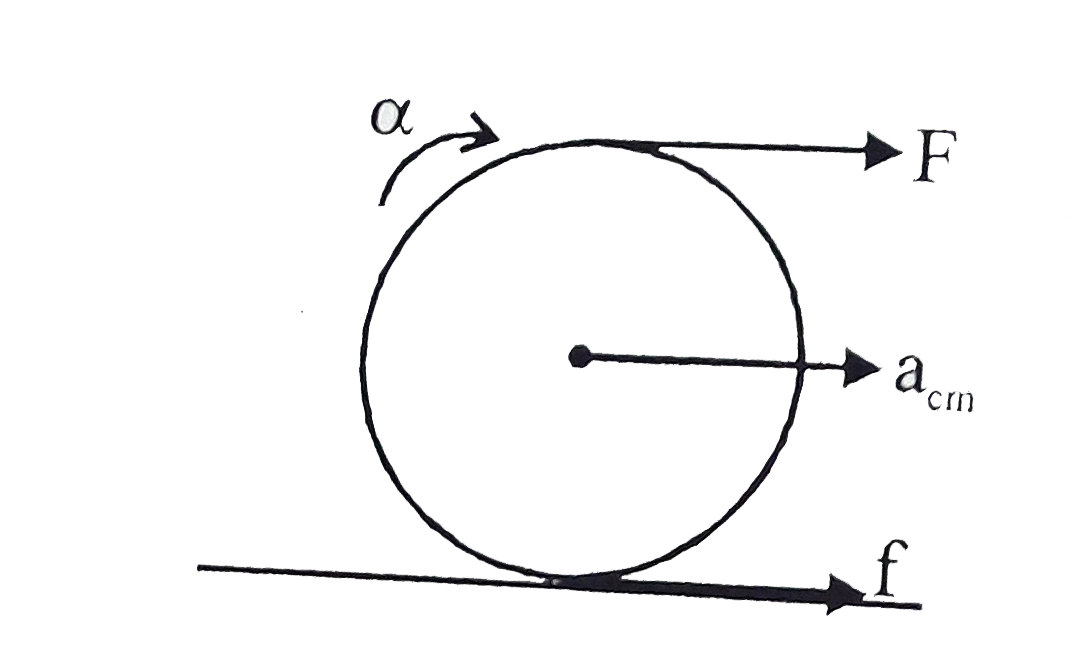
|
|
| 49. |
If A is 2xx2 matrix such that A[{:(" "1),(-1):}]=[{:(-1),(2):}]and A^2[{:(" "1),(-1):}]=[{:(1),(0):}], then trace of A is (wherethe trace of the matrix is the sum of all principal diagonal elements of the matrix ) |
|
Answer» 1 |
|