

Saved Bookmarks
This section includes 7 InterviewSolutions, each offering curated multiple-choice questions to sharpen your Current Affairs knowledge and support exam preparation. Choose a topic below to get started.
| 1. |
A particle is released from rest from a tower of height 3h. The ratio of times to fall equal heights 'h' i.e. t_(1):t_(2):t_(3)" is "(sqrt(3)=1.7&sqrt(2)=1.4) |
|
Answer» `SQRT(3):sqrt(2):1` |
|
| 2. |
1 kilowatt hour is equivalent to |
| Answer» Answer :D | |
| 3. |
Three identical spheres each of radius 3cm are placed on a horizontal surface touching one another. The distance of centre of mass of system from any centre of the sphere is |
|
Answer» 1/3 m |
|
| 4. |
A load of 100 N acts on a bar of length 10 cm and area of cross section 1 cm. Find the energy stored in it. (Y= 10^(11) N//m^(2)) |
|
Answer» |
|
| 5. |
For a gas elastic limit |
|
Answer» Exists |
|
| 6. |
A body is projected at angle 30^(0) to horizontal on a planet with a velocity of 80 ms^(-1) its time of flight is 4 seconds then acceleration due to gravity on that planet is |
|
Answer» `2 ms^(-2)` |
|
| 7. |
Two blocks are connected by a string as shown in figure. They are released from rest. Show that after they moved a distance L, their common speed in given by sqrt((2(m_(2)-mum_(1))gl)/((m_(1)+m_(2)))) where mu is the coefficient of friction |
|
Answer» SOLUTION :In moving a distance L by `m_(1) and m_(2)` the PE will be lost by `m_(2)` only and will be `m_(2)gl`, while work done by friction will be only on `m_(1)` and will be `MU m_(1)gL`. Now as the string is inextensible `v_(1) = v_(2) = v ` and so, the gain in KE wil be = `(1//2) (m_(1) + m_(2)) v^(2)`. By conservation of energy. Loss in PE = Grain in KE + WD against friction i.e., `m_(2)gL =(1)/(2)(m_(1)+m_(2))v^(2)+mu m_(1)gL` `v=sqrt((2(m_(2)-mum_(1))gL)/((m_(1)+m_(2))))` |
|
| 8. |
A liquid in a thermos flask is vigorouslyshaken. Then the temperature of the liquid |
|
Answer» Is not ALTERED |
|
| 9. |
A body of mass M is kept on a rough horizontal surface (friction coefficient = mu). A person is trying to pull the body by applying a horizontal force but the body is not moving. The force by the surface on A is F where |
|
Answer» F = Mg |
|
| 10. |
An object 1cm tall is placed 4cm infront of a mirror. In order to produce an upright image of 3cm height one needs a |
|
Answer» CONVEX MIRROR of radius of CURVATURE 12cm |
|
| 11. |
A uniform square plate has a small piece Q of an irregular shape removed and guled to the centre of the plate leaving a hole behind in figure. The moment of inertia about the z-axis is then, . |
|
Answer» increased |
|
| 12. |
An ideal gas is initially at temperature T and volume V. Its volume is increased by Delta V due to an increase in temperature Delta T. Pressure remaining constant. The physical quantity delta = ( Delta V)/( V Delta T) varies with temperature as : |
|
Answer»
|
|
| 13. |
A car of mas 1250 kg experiences a resistance of 750 n when it moves at 30ms^(-1). If the engine can develop 30 KW at this speed, the maximum acceleration that the engine can produce is |
|
Answer» `0.8ms^(-2)` |
|
| 14. |
One mole of helium is kept in a cylinder of area 8.5 cm^2 . Cylinder is closed by a light frictionlesspiston. If a heat of 42 J given to gas causes a rise of temperature through 2^@C , then |
|
Answer» `DELTA U =30J` |
|
| 15. |
If a street light of mass M is suspended from the end of a uniform rod of length L in different possible patterns as shown in figure, then: |
|
Answer» PATTERN A is more sturyd |
|
| 16. |
A book with printing error contains four different formulae for displacement. Choose the correct formula/formulae (a) y = a sin (2pi)/(T)t (b) y = a sin vt (c) y = a/T sin (t/a) (d) y =a/T (sin (2pi)/(T) t + cos (2pi)/(T) t) |
|
Answer» SOLUTION :The argument of sine and cosine function must be dimensionaless so (a) is the PROBABLE correct FORMULA. Since (a) y = a sin `((2pi)/(T)t), :. [(2pit)/(T)] = [T^(0)]` is dimensionless. (b) y = a sin vt, `:. [vt] = [T]` is dimensional so this equation is INCORRECT. (c) y = `a/t sin (t/a), :. [t/a]` is dimensional so this is incorrect. (b) y = `a/t (sin ""(2pi)/(T) t + cos""(2pit)/(T))` , Though `(2pit)/(T)` dimensionless `a/T` does not have dimension of displacement so this is also incorrect. |
|
| 17. |
If L_1 = 2.02 m pm 0.01 m , L_2 = 1.02 m pm 0.01 m ,determine L_1 + 2L_2 |
|
Answer» Solution :`L_(1) + 2L_(2) = L_(1) + L_(2) + L_(2)` `= (2.02 MPM 0.1) + (1.02 m pm 0.01m) + (1.02 m pm 0.01 m) ` |
|
| 18. |
100g of water is supercooled to -10°C. At this point, due to some disturbance mechanized or otherwise some of it suddenly freezes to ice. What will be the temperature of the resultant mixture and how much mass would freeze? [S_(W) = 1 "cal"/g/""^(@) C and L_("Fusion")^("W") = 80 "cal/g"] |
|
Answer» `0^(@) , 12.5g` |
|
| 19. |
The relation between pressure and temperature of a monoatomic gas in an adiabatic process is P prop T^(-C), where C = ____ |
|
Answer» `2/5` `P.T^(gamma/(1-gamma))` =constant `therefore P prop T^((1-gamma)/gamma)`, comparing it with `P prop T^(-C)` `therefore -C=(1-gamma)/gamma` `therefore C=(gamma-1)/gamma` For MONOATOMIC gas `gamma=5/3` `therefore C=(5/3-1)/(5/3)=(2/3)/(5/3)` `therefore C=2/5` |
|
| 20. |
A satellite S is moving in an elliptical orbit around the earth. The mass of the satellite is very small compared to the mass of the earth |
|
Answer» the acceleration of S is always directed towards the centre of the earth |
|
| 21. |
How can you move the body up the smooth plane without acceleration? |
|
Answer» SOLUTION :By APPLYING an EXTERNAL force `F=mg SINTHETA`, up the plane after giving an initial VELOCITY up the plane. |
|
| 22. |
Why are gas thermometers more sensitive than mercury thermometers? |
| Answer» SOLUTION :The COEFFICIENT of expansion of GAS is very LARGE compared to that of MERCURY. | |
| 23. |
A small body of mass m can slide without friction along a through bent which is in the form of a semi-circular arc of radius R. At what height h will the body be at rest with respect to the trough,if the trough rotates with uniform angular velocity omega about a vertical axis: |
|
Answer» R |
|
| 24. |
A body constrained to move along the z-axis of a coordinate system is subject to a constant force F given by. What is the work done by this force in moving the body a distance of 4m along the z-axis ? |
| Answer» ANSWER :A | |
| 25. |
The bob of vibrating simple pendulum is made of ice. How will the period of swing will change when the ice starts melting ? |
|
Answer» Solution :(i) The period of swing of simple pendulum will remains unchanged till the location on the centre of gravity of the bob left after melting the ICE remains at a fixed distance from the point of suspension. (II) If the centre of gravity pf ice bob after melting is raised upwards , then the effective length of pendulum decrease and hence the time period of SAWING decrease. If the centre of gravity of ice shifts on lower side, the time period of swing INCREASE. |
|
| 26. |
What is meant by a closed pipe system ? |
| Answer» Solution :A pipewhich is clsed at ONE END is KNOWN as a CLOSED PIPE system. | |
| 27. |
Regarding linear momentum of a body (a) It is a measure of quantity of motion contained by the body (b) Change in momentum is the measure of impulse (c) Impulse and acceleration act in opposite direction to the change in momentum (d) In the case of uniform circular motion the linear momentum is conserved. |
|
Answer» a & B are TRUE |
|
| 28. |
Answer the following questions based on the P - T phase diagram of CO_(2) : (a) CO_(2) at 1 atm pressure and temperature -60^(@)C is compressed isothermally. Does it go through a liquid phase ? (b) What happens when CO_(2) at 4 atm pressure is cooled from room temperature at constant pressure ? (c) Describe qualitatively the changes in a given mass of solid CO_(2) at 10 atm pressure and temperature -65^(@)C as it is heated up to room temperature at constant pressure. (d) CO_(2)is heated to a temperature 70^(@)C and compressed isothermally. What changes in its properties do you expect to observe ? |
|
Answer» Solution :(a) No, `CO_(2)` is in steam from at 1 atm pressure and `-60^(@)C` TEMPERATURE. It its isothermal compression is done i.e. increasing pressure with constant temperature then it DIRECTLY converts into solid form without coming through liquid. (SUBLIMATION) (b) `CO_(2)` is in gaseous state at 4 atm pressure and `27^(@)C` temperature. If it is clled at constant pressure then it directly converts into gaseous state without coming through liquid. It intersects at curve III. (c) `CO_(2)` is in solid form at 10 atm pressure and `-60^(@)C` temp. If it is heated at constant pressure then first it comes in liquid form and then in gaseous form because it intersects the fusion and vaporization curve. (d) It is seen from phase diagram of `CO_(2)` that the above `70^(@)C` temperature it doesn.t have liquid area. Then ALSO it reacts as an ideal gas with increase in pressure. |
|
| 29. |
In Column-I, 4 situations are depicted and in columa-II, 4 possible kinds of collision are listed. Match the situation with type of collision. |
|
Answer» |
|
| 30. |
A flask is filled with 13 g of an ideal gas at 27^(@)C and its temperature is raised to 52^(@)C. Find the mass of the gas that has to be released to maintain the temperature of the gas in the flask at 52^(@)C and the pressure is same as the initial pressure. |
|
Answer» SOLUTION :Let n be the initial number of moles and n. be the final number of moles. Since PRESSURE and volume REMAIN the same, we have `PV=nRT=nRxx300=n.Rxx325` `(n.)/(n)=(300)/(325)=(12)/(13)` `("Final mass")/("Initial mass")=(12)/(13)RARR" Final mass"=(12)/(13)xx13=12g` `"Mass to be released "=13-12=1g` |
|
| 31. |
What do you mean by mass element dm? |
| Answer» SOLUTION :Mass element (dm) is a small PORTION of BODY which when integrated over the whole body GIVES TOTAL mass of the body. | |
| 32. |
Consider a mixture of oxygen and hydrogen kept at room temperature. As compared to a hydrogen molecule an oxygen molecule hits the wall. |
|
Answer» with GREATER AVERAGE speed |
|
| 33. |
An uniform block of mass M, height h and base width a is kept on a rough inclined plane as shown in figure. Friction is enough to prevent any slipping between inclined plane and block. The angle of inclined plane is then increased. The limiting value of theta so that the block not tip over tan^(-1)("xa/h") where 'x' is |
|
Answer» |
|
| 34. |
Using free body diagram show that it is easy to pull an object than to push it |
|
Answer» <P> Solution :Whena bodyis pushedat anarbitraryangle `theta` thatvariesfrom `(p " to"(pi )/(2))` . TheappliedforceF canberesolvedintotwocomponentsas Fsin `theta` parallelto the surfaceand F cos `theta` prependicularto the SURFACE. Thetotaldownwardforceactingon thebodymg +F cos `theta` . Itis impliedthat thenormalforceactingon thebodyincrease. sincethereis noaccelerationalongthe verticaldirectionthe normalforce N is given byAs a resultthe maximalstaticfrictionalsoincreasesand thatis EQUAL to `f_(s) ^(MAX)= mu_(s)N_(push)` `-mu_(s ) (mg + F cos theta)` Equationshows thata greaterforceneedstobe appliedto pushthe objectintomotion 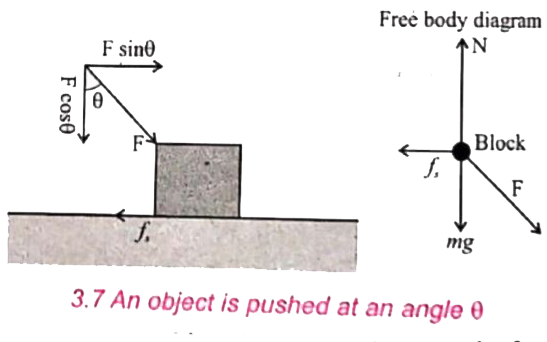 Whenan OBJECTIS pulledat anangle `theta` the aplliedforceisresolvedinto twocomponents. The totaldownwardforceacting on theobject is 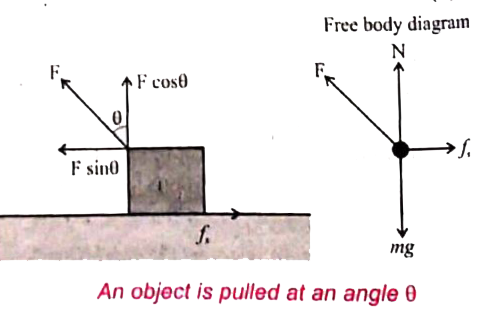 Equation (3)showsthat thenormal forceis less that `N_(push)`Fromequation `(1) ` and (3)weknowthat itis easier to pullan objectthattopushto makeit move. |
|
| 35. |
For a particle executing S.H.M along x-axis force is given by |
| Answer» Answer :A | |
| 36. |
What will be the speed of infrasonics and ultrasonics in air at 0^(@)C ? |
| Answer» Solution :The SPEED of audible sound (20 HZ to 2000Hz) in air at `0^(@)C` is roughly `332ms^(-1)` . Irrespective of the frequencies, whether infrasonics, ultrasnics or audible , sound propagates with the same speed in a given medium. | |
| 37. |
A particle is acted by a force F= kx, where 'K' is a positive constant. Its P.E at x=0 is zero. Which curve corretly represents the variation of potential energy of the block with respect to 'x' |
|
Answer»
|
|
| 38. |
Draw the P-T and V-T diagrams for an isobaric process of expansion, corresponding to n moles of an ideal gas at a pressure P_(0),from V_(0) to 2V_(0). |
|
Answer» SOLUTION :For the graph of P versus T the variation is a straight line normal to the PRESSURE axis, the temperature varying from `T_(1)`to `T_(2)`as shown figure. From the gas equation PV = nRT  we have, `V = ((NR)/(P_(0)))T or V prop T` At `V=V_(0) , T_(1) =(P_(0)V_(0))/(nR) and " at " V=2V_(0), T_(2) =(2P_(0) V_(0))/(nR)`  From the graph of V versus T, the equation `V=((nR)/(P_(0)))T or V = kT` shows that the volume variesdirectly, as the temperature (Charles. law). So, the graph is a straight line inclined to the (V-T) axis, and passing through the ORIGIN (when produced) as shown in figure. |
|
| 39. |
The gravitational force between a hollow spherical shell (of radius R and uniform density) and a point mass is E. Show the nature of F versus r graph where r is the distance of the point from the centre of the hollow spherical shell of uniform density. |
Answer» Solution :`IMPLIES` Take density of the shell `(RHO)`is constant.  Mass of the shell = (density) `xx`(volume) `(rho) xx 4/3 piR^(3) = M` As the density of the shell is uniform, it can be treated as a point mass placed at its centre. Now, gravitational force between `M and M_D` `F = (GMm)/R^(r ge R)` `F = 0 (r lt R)` The RELATION of F versus r is SHOWN in the diagram. 
|
|
| 40. |
The distance travelled by a body is 107.25m in time 1.5s. The velocity with correct significant figures is |
|
Answer» 71.5 |
|
| 41. |
A container of negligible heat capacity contains 1kg of water. It is connected by a steel rod of length 10m and area of cross-section 10cm^(2) to a large steam chamber which is maintained at 100^(@)C. If initial temperature of water is 0^(@)C, find the time after which it beomes 50^(@)C. (Neglect heat capacity of steel rod and assume no loss of heat to surroundings) (use table 3.1, take specific heat of water =4180 J//kg.^(@)C) |
|
Answer» Solution :Let temperature of water at TIME t be `T`, then thermal current at time t, `I = ((100 -T)/(R ))` This increases the temperature of water form `T to T +dT` `rArr i = (DH)/(dt) = ms (dT)/(dt)` `rArr (100-T)/(R ) = ms(dT)/(dt) rArr overset(50)underset(0)INT (dT)/(100-T) = overset(t)underset(0)int (dT)/(Rms)` `rArr -ln ((1)/(2)) = (t)/(Rms)` or `t = Rms LN2 sec` `= (L)/(KA) ms ln2 sec` `= ((10m)(1kg)(4180J//kg-^(@)C))/(46(w//m^(@)C)xx(10xx10^(-4)m^(2)))ln2` `= (418)/(46) (0.69) xx 10^(5) = 6.27 xx 10^(5) sec = 174.16 hours` |
|
| 42. |
Explain work energy theorem . |
|
Answer» Solution :For straightline motion : If body is MOVING with initial velocity u and constantacceleration a , it acquired velocity v with displacement s THENFROM the third equationof motion , `v^(2) -u^(2) = 2as` multiplying `m/2 `on both sides of equation , `1/2 mv^(2) -1/2 "mu"^(2) =mas ` `K_(f) -K_(i)=Fs [ :. ma =F] ` For motion in three dimension : `v^(2) -u^(2) = 2vec(a) .vec(d)` where v = final velocity , u = INTIAL velocity , `vec(a)` = constant acceleration and `vec(d)` = displacementMultiplying by `m/2 ` on both side of equation , ` 1/2 mv^(2) -1/2 "mu"^(2) = m vec(a) .vec(d)` `vec(F) .vec(d) ""[ :. mvec(a) = vec(F)] ` The left hand side is the change in kinetic energy of body , whileright HANDIS the multiplication of force and the displacement .It is known as work and it is denoted by W. ` :. K_(f) - K_(i) = W and DeltaK = W ` This RELATION is known as work energy theorem . Note : If a body undergoes a displacement in the direction of net force , then work done on the body which is positive andthe speed and kineticenergy of body increases but if force and displacement are in opposite direction , then work done by the body which is negative and the speed and kinetic energy decreases . |
|
| 43. |
A moving particle of mass .m. makes head on elastic collision with another particle of mass 3m. The least Fraction of the initial kinetic energy lost by the first particle (mass m) is |
|
Answer» `2//3` |
|
| 44. |
If the Earth shirnks such that its density becomes 8 times to the present value, then the new during of the day in hours will be |
|
Answer» 24 |
|
| 45. |
The pair of physical quantities having the same dimensions is |
|
Answer» POWER and Torque |
|
| 46. |
Assertion - Finite angular disacement is not a vector quantiy. Reason It does not obey vector laws. |
|
Answer» If both Assetion and Reason are correct but Reason is the correct explanation of Assertion. `d theta+d theta_(2)=d theta_(2)+d theta_(1)` `buttheta_(1)+theta_(2) netheta_(2)+theta_(1)` |
|
| 47. |
The efficiency of a carnot heat engine depend on |
|
Answer» WORKING substance |
|
| 48. |
In order to stop a car in shortest distance on a horizontal road one should |
|
Answer» apply the BRAKES very hard so that the wheels stop rotating |
|
| 49. |
The potential as a function of x is plotted in figure. Which of the following is // are correct? |
|
Answer» |
|
| 50. |
Consider the Earth as a homogenous sphere of radius R and a straight hole is bored in it through its centre. Show that a particle dropped into the holewill execute a simple harmonic motion such that its time period is T= 2pi sqrt((R)/(g)) |
|
Answer» SOLUTION :`T=2pisqrt((R)/(g))` Oscillations of a particle dropped in a tunnel along the diameter of the earth. Consider earth to be a sphere of RADIUS R and centre O. A straight tunnel is dug along the diameter of the earth. Let .g. be the value of acceleration due to gravity at the surface of the earth. Suppose a body of mass .m. is dropped into the tunnel and it is at point P. i.e., at a depth d below the surface of the earth at any instant. If g. is acceleration due to gravity at P. then `g.=g(1-(d)/(R))=g((R-d)/(R))`  If y is distance of the body from the centre of the earth, then `R-d=y` `therefore g.=g((y)/(R))` Force acting on the body a point P is `F=-mg.=-(mg)/(R)y" i.e., "Fpropy` Negative sign indicates that the force ACTS in the opposite direction of displacement. Thus the body will execute SHM with force CONSTANT, `k=(mg)/(R)` The period of oscillation of the body will be `T=2pisqrt((m)/(k))=2pisqrt((m)/(mg//R))` `T=2pisqrt((R)/(g))` |
|


