

Saved Bookmarks
This section includes 7 InterviewSolutions, each offering curated multiple-choice questions to sharpen your Current Affairs knowledge and support exam preparation. Choose a topic below to get started.
| 1. |
When a body is taken from poles to equator on the Earth, its weight: |
|
Answer» decreases |
|
| 2. |
three identical particles lie in x y plane. The (x, y) coordinates of their positions are (3, 2), (1.1) and (5.3), respectively. The (x, y) coordinates of the centre of mass are |
|
Answer» Solution :The X and Y COORDINATES of the centre of MASS are `X=(m_(1)X_(1)+m_(2)X_(2)+m_(3)X_(3))/(m_(1)+m_(2)+m_(3))=(1)/(3)(X_(1)+X_(2)+X_(3))=(1)/(3)(3+1+5)=3` `Y=(1)/(3)(2+1+3)=2` |
|
| 3. |
The volume of 1 kg of hydrogen gas at N.T.P is 11.2 m^3 . Specific heat of hydrogen at constantvolume is 10046 J kg^(-1) K^(-1).Find the specific heat at constant pressure in JKg^(-1) K^(-1) |
|
Answer» 120.2 |
|
| 4. |
In the measurement of volume of solid sphere using the formula V=(4)/(3) pir^(3) if the error committed in the measurement of the radius r is 1.5%, the percentage error in the volumemeasurement is |
|
Answer» 0.03 |
|
| 5. |
A ball is thrwon from the top of a tower of 61 m high with a velocity 24.4ms^(-1) at an elevation of 30^(@) above, the horizontal. What is the distance from the foot of the tower to the point where the ball hits the ground ? |
Answer» SOLUTION : `h=(1)/(2)"gt"^(2)-(usintheta)t RARR t=5` SECONDS Also, `d=(ucostheta)t = 105.65m` |
|
| 6. |
A person of mass 40 kg standing on a smooth horizontal plane of ice throws a body of mass 10 kg with a velocity 8ms^(-1). Then the total kinetic energy of person and body is |
|
Answer» 100 J |
|
| 7. |
The ring of radius 1 m is lying on the surface of liquid. It is lifted from the liquid surface by a force of 4 Newton in such a way that the liquid film in it remains intact. The surface tension of liquid will be- |
|
Answer» `(1)/( 2PI ) N//m` |
|
| 8. |
How will you prove that Earth itself is spinning? |
| Answer» Solution :The Earth's spinning MOTION can be proved by observing star's POSITION over a night. Due to Earth's spinning motion, the stars in sky appear to move in CIRCULAR motion about the pole star. | |
| 9. |
If the linear momentum of the object is inceaseby by 0.01% the the kinetic energy is increased by |
|
Answer» 0.0001 `P = sqrt(2mE_K)rArr E_K = (P^2)/(2m)` If L is increased by 0.1 % `= P + (0.1)/(100) P` `E_K = ( (P+(0.1)/(100) P)^2)/(2m) = (1.002001P^2)/(2m) = 1.002001E_K` Increase in KINETICENERGY ` = (E_K - E_K)/(E_K) XX 100 = [ (1.002001E_K - E_K)/(E_K) ] xx 100 = 0.2%` |
|
| 10. |
A swimmer crosses a flowing stream of width 'omega'to and fro in time t_(1).The time taken to cover the same distance up & down the stream is t_(2).ift_(3) is the time swimmer would take to swim a distance2 omega in still water. Then: |
|
Answer» `t_(1)^(2)=t_(2)t_(3)` |
|
| 11. |
In general, if static friction is the cause of rolling friction, how it less than static friction ? |
|
Answer» Solution :Rolling STARTS before the static FRICTION reaches its maximum VALUE. |
|
| 12. |
A slightly loose fit widnow is balanced by two strings which are connected to weights w//2 each. The stringes pass over the frictionless pulleys as shown in the figure. The stringes are tied almost at the corner of the window accelerates downward. If coefficient of friction between the window and the side supports is mu then calculate the acceleration of the window in terms of mu, a, b and g. whereas width and b is the lengths of he window. . |
|
Answer» `w - T - 2f = (w)/(G) A` `w - T - 2 mu N = (w)/(g) A`…(1) Translational motion of weight `T - (w)/(2) = (w)/(2 g) A rArr T = (w)/(2) (1 + (A)/(g))` ….(2) TAKING torque about `C.M` 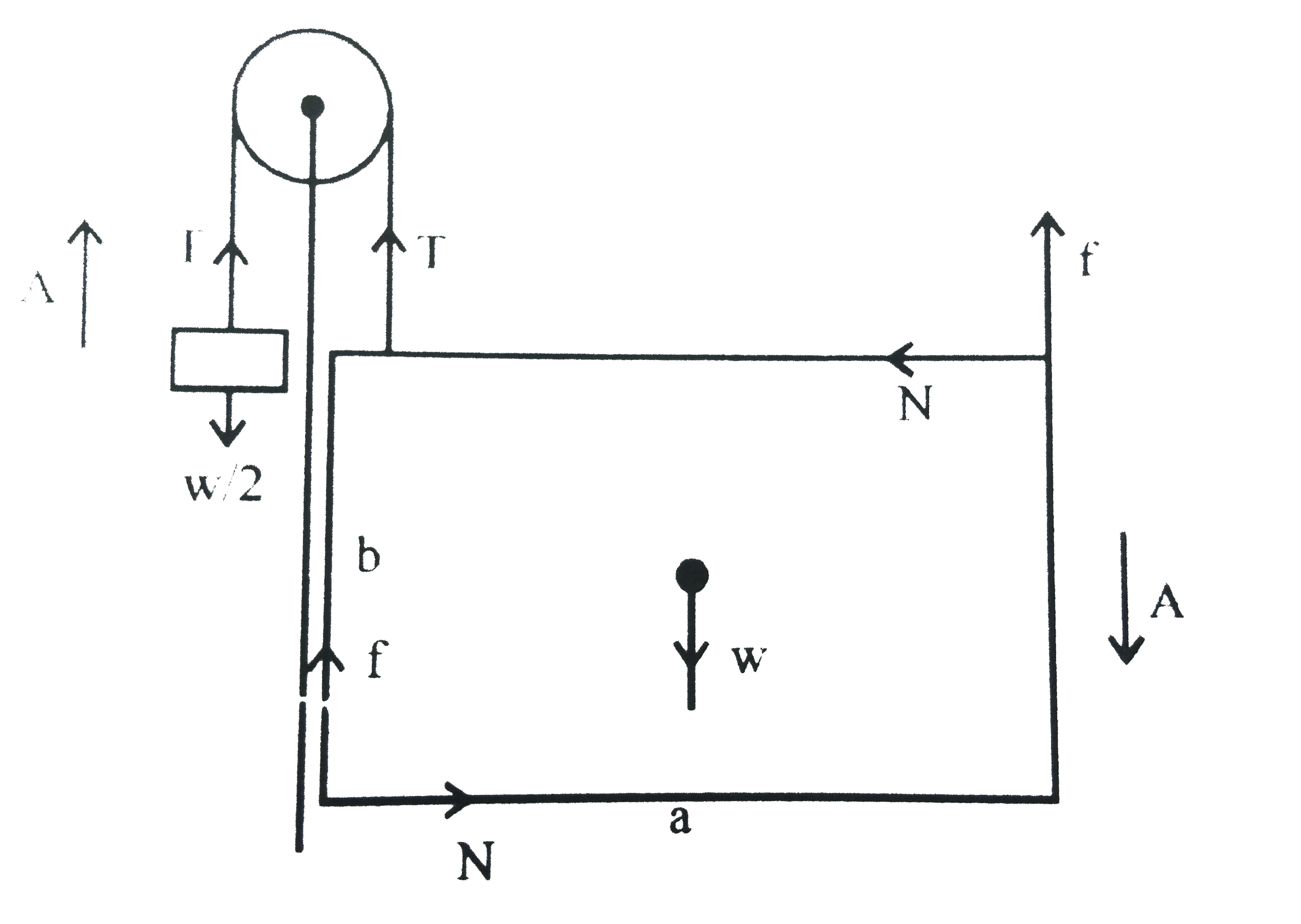 `F xx (a)/(2) + T xx(a)/(2) -2N xx (b)/(2) -FXX(a)/(2) = 0` `T = 2N (b)/(a)`...(3) From (2) and (3) `(w)/(2) ((g + A))/(g) = (2Nb)/(a)` `N = (wa(g+A))/(4 bg)`...(4) From (1),(2) and (4) `w -(w)/(2) ((g+A))/(g) - (2 mu wa(g +A))/(4 bg) = (w)/(g) A` `1-(1)/(2) ((g-A))/(g) - ((2mu ag +A))/(4bg) = (A)/(g)` `1 -(1)/(2) -(mu a)/(2b) = (A)/(g) + (A)/(2g) + (mu aA)/(2 bg)` `((b - mua))/(2b) = ((3b + mua)/(2bg)) A rArr A = ((b - mu a)g)/((3b + mu a))`. |
|
| 13. |
An elastic body which can be stretched to cause arge strains are called ….. |
| Answer» SOLUTION :Alastomers. | |
| 14. |
Two sitar strings A and Bplaying the note 'Dha' are slightly out of tune and produce beats of frequency 5 Hz, The tension of the string B is slightly increased and the beat frequency is found to decrease to 3 Hz. What is the original frequency of B if the frequency of A is 427 Hz ? |
|
Answer» Solution :Suppose original frequencies of WIRES A and B are respectively `f _(A) and f _(B).` Here `f _(A) = 427 Hz and `initially `f _(B) = 422 Hz or f _(B) = 432 Hz` (Because initially there are 5 beats per SECOND between A and B). Now, after increasing tension in B, its frequency increases and assumes such a value `f._(B)` which can produce 3 beats per second with A. Hence, we should TAKE `f _(B)= 422 Hz and f ._(B) = 424 Hz.` So that `f._(B) gt f_(B)` `f _(A) -f_(B) =427-422 =5` beats per second (before increasing tension in B) `f _(A) - f._(B) =427 -424=4` (After increasing tension in B) Note: Here we can not take `f _(B) = 432 Hz` because after increasing tension in B its frequency would be greater than 432 Hz and then it would peoduce more than 5 beats per second with A which would be wrong as per the STATEMENT. |
|
| 15. |
The ratio of the time periodsof two satellites at heights h_1,h_2 from the surface of the earth. |
|
Answer» `(h_1/h_2)^(3//2)` |
|
| 16. |
Discuss in detail the energy in simple harmonic motion. |
|
Answer» Solution :(a) Expression for Potential Energy For the simple harmonic motion, the force and the displacement are related by Hooke.s LAW `vecF=-kvecr` Since force is a vector quantity, in three dimensions it has three components. Further, the force in the above EQUATION is a conservative force field, such a force can be derived from a scalar function which has only component. In one DIMENSIONAL case `F=-kx""...(1)` The work done by the conservative force fieldis independent of path. The potential energy U can be CALCULATED from the following expression. `F=-(dU)/(dx)""...(2)` Comparing (1) and (2), we get `-(dU)/(dx)=-kx` `dU=-kx dx`  This work done by the force F during a small displacement dx stores as potential energy `U(x)=int_(0)^(x)kx.dx.=(1)/(2)k(x.)^(2)|_(0)^(x)=(1)/(2)kx^(2)" "...(3)` From equation `omega=sqrt((k)/(m))`, we can substitute the value of force constant `k=momega^(2)` in equation (3), `U(x)=(1)/(2)momega^(2)x^(2)""...(4)` where `omega` is the natural frequency of the oscillating system. For the particle executing simple harmonic motion from equation `y=Asinomegat`, we get `x=Asinomegat` `U(t)=(1)/(2)momega^(2)A^(2)sin^(2)omegat""...(5)` This variation of U is shown in figure. (b) Expression for Kinetic Energy Kinetic energy `KE=(1)/(2)mv_(x)^(2)=(1)/(2)m((dx)/(dt))^(2)""...(6)` Since the particle is executing simple harmonic motion, from equation `y=Asinomegat` `x=Asinomegat` Therefore, velocity is `v_(x)=(dx)/(dt)=Aomegacosomegat""...(7)` `=Aomegasqrt(1-((x)/(A))^(2))` `v_(x)=omegasqrt(A^(2)-x^(2))""...(8)` Hence, `KE=(1)/(2)mv_(x)^(2)=(1)/(2)momega^(2)(A^(2)-x^(2))""...(9)` `KE=(1)/(2)momega^(2)A^(2)cos^(2)omegat""...(10)` This variation with time is shown in figure. (c ) Expression for Total Energy Total energy is the sum of kinetic energy and potential energy `E=KE+U""...(11)`  `E=(1)/(2)momega^(2)(A^(2)-x^(2))+(1)/(2)momega^(2)x^(2)` Hence, cancelling `x^(2)` term, `E=(1)/(2)momega^(2)A^(2)=` constant `""...(12)` Alternatively, from equation (5) and equation (10), we get the total energy as `E=(1)/(2)momega^(2)A^(2)sin^(2)omegat+(1)/(2)momega^(2)A^(2)cos^(2)omegat` `=(1)/(2)momega^(2)A^(2)(sin^(2)omegat+cos^(2)omegat)` From trigonometry identify, `(sin^(2)omegat+cos^(2)omegat)=1` `E=(1)/(2)momega^(2)A^(2)` = constant which gives the law of conservation of total energy Thus the AMPLITUDE of simple harmonic oscillator, can be expressed in terms of total energy. `A=sqrt((2E)/(momega^(2)))=sqrt((2E)/(k))""...(13)` 
|
|
| 17. |
The law that leads to absolute scale of temperature is |
|
Answer» Kelvin's LAW |
|
| 18. |
One end of a horizontal thick copper wire of length 2L and radius 2R is welded to an end of another horizontal thin copper wire of length L and radius R.When the arrangement is stretched by applying forces at two ends, the ratio of the elongation in the thin wire to that in the thick wire is |
|
Answer» 0.25 |
|
| 19. |
Show that, the change in frequency of sound during the motion of the source towards audience is more than that when audience moves towards source with same velocity. |
|
Answer» Solution :Natural frequency of the source `=N,` VELOCITY of sound `=V,` velocity of the source = v and velocity of the audience = u. So apparent change in frequency = Doppler shift (`(Deltan)` `(v+u)/(V-v) n` When the source of sound remains stationary, v = 0 . When the audience MOVES towardes the source, `Deltan_(1) =u/V n` When the audience is stationary, u = 0. when the source moves towards the audience with the same velocity (i.e., v = u). `Deltan_(2) =u/(V-u) n` Clearly, `Deltan_(2)GT DELTA n_(1)` |
|
| 20. |
If |vecPxxvecQ|=|vecP.vecQ| then angle between Pand will be |
|
Answer» `0^(@)` `PQsintheta=PQcostheta` `tantheta=1""theta=45^(@)` |
|
| 21. |
The maximum and minimum distance of a comet from the sun are 1.4xx10^(12)m and 7xx10^(10)m . If its velocity nearest to the sun is 6xx10^(4)ms^(-1), then what is the velocity at the farthest position ? Assume the path of the comet as circular. |
|
Answer» Solution :`I_1=1.4xx10^(12)m,d_2=7xx10^(10)m` `v_1=6xx10^(4)MS^(-1),v_2`=? Since ANGULAR momentum is CONSERVED `m_pr_pv_p=m_pr_av_a` `(v_p)/(v_A)=(r_A)/(r_p)`i.e, `(6xx10^4)/(V_a)=(7xx10^(10))/(1.4xx10^(12))` i.e `v_A=(6xx10^4xx1.4xx10^(12))/(7xx10^(10))"":." "v_A=1.2xx10^(6)ms^(-1)` |
|
| 22. |
Describe the vertical oscillations of a spring. |
|
Answer» Solution :Vertical oscillations of a spring: Let us consider a massless spring with stiff NESS constant or force constant k attached to a ceiling as shown in figure. Let the LENGTH of the spring before loading mass m be L. If the block of mass m is attached to the other end of spring, then the spring ELONGATES by a length l. Let `F_(1)` be the restoring force due to stretching of spring. Due tomass m, the gravitational force acts vertically downward. We can draw free-body diagram for this system as shown in figure. When the system is under equilibrium, `F_(1)+mg=0""...(1)` But the spring elongates by small displacement l, therefore, `F_(1)proplimpliesF_(1)=-KL""...(2)` Substituting equation (2) in equation (1), we get `-kl+mg=0""...(3)` `mg=kl" (or) "(m)/(k)=(l)/(g)""...(3)` Suppose we apply a very small external force on the mass such that the mass further displaces downward by a displacement y, then it will oscillate up and down. Now, the restoring force due to this stretching of spring (total extension of spring is `y+1`) is `F_(2)prop(y+l)` `F_(2)=-k(y+l)=-ky-kl""...(4)` Since, the mass moves up and down with acceleration `(d^(2)y)/(dt^(2))`, by drawing the free body diagram for this case, we get `-ky-kl+mg=m(d^(2)y)/(dt^(2))""...(5)` The net force acting on the mass due to this stretching is `F=F_(2)+mg` `F=-ky-kl+mg""...(6)` The gravitational force opposes the restoring force. Substituting equation (3) in equation (6), we get `F=-ky-kl+kl=-ky` Applying Newton.s law, we get `m(d^(2)y)/(dt^(2))=-kyimplies (d^(2)y)/(dt^(2))=-(k)/(m)y"" ...(7)` The above equation is in the form of simple harmonic differential equation. Therefore, we get the time period as `T=2pisqrt((m)/(k))" second"...(8)` The time period can be rewritten using equation (3) `T=2pisqrt((m)/(k))=2pisqrt((l)/(g))""...(9)` The acceleration due to gravity g can be computed from the formula `g=4pi^(2)((1)/(T^(2)))ms^(-2)""...(10)` 
|
|
| 23. |
There is some change in length when a 33000 N tensile force is applied on a steel rod of area of cross-section 10^-3 m^2. The change of temperature required to produce the same elongation, if the steel rod is heated, is (The modulus of elasticity is 3 xx10^11 N m^-2 and the coefficient of linear expansion of steel is 1.1 xx10^-5//^@c) |
|
Answer» 20°C |
|
| 24. |
A sphere moving with a velocity v_(0) on a smooth surface enters on a rough horizontal surface as shown in the figure Which of the following statements are true |
|
Answer» The sphere loses translational kinetic ENERGY and gains rotational kinetic energy. |
|
| 25. |
A uniform rope of length l and mass 'm' hangs over a horizontal table with two third part on the table. The coefficient of friction between the table and the chain is mu. The work done by the friction during the period the chain slips completely off the table is |
|
Answer» `(2)/(9) MU mgl` |
|
| 26. |
The angle subtended by a coin of radius 1 cm held at a distance of 80cm from your eyes is : |
|
Answer» 1.25 rad `x=80xx10^(-2)` `b=1 cm=1xx10^(-2)m` `THEREFORE theta=(1xx10^(-2))/(80xx10^(-2))=(1)/(80)=0.125" rad"` |
|
| 27. |
When a mass M hangs from a spring of length l, it stretches the spring by a distance x. Now the spring is cut in two parts of length l//3"and" 2l//3, and two springs thus formed are connected to a straight rod of mass M which is horizontal in the configuration shown in figure . Find the stretch in each of the spring |
|
Answer» Solution :AS it given that the mass M STRETCHES the original spring by a distance x, we have `kx=Mg "(or)"k=(Mg)/x`….(1) The new force CONSTANTS of the two springs can be given by using equation `k_(1)=(k_(eq)l)/l_(1) "and" k_(2)=(k_(eq)l)/l_(2)`as,`k_(1)=3k "and" k_(2)=(3k)/2` Let we take the STRETCH in the two springs be `x_(1)` and `x_(2)` we have for the equilibrium of the rod `k_(1)x_(1)+k_(2)x_(2)=Mg`(or)`2kx_(1)+(3k)/2x_(2)=Mg` From equation (1), we have `x_(1)+x_(2)/2=x/3`...(2) As the rod is horizontal and in STATIC equlibrium , we have net torque acting on the rod about any point on it must be ZERO . Thus we have torque on it above end A are `k_(2)x_(2)L=Mg l/2` (or)`x_(2)=(Mg)/(2k_(2))=(Mg)/(3k)=x/3` Using this value of `x_(2)` in equation (2) we have `x_(1)=x/6` * This can also be directly obtained by using torque zero about point B on rod as `k_(1)x_(1)L=Mg L/2` (or) `x_(1)=(Mg)/(2k_(1))=(Mg)/(6k)=x/6` 
|
|
| 28. |
When force (3,2,1)Newton acts on a body, dispalcement of the bodyin the direction ofY - axiss 5 meter . Work done is ………. |
|
Answer» 15 Joule ` :. W = 2xx5 = 10 J ` (Taking Y - COMPONENT of force ) |
|
| 29. |
Which one of the following is the physicalquantity of the unit (Nm^(2))/(kg)^2? |
|
Answer» Linear momentum `:. G = (Fr^2)/(m_1m_2)` `:.` UNIT of G = unit of `(Fr^2)/(m_1m_2)` `= (Nm^2)/(kg^2)` |
|
| 30. |
A ball is projected vertically down with an initial velocity from a height of 20m on to a horizontal floor. During the impact it loses 50% of its energy and rebounds to the same height. The velocity of projection is (g= 10 ms^(-2)) |
| Answer» Answer :A | |
| 31. |
The physics books are stacked on each other in the sequence +1 and 2, +2volumes 1 and 2 on a table identify theforces acting on each book and draw the free body diagram (b) Identify the forcesexerted by each book on the other |
Answer» SOLUTION : 
|
|
| 32. |
The path of a projectile is given by the equation y = ax - bx^2 , where a and b are constants and x and y are respectively horizontal and vertical distances of projectile from the point of projection. The maximum height attained by the projectile and the angle of projection are respectively |
|
Answer» `(2A^2)/(b), TAN^(-1)(a)` |
|
| 33. |
A couple produces |
|
Answer» PURELY LINEAR MOTION |
|
| 34. |
Two Carnot engines A and B are operated in series. The engine A receives heat from the source at temperature T_(1) and rejects the heat to the sink at temperature T. The second engine B receives the heat at temperature T and rejects to its sink at temperature T_(2). For what value of T the efficiencies of the two engines are equal. |
|
Answer» `(T_(1) - T_(2))/(2)` where `T_(1)` is the TEMPERATURE of source and `T_(2)` is the temperature of sink respectively. For engine A, `eta_(A) = 1 - (T)/(T_(1))` For engine B, `eta_(B) = 1 - (T_(2))/(T)` As per question, `eta_(A) = eta_(B)` As per question, `eta_(A) = eta_(B)` `:. 1 - (T)/(T_(1)) = 1 - (T_(2))/(T)` or `(T)/(T_(1)) = (T_(2))/(T)` or `T^(2) = T_(1)T_(2)` or `T = sqrt(T_(1)T_(2))` |
|
| 35. |
The pitch of a screw gauge is 1 mm and there are 100 divisions on circular scale. When the two studs of the screw gauge are touching each other, the 32^(nd) division of the circulasr scale coincides with the reference line / base line / index line on the pitch scale. When a glass plate is placed in between the studs firmly, the pitch scale reads 4 divisions and the circular scale reads 16 divisions Least count of the apparatus is |
|
Answer» `0.1 MM` |
|
| 36. |
The pitch of a screw gauge is 1 mm and there are 100 divisions on circular scale. When the two studs of the screw gauge are touching each other, the 32^(nd) division of the circulasr scale coincides with the reference line / base line / index line on the pitch scale. When a glass plate is placed in between the studs firmly, the pitch scale reads 4 divisions and the circular scale reads 16 divisions Zero correction of the instrument is |
|
Answer» 0 MM |
|
| 37. |
A bridge of over a canal is the form of a circular arc of radius 5m. The maximum speed with which a motor cycle corsses the bridge withoue leaving the ground at the highest point is g = 10ms^(-2), (in m/s) |
|
Answer» 10 |
|
| 38. |
The pitch of a screw gauge is 1 mm and there are 100 divisions on circular scale. When the two studs of the screw gauge are touching each other, the 32^(nd) division of the circulasr scale coincides with the reference line / base line / index line on the pitch scale. When a glass plate is placed in between the studs firmly, the pitch scale reads 4 divisions and the circular scale reads 16 divisions The thickness of glass plate is |
|
Answer» 3.84 CM |
|
| 39. |
A hollow sphere of simple pendulum is first filled with mercury and then with water. The time periods are in the ratio if their densities are in the ratio 13.6 :1 |
| Answer» Answer :A | |
| 40. |
A circular plate has a uniform thickness and has a diameter 56 cm. A circular disc of diameter 42 cm is removed from one edge of the plate. The distance of centre of mass of the remaining portion from the centre of the circular plate is |
|
Answer» 18 cm |
|
| 41. |
Two simple harmonic oscillators with amplitudes in the ratio 1:2 are having the same total energy. The ratio of their frequencies is |
|
Answer» `1:4` |
|
| 42. |
A block of mass m is connected to another block of mass M by a massless spring of spring constant k. The blocks are kept on a smooth horizontal plane. Initially, the blocks are at rest and the spring is unstretched when a constant force F starts acting on the block of mass M to pull it. Find the maximum extension of the spring. |
|
Answer» |
|
| 43. |
A cube is pplaced on an inclined plane of inclinbation theta as shown in figure. Cofficent of friction br=etween the cube and the plane is mu. As the angle theta is gradually increased, the cube slides before toppling if |
|
Answer» `MUGT1` |
|
| 44. |
The phase difference between acceleration and displacement of simple harmonic oscillator |
| Answer» ANSWER :A | |
| 45. |
Calculate the difference in efficiencies of a Carnot engine working between (i) 400 K and 350 K and (ii) between 350 K and 300 K |
|
Answer» |
|
| 46. |
A solid at 0^(@)C floats with 98% of its volume immersed in a liquid. The solid floats completely immersed when the temperature is raised to 25^(@)C. If the coefficientof volume expansion of the solid is 2.6 times 10^(-6@)C^(-1), find the coefficient of real expansion of the liquid . |
|
Answer» Solution :LET at `0^(@)C`, volume of the SOLID `=V_(0)`, density of the liquid `=rho_(0)`, at `25^(@)C`, volume of the solid `=V^(.)` and density of the liquid `=rho^(.)` Now, `V^(.)=V_(0)[1+2.6 times 10^(-6) times 25]` and `rho_(0)=rho^(.)[1+GAMMA times 25]` where `gamma=` coefficient of real expansion of the liquid. From the condition of floatation, `""V_(0) times 0.98 times rho_(0)=V^(.)rho^(.)` or, `""V_(0) times 0.98 times rho^(.)[1+gammatimes 25]=V_(0)[1+2.6 times 10^(-6) times 25] times rho^(.)` or, `"" 1+25 gamma=(1+0.000065)/(0.98) " or, " 25 gamma=1.02047-1` `therefore "" gamma=8.19 times 10^(-4@)C^(-1).` |
|
| 47. |
A hydraulic automobile life is designed to lift cars with a maximum mass of 3000 kg. The area of cross section of the piston carrying the load is 425 cm^2.What maximum pressure would the smaller piston have to eat? |
| Answer» SOLUTION :`6.92 TIMES 10^5 PA` | |
| 48. |
A cat is able to land on its feet after a fall taking advantage of the conservation of angular momentum . Explain. |
| Answer» Solution :While FALLING a cat stretches its body along with its TAIL so that its MOMENT of INERTIA increases. | |
| 49. |
Define velocity and speed. |
|
Answer» Solution :Speed is defined as the ratio of total DISTANCE covered to the total time taken. it is a SCALAR quantity and ALWAYS it is positive. Velocity is defined as the ratio of the displacement vector to the corresponding time INTERVAL. It is a vector quantity or it can also be defined as rate of change of displacement. |
|