

Saved Bookmarks
This section includes 7 InterviewSolutions, each offering curated multiple-choice questions to sharpen your Current Affairs knowledge and support exam preparation. Choose a topic below to get started.
| 1. |
Define thermal capacity of substance. |
|
Answer» |
|
| 2. |
A body of mass 2kg is dropped from a height of 4m. If the average resistance offered by the ground is 4020N, the distance through which the body penetrates in to the ground before coming to rest is (g=10 ms^(-2)) |
| Answer» ANSWER :D | |
| 3. |
A block is partially immersed in liquid and vessel containing theliquid is moving upward with an acceleration a. The block is observed by two observersO_(1) and O_(2), one at rest (O_(1)) and the ... (0_(2)) moving upward with acceleration afind the total upward buoyant force on the block. |
Answer» SOLUTION :
|
|
| 4. |
A monoatomic gas initially at 27^(@)C is compressed adiabatically to one eight of its origiani volume. The temperature after compression will be |
|
Answer» `10^(@)C` |
|
| 5. |
How does the viscosity of a liquid change with an increase in pressure? |
| Answer» SOLUTION :INCREASES | |
| 6. |
Find the moment of inertia of thin and massless rod about an axis passing through its centre of mass of rod and pair of mass is suspended on both end of this rod. |
Answer» SOLUTION :A system of a ligh rod of length l with a pair of small masses is shown as in figure. TOTAL mass of system is M.  System is rotating about an axis through the centre of mass of system and perpendicular to the rod. SUPPOSE C is the centre of mass. So distance of small mass from its ends is `(l)/(2)`. MOMENTUM of inertia of masses about mention axis is `((M)/(2))((l)/(2))^(2)` : `therefore` Total moment of inertia of a system `I=((M)/(2))((l)/(2))^(2)+((M)/(2))((l)/(2))^(2)` `=2((M)/(2))((l)/(2))^(2)` `=(Ml^(2))/(4)` |
|
| 7. |
In order to find time, an astronant orbiting in an earth satellite should use |
|
Answer» A watch having flat SPIRAL spring |
|
| 8. |
When a horse pulls a cart, which force helps the horse to move forward ? |
| Answer» SOLUTION :The FORCE EXERTED by the GROUND on the HORSE. | |
| 9. |
The magnitude of a vector cannot be |
|
Answer» positive |
|
| 10. |
A gas is compressed isothermally to half its initial volume. The same gas is compressed separately separately through an adiabatic process untial its volume is again reduced to half. Then |
|
Answer» COMPRESSING the GAS isothermally or adiabatically will REQUIRE the same AMOUNT of work. On P-V diagram, Area under adiabatic curve `gt` Area under isothermal curve. So compressing the gas through adiabatic process will require more work to bedone. 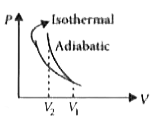
|
|
| 11. |
A spherical ball of mass m and radius r rolls without slipping on a rough concave surface of large radius R=(R= (9)/(7)m). It makes small oscillations about the lowest point. Find the time period. |
|
Answer» `5pi sec` |
|
| 12. |
What are the maximum values of potential energy and kinetic energy of a harmonic oscillator ? |
|
Answer» SOLUTION :`{:("Max. value of"),("kinetic ENERGY"):}}={{:("Max. value of"),("potential energy"):}` `=(1)/(2) m omega^(2)A^(2)` |
|
| 13. |
A body falls freely from a height 'h' after two seconds if acceleration due to gravity is reversed the body |
|
Answer» continues to fall down |
|
| 14. |
A clock with a brass pendulum keep correct time at 20^(@) C but loses 8.212 s per day when the temperature rises to30^(@) C. The coefficient of linear expansion of brass is |
|
Answer» `25 xx 10^(-6)//^(@)C ` |
|
| 15. |
What is the time period of ratation of the earth around its axis so that the objects at the equator becomes weightless ? (g = 9.8 m//s^(2), Radius of earth= 6400 km) |
|
Answer» Solution :G at the equator is `g_(0) = g-g_(0) = g - R omega^(2)` If bodies are to BECOME WEIGHTLESS at the equator, `g_(0) = 0`. `0 = g - R omega^(2) rArr R omega^(2) = g""omega = sqrt((g)/(R))` Time period of rotation, `T = (2pi)/(omega) = 2pi sqrt((R)/(g))` `R = 6400 xx 10^(3)m, g = 9.8 m//s^(2)` `T = 2pi sqrt((6.4 xx 10^(6))/(9.8)) = 5078 s = 84` minute 38s. |
|
| 16. |
When a car takes a sudden turn it is likely to fall. |
|
Answer» Away from the CENTRE of CURVATURE. |
|
| 17. |
Which one of the following statement is correctfor the following situation Assertion : A man in a closed cabin which is falling freely does not experience gravitational force Reason: Inertialmass is equaltogravitational mass |
|
Answer» assertiois TRUE but REASON is false |
|
| 18. |
Three blocks of masses 10 kg, 7 kg and 2 kg are placed in contact with each other on a frictionless table. A force of 50 N is applied on the heaviest mass. What is the acceleration of the system? |
Answer» Solution : We know that ` a = [ (F)/(m_1 + m_2 + m_3) ] = (50 N)/(10 kg + 7KG + 2kg) ` ` 50/19 = 2.63 ms^(-2)` |
|
| 19. |
The period of oscillation of a mass m suspended from a spring of negligible mass is T. If along with it another mass m is also suspended the period of oscillation will now be…….. |
|
Answer» `T` In second case `T. = 2pi sqrt((M+M)/(k))= 2pi sqrt((2M)/(k))` `therefore (T.)/(T)= sqrt(2)` `therefore T. = sqrt(2)T`. |
|
| 20. |
The radius of a ball is (5.4 +- 0.2) cm. The percentage error in the volume of the ball is |
|
Answer» `11%` |
|
| 21. |
Write a note on scope of physics. |
|
Answer» Solution :(i) Discoveries in physics are of two types, accidental discoveries and well-analysed research outcome in the laboratory based on INTUITIVE thinking and prediction. (II) For example, the famous equation of ALBERT Einstein, `E=mc^(2)` was a theoretical prediction in 1905 and experimentally proved in 1932 by Cockeroft and Walton. (iii) This technique was used by the pharmaceutical industry very effectively to design new drugs. Bio compatible materials for organ replacement are predicted USING quantum prescriptions of physics before fabrication. (iv) In Physics we have accidental discoveries and well-analysed research outcome in the laboratories. For instance, analysis of the behaviour magnets lead to so many technological applications. Theoretical predictions contributed the developments in TECHNOLOGY and medicine. For example the most famous theoretical prediction is Einstein’s mass-energy relation `E= mc^(2)` ?. Theoretical predictions are widely used to identify suitable materials for so many applications like manufacture of magnetic tapes, memory storage in computers and robust applications. |
|
| 22. |
Derive the ratio of two specific heat capacities of monoatomic, diatomic and triatomic molecules. |
|
Answer» Solution :Application of law of equipartition energy in specific heat of a gas : Meyer's relation `C_(P)-C_(Y)=R` connects the two specific heats for one mole of an ideal gas. Equipartition law of energy is used to calculate the value of `C_(P)-C_(V)` and the ratio between them `gamma=(C_(P))/(C_(V))` Here `gamma` is called adiabatic exponent. (i) Monotomic molecule: Average kinetic energy of a molecule `=[(3)/(2)kT]` Total energy of a mole of gas `(3)/(2)kTxxN_(A)=(3)/(2)RT` For one mole, the molar specific heat at constant volume `C_(V)=(dU)/(dT)=(d)/(dT)[(3)/(2)RT]` `C_(V)=[(3)/(2)R]` `C_(P)=C_(V)+R=(3)/(2)R+R=(5)/(2)R` The ratio of specific heats, `gamma=(C_(P))/(C_(V))=((5)/(2)R)/((3)/(2)R)=(5)/(3)=1.67` (ii) Diatomic molecule: Average kinetic energy of a diatomic molecule at low temperature = `(5)/(2)kT`. Total energy of one mole of gas `=(5)/(2)kTxxN_(A)=(5)/(2)RT` (Here, the total energy is PURELY kinetic) For one mole Specific heat at constant volume `C_(V)=(dU)/(dT)=[(5)/(2)RT]=(5)/(2)R` But `C_(P)=C_(V)+R=(5)/(2)R+R=(7)/(2)R` `THEREFORE gamma=(C_(P))/(C_(V))=((7)/(2)R)/((5)/(2)R)=(7)/(5)=1.40` Energy of a diatomic molecule at high temperature is equal to `(7)/(2)` RT `C_(V)=(dU)/(dT)=[(7)/(2)RT]=(7)/(2)R` `therefore C_(P)=C_(V)+R=(7)/(2)R+R` `C_(P)=(9)/(2)R` Note that the `C_(V)` and `C_(P)` are higher for diatomic molecules than the monoatomic molecules. It implies that to increase the temperature of diatomic gas molecules by `1^(@)C` it require more heat energy than monoatomic molecules. `therefore gamma=(C_(P))/(C_(V))=((9)/(2)R)/((7)/(2)R)=(9)/(7)=1.28` (iii) Triatomic molecule: (a) Linear molecule Energy of one mole `=(7)/(2)kTxxN_(A)=(7)/(2)RT` `C_(V)=(dU)/(dT)=(d)/(dT)[(7)/(2)RT],C_(V)=(7)/(2)R` `C_(P)=C_(V)+R=(7)/(2)R+R=(9R)/(2)` `therefore gamma=(C_(P))/(C_(V))=((9)/(2)R)/((7)/(2)R)=(9)/(7)=1.28` (b) Non-linear molecule Energy of a mole `=(6)/(2)kTxxN_(A)=(6)/(2)RT=3RT` `C_(V)=(dU)/(dT)=3R` `C_(P)=C_(V)+R=3R+R=4R` `therefore gamma=(C_(P))/(C_(V))=(4R)/(3R)=(4)/(3)=1.33` Note that ACCORDING to kinetic theory model of gases the specific heat capacity at constant volume and constant pressure are independent of temperature. But in reality it is not sure. The specific heat capacity varies with the temperature. |
|
| 23. |
Water rises to a height of 20 mm in a capillary .If the radius of the capillary is made (1)/(3) rd of its previous is made then what is the new value of the capillary rise ? |
|
Answer» SOLUTION :`{:(" "hprop(1)/(R),""H.=h(R)/(R.)=((R)/((R)/(3)))),(THEREFORE(h)/(h)=(R)/(R),"" h.=3h):}` `=3(20)=60mm` |
|
| 24. |
A bomb explodes andsplits up into three fragments. Two fragments, each of mass 200g, move away from each other making an angle 120^@ , at a speed of 100 m*s^(-1). Find the direction and velocity of the third fragment whose mass is 500 g. Also find outthe energy released in explosion. |
Answer» Solution :Fig.1.45 shows the velocity of fragment A and B ALONG OA and OB .A and B have equal mass and speed. From the law of conservation of linear momentum, the third piece must move along OD, INTHE direction opposite to the resultant of OA and OB.  If the velocity of the third PIECEIS v, then taking the component along the LINE CD in CGS system. `500v =200xx10^4 cos 60^@ +200xx10^4 cos 60^@` `or, v=(200xx10^4)/(500)=4xx10^3 cm *s^(-1) =40 m*s^(-1)`. Hence, the velocity of the third fragment is `40 m*s^(-1)`. it moves so as tomake an angle `120^@` with each of OA and OB. The energy released due to explosion, isthe kinetic energy the three fragment. `therefore` Energy released `=1/2 xx200xx(10^4)^2+1/2 xx200xx(10^4)^2+1/2xx500xx(4xx10^3)^2=2400xx10^7 ergs=2400 J`. |
|
| 25. |
On earth, the value of G = 6.67 xx 10^(-11) Nm^(2)// kg^(2) . What is its value on the moon ? |
| Answer» Solution :`IMPLIES`The value of G is the same everywhere in the UNIVERSE. So, it is `6.67 xx 10^(-11)NM^(2) //kg^(2)`on MOON. | |
| 26. |
The boling point of water at a pressure of 50 atmosphere is 250^(@)C. Compare the theoretical efficincies of the engine oprating between the boling of water at (i) 1 atmosphere (ii) 50 atmosphere, assuming the temperature of sink the wach case as 27^(@)C. |
|
Answer» |
|
| 27. |
Four particles, each of mass 1kg, are placed at the corners of a square OABC of side 1m. 'O' is at the origin of the coordinate system. OA and OC are aligned along positive x-axis and positive y-axis respectively. The position vector of the centre of mass is (in 'm') |
|
Answer» `HAT(i)+hat(j)` |
|
| 28. |
Prove that at points near the surface of the Earth, the gravitational potential energy of the object is U = mgh. |
|
Answer» Solution : When an object of mass m is raised to a height h, the POTENTIAL energy stored in the object is mgh. This can be derived using the general expression for gravitational potential energy. Consider the Earth and mass system, with r, the distance between the mass m and the Earth.s centre. Then the gravitational potential energy. `U = - (GM_e m )/(r) `....(1)  Here `r = R_e + h` , where `R_e`is the radius of the Earth, h is the height above the Earth.s SURFACE `U = - G (M_e m)/((R_e + h) ) `...(2) If h < < `R_e` ,equation (2) can be modified as `U = - G (M_em)/(R_e (1 + h/(R_e) ) )` `U = -G (M_e m)/(R_e) (1 + (h)/(R_e) )^(-1)` By using Binomial expansion and neglecting the higher order TERMS, we get `(1 + x)^n = 1 + nx + (n(n-1))/(2!) x^2 + ..... + oo` here , ` x = (h)/(R_e)` and n = - 1 `(1 + (h)/(R_e))^(-1) = (1 - (h)/(R_e) )` Replace this value and we get, `U = - (GM_e m)/(R_e) (1 -(h)/(R_e) )`....(4) We know that, for a mass m on the Earth.s surface, ` G (M_e m)/(R_e) = mg R_e`....(5) Substituting equation (4) in (5) we get, ` U = - mgR_e + mgh_1`....(6) It is clear that the FIRST term in the above expression is independent of the height h. For example, if the object is taken from height `h_1` to `h_2` , then the potential energy at `h_1`is `U(h_1) = - mgR_e + mgh_1`.....(7) and the potential energy at `h_2` is `U(h_2) = - mgR_e + mgh_2`....(8) The potential energy difference between `h_1` and `h_2`is `U(h_2) - U(h_1) = mg(h_1 - h_2)`....(9) The term `mgR_e`in equation (7) and (8) plays no role in the result. Hence in the equation (6) the first term can be OMITTED or taken to zero. Thus it can be stated that the gravitational potential energy stored in the particle of mass m at a height h from the surface of the Earth is U = mgh. On the surface of the Earth, U = 0, since h is zero. |
|
| 29. |
What does the word LASER stand for ? |
|
Answer» LIGHT AMPLIFICATION by STIMULATED electron of radiation |
|
| 30. |
If heavier bodies are attracted more strongly by the earth, why don.t they fall faster than the lighter bodies? |
| Answer» Solution :As ACCELERATION DUE to GRAVITY (G) is same for both heavier and LIGHTER bodies, both fall at the same rate. | |
| 31. |
A block of mass 2kg is lying on a rough inclined plane. The force needed to move the block up the plane with uniform velocity by appling a force parallel to the plane is 100 N. The force needed to move the block up with an acceleration of 2 ms^(-2) is |
| Answer» ANSWER :D | |
| 32. |
A simple pendulum is oscillating with out damping when the displacement of the bob is less than maximum its acceleration vector .a. is correctly shown is |
|
Answer»
|
|
| 33. |
A thin circular loop of radius R rotates about its vertical diameter with an angular frequency co. Show that a small bead on the wire remains at its lowermost point for omegale sqrt(g//R) . What is the angle made by the radius vector joining the centre to the bead with vertical downward direction for omega=sqrt(2g//R) 1 Neglect friction. |
|
Answer» Solution :Consider the free-body diagram of the BEAD when the radius vector JOINING the centre of the wire makes an angle `theta` with the vertical downward direction.We have mg `= N cos theta` and `m R SIN thetaomega^2 = N sin theta` .These equations give` cos theta = g//Romega^2`.Since `cos theta lt= 1,` the bead remains at its lowemost point `omega lt= sqrt(g/R )` For `omega = sqrt((2g)/(R ), cos theta = 1/2 i.e theta = 60^@` |
|
| 34. |
Passage - IV : A solid sphere is kept over a smooth surface . It is hit by a cue at 'h' height above the centre ''C'', with same force, for different values of h in terms of R. In two cases, case 1 : h = R/4, case 2 : h = R/2. In case 1 the sphere acquires total kinetic energy K_(1) and in II case it is K_(2) then |
| Answer» Answer :B | |
| 35. |
the displacment of a particle long x-axis is given by x=7t^(2)+8t+3 . Its acceleratiton anf velocity at t=2s respectively…. |
|
Answer» `36ms^(-1),14ms^(-2)` `V=(dx)/(dt)=14t+8, at t=2s, V=36ms^(=1)` `a=(dv)/(dt)=14ms^(-2)` |
|
| 36. |
What is the temperature for which the reading on Kelvin and Fahrenheit scales are same ? |
|
Answer» Solution :On the Kelvin and Fahrenheit scales `(K - 273.15)/(100) = (F - 32)/(180)` K = F `rArr (F - 273.15)/(100) = (F - 32)/(180)` `rArr F - 273.15 = (5)/(9) F - (160)/(9)` `(4)/(9) F = 273.15 - 17.77 "" F = (9)/(4)` (255.38) = 574.6 `"" therefore 574.6K = 574.6^(@)` F. |
|
| 37. |
Passage - IV : A solid sphere is kept over a smooth surface. It is hit by a cue at 'h' height above the centre ''C'', with same force, for different values of h in terms of R. In the surface is rough then after hitting the sphere, the case in which, friction is in forward direction, in above question is |
|
Answer» In CASE 2 |
|
| 38. |
The time period of revolution of a planet A around the sun is 8 times that of another planet B. The distance of planet A from the sun is how many times greater than that of the planet B from the sun |
|
Answer» 2 |
|
| 39. |
The bob of a simple pendulum of effective length 1 m is pulled through a distance of 2 cm horizontally from its equilibrium position and then released. Determine the equation of motion of the bob. [Given, tan^(-1)(2/100)lt4^(@)] |
|
Answer» |
|
| 40. |
The velocity of a particle v at a instant t is given by v=at+bt^(2). The dimension of b is |
|
Answer» [L] |
|
| 41. |
A clock 'S' is based on oscillations of a spring and a clock P is based on pendulum motion. Both clocks run at the same rate on earth on a planet having the same density as earth but twice the radius |
|
Answer» S will RUN FASTER than P |
|
| 42. |
Marching soldiers are asked to break their steps while crossing a bridge. Why? |
| Answer» Solution :DUE to resonance the BRIDGE MAY break, when the NATURAL frequency of oscillation of the bridge equals the frequency of the MARCHING of the soldiers. | |
| 43. |
The periodic time of simple pendulum is T=2pi sqrt((l)/(g)). The length (l) of the pendulum is about 100 cm measured with 1mm accuracy. The periodic time is about 2s. When 100 oscillations are measured by a stop watch having the least count 0.1 second. Calcaulte the percentage error in measurement of g. |
|
Answer» `0.1%` `T=2pisqrt((l)/(g))"":.T=(4pi^(2)l)/(g)` `:.g=(4pi^(2)l)/(T^(2))` `4pi^(2)`= CONSTANT =dimensionless `:.(Deltag)/(g)=(Deltal)/(l)+(2DeltaT)/(T)` `=(Deltal)/(l)xx100+2(Deltat)/(t)xx100` `=[(0.1)/(100)xx100]+[2xx(0.1)/(2xx100)xx100]` `=0.1+0.1=0.2%` |
|
| 44. |
Deduce the relation between torque and angular acceleration. |
|
Answer» Solution :The torque produced by the force on the point mass m about the axis can be WRITTEN as, `taui=RF sin 90^(@)=rF [ :' sin 90^(@)=1]` `rau=rma [:' (F=m)]` `TAU=R mr alpha=mr^(2) alpha [ :' (a=r alpha)]` `tau=(Sigma m_(i)r_(i)^(2))vec(alpha)` `vec(tau)=Ivec(alpha)` |
|
| 45. |
Using dimensions show that the viscous force acting on a glass sphere falling through a highly viscous liquid of coefficient of viscosity eta is Fprop eta av where a is the radius of the sphere and v its terminal velocity. |
|
Answer» Solution :Dimensional formula of `eta` is `[ML^(-1)T^(-1)]` `F PROP eta^(x)a^(y)v^(z)` `F=keta^(x)a^(y)v^(z)`, k is dimensionaless constant Taking DIMENSIONS on both SIDES `MLT^(-2)=[ML^(-1)T^(-1)]^(x)[L]^(y)[LT^(-1)]^(z)` `MLT^(-2)=M^(x)L^(-1)T^(-x)L^(y)T^(-z)` `MLT^(-2)=M^(x)L^(-x+y+z)T^(x-x-z)` EQUATING dimensions on both sides of M, `1=x""` i.e. x=1 of T `2=-x-z""-z=-2+x=-2+1,z=1` of L `1=-x+y+z=-1+y+1""` i.e. `y=1` `F=k eta^(1)a^(1)v^(1)` or `F prop eta av`. |
|
| 46. |
Express the constant k of Eq. (8.38) in days and kilometres. Given k = 10^(–13) s^(2) m^(–3) . The moon is at a distance of 3.84 x× 105 kmfrom the earth. Obtain its time-period of revolution in days. |
|
Answer» Solution :Given K = `10^(-13) s^(2) m^(-3)` `= 10^(-13)[ (1)/((24 XX 60 xx 60 )^(2))d^(2) ] [ (1)/((1 // 1000)^(3) km^(3)) ] ` `= 1.33 xx 10^(-14) d^(2) km^(-3)` Using EQ. (8.38) and the given VALUE of k, the time period of the moon is `T^(2) = (1.33 xx 10^(-14)) (3.84 xx 10^(5))^(3)` Not that Eq. (8.38) also holds for elltpttcal orbits If we REPLACE `(R_(E) + h)` by the semi- major axis of the elltpse. The earth. will then the at one of the foct of this ellipse. |
|
| 47. |
The weight of an object in the coal mine, sea level and at the top of the mountain are respectively W_1,W_2 and W_3 , then |
|
Answer» `W_1 LT W_2 GT W_3` |
|
| 48. |
The Hubble constant has the dimension of |
|
Answer» time `H= ("speed of galaxy")/("DISTANCE of galaxy from US")= (1)/("time")= ("time")^(-1)` |
|
| 49. |
Suppose your mass is 50 kg, how fast should you run so that your linear momentum become equal to that of cycle rider of 100 kg moving along a straight road with a speed of 20 km/h? |
|
Answer» `40m//s` `m_(1)v_(1)=m_(2)v_(2)` `therefore v_(1)=v_(2)XX(m_(2))/(m_(1))` `=(20xx100)/(50)` `=40km//h` `=(40xx1000)/(3600)m//s` `=11.11m//s` |
|
| 50. |
A cubical block of mass 'm' rests on rough horizontal surface. muis coefficient of static friction between block and the surface. A force "mg" acting on cube at an angle "theta" with vertical side of cube pulls the block. if the block is to be pulled along the surface then the value of cot (theta //2) is |
|
Answer» less than `MU` |
|


