

Saved Bookmarks
This section includes 7 InterviewSolutions, each offering curated multiple-choice questions to sharpen your Current Affairs knowledge and support exam preparation. Choose a topic below to get started.
| 1. |
Relative velocity of A with respect to B when A and B are in the opposite direction is : |
|
Answer» ` V_(A) + V_(B)` |
|
| 2. |
The total workdone on a particle is equal to change in it's kinetic energy |
|
Answer» Only if the FORCES acting on it are conservative |
|
| 3. |
Moment of inertia depends upon……………… and it does not depend upon……………. |
|
Answer» torque applied and axis of rotation. |
|
| 4. |
Define stress and strain. |
|
Answer» SOLUTION :Stress: the restoring force PER unit area of deformed body is known as stress. Strain: strain produced in a body is defined as the ratio of CHANGE in SIZE of body to the original size. |
|
| 5. |
When did scientific study of waves begin? Give names of those scientists who had studied physics of waves. |
| Answer» SOLUTION :Since the ancient times, sound waves have been INFLUENCING the minds of people. But scientific analysis of waves began in `17^(TH)` century. Major contribution in this study was given by scientists like Christian Huygens, Robert Hooke and ISAAC Newton. | |
| 6. |
There is a large wedge placed on a horizontal surface with its incline face making an angle of 37^(@) to the horizontal. A particle is projected in vertically upward direction with a velocity of u = 6.5 m//s from a point O on the inclined surface. At the instant the particle is projected, the wedge begins to move horizontally with a constant acceleration of a = 4 m//s^(2). At what distance from point O will the particle hit the incline surface if (i) direction of a is along BC? (ii) direction of a is along AB? |
|
Answer» |
|
| 7. |
The gas constant for one kg of oxygen is 259.3 J kg ^(-1) K ^(-1).Find the value of C_(p)and C_(v)in J mol ^(-1) K ^(-1) gamma = 1.4 |
|
Answer» <P> SOLUTION :`R = MR = 32 xx 10 ^(-3) xx 259.3 = 8.298 J mol^(-1) K ^(-1) , C _(V) = R//gamma - 1 = 20.74J mol ^(-1) K ^(-1) , C _(P)=C_(V) +R` |
|
| 8. |
In the above question, if your body temperature is lower what will be your feeling? |
| Answer» SOLUTION :The METAL CHAIR will be FELT HOTTER. | |
| 9. |
Match thecolumn-I and II. {:("Column-I",,"COlumn-II"),("(A) Kineic energy of a body projected from surface of earth, at large distance from surface of earth.",,"(P) must be zero"),("(B) Gravitational potential energy of a bound system",,"(Q) may be zero"),("(C) Change is potential energy of a point mass it left free to itself, with time",,"(S) may be negative"),("(D) Changes in areal velocity of earth as earth moves from apogee towards perigee",,"(T) must be negative"):} |
|
Answer» |
|
| 10. |
Two boys are standing at the ends A and B of a ground where AB = a. The boy at B starts runing in a direction pependicular to AB with velocity v_(1).The boy at A starts runing simultaneously with velocity is v and catches the other boy is time t, where t is |
|
Answer» `a// SQRT(V^(2)+v_(1)^(2))` |
|
| 11. |
Excess pressure inside a bubble is |
|
Answer» DIRECTLY PROPORTIONAL to its radius |
|
| 12. |
In ideal gas is expanding such that PT^(2) = constant. The coefficient of volume expansion of the gas is. |
|
Answer» `(1)/(T )` `PT^(2)=K and PV=nRT` `(T^(2))/(V)=(K)/(nRT)rArr (KV)/(nR)=T^(2)` Differentiating.`""(T^(3))/(V)dV=3T^(2)dTrArr alpha_(V)=(dV)/(DT)=(3)/(T)` |
|
| 13. |
It is claimed that two cesium clocks, it allowed to run for 100 years, free from any distrubance, may differ by only about 0.02 s. What does this imply for the accuracy of the standard cesium clock in measuring a time -interval of 1s ? |
| Answer» Solution :ACCURACY of 1 part in `10^(11) "to" 10^(12)` | |
| 14. |
Which of the following relationships between the acceleration a and the displacement x of a particle involve simple harmonic motion? |
|
Answer» `a=0.7x` |
|
| 15. |
Two clocks are being tested against a standard clock located in a national laboratory At 12 : 00 : 00 noon by standard clock, the readins of the two clocks are{:("Day","Clock - I","Clock - II"),("Monday",12:00:05,10:15:06),("Tuesday",12:01:15,10:14:59),("Wednesday",11:59:08,10:15:18),("Thursday",12:01:50,10:15:07),("Thursday",12:01:50,10:15:07),("Friday",11:59:15,10:14:53),("Saturday",12:01:30,10:15:24),("Sunday",12:01:19,10:15:11):} From the Observations carefully read the following conclusive statements.Statement I : Zero - error in clock II is much longer than zero - error in clock I.Statement II : Zero - error can always be corrected by applying necessary corrective measuresStatement III : Precision of clock - I is more than precision of clock - IIStatement IV : Precision of clock - II is more than precision of clock - I Pick up the correction option from the following. |
|
Answer» Only I and II are CORRECT |
|
| 16. |
An elastic metal rod will change its length when it a) falls vertically under its weight b) is pulled along its length by a force acting at one end c) rotates about an axis at one end d) slides on a rough surface |
|
Answer» only a, B are true |
|
| 17. |
Explain the Graphical representation of the wave. |
|
Answer» Solution :Let US graphically represent the two forms of the wave variation. (a) Space (or Spatial) variation graph (b) Time (or TEMPORAL) variation graph (a) Space variation graph  By keeping the time fixed, the change in displacement with RESPECT to x is plotted. Consider a sinusoidal graph, y=A sin(kx) as shown in figure 1, where k is a constant. Since the wavelength `lambda` denotes the distance between any two points in the same state of motion, the displacement y is the same at both the ends. y=xand `y= x + lambda`, i.e., `y=A sin(kx) =A sin(k(x+lambda))` `=A sin(kx + k lambda)`........(1) The sine function is a periodic functions with period `2pi`. Hence, `y=A sin(kx + 2pi) = A sin(kx)`........(2) Comparing equation (1) and equation (2), we get `kx+ k lambda = kx+ 2pi` This implies, `k =(2pi)/lambda "rad" m^(-1)`.......(3) where k is called wave number. This measures how many wavelengths are present in `2pi` radians. The spatial periodicity of the wave is `lambda = (2pi)/k m` Then, At t= 0s, `y(x,0) =y(x+lambda,0)` and At any time, `t,y(x,t) =y(x+lambda,t)` (b) Time variation graph: By keepig the position fixed, the change in displacement with respect to time is plotted. Let us consider a sinusoidal graph, `y= A sin (omega t)` as shown in the figure 2, where `omega` is angular frequency of the wave which measures how quickly wave oscillates in time or number of cycles per second.  The temporal periodicity or time period is `T=(2pi)/omega rArr omega =(2pi)/T` The angular frequency is related to frequency f by the expression `omega =2pi f`, where the frequency f is defined as the number of oscillations made by the medium particle per second. Since INVERSE of frequency is time period, we have, `T=1/f` in SECONDS. This is the time taken by a medium particle to complete one oscillation. Hence, we can define the speed of a wave (wave speed, v) as the distance travelled by the wave per second. `v=lambda/T = lambda f` in `ms^(-1)`. |
|
| 18. |
According to the principle of conservation of linear momentum, if the external force acting on the system is zero, the linear momentum of the system will remain conserved. It means if the centre of mass of a system is initially at rest, it will remain, at rest in the absence of external force, that is, the displacement of centre of mass will be zero. Two blocks of masses 'm'and '2m' are placed as shown in Fig. There is no friction anywhere. A spring of force constant k is attached to the bigger block. Mass 'm' is kept in touch with the spring but not attached to it. 'A' and 'B' are two supports attached to '2m'. Now m is moved towards left so that spring is compressed by distance 'x' and then the system is released from rest. Now m arrives at B. Due to its inertia of motion 'm' breaks the support 'B' and due to some resistance offered by 'B' , the resulting velocity of 'm' is reduced to half of its previous value. Then what you can say about the velocity of 2m? |
|
Answer» It is also REDUCED to half of its previous value |
|
| 19. |
According to the principle of conservation of linear momentum, if the external force acting on the system is zero, the linear momentum of the system will remain conserved. It means if the centre of mass of a system is initially at rest, it will remain, at rest in the absence of external force, that is, the displacement of centre of mass will be zero. Two blocks of masses 'm'and '2m' are placed as shown in Fig. There is no friction anywhere. A spring of force constant k is attached to the bigger block. Mass 'm' is kept in touch with the spring but not attached to it. 'A' and 'B' are two supports attached to '2m'. Now m is moved towards left so that spring is compressed by distance 'x' and then the system is released from rest. What is the loss in the energy of the system due to breaking ofB? |
|
Answer» `3/8kx^(2)` `KE_(F)=1/2m((v_(1))/2)^(2)+1/2xx2m((v_(2))/2)^(2)=1/4[1/2kx^(2)]` LOSS `=KE_(i)-KE_(f)=3/8kx^(2)` |
|
| 20. |
According to the principle of conservation of linear momentum, if the external force acting on the system is zero, the linear momentum of the system will remain conserved. It means if the centre of mass of a system is initially at rest, it will remain, at rest in the absence of external force, that is, the displacement of centre of mass will be zero. Two blocks of masses 'm'and '2m' are placed as shown in Fig. There is no friction anywhere. A spring of force constant k is attached to the bigger block. Mass 'm' is kept in touch with the spring but not attached to it. 'A' and 'B' are two supports attached to '2m'. Now m is moved towards left so that spring is compressed by distance 'x' and then the system is released from rest. Find the relative velocity of the blocks after 'm' leaves contact with the spring. |
|
Answer» `sqrt((2k)/(3m))` 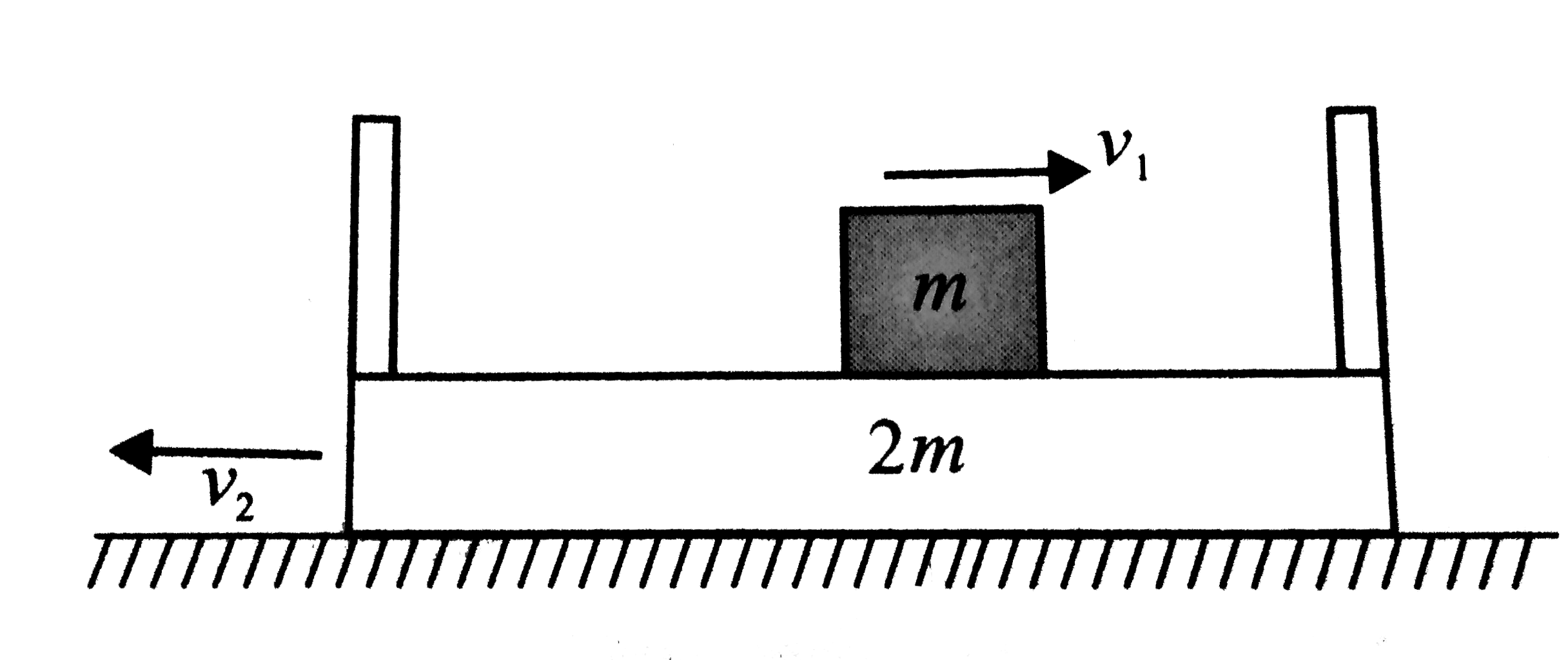 `implies v_(1)-2v_(2)` `1/2mv_(1)^(2)xx2mv_(2)^(2)=1/2kx^(2)` SOLVING, we get `v_(1)=2(sqrt(k/(6m)))x, v_(2)=(sqrt(k/(6m))),x` RELATIVE velocity `v_(1)+v_(2)=3(sqrt(k/(6m)))x=xsqrt(3/2 k/m)` |
|
| 21. |
Find the resultant amplitude and phase of a point at which N sinusoidal waves interfere. All the waves have same amplitude A and their phases increase in arithmetic progression of common difference phi. |
|
Answer» SOLUTION :The diagram for their SUM is shown in figure for N=6. The resultant amplitudes is `A_(R)`. The apex angle of every ISOSCELES TRIANGLE is `phi`. So, the angle subtended by the resultant is `Nphi`. Since, the heads of the vectors are all at the same distance r from the apex of the diagram.  From Fig. (a), `A_(R)/2 = r sin (Nphi)/2 ` and from Fig. (b), `A/2 = r sin (phi/2)` DividingEq. (i) by Eq. (II), we get `A_R/A = (sin(Nphi)/2)/("sin"(phi)/(2))` `A_(R) = A ((sin((Nphi)/2))/(sin(phi/2)))`s |
|
| 22. |
Sketch the nature of the position - time graph for the unidirectional motion of a particle, having a variable velocity. |
Answer» Solution :The curved line OP in Fig. 1.44 indicates the NATURE of the graph. It is to be noted that the curve OP does not have a NEGATIVE gradient at any point on it. The negative gradient of a line LIKE AB means that, TIME is running backwards - it is physically meaningless. On the other hand the negative gradient of CD means that the particle is moving back then it would not be a unidirectional motion. 
|
|
| 23. |
Consider the following two statements : 1. Linear momentum of a system of particles is zero 2. Kinetic energy of a system of particles is zero , Then |
|
Answer» `v` `MV = (3m)/(4)v_(1) rArr v_(1) = (4 v)/(3)` 
|
|
| 24. |
If R is the electric resistance and C is the capacitance, the dimensional formula of RC is |
| Answer» Answer :D | |
| 25. |
Explain why (a) a horse cannot pull a cart and run in empty space, (b) passengers are thrown forward from their seats when a speeding bus stopssuddenly, (c) it is easier to pull a lawn mower than to push it, (d) a cricketer moves his hands backwards while holding a catch. |
| Answer» Solution : (a) The horse-cart system has no external FORCE in empty space. The mutual forces betweenthe horse and the cart cancel(Third Law).On the ground, the CONTACT force between the system and the ground (friction) causes their motion from rest. (b) Due to INERTIA of the body not directly in contact with the SEAT. (c) A lawn mower is pulled or pushed by applying force at an angle. When you push, the normal force (N) must be more than its weight, for EQUILIBRIUM in the vertical direction. This results in greater friction f `( fprop N)` and, therefore, a greater applied force to move. Just the opposite happens while pulling. (d) To reduce the rate of change of momentum and hence to reduce the force necessary to stop the ball. | |
| 26. |
n' number of liquids of masses m,2m,3m, 4m, ...... . having specific heats s, 2s,3s,4s, .... are at temperatures t, 2t, 3t, 4t .... are mixed. The resultant temperature of mixture is |
|
Answer» `( 3n)/( ( 2n+1) )t` |
|
| 27. |
An woman walks on a straight road from her home to a market 2.5 km away with a speed of 5 km/h . Finding the market closed .he instantly turns and walks back with a speed of 7.5 km/hr. What is the(a)magnitude of an average velocity ,(b)average speed of the man,over the interval of time .0 to 30 min, |
|
Answer» Solution :TIME taken by woman to GO from her home to market `t_(1) =("Distance") /("SPEED") = (2.5)/(5) = (1)/(2)` h Time taken by woman to go from market to her home, `t_(2) = (2.5)/(7 . 5) = (1)/(3) h` `:.`Total time`= t_(1) + t_(2) = (1)/(2) +(1)/(3) = (5)/(6)`h =50 min (a)AVERAGE velocity `vec(v) _(av) = ("Displacement")/("Time")` (b)Average sped `v_(av) = ("Distance")/("Time") ` Between 0 to 30 min `vec(v) _(av) = (2.5)/((1)/(2))` = 5 km /h towards market |
|
| 28. |
An aeroplane flies along a straight line from A to B with a speed v_0and back again with the same speed v_0. A steady wind v is blowing. If AB = 1 thena) total time for the trips is(2v_(0) 1)/(v_0^2 - v^1) if wind blows along the line ABb) total time for the trip is (21)/(sqrt(v_0^2 - v^2)) ,if wind blows perpendicular to the line AB c) total time for the trip decrease because of the presence of windd) total time for the trip increase because of the presence of wind |
|
Answer» a, B, d are CORRECT |
|
| 29. |
A 100 cm long vertical cylinder,closed at the bottom end , has a movable,frictionless,air tight disattached at its other end. An ideal gas is confined within the cylinder. Initially when the disc between the confined gas and atmosphere is in equilibrium,the length of the gas column is 90 cm. Mercury is poured slowly on the disc. When the disc descends by 32 cm,mercury over it is just about to overflow. Find the atmospheric pressure if the operation took place at a constant temperature of the gas. Neglect the weight or thickness of the disc. |
|
Answer» SOLUTION :Let the atmospheric pressure be p cmHg and a=area of cross SECTION of the cylinder. Initially in equilibrium, pressure of confined gas = atmospheric pressure p. Now, volume of enclosed gas `V=90a CM^3` When mercury just overflows from the cylinder,pressure of the gas `p_1=(p+42)` cmHg (Fig.6.4) and volume `V_1=(90-32)a=58a cm^3`. As the temperature is constant,according to Boyle.s law `pV=p_1V_1` or, `p times 90 a=(p+42)times 58a` `90p=58p+58 times 42` or,`32 p=58 times 42` or, `p=(58 times 42)/32=76.125 cm Hg` 
|
|
| 30. |
A 14.5 kg mass, fastened to the end of a steel wire of unstretched 1.0 m, is whirled in a vertical circle with an angular velocity of 2 rev/s at the bottom of the circle. The cross- sectional area of the wire is 0.065" cm"^(2). Calculate the elongation of the wire when the mass is at the lowest point of its path. |
|
Answer» |
|
| 31. |
What should be the frequency so that it is not audible to human ear ? |
| Answer» Answer :A | |
| 32. |
When a person walkson surface thefrictional force exerted by the surface on the person isopposite to the direction of motion true or false |
| Answer» SOLUTION :Falsebecause when the personwalks hepushes thegroundin thebackwarddirectionwith hisfootandforceof frictionactsin theforwarddirection i.e.,in the DIRECTION inwhichmanwalks. | |
| 33. |
How is the gravitational force between two point masses affected when they are dipped in water keeping the separation between them the same ? |
| Answer» Solution :`implies` GRAVITATIONAL force `F = (Gm_(1)m_(2))/r^2`is independentof the NATURE of medium between them. THEREFORE it will remain CONSTANT. | |
| 34. |
Can Bernoulli'sequations be used to describe the flow of water through a rapid in a river ?Explain . |
| Answer» Solution :No , Bernoull.s theorem is applicable only if there is IDEAL fluids in STREAMLINE motion . Sincethe flow of water in a river is RAPID , way cannot be treated as STREAMLINED motion the theorem cannot be USED. | |
| 35. |
In the absence of external torque for a body revolving about any axis, the quantity that remains constant is |
|
Answer» kinetic energy `vectau = (d vecL)/(dt)` As `vectau = 0 therefore (dvecL)/(dt) =0` or `vecL = ` constant |
|
| 36. |
Two identical balls A and B each of mass 2kg and radius R, are suspended vertically from an inextensible strings as shown in fig. Third ball C of mass 1 kg and radius r = (sqrt(2) - 1)R falls and hits A and B symmetrically with 10m/s. Speed of both A and B just after the collision is 3m//s. The value of coefficient of restitution is |
|
Answer» `(1)/(4)` |
|
| 37. |
Two identical balls A and B each of mass 2kg and radius R, are suspended vertically from an inextensible strings as shown in fig. Third ball C of mass 1 kg and radius r = (sqrt(2) - 1)R falls and hits A and B symmetrically with 10m/s. Speed of both A and B just after the collision is 3m//s. Impulse provided by each string during collision is |
| Answer» Answer :D | |
| 38. |
Torques of equal magnitude are applied to a hollow cylinder and a solid sphere, both having the same mass and radius. The cylinder is free to rotate about its standard axis of symmetry, and the sphere is free to rotate about an axis passing through its centre. Which of the two will aquire a greater angular speed after a given time? |
| Answer» Solution :Angular SPEED of SOLID sphere will be GREATER than the angular speed of HOLLOW CYLINDER | |
| 39. |
If the pressure in a closed vessel is reduced by drawing out some , the mean free path of the molecules : |
|
Answer» is increased |
|
| 40. |
Explain why, a body with large reflectivity is a poor emitter. |
|
Answer» Solution :ACCORDING to Kirchhoff.s law, good absorber is good EMITTER and its REVERSE is, weak absorber is weak emitter. It is clear that if absorptivity is high, then reflectivity is low and if absorptivity is low, then reflectivity is high. |
|
| 41. |
The dimensions of Thermal resistance is |
|
Answer» `M^(-1) L^(-2) T^(3)K^(1)` |
|
| 42. |
Which of the following is true for center of mass ? (i) The center of mass of a body may lie within , outside , on the surface of the body. (ii) In the case of symmetrical bodies , the center of mass coincides with the geometrical center of the body. (iii) In theabsence of external forces , the center of mass moves with constant velocity. (iv) If external forces are absent and system is initially at rest, then location of center of mass is fixed. |
|
Answer» `(i) ,(II)` |
|
| 43. |
(A) : Gravitational force between two particles is negligible small compared to the electrical force. (R) : The electrical force is experienced by charged particles only. |
|
Answer» Both (A) and (R) are true and (R) is the CORRECT explanation of (A) |
|
| 44. |
In a refrigerator, heat from inside at 270K is transferred to a room at 300K. How many calories of heat will be delivered to the room for each joule of electrical energy consumed ideally? |
|
Answer» |
|
| 45. |
Express the law of reflection vectorially taking the direction of unit vectors along the incident ray and reflected ray as hate and hate' and the outward normal to the reflector as hatn. |
|
Answer» |
|
| 46. |
The escape velocity of a body on the surface of the Earth is 11.2km/s If the mass of the Earth is increase to twice its present value and the radius of the earth becomes half, the escape velocity becomes= ……"kms"^(-1) |
|
Answer» 5.6 |
|
| 47. |
A uniform horizontal metre scale of mass m is suspended by two vertical strings attached to its two ends. A body of mass 2m is placed on the 75 cm mark. The tensions in the two strings are in the ratio is |
|
Answer» `1: 2`  `T_(1) + T_(2) = 3mg` TAKING TORQUES about A , we get 0.5 mg + 0.75 `xx 2 mg = 1 xx T_(1) therefore T_(2) = 2 mg` SIMILARLY , taking torque about B , we get `T_(1) = mg` `therefore (T_(1))/(T_(2)) = (1)/(2)` |
|
| 48. |
A varnier caliper is used to measure the diameter of a cylindrical rod. Zero of the varnier scale is found to lie between 4.15 cm and 4.20 cm of the main scale. Varnier scale has 50 divisions which are equivalent to 2.45 cm. The 36th division of varnier scale matches with one of the main scale divisions. What is the diameter of rod? |
|
Answer» Solution :It is given that zero of varnier scale LIES between 4.15cm and 4.20cm. Hence, length of one main scale division can be WRITTEN as follows : 1MSD= 4.20-4.15=0.05 cm 50 divisions of Varnier scale is equivalent to 2.45cm. Hence, length of one varnier scale division can be written as follows : `1 VSD = (2.45)/(50)=0.049cm` Least count is defind as difference in length of main scale and varnier scale division. LC = 1 MSD-1 VSD= 0.05-0.049= 0.001cm. Zero of the varnier scale lies between 4.15 and 4.20cm. Hence, main scale reading MSD is 4.15cm. It SI given that 36th division of varnier scale MATCHES with some division of main scale. So, reading of the varnier caliper can be written as follows : `d= MSR+VSR xx LC` `implies d=4.15+36xx0.001= 4.186cm`. |
|
| 49. |
Moment of inertia of a hollow cylinder of mass M and radius r about its own axis is |
|
Answer» `(2)/(3) MR^(2)` |
|
| 50. |
Figure shows tow blocks in contact sliding down an inclined surface of inclination 30^0. The friction coefficient between the block o fmass 2.0 kg and the incline is mu_1 and that between the block of mas 4.0 kg and the incline is mu_2. Calculate teh acceleration of the 2.0 kg bloc if a. mu_1=0.20 and mu_2 =0.30 b. mu_1=0.30 and mu_2=0.20. Take g=10m/s^2. |
|
Answer» R=4g cos 30^0` `rarrR=4xx10xx sqrt3/2` `20sqrt3`  `mu_2R+4a-p-4g sin30^0` `rarr 0.3(40)cos30^0+4a-p-40sin20^0` =20  `R_1=2g cos 30^0 = 10 ........iii sqrt3` `p+2a-mu_1R_1-2g SIN 30^0=0`....iv ` From equation ii. `6sqrt3+4a-p-20=0`  From equation iv `p+2a+2sqrt3-10=10` `6sqrt+6a+30+2sqrt3=0` `rarr6a=30-8sqrt3` `=30-13.85=1615` `rarr a=16.15/6` `=2.69=2.7m/s^2` B. In this CASE 4 kg block will travel with more acceleration because, coefficient of friction is less than that of 2 kg. So, they will MOVE separately. Drawin the free body diagram of 2 jkg mass only, it can be found that `a=2.4m/s^2` |
|