

Saved Bookmarks
This section includes 7 InterviewSolutions, each offering curated multiple-choice questions to sharpen your Current Affairs knowledge and support exam preparation. Choose a topic below to get started.
| 1. |
A particle of mass 0.1 kg executes SHM under a for F=(-10x) N. Speed of particle at mean position 6m//s. Then amplitude of oscillations is |
|
Answer» 0.6 m |
|
| 2. |
A sphere of radius R is in contact with a wedge. The point of contact is R//5 from the ground as shown in the figure. Wedge is moving with velocity 20m//s, then the velocity of the sphere at this instant will be |
|
Answer» `20m//s` `sin theta =(4)/(5), cos theta=(3)/(5)` 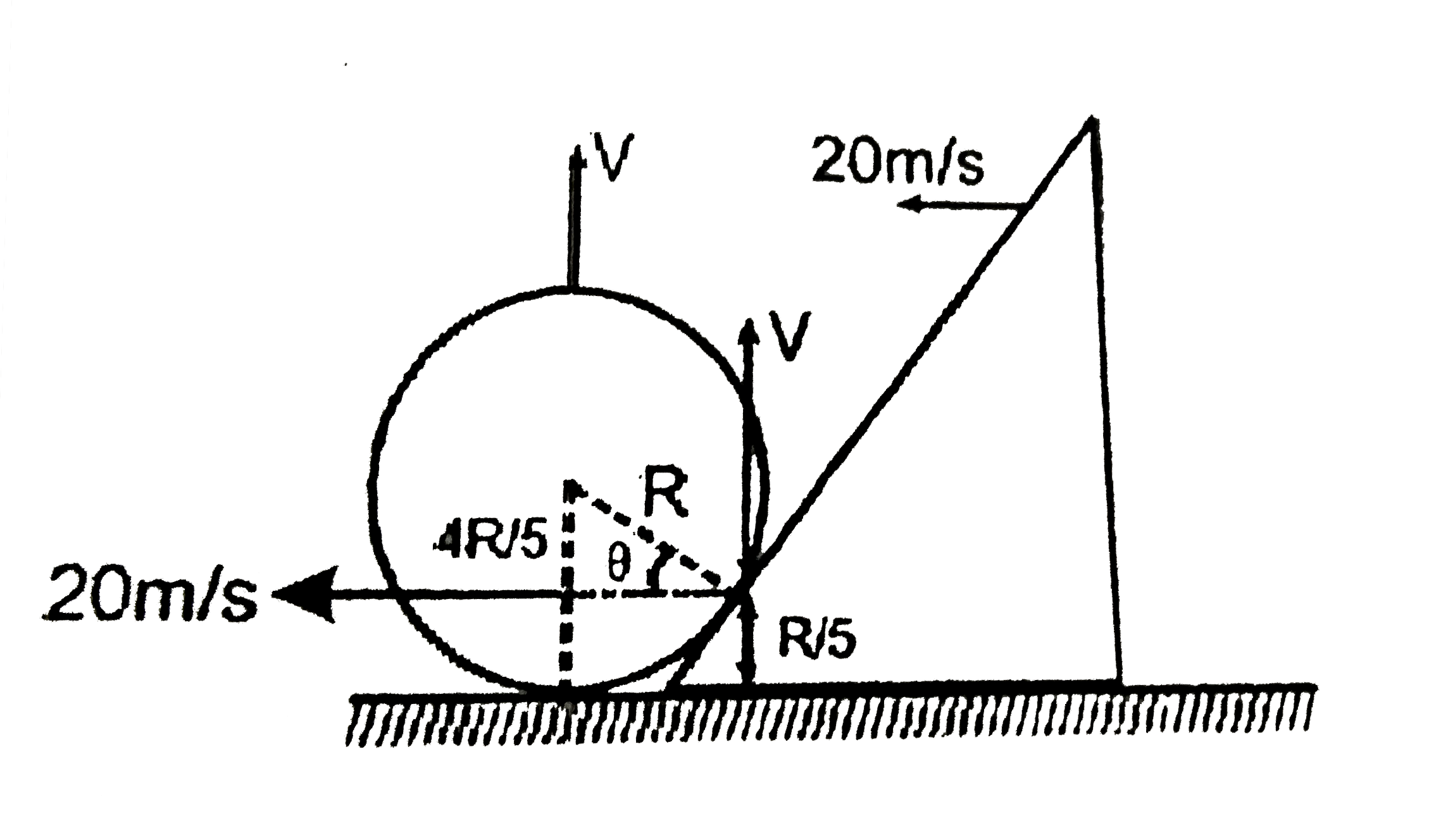 From WEDGE CONSTRAINT `,` `V=20cot theta` `V=20xx(3)/(4)=2.5m//s.` |
|
| 3. |
A bat emits ultrasonic sound of frequency 1000kHz in air. If the sound meets a water surface. What is the wavelength of (a) the reflected sound (b) the transmitted sound? Speed of sound in air is 340ms^(1) and in water 1486 ms^(-1) |
| Answer» Solution :(a) `3.4 xx 10^(4)m` (B) `1.49 xx 10^(-3)m` | |
| 4. |
If J is the angular momentum and E is the kinetic energy, then (J^2)/Ehas the dimensions of |
|
Answer» MOMENT of Inertia |
|
| 5. |
Two identical rods are joined to form an 'X'. The smaller angle between the rods is theta. The moment of inertia of the system about and axis passing through the point of intersection of the rods and perpendicular to their plane is |
|
Answer» `ALPHA COSTHETA` |
|
| 6. |
In the cyclic process shown on the V-p diagram, the magnitude of the work done is |
|
Answer» <P>`PI[(P_(2)-P_(1))/2]^(2)` |
|
| 7. |
What do you mean by inertia of motion? Give one example |
| Answer» SOLUTION :WHENTHE busis inmotionand IFTHE BRAKE isappliedsuddenlypassengersmoveforwardEg:Theinabilityof anobjectto changeits stateofuniformspeedon itsownin calledinertiaof MOTION | |
| 8. |
A small glass marble of mass.m. oscillates between the two edges, inside a hemispherical glass bowl of radius .r..If .V is the speed of marble at the lowest position, the normal reaction at that position is: |
| Answer» Answer :D | |
| 9. |
The displacement of a SHM particle is y= 3 sin omega t+4 cos omega t then its amplitude will be…… |
|
Answer» `7` `y= A sin omega t+ B cos omega t` with equation `y= 3sin omega t+4 cos omega t` `A= 3" and "B= 4` AMPLITUDE `a= sqrt(A^(2)+B^(2))` `= sqrt((3)^(2)+(4)^(2))` `THEREFORE a= 5`. |
|
| 10. |
Match the parameters given in column I with the expressions given in column II. {:("Column I","Column II"),("1. Pressure of a gas",(i)(KT)/sqrt2pid^2P),("2. RMS speed of gas molecules ",(ii) sqrt((2KT)/m)),("3. Mean free path ",(iii) KT/(sqrt3piP^2)),("4. Most probable speed of gas molecules",(iv) sqrt((3KT)/m)),(,(v)1/3mnv^2),(,(vi)1/3KT):} |
|
Answer» 1 - (VI) , 2 - (i) , 3- (iv) , 4 - (ii) |
|
| 11. |
Show that C _(V) = (R )/(gamma -1) |
|
Answer» <P> SOLUTION :`C _(P) - C _(V) = R and GAMMA = ( C _(P))/(C _(V)) so gamma C _(v) = C _(P)``gamma C _(V) - C _(V) = R, C _(v) (gamma +1) = R or C_(V) = (R )/(gamma -1)` |
|
| 12. |
50gm of water and an equal volume of alcohol (Sp.gravity = 0.8) are placed one after another in a calorimeter of water equivalent 2gm. They are found to cool from 60°C to 55°C in 2 min. and 1 min respectively. The sp.heat of Alcohol in Cal gm""^(-1)""^(@) C is |
|
Answer» `0.1` |
|
| 13. |
Figure given along side shows a block pressed against a rough vertical wall with a force F as shown in side view . Column -I shows angle at which force F is applied and Column-II givesinformation about corresponding friction force , match them . |
|
Answer» `sin theta lt (75)/(100) , sin theta lt (3)/(4) , thetalt 53^(@)`  (c) `theta = 53^(@) , F sin 53^(@) = 100 XX (4)/(5) =80 N` `therefore f = 80 - 75 = 5 N` (STATIC, downward) `therefore(c) to (q) , (r)` (d) `theta = 0^(@) , F sin 0^(@) = 0 ( therefore f` is upward) `f_("limit") = mu N= mu F cos theta = 0.1 xx 100 xx (4)/(5) = 8 N` Thus, friction is kinetic because (0 + 8) N is less than 75 N , `therefore (d) to (p) , (s)` (a) `theta = 37^(@) , F sin theta = 100 xx (3)/(5) = 60 N( therefore` f is upward) mg = 75 N `f_("limit") = 8 N` `therefore ` f is kinetic and upward. (b) `theta = 45^(@) , F = sin 45^(@) = (100)/(SQRT2) = 50 sqrt2 = 70.7 N` `f_("limit") = 8 N` Thus , `mg lt (F sin theta + f_("limit") )` and f is static and upward . |
|
| 14. |
A) A body of low Thermal capacity gets heated or cooled quickly B) Good emitters are bad reflectors |
|
Answer» Both A&B are TRUE |
|
| 15. |
On a frictionless surface, a blockof mass . Mmoving at speed v collides elastically with another blockof same mass M which is intiallyat rest /After collisionthe firstblockmoes at an angle thetato its initial direction and has a speed v/3 The second block's speed after the collision is : |
|
Answer» `(sqrt(3))/2v` ` :. ` Kinetic energy before collision = kinetic energy after collision ` :. 1/2 mv^(2)+0=1/2m (v/3)^(2) +1/2m(v)^(2)` After collision , v is the SPEED of second block . ` :. v^(2) = (v^(2))/9+(v)^(2)` ` :. (9V^(2)-v^(2))/9 =(v)^(2)` ` :. (8v^(2))/9 = (v)^(2)` ` :. v = (2sqrt(2))/3 v ` |
|
| 16. |
A porcelain crucible is filled with 1kg of mercury at room temperature (20^(@)C). The crucible is then placed inside a furnance, kept there for sufficient time and finally removed. It is found that it contains only 0.8Kg of mercury. Calculate the temperature of the furnace. (Average cubical expansivity of mercury =18.2xx10^(-5)K^(-1) and that of porcelain=2xx10^(-5)K^(-1)) |
|
Answer» |
|
| 17. |
Which of the following is zero at the highest point in vertical circular motion ? |
|
Answer» VELOCITY of the PARTICLE |
|
| 18. |
A ball falls verically onto a floor, with momentum p, and then bounces repeatedly. The coefficient of restitution is e. The total momentum imparted by the ball to the floor is |
|
Answer» <P>`P(1+E)` |
|
| 19. |
A shell of mass m is fired from a cannon at angle q to the horizontal with a velocity V. The shell at the highest point breaks into two fragments having masses in the ratio 2:3. The lighter fragment has a velocity zero immediately after explosion and falls vertically downward. the velocity of the other fragment just after explosion is |
|
Answer» `5V COS q` |
|
| 20. |
A photograph the magnifying power of telescope (f_0= focal length of the objective and f_e= focal length of the eye lens) |
|
Answer» The IMAGE of HOUSEFLY will be reduced |
|
| 21. |
A block is moving on an inclined plane making an angle 45^(@) with the horizontal and the coefficient of friction is mu . The force required to just push it up the inclined plane is 3 times the force required to just preventit from sliding down . If we define N = 10 mu , then N is : |
|
Answer» mg (SIN `45^(@) + mu` cos `45^(@)`) = 3 mg (sin `45^(@) - mu "cos" 45^(@))` `(1)/(sqrt2) ( 1+ mu) = (3)/(sqrt2) (1 - mu)` `mu = 0.5` `therefore "" N= 10 mu` = `10 XX 0.5` N = 5 |
|
| 22. |
Helium gas goes through a cycle ABCDA as shown in figure. Efficiency of this cycle is nearly _______ (Imagine He is an ideal gas) |
|
Answer» `9.1%` (Cyclic process is clockwise so work is positive) `therefore` W=Area of ABCD =AB x BC `=(2P_0-P_0)xx(2V_0-V_0)` `therefore W=P_0V_0` …(1) For He gas, Specific heat at constant VOLUME `C_v=3/2R` and Specific heat at constant pressure `C_p=5/2R` Heat absorbed (along path AB) at constant volume , `(DeltaQ)_(AB)=muC_VDeltaT=3/2muR DeltaT` `=3/2xxDeltaP V_0 [because PV=muRT]` `=3/2(2P_0-P_0)V_0=3/2P_0V_0` Heat absorbed (along path BC ) at constant pressure, `(DeltaQ)_(BC)=muC_P DeltaT =5/2muR DeltaT` `=5/2 (2P_0)DeltaV[because MUR DeltaT=PV]` `=5/2(2P_0)(2V_0-V_0)` `=5/2(2P_0xxV_0)` `=5P_0V_0` Heat is not absorbed at path CD and DA, `therefore` Total heat absorbed `Q_1=3/2P_0V_0+5P_0V_0` `=13/2P_0V_0` ...(2) `therefore` Efficiency `eta=W/Q_1` `=(P_0V_0)/(13/2P_0V_0)` (`because` From eq.(1) and (2)) `=2/13xx100%` =15.38% `approx` 15.4% |
|
| 23. |
The melting point of an alloy is usually |
|
Answer» LOWER than those of the constituents |
|
| 24. |
Air is pushed into a soap bubble of radius r to double its radius. If the surface tension of the soap solution is S, the work done in the process is |
|
Answer» `8pir^(2)S` |
|
| 25. |
If number of molecules of H_2 are double than that of O_2, then ratio of kinetic energy of hydrogen and that of oxygen at 300K is |
|
Answer» `1:1` |
|
| 26. |
A monoatomic ideal gas, initially at temperature T_(1) is enclosed in a cylinder fitted with a frictionless piston. The gas is allowed to expand adiabatically to a temperature T_(2) by releasing the piston suddenly. If L_(1) and L_(2) are the lengths of the gas column. before and after expansion respectively, then (T_(1))/(T_(2)) is given by |
|
Answer» Solution :For monoatomic gas `gamma = 5//3` For ADIABATIC process, `TV^(gamma-1)` = constant `:. T_(1)(L_(1)A)^(2//3) = T_(2)(L_(2)A)^(2//3)` `:. (T_(1))/(T_(2)) = ((L_(2))/(L_(1)))^(2//3)`. |
|
| 27. |
Which of the following error is not systematic error? |
|
Answer» LEAST COUNT ERROR |
|
| 28. |
Two horizontal pipes of radii 1 cm and 2cm are connected with one-another. Water is flowing through them. If the velocity of water in first pipe is 8 ms^(-1) and the pressure is 1.0 xx 10^(5) Nm^(-2), then pressure (in N m^(-2)) and velocity (inms^(-1)) of water in second pipe are (Density of water = 10^(3) kg m^(-3)) |
|
Answer» <P>`1.0 xx 10^(5), 8` `A_(1) v_(1) = A_(2) v_(2) :. (v_(2))/(v_(1)) = (A_(1))/(A_(2)) = (pi r_(1)^(2))/(pi r_(2)^(2)) = ((r_(1))/(r_(2)))^(2) or v_(2) = v_(1) ((r_(1))/(r_(2)))^(2)= 8 ((1)/(2))^(2) = (8)/(4) = 2 ms^(-1)` From Bernoulli.s theorem, `P_(2) = P_(1) + (1)/(2) RHO (v_(1)^(2) - v_(2)^(2))` `= 1.0 xx 10^(5) + (10)/(2) xx 10^(3) xx (8^(2) -2^(2)) = 1.3 xx 10^(5) Nm^(-2)` |
|
| 29. |
Identify the unit vector in the following . |
|
Answer» `HATI+hatj` |
|
| 30. |
Define horizontal range. |
| Answer» Solution :The HORIZONTAL DISTANCE covered by the projectile from the FOOT of the tower to the POINT where the projetile hits the ground is called horizontal range . | |
| 31. |
State and explain the charateristics of vector product of two vectors. |
|
Answer» Solution :(1) `vecaxxvecb=vecbxxveca` The vector product of two vector is not commutative ut `vecaxxvecb=-vecbxxveca` is opposite to each other. However `|vecaxxvecb|=|vecbxxveca|` (2) Scalar product act behave like reflection (taking image in mirror) `xrarr-x,yrarr-yandzrarr-z`. In reflection occurrence all components change sign mean positive vector becomes negative. So, `vecaxxvecbrarr(-veca)xx(-vecb)=vecaxxvecb` Hence, in reflection sign is not change in resultant. (3) Vector product obeys distributive law : `vecaxx(vecb+vecc)=vecaxxvecb+vecaxxvecc` (4) For two non-zero vectors `vecaxxveca=vec0` where `vec0` is vector of zero modulus Here `vecaxxveca=(a)(a)SIN0^(@)hatn` `=vec0` (`because` Angle between `veca and veca` is `0^(@)`) Hence, condition of parallel or anti parallel of two non-zero vectors is that its vector product should be zero. (5) If two non-zero vector is perpendicular, then `vecaxxvecb=ab SIN90^(@)hatn` `=abhatn` where `hatn` is unit vector in direction of `veca xx vecb`. (6) Vector product for unit vector of cartesian co-ordinate system. In cartesian co-ordinate system `hati,HATJ and hatk` are the unit vectors in the direction of X, Y and Z-axis respectively, `therefore hatixxhati=|1||1|sin0^(@),hatn` `=vec0` `hatjxxhatj=|1||1|sin0^(@).hatn` `=vec0` and `hatkxxhatk=|1||1|sin0^(@).hatn` `vec0` and `hatixxhatj=|1||1|sin90^(@).hatn` `=1hatk` [`because hatk` is perpendicular unit vector of the plane `hatixxhatj`] `=1(hatk)` `=hatk` Similarly `hatjxxhatk=hatiandhatkxxhati=hatj` and `hatjxxhati=-hatk` `hatkxxhatj=-hatiandhatixxhatk=-hatj`  (7) Vector product of two vectors in cartesian co-ordinate system : Suppose `veca=a_(x)hati+a_(y)hatj+a_(z)hatk` and `vecb=b_(x)hati+b_(y)hatj+b_(z)hatk` then `vecaxxvecb=(a_(x)hati+a_(y)hatj.+a_(z)hatk)xx(b_(x)hati+b_(y)hatj+b_(z)hatk)` `=a_(x)b_(x)(hatixxhati)+a_(x)b_(y)(hatixxhatj)+a_(x)b_(z)(hatixxveck)` `+a_(y)b_(x)(hatjxxhati)+a_(y)b_(y)(hatjxxhatj)+a_(y)b_(z)(hatjxxhatk)` `+a_(z)b_(x)(hatkxxhati)+a_(z)b_(y)(hatkxxhatj)+a_(z)b_(z)(hatkxxhatk)` `therefore` From property (6) result, `vecaxxvecb=a_(x)b_(y)(hatk)+a_(x)b_(z)(-hatj)+a_(y)b_(x)(-hatk)+a_(y)b_(z)(hati)+a_(z)b_(x)(hatj)+a_(z)b_(y)(-hati)` `=a_(y)b_(z)hati-a_(z)b_(y)hati+a_(z)b_(x)hatj-a_(x)b_(z)hatj+a_(x)b_(y)hatk-a_(y)b_(x)hatk` `vecaxxvecb=|(hati,hatj,hatk),(a_(x),a_(y),a_z),(b_(x),b_(y),b_(z))|` |
|
| 32. |
Water flows faster than honey. Why? |
| Answer» Solution :` V prop 1//eta.`For boney is high so the volume (1) of honey flowing will be LESS COMPARED to water which has low VALUE for `eta.` | |
| 33. |
When a mass M hangs from a spring of length l, it stretches the spring by a distance x. Now the spring is cut in two parts of length l/3 and 2l/3, and the two springs thus formed are connected to a straight rod of mass M which is horizontal in the configuration shown in figure. Find the stretch in each of the spring. |
|
Answer» Solution : As it given that the mass M stretches the original spring by a distance x, we have `kx = Mg` (or) `k=(Mg)/(x)`......... (1) The new force CONSTANTS of the two springs can be given by using equations `k_1 = (k_(eg) L)/(l_1) and k_2=(k_(eq)l)/(l_2) as , k_1 = 3k and k_2=(3k)/(2)` Let we takethe stretch in the two springs be `x_1 and x_2 ` we have for the equilibrium of the rod `k_1 x_1 + k_2 x_2 = Mg` (or) ` 2kx_1 + (3k)/(2) x_2 = Mg` From equation (1) , we have ` x_1 +(x_2)/(2)=(x)/(3)`......... (2) As the rod is horizontal and in static equilibrium , we have net torque ACTING on the rod about any point on it must be zero. Thus we have torquie on it above end A are `k_2x_2L=Mg(L)/(2)` (or) `x_2=(Mg)/(2k_2)=(Mg)/(3k)=(x)/(3)` Using this value of `x_2 ` in equation (2) , we have `x_1=(x)/(6)` This can also be directly obtained by using torque zero about point B on the rod as `k_1x_1L=Mg(L)/(2)` (or) ` x_1= (Mg)/(2k_1)=(Mg)/(6k)=(x)/(6)` |
|
| 34. |
If vec(A) and vec(B)are two vectors , vec(A) . vec(B) = vec(A) xx vec(B)then resultant vector is : |
|
Answer» A + B |
|
| 36. |
Can a particle have a constant velocity and varying speed ? |
| Answer» SOLUTION :No, if VELOCITY is CONSTANT , the MAGNITUDE of the instaneous velocity , i.e., SPEED is constant | |
| 37. |
Surafce tension is exhibited by liquids due to force of attraction between the molecules of the liquid .The surface tension decreases with increases in temperature and vanishes at boiling point Given that the latent heat of vaporization for water L_(v)=540(kcal)/(kg)the mechanical equivalent of heat J=4.2(J)/(cal) density of water rho_(w)=10^(3)kgl^(-1),Avogadro'sno.N_(A)=6.0xx10^(26)k " mole"^(-1).Molecular weight ofwater M_(A)=10kg, for 1k mole .(a)Estimate the energyrequired for one molecule of water to evaporated. (b)Show that the inter molecular distance for water is d=((M_(A))/(N_(A))xx(1)/(rho_(w)))^((1)/(3)) and find its value. (c ) 1 g of water in the vapour state at 1 atm occupies 1601cm^(3) , estimate the intermolecular distance at boiling point in the vapour state. (d) During vaporisation a molecule overcomes a force F, assumed constant to go from an inter molecular distance d to d .Estimate the value of F.(e ) Caculate (F)/(d) , which isa measure of the surface tension. |
|
Answer» Solution :(a)`L_(V)=540kcal kg^(-1)` `=540xx10^(3)calkg^(-1)` `=540xx10^(3)xx(4.2J)kg^(-1)` 1kg of water requires `L_(v)Kcal`. `thereforeM_(A)kg` of water requires `M_(A)L_(v)Kcal.` `therefore` Mass of 1 mol water is `M_(A)`.There are `N_(A)` molecules in it . The energy required for 1 molecules in evaporate is `M_(A)L_(v)`. `U=(M_(A)L_(v))/(N_(A))J` `=((18)(540)(4.2xx16^(3)))/(6XX10^(26))J` `=6.8xx10^(-20)J` (b)Consider the water molecules to be points at a distanced from each other. Volume of `N_(A)` molecules of water `=(M_(A))/(rho_(w))` Volume of one molecule `d^(3)=(M_(A))/(N_(A)rho_(w))` `therefored=[(M_(A))/(N_(A)rho_(w))]^((1)/(3))` `therefored=[(18)/(6xx10^(26)xx10^(3))]^((1)/(3))` `therefored=(30xx10^(-30))^((1)/(3))` `d=3.1xx10^(-10)m` (c)The volume occupied by 1kg of vapour = `16.1cm^(3)` . The volume occupiedby `10^(-3)kg` of vapour=`1601xx10^(-6)m^(3)` `therefore` The volume occupied by 1kg of vapour `=1601xx10^(-3)m^(3)`....(1) Volumeoccupied by 1 kg of vapour `=1601xx10^(3)m^(3)` `therefore` Volume occupied by 18 kg of vapour `=18xx1601xx10^(-3)m^(3)` (But `M_(A)=18kg//kmol)`that is `18kg=6xx10^(26)` molecules`therefore` The volume of mass occupied by `6xx10^(26)=18xx1601xx10^(-3)m^(3)` `therefore` The volume occupied by 1 molecules occupies =? `=(18xx1601xx10^(-3))/(6xx10^(26))` `=(3xx1601xx10^(-29))m^(3)` If `d_(1)`is the inter molecular distance , then `d_(1)^(3)=(3xx1601xx10^(-29))m^(3)` `therefored_(1)^(3)=30xx1601xx10^(-30)` `therefored_(1)=(30xx1601)^((1)/(3))xx10^(-10)m` `d_(1)=36.3xx10^(-10)m` (d)Distance between molecules of water =d Distance between molecules of vapour `=d_(1)` (For vapour `d_(1)gtd`, more intermolecular distance then water) Work done from distance d to `d_(1)` `W=F(d_(1)-d)` This work done (energy)is required to 1 MOLEOF water into vapour. `F(d_(1)-d)=6.8xx10^(-20)` `F=(6.8xx16^(-20))/(d_(1)-d)` `F=(6.8xx10^(-20))/((36.3xx10^(-10)-3.1xx16^(10)))` `=2.05xx10^(-11)N` (e )Surface tension `=(F)/(d)` `=(2.05xx10^(-11))/(3.1xx10^(-10))` `=6.6xx10^(-2)N//m` |
|
| 38. |
The ceiling of a long hall is 20m high. What is the max imum horizontal distance that a ball thrown with a speed of 40ms^(-1) can go without hitting the ceiling of the hall (g=10ms^(-2))? |
|
Answer» Solution :Here, H=20m, `u=40ms^(-1)`. Suppose the ball is thrown at an ANGLE `theta` with the horizontal. Now, `H=(u^(2)sin^(2)theta)/(2G)rArr=((40)^(2)sin^(2)theta)/(2XX10)` or, `sintheta=0.5 ""or, theta=30^(@)` Now `R = (u^(2).sin2theta)/(g)=((40)^(2)xxsin120^(@))/(10)` `((40)^(2)xx0.866)/(10)=138.56cm` |
|
| 39. |
A new unit of length is chosen such that the speed of light in vscuum is unity. What is the distance between the sun and the Earth in terms of the new unit if light takes 8 min and20 s to cover this distance. |
|
Answer» 100 new unit Time = 8 min and 20 sec = 500 sec Distance b/w SUN and earth = Speed `xx` Time = 1 `xx` 500 = 500 unit |
|
| 40. |
A certain volume of dry air at 20^(@)C is expanded to three thimes its volume (i) Slowly, (ii) suddenly. Calculate the final pressure and temperature in each case. Atmosperic pressure = 10^(5) Nm^(-2), gamma of air = 1.4 |
|
Answer» pV=a cosntant `therefore10^(5)V=p_(2)3 V or p_(2)=(10^(5)/(3)=3.3xx10^(4)Nm^(-2)` When the process is SUDDEN, it adiabatic In a adiabatic change ltbRgt `TV^(GAMMA-1)= a constant` or `293V^(0.4)=(273+t)3^(0.4),or(273+t)=(293)/(3)^(0.4)` `therefore log(273+t)=log293-log3^(0.4)=log293-0.4log3` `therefore 273+1 = antilog 2.2761= 188.8` For an adiabatic change `pV^(gamma)=constant` `therefore 10^(5)V^(1.4)=p_(2)(3V)^(1.4)`, or `10^(5)V^(1.4)V^(1.4)` or `p_(2)=106(5)/(3)6(1.4)` `therefore logp_(2)-log 106(5)-1.4log3=5-1.4xx0.4771=5-0.6679=4.3321` `therefore P_(2) = antilog 4.3321 = 2.15xx10^(4)Nm^(-2)` In the slow process final temperature `= 20^(@)C` and pressure `= 3.3xx106(4)Nm^(-2)` In the sudden processfinal temperature`=-84.2^(@)C` and pressure `= 3.3 xx10^(4)Nm^(-2)` In the sudden process final tempeature`=-84.26^(@)C` and pressure `= 2.15xx10^(4)Nm^(-2)` |
|
| 41. |
If a particle is executing SHM on a straight line. A and B are two points at which its velocity is zero. It passes through a certain point P (AP < PB) at successive intervals of 0.5 sec and 1.5 sec with a speed of 3 m/s. The maximum speed of the particle is |
|
Answer» 3 m/s |
|
| 42. |
Why are the bridges declared unsafe after long use ? |
| Answer» SOLUTION :A BRIDGE during its use undergoes alternating strains a large number of times every DAY . When a bridge is used for long time it loses its elastic strength . Due to this the strain produced for a given STRESS may be quite large . ASA result the bridge may collapse . To avoid this the bridges are decleared unsafe after long use . | |
| 43. |
What is geostationary satellite ? For remain geostationary obtain the equation of its height from the surface of earth. |
|
Answer» SOLUTION :`implies` If any EARTH.s satellite having orbital periodic time of 24 hours equal to the periodic time of rotation of the earth about its own axis and it appears always stationary as viewed from the earth and it REVOLVE around the earth in the equatorial plane in east-west direction then such type of satellite is known as GEOSTATIONARY satellite. `implies` For this it is placed with suitable height (h) from the earth.s surface. `implies` If a satellite of mass m revolves at distance `r=R_(E)+h`from the centre of earth, height from the earth.s surface is as below. `h=((GM_(E)T^2)/(4pi^2))^(1/3)-R_E` T = 24 HOUR, then h = 35,800 km `implies` This satellite is widely used for telecommunication. |
|
| 44. |
Find the centre of mass of a triangular lamina. |
Answer» Solution :The lamina `(∆LMN)` MAY be subdivided into narrow strips each parallel to the base (MN) as shown in Fig. 7.10  By symmetry each strip has its centre of mass at its midpoint. If we join the midpoint of all the strips we get the median LP. The centre of mass of the triangle as a WHOLE THEREFORE, has to lie on the median LP. SIMILARLY, we can argue that it lies on the median MQ and NR. This MEANS the centre of mass lies on the point of concurrence of the medians, i.e. on the centroid G of the triangle. |
|
| 45. |
One mole of a monoatomic gas is mixed withone mole of a diatomic gas. What will be the gammafor the mixture? |
|
Answer» 1.5 |
|
| 46. |
If compressibility of material is 4xx10^(-5) per atm, pressure is 100 atm and volume is 100 cm^(3) then find triangleV=? |
|
Answer» `0.4 CM^(3)` |
|
| 47. |
A vessel at rest explodes breaking it into three pieces. Two pieces having equal mass fly off perpendicular to one another with the same speed of 30 m//s. The third piece has three times the mass of each of the other two pieces. What is the direction (w.r.t. the pieces having equal masses) and magnitude of its velocity immediately after the explosion? |
|
Answer» `10sqrt(2), 135^(@)`  Accoprding to FIGURE `3mvcostheta="mu"3mvsintheta="mu"` `tantheta=1`or `theta=45^(@)` Hence `3mvcos45^(@)="mu"` or `(3v)/sqrt2=u=30m//s` or `v=10sqrt2m//s` |
|
| 48. |
If vecA, vecB,vecC are the three vectors the angle between vecA,vecB is alpha, vecB and vecCis beta and vecC and vecA is gamma, and k is constant then match the following. |
|
Answer» a-1, b-2, C-3 |
|
| 49. |
A string of length 20 cm and linear mass density 0.40 g//cm is fixed at both ends and is kept under a tension of 16 N . A wave pulse is produced at t = 0near an ends as shown in Fig. 7.17 (b) , which travels towards the other end . When will the string have the shape shown in the Fig . ( c). |
|
Answer» SOLUTION :Given `mu = 0.40 g//CM = ( 0.40)/(1000) xx 100 = 0.040 kg//m` Wave speed in the stretched string , ` V = sqrt ((F)/(mu)) = sqrt((16)/( 0.040)) = 20 m//s` The string will have the same shape after the pulse TRAVELS a distance ` = 20 + 20 = 40 cm` THUS time period ` t = 0.40//20 = 0.02 s` |
|
| 50. |
What do you understand by the term precession? |
| Answer» Solution :The torque about the AXIS will ROTATE the object about it and the torque PERPENDICULAR to the axis will turn the axis of rotation. When both exist simultaneously on a rigid body, the body will have a precession. One can witness the precessional motion in a spinning TOP when it is about to come to rest. | |