Saved Bookmarks
This section includes 7 InterviewSolutions, each offering curated multiple-choice questions to sharpen your Current Affairs knowledge and support exam preparation. Choose a topic below to get started.
| 1. |
A closed tube partly filled with water lies is a horizontal plane. If the tube is rotated about perpendicular bisector, the moment of inertia of the system. ...... |
|
Answer» increases |
|
| 2. |
A car of mass 1000 kg moves on horizontal road with velocity of 30 m/s. When driver applies brake, constant retarding force of 40 kN is applied, retardation of car will b e ..... |
|
Answer» 2 `m//s^(2)`  `F= 40 kN = 40xx 10^(3) N` DUETO retardatin therewill benegativesign `a= -4 m//s` |
|
| 3. |
In the last problem, the rope is placed on the cylinder as shown. Find maximum tension in the rope. |
|
Answer» |
|
| 4. |
A particle is pojected from the ground at an angle of theta with the horizontal with an initial speed of u. Time after which velocity vector of the projectile is perpendicular to the initial velocity is |
|
Answer» `U//(g SIN THETA)` |
|
| 5. |
We can get vapour State of a substance through the process of |
|
Answer» boiling |
|
| 6. |
Energy of a body is defined as its capacity of doing work. A body of mass 5 kg initially at rest is subjected to a horizontal force of 20 N. What is the kinetic energy acquired by the body at the end of 10 s? |
|
Answer» SOLUTION :`a=F/m=20/5=4ms^-2` `v=u+at=0+4xx10=40ms^-1` `KE=1/2mv^2=1/2xx5xx(40)^2=400J` |
|
| 7. |
A uniform disc is rotating at a constant speed in a vertical plane about a fixed horizontal axis, passing through the centre of the disc. A piece of disc from its rim detaches itself from the disc at the instant when it is, on the same horizontal with the centre of the disc and moving upwards. lien about the fixed axis, the angular speed of the |
|
Answer» remaining disc remains unchanged  Velocity of broken away piece decreases initially then increases. |
|
| 8. |
A satellite is revolving near the earth.s surface. Its orbital velocity is nearly |
|
Answer» `5.8 KMS^(-1)` |
|
| 9. |
A solid sphere rolls down two different inclined planes of the same heights but different angles of inclination. (a) Will it reach the bottom with the same speed in each case? (b) Will it take longer to roll down one plane than the other? (c) If so, which one and why? |
| Answer» Solution :(a) Yes, (b) Yes, (c) the PLANE with SMALLER inclination (`because a α SIN θ`) | |
| 11. |
Two block of equal mass m are connected byan unstretched spring and the sytem is keptat rest on a frictionless horizontal surface. A constant force F is applied on one of the blocks puling it away from the other as shown in figure. a.Find the positon of the centre of mass at time t. b.If the extansion of the spring is x_0 at time t find the displacement of the two blocks at this instant. |
|
Answer» Solution :a. The acceleration of the centre of MASS is given by `a_(CM) =F/M=F/(2M) ` The position of the centre of mass at time to is `x=1/2a_(CM) t^2=(Ft^2)/(4m)` b. Suppose the displacement of the first block is `x_1` ANDTHAT of the SECOND is `x_2`. As the centre of mass is at x, we should have `x=(mx_1+mx_2)/(2m)` `or, (Ft^2)/(4m)=(x_1+x_2)/2` `or, x_1+x_2=(Ft^2)/(2m)` .......i the extension of th spring is `x_2-x_1`. therefore `x_2-x_1=x_0` ......ii ltbr `from i and ii `x_1=1/2((Ft^2)/(2m)-x_0)` and `x_2=1/2((Ft^2)/(2m)+x_0)`. |
|
| 12. |
'Gulab Jamuns' (assumed to be spherical) are to be heated in an oven. They are available in two sizes, one twice bigger (in radius) than the other. Pizas (assumed to be discs) are also to be heated in oven. They are also in two sizes, one twise big (in radius) than the other. All four are put together to be heated to oven temperature. Choose the correct option from the following: |
|
Answer» both SIZE gulab jamuns will get heated in the same time |
|
| 13. |
A piece of iron sinks in water, but a slip made of iron floats in water. Why? |
| Answer» SOLUTION :Welgist of water displaced by iron piece is not EQUAL to the weight of iron piece. But in the case of ship It can balance its whole weight by the weight of water displaced by a small PORTION immersed in water, DUC to its shape. | |
| 14. |
What is sublimation ? Give name of sublimation substances. |
|
Answer» Solution :There are certain substances which normally pass from the solid to the vapour state DIRECTLY and vice versa. The change from solid state to vapour state without PASSING through the liquid state is called sublimation, and the substance is said to sublime. Dry ICE (solid `CO_(2)`) sublimes, so also iodine. During the sublimation process both the solid and vapour states of a substance coexist in THERMAL EQUILIBRIUM. |
|
| 15. |
Can the sun become a black hole ? |
| Answer» Solution :No, since a STAR can become a black HOLE only when its initial MASS is 10 times the mass of the sun. | |
| 16. |
F=(Gm_1m_2)/r^2 is valid |
|
Answer» Between BODIES with any shape |
|
| 17. |
Which of the following are vectors? (i) Angular displacement, (ii) Angular velocity, (iii) Angular acceleration. (iv) Moment of inertia. |
| Answer» Solution :A SMALL angular displacement is a vector: Angular velocity and angular acceleration are VECTORS. MOMENT of INERTIA is a scalar. | |
| 18. |
The direction cosines of a vector vec(A) are cos alpha = (4)/(5sqrt(2)), cos beta = (1)/(sqrt(2)) and cos gamma = (3)/(5sqrt(2)), then the vector vec(A) is |
|
Answer» `4hat(i) + hat(J) + 3hat(K)` |
|
| 19. |
A wire of length 1.0 m and radius 10^(-3) m is carrying a heavy current and is assumed to radiate as a black body. At equilibrium, its temperature is 900K, while that of the surroundings is 300K. The resistivity of the material of the wire at 300K is pi^(2)xx10^(-8) ohm-m and its temperature coefficient of resistance is 7.8xx10^(-3)//""^(0)C. The current (in ampere) in the wire is 6x. Find .x.. (Given Stefan.s constant =5.68xx10^(-8)" W"//"m"(2)//K^(-4)). |
|
Answer» |
|
| 20. |
A wheel of moment of inertia I_(1)rotates about a vertical frictionless axle with an angular velocity omega_(1). A second wheel of moment of inertia I_2 and initially at rest drops onto the first wheel. The two wheels attain a common angular velocity of omega_(2) . (a) What is the value of omega_(2) ? (b) What is the ratio of the initial to the final rotational energy ? |
| Answer» SOLUTION :`omega_(2)=I_(1)OMEGA(1)//I_(1) + I_(2), K.E_(i)//K.E_(F) =(1//2) I_(1)omega_(2)^(2) = I_(1) + I_(2)//I_(1)` | |
| 21. |
A girl is in standing position in an oscillating swing. If the girl sits in the swing, the frequency of oscillation |
|
Answer» Increases |
|
| 22. |
A car starts from rest and moves on a surface in which the coefficient of friction between the road and the tyres increases linearly with distance (x). The car moves with the maximum possible acceleration. The kinetic energy (E) of the car will depend on x as |
|
Answer» `E PROP 1/(x^2)` or `int_0^v vdv = int_0^x alpha g x dx " or " 1/2 mv^2 = 1/2 m alpha g x^2" or " E prop x^2`. |
|
| 23. |
A body falling freely under gravitypassestwo points 30 m apart in 1 s. find from what point above the upper point it began to fall ? Take g 9.8^(-2) |
|
Answer» |
|
| 24. |
It is difficult to heal wound on mountain. |
| Answer» Solution :The AIR pressure is low on mountain , where as the pressure of BLOOD REMAINS the same . Because of this DIFFERENCE in pressure ,blood comes out of the body .so ,it is diffcult to HEAL wound on the mountain. | |
| 25. |
The moment of inertia of a solid sphere of radius R about its diameter is same as the that of disc of radius 2R about its diameter. The ratio of their masses is - |
|
Answer» `5:2` `or (M_(s))/(M_(d))=(5)/(2)` |
|
| 26. |
A shell of mass 0.020 kg is fired by a gun of mass 100 kg.If the muzzlespeed of the shell is 80 m s^(-1), what is the recoil speed of the gun ? |
|
Answer» Solution :USE MOMENTUM conservation :`100 v = 0.02 xx 80` ` v = 0.016 MS^(-1) = 1.6 cm s^(-1)` |
|
| 27. |
A car is moving in a circular path with a uniform speed v. Find the magnitude of change in its velocity when the car rotates through an angle theta. |
|
Answer» Solution :Change in velocity `VEC(Deltav) = vecv -VECU` The magnitude of change in velocity `Deltav = SQRT(v^(2)+u^(2)-2uvcostheta)` As the SPEED is uniform `= |vecv| = |vecu| = v` `:. Deltav = 2vsin((theta)/(2))`. |
|
| 28. |
Consider a planet moving in an elliptical orbit round the sun. The work done on the planet by the gravitational force of the sun a) is zero in any small part of the orbit b) is zero in some parts of the orbit c) is zero in one complete revolution d) is zero in no part of the motion |
|
Answer» only a & C are TRUE |
|
| 29. |
Three moles of an ideal gas, initially at T_(0)=273K isothermally expanded n=5 times its initial volume and then isochorically heated so that the pressure in the final state became equal to that in the initial state. The total quantity of heat transferred to the gas during the process was Q=80kJ. Represent the whole process ina pV diagram. Find the adiabatic exponent of the gas. |
|
Answer» |
|
| 30. |
100 g of water is heated from 30^@C to 50^@C. Ignoring the slight expansion of the water, the change in its internal energy is : (specific heat of water is 4184 J kg^(-1) K^(-1) ) |
| Answer» ANSWER :B | |
| 31. |
When a force (8hat(i) + 4hat(j)) newton displaces a particle through (3hat(i) - 3hat(j)) metre, the power is 0.6W. The time of action of the force is |
|
Answer» 20s |
|
| 32. |
By joining two wires PQ and QR, having lengths 4.8 m and 2.56 m, having masses 0.06 kg and 0.2 kg having same radii of cross section, a single wire PQR is prepared. When this wire has a tension of 80 N, find time taken by a pulse produced at P to reach at R. |
|
Answer» Solution :Wave SPEED in WIRE PQ, `v _(1) = sqrt ((T)/( mu _(1)) ) sqrt ((T )/( M _(1) // L _(1))) = sqrt ((T L _(1))/( M _(1))) = sqrt (( 80 xx 4.8 )/(0.06 ))= 80 (m)/(s)` SIMILARLY, wave speed in wire OQ, `v _(2) = sqrt (( T )/(mu _(2))) = sqrt ((T)/( M _(2) // L _(2)))= sqrt ((T L _(2))/( M _(2))) = sqrt (( 80 xx 2.56)/( 0.2)) = 32 (m)/(s)` Now, time TAKEN by the wave to travel from P and Q, `t = t _(1) + t _(2) = (L_(1))/( v _(1)) + (L _(2))/( v _(2)) = (4.8)/( 80) + (2.56)/(32)` `=0.06 + 0.08 = 0.14 s ` |
|
| 33. |
The internal energy of ideal gas is independent of the gas in bulk but depends only on the |
|
Answer» IMPURITIES |
|
| 34. |
A body is executing simple harmonic motion with an angular frequency 2 rad/sec. The velocity of the body at 20mm displacement, when the amplitude of motion is 60mm, is |
|
Answer» 90 mm/s |
|
| 35. |
Steam is passed into a calorimeter with water having total thermal capacity 110 cal/gm and initial temperature 30°C. If the resultant temperature is 90°C, the increase in the mass of the water is |
|
Answer» 12 gm |
|
| 36. |
In Fig. find moment of inertia of a plate having mass M, length l and width b about axes 1, 2, 3 and 4. Assume that C is the centre and mass is uniformly distributed. |
|
Answer» Solution :Moment of INERTIA the plate about axis `1` (by taking rods perpendicular to axis`1`) `I_(1)=(Mb^(2))/3` Moment of inertia of the plate about axis `2` (by taking rods PER pendicular to axis `2` `I_(2)=(Ml^(2))/12` Moment of inertia of the plane about axis `3` (by taking rods perpendicular to axis `3`) `I_(3)=(Mb^(2))/12` Moment of inertia of the plate about axis `4` (by taking rods perpendicular to axis `4`) `I_(4)=(Mb^(2))/3` |
|
| 37. |
A massive ball moving with speed v collides head on with a fine ball having mass very much smaller than the mass of the first ball.The collision is elastic. Then, immediately after the impact, the second ball will move with a speed approximately equal to |
|
Answer» v |
|
| 38. |
Which of the following functions of time represent periodic and non-periodic motion? (a) sin omegat+cos omegat (b) e- omegat |
|
Answer» SOLUTION :(a) PERIODIC (B) Non-periodic |
|
| 39. |
The ratio of the accelerations due to gravity at the bottom of a deep mine and that on the surface of the earth is 978/980. Find the depth of the mine if the density of the earth is uniform throughout and the radius of the earth is 6300 km. |
|
Answer» 12.86 km |
|
| 40. |
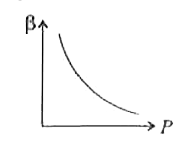
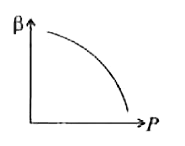
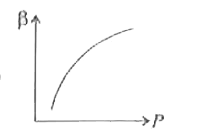
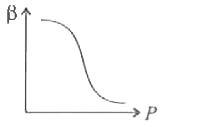
Which of the following graphs correctly represents the variation of beta = -((dV)/(dP))(1)/(V) with P for an ideal gas at constant temperature ? |
|
Answer»
At CONSTANT temperature dT = 0 `rArr VdP + PdV = 0` `PdV = -VdP` `(-dV)/(dP) = ((V)/(P))` or `-((dV)/(dP)) (1)/(V) = (1)/(P) rArr beta = (1)/(P)` `beta P` = constant HENCE the graph could be a rectangular HYPERBOLA as shown in (a). |
|
| 41. |
A wire of length I and radius of cross section is suspended vertically. If Y is Young.s madulus and d is density of the wire, find the increase in length of the wire due to its own weight . |
|
Answer» Solution :ELONGATION of wire on streching `e=(Fl)/(AY)` Here stretching force F = Mg (weight of the wire) will ACT at the centre of gravity of the wire i.o. LENGTH of wire which is stretched will be 1/2. Then `e=(Mgl//2)/(AY)` but`M=dA l and e=(d Al^(2)g)/(2YA)=(l^(2)dg)/(2Y)` |
|
| 42. |
A man weighing 60 kg is in a lift that descends with an acceleration of 4 cmcdot s^(-2). What force will the man exert on the floor of the lift? |
|
Answer» Solution :If the lift descends with an acceleration a, and if the reaction force exerted by the lift on the MAN in the upward direction is R, then mg - R = ma `therefore` Force exerted by the man on the lift.s floor, R= mg - ma [ 4 cm`cdot s^(-2)` ] = 60(9.8 - 0.04) = 585.6 N If the lift ascends with the same acceleration, then reaction force on the man is, R.= mg + ma[ 4 cm`cdot s^(-2) = 0.04 m cdot s^(-2)` ] = 60(9.8 + 0.04) = 590.4 N When the acceleration of the lift, while descending, is a = g, then from equation (1) , we get, R = mg - mg = 0, for this zero reaction force, the man feels weightless. So, for a lift falling freely with an acceleration g, the man inside it will feel no weight. |
|
| 43. |
A steel rod of cross-sectional areaIm^(2) is acted upon by forces shown in the fig. Determine the total elongation of the bar. (Take Y=2.0xxK=8.33xx10^(-11)N//n^(2)) |
Answer» Solution :The ACTION of forces on each part of rod is SHOWN in fig.  We know that the EXTENSION due to external force F is given by `Deltal_(AB)=(FL)/(AY)` `Deltal_(AB)=((60xx10^(3))xx1.5)/(1xx2xx10^(11))=4.5xx10^(-7)m` `Deltal_(BC)=((70xx10^(3))xx1)/(1xx2xx10^(11))=3.5xx10^(-7)m and Deltal_(CD)=((50xx10^(3))xx2)/(1xx2xx10^(11))=5.0xx10^(-7)m` The total extension `Delta=Delta_(AB)+Delta_(BC)+Delta_(CD)` `=4.5xx10^(-7)+3.5xx10^(-7)+5.0xx10^(-7)=13xx10^(-7)m` |
|
| 44. |
The relation PV=RT can describe the behaviour of a real gas at |
|
Answer» HIGH PRESSURE and LOW temperature |
|
| 45. |
Liquid rises to a height of 2cm in a capillary tube. The angle of contact between the solid and liquid is zero. The tube is depressed more now so that the tip of the capillary tube is only 1 cm above the liquid then the apparent angle of contact between solid and liquid is |
| Answer» Answer :C | |
| 46. |
In the case of a freely falling body, which of the graphs will indicate accurately the distance vs variation ? (air resistance is neglected) |
|
Answer»
|
|
| 47. |
A block of mass M is pulled along a horizontal frictionless surface by a rope of mass m. Force F is applied at one end of the rope. Find the force which the rope exerts on the block. |
Answer» Solution :ACCELERATION in (block + rope) SYSTEM i.e., `F=(M+m)a=Ma+ma` The force with which the rope exerts on the black is `P=Ma=M.(F)/((M+m))` |
|
| 48. |
Passage - IV: A perfectly plane house roof makes an angle theta with the horizontal surface. A flat square metal plate of side L rests over the roof. Each day temperature varies between day's high (T_1) and day's low (T_2). Coefficients of thermal expansions of roof and plate are alpha_(1) and alpha_(2) ( alpha_(2) gt alpha_(1) ) respectively. Coefficient of kinetic friction between plate and roof is mu_(k). Plate and roof are always in contact and both have same temperature at every instance of day. Because of difference in coefficients of thermal expansions, each bit of plate is moving relative to the roof, except for points along a certain horizontal line (called stationary line). The stationary line occupies no area, so we assume no force of static friction acting on the plate while the temperature is changing. When the temperature is falling, then distance of the stationary line from bottom edge of plate will be |
|
Answer» `(L)/(2) ( 1- ( TAN THETA )/( mu_(k) ))` |
|
| 49. |
Passage - IV: A perfectly plane house roof makes an angle theta with the horizontal surface. A flat square metal plate of side L rests over the roof. Each day temperature varies between day's high (T_1) and day's low (T_2). Coefficients of thermal expansions of roof and plate are alpha_(1) and alpha_(2) ( alpha_(2) gt alpha_(1) ) respectively. Coefficient of kinetic friction between plate and roof is mu_(k). Plate and roof are always in contact and both have same temperature at every instance of day. Because of difference in coefficients of thermal expansions, each bit of plate is moving relative to the roof, except for points along a certain horizontal line (called stationary line). The stationary line occupies no area, so we assume no force of static friction acting on the plate while the temperature is changing. The distance moved by plate relative to roof (down the roof) in each day is |
|
Answer» `(L ( alpha_(2) - alpha_(1) ) tan theta)/( mu_(k) )` |
|