

Saved Bookmarks
This section includes 7 InterviewSolutions, each offering curated multiple-choice questions to sharpen your Current Affairs knowledge and support exam preparation. Choose a topic below to get started.
| 1. |
Passage - IV: A perfectly plane house roof makes an angle theta with the horizontal surface. A flat square metal plate of side L rests over the roof. Each day temperature varies between day's high (T_1) and day's low (T_2). Coefficients of thermal expansions of roof and plate are alpha_(1) and alpha_(2) ( alpha_(2) gt alpha_(1) ) respectively. Coefficient of kinetic friction between plate and roof is mu_(k). Plate and roof are always in contact and both have same temperature at every instance of day. Because of difference in coefficients of thermal expansions, each bit of plate is moving relative to the roof, except for points along a certain horizontal line (called stationary line). The stationary line occupies no area, so we assume no force of static friction acting on the plate while the temperature is changing. When the temperature is raising, then distance of the stationary line from top edge of plate will be |
|
Answer» `(L)/(2) ( 1- ( tan THETA )/( mu_(k) ))` |
|
| 2. |
State and prove Bernoulli's theorem for a flow of incompressible, non-viscous, and streamlined flow or fluid. |
|
Answer» Solution :Bernoulli's theorem According to Bernoulli's theorem the sum of pressure energy, kinetic energy, and potential energy per UNIT mass of an imcompressible, non-viscous fluid in a streamlined flow remains a constant. Mathematically, `(P)/(rho) + (1)/(2)v^(2) + gh` = constant This is KNOWNAS Bernoulli's equation. Proof :  Let us consider a flow of liquid through a pipe AB as shown in figure. Let V be the volume of the liquid when it enters A in a time t which is equal to the volume of the liquid leving B in the same time. Let `a_(A), v_(A)` and `P_(A)` be the area of cross section of the tube, velocity of the liquid and pressure exerted by the liquid at A respectively. Let the force exerted by the liquid at A is `F_(A) = P_(A)a_(A)` Distance travelled by the liquid in time t is `d = v_(A) t` Therefore, the work done is `W = F_(A)d = P_(A) a_(A) v_(A) t` But `a_(A)v_(A) t = a_(A) d = V`, volume of the liquid entering at A. Thus, the work done is the pressure energy (at A), `W = F_(A)d = P_(A)V` Pressure energy per unit volume at `A = ("Pressure energy")/("volume") = (P_(A)V)/(V) = P_(A)` Pressure energy per unit mass at `A = ("Pressure energy")/("mass") = (P_(A)V)/(m) = (P_(A))/((m)/(V)) = (P_(A))/(rho)` Since m is the mass of the liquid entering at A in a given time, therefore, pressure energy of the liquid at A is `E_(PA) = P_(A)V = P_(A)V xx ((m)/(m)) = m(P_(A))/(rho)` Potential energy of the liquid at A, `PE_(A) = MG h_(A)`, Due to the flow of liquid, the kinetic energy of the liquid at A, `KE_(A) = (1)/(mv_(A)^(2)` Therefore, the TOTAL energy due to the flow of liquid at A, `E_(A) = E_(PA) + KE_(A) + PE_(A)` `E_(A) = m(P_(A))/(rho) + (1)/(2)m v_(A)^(2) + mg h_(A)` Similarly, let `a_(B), v_(B)`, and `P_(B)` be the area of cross section of the tube, velocity of the liquid, and pressure exerted by the liquid at B. Calculating the total energy at `E_(B)`, we get `E_(B) = m(P_(B))/(rho) + (1)/(2)mv_(B)^(2) + mg h_(B)` From the low of conservation of energy, `E_(A) = E_(B)` `m_(P_(A))/(rho) + (1)/(2) mv_(A)^(2) + mgh_(A) = m(P_(B))/(rho) + (1)/(2) mv_(B)^(2) + mgh_(B)` `(P_(A))/(rho) + (1)/(2)v_(A)^(2) + gh_(A) = (P_(B))/(rho) + (1)/(2) v_(B)^(2) + gh_(B)` = constant Thus, the above equation can be written as `(P)/(rho G) + (1)/(2)(v^(2))/(g) + h` = constant. |
|
| 3. |
(A) : When a rigid body rotates there is always a fixed axis or a fix point about which it has to perform the rotation.(R ) : In a pure rotation different particle in a rigid body has different linear velocity. |
|
Answer» Both (A) and (R ) are true and (R ) is the CORRECT EXPLANATION of (A) |
|
| 4. |
State the expression for net compliance of a system containing n springs connected in parallel. |
| Answer» Solution :When N springs are CONNECTED in parallel NET compliacne `(1)/(C_(P)) = overset(n) underset(i=1)SUM C_(i)` | |
| 5. |
A bus of mass 6 metric tons is pulled at a speed of 18 KMPH on a smooth incline of inclination 1 in 20. Power of the engine is, (g= 10 m^(-2)) |
|
Answer» 15kW |
|
| 6. |
The period of oscillation of a simple pendulum is 1.45 s. If the density of the material of the bob is 7.8xx10^(3)" kgm"^(-3) and that of water is 1.0xx10^(3)" kgm"^(-3), then calculate the period of oscillation of the simple pendulum in water. |
|
Answer» Solution :We KNOW that `T.=2pisqrt((L)/(g(1-(rho)/(sigma))))` `"i.e."T=2pisqrt(((L)/(g))((sigma)/(sigma-rho)))"i.e "T.=Tsqrt((sigma)/(sigma-rho))` Here`""T=1.45 s, s=7.8xx10^(3)kgm^(-3)` and `rho=1.0xx10^(3)kgm^(-3)` SUBSTITUTING the VALUE we get, `T=1.45 sqrt((7.8)/(7.8-1.0))xxsqrt((10^(3))/(10^(3)))=1.45xx1.071=1.55s.` Hence the number of OSCILLATION of a simple pendulum decreases in water. |
|
| 7. |
Two blocks A and B of masses 2 kg and 3kg are connected by a light string as shown in the figure and place on a horizontal surface. mu between all surface is 0.1 and g = 10 ms^(-2). The acceleration of the system is, when the force applied F = 45 N. |
|
Answer» Solution :`F-mu (m_(1)+m_(2))g=(m_(1)+m_(2))` `45-0.1(5)10=5a` `45-5=5a` `a=8 MS^(-2)` 
|
|
| 8. |
One end of a metal rod of length 0.3 m area 60 cm^2 is in boiling water and the other end is in melting ice. If 0.12 Kg of lce melts per minute, then coefficient of thermal conductivity of the material of the rod is |
|
Answer» `168 "Wm"^(-1) K^(-1)` |
|
| 9. |
Explain why friction is necessary to make the disc in Fig. 7.41 roll in the direction indicated. (a) Give the direction of frictional force at B, and the sense of frictional torque, before perfect rolling begins. (b) What is the force of friction after perfect rolling begins ? |
|
Answer» Solution :(a) Frictional force at B opposes VELOCITY of B. THEREFORE, frictional force is in the same direction as the arrow.The sense of frictional torque is such as to oppose angular motion. `omega_(o)andtau` are both NORMAL to the paper, the FIRST into the paper, and the second coming out of the paper. (b)Frictional force decreases the velocity of the point of contact B.Perfect rolling ensues when this velocity is zero. Once this is so, the force of friction is zero. |
|
| 10. |
From a uniform disc of mass M and radius R, a concentric disc of radius R//2 is cut out for the remaining abgular disc I_(1) is the moment of inertia about axis'1', I_(2) about 2, I_(3) about '3' and I_(4) about '4' Axes '1' and '2' are perpendicular to the disc and '3' and '4' are in the plane of disc Axes '2', '3' and '4' intersect at a common point. |
|
Answer» |
|
| 11. |
Which one of the following statement does not hold good when two balls of masses m_(1) and m_(2) undergo elastic collision |
|
Answer» When `m_(1) lt lt m_(2)` and `m_(2)` at rest, there will be maximum TRANSFER of momentum |
|
| 12. |
A roller of mass 300 kg rests against a step of height 20 cm. If radius of the roller is 50 cm find the minimum horizontal force to be applied passing through its center of mass to take the roller on to the step. |
|
Answer» Solution :TAKING the moments of forces about .O. `h=0.2m, R=0.5m, x^(2)=R^(2)-(R-h)^(2)` `x=sqrt(R^(2)-(R-h)^(2))=0.4m` To CLIMB up the step, moment due to horizontal force `ge` moment due to WEIGHT `F xx (R-h)ge mgx` `F ge (mgx)/(R-h)` `F ge (300xx9.8xx0.4)/(0.3)=3920N` 
|
|
| 13. |
The gravitational field in a region is given by vecE = (2hati+3hatj) N/Kg. The workdone by the field when the particle is moved on the line 3y + 2x = 5 |
|
Answer» Solution :`vecE=2hati+3hatj` The FIELD is represented as Slope `m_1 = Ttantheta_(1)=3//2` The line 3Y + 2X = 5 can be represented as Slope `m_2=Tantheta_(2)=-2//3` `m_(1)xxm_2=-1` Since, the DIRECTION of the field and displacement are PERPENDICULAR the workdone by the field on the particle is zero. 
|
|
| 14. |
A hydrogen balloon released on the moon from a height will |
|
Answer» move up with ACCELERATION `9.8ms^(-2)` |
|
| 15. |
A uniform plate of mass M stays horizontally symmetrically on two wheels rotating in opposite directions. The separation between the wheels is L. the friction coefficient between each and the plate is mu. Find the time period of oscillation of the plate if it is slightly displaced along its length and released. |
Answer» Solution :LET the plate be displaced towards right by X and RELEASED.  `N_1+N_2=mg` TAKING torque about A `N_2L=mg(L/2+x)`, `N_2=mg(1/2+x/L)` `N_1=mg(1/2-x/L)` Restoring force `F=-(f_2-f_1)=-mu(N_2-N_1)=-mu(2mgx)/(L)` `a=F/m=-(2mug)/(L)x=-omega^2x` `T=2pi((L)/(2mug))` |
|
| 16. |
If V=sqrt((gammaP)/(rho)),V =velocity, P= pressure rho= density, then dimension of gamma will be ……. |
|
Answer» <P>`M^(0)L^(0)T^(0)` `:.GAMMA=(v^(2)rho)/(P)` `:.` Dimension of `gamma=((L^(1)T^(-1))^(2)xxM^(1)L^(-3)T^(0))/(M^(1)L^(-1)T^(-2))` `=(M^(0)L^(2)T^(-2)xxM^(1)L^(-3)T^(0))/(M^(1)L^(-1)T^(-2))` `=M^(0)L^(0)T^(0)` |
|
| 17. |
By sucking through a straw, a student can reduce the pressure in his lungs to 750 mm of Hg (density =13.6 g cm^(-2)). Using the straw, he can drink water from a glass upto a maximum depth of. |
|
Answer» Solution :PRESSURE difference between atmosphere and lungs `DELTAP = 760 -750 10 mm = 1 CM of Hg` Maximum depth upto which the student can suck water from a GLASS `= 1 XX 13.6 = 13.6 cm` |
|
| 18. |
The water current in a river of width 1 km flows at the rate of 13 km/hr. A person rows his boat at an angle tan^(-1)(5//12) to the normal to the river bank, with an aim to go through the shortest path ( but unable to reach direct opposite point). The time will he take to cross the river and the distance travelled by him arep(13) min, q(1.3) km. The values of p, q are |
|
Answer» |
|
| 19. |
Pascal is the S.I. unit of |
|
Answer» Impulse |
|
| 20. |
If a wax coated capillary tube is dipped in water, then water in it will |
|
Answer» RISE up |
|
| 21. |
Let P_(1)andP_(2) be the pressures above and below the water meniscus in a capillary tube, then |
|
Answer» `P_(1)=P_(2)` |
|
| 22. |
A player kickts a foot ball obliquely at a speed of20ms^(-1)so that its range is maximum. Another player at a distance of 24m away in the direction of kick starts running at that instant to catch the ball. Before the ball hits the ground to catch it. The speed with which the second player has to run is(g=10ms^(-2)) |
| Answer» Answer :B | |
| 23. |
A piece of wire is bent in the shape of a parabola y=kx^(2)(yaxis vertical ) with a bead of mass m on it . The bead can slide on the wire without friction . It stays at the lowest pint of the parabola when the wire is at rest.Thewire is now accelerated paralle to the x-axis with a constant acceleration a. The distance of the new equilibrium position of the bead. Find the X-coordinate where the bead can stay at rest with respect to the wire? |
|
Answer» |
|
| 24. |
A cylindrical drum of radius 20 cm has a capacity of 2.5 m^(3) of water. It contains 1.8 m^(3) of water and is placed on an iron block of same size as the drum. Calculate the horizontal range of water on the ground from an orifice made at lower end of drum, perepndicular to its length. |
|
Answer» Solution :Radiu of DRUM r=20cm=0.2 m Capacity fo drum `=2.5 m^(3)` Let l be the height of the drum. THUS, `pi r^(2)l=2.5` `rArrrl=(2.5)/pi^(2)=(2.5 xx 7)/(22 xx (0.2)^(2))` =19.88 m  Height of block =l=19.88m Volume of water inside the tank `=1.8 m^(3)` Let H be the height of the water column in the drum. Then, `pi r^(2) h=1.8 m^(3)` `rArr h=(1.8)/(pi r^(2))=(1.8 xx 7)/(22 xx (0.2)^(2))` =14.32 m Time taken by water to REACH the ground `t=sqrt((2h)/(g))` Also, efflux velocity, `u=sqrt(2gl)` [l=height of orifice from ground] Horizontal range of water, then R=vt `=sqrt(2gl) xx sqrt((2h)/(g)) =2sqrt(LH)` `=2sqrt(19.88 xx 14.32)=33.75m` |
|
| 25. |
Two solid spheres of same ,naterial but diameters in the ratio of 5 : 4 are at temperatures 227^(0) and 127^(0) C respectively. The temperature of the surrounding is 27^(0) c and Stefan's law holds. Calculate the ratio of rates of loss of heat of the two spheres? |
|
Answer» `2:3` |
|
| 26. |
The speed of sound through oxygen gas at T K is v m s^(-1).As the temperature becomes 2T and oxygen gas dissociated into atomic oxygen, the speed of sound |
|
Answer» REMAINS the same |
|
| 27. |
An electrically maintained tuning fork vibrtes with constant frequency and constant amplitude. If the temperature of the surronding air increases but pressure remains constnt, the sound produced will have |
|
Answer» LARGER wavelength |
|
| 28. |
Out of aphelion and perihelion, where is the speed of the earth more and why |
Answer» Solution :`implies` Aphelion is the location of the earth which is at the GREATEST distance from the SUN and perihelion is the location of the earth which is at the nearest distance from the sun. HENCE, the speed of the earth is more at the perihelion than at the aphelion. |
|
| 29. |
The distance between the centres of carbon and oxygen atoms in the carbon monoxide gas molecule is 1.13xx10^(-10)m. The distance of centre of mass of the molecule relative to carbon atom is |
|
Answer» `0.48xx10^(-10)m` |
|
| 30. |
For the uniform T shaped structure, with mass 3M, moment of inertia about an axis normal to the plane and passing through O would be |
|
Answer» `(2)/(3)Ml^(2)` |
|
| 31. |
A ball rolls down, an inclied plane and acquires a velocity v_(r) when it reaches the bottom of the plane. If the same ball slides without friction and acquires rolling from the same height down an equally inclined smooth plane and acquires a velocity v_(s). Then which of the following statement(s) is/are not correct ? |
|
Answer» `v_(r)ltv_(s)`, because a work is done by the rolling ball against the frictional force |
|
| 32. |
Calculate the vertical and horizontal reactions of the pivot when the rod of the problem 15 has turned through theta=60^(@). |
|
Answer» |
|
| 33. |
When two ends of a rod wrapped with cotton are maintained at differences and after some time every point of the rod attains a constant temperature, then |
|
Answer» Condition of HEAT at different points of the ROD stops becasuse the temperature is not increasing |
|
| 34. |
Derive an expression for the rate of flow of a liquid through a capillary tube. Assume that the rate of flow depends on (i) pressure gradient ((P)/(l)), (ii) The radius, r and (iii) the coefficient of viscosity, eta. The value of the proportionally constant k= (pi)/(8). |
|
Answer» <P> Solution :`(V)/(t)= k ((p)/(l) (r^(4))/(eta))= (pi)/(8) ((PR^(4))/(1 eta)) [ because k= (pi)/(8)]` |
|
| 35. |
Given frequency of source f=100Hz,v_(s)=20m//s and v=330 m//s. The beat frequencies f_(1) and f_(2) are |
|
Answer» `f_(1)=20Hz` |
|
| 36. |
A cable in the form of a spiral roll as shown in the figure has a linear density 0.25 kg/m. It is uncoiled at a uniform speed of 2 m/s. If the total length of the cable is 15 m, the work done in uncoiling is (neglect friction) |
| Answer» ANSWER :B | |
| 37. |
The speed of a car to move on the banked road so that it will have safe turn is |
|
Answer» `mu_s RG ` |
|
| 38. |
Area of parallelogram whose adjacent sides are (hat(i)+2hat(j)+3hat(k))m and(hat(i)-3hat(j)+hat(k))m is |
|
Answer» `sqrt50 m^(2)` |
|
| 39. |
A body is projected at angle 30° to the horizontal with a velocity 50 ms^(-1) maximum height of projectile is |
|
Answer» 40 m |
|
| 40. |
An open retangular tank 5mxx4mxx3m high containing water upto a height of 2m is accelerated horizontally along the longer side. (i). Determine the maximum acceleration that can be given without spilling the water. (ii). Calculate the percentage of water split over if this acceleration of increased by 20% (iii). If initially the tank is closed at the top and its accelerated horizontally by 9m//s^(2) find the gauge pressure at the bottom of the front and rear walls of the tank. |
|
Answer» (II). `10%` (III). `0,45KPa` |
|
| 41. |
A closed circular wire hung on a nail in a wall undergoes small oscillations of amplitude 2^@ and time period 2 s. Find(a) the radius of the circular wire. (b)the speed of the particle farthest away from the point of suspension as it goes through its . |
| Answer» SOLUTION :(a) 50 cm , (b)`11 cm//s ` (c) 1.2 `cm//s^2` TOWARDS the POINT of suspension. | |
| 42. |
What are the dimensions of mu_(0)epsilon_(0)? Here mu_(0)= magnetic permeability in vacuum, epsilon_(0)= electric permittivity in vacuum |
|
Answer» `[ML^(-2)T^(-2)]` or `c^(2)=1/(mu_(0)epsilon_(0)) :. mu_(0)epsilon_(0)=1/(c^(2))=1/([LT^(-1)]^(2))=[L^(-2)T^(2)]` |
|
| 43. |
The string is now replaced by a spring of spring constant k and natural length l. Mass 2m is fixed at the bottom of the frame . The mass m which has the other endof the spring attached to it is brought near the mass 2m and released as shown in figure. The maximum angle theta that the spring will substend at the centre will be : ( Take k=10N//m,l=1m,m=1kg and l=r) |
|
Answer» `60^(@)` `:.` Extension is `x=(2l cos phi -l)` Now initial potential energy of the spring is CONVERTED into FINAL `PE` of spring and gravitational `PE`.  `:. (1)/(2)kl^(2)=(1)/(2)k(2lcos theta -l)^(2)+MG(l-lcos theta )` Putting values `(1)/(2)xx10xx1^(2)=(1)/(2)xx10(2 cos phi-1)^(2)+10(1-cos theta)` `:' theta =pi-2phi` `5=5(2 cos phi -1)^(2)+10(1+cos 2phi)` `1=(4 cos ^(2) phi +1)1-4 cos phi)+2 (1+2 cos ^(2)phi-1)` `8 cos ^(2) phi =4 cos phi` `:. cos phi =(1)/(2)` `:. phi =60^(@)` `theta=60^(@)`. |
|
| 44. |
State and prove parallel axis theorem |
|
Answer» Solution :Parallel axis theorem: Parallel axis theorem STATES that the moment of inertia or a body about any axis is equal to the sum of its moment of inertia about a parallel axis through its center of mass and the PRODUCT of the mass of the body and the square of the perpendicular distance between the two axes. If `I_C`is the moment of incrliu oflhe body of mass M about an axis passing through the center of mass then the moment of inertia I about a parallel axis at a distance d from it is given by the relation ` I = I_C = md^2` `I=I_C + Md^2` Let us consider a rigid body as shown in figure. Its moment of inertia about an axis AB passing through the center of mass is `I_C` . DEis another axis parallel to AB at a perpendicular distance d from AB. The moment of inertia of the body about DE is I . We attempt to GET an expression for I in terms of `I_C`. For this, let us consider a point mass m on the body at position x from its center of mass The moment of inertia of the point mass about the axis DE is `m(x +d)^2` The moment of inertia I of the whole body about DE is the summation of the above expression. ` I = sum m (x+d)^2` This equation could further be written as, ` I sum m (x^2 + d^2 + 2xd)` `I = sum (mx^2 +md^2 + 2dmx)` `I = sum mx^2 + sum md^2 + 2d sum mx ` Here`sum mx^2` is the moment of inertia of the body aboutthe center of mass. Hence . `I_C = sum mx^2` The TERM `sum mx = 0`because, x can take positiveand negative values with respect to the axis AB. Thesummation `(sum mx)` will be zero . Thus `I=I_C + (sum mx)` will be zero . Thus`I = I_C + sum md^2 = I_C + (sum m)d^2` Here ` sum m ` is the entire mass M of the object `(sum m = m )` `I = I_C + Md^2` 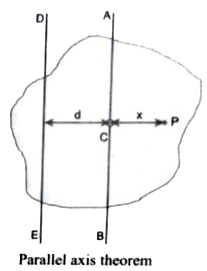
|
|
| 45. |
The displacement of two particles executing S.H.M are represented by y_(1) =a sin(wt + phi) and y_(2)=a cos omegat. The phase difference between the velocities of these particles is |
|
Answer» `-PHI` |
|
| 46. |
A police van moving on a highway with a speed of 30km h^(-1) fires a bullet at a thief's car speeding away in the same direction with a speed of 192kmh^(-1). If the muzzle speed of the bullet is 150ms^(-1), The speed with which the bullet hit the thief's car is |
|
Answer» `42m//s` |
|
| 47. |
Mark the correct options : |
|
Answer» A SUSTEM X is thermal equilibrium with Y but not with Z. SYSTEM Y and Z may be in thermal equilibrium with each other. x and y are in thermal equilibrium `T_(x)!=T_(z)` `:.T_(y)!=T_(z)"":.` Option (B) is CORRECT. Now `T_(x)!=T_(y)` and `T_(x)!=T_(z)` `:.` System Y and Z may be in thermal equilibrium and may not be. `:.` Option (D) correct. |
|
| 48. |
Two identical equi-concave lenses made of magnitude of combined glass of refractive index 1.5, placed in contact has magnitude of combined power p. when a liquid of refractive index mu is filled in the gap between the concave lenses, the power becomes +p/3. the value of mu is K/3. find the value of K |
|
Answer» |
|
| 49. |
A solid sphere and a hollow sphere of same material have same mass. When they are heated by 50^(@)C, increase in volume of solid sphere is 5 c.c. The expansion of hollow sphere is |
|
Answer» 5 c.c. |
|
| 50. |
A force of 5N is applied on a 20kg mass at rest. The work done in the third second is, |
| Answer» Answer :A | |