

Saved Bookmarks
This section includes 7 InterviewSolutions, each offering curated multiple-choice questions to sharpen your Current Affairs knowledge and support exam preparation. Choose a topic below to get started.
| 1. |
Statement 1 represents Assertion, statement 2represent Reasons .Statement I : One radian is the angle subtended at the center of a circle by an arc that is equal to the radius of the circle .Setement 2:Radian describes the planar angle subtended by a circular arc at the centre of the circle .Which one of the following statements is a correct statement ? |
|
Answer» STATEMENT 1 is TRUE and statement 2 is false |
|
| 2. |
A rotating platform for a stationary observer outside it is |
|
Answer» inertial FRAME of reference |
|
| 3. |
When a hollow sphere is rolling without slipping on a rough horizontal surface then the percentage of its total K.E which is Translational is |
|
Answer» 0.72 |
|
| 4. |
If hatn is a unit vector along the direction of vecA then hatn is |
|
Answer» `VECA A` |
|
| 5. |
There are two displacement vectors , one of magnitude 3m and other of 4m . How should the two vecotrs be added so that the resultant vector be5 m . |
|
Answer» SOLUTION :As`R = SQRT(A^(2) + B^(2) + 2AB COS theta)` For 5m both VECTORS should be PERPENDICULAR to each other . i.e.,angle betweenthem should be `90^(@)` |
|
| 6. |
A force is applied on a body of mass 0.9kg that is at rest. The force is applied for a duration of 5s and as a result the body covers a distance of 250 m. Find the magnitude of the force. |
|
Answer» |
|
| 7. |
A brass scale of barometer gives correct reading at 2^(@)C. The coefficient of thermal expansion for brass is 0.00002 ^(@)C^(-1). The barometer reads 75 cm at 27^(@)C. What is the atmospheric pressure at 2^(@)C ? |
| Answer» SOLUTION :`74.96 CM` | |
| 8. |
In a simple pendulum if iron sphere is replaced by a wooden sphere of same mass, time period. |
|
Answer» increases |
|
| 9. |
The poisson' s ratio of a wire of sigma. Show that if e is the longitudinal strain due to an applied forces, the volume strain will be e(1-2sigma). |
|
Answer» Solution :SUPPOSE the LENGTH of the wire is l, RADIUS is R and its volume is V. `thereforeV=pir^2l` or,`dV=pir^2dl+2pilrdr=pi r^2dl-2pir^2sigmadl` `[becausesigma=(-dr//r)/(dl//l),dr=-rsigma(dl)/l]` `=pir^2dl(1-2sigma)` `therefore ` Volume strain `=(dV)/V=(pir^2dl(1-2sigma))/(pir^2l)=(dl)/l(1-2sigma)` `=e(1-2sigma)` [given that `(dl)/l=e`]. |
|
| 10. |
The minimum time the particle takes to travel from y = + "1 m to y" = - 1m in the figure given in problem (61)is |
| Answer» Answer :A | |
| 11. |
Assertion : x-t equation of a particle in SHM is given as :x=A "cos"omegat Reason : In the given equation the minimum potential energy is zero. |
|
Answer» If both Assertion and Reason are correct and Reason is the correct explanation of Assertion. |
|
| 12. |
A soap bubble, having radius of 1mm, is blown from a detergent solution having a surface tension of 2.5 xx 10^(-2)N//m. The pressure inside the bubble equals at a point Z_(0) below the free surface of water in a container. Taking g= 10 m//s^(2), density of water =10^(3)kg//m^(3), the value of Z_(0) is |
|
Answer» 0.5cm Density of water `rho= 10^(3) kgm^(-3)` `h= Z_(0)` `T= 2.5 xx 10^(-2) N//m` 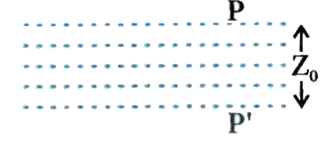 `G= 10 ms^(-2)` Pressure inside the bubble, formed in air, 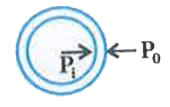 `P_(i) = P_(0) + (4T)/(R )= P + (4T)/(R )` ...(1) (Where P= atmospheric pressure) If pressure at depth `Z_(0)` from the free SURFACE of water is P. then, `P.= P + rho gh= P + rho g Z_(0)` ...(2) Comparing equations (1) and (2), `rho g Z_(0) = (4T)/(R )` `:. Z_(0) = (4T)/(rho gR) = (4 xx 2.5 xx 10^(-2))/(10^(3) xx 10 xx 1 xx 10^(-3))` `:. Z_(0) = 10^(-2)m= 1cm` |
|
| 13. |
Give reason why are some insects able to walk on water surface ? |
| Answer» Solution :DUE to surface tension , surface of a LIQUID has a tendency to contract LIKE stretched elastic membrane .Hence ,some insects able to walk on water surface . | |
| 14. |
From a disc of radius R a mass M, a circular hole of diameter R, whose rim passes through the centre is cut. What is the moment of inertia of the remaining part of the disc about a perpendicular axis passing through it |
|
Answer» `15 MR^(2)//32` |
|
| 15. |
The resultant of two forces 2P and sqrt(2) P is sqrt(10)P The angle between the forces is |
|
Answer» `30^(@)` |
|
| 16. |
A labourer standing near the top of an old wooden step ladder feels unstable. Why ? |
| Answer» SOLUTION :When he is at the top of the LADDER, the leyer arm of the force is LARGE. | |
| 17. |
Two discs of same moment of inertia rotating about their regular axis passing through centre and perpendicular to the plane of disc with angular velocities omega_(1) and omega_(2). They are brought in to contanct face to face coinciding the axis of rotation. The expression for loss of energy during this process is |
|
Answer» `(1)/(4)I(omega_(1)-omega_(2))^(2)` |
|
| 18. |
A girl riding a bicycle with a speed of5 m//s to wards Noth direction, observes rain falling vertically down. If she increases her speed to 10 m//s, rain appeard to meet her at45^@ to the vertical . What is the speed ot the rain ? In what direction does rain fall as observed by a ground based observer ? |
|
Answer» `5sqrt(2)ms^(-1)` let the velocity of rain be `vecv_(r) = a hati + B hatj` In the first case, `vecv_(g) `= velocity of girl ` = 5hati` `thereforevecv_(rg) = vecv_(r) - vecv_(g) = (a hati + b hatj) - 5hati = (a-5)hati + bhatj` Since rain appears to fall vertically downwards, `THEREFORE a - 5 = 0 or a = 5` In the second case, `vecv_(g) = 10 hati` `thereforevecv_(rg) = vecv_(r)-10 hati = (ahati + bhatj) - 10hati = (a -10) hati + bhatj = - 5hati + b hatj` Since rain appears to fall at `45^(@)` with the vertical, Since rain appears to fall at `45^(@)` with vertical, `therefore a = b = -5` `therefore` The velocity of the rain is `vecv_(r) = 5hati - 5hatj` Speed of the rain is `|vecv_(r)| = sqrt((5)^(2) + (-5)^(2)) = 5sqrt(2) ms^(-1)` 
|
|
| 19. |
A thermodynamics system undergoes cyclic process ABCDA as shown in figure. The work done by the system in the cycle is |
| Answer» Answer :D | |
| 20. |
Two inclined frictionless tracks, one gradual and the other steep meet at A from where two stones are allowed to slide down from rest, one on each track as shown in Figure. Which of the following statement is correct. |
|
Answer» Both the STONES REACH the bottom at the same TIME but not with the same speed |
|
| 21. |
A particle of mass m is projected with an initial velocity u at an angle theta to horizontal. The torque of gravity on projectile at maximum height about the point of projection is |
|
Answer» `(MGU^(2)sin2theta)/(2)` |
|
| 22. |
A uniform thin rod has mass m and length l. One end of the rod lies over rough horizontal surface and the other end is connected to a light vertical string as shown in the figure. When string is cut, there is no slipping between rod and surface.Calculate the friction force (in N) on the rod immediately after the string is cut .(Givenmg=(16)/(sqrt(3))N) |
|
Answer» |
|
| 23. |
The Young's modulus of a wire is numerically equal |
|
Answer» not change the LENGTH of the WIRE |
|
| 24. |
Which of the following does not characterize the thermodynamics state of matter |
|
Answer» volume |
|
| 25. |
Explain the formula of stationary waves. |
|
Answer» Solution :When the wave hits the rigid boundary it bounces back to the original medium and can interfere with the original waves. A pattern is formed, which are known as standing waves or stationary waves. Consider two harmonic progressive waves (formed by strings) that have the same amplitude and same VELOCITY but move in opposite directions. Then the displacement of the first wave (incident wave) is `y_(1) =A sin(kx - omega t)`......(1) (waves move toward RIGHT) and the displacement of the SECOND wave (reflected wave) is `y_(2) =A sin(kx+ omega t)`........(2) both will interfer with each other by the principle of superposition, the net displacement is `y=y_(1) + y_(2)`..........(3) Substituting equation (1) and equation (2) in equation (3), we get `y=A sin(kx - omega t) + A sin (kx + omega t)`..........(4) Using trignometric IDENTITY, we write equation (4) as `y(x,t) =2A cos(omega t) sin (kx)`........(5) This represents a stationary wave or standing wave, whihc means that this wave does not move either forward or backward, whereas progressive or travelling waves will move forward or backward. Further, the displacement of the particle in equation (5) can be written in more compact form, `y(x,t)A' cos(omega t)` where, `A' = 2A sin(kx)`, implying that theparticular element of the string executes simple harmonic motion with amplitude equals to `A'`. The maximum of this amplitude occurs at positions for which `sin(kx)=1 rArr kx =pi/2, (3pi)/2, (5pi)/2,....=m pi` where m takes half integer or half integral values. The position of maximum amplitude is known as ANTINODE. Characteristics of stationary waves (i) Stationary waves are characterised by the confinement of a wave disturbance between two rigid boundaries. This means, the wave does not move forward or backward in a medium (does not advance), it remains steady at its place. Therefore, they are called "stationary waves or standing waves". (ii) Certain points in the region in which the waves exists have maximum amplitude, called as anti-nodes and at certain points the amplitude is minimum or zero, called as nodes. (iii) The distance between two consecutive nodes (or) anti-nodes is `lambda/2`. (iv) The distance between a node and its neighbouring anti-node is `lambda/4`. (v) The transfer of energy along the standing wave is zero. |
|
| 26. |
The quatity having negative dimensions in mass is |
|
Answer» GRAVITATIONAL Potential |
|
| 27. |
State and prove Bernoulli's theorem. |
|
Answer» Solution :1st part: N/A 2nd part: Let an incompressible, non-viscous LIQUID entering into the cross -sectional area `A_1` at point A with VELOCITY `V_1` and coming out a height `h_2` at point B with velocity `v_2` [Fig. 3.52]. The value of the potential energy (PE) and kinetic energy (KE) are increased , since `h_2 gt h_1 and v_2 gt v_1` . This is done by the pressure at the TIME of WORK done on the liquid. If `p_1 and p_2` are the pressure at A and B, for a small displacement at A and B, the work done on the liquid at A. `Deltax_1=p_1 A_1v_1 Delta t` So, net work done by pressure `=(p_1-p_2)A_0v_0 Delta t` [ where `A_1 v_1=A_2v_2=A_0v_0]` From conservation of energy, `(p_1-p_2)A_0 v_0 Delta t =` CHANGE in KE + change in PE or, `(p_1 -p_2) A_0v_0 Delta t =1/2A_0v_0 Delta t rho (v_2^2-v_1^2)+A_0 v_0 rho Delta tg (h_2-h_1)` or, `p_1-p_2=rhog(h_2-h_1)+(rho)/(2)(v_2^2-v_1^2)` or, `p_1+rho gh_1+(rho)/(2)v_1^2=p_2+rho gh_2+(rho)/(2)v_2^2` `therefore (p)/(rhog)+h+(v^2)/(2g) =` constant 
|
|
| 28. |
A slab of uniform cross section is such that , its thermal conductivityK varieswith distancex from one ends as K = K_(1) x + k_(2). Determine the effectivethermalconductivityof the slab . |
Answer» Solution :The entire slab of LENGTH l can besubdivided into innumerableelemental SECTION , each of a particularthermalconductivity . CONSIDER one suchsectionM atdistancex fromone of the ends X (say) .Let N be anothersectionat a distance x + dxfrom the endX . Further , letthe temperature of the sectionM and Nbe T and ` T + dT` Now , thermal currentacross the section M will be (in steady state). `(dQ)/(dt) = i - KA (dT)/(dx)= - (Kx+ K) = (-A)/(i) dT (or) int_(0)^(1) (dx)/(k_(1)x+ k_(2)) = -(A)/(i) int_(T_(1))^(T_(2)) dT` `rArr (1)/(K_(1)) [In(K_(1)x + K_(2)]_(0)^(t) = (-A)/(i)[T]_(T_(i))^(T_(2)) rArr (1)/(k_(1)) In((k_(1)l + k_(2))/(K_(2))) = (-A)/(i) (T_(2)-T_(1)) ` `i.e.,i = (-K_(1)A(T_(2) -T_(1)))/(In[(K_(1)l + k_(2))//K_(2)])"".......(1)` Now , if `K_(eff)` be theeffective thermalconductivityof the slab , then . `i = - k_(eff) (A (T_(2) - T_(1)))/(l)""......(2)` Comparing Eqs. (iv) `(sum_(i=1)^(n) l_(i)) //k_("eff") = sum_(i=l)^(n)(l_(i) //k_(i)) i.e., (l)/(k_("eff")) = int_(0)^(l)(dx)/(K)` [Replacing the summationsign byinergral sign] `= int_(0)^(i) = (dx)/(k_(1)x + K_(2))= (1)/(K_(1)) In((k_(1)l+ K_(2))/(k_(2))) i.e., K_("eff") = (lK_(1))/(In((K_(1)l + k_(2))/(K_(2))))` |
|
| 29. |
A particle having mass 10 g oscillates according to the equation x = (2.0 cm) sin[(100 s^(-1))t + pi//6].Find the amplitude , the time period and the spring constant . |
| Answer» SOLUTION :2.0 CM 0.063 s , 100 N/m | |
| 30. |
A massless string is wrapped around a uniform solid cylinder of mass 30kg and radius 0.20m. One end of the string is attahed to the cylinder and the free end is pulled tangentially by a force that maintains a constant tension of 3.0 N. Find a) the angular acceleration and b) The angular speed of the cylinder 2.0 s after the force is applied to the cylinder at rest. |
|
Answer» SOLUTION :(a) We know that `tau=Ialpha` `F.r=Ialpha` `F.r=(mr^(2))/(2).alpha` `alpha=(2F)/(mr)=(2XX3)/(30xx0.2)=1rad//s^(2)` (B) `omega_(2)-omega_(1)=ALPHAT` `:.omega_(2)=alphat` angular speed after 2 sec, `omega_(2)=1xx2=2rad//sec` |
|
| 31. |
Water flows at a speed of hems through a tube of radius 1 cm. coefficient of viscosity of water at room temperature is 0.01 poise. The Reynolds number is |
|
Answer» 100 |
|
| 32. |
Choose the correct statement//(s) |
|
Answer» Weight of a body is greater on PLANES and less on HILL TOPS |
|
| 33. |
The maximum magnification that can be obtained with convex lens of focal length 2.5 cm is (the least distance of distinct vision is 25 cm) |
|
Answer» 10 |
|
| 34. |
When a capillary tube is lowered into water, the mass of water raised in the tube, above the outside water level is 5gm. If the radius of the tube is doubled, the mass of water that rises in the capillary tube above the outside water level is |
| Answer» ANSWER :C | |
| 35. |
sqrt(58.97) = |
|
Answer» `7.679` |
|
| 36. |
The work done by a force vecF= (-6x^(3) hati)N in displacing a particle from x= 4m to x= -2m is |
| Answer» ANSWER :B | |
| 37. |
A piece of metal weight 45 g is air and 25 g in a liquid of density 1.5 xx 10^(3)kg-m^(-3) Kept at 30^(@). When the temperature of the liquid is raised to 40^(@)C, the metal piece weight 27g. The density of liquid at 40^(@)C is 1.25 xx 10^(3) kg-m^(-3). The coefficient of linear expansion of metal is |
|
Answer» `1.2 XX 10^(-5)` |
|
| 38. |
A rough inclined plane is inclined at 30^(@) to the horizontal as shown in the figure. A uniform chain of lengh L is partly on the inclined plane and partly hanging from the top of the incline. If the coefficient of friction between chain and inclined plane is mu, the maximum length of the hanging part to prevent the chain from falling vertically is |
Answer» SOLUTION : `sigma xg = sigma (L-x)g sin 30+mu sigma(L-x)g cos 30` `x=(L-x)(1)/(2)+mu(L-x)(SQRT(3))/(2)` `therefore x = ((1+sqrt(3)mu)L)/(sqrt(3)(mu+sqrt(3)))` |
|
| 39. |
A block released from rest from the top of a smooth inclined plane of angle 30^@ reaches the bottom in time t_1. The same block released from rest from the top of another smooth inclined plane of angle 60^@, reaches the bottom in time t_2. If the two inclined planes have the same height, the relation between t_1 and t_2 is |
|
Answer» `(t_2 )/(t_1) =1/2` |
|
| 40. |
The diameter of a rotating fly wheel is R. Its coefficient of linear expansion is alpha. If the temperature is increased by Delta T, the percentage change in its rotational KE would be |
|
Answer» `ALPHA.Delta t.100` |
|
| 41. |
A particle is executing SHM along a straight line. Its velocities at distances x_(1)andx_(2) from the mean position are V_(1)andV_(2), respectively. Its time period is |
|
Answer» `2pisqrt((x_(1)^(2)+x_(2)^(2))/(V_(1)^(2)+V_(2)^(2)))` Similarly, `V_(2)^(2)/omega^(2)=a^(2)-x_(2)^(2)` `therefore" "V_(1)^(2)/omega^(2)-V_(2)^(2)/omega^(2)=x_(2)^(2)-x_(1)^(2)or,omega=sqrt((V_(1)^(2)-V_(2)^(2))/(x_(2)^(2)-x_(1)^(2)))` i.e., `T=(2PI)/omega=2pisqrt((x_(2)^(2)-x_(1)^(2))/(V_(1)^(2)-V_(2)^(2)))` |
|
| 42. |
If a large number of water droplets of diameter 2r cm each coalesce to form a large water drop of diameter 2 R cm, then prove that the rise in temperature of water is (3T)/(J)((1)/(r )-(1)/(R )). Here, T is the surface tension of water and J is the mechanical equivalent of heat. |
|
Answer» Solution :If the number of SMALL droplets is n , then . The dissipation of surface energy, W = `(4pir^2 n-4piR^2) T.` We KNOW thatW = JH and H = heat absorbed = `mstheta` [where m = MASS of the larger water drop, s = SPECIFIC heat of water, `theta` = temperature INCREASES] `therefore H=(W)/(J)=(T)/(J)xx4pi(nr^2-R^2)` or, `(3)/(4)piR^3.1.theta=(T)/(J)xx4pi(nr^2-R^2)` [`because m =(4)/(3)piR^3. 1 =(4)/(3)piR^3 and s=1 cal. g^-1. ^@ C^-1`] or, `theta=(3T)/(J)((nr^2-R^2))/(R^3)` `["here", n.(4)/(3)pir^3=(4)/(3)piR^3 or, R^3=nr^3 or, n=(R^3)/(r^3)]` `=(3T)/(J)[(R^3)/(r^3).(r^2)/(R^3)-(1)/(R)]` `=(3T)/(J)(1/r-1/R)`. |
|
| 43. |
Two blocks of masses m_(1) and m_(2) in contact lie on a horizontal smooth surface as shown in The blocks are pushed by a force F If the two blocks are always in contact what is the force at their common interface . |
|
Answer» `:. A = (F)/(m_(1) m_(2))` If f is force EXERTED by `m_(1)` on `m_(2)` then force exerted by `m_(2)` on `m_(1)` is (-) f , as SHOWN in As block of mass `m_(2)` has accelera- tio a `:. f = m_(2) a = (m_(2) xx F)/(m _(1) + m_(2)`  . |
|
| 44. |
Lubricants are used between the two parts of a machine. Why? |
| Answer» SOLUTION : To REDUCE FRICTION and so to reduce WEAR and TEAR. | |
| 45. |
The masses of the earth and moon are M and M/n respectively. Their centres are separated by a distance 2r. The minimum speed with whicih a particle of mass m should be projected from a point midway the two centres so as to escape to infinity is |
|
Answer» `sqrt((GM(n+1))/(nr))` |
|
| 46. |
Which of the following is not a thermodyanmic coordinate ? |
|
Answer» Gas constant (R ) |
|
| 47. |
An explosion breaks a rock into three parts in a horizontal plane two of them go off at right angles to each other the first part of mass 1 kgmoves with a speed of 12 m/sthe second part of mass 2kgmoves with a speedof 8 m/sand thethird aprt flies off with a speed of 4 m/s calculate the mass of third part |
|
Answer» 10 kg `:. |m_(3) vec(v )_(3) | = |-(m_(1) vec(v )_(1)+ m_(2) vec(v )_(2))|` `m_(3) v_(3)= SQRT(m_(1)^(2) v_(1)^(2) + m_(2)^(2) v_(2)^(2))` `4m_(3) = sqrt(144+ 256)= sqrt(400)= 20` Mas`m_(3)= (20)/(4) = 5kg` |
|
| 48. |
A cartis moving horizontally along a straight line with constant speed 30m/s.At projectile is to be fired from the moving cart in such a way that it will return to the cart after the cart has moved 8Om. At what speed (relative to the cart) must the projectile be fired? (Take g=10 m//s^(2)) |
|
Answer» `10 sqrt(8m)//s` `t=(s)/(v)=(80)/(30)=(8)/(3)"Sec"` We have, `v=u=at"` `u=?,v=0, a=-g=10 m//s^(2) and t=(8//3)/(2)=(4)/(3)` (SINCE time of fight to REACH the highest point is halfofthe total time of fight) `:.0 u-10xx(4)/(3)` `u=(40)/(3)m//s` |
|
| 49. |
Below Figure represents a painter in a crate which hangs alongside a building . When the painter of mass 100 kg pulls the rope , the force exerted by him on the floor of the crate is 450N. If the crate weights 25 kg , find the accelertion and tension in the rope, (g=10 m//s^(2)) |
|
Answer» |
|
| 50. |
A 100 kg gun fires a ball of 1 kg horizontally from a cliff of height 500 m. It falls on the ground at a distance of 400 m from bottom of the cliff. Find the recoil velocity of the gun. (acceleration due to gravity = 10 ms^(-2) ) |
|
Answer» Solution :Massof gun`m_(1) =100kg` mass of BALL`m_(2)=1 kg` Height of thecliffh =500 m x = 400m Initiallyverticalcomponentof velocityis zero(in downarddirection ) `h= (1)/(2)gt^(2)` `500 = 5t^(2)` `t= SQRT(100) = 10 s` Forhorizontalmotionof ball x= ut `u = (x )/( t ) = (400)/(10) =40 m//s` Letv isrecoil VELOCITY of gun BYLAW of conservation of linearmomentum `m_(1)v= m_(2) u` `v= (m_(2) u )/( m_(1)) = (1)/(100)xx 40 = 0.4 m//s` |
|