

Saved Bookmarks
This section includes 7 InterviewSolutions, each offering curated multiple-choice questions to sharpen your Current Affairs knowledge and support exam preparation. Choose a topic below to get started.
| 1. |
A non-linear triatomic gas 50% dissociates into individual atoms. Ignoring the vibrational degree of freedom and any further dissociation, the gas behaves as if the number of degrees of freedom is |
|
Answer» `4.67` |
|
| 2. |
A simple pendilum is swinging in a vertical plane. The ratio of its potential energies when it is making angle 30^(@) and 60^(@) with the vertical is, |
|
Answer» `1:(2-sqrt(3))` |
|
| 3. |
Two balls A and B are thrown vertically upwards from the same location on the surface of the earth with velocities 2 sqrt((gR)/(3))and sqrt((2gR)/(3))respectively, where R is the radius of the earth and g is the acceleration due to gravity on the surface of the earth. The ratio of the maximum height attained by A to that attained by B is |
|
Answer» 2 `1/2 mv^2 - (GMm)/( R) = - (GMm)/((R + h))` or` v^2 = (GMh)/(R(R + h)) = (2ghR)/((R+h)) ""( because g = (GM)/(R^2))` For ball A `, v = 2 sqrt((gR)/(3)) , h = h_A` ` therefore (4gR)/(3) = (2gh_A R)/((R + h_A)) " or " h_A = 2R` For ball B, v ` = sqrt((2gR)/(3) ) ,h = h_B` `therefore (2gR)/(3) = (2gh_B R)/((R + h_B)) " or " h_B = R/2 therefore h_A/h_B = 4` |
|
| 4. |
Find the product of 1.2, 2.54 and 3.257 with due regard to significant figures. |
| Answer» Solution :Out of the three number 1.2 has GOT the least number of significant figures -TWO. We should round off the other numbers to `2 + 1= 3` significant figures and carry the multiplication. 2.54 has three significant figures and hence NEEDS no rounding off. 3.257 is to be ROUNDED off to 3.26. `1.2 xx 2.54 xx 3.26= 9.93648`. But the result should be limited to the least number of significant digits-that is two digits only. The final answer should be written as 9.9 after rounding off. | |
| 5. |
Derive an expression for the acceleration of a body of mass m moving with a uniform speed v in circular path of radius r. |
|
Answer» Solution :Let A = initial position of the body , B = position of the body after a small time INTERVAL t. So, the angular displacement `theta= angleAOB`, is also small, and the displacement x effectively coincides with the arc AB of the CIRCULAR path. Then, Now at A, the velocity v is horizontal , at B, the velocity makes the same angle `theta` with the horizontal direction, keeping its magnitude v to be the same, as the body moves with a uniform speed v . Again, as `theta` is small, the CHANGE of velocity u, effectively coincides with a circular arc. So, `theta = (u)/(v)` Then we get, `(x)/( r) = (u)/(v)` or,u = `(v)/(r )x` Hence, the acceleration is, a = `("change of velocity")/("time") = (u)/(t) = (vx)/(r t)` = `(v)/(r ) v = (v^(2))/(r )` also SHOWS that, as `theta` is small, u is normal to the velocity v. As v is TANGENTIAL at every point on the circular path, the acceleration a is radial. This is centripetal acceleration of a uniform circular motion. 
|
|
| 6. |
Two rods of different metals, having the same area of cross-section A, are placed end to end between two massive walls as shown in fig. If the temperature of both the rods are now raised by Delta t^@ Cthen a) Find the force with which the rods acts on each other at higher temperature. b) Find the lengths of the rods at the higher temperature. Assume that there is no change in the cross-sectional area of the rods and the rods do not bend. There is no deformation of walls. |
|
Answer» Solution :a) Due to heating the increases in LENGTH of the composite rod will be `(Delta l)_1 = l_1 alpha_1 Delta t + l_2 alpha_2 Delta t = (l_1 alpha_1 + l_2 alpha_2 ) Delta t `......(1) due to compressive force .F. from the walls, due to ELASTICITY, the decrease in length will be `(Delta l)_D = (Fl_1)/(AY_1) + (Fl_2)/(AY_2) = F/A (l_1/Y_1 + l_2Y_2)`.....(2) As the length of the composite rod remains unchanged the increase in length due to heating MUST be EQUAL to decrease in length due to compression. `(l_1 alpha_1 + l_2 alpha_2) Delta t = F/A (l_1/Y_1 + l_2Y_2)` ` rArr F = (A(l_1 alpha_1 + l_2 alpha_2)Delta t)/((l_1/Y_1 + l_2/Y_2))` b) As initially the length of one rod in `L_1`and due to heating its length increases by `(Delta l_1)_H = alpha_1 l_2 Delta t` ,while due to compression its length decreases by `(Delta l_1)_C = (Fl_1)/(AY_1)` so its final length` l_1^1 = l_1 + (Delta l_1)_H - (Delta l_1)_C` ` = l_1 + l_1 alpha_1 Delta t- (Fl_1)/(AY_1)` For the other rod `l_1^1 = l_2 + (Delta l_1)_H - (Delta l_2)_C` `l_2^1= l_2 + l_1 alpha_2 Delta t- (Fl_2)/(AY_2)` |
|
| 7. |
A particle who has a constant speed of 50 m/s. it moves along a straight line from A(2,1) to B(9,25). Find its velocity vector. If at initial instant of time it is located at (2, 0), find its final location after 3 s. |
|
Answer» SOLUTION :`vec(AB)=vec(B)-vec(A)=7hat(i)+24hat(j)` `vec(v)=(HAT(A)B)|vec(v)|=((7hat(i)+24hat(j)))/(25)xx50 =14hat(i)+48hat(j)` `vec(s)_(2)-vec(s)_(1)(3), and vec(s)_(1)=2hat(i)` `vec(s)_(2)=(42hat(i)+144hat(j))+2hat(i)=(44hat(i)+144hat(j))` |
|
| 8. |
A runner jogs a along a straight road (in the +x direction) for 30 min, travelling a distance of 6 km. She then turns around and walks back towards her starting point for 20 min, travelling 2 km during this time. State true/ false: a. The final displacement of the entire trip is 0.16 km min^(-1) . b. Her average speed for the entire is 0.16 km min^(-1). c. The average velocity for the entire trip is 0.4 km min^(-1). d. The runner's average velocity while jogging is 0.4 km min^(-1). e. Her average velocity while walking is 0.1 km min^(-1). |
Answer» 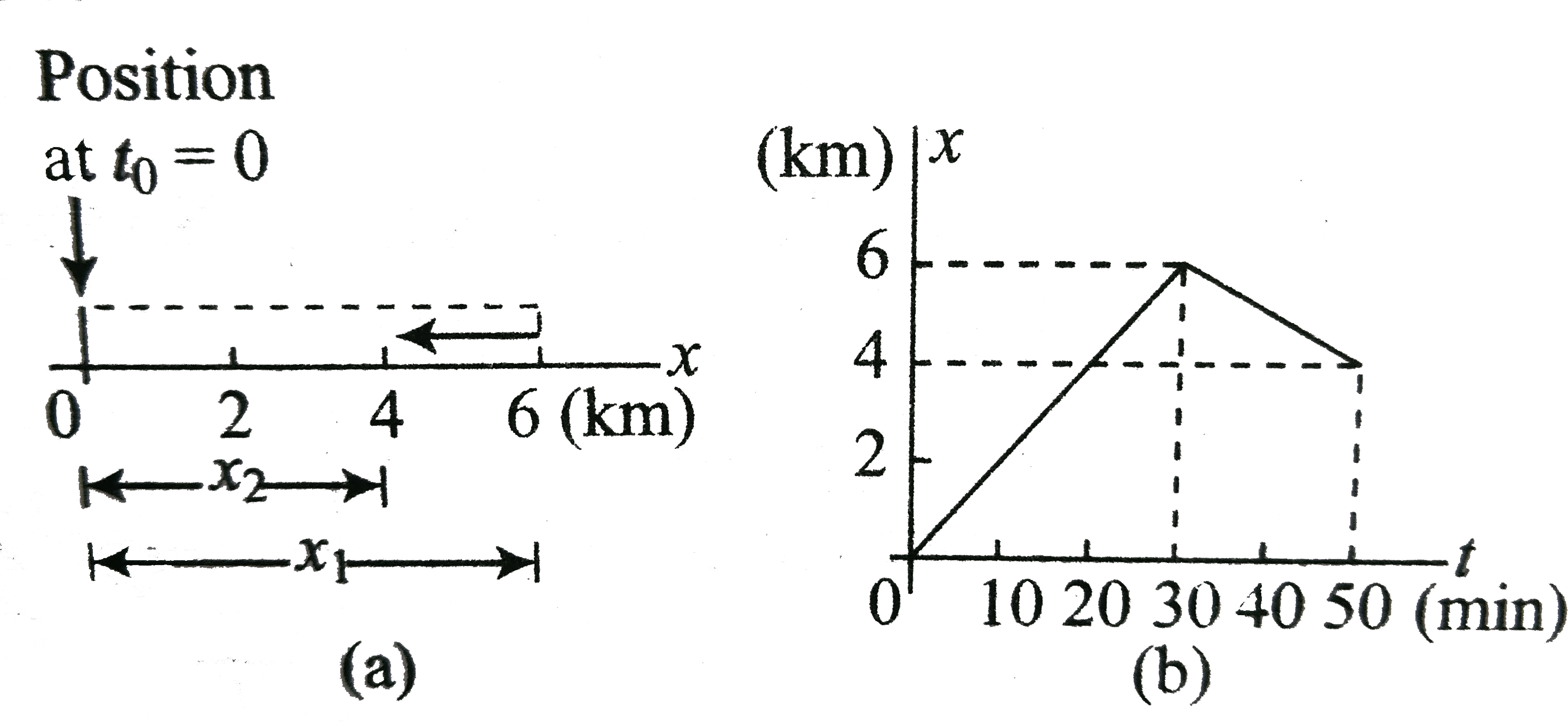 , `{:(Position""Time),(x_(0)=0""t_(0)=0), ("Jogging"""x_(1) =6 km""t_(1) =30 min),("Walking"""x_(2)=4 km""t_(2) =50 min):}` a. True,`Delta x=(x_(2)-x_(0))=3 km-0) =4 km` b. True , average =`(Total distance)/(Total time) =(8KM)/(50 mi n)` c. False, the average velocity for the entire trip is ` v_(av) =(Delta x)/(Delta t) =((x_(2)-x_(0)))/((t_(2)-t_(0)))=(4-0)/(50-0) =0.080 km min^(-2)` ltbrtgt d. False, while jogging `v_(av)=(Deltax)/(Deltat) =((x_(1)-x_(0)))/((t_(1)-t_(0))) =(6-0)/(30-0) =0.2000 km min^(-1)` e. True, while walking `v_(av)=(Delta x)/(Delta t) =((x_(2)-x_(1)))/((t_(2)-t_(1))) =((4 km -6 km))/((50 min-30 mi n))` `=(-2 km)/(20 mi n) =-0.100 km min^(-1) (walki ng)` The negative value indicates a velocity in the -`x` direction. A word of CAUTION: Please note that the runner`s average velocity for the entire trip is not SIMPLY the average of her jogging and walking velocities, because the times she spends in the these two different motions are not EQUAL. |
|
| 9. |
If vec(C) = vec(A) + vec(B) then |
|
Answer» `VEC(C)` is ALWAYS GREATER than `|vec(A)|` |
|
| 10. |
On a 60 km straight road, a bus travels the first 30km with a uniform speed of 30kmh^(-1). How fast must the bus travel the next 30 km so as to have average speed of 40kmh^(-1) for the entire tirp? |
|
Answer» SOLUTION :`V_(AVG)=(S_(1)+S_(2))/(t_(1)+t_(2))=(S+S)/(S((1)/(V_(1))+(1)/(V_(2))))=(2V_(1)V_(2))/(V_(1)+V_(2))` or `40=(2xx30xxV_(2))/(V_(1)+V_(2))impliesV_(2)=60kmh^(-1)` |
|
| 11. |
Figure show the stress-strain curve for a given material. What are (a) Young's modulus and (b) approximate yield strength of the material? |
|
Answer» SOLUTION :a)From the GRAPH, corresponding to point P, Stress = `150 xx 10^(6) N//m^(2), ` Strain = `0.002 = 2 xx 10^(-3)` Young.s MODULUS, `Y = ("stress")/("strain")= (150 xx 10^(6))/(2 xx 10^(-3))=7.5 xx 10^(10) N//m^(2)` b) From graph, corresponding to point B (yield point), stress = `300 xx 10^(6) N//m^(2)`. THUS, approximate yield strength = `2 xx 10^(8) N//m^(2)`. |
|
| 12. |
Three identical spheres each of radius .R. are placed touching each other so that their centres A, B and C lie on a straight line. The position of their centre of mass from A is |
|
Answer» `(2R)/(3)` |
|
| 13. |
An object is placed in front of a slab (mu=1.5) of thickness 6 cm at a distance 28 cm from it . Other face of the slabs silvered. Find the position final image. |
|
Answer» Solution :By the principleof reversibility of light, we can say if light rays are coming from the mirror and PASSING through the slab, the mirror will shift 2cm TOWARDS right for OBSERVER in fron of the slab. The position of the object from SHIFTED mirror =32 cm So, the position of the image formed by shifted mirror will be 32 cm BEHIND it. Hence, position of the image from surface 2 is 30 cm left to it and 36 cm left of surface 1. 
|
|
| 14. |
A circular platform is free to rotate in a horizontal plane about a vertical axis passing through its centre. Atortoise is sitting at the edge of platform. Now the platform is given an angular velocity omega_(0). When the tortoise moves along the chord of the platform with a constant velocity (with respect to the platform), The angular velocity of platform omega(t) will vary with time.t. as |
|
Answer»
|
|
| 15. |
A block of mass m is placed on the top of another block of mass M as shown in the figure. The coefficient of friction between them is mu. The maximum acceleration with which the block M may move so that m also moves along with it is |
|
Answer» `MU g` `f_("max")=mu mg implies(a_(m))_("max")=(mu mg)/(m)=mu g` |
|
| 16. |
Explain what is meant by dimensions of a physical quantity, its dimensional formula an dimensional equation. |
| Answer» SOLUTION :1 (d) and 1 (d). 2 | |
| 17. |
The rate of change of total momentum of a system of many particle system is proportional to the ……….on the system. |
| Answer» Answer :A | |
| 18. |
Which devices are used for measurement of length of different order? |
Answer» Solution : Explain direct and indirect method of measurement of length. In laboratory sometimes length is to be measured. If DEVICE (INSTRUMENT) like meterscale, VERNIER CALIPERS, micrometer, screw gauge or spherometer are used to MEASURE length then it is called direct method for measurement of length. To measure very large distance like distance between celestial objects some special method are used such method are called indirect method. |
|
| 19. |
Two glass bulbs of volumes 500 c.c and 200 c.c are connected by a narrow tube. These bulbs are filled with air at 17^(@)C and 750 mm of Hg pressure. If the small bulb and big bulb are placed in melting ice and boiling water respectively, find the pressure of the air in bulbs. |
|
Answer» Solution :If the two bulbs are at the same and temperature Total volume `V_(0)=V_(1)+V_(2)=500+200=700 cm^(3)`, Total mass of the gas = m Pressure `P_(0)=750mm` of Hg , Temperature `T_(0)=273+17=290K` From the gas equation, `P_(0)V_(0)=m/M""RT_(0)" (or) "(P_(0)V_(0))/T_(0)=m/MR"....(1)"` If the two bulbs are different temperatures let P be the temperature in the bulbs. For big bulb, `PV_(1)=m_(1)/M""RT_(1)` Here, `V_(1)=200CM^(3)" and "T_(1)=273+100=373K` For small bulb, `P_(2)=m_(2)/M""RT_(2)` Here, `V_(2)=200 cm^(3)" and "T_(2)=273K` `(PV_(1))/T_(1)+(PV_(2))/T_(2)=m_(1)/M""R+m_(2)/M""R=m""R/M` For gas equation, `(P_(0)V_(0))/T_(0)=(PV_(1))/T_(1)+(PV_(2))/T_(2)=P(V_(1)/T_(1)+V_(2)/T_(2))` `P=(P_(0)V_(0))/T_(0) times 1/(V_(1)/T_(1)+V_(2)/T_(2))=(750 times 700)/(290) times 1/((500/373+200/273))` `THEREFORE P=873mm` of Hg. |
|
| 20. |
Explain with illustration meaning of work , energy and power in everyday life and state that this meaning in physics |
|
Answer» Solution :A farmer FARMING his farm , a worker carrying bricks , a PAINTER a picture ETC . Is said that they all are doing work but there is no work DONE in the physics . If a person work works 14 to 16 hours in a day then we say that his energy is more for work but in physics work and ability to do work has different meaning . In a quarrel between a father and his son , another person gets involves and we have often heard the saying that " being a son on whom you are showing your power" .Then meaning of power here is different than power of in physics . |
|
| 21. |
If the kinetic energy of the body is increased by 300 % then , theincrease in momentum will be …… |
|
Answer» 1 When kinetic energy increases300 % then Now kinetic energy `E_(2)=E+ 2E = 4E` Now `E = (p^(2))/(2m)` ` :. P prop sqrt€ ` (m = constant) `:. (p_(2))/(p_(1))=sqrt((E_(2))/(E_(1)))=sqrt((4E)/E)` ` :. p_(2) =2p_(1) =p_(1)+p_(1)` ` :. ` Momentum increased by 100 % |
|
| 22. |
What will be the shape of speed of sound in air versus pressure at constant temperature ? |
| Answer» SOLUTION :STRAIGHT line, parallel to pressure axis (because SPEED of sound does not DEPEND on pressure at constant temperature). | |
| 23. |
An object is thrown from Earth is such a way that it reaches a point at infinity with non-zero kinetic energy [K.E(r=infty)=(1)/(2)MV_(infty)^(0)], with what velocity should the object be thrown from Earth? |
|
Answer» SOLUTION :`V_(E) = sqrt(2g(R_(E)+H)) = sqrt(2g(R_(E) + oo))` `:. H = oo` `V_(e) = sqrt(V_(oo) + 2ghR_(E))`. |
|
| 24. |
A train is moving with constant acceleration. When the ends of the train pass by a signal their speeds are 30 km/h and 40 km/h respectively. Calculate the speed of the midpoint of train while passing the signal. |
|
Answer» 35 km/hr `V. = SQRT (( u ^(2) + v ^(2))/( 2 )) = sqrt (((30 ) ^(2) + (40 ^(2))^(2))/( 2))` `therefore v. = sqrt (( 900+ 1600)/(2)) = sqrt ((2500)/(2))` `therefore v. = (50)/(sqrt2) = 25 sqrt2 (m)/(s)` |
|
| 25. |
A galvanometer has resistance1 Omega. Maximum deflection current through it is 0.1 A |
|
Answer» To measure a current of 1A a resistance of `(1)/(10)Omega` is put in PARALLEL with galvanometer |
|
| 26. |
The resistance R of a wire is found by determining its length 1 and radius r. The percentage errors in measurement of 1 and r are respectively 1% and 2%. The percentage error in measurement of R is |
|
Answer» 0.04 |
|
| 27. |
A satellite which is geostationary in a particular orbit is taken to another orbit. Its distance from the center of earth in new orbit is two times of the earlier orbit. The time period in second orbit is ......... hours. |
|
Answer» 4.8 |
|
| 28. |
The average resisting force that must act on a 5 kg mass to reduce its speed from 65cms^(-1) to 15cms^(-1) in 0.2 s is |
|
Answer» 12.5 N |
|
| 29. |
The force between two objects decreases by 36% when the distance between them is increasedby 4 m. The original distance between them in meter is |
|
Answer» 4 |
|
| 30. |
The position vector for a particle is represented be vecr=3t^(2)hati+5thatj+6hatk, find the velocity and speed of the particle at t=3 sec. |
|
Answer» Solution :`vecv=(BAR(dr))/(dt)=6thati+5hatj` The velocity at any time .t. is GIVEN by `vecv=6thati+5hatj`. The MAGNITUDE of velocity is speed. The speed at any time .t. is then given by speed `=sqrt((6t)^(2)+5^(2))=sqrt(36t^(2)+25)` Now the velocity at t=3 sec is given by `vecv=6(3)hati+5hatj=18hati+5hatj` and speed at t=3 sec, is given by speed `sqrt(349)m//s`. |
|
| 31. |
Which of the following statement is/are correct about location of centre of mass ? |
|
Answer» The CENTRE of mass of three particles of equal weight placed at the vertices of a triangle ABC COINCIDES with the CENTROID of triangle ABC. |
|
| 32. |
A train of mass 4000 metric tons is moving with a velocity of 18 KMPH. With the application of a force, its velocities changes to V. in 2 minutes. IF the power of the engine is 10 MW, the value of V. is (in KMPH) |
|
Answer» 72 |
|
| 33. |
The unit and dimensions of impedance in terms of charge Q are |
|
Answer» `ohm, ML^(2) T^(-2) Q^(-2) ` |
|
| 34. |
The average kinetic energy of nitrogen molecules is E, at room temperature. The corresponding value for helium molecules will be: (Relative molecular weights of N_2 and He are 28 and 4 ) |
| Answer» ANSWER :D | |
| 35. |
Two rods identical in length and cross-sectional area, but one of brass and the other of lead are coated with wax and then fitted into the holes in th sides of a bathl. Boiling water is poured into the bath. The wax coating of which rod wil melt first and to what extent? Thermal conductivity of brass =110 SI units and theat of lead =32 SI units. Sp. heat capacity of brass =370Jkg^(-1)K^(-1) and that of lead =126J kg^(-1)K^(-1). Densitiy of brass =8500kgm^(-3) and that of lead =11340 kg ,m^(-3) |
|
Answer» |
|
| 36. |
A bus starts from rest with a constant acceleration of 5 "m/s"^2. At the same time a car travelling with a constant velocity 50 m/s overtakes and passes the bus. How fast is the bus travelling when they are side by side? |
|
Answer» 10m/s |
|
| 37. |
Stirred liquid comes to rest after some time. Why? |
| Answer» Solution :DIFFERENT layers of a stirred liquid destroy the relative MOTION AMONG themselves DUE to intenal VISCOUS force. | |
| 38. |
A constant retarding force of 50 N is applied to a body of mass 20 kg moving initially with a speed of 15 m s^(-1) . How long does the body take to stop ? |
|
Answer» Solution :RETARDING forceF= - 50 N Mass m= 20 kg Finalvelocityv= 0 ByNewtonsecondlaw of motion `:.A = (F )/( m ) =(-50)/(20)-2.5m//s^(2)` Accordingto equationof motion `V= v_(0)+ at ` `0=15+ (-2.5)t` `t= (15)/( 2.5)=6s` |
|
| 39. |
An organ pipe open at one end is vibrating in first overtone and is in resonance with another pipe open at both ends and vibrating in thrid harmonic. The ratio of length of 2 pipes is |
|
Answer» `1:2` |
|
| 40. |
A rubber ball is thrown downwards from the top of a tower with a velocity of14 m/s. A second ball is dropped from the same place 1 s later. The firstball reaches the ground in 2 s and rebounds with the same magnitude of velocity . How much later wouldthe two balls collide with each other ? |
|
Answer» Solution :HEIGHT of thetower, h=Distance travelley bythe FIRST ball in 2 s(t=0 to t=2s ) `=14xx2+1/2xx9.8xx2^2=47.6 m` The second ball startsat t=1 s. From t=1 s tot=2 s, this ball comes down through a height, `h. =1/2xx9.8xx(2-1)^2=4.9m` `therefore`Att=2 s, the distance between the two BALLS, `H=h-h.=47.6-4.9=42.7 m ` For the first ball, velocity at t=2s is, `v_1=14+9.8xx2=33.6 m//s` As it rebounds with thesame instant , i.e ,at t=2s is `v_(1)^(.) =-33.6 m//s.` For the second ball , att=1 s, the velocity u=0. So, at t=2s , the velocity, `v_(2)=0+9.8xx(2-1)=9.8m//s` `therefore` RELATIVE velocity of the second ball with respect to the first at t=2 s is, `V=v_(2)-v_(1)^(.)=9.8 -(-33.6)=43.4 m//s` Relative acceleration =g-g=0. So, for relative motion , the velocity V is uniform . Thus TIME required totravel the height of H =42.7m is , `t=H/V=(42.7)/(43.4)=0.98 s` Therefore , theballs will collide at `T=2+t=2.98s.` |
|
| 41. |
The dimensions of which of the quantities of the following pairs are not the same ? |
|
Answer» light YEAR and WAVELENGTH |
|
| 42. |
What is the relation between the average kinetic energy and pressure? |
|
Answer» Solution :The internal energyof the gas is GIVEN by ` U = 3/2NkT` The aboveequation can alsobe writtenas ` U = 3/2 PV` sincePV = NkT `P= 2/3 U/V= 2/3 u` From the equation (1),the pressure of the gas is equal to twothirds of internal ENERGYPER unitvolume or internal energy per unit volume or internal energydensity ( u = UV) Writingpressure in TERMS of meankineticenergy densityusing equation ` P = 1/3 nmv^(bar2) = 1/3 pv^(bar2)` Where p= nm = massdensity( Note n is number f density) Multiplyand divideR.H.S of equation (2) by 2,we get ` P = 2/3 ( P/2 bar(v^(2)))` ` P = 2/3 K E ` From the equation (3) , pressureis equalto 2/3of mean kineticenergyper unitvolume. |
|
| 43. |
A stone is projected from the point of a ground in such a direction so as to hit a bird on the top oftelegraph post of height h and then attain the maximum height 2h above the ground. If at the instant of projection, the bird were to fly away horizontally with a unifrom speed. Find the ratio between the horizontal velocities of the bird and stone, if the stone still his the bird while ascending. |
|
Answer» Solution :Let the stone is projected with a velocity u at an angle `theta`with the horizontal, we have `(2h)=((usin theta)^(2))/(2g)` or `u SIN theta=2sqrt(gh)` Suppose t is the time taken by the stone to reach the height h above the ground. Then `h=u sin theta t-1/2"GT"^(2)` (or) `("gt"^(2))/2- u sin theta+h=0` As we have `u sin theta =2sqrt(gh)"" :.("gt"^(2))/2-2sqrt(gh)t+h=0`  Solving above equation for t we get `t=(2sqrt(TH)+-sqrt((2sqrt(gh))^(2)-4xxg/2h))/(2xxg/2)=(2sqrt(gh)+-sqrt(2gh))/g` Let `t_(1)=sqrt((2h)/g)(sqrt(2)-1)` and `t_(2)=sqrt((2h)/g)(sqrt(2)+1)` Where `t_(1)` and `t_(2)` correspond to P and Q in the figure. Suppose V is the horizontal velocity of the bird. Then `PQ=vt_(2)` For the motion of stone `PQ=u cos theta (t_(2)-t_(1))"":.vt_(2)=ucos theta(t_(2)-t_(1))` which gives `v/(u cos theta)=((t_(2)-t_(1))/(t_(2)))=(sqrt((2gh)/g)(sqrt(2)+1)-(sqrt(2)-1))/(sqrt((2h)/g)(sqrt(2)+1))=2/(sqrt(2)+1)` |
|
| 44. |
A constant power is supplied to a rotating disc. The relationship of angular velocity (w) of disc and number of rotations (n) made by the disc is governed by: |
|
Answer» `W PROP N^(1//3)` |
|
| 45. |
Explain the role of lakes in an ecosystem. |
|
Answer» ice is a good conductor of heat |
|
| 46. |
A man is sitting in a boat, which is floating on a pond. If the man drinks some water from the pond, the level of water in the pond: |
| Answer» Solution :No, When the man drinks WATER, say m KG, he DISPLAYS m kg of water and HENCE the level TENDS to increase. But m kg of water has already gone inside his stomach. So the level remains the same. | |
| 47. |
The value of 44.8- 21.235 is |
|
Answer» 23.565 |
|
| 48. |
If the gas in an open vessel is heated what will be the relation between its temperature and mass of the gas in the container? |
| Answer» SOLUTION :When temperature increases some of the GAS flows out of the container which is to be kept OPEN to maintain PRESSURE constant. Mass of the gas in the container is inversely proportional to its temperature on Kelvin Scale. | |
| 49. |
Calculate the percentage increase in the moment of inertia about the axis of symmetry of a flywheel when the diameter of the flywheel is increased by 2%. |
|
Answer» |
|
| 50. |
State Pascal's law in fluids. |
| Answer» Solution :Pascal's law STATE that, if the pressure in a liquid is changed ata PARTICULAR POINT, the change is transmitted to the entire liquid without being diminished in magnitude. | |


