

Saved Bookmarks
This section includes 7 InterviewSolutions, each offering curated multiple-choice questions to sharpen your Current Affairs knowledge and support exam preparation. Choose a topic below to get started.
| 1. |
The velocity-time graph of a particle moving along a srtaight line is as shown in fig. The rate of acceleration and deceleration is constant and it is equal to5ms^(-2).If the avrage velocity during the motion is 20ms^(-1), then The distance travelled with uniform velocity is |
|
Answer» 20 m/s |
|
| 2. |
A body projected vertically up with a velocity of 20 ms^(-1) returns to the ground with a velocity of 18 ms^(-1). The maximum height attained by the body is (g=10 ms^(-2)) |
|
Answer» 12.1 m |
|
| 3. |
The surface tension and vapour pressure of water at 20^(@)C is 7.28xx10^(-2)Nm^(-1)and2.33xx10^(3) Pa ,respectively .What is the radius of the smallest spherical water droplet which can form without evaporating at 20^(@)C? |
|
Answer» <P> Solution :Surface tension of water `S=7.28xx10^(-2)N//m`Vapour pressure `P=2.33xx10^(3)P_(a)` The drop will evaporate if the water pressure on liquid is GREATER than vapour pressure above THESURFACE of liquid. Vapour pressure without evaporation =excess pressure in a drop `P=P_(i)-P_(o)` `P=(2S)/(R) "" (because "For drop"P_(i)-P_(o)=(2rho)/(R))` `thereforeR=(2S)/(P)` `thereforeR=(2xx7.28xx10^(-2))/(2.33xx10^(3))` `R=6.25xx10^(-5)m` |
|
| 4. |
An elastic ball is dropped from a height to 100m.It lose s 20% of its energy .To what height will the ball rebound? |
|
Answer» 80 m |
|
| 5. |
An open organ pipe of length L vibrates in its fundamental mode. The pressure variation is maximum |
|
Answer» at the DISTANCE `(lambda)/(2)` inside the ends `L=(lambda)/(2)` |
|
| 6. |
A system S receives heat continuously from an electric heater of power 10W. The temperature of S becomes constant at 50^@C .when the surrounding temperature is 20^@СAfter the heater is switched ull, S cools from 35.1""^@C " to "34.9^(@)Cin 1 minute. The heat capacity of S is |
| Answer» Answer :D | |
| 7. |
A body of mass 5kg has linear momentum of 20kg/s. If a constant force of 5N acts on it in the direction of its motion for 10s. The change in kinetic energy of the body is |
|
Answer» 320J |
|
| 8. |
(A) : When a body is projected at angle 45^(@) iits range is maximum ( R) : For maximum of range, the value of sin2theta should be equal to one |
|
Answer» Both (A) and ( R) are ture and ( R) is the correct EXPLANATION of (A) |
|
| 9. |
In a nuclear reactor a neutron of high speed (typically 10^(7) ms^(-1)) must be slowed to 10^(3) ms^(-1) so that it can have a high probability of interacting with isotope {:(235),(92):}U and causing it to fission. Show that a neutron can lose most of its kinetic energy in an elasticcollision with a light nuclet like deuterium or carbon which has a mass of only a few times the neutron mass. The material making up the light nuclet, usually heavy water (D_(2)O) or graphite, is called a moderator. |
|
Answer» Solution :The initial kinetic energy of the NEUTRON is `K_(1i)= (1)/(2)m_(1)v_(1i)^(2)` While its final kinetic energy from Eq. (6.27) `K_(1F)=(1)/(2)m_(1)v_(1f)^(2)= (1)/(2)m_(1)((m_1 -m_2)/(m_1 +m_2))^(2)v_(1i)^(2)` The fractional kinetic energy lost is `f_(1)=(K_(1f))/(K_(1i))=((m_1-m_2)/(m_1+m_2))^(2)` while the fractional kinetic energy GAINED by the moderating nuclei `K_(2f)"/"K_(1i)` is `f_(2)= 1- f_(1)` (elastic collision) `=(4m_(1)m_(2))/((m_(1)+m_(2))^2)` One can also verify this RESULT by substituting from Eq. (6. 28). For deuterium `m_(2)= 2m_(1)` and we obtain `f_(1)= 1"/"9" while "f_(2)= 8"/"9`. Almost 90% of the neutron.s energy is transferred to deuterium. For carbon `f_(1)= 71.6%" and "f_(2)= 28.4%`. In practice, howerver, this number is smaller since head-on-collisions are rare. |
|
| 10. |
A pendulum is hanging from the ceiling of a cage. When the cage is moving up with certain acceleration and when it is moving down with the same acceleration, the tensions in the string are T_(1) and T_2 respectively. When the cage moves horizontally with the same acceleration, the tension in the string is, |
|
Answer» `SQRT(2(T_1^(2)+T_(2)^2))` |
|
| 11. |
A: The bob of a simple pendulum is a ball fell of water. If a fine hole is made at the bottom of the ball, then the time period will no more remain constant.R: The time period of a simple pendulum does not depend upon mass. |
|
Answer» Both 'A' and 'R' are ture and 'R' is the correct EXPLANATION of 'A' |
|
| 12. |
A particle with restoring force proportional to displacement and resisting force proportional to velocity is subjected to a force Fsinomega. If the amplitude of a particle is maximum for frequency omega = omega_(1) while the energy is maximum for the frequency omega = omega_(2), then (where omega_(0) = natural frequency of oscillation of particle) |
|
Answer» `omega_(1)= omega_(0)` and `omega_(2) ne omega_(0)` |
|
| 13. |
The equation (d^(2)y)/(dt^(2))+b(dy)/(dt)+omega^(2)y=0 represents the equation of motion for a……………….vibration. |
|
Answer» free |
|
| 14. |
The rate of change of total momentum of a system of many particle system is proportional to the _____ on the system. |
| Answer» Answer :A | |
| 15. |
The work done in carrying a body from A to B is 20 J and from B to C is 15J. The work done in moving the body from A to C assuming the force involved in all the cases is conservative force is |
| Answer» ANSWER :A | |
| 16. |
(A): At constant volume on increasing temperature the collision frequency increases.(R) : Collision frequency is directly proportional to temperature of the gas |
|
Answer» Both (A) and ( R) are true and (R ) is the correct EXPLANATION of (A) |
|
| 17. |
If maximum velocity of a particle executes simple harmonic motion v_m then its average velocity will be………. |
|
Answer» `(pi)/(2)v_(m)` The average velocity on half cycle of period `lt v GT = (1)/((T)/(2)) int_(0)^((T)/(2)) v_(m) sin (omega t+phi)dt` `= lt v gt = (2v_m)/(T)int_(0)^((T)/(2))sin (omega t+phi)dt` `= -(2v_(m))/(T omega) [cos (omega t+phi)]_(0)^((T)/(2))` `= -(2v_(m))/(T omega) [cos (omega XX (T)/(2)+phi)-cos (0+phi)]` `= -(2v_(m))/(T omega) [cos(pi-phi)-cos phi]` `= -(2v_(m))(Txx(2PI)/(T))[-cos phi -cos phi]` `= +(2v_(m))/(pi)[cos phi]` If `phi = 0" then "lt v gt = (2v_(m))/(pi)`. |
|
| 18. |
Which instrument will you most conveniently employ to measure a temperature of 400^(@) C? |
|
Answer» VAPOUR PRESSURE thermometer |
|
| 19. |
A body is projected from earth's surface with a velocity equal to half the escape velocity of earth. The maximum height it will reach is (R to Radius of earth) |
| Answer» ANSWER :C | |
| 20. |
A pendulum clock keeping correct time tis taken to high altitude |
|
Answer» it will KEEP corrct TIME |
|
| 21. |
Two particles starts simulteously fromthe same point and movealong two straight lines, one with uniform velocity 'v' an other with a uniform acceleration a . If alpha(lt 90) is the angle between the lines then |
|
Answer» LEAST value of relative velocity is `V SIN alpha` |
|
| 22. |
Distinguish between tone and a note. |
|
Answer» Solution :TONE : SINGLE frequency SOUND. Note : COMBINATION of DIFFERENT frequency. |
|
| 23. |
What is necessary for work done when the force is exerted on the body ? |
| Answer» SOLUTION :DISPLACEMENT and FORCE should not be PERPENDICULAR to each other . | |
| 24. |
A rigid bar of mass 15 kg is supported symmetrically by three wires each 2.0 m long. Those at each end are of copper and the middle one is of iron. Determine the ratios of their diameters if each is to have the same tension. Y_(Cu)=1.2 xx 10 ^(11) N m ^(-2), Y_(Fe) = 1.9 xx 10 ^(11) N, ^(-2) |
|
Answer» SOLUTION :Suppose cross sectional area of COPPER and iron wire are `A _(Cu) and A _(Fe)` respectively and their diameter are `D _(Cu) and D_(Fe)` `therefore A _(Cu ) = (pi D _(Cu ) ^(2))/( 4) and A _(Fe ) = (pi D _(Fe ) ^(2))/( 4)` `therefore (A _(Cu ))/( A _(Fe)) = ((D _(Cu ))/( D _(Fe)))""...(1)` Now `Y= (F//A)/("Strain")` `therefore` Strain in copper `= (F)/(A _(Cu) Y_(Cu)) and ` strain in iron `= (F)/(A _(Fe) Y _(Fe))` SInce each wire is to have same tension therefore each wire has same strain, `therefore (F)/(A _(Cu ) Y _(Cu )) = (F )/( A _(Fe )Y _(Fe))` `therefore (Y _(Fe)\)/( Y _(Cu )) = (A _(Cu ))/( A _(Fe)) =((D _(Cu))/( D _(Fe))) ^(2) [because ` From result (1)] `therefore ( D _(Cu ))/( D _(Fe)) = sqrt (( Y _(Fe))/( Y _(Cu )) ) = sqrt (( 1. 9 xx 10 ^(11))/( 1.2 xx 10 ^(11)))` `therefore (D _(Cu))/( D _(Fe)) = sqrt ((19)/(12)) = sqrt (1.58)` `therefore (D_(Cu ))/( D _(Fe)) = 1.256 :1` |
|
| 25. |
If the earth stops rotating about its axis, then will be the effect on the value of g ? |
| Answer» SOLUTION :The value of G will increase at all PLACES EXCEPT at the poles. The increase will be different at different places, maximum at the equator. | |
| 26. |
Two pendulum bobs of mass m and 2m are attached to treads of lengths L suspended from a rigid support. Boty the bobs are taken to a height H from the lowest point and then released so they collide elastically at the lowest point in their motion. Velocity of bob of mass m just after impact is |
|
Answer» `(4)/(3)sqrt(2gH)` |
|
| 27. |
A person can see things clearly upto 3m what is the power of lens he should use so that he can see upto 12 m ? |
|
Answer» `+0.5D` |
|
| 28. |
A body of mass 0.5 kg travel in a straight line with velocity v= ax^(3"/"2) where a= 5m^(1"/"2)s^(-1). What is the work done by the net force during its displacement from = 0" to "x= 2m? |
| Answer» ANSWER :A | |
| 29. |
A capillary tube has a uniform bore of radius 1 mm. It is palced in water of surface tesion 0.07Nm^(-1). Mass of water rised into the capillary tube is |
|
Answer» 44 mg |
|
| 30. |
A particle moves so that its position vector varies with time as vecr=A cos omega thati+Asin omegathatj. Find the (a)initial velocity of the particle (b) angle between the position vector and velocity of the particle atony time (c) speed at any instant. |
|
Answer» |
|
| 31. |
Which of the following curves represents spectral distribution of energy of black body radiation ? |
|
Answer»
|
|
| 32. |
If the ratio of the orbital distance of two planets(d_(1))/(d_(2))= 2what is the ratio of gravitational field experienced by these two planets? |
|
Answer» SOLUTION :The gravitationalfieldexpreriencedby planets1 ` E_(1)= (GM)/(d_(1)^(2))` The gravitationalfieldexperienced by PLANET 2 `E_(2) = (GM)/(d_(2)^(2))` The ratioof their orbital distance `d_(1)=2d_(2)` Theratio of gravitationalfieldof two PLANETS . ` (E_(1))/(E_(2)) = (GM)/((2d_(2))^(2))xx (d_(2)^(2))/(GM) = (GM)/(4d_(2)^(2)) xx (d_(2)^(2))/(GM) ` `(E_(1))/(E_(2)) = 1/4` ` :."" E_(2) = 4E_(1)` |
|
| 33. |
A particle of mass 10 g executes a linear SHM of amplitude 5 cm with a period of 2s. Find the P.E and K.E,. 1/6s after it has passed through the mean position. |
|
Answer» Solution :Mass of the PARTICLE `m=10g=10xx10^(-3)=1xx10^(-2)kg` Time PERIOD `T=2s,omega=(2pi)/T=(2pi)/2=pi"rad"//s` Amplitude `A=5cm=5xx10^(-2)m` K.E. `=1/2mA^(2)omega^(2)COS^(2)omega t` when `t=1/6s` K.E `=1/2xx1xx10^(-2)xx(5xx10^(-2))^(2)` `(pi^(2))"cos"^(2)(pi)/6=(25xx10^(-6))/2xxpi^(2)xx((sqrt(3))/2)^(2)` `=75/8xxpi^(2)xx10^(-6)J=9.255xx10^(-5)J` `P.E =1/2mA^(2)omega^(2)SIN^(2)omegat` `=1/2xx1xx10^(-2)xx(5xx10^(-2))^(2)pi^(2)"sin"^(2)(pi)/6` `=(25xx10^(-6))/2xxpi^(2)xx(1/2)^(2)=25/8xxpi^(2)xx10^(-6)J=3.085xx10^(-5)J` |
|
| 34. |
When forces F_(1), F_(2) and F_(3) are acting on a particle of mass m such that F_(2) and F_(3) are m utually perpendicular, then the particle remains stationary. If the force F x is now removed, then the acceleration of the particle is ......... |
|
Answer» `(R_(3))/(m)` `R_(3) = sqrt(R_(1)^(2) + R_(2)^(2))` Nowacceleration`=("resultant force" ) /( " MASS ")` `a= (R_(3))/(m ) = (sqrt(R_(1)^(2) + R_(2)^(2))/( m ))` |
|
| 35. |
A ball is projected with initial speed u at an angle theta above the horizontal . Calculate the time afterwhich ball will be moving at right angle to its initial velocity. |
Answer» Solution :Let particle be projected from the point A and its velocitybecome perpendicular to its initialvelocityat pointBasshown in thefigure. Let velocity ofthe ball at point B be v . Refer to thefigure to understand that velocity at point B will make an ANGLE ` theta`with the vertical.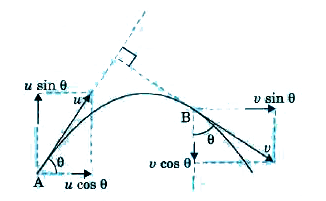 Components of VELOCITIES are shown in figure . We know that horizontal component of velocity remains constant, hence we can write the following: `v sin theta =u costheta` `rArr v=(u cos theta)/(sin theta)` Let US asume upward direction as positivedirection and apply equation of kinematics . `v_(y)=u_(y)+a_(y)t` `rArr (-v cos theta)=(u sin theta)+ (-g) t` SUBSTITUTING VALUE of v from equation(i), we get thefollowing: `"gt"=u sin theta+(u cos theta)/( sin theta) cos theta` `t=(u)/(g) cosec theta` |
|
| 36. |
The alttitude at which the weight of a body 64% of its weight on the surface of the earth is (Radius of the earth is 6400 km) |
| Answer» ANSWER :D | |
| 37. |
Two rods of the same cross-sectional area are attached end to end forming a total length of 1 m, at 25^(@)C. One rod in the combination is a 30 cm long copper rod. The composite rod, increases by 1.91 mm at 125^(@)C. If the composite rod is rigidly fixed between two walls so that no change in length may occur even with the rise in temperature, find the Young's modulus (Y) and the coefficient of linear expansion (alpha) for the second rod. alpha for copper =1.7 times 10^(-5@)C^(-1),Y for copper =1.3 times 10^(11)N*m^(-2). |
|
Answer» Solution :Length of the 2nd rod at `25^(@)C` = 100 cm - length of the copper rod at `25^(@)C` = 100 - 30 = 70 cm. Increase in length of the copper rod for the rise in temperature. `""=30 times 1.7 times 10^(-5) times(125-25)cm` `"" =0.051 cm=0.51mm` Increase in length of the 2nd rod for the same rise in temperature = 1.91 - 0.51 = 1.4 mm = 0.14 cm If the coefficient of linear expansion of the MATERIAL of the second rod is `alpha,` `"" 0.14=70 times alpha times (125-15)` `therefore "" alpha=0.14/(70 times (125-25))=2.0 times 10^(-5@)C^(-1)` Again, thermal stress `=Yalpha(t_(2)-t_(1))`. For copper rod, thermal stress `=1.3 times 10^(11) times 1.7 times 10^(-5) times (t_(2)-t_(1))` and for the 2nd rod, the thermal stress `=Y times 2 times 10^(-5) times (t_(2)-t_(1)).` [Y = Young.s modulus for the second rod] Since the two RODS have the same area of cross-section, the thermal stresses should be equal. `therefore "" 1.3 times 10^(11) times 1.7 times 10^(-5) times (t_(2)-t_(1))=Y times 2 times 10^(-5) times (t_(2)-t_(1))` or, `"" Y=(1.3 times 10^(11) times 1.7 times 10^(-5))/(2 times 10^(-5))=1.105 times 10^(11) N*m^(-2).` |
|
| 38. |
Net work done on a satellite revolving in an elliptical orbit in one complete revolution |
|
Answer» is ZERO |
|
| 39. |
The level of water in a vessel falls from a height 36cm to 16 cm in 6 minutes as water flows out through a hole in its bottom. At the end of next 3 minutes, the height of water level in the vessel will be |
|
Answer» 6 cm |
|
| 40. |
A body of mass 4 kg is attached to another body of mass 2 kg with a massless rod. If the 4 kg mass is at (2i + 5j)m and 2 kg mass is at (4i + 2j)m, the centre of mass of the system is at (in m) |
|
Answer» `8i+12j` |
|
| 41. |
If the velocity is represented by V, force by F and work by W. These quantities are taken as fundamental quantities then the correct dimensions of mass will be |
|
Answer» `W//V^(2)` |
|
| 42. |
Which of the following substances has the highest elasticity |
|
Answer» Rubber |
|
| 43. |
Sand is pilled up on a horizontal ground in the form of a regular cone of a fixed base radius R. The coefficient of static friction between sand layers is m. The maximum volume of sand that can be pilled up, without the sand slipping on the surface is |
|
Answer» `(MU R^3)/(3PI)` |
|
| 44. |
Which number is obtained by rounding off 96378 upto 2 significant digit? |
| Answer» Solution :`96378 to 5` significant DIGIT when rounded off become 96000. In 96000 NUMBER of significant digit are 2. | |
| 45. |
The energy density and pressure have |
|
Answer» same dimensions |
|
| 46. |
A wind with speed 40m /s blows parallel to the roof of a house. The area of the roof is 250m^2. Assuming that the pressure inside the house is atmospheric pressure, the force exerted by the wind on the roof and the direction of the force will be [p_("air")=1.2 kg//m^3] |
|
Answer» <P>`4.8xx10^5 N`, downwards `p+1/2rho v^2=` constant When pressure INSIDE that house = atmospheric pressure , `p_0`. Let the pressure on the roof be P. `thereforep+1/2 RHO v^2 = p_0+` Clearly, `p_0 gt p` So, effective pressure `p_0-p` willact in the upward direction . `p_0-p=1/2 rho v^2=1/2xx1.2xx(40)^2` Hence, effective force `=1/2xx1.2xx(40)^2xx250=2.4x10^5 N` |
|
| 47. |
If radius of the earth contracts to half of its present value without change in its mass, what will be the new duration of the day? |
| Answer» Solution :`W=(1//2) I(omega_(1)^(2)-omega_(2)^(2)) =(1//2)(2//5) mR^(2)[(2pi//T_(1))^(2) -(2pi//T_(2))^(2)]=9.36 xx 10^(28) J` | |
| 48. |
StateStefan-Boltzmannlaw. |
|
Answer» Solution :Stefan Boltzmann law STATES that, the TOTAL amount of heat RADIATED per second per unit AREA of a black body is directly proportional to the fourth POWER of its absolute temperature. `E prop T^4 " or" E= sigma T^4` |
|
| 49. |
A rod of length L is composed of a uniform length L/2 of wood whose mass is m_(w) and a uniform length L/2 of brass whose mass is M_(b) |
|
Answer» The MOMENT of inertia of rod about an axis passing through the CENTRE and perpendicular ot it is `(1)/(12)M_(w)L^(2)`. |
|
| 50. |
How far from earth must a body be along a line towards the sun so that the sun's gravitational pull on it balances that of the earth. Distance between sun and earths's centre is 1.5xx10^(10)km. Mass of sun is 3.21xx10^5 times mass of earth. |
|
Answer» MOON is the SATELLITE of the EARTH |
|


