

Saved Bookmarks
This section includes 7 InterviewSolutions, each offering curated multiple-choice questions to sharpen your Current Affairs knowledge and support exam preparation. Choose a topic below to get started.
| 1. |
A steel tube has an outside diameter of 3.000 cm at room temperature of 20°C. A brass tube has an inside diameter of 2.997 cm at the same temperature. If the temperature of the brass tube is changed to( 400- x)^(@) C the steel tube can inserted into the brass tube, then x-____ |
|
Answer» |
|
| 2. |
A heavy stone is thrown from a cliff of height h with a speed v. The stone will hit the ground with maximum speed if it is thrown |
|
Answer» vetically DOWNWARD |
|
| 3. |
How much work to be done in decreasing the volume of and ideal gas by an amount of 2.4xx10^(-4)m^(3) and constant normal pressure of 1xx10^(5) N//m^(2) |
|
Answer» 28 JOULE |
|
| 4. |
The specific heat of an ideal gas is |
|
Answer» PROPORTIONAL to T |
|
| 5. |
A body is placed on a smooth inclined plane of inclination 1 in x. The horizontal acceleration to be given to the inclined plane so that the body on it remains at rest with respect to inclined plane is |
|
Answer» `gsqrt(x^(2)-1)` |
|
| 6. |
In case of volume expansion of a gas,mention of both the pressure and the temperature is necessary,whereas for expansion of solids and liquids, only the temperature is mentioned.Why? |
| Answer» SOLUTION :The effect of change in pressure on the volume of a solid or a LIQUID is PRACTICALLY because of COMPACTNESS of molecules But inter-molecular attraction in gases is weak.so change in pressure significantly changes the volume ofa GAS .All substances solid liquid or gas expand or increase in temperature ingeneralHence the mention of pressure along with temperature is necessary in case of volume expansion of a gas. | |
| 7. |
Do all physical quantities have dimensions? If not, name two physical quantities which are dimensionless. |
| Answer» Solution :No. Physical QUANTITIES like angle, STRAIN and RELATIVE DENSITY are DIMENSIONLESS. | |
| 8. |
How many light years alpha centauri away from the earth? |
|
Answer» 1.29 |
|
| 9. |
A plank of mass M, whose top surface is rough with coefficient of friction mu is placed on a smooth ground. Now a disc of mass m=M//2 and radius r is placed on the plank. The disc is now given a velocity v_(0) in the horizontal direction at t=0 a. Find the time when the disc starts rolling b. Find the velocity of the plank and the disc up to that time. c. Find the distance travelled by the plank up to this instant. Find the work done by the friction force up to this instant. |
Answer» Solution :a. Step 1: Free body diagram 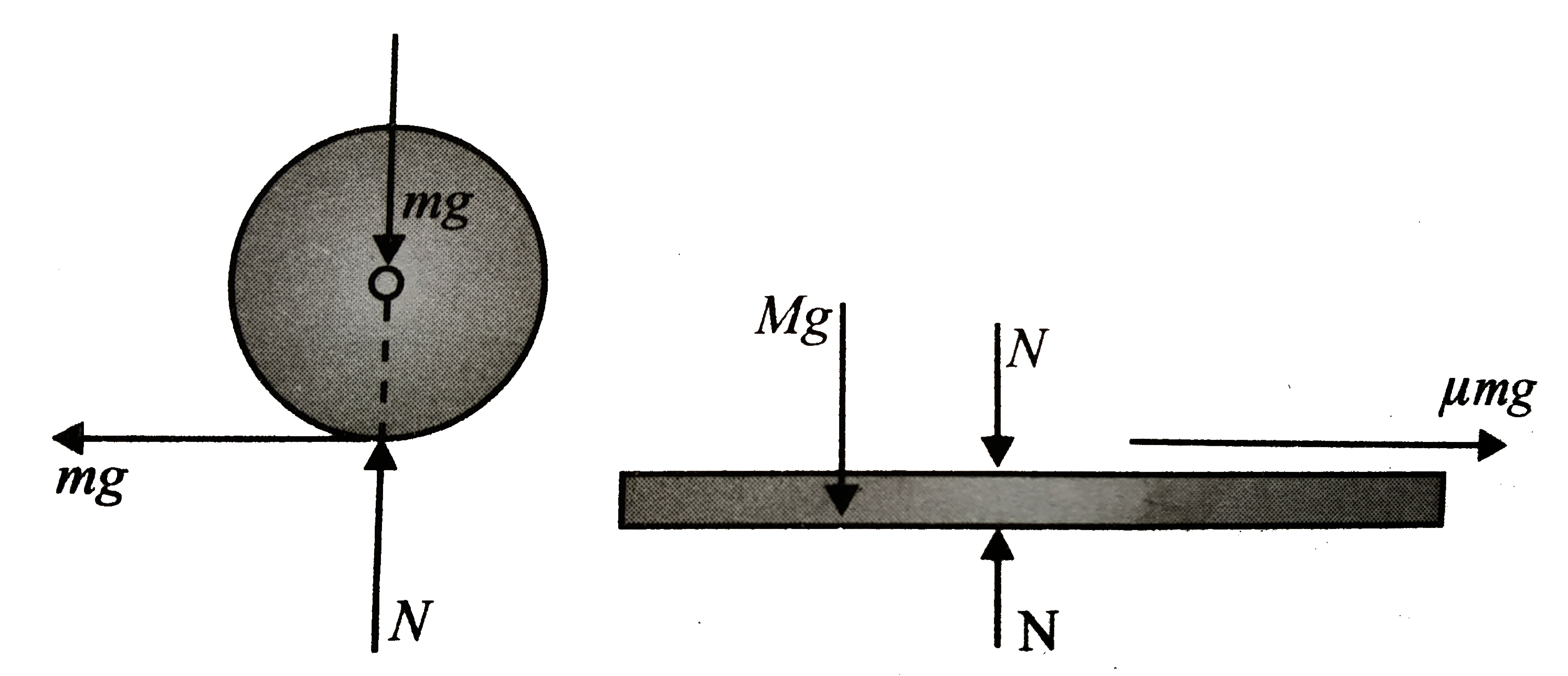 B. Step 2: Equation of motion For the plank: `mumg=MA` `impliesA=(mumg)/M` (towards right) …………i `impliesA=(mug)/2` (as `m=M/2`) (will be positive) Forthe disc: `mumg=ma` `a=mug` (backwards, towards left) (will be negative) c. Step 3: Torque equation `mumgR=Ialpha` `mumgR=(MR^(2))/2alpha` `alpha=(2mug)/R` (clockwise) (will be positive) d. Step 4: Constraint relations At the time of rolling point `P` should not slide with respect to the plank. 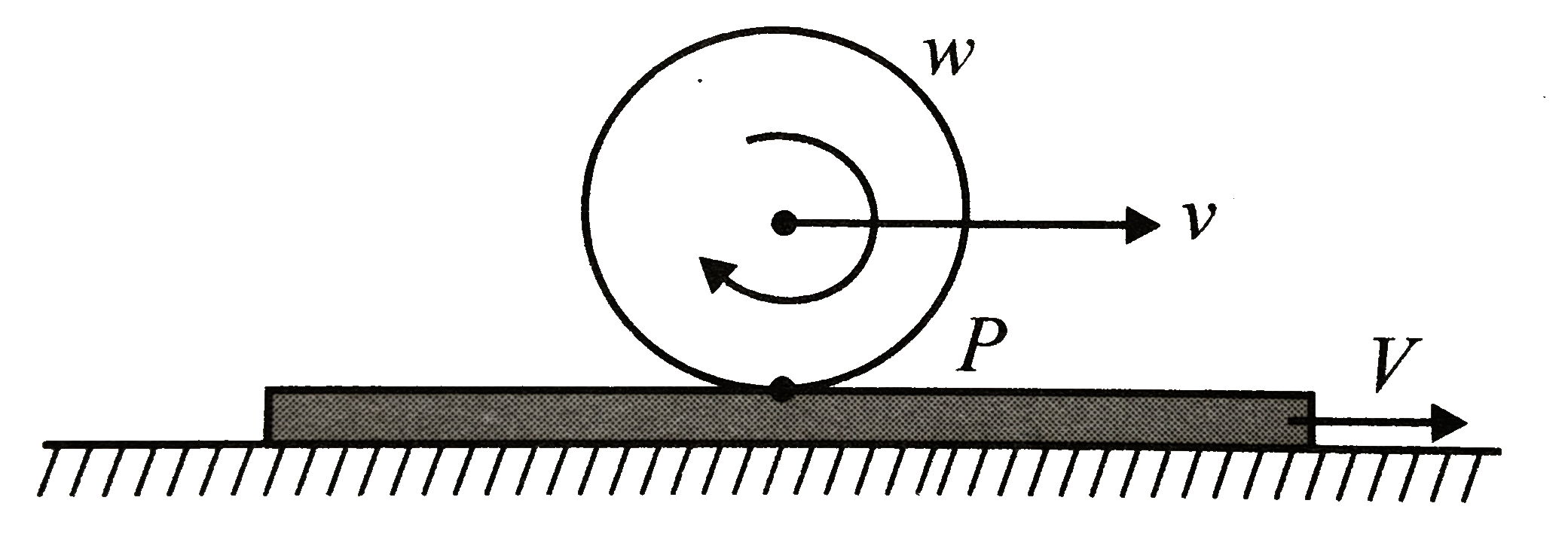 `-omegaR` `(0+at)=(v_(0)-a)-(0+alphat)R` Now substituting the values of `A` and a, we can calculate `t`, `(mumg)/Mt(v_(0)-mugt)-((2mug)/Rt)R` `((mumg)/M+mug+2mug)t=v_(0)` Which gives `t=v_(0)/(mug(m/M+3))=(v_(0))/(5mug)` (as`m=M//2`) Velocity of the plank when rolling STARTS `V=At=((mug)/2)((v_(0))/(5mug))=(v_(0))/10` Velocity of the disc when rolling starts `v=v_(0)+at=v_(0)+(-mug)((v_(0))/(5mug))=4/5v_(0)` Angular velocity at time of rolling, `omega=alphat=((2mug)/R)((v_(0))/(5mug))=2/5 (v_(0))/R` DISTANCE travelled by the plank, `S_("plank") =1/2At^(2)=1/2((mug)/2)((v_(0))/(5mug))^(2)=(v_(0)^(2))/(100mug)` Work done by friction FORCE, `W_("friction") =/_\K_("translation")+/_\K_("rotation")` `=[/_\K_("disc")+/_\K_("plank")]_("translation")+/_\K_("rotation")` `[(1/2mv^(2)-1/2mv_(0)^(2))+(1/2MV^(2)-0)(1/2Iomega^(2)-0)]` substituting the vaues of `v, V` and `omega`, we get the work done by friction i.e., `W_("friction")=13/200Mv_(0)^(2)` |
|
| 10. |
The rate of coolingof water in a calorimete is one-tenth of a degree per second when itstemperature is 40^(@)Cabove thatof the sorroudings . Whatis the rateof cooling andheatlost persecond whenthe excess temperatuer over thesurrodings is 30^(@)C ? Thermalcapacityof waterand calorimater is 4600 J//""^(@)C |
|
Answer» Solution :Rate of cooling, `(d theta)/(dt) prop`excess temperatureover the surroudings. In the first CASE `(1)/(10) prop 40`, In the second case `(d theta)/(dt) prop 30` . DIVING`(dtheta)/(dt) //(1)/(10) =(30)/(4) ""therefore (d theta)/(dt) = (3)/(4 xx 10)=(3)/(40)""^(@)C// SEC ` Rateof heat RADITION ` = ms ( d theta)/(dt) `= Thermal capacity `xx ( d theta)/(dt) = 4600 xx (3)/(40) = 345J//sec` |
|
| 11. |
Two identical ball bearings in contact with each other and resting on a frictionless table are hit head-on by another ball bearing of the same mass moving initially with a speed V. If the collision is elastic, which of the following (Fig. 6. 14) is a possible result after collision? |
|
Answer» |
|
| 12. |
What is weightlessness ? Explain with example. |
|
Answer» Solution :`implies` When a weight of the body becomes zero or when any surface exerts a force on a body and reaction force becomes zero then this body is said to be in weightlessness position. `implies`When a spring BALANCE hang through a ceiling and on its other end, mass of body SUSPENDED the length of spring increases and from this we can know the weight of body. `implies`Now, when a spring fall freely, the spring is not stretched at all, the weight of body is not notable. This phenomena is known as weightlessness. (i)The resultant weight of person in a lift when the lift is in free fall motion, `W = mg - ma ` but a = G `:. W = mg - mg ` `:.` When the weight of person becomes zero this position is known as weightlessness.  (ii)The acceleration of the every parts of the satellite is towards the centre of carth when it revolves. THUS, acceleration of this is EQUAL to the acceleration due to gravity at that place. Hence, everything in the satellite will be in weightlessness position, all are in free fall state. Resultant force `F= mg. - ma_c` (Centripetal acceleration `a_c`= acceleration due to gravity at that place) ` :.F = 0` (iii)There is no any gravitational force acting on a person sitting in a spacecraft. Hence, they are also in weightlessness position. For us gravitation determined the vertical direction, but for astronauts there is no vertical or horizontal directions. |
|
| 14. |
Sketch the function y=x+a. Explain your sketch. |
|
Answer» Solution :When a = 0 , y = x when a = 1 , x = 1 , y = 1 + 1 = 2 when a = 2 , x= 2 , y = 2 + 2 = 4 Explanation: This implies, when increasing the value of a, the LINE shifts towards right side at a= 0, and line shifts towards left side at a= 1, 2, .... For a = vt, y = x - vi SATISFIES the differential equation. Though this function satisfies the differential equation, it is not finite for all values of x and t. Hence it does not represent a waves. 
|
|
| 15. |
A body can be cooled by |
|
Answer» CONDUCTION |
|
| 16. |
The position of an object, moving in one dimension, is given by the formula x (t) = (4.2 t ^(2) + 2.6)m. Calculate its (i) average velocity in the time interval fromj t =0 to t = 3 s and (ii) Instantaneous velocity att=3s. [ (d (x ^(x)))/( dt ) = nx ^(n -1)] |
|
Answer» Solution :The position of an OBJECT for `t =0,` `X (0) = 4.2 (0) ^(2) + 2.6 = 2.6 m` (initial position) `(because x (t) = 4.2 t ^(2) + 2.6)` Similiarly, for `t = 3s, x (3) = 4.2(3) ^(2) +2.6 = 40.4m` (final position) Now, average VELOCITY in the time interval from `t =0` to `t =3s` is `lt v gty = ("final position - initial position")/("time interval")` `=(x (3) -x(0))/(3-0) = (40.4 -2.6)/(3)` ` therefore lt v gt = 12.6 ms ^(-1)` To find the instantaneous velocity at 3s, first we have to differentiate the position equation, `x (t) = (4.2 tg ^(2) + 2.6) m ` with respect to .t.. `therefore` Instantaneous velocity `v = (dx)/(dt) = (d)/(dt) = (4.2 t ^(2) + 2.6)` `=4.2 (2t) + 0 (because (d)/(dt) (2.6) =0)` `therefore v = 8.4 ms ^(-1)` Putting t = 3s in above equation, `v = 8.4(3)` `therefore v = 25.2 ms ^(-1)` |
|
| 17. |
A wooden block of mass 2 kg rests on a soft horizontal floor.When an iron cylinder of mass 25 kg is placed on top of the block, the floor yields steadily and the block and the cylinder together go down with an acceleration of 0.1 m s^(-2).What is the action of the block on the floor (a) before and (b) after the floor yields ? Take g = 10 m s^(-2) . Identify the action-reaction pairs in the problem. |
|
Answer» Solution :(a) The block is at rest on the floor. Its free-body diagram SHOWS TWO forces on the block, the force of gravitational attraction by the earth equal to `2 ×x 10 = 20 N` , and the normal force R of the floor on the block. By the First Law, the net force on the block must be zero i.e., R = 20 N.Using third law the action of the block (i.e. the force exerted on the floor by the block) is equal to 20 N and DIRECTED vertically downwards. (b) The SYSTEM (block + cylinder) accelerates downwards with `0.1 m s^(-2)` . The free-body diagram of the system shows two forces on the system : the force of gravity due to the earth (270 N), and the normal force R′ by the floor.Note, the free-body diagram of the system does not show the internal forces between the block and the cylinder.Applying the second law to the system, `270 - R. = 27 xx 0.1 N` `i.e., R. = 267.3N` 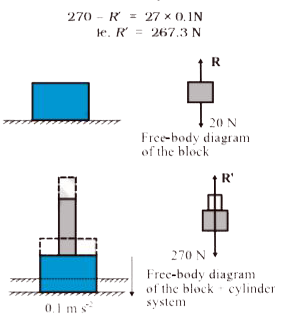 By the third law, theactionof the system on the floor is equal to 267.3 N vertically downward |
|
| 18. |
When you mix a tumbler of hot water with one bucket of normal water, what will be the direction of heat flow? Justify. |
|
Answer» Solution :The water in the TUMBLER is at a higher temperature than the bucket of normal water. But the bucket of normal water has larger internal energy than the hot water in the tumbler. This is because the internal energy is an extensive variable and it depends on the SIZE or mass of the system. Even though the bucket of normal water has larger internal energy than the tumbler of hot water, heat will flow from water in the tumbler to the water in the bucket. This is because heat flows from a body at higher temperature to the one at lower temperature and is independent of internal energy of the system. Once the heat is transferred to an object it becomes internal energy of the object. The right way to say is .object has CERTAIN AMOUNT of internal energy.. Heat is one of the ways to increase the internal energy of a system as shown in the Figure. 
|
|
| 19. |
The rate of a flow V a of liquid through a capillary under a constant pressure depends upon (i) the pressure gradient (P/l) (ii) coefficient of viscosity of the liquid eta (iii) the radius of the capillary tube r. Show dimesionally that the rate of volume of liquid flowing per sec V∝ Pr^4 /ηl |
| Answer» Solution :`V=k(P//l)^(x)R^(y)eta^(z), [L^(3)T^(-1)]=[ML^(-1)T^(-2)//L]^(x)L^(y)[ML^(-1)T^(-1)]^(z)`. SIMPLIFYING `x=1, y=4 z=-1`. | |
| 20. |
A body is projected vertically up with centain velocity. At a point 'P' in its path, the ratio of its potential to kinetic energies is 9 : 16. The ratio of velocity of projection to velocity at 'P' is, |
| Answer» Answer :B | |
| 21. |
The minimum coefficient of static friction between an inclined plane and cylinder for the cylinder not slipping on the inclined plane is given by mu= |
| Answer» Answer :A | |
| 22. |
The potential energy for field vecF is givenn by U(x,y)=sin(x+y). Find the force acting on the paticle of mass m at a position given by co-ordinates (0,(pi)/4). (consider all values in S.I. system) |
|
Answer» |
|
| 23. |
What will be the amplitude of simple harmonic motion at resonance in the absence of damping force? |
| Answer» SOLUTION :INFINITY. | |
| 24. |
An ideal fluid is flowing through four tubes a, b, c, d of radii in the ratio 2:7:3:1 with velocities in the ratio 1:2:5:15 when maintained at different pressures. The ascending order of the amount of fluid flowing through the tubes persecond is |
|
Answer» a, d, c, b |
|
| 25. |
A body at 80" "^(@)C cools down to 64" "^(@)C in 5 minutes, and in 10 minutes it cools down to 52" "^(@)C. What will be its temperature after 20 minutes ? What is the temperature of the environment ? |
|
Answer» Solution :For the first 5 minute, `Deltat=5min`. `DeltaT=T_(2)-T_(1)=64-80=-16` Now USING `-(dQ)/(dt)=-k.[T-T_(s)]` `(16)/(5)=+k.[(80+64)/(2)-T_(s)]`. .. .(1) Here we have taken the average of initial and FINAL temperature as the temperature of the body. `T=(T_(1)+T_(2))/(2)` For the NEXT `Deltat=5` min., `(12)/(5)=k.((52+64)/(2)-T_(s))`. . . (2) Dividing equation (1) by equation (2) `(16)/(5)xx(5)/(12)=(72-T_(s))/(58-T_(s))` `:.4/3=(72-T_(s))/(58-T_(s))` `:.232-4T_(s)=216-3T_(s)` `:.T_(s)=16" "^(@)C` From equation (1) `(16)/(5)=k.(72-16)` `=56k.` `:.k.=(16)/(5xx56)=(2)/(32)` For the last `Deltat=10` minutes, `DeltaT=T-52`, where T = Final temperature `(52-T)/(10)=(2)/(35)((52+T)/(2)-16)(becauseTlt52)` `:.52-T=(4)/(7)((52+T-32)/(2))(because(20)/(35)=(4)/(7))` `:." "52-T=(2)/(7)(20+T)` `:.364-7T=40+2T` `:.324=9T` `:.T=(324)/(9)=36" "^(@)C` |
|
| 26. |
An athleteruns a certain distance before taking a long jump . Why ? |
| Answer» SOLUTION :So that inertia of MOTION may help him in his MUSCULAR efforts to take a LONGER jump. | |
| 27. |
What do mechanical wave transfer: energy, matter, both or neither? |
| Answer» SOLUTION :MECHANICAL waves transfer only energy from one POINT to ANOTHER. | |
| 28. |
Two bodies of masses (M+m) and (M-m) are connected to the ends of a light inexte-nsible string and the string is laid over a smooth fixed pulley. The system is released from rest. The velocity of the centre of mass of the two body system V seconds after the release is |
|
Answer» `GT m/M` |
|
| 29. |
Diatomic molecules like hydrogen have energies due to both translational as well as rotational motion. From the equation in kinetic theory PV = 2/3 E,E isthe total energy per unit volume |
| Answer» Solution :ACCORDING to kinetic theory equation, PV = 2/3 E [where P= Pressure V = volume]E is representing only translational part of ENERGY. Internal energy contains all TYPES of energies like translational, rotational, vibrational etc. But the molecules of an ideal gas is treated as point MASSES in kinetic theory, so its kinetic energy is only DUE to translational motion. Point mass does not have rotational or vibrational motion. Here, we assumed that the walls only exert perpendicular forces on molecules. They do not exert any parallel force, hence there will not be any type of rotation present. The wall produces only change in translational motion. | |
| 30. |
A bridge of mass 10 tonne and length 50 m is supported at its ends by twopillars. What weight do the pillars sustain when a lorry of mass 4 tonne is 10 m away from the first pillar? |
|
Answer» |
|
| 31. |
What is the SI unit of angular velocity and angular acceleration? |
|
Answer» SOLUTION :SI unit of angular velocity : `"RADS"^(-1)` or `"REVOLUTION s"^(-1)` SI unit of angular acceleration : `"rads"^(-2)` or revolution `s^(-2)` |
|
| 32. |
When a coil of copper is kept at a certain distance above a flame, the candle keeps buring. On placing the coil over the flame it is extinguished. This happens because |
|
Answer» the coil CONDUCTS away heat very QUICKLY due to its high conductivity which reduces the temperature of the FLAME to a value below is ignition temperature |
|
| 33. |
An object of mass 0.2kg executes simple harmonic oscillations along the x-axis with a frequency 25/pi Hz.At the position x = 0.04m, the object has kinetic energy 0.5and potential energy 0.41. The amplitude of oscillation is (Take potential energy to be zero at mean position |
| Answer» ANSWER :A | |
| 34. |
In a hypothetical situation, the density of earth becomes three times that of its original density, but its radius remains same. The acceleration due to gravity becomes : (take g = 10 m//s^(2) on the earth) |
|
Answer» `20 m//s^(2)` if density is made thrice, then g will also become 3 TIMES, i.e., `10 xx 3 = 30 m//s^(2)` |
|
| 35. |
In order to increase the magnifying power of a compound microscope. |
|
Answer» The focal LENGTHS of the objective and the eye piece should be small |
|
| 36. |
The power of a refrigerator which freezes 100 gm of water at 10^(@)C into ice at 0^(@)C in 100 sec is |
|
Answer» 1400 W |
|
| 37. |
One end of a massless spring of spring constant 100 N/m and natural length 0.5 m is fixed and the other end is connected to a particle of mass 0.5 kg lying on a frictionless horizontal table. The spring remains horizontal. If the mass is made to rotate at an angular velocity of 2 rad/s, find the elongation of the spring. |
|
Answer» SOLUTION :The RESTORING force in the spring PROVIDES the centripetal force to the mass. If .x. is the extension in the spring, then `Kx=m(L+x)omega^(2)` Putting the VALUES, we get `x=(0.5xx4xx0.5)/(100-0.5xx4)` `x ~~ 1 cm` |
|
| 38. |
Three rods of equal l are joined to from an equilateral trangle PQR.O is the mid-point of PQ. Distance OR remains same for small change in temperature. Coefficient of linear expansion for PR and RQ is same i.e., alpha_(2) but for PQ is alpha_(1^.) Then |
|
Answer» `alpha_(2) = 3 alpha_(1)` `""=[l(1+alpha_(2)t)]^(2)-[1/2(1+alpha_(l)t)]^(2)` `l-(l^(2))/4=l^(2)(1+alpha_(2)^(2)t^(2)+2alpha_(2)t)-(l^(2))/4(1+alpha_(1)^(2)t^(2)+2alpha_(l)t)` Neglecting `alpha_(2)^(2)t^(2)and alpha_(1)^(2)t^(2)` `""0=l^(2)(2alpha_(2)t^(2))-(l^(2))/4(2alpha_(l)t)` `rArr""2alpha_(2)=(2alpha_(1))/4` `rArr""alpha_(1)=4alpha_(2)` |
|
| 39. |
An air chamber of volume V has a neck area of cross section a into which a ball of mass m just fits and can move up and down without any friction (Fig.14.27). Show that when the ball is pressed down a little and released , it executes SHM. Obtain an expression for the time period of oscillations assuming pressure-volume variations of air to be isothermal [see Fig. 14.27]. |
Answer» Solution :Consider an air chamber of volume V with a long NECK of uniform area of cross-section a, and a frictionless ball of mass m fitted smoothly in the neck at position C shown in figure. The pressure of air below the ball inside the chamber is equal to the atmosphere pressure.  Increase the pressure on the ball by a little amoung P, so that ball is depressed to position D, where CD = y There will be decrease in volume `triangleV = Ay` Volume strain `=(" Change in volume ")/(" Original volume ")` `= (triangle V)/(V) = (Ay)/(V)` BULK Modulus `B= (" Stress ")/(" Volumetric strain ")` `therefore B = (-P)/(Ay"/"V) = -(PV)/(Ay)` Here, negative SIGN shows that the increase in pressure will decrease the volume `therefore P= (-BAy)/(V)` Due to this excess pressure the restoring FORCE acting on the ball is, `F= PA = (-BAy)/(V)xx A` `therefore F= -(BA^(2)y)/(V)` `= -ky` `therefore F propto -y`, where force constant `k= (BA^(2))/(V)` The motion of a ball around C is SHM and from restoring force `F= -ky`, `k= (BA^(2))/(V)` Period `T= 2pi sqrt((m)/(k))` `= 2pi sqrt((m)/((BA^2)/(V)))` `= 2pi sqrt((mV)/(BA^2))` |
|
| 40. |
Explain in detail the Maxwell Boltzmann distribution function. |
|
Answer» Solution :Maxwell-Boltzmann: In speed distribution function CONSIDER an atmosphere, the air molecules are moving in random directions. The speed of each molecule is not the same EVEN though macroscopic parameters LIKE temperature and pressure are fixed. Each molecule collides with every other molecule and they exchange their speed. In the previously we calculated the rms speed of each molecule and not the speed of each molecule which is rather difficult. In this scenario we can find the number of gas molecules that move with the speed of 5 `ms^(-1)` to 10 `ms^(-1)` or 10 `ms^(-1)` to 15 `ms^(-1)` etc. In general our interest is to find how many gas molecules have the RANGE of speed from v to v + dv. This is given by Maxwell.s speed distribution function.  The above expression is graphically shown as follows: From the figure (1), it is clear that, for a given temperature the number of molecules having lower speed increases parabolically but decreases exponentially after reaching most probable speed. The rms speed, average speed and most probable speed are indicated in the figure (1). It can be seen that the rms speed is greatest among the three. (i) The area under the graph will give the total number of gas molecules in the system (ii) Figure 2 shows the speed distribution graph for TWO different temperatures. As temperature increases, the peak of the curve is shifted to the right. It implies that the average speed of each molecule will increase. But the area under each graph is same since it represents the total number of gas molecules. 
|
|
| 41. |
The ratio of velocitiesof equal masses in an inelastic collision with one of the masses is stationary is |
|
Answer» (a) `(1-e)/(1+e)` |
|
| 42. |
An object falling freely under gravity close to Earth is |
|
Answer» ONE dimensional |
|
| 43. |
Acceleration of a solid cylinder rolls on inclined plane with a 30^(@) angle is …………… |
|
Answer» `(g)/(3)` `a=(2)/(3)gsintheta` `=(2)/(3)xxgxxsin30^(@)` `=(2)/(3)xxgxx(1)/(2)` `therefore a=(g)/(3)` |
|
| 44. |
10g of a liquid of density 5g cm^(-3) is mixed with 12g of another miscible liquid of density 4g cm^(-3). Find the density of mixture. |
|
Answer» Solution :Density of mixture `= (["TOTAL mass of mixture"])/(["Total volume of mixture"])` or Density of mixture, `D= (m_(1) + m_(2))/((m_(1))/(sigma_(1)) + (m_(2))/(sigma_(2))) = (sigma_(1) sigma_(2) (m_(1) + m_(2)))/(m_(1) sigma + m_(2) sigma_(1))` `:. D= (5 xx 4 (10 + 12))/(10 xx 4 xx 12 xx 5) = (20 xx 22)/(40+60)` `=(20 xx 22)/(100) = 4.4 g cm^(-3)` `:.` Density of mixture of liquids = `4.4 g cm^(-3)` |
|
| 45. |
{:(,"Column I",,"Column II"),(("A"),"Electrical resistance",(p),["M"^(-1)"L"^(-2)"T"^(4)"A"^(2)]),(("B"),"Capacitance",(q),["ML"^(2)"T"^(-2)"A"^(-2)]),(("C"),"Magnetic field",(r),["ML"^(2)"T"^(-3)"A"^(-2)]),(("D"),"Inductance",(s),["MT"^(-2)"A"^(-1)]):} |
|
Answer» <P> |
|
| 46. |
The phenomenon of beats can take place : |
|
Answer» for SOUND waves OLNY |
|
| 47. |
The acceleration time graph of a particle moving along a straight line is as shown in figure . At what time the particle acquires its initial velocity. |
|
Answer» SOLUTION :`a=a_(0)t+a_(1), t=0,a=a_(1)=10, a_(1)=10,a=0at t=4`seconds. `0=+4 a_(0)+10, a_(0)=2.5` `a=2.5t+10,(dv)/(dt)=-2.5t+10` `intdv=int(-2.5t+10)dt, v=2.5t^(2)/2+10t+C` `t=0,C=v_(0), v=-2.5t^(2)/2+10t+v_(0)` `v=v_(0)-2.5t^(2)/2+10t=0,2.5t^(2)/5=10t` t=8 seconds. 
|
|
| 48. |
One mole of an ideal gas undergoes anisothermal change at temperature .T. so that its volume v is doubled. R is the molar gas constant. Work done by the gas during this change is |
|
Answer» RT LOG 4 |
|
| 49. |
When a lift is moving upwards with acceleration a, then time period of simple pendulum in it will be ......... . |
|
Answer» `2pisqrt((L)/(g+a))` |
|