

Saved Bookmarks
This section includes 7 InterviewSolutions, each offering curated multiple-choice questions to sharpen your Current Affairs knowledge and support exam preparation. Choose a topic below to get started.
| 1. |
A rogidbody of radiusof gyration k andinclinedplaneat an anglethetawithhorizontal. Calculateits acceleration andthe frictional force actingon it . Alsofindthe expressionsfor velocity as it reachesthe lowestpoint and thetime takento reachthe lowest point. |
| Answer» Solution :WHENTHE body is placedon theinclinedplane , it tries to slipdown and henceastaticfrictionfactsupwards. Thisfriction providesa torquewhichcausesthe bodyto rotate . Let `ALPHA` be thelinear ACCELERATION of CENTREOF mass and `alpha ` be theangular accelerationof the body. From forcediagram : | |
| 2. |
A person performing a somersault is an example of . . . . . Motion. |
|
Answer» circular |
|
| 3. |
What is dynamics? |
|
Answer» SOLUTION :Branch of PHYSICS in which the motinof a bodyis dicussed ALONG with thecause of motionandpropertiesof themovingbody iscalleddynamics Thescience whichdeals with motionofbodiesis calledDynamics |
|
| 4. |
If tau is the torque and theta is the angular displacement then work done is given by |
|
Answer» `(TAU)/(THETA)` |
|
| 5. |
By knowing dimensions what idea do you get about a physical quantity? |
| Answer» SOLUTION :Dimensions tell US about the nature of the physical quantity and do not GIVENN any idea about the magnitude. The concept of dimension is more genralised compared to the idea of UNIT. | |
| 6. |
Find the time period of mass M when displaced from its equilibrium position and then reelased for the system shown in figure. |
|
Answer» Solution :Let k be the spring constant of the spring. When mass Mis suspended from the given system as SHOWN in figure.let l be the length through which mass M MOVES down before itcomes to rest. In this SITUATION, both the spring and string will be stretched by length l. Since string is inextensible, so spring isstretched by length 2l. The tension along the string is the same. So, RESTORING force is `F=-2kxx(2l)=-4kl` ...(i) In equilibrium position,this restoring balances weigth of the mass. i.e., `Mg=4kl` If mass M is pulled doen through small distance y, then restoring force `F^(')` is given by `F^(')=-2k(2l+2y)` Effective restoring force on mass M is given by `f=F^(')-F=-2(2l+2y)-(-4kl)=-4ky`...(iii) As `fpropy` and f is directed towards equilibrium position. hence if massis left free, it will execute linear SHM. From (ii), spring factor`=4k`. Inertia factor `=M` As time period, `T=2pisqrt((i n ertia fact o R)/(spri ng fact o r))=2pisqrt((M)/(4k))` |
|
| 7. |
Moment of inertia of a triangle plane of mass M shown in the figure, about axis AB is (Ml^(2))/(x). Where 'x' is |
|
Answer» |
|
| 8. |
In the given figure, an ideal gas changes its state from state A to state C by two paths ABC and AC. The internal energy of gas at state B is 20 J. Find the amount of heat supplied to the gas to go from A to B |
|
Answer» Solution :As WORK done `W= int PdV`= area under P-V curve, so For PATH AB, first LAW of thermodynamics yields `dQ=(U_b-U_A)+ 0 = 20-10 = 10J`. |
|
| 9. |
In the given figure, an ideal gas changes its state from state A to state C by two paths ABC and AC. The internal energy of the gas at A is 10 J and amount of heat supplied to change its state to C through the path AC is 2003. Calculate the internal energy at C. |
|
Answer» Solution :As work done `W= int PDV`= AREA under P-V CURVE, so According to first law of THERMODYNAMICS dQ=dU+dW `(U_c -U_A ) =dQ-dW =200- 40160 J` ` soU_c= 160+U_A= 160+ 100= 170 J` |
|
| 10. |
A horizontal disc rotating freely about a vertical axis makes 100 rpm. A small piece of wax of mass 10 g falls vertically on the disc and adheres to it at a distance of 9 cm from the axis if the number of revolution per minute is thereby reduced to 90. Calculate the moment of inertia of disc. |
|
Answer» Solution :`I_(1)omega_(1) = I_(2)omega_(2)` Let the moment of inertia of the disc about the axis of rotation be / and that of the putty be .I. where `I. = mr^(2)` `I xx 2pi n_(1) = (I + mr^(2)) xx 2pi n_(2)` `m = 5 xx 10^(-3) kg, r=0.04 m, n_(1) = 300/60 = 5 RPS, n_(2) = 240/60 = 4 rps` `L xx 2pi xx 5 = (I + 5 xx 10^(-3) xx 0.04^(2)) xx 2pi xx 4` `5l = 4L + 32xx 10^(-6) , I = 32 xx 10^(-6) kg m^(2)` `I = 32 xx 10^(-6) kg m^(2)` |
|
| 11. |
A stone is tied at the end of a string lm long and whirled round by holding the other end. The stone makes 120 revolution is 12 seconds. Calculate the angular velocity and linear velocity. |
| Answer» Solution :`OMEGA = 2pin = 2PI (120//12) = 62.8 "rad/s", V = ROMEGA =1 xx 62.8 = 62.8` m/s | |
| 12. |
A solid object of mass M is made from a material of specific heat capacity C and specific latent heat of fusion L and of very high thermal conductivity enters the atmosphere from outer space, its temperature being below its melting point by DeltaT. Because of atmospheric friction it absorbs energy at a constant rate R. The time before the solid becomes completely molten is given by |
|
Answer» `(M(C+L)DeltaT)/( R )` |
|
| 13. |
A circular plate has a uniform thickness and has a diameter 56cm. A circular disc of diameter 42cm is removed from one edge of the plate. The distance of centre of mass of the remaining portion from the centre of the circular plate is |
| Answer» ANSWER :B | |
| 14. |
A sphere of mass M and radius R is faling in a viscous fluid. The terminal velocity attained by the falling object will be proportional to |
|
Answer» `R^(2)` |
|
| 15. |
A block m is kept stationary relative to cage on a rough inclined surface of an accelerating cage as shwon in the figure. At the give instant, |
|
Answer» Normal reacton performs positive work on the block in a give TIME interval |
|
| 16. |
A solid sphere is rotating freely about its symmetry axis in free space . The radius of the sphere is increased keeping its mass same . Which of the following physical quantities would remain constant for the sphere ? |
|
Answer» Angular VELOCITY So, `(dL)/(dt) = tau_("ex") = 0` i.e., L = constant So angular momentum REMAINS constant . |
|
| 17. |
A shower stall has dimensions 86.0 cm xx 86.0 cm xx 210 cm. If you singing in this shower , which frequencies would sound the richest ( because of resonance) ? Assume the stall acts as a pipe closed at both ends , with nodes at opposite sides . Assume the voices of various singers range from130 Hz "to" 2000 Hz. Let the speed of sound in the hot air be 355 m//s. |
|
Answer» Solution :We except one set of equally spaced resonance frequencies for sound moving horizontally , and another set with narrower spacing for sound moving vertically . Standing waves must fit between the sides walls , with nodes at both surfaces , or else between floor and ceiling. For a closed box , the resonant air vibrations will have nodes at both sides , so the permitted wavelengths will be defined by ` L = nd_(N N) = (n lambda)/(2) = ( n v)/( 2 f), with n = 1, 2, 3 ,....` Rearranging , and substituting `L = 0.860 m `, the side to side resonant frequencies are `f_(n) = n (v)/( 2L) = ( 355 m//s)/( 2 ( 0.860 m))` ` = n ( 206 Hz)`, for each `n from 1 "to" 9` . With `L' = 2.10 m` , the top to BOTTOM resonance frequencies are `f_(n) = n ( 355 m//s)/(2( 2.10 m)) = n ( 84.5 Hz)` for each `n` from ` 2 "to" 23` We found the allowed values for `n` by checking which resonant frequencies lie in the VOCAL range between `130 Hz "to" 2000 Hz`. If the equations in this problem look like formulas for a pipe open at bothends or a string fixed at both ends , you should draw pictures of the vibrations instead of just thinking about formulas . The shower stall is different from any organ pipe , because it has nodes at both walls instead of antinodes . The shower stall is different from a string from a string because the air wave is LONGITUDINAL . An equation like `d_(N N) = lambda //2` is true for all one - dimensional standing waves , so the best ` f = v//lambda`. A function generator connected to a loudspeaker , with you ear as detector , is all you need to do a nice experiment to observe this PHENOMENON in any SMALL room with hard parallel walls . Listen at different distances from one wall , and you may even discover whether you ear responds more to air displacement or to air pressure . |
|
| 18. |
A bird weighs 0.5 kg and is inside a cage of 2.5 kg. If it starts flying, then what is the weight of the bird an cage assembly? |
|
Answer» 4 kg |
|
| 19. |
Two objects which are initally at rest, move towards each other under the action of their internal attraction. If their speeds are 4 v and 2 v at any instant, then the speed of centre of mass of the system will be |
|
Answer» 2v |
|
| 20. |
Can simple pendulum clock be used in an artificial satellite? Why ? |
| Answer» SOLUTION :No, because an artificial satellite experience WEIGHTLESS position and HENCE effective ACCELERATION is zero. | |
| 21. |
Assertion : The compressibility of solids is less than that of gases and liquids.Reason : There is tightcouplingbetweentheneighbouring atoms in solids. |
|
Answer» |
|
| 22. |
A body is projected vertically up. What is the distance covered in its last second of upward motion? (g=10 m//s^(2)) |
|
Answer» `19.6ms^(-1)` |
|
| 23. |
Assertion : For turbulent flow Reynolds number R_(e)gt2000.Reason : For high value of Reynold number internal force is more effective than viscous force. |
|
Answer» Both ASSERTION and REASON are TRUE and the reason is the CORRECT EXPLANATION of the assertion. |
|
| 24. |
A bus and car have the same momentum. If kinetic energy of the bus is K_1 and that of the car is K_2 then |
|
Answer» `K_1=K_2` |
|
| 25. |
(A) : The centre of mass of a body may lie where there is no mass. (R ) : Centre of mass of a body is a point, where the whole mass of the body is supposed to be concentrated |
|
Answer» Both 'A' and 'R' and TRUE and 'R' is the CORRECT explantation of 'A' |
|
| 26. |
If a body breaks immediately after the elastic limit then this body is known as…… |
| Answer» SOLUTION :DUCTILE. | |
| 27. |
At a given temperature if V_(rms) is the root mean square velocity of the molecules of a gas ,V_(s) is the velocity of sound in it ,then these are related as (gamma=(C_(P))/(C_(v))) |
|
Answer» `V_(rms)=V_(s)` |
|
| 28. |
What does the slope of 'position - time' graph represent? Which physical quantity is obtained from it? |
|
Answer» Solution :(i) GRAPHICALLY the slope of the position - time graph will give the velocity of the particle. (ii) At the same time, if velocity - time graph is GIVEN, the distance and displacement are determined, by calculating the area under the curve. Velocity is given by `(dx)/(dt)=v`. (iii) Therefore, `dx=vdt` By integrating both SIDES, `int_(x_(1))^(x_(2))dx=int_(x_(1))^(x_(2))vdt` Integration is equivalent to area under the given curve. (iv) So the TERM `int_(t_(1))^(t_(2))vdt` REPRESENTS the area under the curve v as a function of time. (v) Since the left and hand side of the integration represents the displacement travelledby the particle from time `t_(1)` to `t_(2)` the area under the velocity time graph will given the displacement of the particle.   (vi) If the area is negative, it means that displacement is negative, so the particle has travelled in the negative direction. |
|
| 29. |
What is the limitation of Hooke's law? |
| Answer» SOLUTION :Hooke's law is obeyed UPTO the PROPORTIONALITY LIMIT of the material. | |
| 30. |
A capilary tube of radius R is dipped vertically in a liquid with surface tension T. If the rise of the liquid in the tube is 'h' then the weight of the liquid column in the tube is. |
| Answer» ANSWER :A | |
| 31. |
If the string of an oscillating simple pendulum is cut, when the bob is at the mean position, the bob falls along a parabolic path. The bob possesses horizontal velocity at the mean position. |
|
Answer» Statement (I) is true, Statement (II) is true , statement (II) is the correct explanation for Statement (I). |
|
| 32. |
A particle starts from point A moves along a straight line pati with an aceleration given by a=p-qx where p,q are constants and x is distance from point A. The particle stops at point B. The maximum velocity of the paticle is |
|
Answer» `p/q` |
|
| 33. |
Identify the correct statement. In the absence of external force, (a) the kinetic energy associated with the motion of centre of mass is conserved (b) Centre of mass is not accelerated (c) The centre of mass always move in curved line (d) Centre of mass must be at rest |
|
Answer» a & b are CORRECT |
|
| 34. |
The workdone in forming a soap film of size 10cmxx10cm will be, if the surface tension of soap solution is 3xx10^(-2)N//m |
|
Answer» `3XX10^(-4)J` |
|
| 35. |
A point mass is orbiting a significant mass M lying at the focus of the elliptical orbit having major and minor axes given by 2a and 2b respectively. Let r be the distance between the mass M and the end point of major axis. Velocity of the particle is given as |
|
Answer» `(AB)/(r ) SQRT((GM)/(a^3))` |
|
| 36. |
0.2m^(3) of an ideal gas at a pressure of 2 MPa and 600 K is expanded isothermally to 5 times the initial volume. It is then cooled to 300 K at constant volume and then compressed back polytropically to its initial state. Determine the net work done and heat transfer during the cycle. |
|
Answer» Solution :Considering PROCESS `1-2` which is isothermal, i.e., `T_(1)=T_(2)=600K` `P_(2)=(p_(1)V_(1))/(V_(2)) = (2xx10^(6)xx0.2)/((5xx0.2))=400xx10^(3)N//m^(2)=0.4MPa`  Work done, `W_(1-2)=p_(1)V_(1) "log"_(e ) (V_(2))/(V_(1)) =2xx10^(6)xx0.2log_(e )5` `=643775J=643.775kJ` Considering process 2-3 which is at constant volume, i.e, `V_(2) = V_(3) = 5 xx 0.2 = 1m^(3)` `P_(3)= p_(2)xx (T_(3))/(T_(2)) = 400 xx 10^(3) xx (300)/(600)` `=200xx10^(3)N//m^(2) =0.2 MPa` `W_(2-3)=0` as volume remains constant. For the polytropic process `3-1=p_(3) V_(3)^(n) =p_(1)V_(1)^(n)` `n=("log"_(e )(p_(1))/(p_(3)))/("log"_(e )(V_(3))/(V_(1)))=("log"_(e )(2)/(0.2))/("log"_(e )(1)/(0.2))=(2.3026)/(1.6094)=1.433` `W_(3-1)=(p_(3)V_(3)-p_(1)V_(1))/(n-1) =(0.2xx10^(6) xx1-2xx10^(6)xx0.2)/(1.433-1)` `= -461894J= -461.894kJ` New work done, `W_(n)=W_(1-2) +W_(2-3) +W_(3-1)` `=643.774+0+(-461.894)=181.88kJ` `:.` Heat TRANSFER during the complete cycle = 181.88 kJ |
|
| 37. |
If force (F), Velocity (V) and time (T) are taken as fundamental units, then the dimensions of mass are |
|
Answer» `[FV^(-1) T^(-1) ]` |
|
| 38. |
Three blocks of masses m_(1), m_(2) and m_(3) are connected by a massless string as shown in figure on a frictionless table. They are pulled with a force T_(3) = 40N. If m_(1) = 10kg, m_(2) = 6kg and m_(3) = 4kg,then tension T_(2) will be |
|
Answer» 10 N Solving the above equations, we GET |
|
| 39. |
If a cyclist takes two minutes to compete half revolution on a circular of 120 m radius. What is the average speed? |
|
Answer» `1m//s` |
|
| 40. |
In a conservation force field, a particle of mass 1 kg moving from rest from the origin. The potential energy at various x-coordinates as shown in graph. Findthe correct option if (du)/(dy)=(du)/(dz)=0 |
|
Answer» When the particle CROSSES -4m, the SPEED of the particle is `2sqrt(10)`m/sec |
|
| 41. |
A merry go round has a radius 4 m and completes a revolution in 2 seconds. Then acceleration of a point on its rim is |
| Answer» Answer :A | |
| 42. |
The temperature of a given mass of gas is increased from 27^@C to 327^@C. The rms speed of the molecules increases |
| Answer» Answer :B | |
| 43. |
A vertical pipe open at both ends is partially submerged in water . A tuning fork is unknown frequency is placed near the top of the pipe and made to vibrate . The pipe can be moved up and down and thus length of air column the pipe can be adjusted. For definite lengths of air column in the pipe, standing waves will be set up as a result of superposition of sound waves travelling in opposite directions. Smallest value of length of air column , for which sound intensity is maximum is 10 cm[ take speed of sound , v = 344 m//s]. Answer the following questions. Length of air column for third resonance will be |
|
Answer» `30 cm` `L = (lambda_(0))/(4)` `lambda_(0) = 4 L = 40 cm`( First harmonic) `v = lambda f` `f = (v)/(lambda) = ( 344)/( 40 xx 10^(-2)) = 860 Hz` For the second resonance `( 3lambda_(0))/(4) = L` `L = 30 cm` For the THIRD resonance `5 lambda_(0)//4 = L` `L = 50 cm` Also , ` v = v//lambda` `3 rd` harmonic is `2 nd` overtone . Hence , frequency for `2 nd` overtone ` = ( 5 v)/( 4 L) = 4300 Hz` 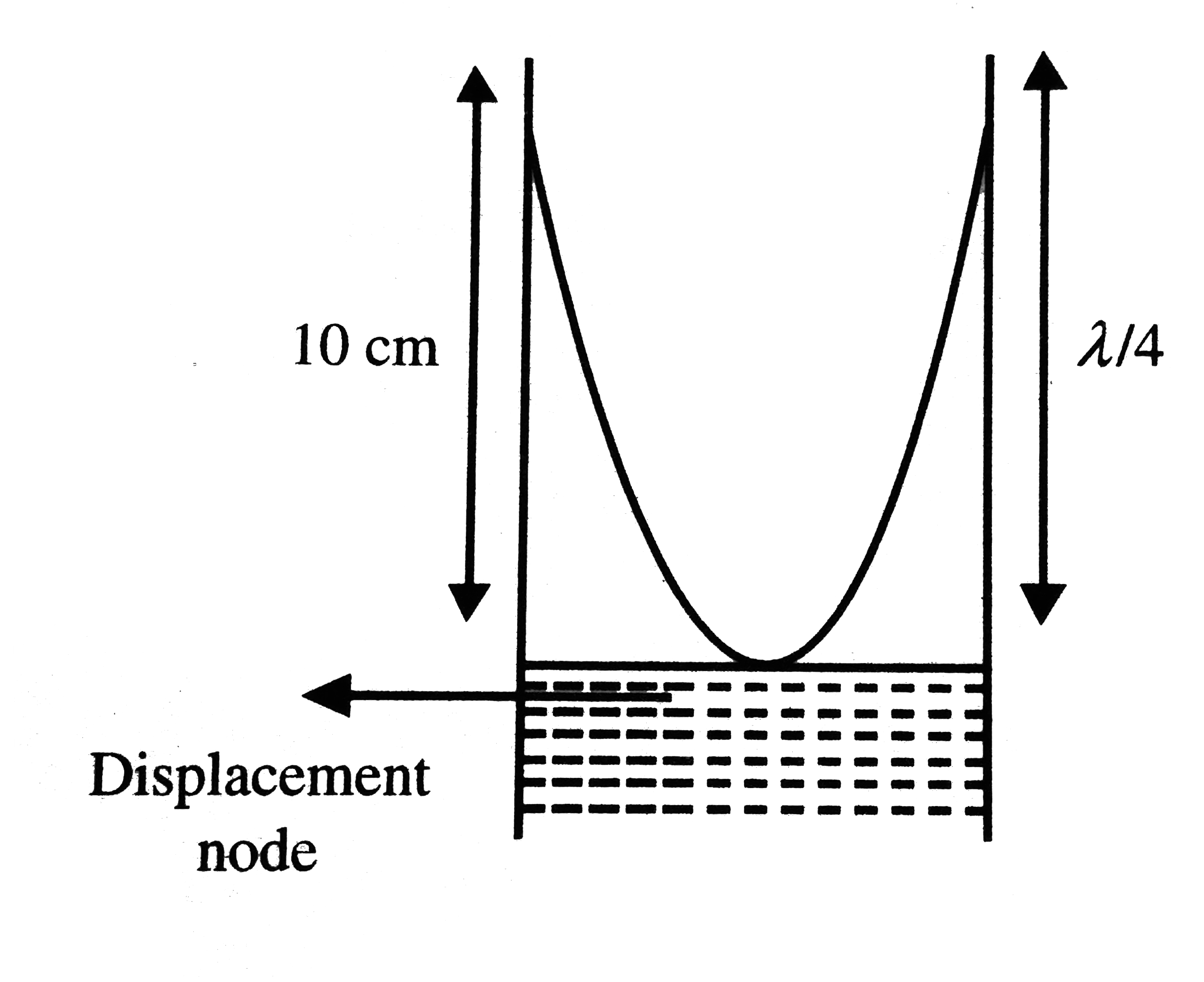 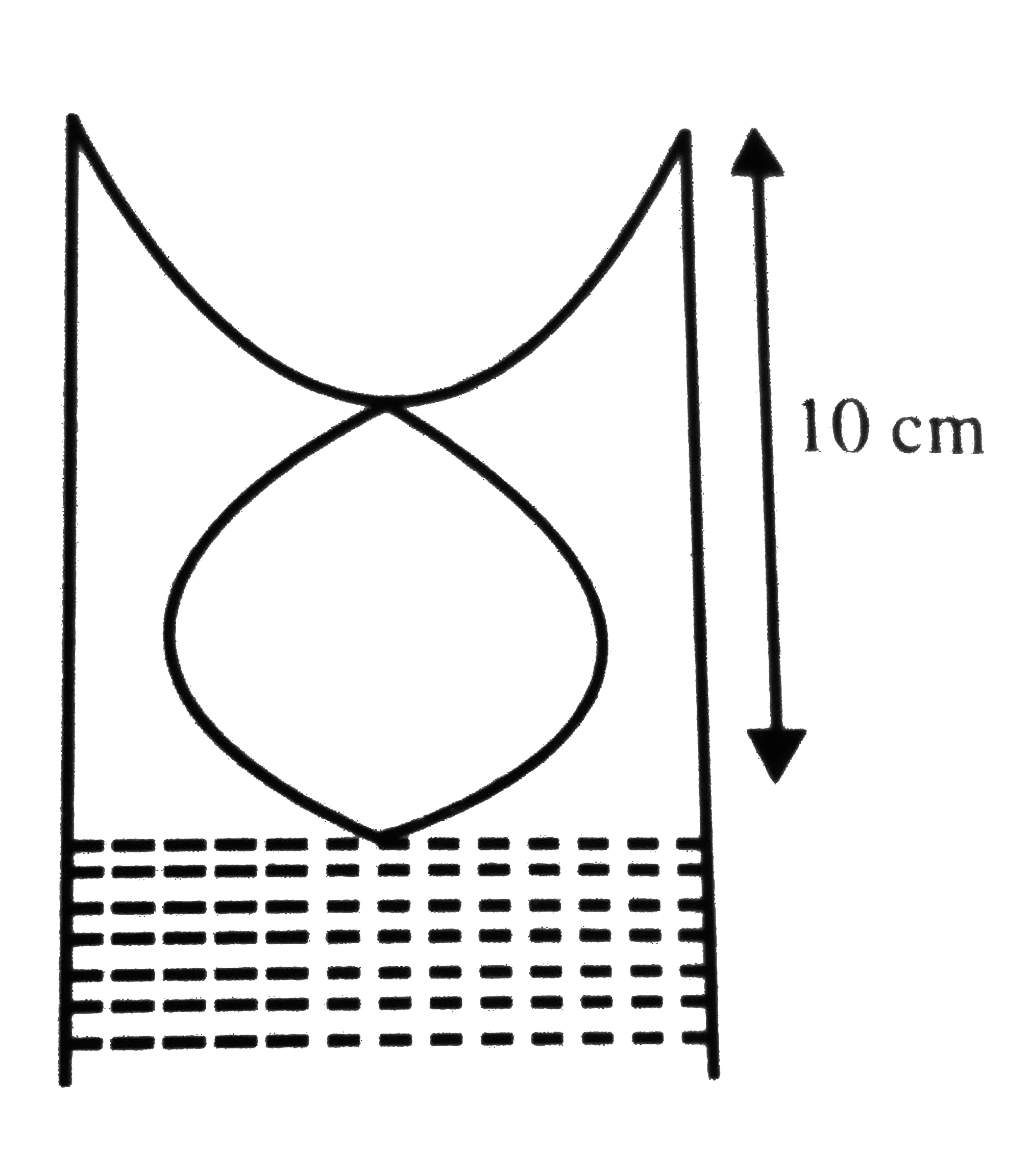
|
|
| 44. |
A seconds pendulum is placed in a space laboratory orbiting around the Earth at a height 3R from the Earth's surface where R is the radius of the Earth. The time period of the pendulum will be…………… |
| Answer» Solution :In a SPACE laboratory `g=0`. Therefore, `T=2pisqrt((L)/(g))=oo` | |
| 45. |
(A) : Comets move around the sun in elliptical orbits. The gravitational force on the comet due to sun is not normal to the comet.s velocity but the work done by the gravitational force over every complete orbit of the comet is zero.(R ) : Gravitational force is a non conservative force. |
|
Answer» Both (A) and (R ) are true and (R ) is the CORRECT explanation of (A) |
|
| 46. |
"Zero speed and non-zero velocity". Is this statement true or false ? Explain. |
| Answer» Solution :False. SPEED is the magnitude of velocity. So, if the speed is ZERO then its velocity will ALSO be zero. | |
| 47. |
Shear modulus is zero for ........ |
|
Answer» solids OBJECT |
|
| 48. |
If a=3hati+hatj-4hatk,b=6hati+5hatj-2hatk, then find the area of a triangle whose adjacent sides are determined by a and b. |
|
Answer» `12.5"SQ unit" ` `axxb=|UNDERSET(6,5,-2)underset(3,1,-4)hati,HATJ,hatk|` `=hati(-2+20)-hatj(-6+24)+(15+6)=18hati-18hatj+9hatk` magniutde of a and b `|axxb|=sqrt((18)^(2)+(-18)^(2)+(9)^(2))=sqrt(729)=27` `therefore "Areaof" Delta=(1)/(2)|axxb|=(27)/(2)=13.5"sq unit" ` |
|
| 49. |
If R is the radius of the earth and .g. the acceleration due to gravity, the mass of the earth is |
|
Answer» `(gR^2)/G` |
|
| 50. |
A comet orbits the sun in a highly elliptical orbit. Does the comet have a constant (a) linear speed, (b) angular speed, (c) angular momentum, (d) kinetic energy, (e) potential energy, (f) total energy throughout its orbit ? Neglect any mass loss of the comet when it comes very close to the Sun. |
|
Answer» Solution :(a) No, when comet (planet) is near the sun, its speed is higher, when the comet is far AWAY from the sun, its speed is very less. (b) No, angular speed does not remain constant throughout the motion. (c) Yes, the gravitational force of line acting on comet passes through sun and torque have become zero and hence angular MOMENTUM remains constant. (d) No, linear speed is not constant and so kinetic energy does not remains constant. (E) No, DISTANCE of comet from sun decreases and hence potential energy does not remains constant. (f) Yes, total energy throughout the orbit remains constant. |
|