

Saved Bookmarks
This section includes 7 InterviewSolutions, each offering curated multiple-choice questions to sharpen your Current Affairs knowledge and support exam preparation. Choose a topic below to get started.
| 1. |
A U-tube is made up of two capillary tubes of bores 1 mm and 2 mm. The tube is held vertically and some part of it is filled with a liquid of surface tension 0.049N .m^-1 and of zero angle of contact. If the level difference of the liquid in the two arms is 1.25 cm, then determine the density of the liquid. |
| Answer» SOLUTION :`0.8xx10^3 KG. m^-3` | |
| 2. |
The M.I. of a uniform disc about an axis passing through its centre and perpendicular to its plane is 1 kg m^(2). It is rotating with an angular velocity of "100 rad s"^(-1). A second disc of same mass and radius is joined to coaxially. Now these two together continue to rotate about the same axis. Then the lose in kinetic energy in kilo joules is |
|
Answer» `2.5` |
|
| 3. |
A projectile has the maximum range of 500 m. If the projectile is now thrown up on an inclined plane of 30^(@) with the same speed, what is the distance covered by it along the inclined plane ? |
|
Answer» Solution :`R_("max") = (u^(2))/(g)` `THEREFORE 500 = (u^(2))/(g)` or `u = sqrt(500g)` `v^(2) - u^(2) = 2gs` `RARR 0 - 500 g = 2 XX (-g sin 30^(@)) xx x` x = 500 m. |
|
| 4. |
A dump-bell consists of two weights W_(1) and W_(2)(W_(2) gt W_(1)) and is hinged at a point distant l_(1) and l_(2) from W_(1) and W_(2) , respectively . Establish the criterion of stable equilibrium for the vertical position of the dump-bell. |
|
Answer» |
|
| 5. |
A sonometer wire is made taut by hanging a body of mass so.7 kg volumn 0 .0075 m^(3) fromthe free end. The frequency of the fundamental tone of the vibration in the wire is 260 Hz . If the body is completely immersed in water, what will be the frequency of the fundamentaltone ? |
|
Answer» |
|
| 6. |
Turpentine is optically denser than water. It means |
|
Answer» mass per UNIT VOLUME of turpentine is more from that of WATER |
|
| 7. |
A raindrop falling from a height h aboveground , attains a near terminal velocity when it has fallenthrough a height (3/4) h . Which fthe diagrams shownin figurecorrectly shows the changein kineticand potential energyofthe dropduring its fall up to the ground? |
|
Answer»
The fluctuation in PE and KE is REPRESENTED by |
|
| 8. |
A particle falls towards earth from infinity. It's velocity reaching the Earth would be ......... |
|
Answer» INFINITY |
|
| 9. |
If the resultant of all the external forces acting on a system of particles is zero, then from an inertial frame, one can surely say that |
|
Answer» Linear momentum of the system does not change in TIME |
|
| 10. |
A cyclist on a level road takes a sharp circular tu rn of rad iu s 3 m (g = 10 ms^(- 2) ). If th e coefficient of static friction between the cycle tyres and the road is 0.2, at which of the following speeds will the cyclist not skid while taking the turn ? |
|
Answer» 14.4 km `h^(-1)` `=squr(6)` `=2.45 m//s` `=(2.45 XX 3600)/(1000) kmh^(-1)` `=8.82 kmh^(-1)` `=9kmh^(-1)` |
|
| 11. |
A solid sphere of mass M and radius R lies concentrically inside a spherical shell of mass M and radius 2R. A particle of mass M is placed at a distance 4R from the common center as shown in the figure. Find the total potential energy of the system of masses, |
| Answer» SOLUTION :`37/20 (GM^2)/(R )` | |
| 12. |
Two particles of masses m_(1)and m_2 in projectile motion have velocities vecv_(1)and vecv_(2)respectively at time t = 0. They collide at time t_(0). Their velocities become vecv_(1) and vecv_(2) at time 2t_(0) while still moving in air. The value of |(m_(1)vecv_(1) + m_(2)vecv_(2)) -(m_(1)vecv_(1) + m_(2)vecv_(2))| is |
|
Answer» ZERO |
|
| 13. |
A gas expands from A to C along three different paths as shown in Fig. What is the work done by the gas along the path ABC, AC and ADC? |
| Answer» Solution :`W _(ABC)= 4 xx 10 ^(-3) 4 xx 103125 += 1620 J W _(AC) = [ (4 + 1)//2] xx 101 325 xx 4 xx 10 ^(-3) = 1013.2 J` | |
| 14. |
The volume of a liquid flowing out per second of a pipe of length I and radius r is written by a student as V=(pi)/(8)(pr^(4))/(etal) where p is thepressure difference between the two ends of the pipe and eta is coefficent of viscosity of the liquid having dimensional formula (ML^(-1)T^(-1)). Check whether the equation is dimensionally correct. |
|
Answer» <P> Solution :The VOLUME of a liquid flowing out per second of a pipe is GIVEN by `V=(pi)/(8)(pr^(4))/(etal)``[V]=(["Volume"])/(["Time"])=([L^(3)])/([T])=L^(3)T^(-1)` `[p]=[ML^(-1)T^(-2)]` `[eta]=[ML^(-1)T^(-1)]` `[l]=[L]` `[r]=[L]` `[LHS]=[V]=([L^(3)])/([T])=L^(3)T^(-1)` `[RHS]=([ML^(-1)T^(-2)]xx[L^(4)])/([ML^(-1)T^(-1)]xx[L])=[L^(-3)T^(-1)]` `[LHS]=[RHS]` Thus, equation is dimensionally correct. |
|
| 15. |
2.34 is obtained by rounding of the number |
|
Answer» 2.346 |
|
| 16. |
Anvils made of single crystals of diamond, with the shape as shown in figure, are used to investigate behaviour of materials under very high pressures. Flat faces at the narrow end of the anvil have a diameter of 0.50 mm, and the wide ends are subjected to a compressional force of 50,000 N. What is the pressure at the tip of the anvil ? |
|
Answer» Solution :Diameter of the NARROW end of the anvil, `d = 0.50 m m = 0.5 XX 10 ^(-3) m` Area of cross section of trip `A = (pi d ^(2))/( 4) ""[because r = (d)/(2) ]` `= (22 xx (0.5 xx 10 ^(-3)) ^(2))/(7 xx 4)` `=0.19643 xx 10 ^(-6) m ^(2)` STRESS(=pressure at the narrow end of the anvil) `sigma = (F)/(A) = (50000)/(0.19643 xx 10 ^(-6)) ` `therefore sigma = 254543.6xx10 ^(6)` `therefore sigma ~~2.54xx 10 ^(11) N m ^(-2) or Pa` |
|
| 17. |
An air bubble of radius 'r' is formed at a depth 'h' below the surface of water of density 'd' and if 'p_0' is the atm pressure, T is surface tension of water, then the pressure inside the bubble is |
|
Answer» `p_0 + ( 2T)/( r)` |
|
| 18. |
Two identical balls A and B. each of mass 2 kg and radius R, are suspended vertically from inextensible strings as shown in Fig. The third ball C of mass 1 kg and radius r=(sqrt(2)-1)R falls and hits A and B symmetrically with 10 m//s. Speed of both A and B just after the collision is 3 m//s. Impulse provided by each sting during collision is |
|
Answer» `6sqrt(2)NS` `I_(1)=Isintheta=6Ns` |
|
| 19. |
Two identical balls A and B. each of mass 2 kg and radius R, are suspended vertically from inextensible strings as shown in Fig. The third ball C of mass 1 kg and radius r=(sqrt(2)-1)R falls and hits A and B symmetrically with 10 m//s. Speed of both A and B just after the collision is 3 m//s. The value of coefficient of restitution is |
|
Answer» `1/4` `implies e=(3costheta+V_(C)^(')sintheta)/(10sintheta)impliese=(3+2)/10=1/2` |
|
| 20. |
Two identical balls A and B. each of mass 2 kg and radius R, are suspended vertically from inextensible strings as shown in Fig. The third ball C of mass 1 kg and radius r=(sqrt(2)-1)R falls and hits A and B symmetrically with 10 m//s. Speed of both A and B just after the collision is 3 m//s. speed of C just asfter collision is |
|
Answer» `2m//s` 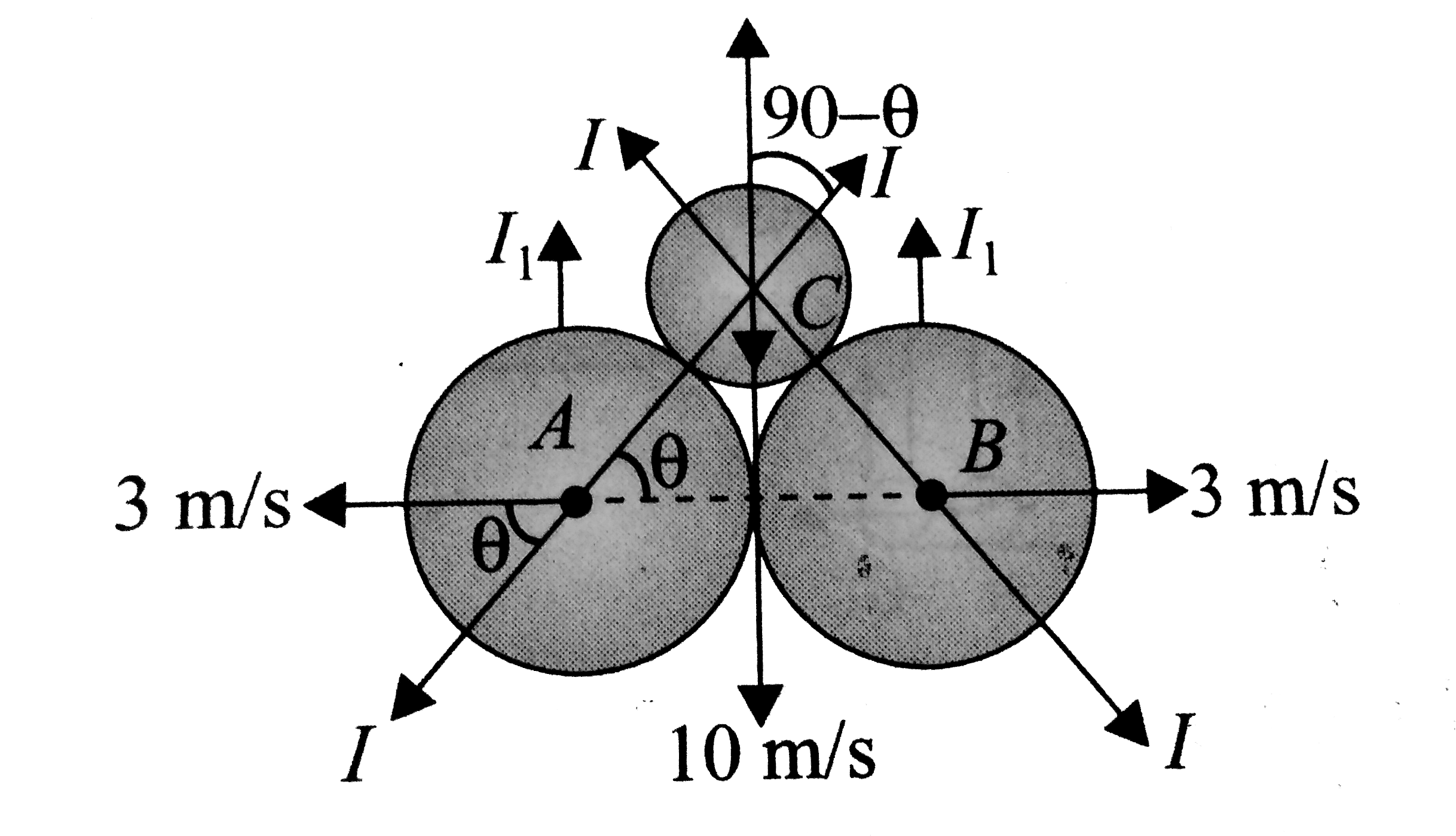 Now, each of ball `B` and `C` received impulse `'I'` as shown in figure. but moves impulse IMPARTED to ball `B` and `C` by the respective strings and hence, `Icostheta=M_(A)V_(A)=M_(B)V_(B)` Now, for ball `C` if its final velocity is `V_(C)^(')` downwards we have `M_(C)V_(C)^(')=M_(C)V_(C)-2Isintheta` `impliesV_(C)^(')=V_(C)-2(MA)/(MC)V_(A)` (`:'theta=45^(@))` `=-2m//s` (`-ve` sign indcates that it is directed upwards) |
|
| 21. |
Consider the process on a system shown infigure. During the process, the work done by the system |
|
Answer» CONTINUOUSLY INCREASES |
|
| 22. |
Kinetic friction is independent of |
|
Answer» nature of materials |
|
| 23. |
A massless string is wrapped around a uniform solid cylinder of mass 30 kg and radius 0.20 m one end of the string is attached to the cylinder and the free end is pulled tangentially by a force that maintains a constants tension of 3.0N find (a)the angular acceleration and (b)the angular speed of the cylinder 2.0 s after the force is applied to the cylinder at rest. |
|
Answer» Solution :MASS =30 KG ,radius r=0.20 m,tension T=3N a) angular acceleration `alpha`,we know that `tau`=lalpha` F.r=`Ialpha,`F.r=(mr^(2))/(2)alpha,alpha=(2F)/(mr)=(2XX3)/(30xx0.2)=1 rad//s^(2)` B) `omega_(2)-omega_(1)=alphat,omega_(1)=0` `omega_(2)=alphat` angular speedafter 2 secl `omega_(2)=1xx2=2` rad/sec/ |
|
| 24. |
A body of mass 4kg is kept in limiting equilibrium over an inclined plane of inclination 30^(@). If the inclination is made 45^(@), find minimum force required to prevent the body from sliding down (g=10ms^(-2)) |
|
Answer» SOLUTION :`10sqrt2N` |
|
| 25. |
In an experiment using the Searle's friction cone method the haing mas, which was 250xx10^(-3)kg remained stationary when the wheel was rotated at the rate of 1//2 revolution per second. It was found that the temperature of water in the cones increased by 3^(@)C in 27 minutes. The total water equivalent of the cones and water taken was 150. Diameter of wooden disc =30cm, sp. heat capacity of water =100calkg^(-1)K^(-1). Calculate J. |
|
Answer» |
|
| 26. |
The z component of the angular momentum of a particle whose position vector is |
|
Answer» <P> `vecp=p_(x)hati+p_(y)hatj+p_(Z)hatk` `vecp=p_(x)hati+p_(y)hatj+p_(z)hatk` Let `vecL=L_(x)hati+L_(y)hatj+L_(Z)hatk`……………(i) As `vecL=vecr xx vecp = |{:[hati,hatj,hatk],[x,y,x],[p_(x),p_(y),p_(z)]:}|` `=hati(yp_(z)-zp_(y))+hatj(zp_(x)-xp_(z))+hatk(xp_(y)-yp_(x))`............(ii) Comparing the COEFFICIENTS of `hati, hatj` and `hatk` in Eqs. (i) and (ii), we GET `L_(x) = yp_(z)-zp_(y)` `L_(y)=zp_(x)-xp_(z)` `L_(z)=xp_(y)-yp_(x)` |
|
| 27. |
There were two fixed points in the original Celsius scale which were assigned the number 0^(@)C and 100^(@)C respectively. On the absolute scale, one of the fixed point is the triple - point of water, which on the Kelvin absolute scale is assigned the number 273.16 K. What is the other fixed point on this (Kelvin) scale ? |
| Answer» SOLUTION :There is only one definite point on Kelvin SCALE. It is TRIPLE of water. There is no other definite point. | |
| 28. |
The car starts from rest at x=0 and is subjected to an acceleration shown by the a-s graph . Draw the v-s graph and determine the time needed to travel 60 m. |
|
Answer» |
|
| 29. |
Two particles of mass m_(1) " and " m_(2) are connected by a spring of natural length L and force constant k. The masses are brought close enough so as to compress the spring completely and a string is used to tie the system. Assume that length of spring in this position is close to zero. The system is projected with a velocity V_(0) along the positive x direction. At the instant it reaches origin at time t = 0, the string snaps and the spring starts opening. (a) Show that the mass m_(1) (or m_(2)) will are perform SHM in the reference frame attached to the centre of mass of the system. Find the time period of oscillation. (b) Write the amplitude of m_(1) " and " m_(2) as a function of time. lt( c) Write the X co ordinates of m_(1) " and " m_(2) as a function of time |
|
Answer» ` (b) (m_(2)L)/(m_(1)+m_(2))=A_(1)` `(c ) X_(1)=V_(0^(t))-A_(1)(1-cos omegat);` `X_(2)=V_(0^(t))-A_(2)(1-cos omegat) Where `A_(1)=(m_(2)L)/(m_(1)+m_(2)); A_(2)=(m_(1)L)/(m_(1)m_(2)); omega=sqrt((k(m_(1)+m_(2)))/(m_(1)m_(2)))` |
|
| 30. |
Show that pressure exerted by the gas is two - thirds of average kinetic energy per unit volume of the gas molecules. |
|
Answer» Solution : The intemal cnergy of the gas is given by `U=(3)/(2)NkT` The above equation can also be written as `U =(3)/(2)PV` Since PV =NKT `P=(2)/(3) (U)/(V) =(2)/(3)u`........(1) From the equation (1), we can state that the pressure of the gas is equal to two thirds of internal energy per UNIT volume or internal energy density `(u=(U)/(V))` . Writing pressure in terms of mean KINETIC energy density using equation `P = (1)/(3)nmbar(V^(2)) =(1)/(3)rhobar(V^(2))`......(2) where `rho = nm = "mass density"` (Note n is number density) Multiply and DIVIDE R.H.S of equation (2) by 2, we get `P=(2)/(3)((rho)/(2)bar(V^(2)))` `P=(2)/(3)bar(KE)`..(3) From the equation (3), pressure is equal to `(2)/(3)` of mean kinetic energy per unit volume. |
|
| 31. |
Audible frequencies have a range 20 Hz to 20,000 Hz. Express this range in terms of (i)Period T. (ii) Wavelength lambda in air. (iii) Angular frequency. Given velocity of sound in air is 330ms^(-1). |
|
Answer» SOLUTION :Here, `v_(1=)=20Hz,v_(2)=20,000Hz,v=330ms^(-1)` (i) Time period `T_(1)=(1)/(v_(1))=(1)/(20)=5XX10^(-2)s`, `T_(2)=(1)/(v_(2))=(1)/(20,000)=5xx10^(-5)s` THUS the audible range in terms of period is from `5xx10^(-2)s" to "5xx10^(-5)s`. (ii)Wave length `lamda_(1)=(v)/(v_(1))=(330)/(20)=16.5m` `lamda_(2)=(v)/(v_(2))=(330)/(20000)=16.5m` Thus the audible range in terms of wavelength is from 16.5 to 0.0165 m. (iii) Angular frequency `omega_(1)=2piv_(1)=2pixx20` `=40pi" rdas"^(-1)` `omega_(2)=2piv_(2)=2pixx20,000` `=40,000pi" rad "s^(-1)` Thus the audible range in terms of angular frequency is from `40pi" rad"s^(-1)" to "40,000pi" rad "s^(-1)`. |
|
| 32. |
The average depth of Indian Ocean is about 3000 m. Calculate the fractional compression, DeltaV//V, of water at the bottom of the ocean, given that the bulk modulus of water is 2.2xx10^(9)" N m"^(-2). (Take g=10" m s"^(-2)) |
|
Answer» Solution :The pressure exerted by a 3000 m column of water on the bottom layer `p=hrho" g"=3000" m"xx1000" kg m"^(-3)xx10"m s"^(-2)` `=3xx10^(7)" kg m"^(-1)" s"^(-2)` `=3xx10^(7)"N m"^(-2)` FRACTIONAL COMPRESSION `DeltaV//V`, is `DeltaV//V=" stress/B"=(3xx10^(7)" N m"^(-2))//(2.2xx10^(9)" N m"^(-2))` `=1.36xx10^(-2)` or `1.36%` |
|
| 33. |
Define one newton |
| Answer» Solution :One newton is DEFINED as the force which acts on 1 KG of mass to GIVE an acceleration 1 ms in the DIRECTION of the force. | |
| 34. |
A particle is projected from the ground . Point of projection is taken as origin, horizontal direction as X-axis and verticle upward direction ass Y-axis. Equation of trajectory of the partcle is y=alphax-betax^(2). Horizontal range of the projectile is |
|
Answer» `alpha +beta` `y=alphax-beta x^(2) =0` `RARR x=alpha//beta` Thus `alpha//beta` is the range of projectile . HENCE , option (c) is correct . |
|
| 35. |
Moment of inertia of a body is independent of |
|
Answer» MASS of the BODY |
|
| 36. |
Keeping the mass of the earth constant, if the radius of the earth decreases by 2%. What would be the change in .g.? |
|
Answer» Solution : We know that the relation between .g. and .G. is g= `(GM)/(R^2)` When mass is kept as constant and radius is decreased by 2% then`(Delta R)/( R) xx 100 = 2` From DISTRIBUTION of errors in MULTIPLICATIONS and DIVISIONS`(Delta g)/(g) xx 100 = -2(DeltaR)/(R) xx 100` % change in `g=-2 xx 2 = -4% ` -ve sign indicates that when R decreases .g. increases. |
|
| 37. |
A large force is acting on a body for a short time. The impulse imparted is equal to the change in |
|
Answer» acceleration |
|
| 38. |
A cubical block of wool of side 10 cm floats at the interface between an oil and water with its Jower surface 2cm below the interface, the heights of the oil and water columns are 10 cm each Density of oil ist) Spec. The mass of the block is |
|
Answer» 720 GRAM |
|
| 39. |
When mass of person is doubled, what will change in coefficient of friction ? |
| Answer» Solution :Co- efficientof frictiondo notdependon MASSOF object. Itdependon typeof MATERIALAND natureof surface.Hencewhenmass is DOUBLED there willnotbe anychangein co- efficientof friction. | |
| 40. |
Give the formula of force acting on a particle executes simple harmonic motion. |
| Answer» SOLUTION :`F= -kx`, where k = force CONSTANT. | |
| 41. |
The specific heat of a substance is 0.09 cal/gm""^(@)C. If the temperature is measured on Fahrenheit scale the value of its specific heat in cal/gm/""^(@)F is |
|
Answer» `0.09` |
|
| 42. |
Statement I : Static frictional force is always greater than kinetic frictional force. Statement II : Coefficient of static friction mu_(s) gt coefficient of kinetic friction mu_(k). |
|
Answer» Statement I is true, statement II is true, statement II is a CORRECT explanation for statement I. |
|
| 43. |
A shellof radius Rhasa chargeQ unifromly distributed over it .A point chargeq isplaced at the centerof the shell . Find theworkdonetoincrease the radiusof theshell from R to 2R ? |
|
Answer» Solution :`U_(i) = (U_(s) + U_(int)) ` initially `(Q^(2))/( 8 pi in_(0)R) + (1)/(4 pi in_(0)) (Qq)/(R)` `U_(f) = (U_(s) + U_("int"))`FINALLY ` = (Q^(2))/(16pi in_(0)R) + (1)/(8pi in_(0)) (Qq)/(R)` Work doneby theelectric FIELD` = U_(i) - U_(f)` ` = (Q)/(8 pi in_(0)R)((Q)/(2) + q)` |
|
| 44. |
A man of 60kg mass is in a lift. Find the apparent weight of the man when the lift is moving (a) up with uniform acceleration 4ms^(-2) (b) down with uniform acceleration of 2ms^(-2) (g=10ms^(-2)) |
|
Answer» |
|
| 45. |
A ball is projected horizontally from the top of a building 19.6 m high. If the line joining the point of projection to the point where it hits the ground makes an angle of 45^(@) to the horizontal, the initial velocity of the ball is |
|
Answer» `4.9 MS^(-1)` |
|
| 46. |
If alpha_(1), alpha_(2) and alpha_(3) are the coefficients of linear expansion of a solid along three mutually perpendicular directions, find the average coefficient of volume expansion of that material? |
| Answer» SOLUTION :`alpha_(1)+alpha_(2)+alpha_(3)` | |
| 47. |
When a unifromrod is heatedwhichof thefollowingquantity of therod willincrease |
| Answer» Solution :moment of inertia | |
| 48. |
A hemisphere of mass 3m and radius R is free to slide with its base on a smooth horizontal table. A particle of mass m is placed on the top of the hemisphere. If particle is displaced with a negligible velocity, then find the anuglar velocity of the particle relative to the centre of the hemisphere at an angular displacement theta, when velocity of hemisphere is upsilon. |
|
Answer» `(4 UPSILON)/(R COS theta)` |
|
| 49. |
Twenty identical cubical blocks each of mass 100 gm and of side 10 cm are lying on a horizontal surface. Work done in pilling them one above the other is, (g=10 ms^(-2)) |
| Answer» Answer :C | |
| 50. |
A stone of mass 1 kg tied to a light inextensible string of length L= 5/3m, is whirling in a vertical circle of radius L. If the ratio of the maximum and minimum tension in the string is 4 and g = 10 m//s^2, the speed of stone at the highest point of the circle is |
|
Answer» `5 m//s` `T_A = (mv_A^2)/(L) + mg = T_("max")` `T_B = (mv_B^2)/(L) - mg = T_("min")` `(T_("max"))/(T_("min")) = 4 ((mv_A^2)/L + mg)/((mv_B^2)/L - mg)` or `(v_A^2) + gL)/(v_B^2 - gL) = 4/1 "" ....(i)` But `v_A^2 = v_B^2 + 2g(2L) = v_B^2 + 4gL` (from the law of conservation of ENRERGY) From (i), `(v_B^2 + 5gL)/(v_B^2 - gL) = 4/1` On solving, we GET , `v_B = sqrt(3gL) = sqrt(3 xx 10 xx 5/3) = sqrt(50) = 5sqrt(2) m//s`. 
|
|


