

Saved Bookmarks
This section includes 7 InterviewSolutions, each offering curated multiple-choice questions to sharpen your Current Affairs knowledge and support exam preparation. Choose a topic below to get started.
| 1. |
What are the resultants of the vector product of two given vectors. Given by vecA=4hati-2hatj+hatk and vecB=5hati+3hatj-4hatk |
|
Answer» `=hati(8-3)-hatj(-16-5)+hatk(12+10)=5hati+21hatj+22hatk` |
|
| 2. |
The displacement-time graph of a moving object is shown in figure. Which of the velocity-time graphs shown in figure could represent the motion of the same body ? |
|
Answer» |
|
| 3. |
A stone of mass 2.0 kg is tied to the end of a string of 2 m length. It is whirled in a horizontal circle. If the breaking tension of the string is 400 N, calculate the maximum velocity of the stone. |
|
Answer» Solution :m = 2.0 kg, r = 2 m, tension = 400 N. When the tension in the string reaches the breaking tension, the velocity of the BODY becomes maximum. Let the maximum velocity be V. Tension = centripetal force `400=(mv^(2))/(r ) rArr 400 = (2xx v^(2))/(2)` `v^(2)=400, v = 20 ms^(-1)` |
|
| 4. |
Which two of the following five physical parameters have the same dimensions. (2008) (a) Energy density (b) Refractive index (c) Dielectric constant (d) Young's modulus (e) Magnetic field |
|
Answer» B and d |
|
| 5. |
The value of for one mole of an ideal gas is nearly equal :(a) 2 J / mol K(b) 8.3 J / mol K(c) 4.2 J / mol K(d) 2 cal / mol K |
|
Answer» `2Jmol^(-1)K^(-1)` |
|
| 6. |
A cone falling with a speed v_(0) strikes and penetrates the block of a packing material. The acceleration of the cone after impact is a=g-cx^(2). Where c is a positive constant and x is the penetration distance. If maximum penetration depth is x_(m) then the value of 'c' is (6gx_(m)+kv_(0)^(2))/(2x_(m)^(3)). The value of 'k' is |
|
Answer» |
|
| 7. |
A stone is dropped into water from a bridge 44.1m above the water. Another stone is thrown vertically downward 1 s later. Both strike the water simultaneously. What was the initial speed of the second stone? |
|
Answer» SOLUTION :`t=sqrt((2xx44.1)/(9.8))s=sqrt(9)s=3s`, `44.1=vxx2+(1)/(2)xx9.8xx2xx2` or `2v=44.1-4.9xx4=24.5` or `V=(24.5)/(2)MS^(-1)=12.25ms^(-1)` |
|
| 8. |
When a small magnetising field H is applied to a magnetic material, the intensity of magnetisation is proportional to: |
| Answer» ANSWER :C | |
| 9. |
To determine the composition of a bimetalic alloy, a sample is first weighed in air and then in water. These weights are found to be w_(1)andw_(2) respectively. If the densities of the two constituent metals are p_(1)andp_(2) respectively, then the weight of the first metal in the sample is (where rho_(w) is the density of water) |
|
Answer» `rho_(1)/(rho_(w)(rho_(2)-rho_(1)))[w_(1)(rho_(2)-rho_(w))-w_(2)rho_(2)]` Hence, required weight, `x=rho_(1)/(rho_(w)(rho_(2)-rho_(1)))[w_(1)(rho_(2)-rho_(w))-w_(2)rho_(2)]` |
|
| 10. |
One end of a steel wire of radius .r. is fixed to a ceiling and a load of 3 kg is attached to the free end of the wire. Another wire made of copper of radius .2r. is attached to the bottom of 3 kg load and a 2 kg load is attached to the free end of the copper wire. The ratio of longitudinal strains produced in copper and steel wires is (Young modulus of steel =20xx10^(10)Nm^(-2)) (Young modulus of copper =12xx10^(10)Nm^(-2)) |
|
Answer» `6:1` |
|
| 11. |
Hydrogen is in abundance around the sun and less around the earth. Explain. |
|
Answer» Solution :The mean velocity of hydrogen at ordinary temperature is about 0.5 to `1kms^(-1)` The escape velocity on EARTH is `11.2 kms^(-1)`and on sun it is `620 kms^(-1)` The GRAVITATIONAL attraction of sun is more than the earth.Hence hydrogen is in abundance around sun and less around the earth. |
|
| 12. |
A metal bob of mass 0.6 kg is attached to the end of a string of length 1 m and the bob is whirled in a horizontal circle with a uniform speed of 12 m/s. What is the centripetal force acting on the bob ? If the speed of the bob is 5 m/s calculate the tension in the string. |
|
Answer» Solution :Mass of the BOB `=m=0.6 kg` RADIUS =r=1 m Speed =v=12 m/s (i) Centripetal force = F=? `F = (MV^(2))/r = (0.6 xx 12 xx 12)/1 = 86.4 N` (ii) Tension in the suing = Centripetal force when velocity is 5 m/s `=(mv^(2))/r = (0.6 xx 5 xx 5)/1 = 15 N` |
|
| 13. |
(A) : Two particles of different masses, projected with same velocity, the maximum height attained by same both the particle vertically will be same. ( R) : The maximum height of projectile is independent of particle mass. |
|
Answer» Both (A) and ( R) are TURE and ( R) is the correct EXPLANATION of (A) |
|
| 14. |
A gun of mass M fires a bullet of mass m with a Kinetic energy E. The velocity of recoil of the gun is |
|
Answer» `(SQRT(2ME))/(m)` |
|
| 15. |
A ball of mass .m. is rotated in a vertical circle with constant speed. The difference in tensions at the bottom and horizontal positions would be |
| Answer» Answer :D | |
| 16. |
Which fact is recognized as the hydrostatic paradox ? |
| Answer» SOLUTION :The liquid pressure at any POINT in the liquid does not depen on the SHAPE or area of vessel.This fact is RECOGNIZED as the HYDROSTATIC paradox. | |
| 17. |
A light rod of length 2 m is suspended from the ceiling horizontally by means of two vertical wires of equal length tied to its ends. One of the wire is made of steel and is cross section 10^-3 m^2 and the other is of brass of cross section 2 times 10^-3 m^2 . Young's modulus for steel is 2 times 10^11 N.m^-2 and for brass is 10^11 N.m^-2. Find out the position along the rod at which a weight may be hung to produce equal stress in both wires. |
|
Answer» 1.39m |
|
| 18. |
A light rod of length 2 m is suspended from the ceiling horizontally by means of two vertical wires of equal length tied to its ends. One of the wire is made of steel and is cross section 10^-3 m^2 and the other is of brass of cross section 2 times 10^-3 m^2 . Young's modulus for steel is 2 times 10^11 N.m^-2 and for brass is 10^11 N.m^-2. Find out the position along the rod at which a weight may be hung to produce equals strains on both wires |
|
Answer» 1m |
|
| 19. |
If the kinetic energy of a body becomes four times of its initial value, then new momentum will |
|
Answer» become FOUR times, its INITIAL VALUE |
|
| 20. |
A uniform disc of moment of inertia 1 kg m^2 rotates with a speed of 120 rpm, Calculate the torque required to stop the disc in 10 revolutions ? |
| Answer» Solution :`a =(omega^(2)-omega_(0)^(2))//2THETA -(2PI xx 2)^(2)//2 xx 2pi xx 10 =-1.256 rad s^(-2), tau = l ALPHA = 1.256 Nm` | |
| 21. |
What happens to the acceleration of 'N' when 'P' moves from 'X' to 'Y' on the circle in figure? |
| Answer» SOLUTION :The acceleration INCREASES from ZERO to a MAXIMUM `(Aomega^@)` | |
| 22. |
To go from town A to town B a plane must fly about 1780 km at an angle of 30° West of North. How far north of A is B ? |
|
Answer» 1542 km |
|
| 23. |
P is a point at a distance r from the centre of a solid sphere of radius a. The gravitational potential at P is V. If V is plotted as a function of r, which is the correct curve ? |
|
Answer»
|
|
| 24. |
The escape speed of body thrown vertically from the surface of earth is 11 km/s. If this body thrown at 45^@to vertical then its escape speed will be ...... |
|
Answer» `11sqrt2` km/s |
|
| 25. |
A receiver and a source of sonic oscillations of frequency v_(0) = 2000 Hz are located along the x-axis. The source swings simple harmonically along the axis with a constant frequency and amplitude a = 50 cm. If the frequency band -width registered by the stationary receiver is Delta v = 200 Hz, find the value of oscillation frequency of the source. Speed of sound in air = 340 m s^(-1) |
|
Answer» |
|
| 26. |
Two bodies are thrown form the same point with the same velocity of projection, angle of projection 30^(@) and 60^(@). If R_(1) and R_(2) are the ranges and h_(1) and h_(2) are maximum heights respectively then find the relations among them. |
|
Answer» |
|
| 27. |
One end of a sonometer wire is fixed and a tension is applied on the wire by suspending a solid body of mass Mfrom the other end . A fundamental tone of particular frequency is emittedat length 70 cm of the wire. If the mass M is fundamental tone of the same frequency, the length of the wire should be changed by 5 cm . Determine the density of the material of mass M . |
|
Answer» |
|
| 28. |
Select the odd man out from the following physical quantities. |
|
Answer» Stress |
|
| 29. |
The length of one edge of a glass plate of thickness 0.2 cm is 9.8 cm. If this edge of the glass plate touches the surface of a liquid of surface tension 60 dyne/cm, then it is pulled down with a force of (Assume that angle of contact to be zero) |
| Answer» Answer :D | |
| 30. |
Find the position of centre of mass of the system of 3 objects of masses 1 kg, 2 kg and 3 kg located at the comers of an equilateral triangle of side 1 m. Take 1 kg mass object at the origin and 2 kg is along x-axis. |
|
Answer» Solution :Mass of the first OBJECT `m_(1) = 1kg` , Mass of the second object, `m_(2) = 2kg` Mass of the third object, `m_(3) = 3kg`,CO- ordinates of first object, `(x_(1),y_(1)) =(0,0)`  `x_(cm) = (m_(1)x_(1) + m_(2)x_(2) + m_(3)x_(3))/(m_(1) + m_(2) + m_(3))` `rArr x_(cm) (1 xx 0 + 2 xx 1 + 3 xx 1/2)/(1+2+3) rArr x_(cm) = 7/12 cm` `Y_(cm) =(m_(1)y_(1) + m_(2)y_(2) + m_(3)y_(3))/(m_(1) + m_(2) + m_(3))` `rArr Y_(cm) = (1 xx 0 + 2 xx 0 + 3 xx sqrt(3)/2)/(1+2+3) rArr Y_(cm) = sqrt(3)/4` m Co- ordinates of CENTRE of mass `(x_(cm), y_(cm)) = (7/12m, sqrt(3)/4 m)` |
|
| 31. |
A big Diwali rocket is projected vertically upward so as to attain a maximum height of 160 m. The rocket explodes just as it reaches the top of its trajectory sending out luminous particles in all possible directions all with same speed v. The display, consisting of the luminous particles, spreads out as an expanding, brilliant sphere. The bottom of this sphere just touches the ground when its radius is 80 m. With what speed ("in" m//s)are the luminous particles ejected by the explosion? |
|
Answer» `160 = vt + 1/2 "gt"^2` ………..(ii) On SOLVING , ` V= 20 ms^(-1)` 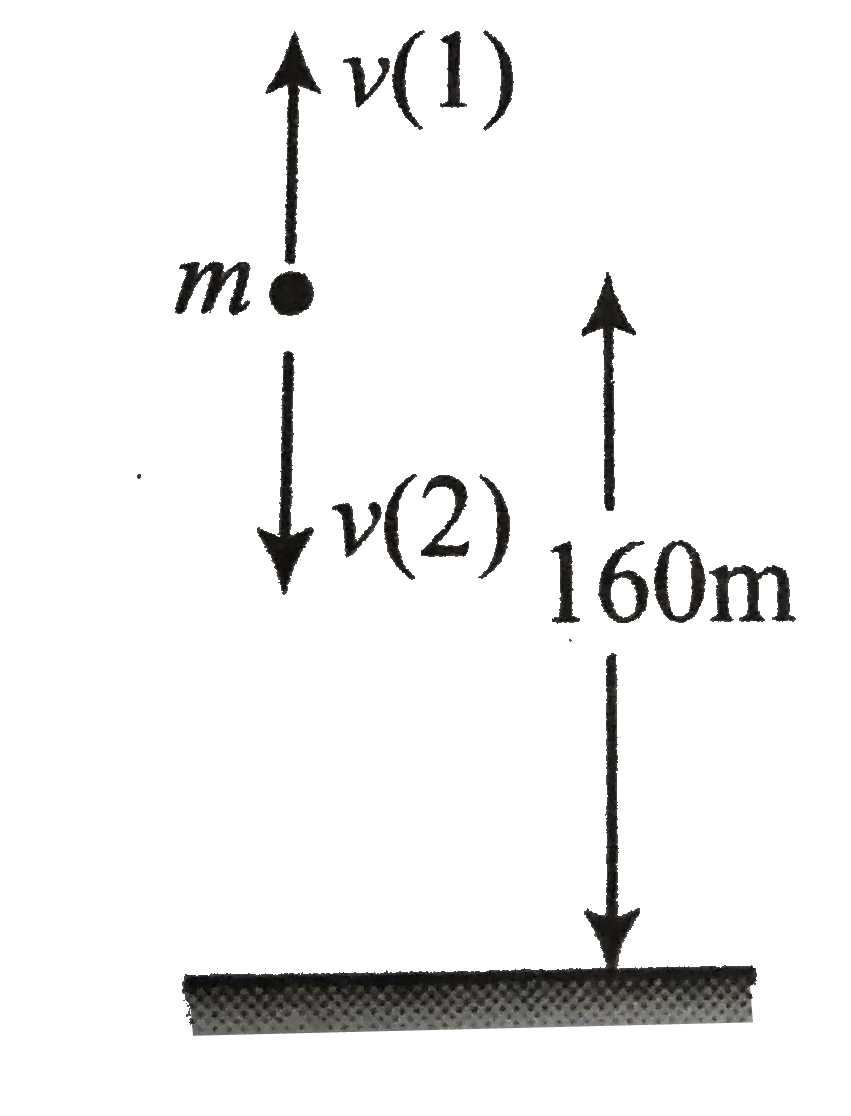 . .
|
|
| 32. |
A body is moving with an acceleration 'a' under the action of a force 'g'. The weight of the body is |
|
Answer» G/a |
|
| 33. |
Two discs A and B are mounted co-axially on a vertical axie. The discs have moments of inertia I and 2I , respectively, about the common axis. Disc A is imparted an initial angular velocity 2 omega using the entire potential energy of a spring compressed by a distance x_(1). Disc B is imparted an angular velocity omega by a spring having the same spring constant and compressed by a distance x_(2). Both the discs rotate in the clockwise direction. When disc B is brought in contact with disc A, they acquire a common angular velocity in time t. The average frictional torque on one disc by the other during this period is |
|
Answer» `(2Iomega)/(3T)` |
|
| 34. |
Two discs A and B are mounted co-axially on a vertical axie. The discs have moments of inertia I and 2I , respectively, about the common axis. Disc A is imparted an initial angular velocity 2 omega using the entire potential energy of a spring compressed by a distance x_(1). Disc B is imparted an angular velocity omega by a spring having the same spring constant and compressed by a distance x_(2). Both the discs rotate in the clockwise direction. The ratio (x_(1))/(x_(2)) is |
|
Answer» 2 |
|
| 35. |
Two discs A and B are mounted co-axially on a vertical axie. The discs have moments of inertia I and 2I , respectively, about the common axis. Disc A is imparted an initial angular velocity 2 omega using the entire potential energy of a spring compressed by a distance x_(1). Disc B is imparted an angular velocity omega by a spring having the same spring constant and compressed by a distance x_(2). Both the discs rotate in the clockwise direction. The loss of kinetic energy during the above process is |
|
Answer» `(Iomega^(2))/(2)` |
|
| 36. |
Let V and E represent the gravitational potential and field at a distance r from the centre of a uniform solid sphere. Consider the two statements. (A) The polt of V against r is discontinuous (B) The polt of E against r is discontinuous |
|
Answer» Both A and B are CORRECT |
|
| 37. |
A glass tube having 2 mm bore is dipped vertically into a vessel containing mercury such that its lower end is 8 cm below the mercury surface. Determine the gauge pressure of air in the tube to blow a hemispherical bubble at its lower end. Take, density of mercury =13.6 "g/cm"^(3) Surface tension of mercury = 36 dyne/cm |
|
Answer» Solution :GIVEN, `r=(2mm)/(2)=1 MM =0.1cm` `sigma ="35 dyne/cm"` `rho=13.6 "g/cm"^(3)` h=3cm Pressure of air = Excess pressure inside air bubble + Pressure exerted by mercury column `=(2 sigma)/(r)+HPG` `=(2 xx 35)/(0.1) +3 xx 13.6 xx 980` `=700+39984` `=40684" dyne/cm"^(2)` |
|
| 38. |
A light wire 10 cm long is placed horizontally on the surface of water and is gentely pulled up with a force of 1.456xx10^(-2)N to keep the wire in equilibrium. What is the surface tension of water ? |
|
Answer» |
|
| 39. |
When a mass is suspended on a metallic wire, the length of the wire increases slightly.if the Young's moduli of iron and glass are 190xx10^-19Nm^-2 and 65xx10^9Nm^-2 respectively which is more elastic?justify your answer. |
|
Answer» |
|
| 40. |
Two men are running on a straight north -south track. The personA moves north with a speed of 5 m *s^(-1)while B moves south with a speed of 2 m *s^(-1). Determint the velocity ( magnitude only) of (i)A with respect to B . (ii) the ground with respect to A . (iii) B with respect to A . |
|
Answer» |
|
| 41. |
Amount of TNT equivalent of energy obtained from fission of 1gm U^235 is- |
| Answer» Answer :C | |
| 42. |
Methematical constants, pi,e etc. are called ……….. . |
|
Answer» |
|
| 43. |
Which of the following functions of time represent (a) periodic and (b) non periodic motion? Give the period for each case of periodic motoin [omega is any positive constant]. (i) sin omega t + cos omega t (ii) sin omega t +cos 2 omega t + sin 4 omega t (iii) e^(-omegat) (iv) log (omegat) |
|
Answer» Solution :(i) `sin omega t+cos omega t` is a periodic function. It can also be written as `sqrt(2)sin(omegat+pi//4)` Now `sqrt(2) sin (omegat+pi//4)=sqrt(2)sin(omega t+pi//4)+2pi)` `=sqrt(2)sin [omega (t+2pi//omega)+pi//4]` The periodic time of the function isd `2pi//omega` (ii) This is an example of a periodic motion. It can be noted that each term represents a periodic functionwith a different angular frequency. Sinc eperiod is the least interval of time after which a function repeats its value, `sin omega t ` has a period `T_(0)=2pi//omega:cos 2 omega` has a period `pi//omega=T_(0)//2` and `sin4 omega t` has a period `2pi/4omega=T_(0)//4`. The period of the first term is a multiple of the periods of thelast two terms. Therefore, the SMALLEST interval of time after whcih the sum of the three terms repeats is `T_(0)`,an THUS the sum is a periodic functionwilth a period `2pi//omega` (iii) The function`e^(-omegat)` is not periodic it decreases monotonically with increasing time and tends to zero as t tens to `PROP` and thus, never repeats it value. (iv) The function`log(omegat)` increase monotonicaly with time t. It therfore, never repeats it value and is a non periodic function. it may be noted that as t tens to `prop , log (omegat)` diverges to `oo`, it therfore, canot represent any kind of PHYSICAL displacement. |
|
| 44. |
For a fluid in a steady flow , the increase in flow speed at a constriction follows |
| Answer» SOLUTION :CONSERVATION of MASS , Bernoulli.s PRINCIPLE | |
| 45. |
To understand resonance describe the experiment of oscillations of five pendulums. |
|
Answer» SOLUTION :Let us CONSIDER a set of five simple pendulums of assorted lengths suspended from a common rope as shown in figure. The pendulum-1 and 4 have the same lengths and the others have different lengths. Let us set pendulum-1 into MOTION. The energy from this pendulum gets transferred to other pendulum through the connecting rope and they start oscillating. Pendulums-2,3 and 5 first start oscillating with their NATURAL frequency of oscillations and different amplitudes, but this motion is GRADUALLY damped and not sustained. Their frequencies of oscillation gradually change and ultimately they oscillate with the frequency of pendulum-1. Thus is, the frequency of the driving force but with different amplitudes. The pendulum-4 is in contrast to this set of pendulum-1. It oscillates with the same frequency as that of pendulum-1 and its amplitude gradually picks up and becomes very large. A resonance phenomena will occur. In general a system may have several natural frequencies. For examples, vibrating strings, air column etc. 
|
|
| 46. |
A solid floats in a liquid in a partially dipped position. |
|
Answer» The SOLID EXERTS a force equal to its weight on the LIQUID |
|
| 47. |
Why a force is applied at right angles to the heavy door at the outer edge while closing or opening it? |
|
Answer» Solution :TORQUE `tau=F R SIN theta` For a force applied at right ANGLE to the OUTER edge of the door i.e. `theta=90^(@) :' sin 90^(@)=1` `:. tau=Fr` `:.` The values of `sin theta` and r are maximum. So, torque produced is maximum. Hence force is applied at right angles to the heavy door at the outer edge. |
|
| 48. |
The surface temperature of the sun which has maximum energy emission at 500nm is 6000K. The temperature of a star which has maximum energy emission at 400nm will be |
|
Answer» 8500K `:. lamda_(m)T= lamda._(m) T. or 500 XX 6000 = 400 xx T.` or `T.= (500 xx 6000)/(400) = 7500K` |
|
| 49. |
For most materials,the Young's modulus is n times the rigidity modulus where n is |
|
Answer» 2 |
|


