Saved Bookmarks
This section includes 7 InterviewSolutions, each offering curated multiple-choice questions to sharpen your Current Affairs knowledge and support exam preparation. Choose a topic below to get started.
| 1. |
Which one of the following statement is correct?the equation y = (8) / (2u^(2)) x^(2)represents : |
|
Answer» the PATH of a freely falling body |
|
| 2. |
A ball A is falling vertically downwards with velocity v_(r) It strikes elastically with a wedge moving horizontally with velocity v_(2) as shown in figure. What must be the ratio v_(1)//v_(2), so that the ballbounces back in vertically upward direction relative to the wedge |
Answer» SOLUTION :In the FIGURE `BAR(v_(12))` = velocity of ball w.r.t wedge before collision and `bar(v_(12)^(1))` = velocity of ball w.r.t wedge after collision, which must be in VERTICALLY upward direction as shwon.  In elastic collision, `bar(v_(12))andbar(v_(12)^(1))` will MAKE equal angles `("say" alpha)` with the normal to the plane. We can show that `alpha = 30^(@)`, `therefore angleMON = 30^(@)` Now `(v_(1))/(v_(2)) = tan 30^(@) = (1)/(sqrt(3))` |
|
| 3. |
The dimension of (1)/(mu_(0)epsilon_(0)) is |
|
Answer» length |
|
| 4. |
Two bodies A and B have masses 20 kg and 5 kg respectively. Each one is acted upon by a force of 4 kg wt. If they acquire the same kinetic energy in times t_A and t_B then the ratio (t_A)/(t_B) is |
|
Answer» `1/2` As force = 40 N `:. a_A = 2 MS^(-2) and a_B = 8 ms^(-2)` ALSO `K_A = K_B` (given) `:. 1/2 m_A (a_A t_A)^2 = 1/2 m_B (a_B t_B)^2` or `1/2 xx 20 xx 4t_A^2 = 1/2 xx 5 xx 64 t_B^2` or `(t_A^2)/(t_B^2) = (1/2 xx 5 xx 64)/(1/2 xx 20 xx 4) = 4/1" or " (t_A)/(t_B) = 2`. |
|
| 5. |
Match the following units given in the column I with dimesnions in the column II. |
|
Answer» I - (VI), 2 - (iv), 3 - (i), 4 - (ii) `"watt:POWER"=("work")/("time")` `"pascal:PRESSURE "=("force")/("area")` `"hertz:frequency "=(1)/("Time period")` |
|
| 6. |
1000 drops of a liquid each of diameter 4 mm coalesce to form a single large drop. If surface tension of liquid is 35 dyne cm^(-1). Calculate the energy evolved by the system in the process. |
|
Answer» Solution :Number of drops `N=1000impliesn^(1//3)=10` `implies n^(2//3)=100` Surface tension of liquid `S=35" dyne cm"^(-1)` Radius of each small drop `r=2mm=0.2cm` Energy evolved in MERGING `W=4pir^(2)S[n-n^(2//3)]` `impliesW=4xx(22)/(7)xx(2xx10^(-1))^(2)35(1000-100]` `implies W=(88xx35xx4xx10^(-2))/(7)[900]` `=15840" ergs".~~1.58xx10^(-3)J` |
|
| 7. |
A lead sphere of 1.0 mm diameter and relative density 11.20 attains terminal velocity of 0.7 c/m in a liquid of relative density 1.26 What is the value of the Reynolds number ? |
|
Answer» `0.01` |
|
| 8. |
A lead sphere of 1.0 mm diameter and relative density 11.20 attains terminal velocity of 0.7 cm/s in a liquid of relative density 1.26 Determine the coefficient of dynamic viscosity of the liquid |
|
Answer» `0.45N//m^(2)` |
|
| 9. |
(A) : (1)/(sqrt(2))hat(i)+(1)/(sqrt(2))hat(j) is a unit vector ( R) : The component vectors of a unit vector need not be unit vectors |
|
Answer» Both (A) and ( R) are TURE and ( R) is the correct explanation of (A) |
|
| 10. |
An electron , a proton a deutron and alpha -particle have the same kinetic energy . Which of these particlehas the larger momentum ? |
|
Answer» <P>an ELCTRON K = constant, `p prop sqrt(m)` ` :. ` if mass is more its LINEAR momentum is more . Here `alpha ` - particle have more mass so its linear momentum is more . |
|
| 11. |
A small ball of mass m is placed on top of a "super ball" of mass M, and the two balls are dropped to the floor from height h. How high does the small ball rise after the collision ? Assume that the collisions with the superball are elastic, and that m lt lt M. |
|
Answer» |
|
| 12. |
A particle starts from rest at A moves with uniform acceleration a m//s^(2) in a straight line. After 1/a Seconds a second particle starts from A with initial velocity 'u' and moves same direction. If u gt 2m//s then during the entire motion the second particle remains ahead of first particle for the duration of k (sqrt(u(u-2)))/(a). The value of 'k' is |
|
Answer» |
|
| 13. |
The contribution of S. Chandra Sekhar to physics is |
|
Answer» cosmic RADIATION |
|
| 14. |
Consider the collision depicted in figure to be between two billiard balls are equal masses m_(1)=m_(2) . The first ball iscalledthe cue while the second ball is called the target . The billiard player wants to 'sink ' the target ball in a corner pocket , which is at angle theta_(2) = 37^(@) .Assume that the collision is elastic and thatfriction and rotational motion are not important . Obtain theta_(1) . |
|
Answer» Solution :From momentum conservation, since the masses are equal `v_(1i)= v_(1f)+v_(2F)` or, `v_(1i)""^(2)=(v_(1f)+v_(2f))*(v_(1f)+v_(2f))` `=v_(1i)""^(2)+v_(2f)""^(2)+2v_(1f)*v_(2f)` `={v_(1f)""^(2)+v_(2f)""^(2)+2v_(1f)v_(2f) cos(theta_1 +37^(@))}""(6.32)` Since the collision is ELASTIC and `m_(1)= m_(2)` it follows from conservation of kinetic energy that `v_(1f)""^(2)= v_(1f)""^(2)+v_(2f)""^(2)` (6.33) Comparing Eqs. (6.32) and (6.33), we get `cos (theta_(1)+37^(@))=0` or, `theta_(1)+ 37^(@)= 90^(@)` Thus, `theta_(1)= 53^(@)`. This proves the following result : when two equal masses undergo a glancing elastic collision with one of them at rest, after the collision, they will move at right angles to each other. |
|
| 15. |
Four indicident rays of light parallel to optic axis and their path after passing through an optical system are shown in table-1. match the corresponding optical instrument from table 2. |
|
Answer» <P> |
|
| 16. |
A bullet of mass 50 g moving at 400 mcdot s^(-1) penetrates a wall with an average force of 4xx 10 ^(4) N. Itcomes out of the other side of the wall at 50 mcdot s^(-1). Find the thickness of the wall. |
|
Answer» Solution :In the case of the 1st bullet, m = 50 g = 5 `xx 10^(-3)` kg As the average force = `4 xx 10^(4)`N, a = average retardation = `(4 xx 10^(4))/(50 xx 10^(-3)) "m"cdot s^(-2)` u = initial velocity = 400 m`cdot s^(-1)` V = final velocity = 50 m`cdot s^(-1)` Let the thickness of the WALL = s. From`v^(2) = u^(2) - 2`as. s = `(u^(2) - v^(2))/(2a) = ((400^(2) - 50^(2)) xx 50 xx 10^(-3))/(2 xx 4 xx 10^(4)) = 0.0984`m The second bullet cannot penetrate the wall, hence its final velocity should be 0, i.e.,v = 0. As it cannot cover the distance s , the maximum possible mass `m_(0)` corresponds to s = 0.0984 m. Average retardation, a = `(F)/(m_(0)) = (u^(2) - v^(2))/(2s) = (u^(2))/(2s)` or,`m_(0) = (2Fs)/(u^(2)) = (2 xx 4 xx 10^(4) xx 0.0984)/(400^(2)) = 0.0492` kg |
|
| 17. |
A uniform square plate of mass m and edge a initially at rest startas rotating about one of the edge under the action of a constant torque tau. Then at the end of the 5^(th) sec after start |
|
Answer» angular momentum is EQUAL to `5tau` |
|
| 18. |
What is the importance of Kirchoff's law ? |
| Answer» SOLUTION :Kirchhoff.s law REVEALS that good absorbers act as good radiatiors and POOR absorbers act as poor EMITTERS. | |
| 19. |
Four particles, each of mass M and equidistant from each other, move along a circle of radius R under the action of their mutual gravitational attraction. Calculate the speed of each particle |
|
Answer» SOLUTION :Force acting on a particle `=(GM^2)/((2R)^(2))+(GM^2)/((R//SQRT(2))^(2))cos45^(@)+(GM^2)/((Rsqrt(2))^(2))cos45^(@)` `F=(GM^2)/(R^2)[(1)/(4)+(1)/(sqrt2)]` Since particle moving CIRCULAR path experience centripetal force, `F=(MV^2)/(R)` `(MV^2)/(R)=(GM^2)/(R^2)[(1)/(4)+(1)/(sqrt2)]` `thereforeV=(1)/(2)sqrt((GM)/(R)(1+2sqrt(2)))` |
|
| 20. |
A spring is placed between the jaws of screw gauge such that the spring is not all compressed. The mai scale reads 2 division and circular scale reads 28 divisions. Now we turn the circular scale by 18^(@) such that the spring is compessed. The circular scale has 200 divisions and the least count of the main scale is 1mm. What is the force exerted by the spring on the jaws if the spring constnat is 100N//m |
| Answer» Answer :C | |
| 21. |
A disc of radius R is cut from a larger disc of radius 2R in such a way that the edge of the hole touches of edge of the disc. The centre of mass of the remaining portion is at |
|
Answer» `R//2` from the CENTRE of big DISC AWAY from the centre of the HOLE |
|
| 22. |
Which of the following is systematic error |
| Answer» Answer :D | |
| 23. |
Which of the following gases willhave least rms speed at a given temperature? |
| Answer» Solution :Carbon-di-oxide | |
| 24. |
How can we reduce least count error of any instrument? |
| Answer» Solution :It can be reduced by INCREASING by the resolution and AVOIDING the ERRORS during EXPERIMENTS. | |
| 25. |
A 1m long rod having a constant cross sectional area is made of four materials. The first 0.2m are made of iron, the next 0.3m of lead, the following 0.2m of aluminium and the remaining part is made of copper. Find the centre of mass of the rod. The densities of iron, lead aluminium and copper are 7.9xx10^(3)kg//m^(3), 11.4xx10^(3)kg//m^(3), 2.7xx10^(3)kg//m^(3) and 8.9xx10^(3)kg//m^(3) respectively. |
Answer» Solution : mass (m)`=` VOLUME(v) `XX` density (d) m`=` Area(A) `xx` LENGTH(l) `xx` density (d) `m=Ald` Mass of iron part, `m_(1)=Axx0.2xx7.9xx10^(3)` `=1.58xx10^(3)A` Mass of lead part `m_(2)=Axx0.3xx11.4xx10^(3)` `=3.42xx10^(3)A` Mass of aluminium part, `m_(3)=Axx0.2xx2.7xx10^(3)` `=3.42xx10^(3)A` Mass of aluminium part, `m_(3)=Axx0.2xx2.7xx10^(3)` `=0.54xx10^(3)A` Mass of copper part `m_(4)=Axx0.3xx8.9xx10^(3)` `=2.67xx10^(3)A` Co-ordinate of iron part from end ..O.. of the rod `x_(1)=0.1m` Co-ordinate of lead part from end ..O.. of the rod, `x_(2)=0.35m` Co-ordinate of aluminium part from end ..O.. of the rod, `x_(3)=0.6m` Co-ordinate of copper part from end ..O.. of the rod, `x_(4)=0.85m` `:.` Centre of mass of the rod, `X_(c )=(m_(1)x_(1)+m_(2)x_(2)+m_(3)x_(3)+m_(4)x_(4))/(m_(1)+m_(2)+m_(3)+m_(4))` `impliesX_(cm)=((1.58xx10^(3)xx0.1+3.42xx10^(3)xx0.35+0.54xx10^(3)xx0.6+2.67xx10^(3)xx0.85)A)/((1.58xx10^(3)+3.42xx10^(3)+0.54xx10^(3)+2.67xx10^(3))A)` `impliesX_(cm)=0.481m` from the end "O.. of the rod. |
|
| 26. |
When a white light passes through a hollow prism, then |
|
Answer» There is no DISPERSION and no DEVIATION |
|
| 27. |
Why are the bends of a road or of a railway track banked? |
| Answer» Solution :At the bend of horizontal roads or RAILWAY tracks, frictional force provides the necessary centripetal force for a CAR or a train to take a turn. If the radius of curavture at the bend is low and if the frictional force is not large enough, the speed of the car or train at the bend has to be lowered to avoid skidding. to avoid this difficulty, instead depending on friction alone, the roads or railway tracks are BANKED to provide additional centripetal force. The necessary centripetal force is supplied by the horizontal COMPONENT of the normal force of the plane of the roda or railway tracks. Hence, the outer side of the road or railway tracks is slightly ELEVATED with respect to the inner side. | |
| 28. |
The fractional error in the n^(th) power of a quantity is ........ |
|
Answer» `(DELTAZ)/(Z)=n (DELTAA)/(A)` |
|
| 29. |
What are the use of resonance ? |
|
Answer» SOLUTION :Reasonance is USED (i) In tuning radio STATION in a radio. (ii) In tuning CHANNEL television CIRCUITS. |
|
| 30. |
The pressure in more on the side of |
|
Answer» CONCAVE SIDE |
|
| 31. |
Which of the diagrams shown below most closely shows the variation in kinetic energy of the earth as it moves once around the sun in its elliptical orbit ? |
|
Answer»
|
|
| 32. |
A ball is dropped from a spacecraft revolving around the earth at a height of 1200 km. What will happen to the ball ? |
|
Answer» It will CONTINUE to MOVE with velocity V ALONG the original orbit of spacecraft |
|
| 33. |
The first derivative of position vector with respect to time is |
|
Answer» velocity |
|
| 34. |
If vec(A)=2hat(i)+3hat(j) and vec(B)=2hat(j)+3hat(k) the component of vec(B) along bar(A) is |
|
Answer» 6 |
|
| 35. |
State the number of significant figures in (i) 0.007 m^(2) (ii) 2.64 xx 10^(24) kg (iii) 0.2370 g cm^(-3) (iv) 0.2300m (v) 86400 (vi) 86400 m |
| Answer» Solution :(i) 1, (ii) 3, (III) 4, (iv) 4, (v) 3, (vi) 5 SINCE it comes from a MEASUREMENT the last TWO zeros become significant. | |
| 36. |
Which pre-assumptions are used for Doppler effect ? |
|
Answer» Solution :Following pre-assumptions will be used for RELATION between true frequency and experienced frequency. (1) Observer and source both should be in MOTION with respect to each other. (2) Velocity of source and observer should be less than velocity of sound. (3) Observers should be ABLE to hear. |
|
| 37. |
A projectile is fired horizontally with a velocityu . Obtain the expression for speed of theparticle when it hits theground . |
|
Answer» Solution :When the projectile hits the GROUND after INITIALLY thrown HORIZONTALLY from the top of tower of height h . The time of flight is given by `t = sqrt((2h)/(g))` the horizontal component velocity of the projectile remains the same i.e.,` v_(x) = u` Hence the vertical component velocity of the projectile at time T is given by ` v_(y) = gT = g sqrt((2h)/(g)) = sqrt(2gh)` The speed of the particle when it reaches the ground is `V = sqrt (u^(2) + 2 g h)`. |
|
| 38. |
Derive an expression for elastic potential energy per unit volume stored for the wire is 1/2x stress x strain. |
|
Answer» Solution :Poisson.s ratio: The ratio fo lateral STRAIN to ongitudinal is known as Possion.s ratio. In case of cylindrical rod if it has length l and radius r, after stretching, its radius DECREASES and length increases `THEREFORE (Delta r)/( r ) =- (mu Delta l )/( l ) ""...(1)` Volume `V = pi r ^(2) l ""...(2)` FOr small change `(Delta V)/(V) = 2 (Deltar )/(r) + (Delta l )/(l)` From equation (1), `(Delta V)/(V) = - 2mu (Delta l)/(l) + (Delta l)/(l) ""...(3)` `therefore (Delta V)/(V) = (Delta l)/(l) (1- 2mu ) = epsi _(1) (1- 2mu ) ""...(4)` Equation (4) shows that , for `Delta V gt 0` value of `mu` can not be increases from `0.5.` This equation is true for any cross-section of rod. |
|
| 39. |
If a gas has 5 degrees of freedom ratio of specific heats of gas 5 |
| Answer» ANSWER :D | |
| 40. |
A neutron moving with a certain kinetic energy collides head on with an atom of mas number A. The fractional kinetic energy retained by it is |
|
Answer» `(A-1)/(A+1)` |
|
| 41. |
IF tube length of astronomical telescope is 105cm and magnifying power is 20 for normal setting,the focal length of the objective is |
|
Answer» 100cm |
|
| 42. |
A block of mass 2 kg slides down an incline plane of inclination 30°. The coefficient of friction between block and plane is 0.5. The contact force between block and plank is : |
|
Answer» 20 N |
|
| 43. |
Total angular momentum of a rotating body remains constant, if the net torque acting on the body is |
|
Answer» zero |
|
| 44. |
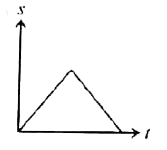
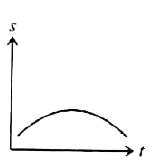
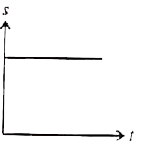
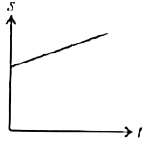
Which one of the following graphs represents uniform motion ? |
|
Answer»
|
|
| 45. |
A body of mass 2 kg is executing simple harmonic motions according to the cquation 0.06 cos (100t+ pi//4 ) m, where t is in seconds. What is the maximum kinetic energy? |
|
Answer» |
|
| 46. |
Calculated the change in g value in your district of Tamil nadu. (Hint : Get the latitude of your district of Tamil nadu from the Google). What is the difference in g values at Chennair and Kanyakumari? |
|
Answer» Solution :Variation of .g. VALUEIN the latitude to chennai ` g .("Chennai") = g - omega^(2) R cos LAMBDA ` Here `omega^(2)R = ((2Pi)/T)^(2) xxR ` Periodof revolution(T) = 1 day= 86400 sec Radiusof the Earth (R ) = `6400 xx10^(3)` m Latitude of Chennai `(lambda) = 13^(@) = 0.2268 ` rad `g. _("Chennai") = 9.8 - [((2xx3.14)/(86400))^(2) xx 6400 xx10^(3)]xx (cos 0.2268 )^(2)` ` = 9.8 - [(3.4 xx10^(-2))xx(0.9744)^(2))] ` ` = 9.8 - [ 0.034 xx 0.9494 ] = 9.8 - 0.0323 ` `g . _("Chennai") = 9.7677 "ms"^(-2)` Variation of .g.valuein the latitudeof Kanyakumari `lambda_("kanyakumari ") = 8^(@)35 . = 0.1457 ` rad `g. _("Chennai") = 9.8 - [((2xx3.14)/(86400))^(2) xx 6400 xx10^(3)]xx (cos 0.2268 )^(2) - [3.4 xx10^(-2) xx (cos 0.1457)^(2) ] = 9.8 - 0.033 ` ` g. _("kanyakumari") = 9.7667 ms^(-2)` the differenceof .g. value `DELTAG = g._("Chennai") - g._("Kanyamukari")` ` = 9.7677 - 9.7667` `Deltag = 0.001 "ms"^(-2)` |
|
| 47. |
The surface which radiates more heat at a given temperature is |
|
Answer» Black& POLISHED |
|
| 48. |
The position vector of the objects of masses 25 kg and 10 kg are (4,7,5)m and (1,3,5) m respectively. Obtain the vector representing the gravitational force on 25 kg object by 10 kg object. (Take G = 6.67 xx 10^(-11) Nm^(2)kg^(-2) ) |
|
Answer» Solution :`implies` Here , `m_1 = 25 kg , m_2 = 10 kg ` `vecr_1 = (4,7,5) m, vecr_2 = (1,3,5) m, vecF_(12) = (?)` `vecF_(12) = G(m_1m_2)/(r^2) hatr_(12) ""....(1)` `vecr_(12) = vecr_(2) - vecr_(1)= (1,3,5) - (4,7,5) = (-3, -4,0) m ` `:. r = |vecr_(12)|=sqrt((-3)^2+(-4)^2+(0)^2)=5m` and ` vecr_(12) = (vecr_(12))/(|vecr_(12)|)=((-3,-4,0))/5` `= (0.6, -0.8 ,0)` `= 0.6 HATI - 0.8 hatj` Putting this in equation (1) , `vecF_(12)=(6.67 xx10^(-11))((25)(10))/(5^2) xx(-0.6 , 0.8 , 0)` `= 6.67 xx 10^(-10)(0.6 hati - 0.8 hatj) N` |
|
| 49. |
The radius of a soap bubble increased from 1/(sqrt(pi)) cm to 2/(sqrt(pi)) cm. If the surface tesionof water is 30 dyne/cm, then the work done will be |
|
Answer» 180 erg |
|