Saved Bookmarks
This section includes 7 InterviewSolutions, each offering curated multiple-choice questions to sharpen your Current Affairs knowledge and support exam preparation. Choose a topic below to get started.
| 1. |
All the known planets move in: |
|
Answer» STRAIGHT path |
|
| 3. |
If the ice in the polar caps of earth melts, how will it affect angular velocity of earth? |
| Answer» SOLUTION :ANGULAR VELOCITY of EARTH DECREASES. | |
| 4. |
Explain why a horse cannot pull a cart and run in empty space ? |
| Answer» Solution :For pulling a CART , the horse PUSHES the earth and the reaction FORSE from the earth makes it to move in the forwarded direction. SINCE in empty SPACE there is no reaction force,the horse cannot run. | |
| 5. |
A container having a volume of 800 cm^3 is dipped in water. The opening of the container faces downwards .At what depth should the container be dipped so that 300 cm^3 of water entersthe container? The barometric reading =76 cmHg, and density of mercury=13.6 g.cm^-3 |
|
Answer» |
|
| 6. |
A mercury drop of radius lcm is sprayed into 10^6 droplets of equal size. If surface tension of mercuryis 35 xx 10^(-3) N/m. The energy expended is 4.36 xx 10^(-n)J Find n |
|
Answer» |
|
| 8. |
A sphere of mass m and radius r rolls on a horizontal plane without slipping with the speed u . Now if it rolls up vertically , the maximum height it would attain will be |
|
Answer» `3u^(2) //4 g` `therefore` Kinetic energy = `(1)/(2) "mu"^(2) + (1)/(2) I OMEGA^(2)` `= (1)/(2)"mu"^(2) + (1)/(2) ((2)/(5) mr^(2)) omega^(2) = (1)/(2) "mu"^(2) + ("mu"^(2))/(5) = (7)/(10) "mu"^(2)` . Potential energy = kineti energy `therefore mgh = (7)/(10) "mu"^(2) or h = (7u^(2))/(10 g)` |
|
| 9. |
A bullet is fired from a rifle. If the rifle recoils freely then the K.E of the rifle as compared to that of bullet is: |
|
Answer» greater |
|
| 10. |
The gravitational self energy U fo a uniform solid sphere is equal to the amount of work done in assembling together its infinitessimal particles initally lying infinite distance apart IF M is the mass and R is the radius of the solid sphere, then the gravitational self energy of a solid sphere is given by |
|
Answer» `(-3)/(5) (GM^(2))/(R)` |
|
| 11. |
The gravitational self energy U fo a uniform solid sphere is equal to the amount of work done in assembling together its infinitessimal particles initally lying infinite distance apart Taking the mass of the sun as2 xx 10^(30) kg and radius of the sun as nearly7 xx 10^(8) metres, the self energy of the sun is nearly equal to |
|
Answer» `-2.29 xx 10^(35)` J |
|
| 12. |
A wheel rotating at an angular speed of 20" rads"^(-1), is brought to rest by a constant torque in 4s. If the M.I. is 0.2" kg m"^(2) , the work done in first 2s is |
|
Answer» 50 J |
|
| 13. |
Match the following : ltimg src="https://d10lpgp6xz60nq.cloudfront.net/physics_images/NCERT_BIO_XI_C22_E09_Q01.png" width="80%"gt |
|
Answer» SOLUTION :(a)oneweightacts as supportanotheractsas WEIGHT Sotension T=10g=10`xx 10` T= 100N (b)`T= 2xx 10xx g` `=2 xx 10xx 10 = 200N` (c )`T = 10 xx 10 sin 30^(@)` `=10 xx 10 xx (1)/(2) = 50N` |
|
| 14. |
A cylinder of volume 10 m ^(3) contains hydrogen gas at 300 K. What is the quantity of heat required to raise the temperature of the gas to 303 K? Using this energy a body of mass m can be lifted to a height of 10 m. What is the body ? Density of hydrogen is 8. 9 xx 10 ^(-2) Kg //m ^(2)- C _(v) = 20. 4 J mol ^(-1) K ^(-1). |
|
Answer» SOLUTION :`Q = m C _(v) dT` Mass = Desnity `XX` Volume `Q = ( 8.9 xx 10 ^(-2) xx 10)/(2 x 10 ^(-3)) xx 20. 4 xx (303 - 300)` `= 2. 72 xx 10 ^(4) J` Let the mass be m. When the mass is raised to a height h, then this energy is converted into potential energy of the mass (mgh) `mgh = 2.72 xx 10 ^(4)` `m = (2. 72 xx 10 ^(4))/(9.8 xx 10) = 277.5 kg ` |
|
| 15. |
The dinensions of angular momentum are |
|
Answer» `[MLT^-2]` |
|
| 16. |
Wavelength of two notes in air is (90 //175) m and ( 90//173) m, respectively . Each pof these notes produces 4 beats//s with a third note of a fixed frequency . Calculate the velocity of sound in air . |
|
Answer» Solution :Given : `lambda_(1) = 90//175 m and lambda_(2) = 90//173 m` If ` f_(1) and f_(2)` are the corresponding frequencies and ` v` is the velocity ofsound in air , we have ` v = f_(1) lambda_(1) and v = f_(2) lambda_(2)` `f_(1) = (v)/( lambda_(1)) and f_(2) = (v)/( lambda_(2))` SINCE , `lambda_(1) LT lambda_(2)` , we must have `f_(1) gt f_(2)`. If `F` is the frequency of the third note , then `f_(1) - f = 4 and f - f_(2) = 4` rArr`f_(1) - f_(2) = 8` `(v)/( lambda_(1)) - (v)/( lambda_(2)) = 8` `v [ (175)/( 90) - (173)/(90)] = 8` `v = 360 m//s` |
|
| 17. |
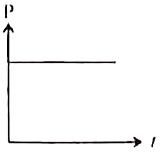
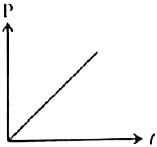
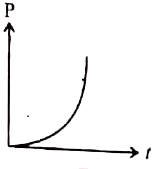
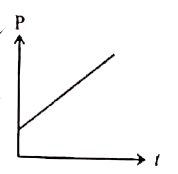
The body moves under the action of constant force along a straight line. The instantaneous power developed by this force with time 't' is correctly represented by: |
|
Answer»
|
|
| 18. |
Explain specific density or relative density of substance. |
|
Answer» Solution :The RELATIVE DENSITY of a substance is the ratio of its density to the density of water at `46(@)C`. Relative density `=("Density of substance")/("Density of water at "4^(@)C "TEMPERATURE")` For example : Density of aluminium is `2.7xx10^(3)kgm^(-3)`. Density of water at `4^(@)C` temperature is `10^(3)kg//m^(3)`. HENCE relative density of aluminium is 2.7. Relative density is positive , scalar and demensionless physical quantity. (Density of substance =Relative density `xx` density of water at `4^(@)C` temperature) The densities of some common fluids are displayed below in table. 
|
|
| 19. |
What is the smallest radius of a circle at which a bicyclist can travel if his speed is 7 m//s and the coefficient of static friction the between tyres and road is 0.25 |
|
Answer» 10 m |
|
| 20. |
A sphere of coefficient of linear expansion alpha, mass 'm' and radius 'r' is is spinning about an axis through its diameter with an angular velocity 'omega' when it is heated such that its temperature increases by Deltat, the angular velocity becomes |
|
Answer» `OMEGA ( 1+ DELTA t)^(2)` |
|
| 21. |
A slab X of thickness .t., thermal conductivity .K. and area of cross-section .A. is placed in thermal contact with another slab Y which is 2N^(2) times thicker, 4n times conductive and having n times larger cross section area. Aty the steady state, if the outside face of X is maintained t 100^(0)C, the outside face of Y at 0^(0)C, then the temperature of the junction is represented by the graph (n gt 0) |
|
Answer»
|
|
| 22. |
The average translational kinetic energy of gas molecules depends on |
|
Answer» <P>NUMBER of MOLES and T |
|
| 23. |
Classical physics deals with ____ phenomena and includes subjects like_____,____ |
|
Answer» Microscopic, STATISTICAL Mechanics, Photoelectric effect |
|
| 24. |
When99.8cm ^(3)waterat 4 ^(@)Cchangesitstemperatureto 0 ^(@)C, itsvolumebecomes100cm ^(3). Calculateaveragevalueof coefficientofcvolumeexpansionof waterin therange0 ^(@) Cto4 ^@C . |
|
Answer» SOLUTION :Averagevalueof coefficientof volumeexpersionofwater , ` GAMMA =(V _(4) - V_(0))/(V_(0) (4-0))` `=(99.8-100 )/(100xx4 )=(-0.2)/(400 ) =- 0.0005 ^(@)C^(-1)` |
|
| 25. |
Three uniform discs each of mass .m. and radius .r. are kept touching each other, such that their centres form a triangle. The MI of the system about a median is |
|
Answer» `(11)/(4) MR^(2)` |
|
| 26. |
A force vec(F)=(5hat(i)-3hat(j)+2hat(k)) N moves a particle from bar(r_(1))=(2hat(i)+7hat(j)+4hat(k))m to bar(r_(2))=(5hat(i)+2hat(j)+8hat(k))m.The work done by the force is, |
| Answer» ANSWER :C | |
| 27. |
Dispersion can take place for |
|
Answer» TRANSVERSE WAVES only but not for LONGITUDINAL waves |
|
| 28. |
In an elastic collision between two bodies |
|
Answer» the INITIAL KINETIC ENERGY of system is equal to the final kinetic energy of system |
|
| 29. |
A perfect black body |
|
Answer» ABSORBS all the RADIATIONS |
|
| 30. |
Points P, Q and R are in a vertical line such that PQ = QR. A ball at P is allowed to fall freely. The ratio of times of descent through PQ and QR is |
|
Answer» 1:1 |
|
| 31. |
A body has maximum range R_(1) when projected up the inclined plane. The same body when projected down, the inclined plane. It has maximum range R_(2). Find its maximum horizontal range. Assume the equal speed of projection in each case and the body is projected onto the gretest slope. |
|
Answer» `R=(2R_(1)R_(2))/(R_(1)-R_(2))` For downward PROJECTION `R_("MIN")=(v_(0)^(2))/(g(1+sin beta))=R_(2)` ..........(ii) |
|
| 32. |
A body moves a distance of 10 m along a straight line under the action of 5 N force . If the work done is 25J, the angle between the force and the direction of motion is |
| Answer» ANSWER :A | |
| 33. |
Which of the following is a null vector (a) velocity of a body moving in a circle with a uniform speed (b) velocity vector of a body moving in a straight line with a uniform speed ( c) position vector of the origin of the rectangular coordinate system (d) displacement vector of a stationary object |
| Answer» Answer :D | |
| 34. |
The approximate depth of an ocean is 2700 m. The compressibility of water is 45.4xx10^(–11) Pa^(–1) and density of water is 10^(3) kg//m^(3). What fractional compression of water will be obtained at the bottom of the ocean? |
|
Answer» `1.0xx10^(-2)` `(Deltav)/(v)=hrhogxxK "" "as"P=h rho g, B= (1)/(K)` `(Deltav)/(v)=2700xx10^(3)xx9.8xx45.4xx10^(-11)` `=1.2xx10^(-2)` |
|
| 35. |
A new system of units is proposed in which unit of mass is alpha kg, unit of length betam and unit of time gammas. How much will 5J measure in this new system? |
|
Answer» SOLUTION :[Energy] `=[ML^(2)T^(-2)]` Let `M_(1),L_(1),T_(2) and M_(2), L_(2), T_(2)`are units of mass, length and time in given two system, `:.M_(1)=kg, L_(1)=1m, T_(1)=1s` `M_(2)= alpha kg, L_(2)= beta m,T_(2) = gammas` The magnitude of a physical QUANTITY remains the same, whatever be the system of units of its MEASUREMENT i.e. `n_(1)u_(1)=n_(2)u_(2)` `n_(2)=n_(1)(u_(1))/(u_(2))=n_(1)([M_(1)L_(1)^(2)T_(1)^(2)])/([M_(2)L_(2)^(2)T_(2)^(-2)])=5` `[(M_(1))/(M_(2))]xx[(L_(1))/(L_(2))]^(2)xx[(T_(1))/(T_(2))]^(-2)` `=5[(1)/(alpha)]xx[(1)/(beta)]xx[(1)/(GAMMA)]^(-2)` `=5xx(1)/(alpha)xx(1)/(beta^(2))xx(1)/(gamma^(-2))` `n_(2)=(5gamma^(2))/(alpha beta^(2))` Thus, NEW unit of energy will be `(gamma^(2))/(alpha beta^(2))` |
|
| 36. |
Circular disc of mass 2 kg and radius 1 metre is rotating about an axis perpendicular to its plane and passing through its centre of mass with a rotational kinetic energy of 8 Joules. The angular momentum in (J-sec) |
|
Answer» 1 |
|
| 37. |
When the absolute temperature of the sourceof a Carnot heat engine is increased by 25%, its efficiency increases by 80%. The new efficiency of the engine is |
| Answer» ANSWER :D | |
| 38. |
800 kW power is supplied to a motor of 70% efficiency. This motor is in turn connected to a crane,whose efficiency is also 70%. If this crane lifts a 20 ton rock, its velocity is |
|
Answer» `2MS^(-1)` |
|
| 39. |
What is optimum speed ? Write its equation. |
|
Answer» Solution :The velocityof thevehicleon acircularbalancedroadis givenby `v_(max) = [RG ((mu_(s)+ tan theta)/(1-mu_(s) tan theta))]^(1/2)` Herewe haveto TAKE `mu_(s)= 0` asthe surfaceis SMOOTH `v_(max)= [rg ((tan theta)/( 1))]^(1/2)` At thisspeedfrictionforceis notneededat alllittlewearand tearon thetyres`v_(o)` is calledtehoptimumspeed for`v ltv_(o)` frictionalforcewill beupwardand avehiclecan be PARKED on a slopeonly if tan `theta le mu_(s)` |
|
| 41. |
A ball is thrown verticaly upward with a velocity .u. from the ballon descending with velocity v. After what time, the ball with pass by the ballon? |
|
Answer» SOLUTION :`S_(f)=u_(R)t+1/2 a_(r) t^(2)` `O=(v+u)t-1/2gt^(2)` `t=(2(v+u))/(G)` |
|
| 42. |
Two particlesof equalmasseshavevelocitiesvec(v)_(1)= 4hat(i) and vec(v)_(2) = 4 hat(j). Firstparticlehac anacceleration of theother particleis zero. Thecentreof massof the twoparticlesmovesina path of |
|
Answer» Straightline |
|
| 43. |
A car accelerates from rest at a constant rate alpha for some time, after which it decelerates at a constant rate beta and comes to rest. If the total time elapsed is t, then the maximum velocity aequired by the car is |
|
Answer» `((ALPHA^(2)+BETA^(2))/(alpha beta))t` |
|
| 44. |
A body of mass 10kg is on a rough inclined plane having an inclination of 30^(@) with the horizontal. If coefficient of friction between the surfaces of contact of the body and the plane is 0.25. Find the least force required to pull the body up. |
|
Answer» 70.2 N |
|
| 45. |
Identify the non-conservative force in the following |
|
Answer» WEIGHT of a body |
|
| 46. |
A body is thrown with a velocity v_(0) at an angle theta_(0) with horizontal. Find the (i) instan-taneous power delivered by gravity after a time t measured from the instant of projection (ii) average power delivered by gravity during the time t. |
|
Answer» Solution :(i) Power : Power DELIVERED by gravity after a time t when the PARTICLE has velocity v is, `P_(g) = m vec(g).vec(v)""...(i)` Kinematics : Substituting `vec(g) = - g vec(j) and vec(v) = v_(0) cos theta_(0) hat(i) + (v_(0) SIN theta_(0) - "gt")`j in eq. (i), We have `P_(g) = - mg (v_(0) sin theta_(0) - "gt")` (ii) The average power is `P_(av) = (int_(0)^(t) PDT)/(t)` Substituting `P = - mg (v_(0) sin theta_(0) -"gt")`, we have `P_(av) = - (mg)/(t) int_(0)^(t) (v_(0) sin theta_(0) -"gt")dt` This gives `P_(av) = - mg(v_(0) sin theta_(0) - ("gt")/(2))` Note : If t = T (time of light), then `P_(av)` = zero |
|
| 47. |
A simple harmonic oscillator has a period of 0.01 s and an amplitude of 0.2 m. The magnitude of the velocity in m/s at the centre of oscillation is………………. |
|
Answer» `20pi` `v_(0)=(2pi)/(T)A=(2pixx0.2)/(0.01)=40pim//s` |
|
| 48. |
A sphere can roll on a surface inclined at an angle theta, if the friction coefficient mu gt (2//7)g sin theta. Now suppose the friction coefficient is (1//7)g sin theta and the sphere is released from rest on the incline, then |
|
Answer» it will stay at rest |
|
| 49. |
Define tube of flow. |
| Answer» SOLUTION :A BUNDLE of STREAMLINES having the same velocity over any cross section perpendicular to the direction of FLOW then such bundle is called a .tube of flow.. | |
| 50. |
Which one of the following is not a force |
| Answer» Solution :Impulse= Force`XX` time | |