Saved Bookmarks
This section includes 7 InterviewSolutions, each offering curated multiple-choice questions to sharpen your Current Affairs knowledge and support exam preparation. Choose a topic below to get started.
| 1. |
The flow rate of water from a tap of diameter 1.25 cm is 0.48 L/min . The coefficient of viscosity of water is 10^(-3) Pa s. (b) After sometime the flow rate is increased to 3L/min. Characterise the flow for both the flow rates. |
|
Answer» Solution :Let the speed of the flow be v and the diameter of the tap be d = 1.25 CM. The VOLUME of the water flowing out per second is `Q = v xx pi d^2//4 ""v= 4Q//d^2pi ` We then estimate the REYNOLDS number to be `R_e = 4pQ//pi d eta` `= 4 xx 10^3 kg m^(-3) xx Q(3.14 xx 1.25 xx 10^(-2) m xx 10^(-3) Pa s)` `= 1.019 xx 10^(8) m^(-3) sQ` SINCE INITIALLY (a) Q = 0.48 L/min = `8 cm^3//s` `= 8 xx 10^(-6) m^3 s^(-1) ,` we obtain, `R_e = 815 ` Since this is below 1000, the flow is steady After some time (b) when Q = 3L/min = 50 `cm^3//s` `= 5xx 10^(-5) m^3 s^(-1)` we obtain , `R_e = 5095`. The flow will be turbulent. |
|
| 2. |
A carnot engine having an efficiency of (1)/(10) as heat engine, is used as a refrigerator. If the work done on the system is 10 J, the amount of energy absorbed from the reservoir at lower temperature is |
|
Answer» 90 J Given `eta = (1)/(10), W= 1 J :. beta = (1-(1)/(10))/((1)/(10)) = (9)/(10).10 = 9` Since, `beta = (Q_(2))/(W)`, where `Q_(2)` is the AMOUNT of energy absorbed from the reservoir `:. Q_(2) = beta W = 9 xx 10 = 90 J` |
|
| 3. |
A simple pendulum of length 20 cm and of mass 0.1 kg is pulled to one side through an angle .theta. and released. If its maximum velocity is 1.4 ms^(-1), the value of .theta. is |
|
Answer» `30^(@)` |
|
| 4. |
Calculate the gravitational field intensity and potential at the centre of the base of a solid hemisphere of mass m, radius R |
|
Answer» Solution :We consider the shaded elemetnal disc of radius `Rsintheta`and thickness `Rd theta` its mass `dM=M/(2/3piR^(3))pi(Rsintheta)^(2)(Rd thetasintheta)` or `dM=(3M)/2SIN^(3)theta d theta` FIELD due to this plate at `O`, `dE=(2GdM(1-costheta))/((Rsintheta)^(2))` (see field due to a uniform disc) or `dE=(3GMsintheta(1-costheta)d theta)/(R^(2))` Therefore, `E=int_(0)^((pi)/2) dE=int_(0)^((pi)/2) =(3GMsintheta(1=costheta))/(R^(2))d theta` `=(3GM)/(R^(2))[-costheta+(cos^(2)theta)/2]_(0)^((p)i/2)` or `E=(3GM)/(2R^(2))` 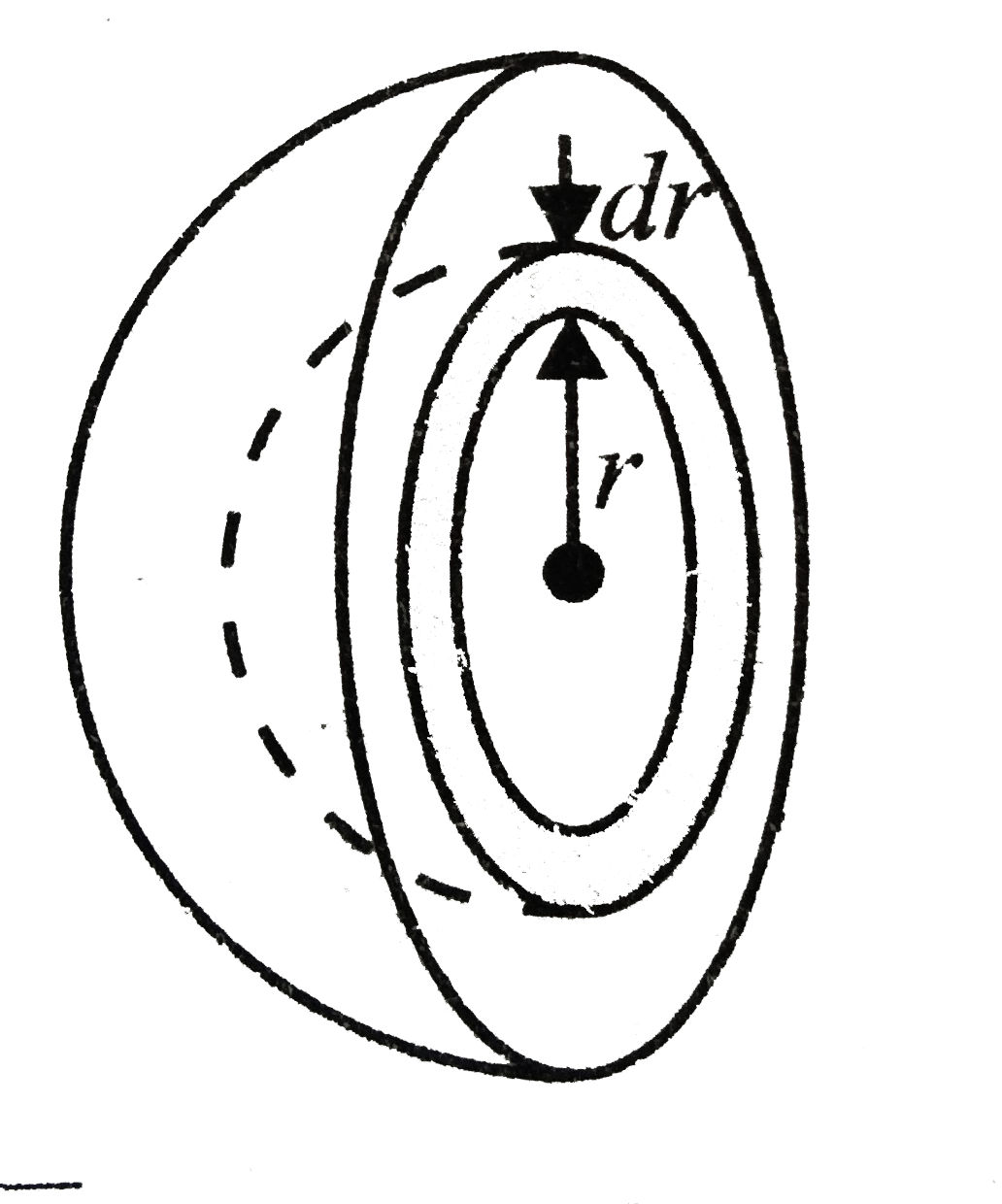 Now potential due to the element under consider at the cente of the baase of the HEMISPHERE `DV=-2GdM//r (cosectheta-cottheta)` (See potential due to a circular plate) or `dV=(-3GMsin^(3)theta(cosectheta-cottheta)d theta)/((Rsintheta)` Therefore, `V=-(3GM)/Rint_(0)^((pi)/2) (sintheta-costhetasintheta)d theta` `=-(3GM)/R[-costheta+(cos^2theta)/2]_0^(pi/2)` or `V=(-3GM)/(2R)` Alternative method: Consider a HEMISPHERICAL shell of radius `r` and thicknes `dr` It mass `dm=M/(2/3piR^(3))(2pi^(2)dr)` or `dm=(3Mr^(2)dr)/(R^(3))` Since all points of this hemispherical shell are at the same distnce `r` from `O` hence potential at `O` is `dV=(-Gdm)/r=(-3GMrdr)/(R^(3))` `:. V=int_(0)^(R)dV=(-3GM)/(2R)` |
|
| 5. |
One mole of ideal gas expands isothermallyto double its volume at 27^(@)C. Then the work done by the gas is nearly |
|
Answer» 2760cal |
|
| 6. |
(A) : If (a^(m). b^(n) )/( C^(P). d^(q) ), then the percentages error in the measurement of x, (Delta x)/( x) =m ((Delta a)/( a) ) + n ((Delta b)/( b) ) + p((Delta c)/( c)) + q((Delta d)/( d)) (R) : The above is true for all values of Delta a , Delta b , Delta c and Delta b. |
|
Answer» Both (A) and (R) are true and (R) is the correct explanation of (A) |
|
| 7. |
The change in internal energy of the gas and workdone by the gas in an adiabatic process are |
|
Answer» UNEQUAL |
|
| 8. |
Explain Tube of flow. |
|
Answer» Solution :Tube of flow is abundle of streamline. The velocity of each FLUID particles on cross SECTION PERPENDICULAR to direction proportionof fluid in tube of flow are same. When the flow of passed through a tube is very SLOW then tube itself is one tube of flow. 
|
|
| 9. |
Two balls of equal masses are thrown at the same time in vacuum. While they are in vacuum, the accelaration of their centre of mass |
|
Answer» DEPENDS on masses of the balls |
|
| 10. |
A copper calorimeter of mass 300 grams contains 500 gm of water at temperature of 15^(0)C. A 560 gm block of copper heated to a temperature 100^(0)C is dropped into calorimeter and the temperature is observed to increase to 225^(0)C. Find the specific heat capacity of copper. |
|
Answer» |
|
| 11. |
Is there any thermal equilibrium in the solar system? |
| Answer» SOLUTION :As the temperatures of the sun, the planets and their SATELLITES are not the same, there is no thermal EQUILIBRIUM in the solar system. | |
| 12. |
On which place on the surface of the earth, centripetal force is maximum ? |
| Answer» SOLUTION :CO- efficientof frictionrubbertyreandroadis lesscompared to steeland ROAD. | |
| 13. |
Find the ratio of the orbital speeds of two satellites one of which is rotating round the earth and the other around Mars close to their surface. (mass of the earth = 6 xx 10^24kg, Mass of the Mars = 6.4 xx 10^23 kg, Radius of the earth = 6400km and Radius of Mars = 3400km) |
|
Answer» Solution :The orbital speed of a satellite CLOSE to the SURFACE of a planet, `V_0=sqrt((GM)/R)` The RATIO of orbital speeds , `V_(01)/V_(02)=sqrt((M_1/M_2)(R_2/R_1))` `V_(01)/V_(02)=sqrt(((6xx10^24)/(6.4xx10^23))(3400/6400))=sqrt((60xx34)/(6.4xx64))=2.232/1` |
|
| 14. |
Under what condition is the average velocity equal the instantaneous velocity? |
| Answer» SOLUTION :When the BODY is MOVING with UNIFORM VELOCITY | |
| 15. |
We are familiar with Newton's lows of motion.Using the above law explain. Impulse - momentum principle |
|
Answer» <P> Solution :Impulse of a force is the product of force and the TIME interval for which it ACTS.We have `VEC F = Delta vec P/ Delta t` ` therefore vec F Delta t = Delta vec P` i.e, Impulse = change in MOMENTUM |
|
| 16. |
Figure shows elliptical path abcd of planet around the sun S such that the area of triangles csa is 1/4 the area of the ellipse .(See figure) With db as the semimajor axis, and ca as the semiminor axi. If t_1 is the time taken for planet to go over path abc and t_2 for path taken over cda then : |
|
Answer» `t_1 =4t_2` |
|
| 17. |
The heart of a man pumps 5 liters of blood through the arteries per minutes at a pressure of 150 mm of mercury. If the density of mercury by 13.6 xx 10^(3) kg//m^3 and g = 10 m//s^2 then the power of heart in watt is |
|
Answer» `3.0` V = 5 litres = `5 xx 10^(-3) m^(3) ( :. "1 litre " = 10^(-3) m^(3))` Time in which this volume of blood PUMPS, `t = 1 "MIN" = 60 s` PRESSURE at which the blood pumps `P = 150 mm " of Hg" = 0.15 m of Hg` `= (0.15 m) (13.6 xx 10^(3) kg//m^3) (10 m//s^2) "" ( :. P = H RHO g)` `:.` Power of the heart = `(PV)/t` `= ((20.4 xx 10^3 N//m^2)(5 xx 10^(-3) m^3))/(60s) = 1.70 W`. |
|
| 18. |
A satellite close to the earth is in orbit above the equator with a period of rotation of 1.5 hours. If it is above a point P on the equator at some time, it will be above P again after time a) 1.5 hours b) 1.6 hours if is rotating from west to east c) 24/17 hours if it is rotating from west to east d) 24/17 hours if it is rotating from east to west |
|
Answer» a only |
|
| 19. |
A man can row a boat with 4 kmph in still water. If he is crossing a river where the current is 8 kmph. Inwhat time he will cross the river in the shortest path ? ( Width of river is 8 km) |
|
Answer» `(2)/(sqrt(3))` HR |
|
| 20. |
Air flows over the top of an aeroplane wing of area A with speed v_1and past the under side of the wing of area A with speed v_2 Show that the magnitude of the upward in force on the wing L is L =(1)/(2)rho A ( v_1^(2) - v_2^(2)) where rhois the density of the alr. |
|
Answer» Solution :Bernouli.s equations `P + (1)/(2)RHO v^(2)+rho gh = a ` CONSTANT The pressure difference ACROSS the upper and lower SURFACE is` Deltap= p_2 -P_1` ` P_1 +(1)/(2)rho v_1^(2)= P_2 +(1)/(2) rho v_2^(2)` because `rhogh`is a constane ` Delta P = P_2 - P_1 = (1)/(2)rho ( v_1^(2) -v_2^(2))` Lift on the PLANE ` = L= Delta P xx A = (1)/(2)rho A (v_1^(2)-v_2^(2))` |
|
| 21. |
Particle A is released from a point on a smooth inclined plane inclined at the angle alpa, with the horizontal. At the same instant another particle B is projected with initial velocity u making an angle beta with the horizontal. Both the particles meet again on the inclined plane. Find the relation between alpha and beta. |
|
Answer» |
|
| 22. |
A body of weight W is suspended by a string It is pulled aside with a horizontal force of 2W and held at rest. The tension in it is |
| Answer» ANSWER :D | |
| 23. |
A helicopter lifts a 72kg astronaut 15 m vertically from the ocean by means of a cable. The acceleration of the astronaut is g/(10). How much work is done on the astronaut by (g=9.8 m//s^(2)) (a) what is the kinetic energy of the block as it passese through x=2.0m? (b) What is the maximum kinetic energy of the block between x=0 and x=2.0m? |
|
Answer» `:. T =m(g + a)=72(9.8 + 0.98)` `=776.16N` 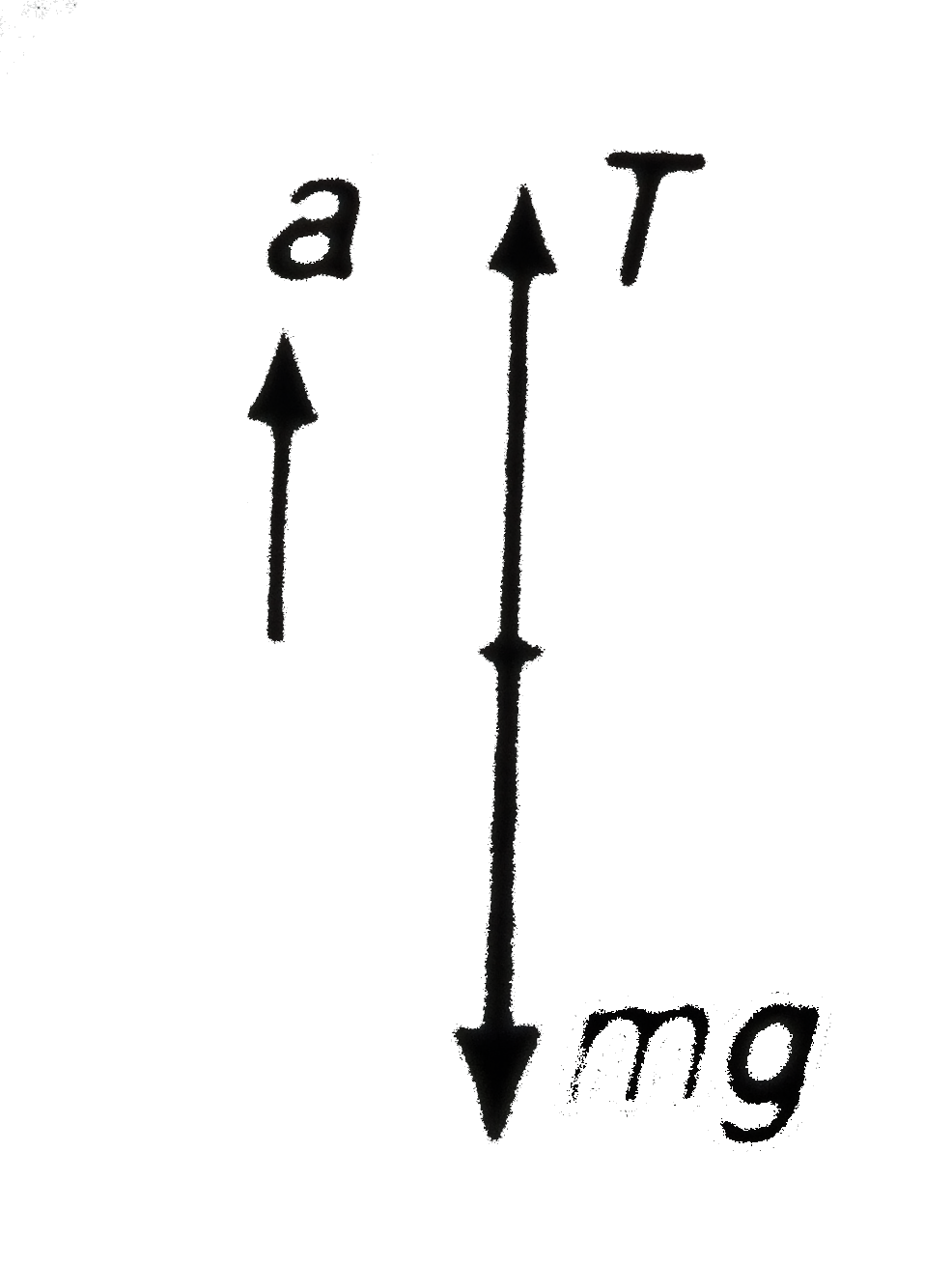 (a) `W_(T) =TS cos 0^@` `=(776.16)(15)` `=11642 J` (b) `W_(mg) =(mg)(S) cos 180^@` `=(72 xx 9.8 xx 15)(-1)` `=-10584 J` (c) `K=W("TOTAL") =11642 - 10584` `=1058 J` (d) `K =1/2mv^(2)` `:. v=SQRT((2K)/(m)) =sqrt((2 xx 1058)/(72))` `=5.42m//s`. |
|
| 24. |
For a satellite to be geostationary, which of the following are essential conditions ? (a) It must always be stationed above the equator (b) It must rotate from west to east (c) It must be about 36,000 km above the earth (d) Its orbit must be circular, and not elliptical |
| Answer» Answer :D | |
| 25. |
The displacement of a body of mass 2 kg varies with time .t. as S =t^(2)+2t, where S is in metres and .t. is in seconds. The work done by all the foces acting on the body during the time interval t = 2 s to t = 4 s is |
| Answer» Answer :B | |
| 26. |
A long metal rod of length I and density p is held vertically with its lower end touching sea-water of density p_(0). Calculate the time in which the whole of the rod will sink into water and the velocity of the rod. Negtect water resistance and assume vertical postion of the rod throughout its motion . |
|
Answer» |
|
| 27. |
To keep a particle moving with constant velocity on a frictionless surface, an external force |
|
Answer» Should ACT CONTINUOUSLY |
|
| 28. |
An engine pumps water through a hose pipe water passes through the pipeand leaves it with velocity of 2 m/s. The mass per unit length of water in the pipe is 100 kg/m .What is the power of the engine ? |
|
Answer» 400 W ` :. M = m/l xxl/t` = mass per unit `xx ` velocity ` :. M = m/l V` Powermeans kinetic energy of flowing water , ` :. "Power " P = 1/2 Mv^(2)` ` = 1/2 ((mv)/l)v^(2)` `= 1/2 .(mv^(3))/l ` ` = 1/2 xx100 xx(2)^(3)` ` [ :. m/l = 100 "kg/m"]` = 400 W |
|
| 29. |
The value of 'g' on moon is five times less than that on earth. If the length of the seconds pendulum on the earth is 100cm , its length on the moon is |
|
Answer» 20cm |
|
| 30. |
When a wave goes from one medium to another , there is a change in ………. . |
|
Answer» VELOCITY |
|
| 31. |
A light rigid rod has a bob of mass m attached to one of its end. The other end of the rod is pivoted so that the entire assembly can rotate freely in a vertical plane. Initially, the rod is held vertical as shown in the figure. From this position it is allowed to fall.(a) When the rod has rotated through theta=30^(@) , what kind of force does it experience– compression or tension? (b) At what value of thetathe compression (or tension) in the rod changes to tension (or compression)? |
|
Answer» (B) `theta =COS^(-1)(2/3)` |
|
| 32. |
Choose the correct options Consider following pair of forces of equal magnitude and opposite directions: (p) Gravitational forces exerted on each other by two point masses separted by a distance. (Q) Couple of forces used to rotate awater tap. (R) Gravitional force and normal force experienced by an object kept on a table. For which of these pair//pairs the two forces do NOT cancel each others's translational effect? |
|
Answer» <P>Only P |
|
| 33. |
What are conservative force , non - conservative force , conservative field and non - conservative field ? |
|
Answer» Solution :Conservative force : A force is said to be conservative if the work done by the force on a body is path INDEPENDENT and depends only on the intial and final POSITIONS . Such FIELD is known as conservation field . For EXAMPLE , gravitational force , electric forces and magnetic forces . Non - conservative forces : A force is saidto be non conservative if the work done by the force on a body is path dependent. The work done by such a force in moving a body arounda closed path is not zero . Such field is known as non - conservative field . For example , frictional and viscous froce . |
|
| 34. |
Three identical rings, each of mass M and radius R are placed in the same plane touching each other such that their centers from the vertices of an equilateral triangle. The M.I of the system about an axis passing through center of one of the rings and perpendicular to its plane is |
|
Answer» `(MR^(2))/(2)` |
|
| 35. |
A shell is fired from the ground at an angle theta with horizontal with a velocity 'v'. At its highest point it breaks into two equal fragments. If one fragment comes back through its initial line of motion with same speed, then the speed of the fragment will be |
|
Answer» `3 V COS theta` |
|
| 36. |
A light mass m and another heavier mass M , are connected by a light inextensible string which passes through a smooth and narrow vertical tube, Keeping the length l of the string inclined at an angle theta with the tube, with what frequency should the mass m be rotated in a horizontal plane so that the mass M will remain in equilibrium? |
|
Answer» |
|
| 37. |
Tuning fork A has frequency 256 Hz. It produces 4 beats per second with fork B. When the prongs of fork B are rubbed little, it produces 2 beats per second with A. Findout frequencies of foek B, before and after rubbing its prongs. |
| Answer» SOLUTION :`f_(B) =252 HZ and f ._(B) =254 HZ OR 258 HZ` | |
| 39. |
The spring balance A read 2 k.g. with ab block m suspended from it. A balance B reads 5kg. When a beaker with liquid is put on the pan of the balance. The two balances are now so arranged that the hanging mass is inside the liquid in the beaker as shown in fig. In this situation. |
|
Answer» The BALANCE A will READ more than 2 kg |
|
| 40. |
Sand is dusted on the railway tracks during rainy season to |
|
Answer» make it ALWAYS wet |
|
| 41. |
What is the maximum value of force F such that the block shown in does not move ? |
|
Answer» Solution :The body diagram of the block is shown in Clearly `R = MG + F SIN 60^(@)` The block will not move , when `F cos 60^(@) le f` (force of friction) `(F)/(2) le mu R ` `(F)/(2) le mu (mg + F sin 60^(@))` `(F)/(2) le (1)/(2 sqrt(3))(sqrt3g+ F sqrt3/2)` `(F)/(2) le ((g)/(2) + (F)/(4))` or `(F)/(2) - (F)/(4) le(g)/(2)` or `F//4 le (g)/(2)` `F le 2 g` Hence `F_(max) = 2 g = 2 XX 10 = 20 N` |
|
| 42. |
If g on the surface of the earth is 9.8 m//s^(2), find its value at a height of 6400 km. (Radius of the earth = 6400 km) |
|
Answer» SOLUTION :Let g at a height H be `g_(h)` `g_(h) = (g)/((1+(h)/(R))^(2))` `h = 6400 km, R = 6400 km, g = 9.8 m//s^(2)` `g_(h) = (9.8)/((1+(6400)/(6400))^(2)) = (9.8)/((1+1)^(2)) = (9.8)/(4) = 2.45 m//s^(2)` |
|
| 43. |
Diameters of the arms of a U tube are 10 mm and 1 mm . It is partially filled with water and it is held in a vertical plane . Find the difference in heights of water in both the arms . (Surface tension of water =70 dyne cm^(-1) angle of contact =0^(@).g=980cms^(-2)) |
|
Answer» SOLUTION :`r_(1)=(d_(1))/(2)=5mm=0.5cm` `r_(2)=(d_(2))/(2)=0.05cm` `T=70"dyne"//CM` `theta=0` `rho=1g//cm^(3)` `rho=1g//cm^(3)` `g=980cm//s^(2)` `T=(rhrhog)/(2costheta)` `thereforeh=(2Tcostheta)/(rrhog)` `thereforeh=h_(2)-h_(1)` `thereforeh=(2Tcostheta)/(rhog)[(1)/(r_(2))-(1)/(r_(1))]` `=(2xx70xxcos0^(@))/(1xx980)[(1)/(0.05)-(1)/(0.5)]` `=(1)/(7)[20-2]` `thereforeh=(18)/(7)=2.57//cm` |
|
| 44. |
Mass of observable universe ........ |
| Answer» Solution :`10^(55)` kg | |
| 45. |
A metal block of area 0.10m^(2) is connected to a 0.010kg mass via a string that passes over an ideal pulley (considered massless and frictionless) as in figure . A liquid with a film thickness of 0.30mm is placed between the block and the right with a constant speed of 0.085ms^(-1) . Find the coefficient of viscosity of the liquid. |
|
Answer» Solution :Area of block `A=0.10m^(2)` THICKNESS of film of LIQUID, `l=0.3mm=0.3xx10^(-3)m` Speed of block `v=0.085ms^(-2)` The coefficient of viscosity `eta=?` Mass of sphere `m=0.01kg` Tension in the STRING F=mg `=0.01xx9.8` `=9.8xx10^(-2)N` Shear strain (Modulus of rigidity) `eta=("shear stress")/("strain rate")=(FcancelA)/(vcancelt)` `=(Fl)/(Av)` `=(9.8xx10^(-2)xx0.3xx10^(-3))/(0.1xx0.085)` `=345.88xx10^(-5)` `thereforeeta=3.46xx10^(-3)Pas` `eta=(2)/(9)xx(r^(2)g)/(v_(t))(rho-sigma)` `=(2xx(2XX10^(-3))^(2)xx9.8(8.9xx10^(3)-1.5xx10^(3)))/(9xx6.5xx10^(-2))` `=9.917xx10^(-6+3+2)` `=9.9xx10^(-1)` `=0.99kgm^(-1)s^(-1)` |
|
| 46. |
A spring of negligible mass having a force constant of 10Nm^(-1) is compressed by a force to a distance of 4 cm. A block of mass 900g is free to leave the top of the spring. If the spring is released, the speed of the block is |
|
Answer» `11.3ms^(-1)` `1/2kx^(2)=1/2mv^(2)` `v^(2)=k/mx^(2)impliesv=sqrt(k/m)x` `v=sqrt((20)/(90))xx4xx10^(-2)=sqrt((100)/9)xx4xx10^(-2)=13.3xx10^(-2)ms^(-1)` |
|
| 47. |
Angle, …………. And ……. Are some of the ……….. Variables. |
|
Answer» |
|
| 48. |
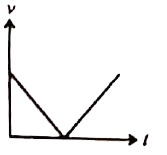
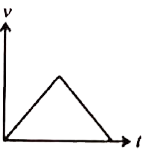
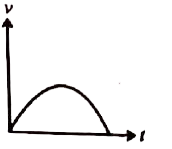
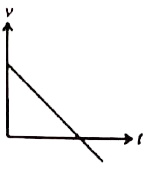
A ball is thrown vertically upwards. Which of the following plots represent the speed graph of the ball during its flight if the air resistence is not ignored? |
|
Answer»
|
|
| 49. |
A U tube is arranged such that diameter of one limb is 2D and diameter of other is D. Surface tension of water contained in the tube is T. If d is density of water, the difference in the levels of liquid is (angle of contact of liquid is zero) |
|
Answer» `(2T)/(DDG)` |
|
| 50. |
A brass sphere of mass 0.2 kg falls freelyfrom a height of 24m and bounces to a height of 8m from the ground. If the dissipated energy in this process is dosorbed by the sphere the rise in its temperature is (specific heat of brass=360 J " kg"^(-1)k^(-1) and g=10ms^(-2)). |
|
Answer» `0.44^(@)C` |
|