

Saved Bookmarks
This section includes 7 InterviewSolutions, each offering curated multiple-choice questions to sharpen your Current Affairs knowledge and support exam preparation. Choose a topic below to get started.
| 1. |
Assertion: When a bottle of cold carbonated drink is opened a slig! fog forms around the opening. Reason: Adiabatic expansion of the gas causes lowering of temperature and condensation of water vapours. |
|
Answer» Both ASSERTION and reason are true and the reason is the CORRECT explanation of the assertion. |
|
| 2. |
A particle of mass m moving towards the east with speed v collides with another particle of the same mass and same speed v moving towards the north. If the two particles stick to each other, the new particle of mass 2m will have a speed of |
|
Answer» `v` According to law of CONSERVATION of linear momentum, we get `m^2 v^2 + m^2v^2 = (2 mV)^(2)` where V is the common VELOCITY after the collision. SOLVING , we get , `V = v/(sqrt2)`. |
|
| 3. |
Two cars A and B are at positions 100 m and 200 m from the origin at t = 0. They start simultaneously with constant velocities 10 ms^(-1) and 5 ms^(-1)respectively in the same direction. Calculate the time and position at which they will overtake one another. |
|
Answer» SOLUTION :`x_(BO) = 200 m , x _(AO)= 100 m, v _(A) = 10 ms ^(-1), v _(B) = 5 ms ^(-1)` Now `x _(B) - x _(A) = (x _(BO) -x _(AO)) + (v _(B) - v _(A)) t ` Suppose, at `t-t,` both cars overtake each other. `therefore x _(B) =x _(A) and x_(B) -x_(A) = 0` `therefore 0= (200 - 100) + (5-10) t` `therefore t = (100)/(5)` `therefore t = 20 s` Now, LET both cars overtake each other at distance x from`x_(AO)` `therefore x = c _(AO) + v _(A)t ` `=100 + 10 xx 20` `=100 + 200` `therefore x = 300 m` Note We can also TAKE distance x from `x _(BO) .` For that equation is `x=x _(BO) + v _(B)t.` |
|
| 4. |
Two identical ball bearings in contact with each other and resting on a frictionless table are hit head - on by another ball bearing of the same mass moving initially with a speed V. If the collision is elastic , which of the following fgures is a possible result after collision ? |
|
Answer» SOLUTION :Suppose , the mass of every BALL of ball bearing is m , The total kintic velocity of a SYSTEM before COLLISION , `=1/2 mv^(2)+0 "" [ :. "Velocity of ball 1 = v and velocity of ball 2=0 "]` After collision , kinetic energy of the system in various cases , Case 1 : `E_(1) =1/2 (2m)(v/2)^(2) =1/4 mv^(2)` Case 2 : `E_(2) =1/2 mv^(2)` Case 3: `E_(3) =1/2 (3m) (v/3)^(2)` ` =1/6 mv^(2)` HENCE , Case 2 is the only possibility . Since , kinetic energy is conserved i this case . |
|
| 5. |
A uniform rod of mass m, length L, area of cross-section A and Young's modulus Y hangs from the ceiling. Its elongation under its own weight will be |
|
Answer» 0 |
|
| 6. |
Why are cooking utensils provided with wooden handles? |
| Answer» Solution :Cooking utensils are provided with wooden HANDLES. Wood is a BAD conductor of HEAT. So, wooden handles would not permit heat to be conducted from HOT utensil to hand. | |
| 7. |
From a circle of radius a, an isosceles right angled triangle with the hypotenuse as the diameter of circle is removed. The distance of the centre of gravity of the remaining portion from the centre of the circle is : |
|
Answer» `3(pi-1)a` |
|
| 8. |
A cube of weight 10N rests on a rough inclined plane of slope 3 in 5. The coefficient of friction is 0.6. The minimum force necessary to start the cube moving up the plane is |
| Answer» Answer :B | |
| 9. |
A ball collides with a frictionless wall with velocity u as shown in the figure. Coefficient of restitution for the impact is e. (a) Find expression for the velocity of the ball immediately after the impact. (b) If impact is perfectly elastic what do you observe? |
|
Answer» Solution :(a) Let us consider the ball as the BODY A and the wall as the body B. Since the wall has infinte,y large inertia (mass) as compared to the ball, the state of motion of the wall, emains unaltered during the impact i.e. the wall remain stationary. Now we show velocities of the ball and its t and n-components IMMEDIATELY before and after the impact. For the purpose we have assumed velocity of the ball after the impact v. 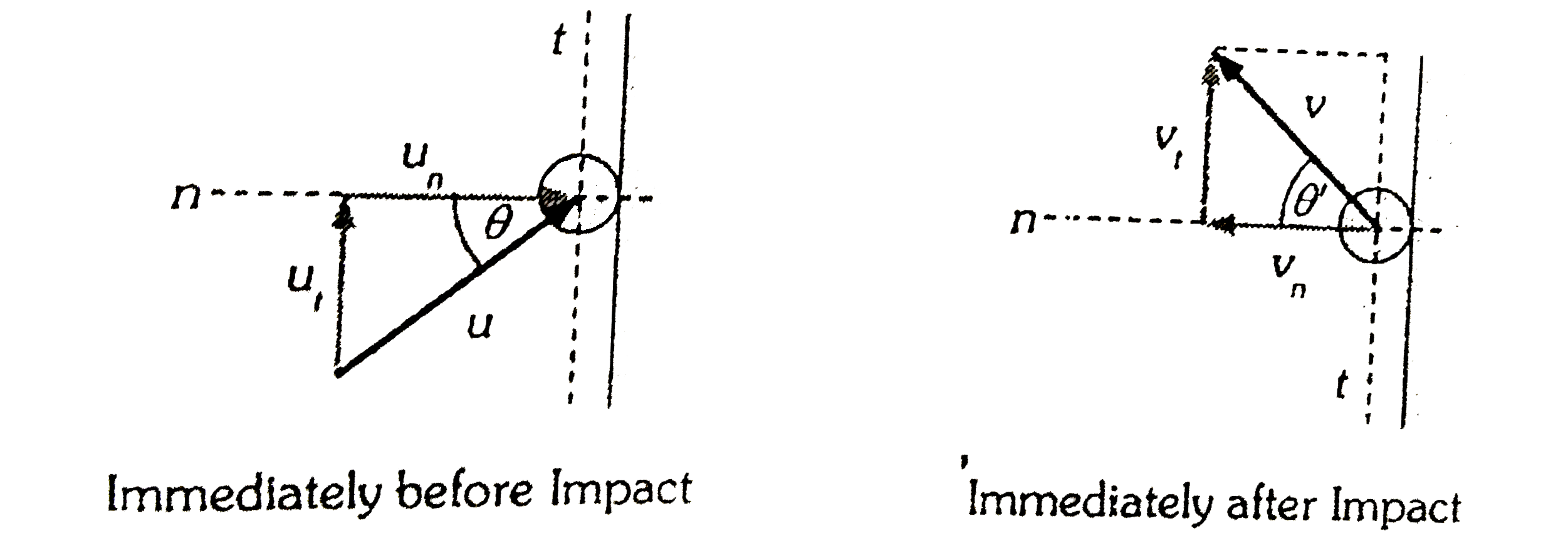 Component along t-axisComponents of momentum along t-axis of the ball is conserved. Hence, t-component of velocities of each of the bodies remains unchanged. `v_t=u_t=usintheta` ...(i) Component along -axisConcept of coefficient of RESTITUTION e is applicable only for the n-component velocities. `v_(Bn)-v_(An)=e(u_(An)-u_(Bn)) rarr -v_(n) = eU_(n)` , From equations (i) and (ii), the t and n-components of velocity of the ball after the impact are `v_(t) = u sin theta` and `v_(n) = eu sin theta` (b) If the impact is perfectly elastic, we have `v_(t) = u sin theta, v_(n) = usintheta`and`theta = theta` The ball will rebound with the same speed making the same angle with the vertical at which it has COLLIDED. In other words, a perfectly elastic collsion of a ball with a wall follows the same laws as light follows in reflection at a plane mirror. |
|
| 10. |
CHOOSE THE CORRECT PAIR : |
|
Answer» EQUAL VECTORS - Unity |
|
| 11. |
At which plane on earth, the centripetal force is maximum? |
|
Answer» |
|
| 12. |
A vehicle of mass 1250 kg is driven with an acceleration 0.25 ms^(-2) along a straight level road against an external resistive force 500 N. Calculate the power delivered by the vehicle's engine if the velocity of the vehicle is 30 ms^(-1). |
|
Answer» Solution :The VEHICLE.s engine has to do work against RESISTIVE force and make vehicle to move with an acceleration. THEREFORE, POWER delivered by the vehicle engine is `p=("resitive force"+"mass"xx"acceleration") ("velocity")` ` p=vecF_("tot").vecv=F_("resistive"+F)vecv` `p=vecF_("tot").vecv=(F_("resistive")+ma)vecv` `=(500N+(1250kg)xx(0.2 ms_(-2))(30MS^(-1))=22.5kW` |
|
| 13. |
Which of the following cannot be verified by using dimensional analysis? |
|
Answer» `s = ut + 1/2 at` |
|
| 14. |
The mass ofa body measures: |
|
Answer» density |
|
| 15. |
The length and breath of a rectangular object are 25cm and 10cm respectively and were measured to an accuracy of 0.1cm. The percentage error in area is |
|
Answer» `2.8%` |
|
| 16. |
A load of mass m falls from a height h on a pan attached to a spring (K) and stays on it. Then: |
|
Answer» AMPLITUDE of VIBRATION will be `sqrt(1 + (2mgh)/(K))` |
|
| 17. |
Three particles of identical masses . m . are kept at the vertices of an equilateral triangle of each side length .a. . Find the gravitational force of attraction on any one of the particles. |
|
Answer» SOLUTION :Let `F_A and F_B` be the FORCES due to the masses at A and B on the mass at C . Here `F_A = F_B` Hence the Resultant force on the mass at C `F = 2F_A"cos"theta//2 = 2.(Gm^2)/a^2 cos 30^@` `= 2 xx(Gm^2)/a^2xxsqrt3/2 = SQRT3(Gm^2)/a^2` 
|
|
| 18. |
Two particle are projected from a point at the same instant with velocities whose horizontal and vertical components are u_(1),v_(1) and u_(2),v_(2) respectively. Prove that the interval between their passing through the other common point of their path is |
|
Answer» |
|
| 19. |
The pulley of Atwood.s machine has a moment of inertia Tabout its axis and its radius is R. Find the magnitude of acceleration of the two blocks assuming the string is light and does not slip on the pulley. |
|
Answer» Solution :Suppose the block of mass .M. GOES down with an acceleration .a.. The angular acceleration of the pulley is, therefore. `ALPHA=(a)/( R)` `Mg-T_(i)=Ma` `T_(2)-mg=ma` `T_(1)R-T_(2) R=Ialpha=I (a)/( R)` SOLVING the equations `a=((M-m)GR^(2))/(I+(M+m)^(2))` 
|
|
| 20. |
A bob is pulled sideway so that string becomes parallel to horizontaland released. Lengthof the pendulum is 2 m. If dueto air resistance loss of cergy is 10%, what is the speed withwhich the bob arrived at the lowest point |
|
Answer» `THEREFORE v=6m/s` |
|
| 21. |
(a) Three rod of lengths 20 cm each and area of cross-section 1 cm^(2) are joined to form a triangle ABC. The conductivities of the rods are K_(AB) = 50 J//m-s-.^(@)C, K_(BC) = 200 J//m-s-.^(@)C and K_(AC) = 400 J//m-s-.^(@)C. The junctions A, B and C are maintained at 40^(@)C, 80^(@)C and 80^(@)C respectively. Find the rate of heat flowing through the rods AB, AC and BC. (b) A semicircular rod is joineted as its end to a straight rod of the same material and the same cross-sectional area. The straight rod forms a diameter of the other rod. The junctions are maintained at different temperatures. Find the ratio of the heat transferred through a cross-section of the simicircular rod to the heat transferred through a cross-section of the straight rod in a given time. |
|
Answer» SOLUTION :`R_(AB) = (l)/(K_(AB) A) = (20 xx 10^(-2))/(50 xx 1 xx 10^(-4)) = 40^(@) C//W` `R_(BC) = (l)/(K_(BC) A) = 10^(@)C//W` `R_(CA) = (l)/(K_(CA) A) = 5^(@)C//W` Road `AB : i_(1) = (80 - 40)/(R_(AB)) = (40)/(40) = 1 W` Rod `AC :i_(1) = (80 - 40)/(R_(AC)) = (40)/(5) = 8 W` Rod `BC : i_(3) = (80 - 80)/(R_(BC)) = 0` (ii) `R_("semicircular"), R_(1) prop pi r` `R_("straight"), R_(2) prop 2 pi r` `(i_(1))/(i_(2)) = ((theta_(1) - theta_(2)) // R_(1))/((theta_(1) - theta_(2)) // R_(2)) = (R_(2))/(R_(1)) = (2r)/(pi r)` 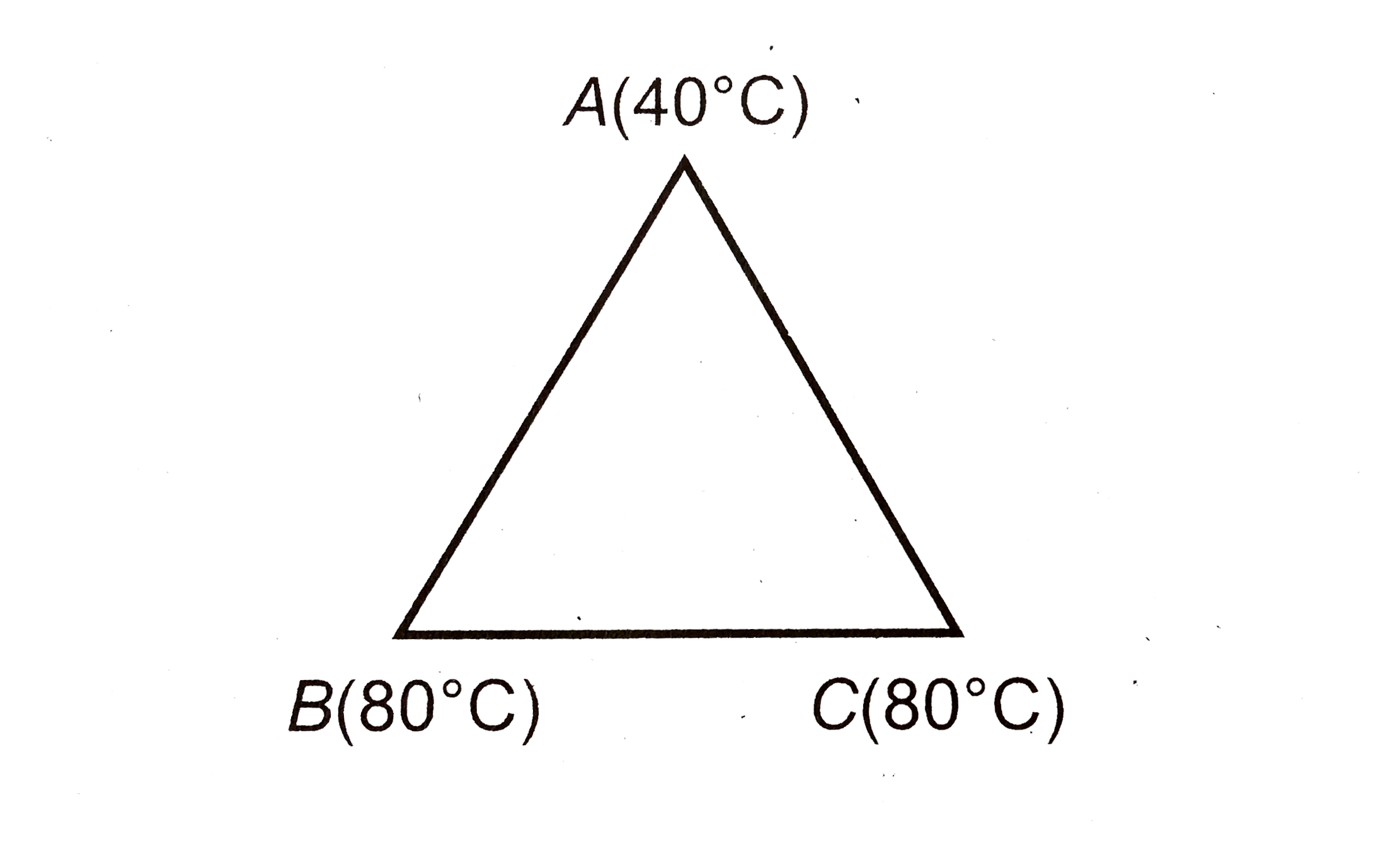 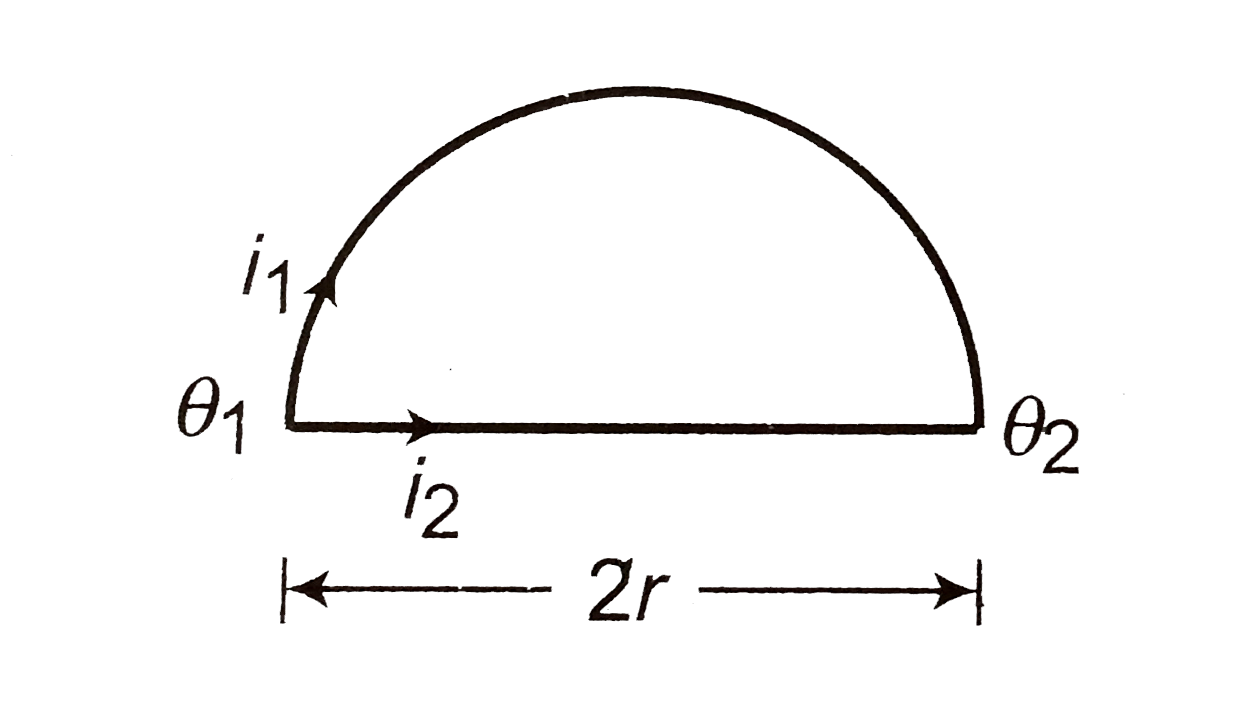
|
|
| 22. |
Force constant and surface tension have the same dimensions is |
|
Answer» MASS |
|
| 23. |
In previous problem if the piece is made of pure gold with some air cavities In it. Calculate the volume of the cavities left that will allow the weights given in that problem. |
|
Answer» |
|
| 24. |
Ten one rupee coins are put on top of each other on table each coin has a mass 2gwhat is the magnitude of the force onthe seventh coindue to all the coins at its top |
|
Answer» SOLUTION :The FORCEON theseventhcoin =Forcedue tothreecoinson ITSTOP `= (3xx 2 ) G= 6 xx9.8` `=58.8n` |
|
| 25. |
Time inerval between two successive heart beats is of the order of |
|
Answer» 10 s |
|
| 26. |
When a mass .m. is attached to a vertical spring and slowly released, the extension in the spring is .x.. When a mass .2m. is attached to the same spring and released suddenly, the extension in the spring is |
|
Answer» x |
|
| 27. |
A uniform circular disc of radius 50 cm at rest is free to turn about an axis which is perpendicular to its plane and passes through its centre it is subjected to a torque which produces a constant angular acceleration of 2.0 rad s^(-2). Its net acceleration in ms^(-2) at the end of 2.0 s is approximately ............. |
|
Answer» `7.0` `r=0.5m` `a_(c)=romega^(2)=0.5xx(4)^(2)=8m//s^(2)` `a_(T)=ralpha=0.5xx2` `=1" rad/s"^(2)` `THEREFORE a=SQRT(a_(c)^(2)+a_(T)^(2))` `=sqrt(8^(2)+1^(2))=sqrt(64+1)=sqrt(65)=8.06` `therefore a~~8ms^(-2)` |
|
| 28. |
If M is the magnetic moment, mu is the magnetic permeability and H is the intensity of magnetising field, then the dimensional formula for mu MH is |
|
Answer» `ML^(2)T^(-2)` |
|
| 29. |
Unit of coefficient of vsicosity is |
|
Answer» `Ns^-1m^-1` |
|
| 30. |
Write down the factors affecting velocity of sound in gases. |
|
Answer» Solution :Effect of density: Let us consider two gases with different densities having same temperature and pressure. Then the speed of sound in the two gases are `v_(1) = sqrt((gamma_(1)P)/(rho_(1)))`...(1) and `v_(2) = sqrt((gamma_(2)P)/(rho_(2)))`...(2) Taking ratio of equation (1) and equation (2), we get `(v_(1))/(v_(2)) = (sqrt((gamma_(1)P)/(rho_(1))))/((gamma_(2)P)/(rho_(2))) = sqrt((gamma_(1)rho_(2))/(gamma_(2)rho_(1)))` For gases having same value of `gamma`. `(v_(1))/(v_(2)) = sqrt((rho_(2))/(rho_(1)))` Thus the velocity of sound in a gas is INVERSELY proportional to the square root of the density of the gas. Effect of moisture (humidity): We know that density of moist air is 0.625 of that of dry air, which means the presence of moisture in air (increase in humidity) decreases its density. Therefore, speed of sound increases with rise in humidity. From equation: v `= sqrt((gammarho)/(rho))` Let `rho_(1), v_(1)` and `rho_(2), v_(2)` be the density and SPEEDS of sound in dry air and moist air, respectively. Then `(v_(1))/(v_(2)) = (sqrt((gamma_(1)P)/(rho_(1))))/(sqrt((gamma_(2)P)/(rho_(2)))) = sqrt((rho_(2))/(rho_(1)))` if `r_(1) = r_(2)` Since P is the TOTAL atmospheric pressure, it can be shown that `(rho_(2))/(rho_(1)) = (P)/(p_(1)+0.625 p_(2))` where `p_(1) "and" p_(2)` are the PARTIAL pressures of dry air and water vapour respectively. Then `v_(1) = v_(2) sqrt((P)/(p_(1)+0.625 p_(2)))` |
|
| 31. |
For a moving paritcle, the relation between time and position is given by t = Ax ^(2) + Bx. Where A and B are contants. Find the acceleration of the particle as a function of velocity. |
|
Answer» SOLUTION :Here, `t = Ax ^(2) + Bx` is given `therefore (dt)/(DX) = 2 A x +B` `therefore v = (dx)/(dt) = (2Ax +B) ^(-1) ""…(1)` Now, acceleration, `a = (dv)/(dt)= (dv)/(dx) xx (dx)/(dt) (because "Multiply by" (dx)/(dx))` `= [(d)/(dx) (2 A x + B) ^(-1) ](v) ` (From eq. (1)) `= (-1 ) (2A) (2 Ax + B) ^(-2) (v)` But if ` (2A x + B) ^(-1)=v,` then `(2Ax +B) ^(-2) = v ^(2) ` `therefore a =- 1A v ^(3)` |
|
| 32. |
A uniform metal sheet of mass M has been folded to give it L shape and it is placed on a rough floor as shown in figure. Wind is blowing horizontally and hits the vertical face of the sheet as shown. The speed of air varies linearly from zero at floor level to v_(0)at height L from the floor. Density of air is rho. Find maximum value of v_(0)for which the sheet will not topple. Assume that air particles striking the sheet come to rest after collision, and that the friction is large enough to prevent the sheet from sliding |
|
Answer» |
|
| 33. |
A sinusoidal wave propagates along a string. In figure (a)and (b) 'y' represents displacement of aprticle from the mean position. 'x'& 't' have usual meanings . Find : (a) wavelength, freuency and speed of the wave. (b) maximum velocity and maximum acceleration of the particles. (c) the magnitude of slopes of the string at x=2 at t=4sec. |
|
Answer» wavelength `=lambda = 6M` from `y-t` graph Time period `=T=4 sec` `rArr `frequency `=f=(1)/(4)=0.25Hz` wave speed `=f lambda=0.25 xx 6 =1.50 m//s` `(b)` maximum `=3 m m xx (pi)/(2) rad //sec = 1.5 pi m m //sec` maximum acceleration `=w^(2) A =(pi^(2))/(4) xx 3m m=0.75 p^(2) mm //sec^(2).` `(c ) k=(2PI)/(lambda)=(pi)/(3) m^(-1)` `rArr w=(2pi)/(T)=(pi)/(2) rad // sec` `y=3 sin ((pi)/(3)xx-(pi)/(2) t+theta_(0))` `y(x=2,t=0)=0` `rArr sin ((2pi)/(3)+theta_(0))=0` `rArr THETA _(0)=-(2pi)/(3) ` or `(pi)/(3)` and `(dely)/(delt)(t=0,x=2) gt 0` `rArr (-3pi)/(2) cos ((pi)/(3) x-(pit)/(2)+theta_(0)) gt 0` `(` For `x=2,t=0)` `rArr cos ((2pi)/(3)+theta_(0)) lt 0` `rArr theta_(0)=(pi)/(3)` `y=(x,t)=3 sin ((pix)/(3)-(pit)/(2)+(pi)/(3))` `rArr `at `x=2 ` and `t=4 sec, (dely)/(delx)=pi` |
|
| 34. |
A stationary source sends forth monochromatic (n = 500 Hz) sound. A wall approaches it with velocity u = 5 cm//s. The velocity of sound in the medium is v = 340 m//s. What is the wavelength and frequency of the sound wave reflected from the wall ? |
|
Answer» |
|
| 35. |
400 cc volume of a gas having gamma = 5//2 is suddenly compressed to 100 cc. If the initial pressure is P, then the final pressure will be |
|
Answer» <P>P/32 Sudden compression is an adiabatic process. For an adiabatic process, `PV^(gamma)` = CONSTANT `:. P_(1)V_(1)^(gamma) = P_(2)V_(2)^(gamma)` or `P_(2) = P_(1)((V_(1))/(V_(2)))^(gamma) = P((400)/(100))^(5//2) = (2^(2))^(5//2)P = 32P` |
|
| 36. |
If the linear momentum of the object in increased by 0.1% , then the kinetic energy is increased by : |
|
Answer» `0.1%` |
|
| 37. |
Statement - 1 : For the calculation of gravitional force between any two uniform spherical shells, they can always be replaced by particled by particles of same mass placed at respective centres. Statement - 2 : Gravitational field of a uniform spherical shell out side it is same as that of particle of same mass placed at its centre of mass. |
|
Answer» STATEMENT -1 is TRUE, statement-2 is true and statement -2 is CORRECT explanation for statement -1. |
|
| 38. |
A metal wire of length L, area of cross-section A and Young's modulus Y behaves as a spring of spring constant k. |
| Answer» Answer :A | |
| 39. |
When floated in water (sigma= 1000 kg m^(-3)), only 0.6 fraction of volume of a solid is submerged. Find the density of liquid in which the solid just floats? |
|
Answer» SOLUTION :When a solid just FLOATS in a liquid, then density of solid= Density of liquid. Let the density of solid `= rho=` density of liquid Weight of floating body= Weight of water displaced `Vxx rho xx G= (0.6V) SIGMA g` `or rho = 0.6 sigma= 0.6 xx 1000= 600 kg//m^(3)` |
|
| 40. |
Two point like objects of masses M and 4 M separated by distance 5r are freely releassed. FI they move under mutual gravitational force of attraction distance covered by lighter body before they collide is Nr. Find the value of n |
|
Answer» |
|
| 41. |
Carnot engine is |
|
Answer» REVERSIBLE engine |
|
| 42. |
Assuming earth to be an inertial frame an example for inertial frame observer is |
|
Answer» a driver in a TRAIN which is slowing down to stip |
|
| 43. |
A vertical cylinder of cross-sectional area S contains one mole of an ideal monoatomic gas under a piston of mass M. At a certain instant, a heater that transmits to the gas an amount of heat q per unit time is switched on under the piston. Determine the velocity v of the piston under the condition that the gas pressure under piston is constant and equal to P_0 and the gas under the piston is thermally insulated. |
| Answer» SOLUTION :`v=2/5 (Q)/( (P_0 S +MG))` | |
| 44. |
In the above problem, if the rod is released from horizontal position, the angular velocity of the rod as it passes the vertical position is (l=length fo rod) |
|
Answer» `sqrt((12G)/(5l))` |
|
| 45. |
Match Column-I with Column-II : {:("Column-I","Column-II"),("(1) When body is projected horizontally with constant velocity its angle of projection.",(a)0),("(2) Acceleration of body thrown horizontally with constant velocity.",(b) 0^@):} |
|
Answer» |
|
| 46. |
A force F is required to break a wire of length L and radius I. Find the force required to break a wire of the same material, length 2L and radius 4r. |
|
Answer» |
|
| 47. |
A rod of mass 100 g and length 1.0 m makes an angle 30^(@) with the axis passing through its centre. Find (i) the moment of inertia of the rod about the give axis. (ii) If the rod rotates with an angular velocity of 2.0 rad.^(-1) about the given axis find the rotational kinetic energy of the rod. |
|
Answer» |
|
| 48. |
Which of the following constant has dimension? |
|
Answer» REFRACTIVE indeed |
|
| 49. |
The relation between acceleration and displacement of four particles are given below |
|
Answer» `a_x = 2X ` |
|