

Saved Bookmarks
This section includes 7 InterviewSolutions, each offering curated multiple-choice questions to sharpen your Current Affairs knowledge and support exam preparation. Choose a topic below to get started.
| 1. |
If vec(A) = 3hat(i) - 4hat(j) and vec(B) = -hat(i) - 4hat(j), calculate the directionof vec(A) -vec(B). |
|
Answer» ALONG POSITIVE x-axis |
|
| 2. |
A body is suspended at the end of a spring hanging vertically and it oscillates with a time period of 1.414 s. The spring is then cut into two equal parts and the same body attached to one of the pieces is made to oscillate. What will be the time period of oscillation ? |
|
Answer» Solution :For the orignal SPRING `T= 2pi SQRT(m/k)` , where T = 1.414 s or `SQRT2` s. If the spring is cut into two equal parts spring constant of each will be 2K. Then `T^1 = 2pi sqrt(m/k) , 1/(sqrt2) T= 1s` |
|
| 3. |
A source of sound and a listener are approaching each other with a speed of 40ms^(-1)The apparent frequency of a note produced by the source is 400 Hz. Then its true frequency is (velocity of sound in air = 360 ms^(-1) ) |
| Answer» Solution :`f. = ((v + v_(0))/(v - v_(s))) f implies 400 = [(360 + 40)/(360 - 40)] f implies f = 320` Hz | |
| 4. |
A screw gauge has a pitch of 1.0mm and 200 divisions on the circular scale. Do you think it is possible to increase the accuracy of the screw gauge arbitrarily by increasing the number of divisions on the circular scale ? |
|
Answer» Solution :Least COUNT of screw guage `("pitch")/("no. of division on circular scale")` By increasing number of turns on circular scale least count of screw guage will decrease hence, measurement will be more accurate. But in this following DIFFICULTIES can arise. On circular scale it is difficult to FORM large number of division which are at equal distance. Also if there are more no. of division due to LIMITATION of resolution of eye division can not be seen (observed) ACCURATELY which can create error in measurement. |
|
| 5. |
During propogation of a plane progressive mechanical wave |
|
Answer» amplitude of all particulars is equal |
|
| 6. |
One gm mole of an ideal gas at S.T.P is subjected to a reversible adiabatic expansion to double its volume. Find the change in internal energy in the process. Given gamma = 1. 4 [E.Q.] |
|
Answer» Solution :`T_(1) = 273 K, T _(2) = GAMMA = 1.4` Final volume `V_(2) = 2 xx `Initial volume `V_(1)` `(V _(2))/( V _(1)) = 2` `T _(1) V _(1) ^( gamma -1) = T_(2) V _(2) ^( gamma -1)` `T _(2) = ((V _(1))/( V _(2)) ) ^( gamma -1) xx T_(1) = ((1)/(2)) ^( 1. 4 -1 ) xx 273` `= 20 7 K` Changle in interanl energy `dU = (R )/(( gamma -1)) = (T_(1) -T_(2))` `= (8. 31)/( ( 1. 4 -1)) ( 273 - 207)` `= 1. 37 xx 10 ^(3) J` |
|
| 7. |
Different physical quantities are given in Column -I and their dimensional formula are given in Column -II . Match them appropriately. |
|
Answer» |
|
| 8. |
Relation between linear and angular velocity for object in rotational motion is vecv=vecrxxvecomega |
|
Answer» |
|
| 9. |
A ladder AP of length 5m inclined to a vertical wall is slipping over a horizontal surface with velocity of 2m/s, when A is at a distance 3m from O, the velocity of CM at this moment is: |
|
Answer» `1.5 MS^(-1)` |
|
| 10. |
What is the technique used for measuring large time intervales ? |
|
Answer» Solution :For measuring large time intervals, we use the TECHNIQUE of radioactive dating. Large time intervals are MEASURED by studing the ratio of number of radioactive ATOMS decayed to the number of SURVIVING atoms in the spectimen. |
|
| 11. |
Two masses of 5 kg and 3 kg are suppended with help of massless inextensible strings as shown in Calculate T_(1) and T_(2) when whole system is going upwards with acceleration =2ms^(2) (us g= 9.8ms^(-2)) . |
|
Answer» Solution :Here, `m_(1) = 5kg` `m_(2) = 3KG` ` G = 9.8 m//s^(2)` `a = 2 m//s^(2), ` UPWARDS `T_(1) = (m_(1) +m_(2)) (g +a) = (5+3) (9.8+2) = 94.4 N` ` T_(2) =m_(2) (g +a) = 3 (9.8 +2 ) = 35.4 N ` . |
|
| 12. |
In the following equation, x, t and F represent respectively, displacement, time and force:F = a + bt + (1)/(c+d. x)+ Asin(omegat+phi) The dimensional formula for A. d is |
|
Answer» `[T^(-1)]` As `sin(omegat+phi)`is dimensionless, therefore A has dimensions of FORCE. `:. [A]= [F]= [MLT^(-2)]` As each term on RHS represents force `:. (1)/(c+d. x)= F` or `(1)/(c)= F` `:. [c]= (1)/([F])= (1)/([MLT^(-2)]= [M^(-1)L^(-1)T^(2)]` As c is added to d.x therefore dimension of c are same that of d.x `:. [d.x]= [c]` or `[d]= ([c])/([x])= ([M^(-1)L^(-1)T^(2)])/([L])= [M^(-1)L^(-2)T^(2)]` The dimensional FORMULA for `A.d = [MLT^(-2)][M^(-1)L^(-2)T^(2)]= [L^(-1)]` |
|
| 13. |
If W be the weight of a body of density (rho) in vacuum then ils apparent weight in air of density (sigma) is |
|
Answer» `(W RHO)/(SIGMA)` |
|
| 14. |
The effective focal length of the lens combination shown in figure -60cm. The radii of curvature of the curved surface of the plano-convex lenses are 12cm each and refractive index of the material of the lens is 1.5. The refractive index of the liquid is |
|
Answer» 1.33 |
|
| 15. |
A cyclist goes around a circular track of circumference 410 m in 20 s. Find the angle that his cycle makes with the vertical. |
|
Answer» |
|
| 16. |
Four spheres each of diameter 0.02m and 0.10 kg are placed with their centres on the vertices of a square of side 0.05m. Calculate the moment of inertia of the system about one side of the taken as the axis of rotation. |
Answer» Solution : Let the AXIS of rotation be ALONG AD. MOMENT of inertia of B and C about the axis XY `=I_0+Md^2` i.e M.I`=2/5MR^2+Md^2=0.1[0.4xx(0.01)^2+(0.05)^2]` M.I`=2.54xx10^(4)kgm^2` Moment of inertia of A & D about an axis XY is `=2/5MR^2` `=0.4xx0.1xx(0.01)^2` `=4xx10^(-6)=0.04xx10^(-4)kgm^2` Hence total M.l of the system`=2xx2.54xx10^(-4)+2xx0.04xx10^(-4)` `=5.16xx10^(-4)kgm^2` |
|
| 17. |
An ideal monoatomic gas is taken through one of the following reversible processes expressed by the equation in Table-1. Match the molar heat capacity of the gas, expressed in multiplies of R, in Table-2 with the appropriate process: |
|
Answer» |
|
| 18. |
If the dimensions of a physical quantity are given by M^(a)L^(b) T^(c), then the physical quantity will be |
|
Answer» velocity if a 1, B = 0, C =-1 `:. [P]= ([M^(1)LT^(-2)])/([L^(2)])= [M^(1)L^(-1)T^(-2)]= M^(a)L^(b)T^(c)` `:.`a=1, b =-1, c=-2 |
|
| 19. |
Give the expression for the velocity of sound in air // gaseous media along with the meanings of the symbols used. |
|
Answer» <P> Solution :Velocity of the speed`v = sqrt((gamma p )/( rho ))` where` gamma = `is ratio of MOLAR specific HEATS of a gas, p - pressure on gas and `rho -` DENSITY of GASEOUS medium. |
|
| 20. |
A man of mass 70 kg stands on a weighing scale in a lift which is moving (a) upwards with a uniform speed of 10 m s 1, (b) downwards with a uniform acceleration of 5 ms^(2) , (c) upwards with a uniform acceleration of 5 ms^(2) . What would be the readings on the scale in each case ? (d) What would be the reading if the lift mechanism failed and it hurtled down freely under gravity ? |
|
Answer» Solution :MASSOF personm= 70kg (a )when itmovesin upwarddirectinwithconstantvelocity WEIGHT ofpersonrecorded in SPRINGBALANCE  W= mg `=70 xx 10` `=700 N` Weighingscale will measure 70 kgweight (b )whenliftis movingdownwithaccelerationin upwarddirectionresultantdirection resultantaccelerationg= g- a  Weight recorded mg = mg- ma `=70 (10-5)` `=350N` `: m = (mg )/( g ) = (350)/( 10)` Weighingscalewillmeasure35 kgweight (c ) Whenliftmoveswithupwardaccelerationwill be indownwarddirection Weight recordedin springbalance `:., mg = mg +ma` `=70 (10 + 5)` `70 xx 15` 1050 N `:.= (mg)/( g) = (1050)/( 10) = 105 kg` Weighingscalewillmeasure105 kgweight (d )whenliftis fallingfreelythenpseudoaccelerationwill beupwarddirection `:.`Weightrecorded w=mg `=m(0)` `=0` this iscalledweightlessness. |
|
| 21. |
A ball of mass 0.20 kg hits a wall at an angle of 45^(@) with a velocity of 25 m/sif the ball reboundat 90^(@)to the direction of incidence calculate the change in momentum of the ball. |
Answer» Solution :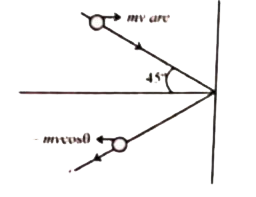 CHANGE is momentum`= (-mv COS 45^(@))` `-(mv cos 45^(@))` dp= 2mv `cos 45^(@) ` `|vec(dp)| = 2xx 0.2xx 25 xx (1)/(SQRT(2))` `:.Dp = 5 sqrt(2) Ns` |
|
| 22. |
Explain with reason, whether the coefficient of friction between two surfaces can be zero. |
| Answer» Solution :Coefficient of FRICTION `mu=(F)/(N)`, For `mu` to be zero F has to be zero. In PRACTICE, no matter how smooth two surfaces may be, there will always be some friction between the two surfaces whenever one is made to MOVE over the other. Hence, `,mu` can NEVER be zero. | |
| 23. |
A ball of mass 5kg hangs from a spring of force constant k N//m and oscillates with certain time period. If the ball is removed, the spring shortens by |
|
Answer» `((K)/(g))` m |
|
| 24. |
A preson standing near a fast moving train has danger of falling towards the train. Why? |
| Answer» SOLUTION :A fast moving train drags some air with it and the velocity of air in between the preson and the train increases. According to Bernouilli.s equationthe air pressure between the person and the train REDUCES. DUE to the larger pressure on the other side, the person gets PULLED TOWARDS the train. | |
| 25. |
A uniform rod of length 'L' and mass 'M' has been placed on a rough horizontal surface. The horizontal force 'F' applied on the rod such that the rod is just in the state of rest. If the coefficient of friction varies according to the relation mu = kx. Where 'K' is a +ve constant. Then |
|
Answer» Tension at mid points is F/3 |
|
| 26. |
Two full turns of the circular scale of a screw gauge cover a distance of 1mm on its main scale. The total number of divisions on the circular scale is 50. Fuerther, it is found that the screw gauge has a zero error of -0.03mm. While measuring the diameter of a thin wire, a student notes the main scale reading of 3mm and the total no.of circular scale divisions in line with the main scale as 35. The diameter of the wire is |
|
Answer» 3.32mm |
|
| 27. |
The speed of sound does not depend upon its frequency. Give an example in support of this statement. |
| Answer» Solution :If sound are PRODUCED by DIFFERENT musical INSTRUMENTS simultaneously, thenall these SOUNDS are heared at the same time. | |
| 28. |
Which of the following functions of time represent (a) simple harmonic, (b) periodic but not simple harmonic. and (c) non-periodic motion ? Give period for each case of periodic motion (omega is any positive constant). (a) sin omega t - cos omega t(b) sin^3 omega t (c) 3 cos (pi/4 -2 omega t) (d) cos omegat + cos3 omega t + cos 5 omega t (e) exp (-omega^2 t^2) (f) 1 + omega t + omega^2 t^2 |
|
Answer» Solution :The function will represent a periodic motion, if it is identically repeated after a fixed INTERVAL of time and will represent S.H.M. if it can be written uniquely in the form of a `cos ((2pit)/(T) + PHI) ` or a `sin ((2pi t)/(T) + phi)` , where T is the time period (a) `sin omegat - cos omega t = SQRT2 [1/sqrt2sin omega t - 1/sqrt2cos omegat] = sqrt2 [ sin omega t cos pi/4 - cos omega t sin (pi)/4]` `=sqrt2 sin (omega t - pi/4 ) ` it is a S.H.M. and its period is `2pi//omega` (b) `sin^3 omega t = 1/4 [3 sin omega t - sin 3 omega t ]` Here each term sin `omega t ` and `sin 3 omega t ` individually represents S.H.M.But(ii) Which is the outcome of the superposition of two S.H.Ms will only be periodic but not S.H.M. Its time period is `2pi//omega` (c) `3cos (pi/4 - 2omega t) = 3cos (2omega t - pi/4) . [because cos(-theta) = cos theta]` Clearly it represents S.H.M. and its time period is `2pi//2omega` (d) `cos omegat + cos 3omega t + cos 5 omega t ` .It represents the periodic but not S.H.M. its time period is `2pi//omega` (e) `e^(-omega^2 t^2) `. It is an exponential function which never repeats itself. Therefore it represented non-periodic motion. (f) `1+ omega t + omega^2 t^2` also represents non periodic motion . |
|
| 29. |
Which of the following is a simple harmonic motion |
|
Answer» Wave moving through a string fixed at both ends |
|
| 30. |
Two forces 3N and 4N are acting perpendicular to each other. The magnitude of the resultant force is |
| Answer» Answer :D | |
| 31. |
The upper half of an inclined plane of inclination thetais perfectly smooth while lower half is rough. A block starting from rest at the top of the plane will again come to rest at the bottom, if the coefficient of friction between the block and lower half of the plane is given by |
|
Answer» `mu =2 TAN theta` |
|
| 32. |
Three capillaries of internal radii 2r, 3r and 4r, all of the same length, are joined end to end. A liquid passes through the combination and the pressure difference across this combination is 20.2 cm of mercury. The pressure differene across the capillary of internal radius 2r is |
|
Answer» 2cm of Hg Here, `P_(1).r_(1)^(4) = P_(2). r_(2)^(4) = P_(3).r_(3)^(4)` or `P_(1) (2r)^(4) = P_(2)(3r)^(4) = P_(3)(4r)^(4) rArr 16P_(1) = 81P_(2)= 256P_(3)` `P_(1) = (810/(16) P_(2)= 16P_(3) rArr P_(2) = (16)/(81) P_(1) and P_(3) = (P_(1))/(16)` It is given that: `(P_(1) + P_(2) + P_(3)) = 20.2 CM` of Hg `rArr P_(1) (1 + (16)/(81) + (1)/(16))= 20.2` `or P_(1) (((81 xx 16) + (16 xx 16) + 81)/(81 xx 16))= 20.2` `P_(1)= 20.2 [(1296)/(1296 + 256 + 81)]= 16 cm "of" Hg` `rArr` (d) is CORRECT |
|
| 33. |
The blockA(2kg) and B(3kg) rest up on a smooth horizontal surface are connected by a spring of stiffness 120 N//m. Identially the spring is underformd. A is imparted a velocity of 2m//s along the line of the spring away from B. Find the displacement of A at t seconds later. |
|
Answer» |
|
| 34. |
On what factors does the efficiency of Carnot engine depend? Even Carnot engine cannot have 100% efficiency. Why? |
| Answer» Solution :`eta=1-T_2/T_1`. Thus EFFICIENCY of a Carnot engine DEPENDS on the ABSOLUTE TEMPERATURES of the source and SINK. The efficiency will be `100%` if `T_2=0 K.` cannot be realised, engine with `100%` efficiency is not possible. | |
| 35. |
For a gas the difference between the two specific heates is 4150 J/Kg K. What is the specific heat of the gas at constant volume if the ratio of specific heat is 1.4? |
|
Answer» Solution :From Mayer.s equation, `C_(P)-C_(V)=R` `C_(P)-C_(V)=4150` `(C_(P))/(C_(V))=1.4 rArr C_(P)=1.4C_(V)` `1.4C_(V)-C_(V)=4150` `THEREFORE""C_(V)=(4150)/(0.4)rArr C_(V)=10375J//kg` |
|
| 36. |
One mole of an ideal gas at 300 K expands from V to 2V volume, then work done W in this process will be … |
|
Answer» 300 Rln2 `W=nRT ln (V_2/V_1)` n=1 , `V_2=2V_1`, T=300 K `thereforeW=Rxx300 ln ((2V_1)/V_1)` =300 Rln 2 |
|
| 37. |
Which of the following expression does not represent simple harmonic motion? |
|
Answer» `x=Acosomega+Bsinomega` |
|
| 38. |
A simple harmonic oscillator has amplitude A and time period T. Its maximum speed is……………… |
|
Answer» `(4A)/(T)` |
|
| 39. |
What are the instruments used for the measurement of length from 10^(-5) m to 10^2m. Give the least count of each instrument. |
| Answer» SOLUTION : 1(C ).3 | |
| 40. |
A uniform glass tube closed at one end contains some air at 27^@C confined by a mercury thread of length 4 cm. When the tube is held vertically with its open end at the top,the length of the confined air column is 9cm. IF the tube is inverted then the length of that air column becomes 10 cm. Determine the atmospheric pressure. |
|
Answer» |
|
| 41. |
Statement A : An engine A can perform a given work in 1 hr and engine B can proform the same work in 1/2 hr. then B has greater power than A. Statement B : Power is the dot product of force and velocity. |
|
Answer» A & B is CORRECT |
|
| 42. |
(I) From equations of Linear motion S=((u-v)t)/(2) (II) From equations of rotational (Angular) motion omega^(2)=omega_(0)^(2)+2 prop theta Which statement is in correct? |
|
Answer» I only |
|
| 43. |
A ball is suspended by a thread of length L at the point O on a wall which in indeed to the vertical by alpha. The thread with the ball is displaced by a small angle beta away from the vertical and also away from the wall. If the ball is released, the period of observation of the pendulum when beta gt alpha will be........... |
|
Answer» `SQRT((L)/(g)) [PI + 2 sin ^(-1) (ALPHA/beta)]` `therefore T= 2pi sqrt((L)/(g))` When `beta propto alpha`, time taken by pendulum from B to C and C to B `t_(1)= (T)/(2)= (1)/(2)XX 2pi sqrt((L)/(g))= pi sqrt((L)/(g))"""........"(1)` Time taken by pendulum from B to A and A to B, `t_(2)= 2t = (2)/(omega)sin^(-1) (alpha/beta)""(" USING " theta = theta_(0) sin omega t)` `therefore alpha= beta sin omega t" or "t= (1)/(omega) sin^(-1) (alpha/beta) = sqrt((L)/(g)) sin^(-1) (alpha)/(beta)` `t_(2)= 2t = 2sqrt((L)/(g)) sin^(-1) (alpha/beta)"""........"(2)` Time period of motion, `T= t_(1)+t_(2)` `= sqrt((L)/(g)) [pi + 2 sin^(-1) (alpha)/(beta)]`. 
|
|
| 44. |
Determine gravitational potential from gravitational potential energy. |
|
Answer» <P> Solution :(i) Consider two masses `m_(1)` and `m_(2)` separeted by a distance R which has gravitational potential energy U(r)/(ii) The gravitational potential due to mass `m_(1)` at a POINT P which is at a distance r from `m_(1)` is OBTAINED by making `m_(2)` equal to unity `(m_(2) = 1 kg)` (iii) THUS the gravitational potential V(r) due to mass m = 1 at a distance r is `V (r) = (Gm_1)/(r)`. |
|
| 45. |
Statement I: A hollow shaft is found to be stronger than a solid shaft made of same material. Statement II: The torque required to produce a given twist is hollow cylinder is greater than that required to twist a solid cylinder of same size and same material. |
|
Answer» STATEMENT I is TRUE, statement II is true, statement II is a correct explanation for statement I. |
|
| 46. |
A 60kg man is inside a lift which is moving up with an acceleration of 2.45 ms^(-2). The apparent percentage change in his weight is, |
| Answer» Answer :B | |
| 47. |
Two moles of a diatomic ideal gas is taken through a process PT = constant. Its temperature is increased from T_0 to 2T_0. Find the work done by the system? |
|
Answer» Solution :`W=int PdV` Here ` Pt =P_1 T_1=P_2 T_2=` constant`.C. = P=(c )/(T)` ` THEREFORE PT=c =P(PV )/(NR )=C ` (From ideal gas equation`V+(nRT)/(P ) = nRTxx(T)/(C) therefore= dV=(nR )/(C ) xx 2TDelta T ` ` thereforeW= int PdV = (c )/(T )xx (2 nR )/( c ) xx TdT = 2 nR int_(T_0)^(2T) DT= 2n R xx T_0= W=4RT_0thereforeW= 8 RT_0` 
|
|
| 48. |
A table top is made of aluminium and has a hole of diameter 2 cm. An iron sphere of diameter 2.004 m is resting on this hole. Below the hole, an insulated container has 2 kg of water in it. Everything is at ambient temperature of 25^(@)C. The table top along with the iron sphere is heated till the ball falls through the hole into the water. Find the equilibrium temperature of the ball and water system Neglect any heat loss from ball–water system to the surrounding and assume the heat capacity of the container to be negligible. Relevant data: Coefficient of linear expansion for aluminium and iron are 2.4 xx 10^(-5) .^(@)C^(-1)and 1.2 xx 10^(-5) .^(@)C^(-1) respectively. Specific heat capacity of water and iron are 4200 J .^(@)C^(-1) g^(-1) and 450 J .^(@)C^(-1) g^(-1) respectively. Density of iron at 25^(@)C is 8000 kg//m^(3). |
|
Answer» |
|
| 49. |
The lengths l_(1) and l_(2) of two rods are recorded as (25.2+0.1) cm and (16.8+0.1) cm. To find the sum of the lengths of the rods. |
|
Answer» The error in the measuremnet is zero |
|
| 50. |
A sphere A moving with a speed .U. and rotating with an angular velocity .omega. makes head - on elastic collision with an identical stationary sphere. There is no friction between the surfacces A and B neglect gravity(A) A will stop moving but continue to rotate with angular velocity .omega..(B) A will come to rest and stop rotating (C ) B will move with speed .U. without rotating (D) B will move with speed U and rotate with an angular velocity w. |
| Answer» ANSWER :A | |