

Saved Bookmarks
This section includes 7 InterviewSolutions, each offering curated multiple-choice questions to sharpen your Current Affairs knowledge and support exam preparation. Choose a topic below to get started.
| 1. |
One mole of gas obey the equation of state P(V - b) = RT and changes its coordinate from (P_1, V_1) to (P_2, V_2) which is established on P-V diagram by line. The work done in this changes will be_____ |
|
Answer» `1/2(P_2-P_1)(V_2+V_1+2b)` W= Area under the graph of `P to V` 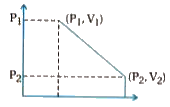 `W=1/2` base x height +Area of rectangular `=1/2(V_2-V_1)xx(P_1-P_2)+(V_2-V_1)P_2` `=(V_2-V_1)[P_1/2-P_2/2+P_2]` `=(V_2-V_1)[P_1/2+P_2/2]` `=1/2(P_1+P_2)(V_2-V_1)` |
|
| 2. |
The simple harmonic oscillation of a particle are according to the equation x= 5cos(2pit+ (pi)/(4)) meter. Find the(i) displacement, (ii) velocity and (ii) acceleration at t = 0. |
|
Answer» SOLUTION :Comparing with, the general equation `x= Acos(omegat+phi_(0))` Amplitude A= 5M and `OMEGA= 2pi` i) Displacement `x= 5cos(2pit+(pi)/(4))` meter when `t=0 , x= x_(0)= 5cos((pi)/(4))= 5 xx (1)/(sqrt(2))= 3.54m` ii) velocity `v= omegasqrt(A^(2)-x^(2))` when `t=0 , v= v_(0)= omegasqrt((A^(2)-x^(2))` `= 2pisqrt(5^(2)- ((5)/(sqrt(2)))^(2))= 2pisqrt(25-(25)/(2))` `= 2pisqrt((25)/(2))= 22.2 ms^(-1)` iii) Acceleration `a= -omega^(2)x` when `t=0 = a= a_(0)= -omega^(2)x_(0)` `= -(2pi)^(2)3.54= -4pi^(2)(3.54)^(2)` `:. a_(0)= 139.42 ms^(-2)` |
|
| 3. |
A simple harmonic oscillator is of mass 0.1kg. It is oscillating with a frequency of 5//pi Hz. If its amplitude of vibration is 5cm find the force acting on the particle at its extreme position |
|
Answer» 0.5N |
|
| 4. |
A body is initially at rest. It undergoes one - dimensional motion with constant acceleration. The power delivered to it at time t is proportional to |
|
Answer» `t^(1//2)` |
|
| 5. |
g_e and g_pdenote the acceleration due to gravity on the surface of earth and another planet whose mass and radius are twice that of the earth, then |
|
Answer» `g_(p)=g_e` |
|
| 6. |
A horizontally oriented tube AB of length l rotates with a constant angular velocity omega about a stationary vertical axis OO^' passing through the end A (figure). The tube is filled with an ideal fluid. The end A of the tube is open, the closed end B has a very small orifice. Find the velocity of the fluid relative to the tube as a function of the column "height" h. |
|
Answer» |
|
| 7. |
A steel ball of diameter d=3.0mm starts sinking with zero initial velocity in olive oil whose viscosity is eta = 0.90P. How soon after the beginning of motion will the velocity of the ball differ from the steady state velocity by eta=1.0% ? |
|
Answer» `0.3` SEC |
|
| 8. |
(A): Efficiency of carnot engine increase on reducing the temperature of sink. (R ): The efficiency of a Carnot engine is defined as ratio of net mechanical work done per cycle by the gas to the amount of heat energy absorbed per cycle from the source. |
|
Answer» Both (A) and(R ) are TRUE and (R ) is the CORRECT EXPLANATION of (A) |
|
| 9. |
(A): Mountain roads rarely go straight up the slope. (R ): Slope of mountains are large therefore more chances of vehicle to slip from roads. |
|
Answer» Both 'A' and 'R' are true and 'R' is the CORRECT explanation of 'A's |
|
| 10. |
When two capillary tubes of different diameters are dipped vertically, the rise of the liquid is |
|
Answer» same in both the tubes |
|
| 11. |
A cycle is fitted with small brakes and another is fitted with very big brakes. The one which is more effective is |
| Answer» Answer :C | |
| 12. |
Consider one mole of perfect gas in a cylinder of unit cross section with a piston attached as shown in figure. A spring (spring constant k) is attached (unstretched length L ) to the piston and to the bottom of the cylinder. Initially the spring is unstretched and the gas is in equilibrium. A certain amount of heat Q is supplied to the gas causing an increase of value from V_0 to V_1. (a) What is the initial pressure of the system ? (b) What is the final pressure of the system ? (c) Using the first law of thermodynamics, write down a relation between Q, P_a, V, V_0 and k. |
|
Answer» Solution :(a) Initially system is in equilibrium hence pressure on piston will be the atmospheric pressure. `THEREFORE P_i=P_a`…(1) (b)On supply of heat, volume of gas increases from `V_0` to `V_1` `therefore` So increase in volume `Axxx =V_1-V_0` (A=area of cross section of cylinder) If displacement of piston is x then volume increase in cylinder = Area of base x height = `A xx x` `therefore A xx x =DELTAV=V_1-V_0` (A=Area of cross section of cylinder) `therefore x=V_1-V_0`...(2) [`because` A=1 unit] `rArr` The force on piston by spring , F=kx `therefore F=k(V_1-V_0)`....(3) `therefore` Final pressure on the system , `P_f=P_i+F_A` `therefore P_f=P_a+k(V_1-V_0)`...(4) [`because` A=1 unit and from equ. (1) and (3)] It is the final pressure on the gas. (c) If the final temperature of gas is T, because the walls of cylinder are insulated then increase in internal energy, `DeltaU=C_V DeltaT` [ `because mu`=1 mole] `therefore DeltaU=C_V (T-T_0)`..(5) `rArr` EQUATION of gas at final state, `P_f V_f =RT` `therefore T=(P_fV_l)/R [ because V_f =V_1]` `therefore T=[(P_a+k(V_1-V_0))/R]V_1` `rArr` Volume of gas increased so work done by gas `DeltaW=P_a DeltaV` + increase in potential energy of spring `therefore DeltaW=P_a (V_1-V_0)+1/2kx^2` `=P_0(V_1-V_0)+1/2k(V_1-V_0)^2` ...(6) From first law of thermodynamics , `DeltaQ=DeltaU+DeltaW` `therefore DeltaQ=C_V (T-T_0)+P_a (V_1-V_0)+1/2k(V_1-V_0)^2`(From equation (5) and (6) is required relation. |
|
| 13. |
A massless platform is kekpt on a light elastic spring as shown in the figure. When a particle of 0.1kg mass is dropped on the pan from a height of 0.24m, the particle strikes the pan, and the spring compresses by 0.01m. From what height should the particle be dropped to cause a compression of 0.04m? |
|
Answer» Solution :If the PARTICLE is dropped from a height .h. and the spring is compressed by y. Loss in PE of the particle will be mg (h+y) while gain in elastic potential energy is `1//2ky^(2)`. According to conservation of mechanical energy `mg(h+y)= (1)/(2) KY^(2)` As .m. and .K. remain same `(h_(1) + y_(1))/(h_(2) + y_(2)) = ((y_(1))/(y_(2)))^(2)` `(0.24 + 0.01)/(h_(2) + 0.04) = ((0.01)/(0.04))^(2), h_(2)= 3.96m` 
|
|
| 14. |
A block is over a plank . The coefficient of friction between the block and the plank id mu=0.2 Initially both are at rest , suddenly the plank startsmoving with accleration alpha_(0)=4m//s^(2) The displacement of the block in s is (g=10m//s^(2)) |
|
Answer» 1M relative to GROUND |
|
| 15. |
The diameter of a cylinder is measured using a vernier callipers with no zero error. It is found that zero of the vernier lies in between 5.10 cm and 5.15 cm of the main scale. The vernier has 50 divisions equivalent to 2.45 cm. The 24th division of the main scale exactly coincides with one of the main scale divisions. the diameter of the cylinder is |
|
Answer» 5.112 CM |
|
| 16. |
The dimensions of ("magnetic moment")/("angular momentum") are |
|
Answer» `[M^(-1)L^(0)TA]` `"Angular momentum" = mvr= [M]{LT^(-1)][L]= [ML^(2)T^(-1)]` `:. ("Magnetic moment")/("Angular momentum")= ([AL^(2)])/([ML^(2)T^(-1)])= [M^(-1)L^(0)TA]` |
|
| 17. |
Following are some statements about buoyant force: (Liquid is of uniform density) (i) Buoyant force depends upon orientation of the concerned body inside the liquid. (ii) Buoyant force depends upon the density of the body immersed. (iii) Buoyant force depends on the fact whether the system is on moon or on the earth. (iv) Buoyant force depends upon the depth at which the body (fully immeresed in the liquid) is placed inside the fluid. Of these statements: |
|
Answer» Only (i),(ii) and (iv) are CORRECT. `F_(B)=vrho_(|| g) g` 'g' is DIFFERENT onmoon and on the earth. Hence by only (III) is a correct STATEMENT. |
|
| 18. |
A block at rest explodes into 3 parts are -2phatj and phatj. Calculate the magnitude of the momentum of third part. |
|
Answer» SOLUTION :Let `vecP` be the momentum of the third particle after the explosion of bomb. ACCORDING to law of conservation of momentum,`-2pvecj+pvecj+vecP``=0(or)vecP=2pveci-pvecj` `P=sqrt(2P)^(2)+(-p)^(2)=psqrt5` |
|
| 19. |
If a long hollow copper pipe carries a current, then magnetic field is produced: |
|
Answer» inside the pipe only `B(2pir)=mu_(0)xx0` or `B=0` So, inside a hollow metallic (copper) pipe carrying CURRENT, the magnetic field is zero. But for external points, the whole current BEHAVES as if were concentrated at the axis only, so outside `B_(0)=(mu_(0)i)/(2pir)` Then, the magnetic field is produced outside the pipe only |
|
| 20. |
A satellite is in a circular orbit around a planet . Its period of revolution is T, radius of the orbit is R, orbital velocity V and acceleration .a. , then |
|
Answer» V = at and a =`V^2/R` |
|
| 21. |
Estimate the mean free path for a water molecule in water vapour at 373.The diameter of the molecule is 2xx10^(10)m, and at STP number of molecules per unit volume is 2.7xx10^(25)m^(-3) |
|
Answer» Solution :The number DENSITY (n) is inversely proportional to absolute temperature. `therefore nalpha(1)/(T)implies(n_(273))/(n_(273))=(273/(373)),n_(373)=n_(273)xx(273)/(373)` `n_(373)=2.7xx10^(25)xx(273)/(373)=2xx10^(25)m^(-3)` Given d=`2xx10^(-10)m` Hence ,mean FREE path `LAMBDA=(1)/(sqrt(E)pid^(2)n)` `=(1)/(sqrt(2)xx3.14xx(2xx10^(-10))^(2)xx2xx10^(25))=4xx10^(-7)m` |
|
| 22. |
Four pair coins are tossed simultaneously. In terms of entropy, choose correct options. |
|
Answer» “Most ordered” STATE has a PROBABILITY of`1/8` |
|
| 23. |
Four molecules of a gas has speed 2, 4, 6 and 8 kms^(-1)respectively. Calculate their average speed and root mean square speed. |
|
Answer» SOLUTION :AVERAGED SPEED, `barv=(v_1+v_2+v_3+v_4)/4` `=(2+4+6+8)/4=5 KMS^(-1)` Root mean square speed, `v_(rms)=sqrt((v_1^2+v_2^2+v_3^2+v_4^2)/4)` `=sqrt((2^2+4^2+6^2+8^2)/4)` `=sqrt((120)/4)=sqrt30= 5.48kms^(-1)` |
|
| 24. |
A particle is acted by a force F = kx, where .K. is a positive constant. Its P.E at x = 0 is zero. Which curve correctly represents the variation of potential energy of the block with respect to .x. |
|
Answer»
|
|
| 25. |
Consider following statements A and B and identify the correct answerA : Coefficient of restitution varies between .0. and .1..B : In inelastic collision, the law of conservation of energy is satisfied. |
|
Answer» A and B are TRUE |
|
| 26. |
A fighter plane is flying horizontally at a height of 250 m from ground with constant velocity of 500m/s. Ifpasses over a cannon which can fire shell at any direction with a speed of 100 m/s. The duration of time for which the plane in danger of being hit by shell is t sqrt(2)sec. The value of 't' is |
|
Answer» |
|
| 27. |
A bullet is fired from a rifle. If the rifle recoils freely, then the kinetic energy of the rifle, is |
|
Answer» same as that of the BULLET |
|
| 28. |
An object fallen freely from top of tower reaches at ground in 4s, then find the height of tower. (Take g = 10 ms^(-2)) |
|
Answer» 20 m `d = v _(0)t + (1)/(2) G t^(2)` `d = 1/2 g t ^(2) (v _(0) =0 and a =g)` `therefore d = 1/2 (10) (4) ^(2) = 80m` |
|
| 29. |
An insect crawls up a hemispherical surface as shown (see the figure) the coefficient offriction between the insect and the surface is 1/3. If the line joining the centre of the hemisperical surface to the insect makes an angle thetawith the vertical, the maximum possible value of thetais given by |
|
Answer» SOLUTION :`COT^(-1)(3)` |
|
| 30. |
(i) Write down the equation of a freely falling body under gravity. (ii) A ball is thrown vertically upwards with the speed of 19.6ms^(-1) from the top of a building and reaches the earth in 6s. Find the height of the building. |
|
Answer» Solution :`(i)` Equation of motion are `(i) v=u+at` `(ii) s=ut+(1)/(2)at2` `(iii) v^(2)=u^(2)+2as` If `a=g`, `s=y` then `v=u+''gt''` `y=ut+(1)/(2)"gt"^(2)` `v^(2)=u^(2)+2gy` if `u=0`, then `v="gt"` `y=(1)/(2)"gt"^(2)` `v^(2)=2gy` If `t=T`, `y=H` then `h=(1)/(2)"gt"^(2)` `T^(2)=(2h)/(g)impliesT=sqrt((2h)/(g))` `v^(2)=2gh` [if `v=v_(g)`] `v_(g)=sqrt(2gh)` where `v_(g)` speed of the body after reaching ground. `(ii)` Let `h` height of the building let the ball attain height `h'` above the builiding. At `h'` the velocity `v=0`  By applying equation of motion `v^(2)-u^(2)=2gh` `0^(2)=(19.6)^(2)-2gh` `2gh'=(19.6)^(2)` `h'=(19.6xx19.6)/(2xx9.8)` `h'=19.6m` TIMES taken by the ball to reach `h'` is `t'` (say) `v=u+at|a-g,t-t'|` `0=19.6-"gt" '` `t'=(19.6)/(9.8)-2s` Time taken by the ball to fall from height `(h+h')` `=6S-2S=4S` We KNOW that, `S=ut+(1)/(2)"gt"^(2)` i.e. `(h+h')=ut+(1)/(2)"gt"^(2)` here `u=0` So, `h+h'=(1)/(2)"gt"^(2)` `h+19.6=(1)/(2)xx9.8xx(4)^(2)` `h=9.8xx8-19.6` `h=78.4-19.6` height of the building `h=58.8m` |
|
| 31. |
A ball is thrown vertically down from a height of 40m from the ground with an initial velocity .v.. The ball hits the ground, loses one-third of its total mechanical energy and rebounds back to the same height. If the acceleration due to gravity is 10ms^(-2), the value of .v. is |
|
Answer» `5 ms^(-1)` |
|
| 32. |
A person carrying a bucket of water walks on a horizontal road with uniform velocity. What is work done by him if the road is smooth ? |
| Answer» Solution :Zero, because the FORCE required to hold the bucket and his DISPLACEMENT are perpendicular to each other. | |
| 33. |
Two particles of masses 1kg and 3kg move towards each other under their mutual force of attraction. No other force acts on them. When the relative velocity of approach of the two particles is 2ms^(-1), the velocity of centre of mass is 0.5ms^(-1). When the velocity of approach becomes 3ms^(-1) , the velocity of centre of mass is |
|
Answer» `0.75ms^(-1)` |
|
| 34. |
Set the following units of energies in increasing order.(A) Joule(B) eV (C ) K.W.H(D) erg |
|
Answer» ABCD |
|
| 35. |
The two thigh bones (femurs), each of cross-sectional area 10cm^(2) support the upper part of a human body of mass 40kg. The average pressure sustained by the femurs is |
|
Answer» `3xx10^(5)N//m^(2)` |
|
| 36. |
A clock with a metallic pendulum is 5 sec fast each day at a temperature of 15^(2)C and 10 sec slow each day at a temperature of 30^(@)C. Find coefficient of linear expansion for the metal. |
|
Answer» Solution :Time LOST or gained per second by a pendulum clock is given by `deltat=(1)/(2)alpha DeltaT` Here if temperature is HIGHER than graduation temperature the clock will loose time and if it is lower than graduation temperature clock will GAIN time. Thus time lost or gained per day is `deltat=(1)/(2) alpha DeltaT xx 86400 ""`[as 1 day = 86400 s.] If graduation temperature of clock is `T_(0)` then we have , At `15^(@)C`, clock is gaining time, thus `5=(1)/(2).alpha.(T_(0)-15)xx86400 ""....(a)`, At `30^(@)C` clock is loosing time thus `10=(1)/(2) alpha (30-T_(0))xx86400""....(b)` Dividing EQUATION (b) by (a), we get 2 `(T_(0)-15)=(30-T_(0)) or T_(0)=20^(@)C` Thus from equation (a) `5=(1)/(2) xx alpha xx [20-15] xx86400 rArr alpha=(2.31xx10^(5)""^(@)C^(-1))` |
|
| 37. |
Let I_(A) and I_(B) be moments of inertia of a body about two axes A and B respectively. The axis A passes through the centre of massof the body but B does not. Choose the correct option. |
|
Answer» `I_(A) LT I_(B)` |
|
| 38. |
The study of the earth's surface is normally performed with |
|
Answer» RECTANGULAR CARTESIAN co-ordinates |
|
| 39. |
A transvrs wave propagating along x-axis is represented by y(x,t) =80.. Sin (0.5 pi x-4pi t-(pi)/(4)). Where x is in metress and t is seconds. The speed of the wave is : |
|
Answer» `4i m//s` `y(x,t)=a sin (kx-OMEGA t-varphi)` `K=0.5 pi , omega= 4pi` `V=(omega)/(k)=(4pi)/(0.5 pi)=8 m//s` |
|
| 40. |
A dancer spins about a vertical axis at 60 rpm with her arms folded. If she strectes her hands so that M.I. about the vertical axis increases by 25%, the new rate of revolvution is |
|
Answer» 48rpm |
|
| 41. |
Two cities A and B are connected by a regular bus servies with buses plying in either direction every T seconds. The speed of each bus is uniform and equal to V_(b). A cyclist cycles from A to B with a uniform speed of V_(e). A busgoes past the cyclist in T_(1) second in the direction A to B and every T_(2) second in direction B to A. Then |
|
Answer» `T_(1)=(V_(B) T)/(V_(b)+V_(c))` |
|
| 42. |
A train is whistling while approaching a tunnel at a speed of 36 kmph. The driver hears the echo of the whistle reflected from the tunnel and estimates its frequency to be 850 Hz. Find the actual frequency of the whistle. The velocity of sound in air = 330 m//s |
|
Answer» |
|
| 43. |
A light and heavy body have equal momentum, which has greater K.E? |
|
Answer» <P>the LIGHT body |
|
| 44. |
The SI unit of surface tension is______. |
|
Answer» `MT^(-2)` |
|
| 45. |
In the experiment for the determination of the speed of sound in air using the resonance column method, the length of the air column that resonates in the fundamental mode, with a tunig for is 0.1, when this length is changed to 3.5m the same tuning fork resonates with the first overtone. Calculate the end correction : |
| Answer» Solution :End correction`e = (L_(2) - 3L_(1))/(2) = (0.7 - 3(0.2))/(2) = 0.05 `m | |
| 46. |
Figure shows three blocks of mass m each hanging on a string passing over a pulley . Calculate the tension in the string connecting A to B and B to C? |
|
Answer» Solution :Net force=2 MG -mg= mg Total MASS = m+m+m=3M ACCELERATION, `a (mg)/(3m)=g/3` Considering block A . `T_(1)-mg=ma "or" T_(1)=mg+ma`(or) `T_(2)=mg -(mg)/3=2/3mg` 
|
|
| 47. |
Transverse waves are generated in two uniform wires A and B of the same material by attaching their free ends to a vibrating source of frequency 200Hz. The cross sectiona of A is half that of B while the tension on A is twice that on B. The ratio of wavelengths of transverse waves in A and B is |
|
Answer» `1 : SQRT(2)` |
|
| 48. |
The amount of heat supplied to 4 xx 10^(-2)kg of nitrogen at room temperature to rise its temperature by 50^(@)C at constant pressure is (Molecular mass of nitrogen is 28 and R = 8.3 J mol^(-1) K^(-1)) |
|
Answer» 2.08 kJ |
|
| 49. |
From parallax measurement, the sun is found to be at a distance of about 400 times the earth-moon distance. Estimate the ratio of sun-earth diameters. |
|
Answer» Solution :From parallax measurement GIVEN that SUN is at a DISTANCE of about 100 times the earth- moon distance, HENCE `=(d_(sun))/(d_("moon"))=400` (Suppose, here r stands for distance and D for diameter) sun and moon both appear to be of the same angular diameter as seen from the earth. `:. (D_("sun"))/(d_(sun))=(D_("moon"))/(d_("moon"))` `:.(D_(sun))/(D_("moon"))=(d_(sun))/(d_("moon"))=400 ""..(1)` But `(D_("earth"))/(D_("moon"))=4 ""....(2)` By taking RATIO of (1) to (2), `:.(D_(sun))/(D_("eart"))=100` |
|
| 50. |
Explain velocity gradient and coefficient ofviscous and gives their units. |
Answer» Solution :Let laminar floe on a horizontal surface as shown in figure Suppose two layer P and Q at distance x and x+dx from stationary surface. The velocity difference dv between two layers separated bydistance dx. `(dv)/(dx)` is know as velocity GRADIENT. Velocity gradient : The difference in velocity between adjacent layers of the fluid is KNOWN as a velocity gradient. Viscous force between two layers depend onfollowing factors . (1)Depends on the area (A) of two contact surface . `FpropA`..... (1) (2) Velocity gradient between two layers `(dv)/(dx)` `Fprop(dv)/(dx)` ......(2) `thereforeFpropA(dv)/(dx)`....(3) `thereforeF=-etaA(dv)/(dx)` .....(4) Here `eta` is known as coefficient of viscosity .Its magnitude depend on the kind of fluid and on temperature. Negative sing indicates viscosityforce , is opposite to the velocity oflayers of fluid. As the temperature increase in liquid `eta` will be decrease while in gas it increases. In equation (4), A=1 unit, `(dv)/(dx)=-1` then `F=eta`. Definitionof coefficient of viscosity : The viscous force acting per unit surface area of contact and per unit velocity gradient between two adjacent layers in a laminar flowis known as the coefficient of viscosity . Unit of coefficient ofviscosity : (1) CGS unit of viscosity is dyne `scm^(-2)` or `gcm^(-1)s^(-1)`. Itis called POISE. `P_(a)*S` MKS unitof viscosity is `Nsm^(-2)` or `KGM^(-1)s^(-1)`.It is called decapoise or poisenile. 1 poisenille `(pl)=Nsm^(-2)` `=(10^(5)"dyne")sxx(10^(2)cm)^(-2)` `=10" dyne"*s*cm^(-2)` =10 poise. (3) Dimensional formula `:[M^(1)L^(-1)T^(-1)]` |
|


