

Saved Bookmarks
This section includes 7 InterviewSolutions, each offering curated multiple-choice questions to sharpen your Current Affairs knowledge and support exam preparation. Choose a topic below to get started.
| 1. |
Two particles of masses m_(1) and m_(2) ( m_(1) m_(2)) are separated by a distance d.. The shift in the centre of mass when the two particles are interchanged. |
|
Answer» `((m_(1)+m_(2))d)/(m_(1)-m_(2))` |
|
| 2. |
A long horizontal rod has a bead which can slide along its length and is initially placed at a distance L from one end A of the rod. The rod is set in angular motion about A with a constant angular acceleration, alpha. If the coefficient of friction between the rod and bead is muand gravity is neglected, then the time after which the bead starts slipping is |
|
Answer» `SQRT((MU)/(ALPHA))` |
|
| 3. |
Explain postulates of the kinetic theory of gases. |
|
Answer» Solution :(i) The molecules in a gas are SMALL and very far apart. Most of the volume which a gas occupies is empty space. (ii) Gas molecules are in CONSTANT random motion. Just as many molecule are moving in one direction as in any other. (iii) Molecules can collide with each other and with the WALLS of the container. Collisions with the walls account for the pressure of teh gas. (iv) When collisions occur, the molecules lose no kinetic energy, that is, the collisions are said to be perfectly elastic. The total kinetic energy of all the molecules remains constant unless there is some outside INTERFERENCE with the molecules. (v) The molecule exert no attractive or repulsive forces on one ANOTHER except during the process of collision. Between collisions, they move in straight lines. |
|
| 4. |
What is meant by 'thermodynamic equilibrium '. |
| Answer» Solution :In a state of thermodynamic equilibrium the macroscopic variables such as pressure, VOLUME and TEMPERATURE will have fixed values and do not CHANGE with time. | |
| 5. |
A water drop of diameter 2 mm is split up into 10^(9) indentical water drops. Calculate the work done in this process. (The surface tension of water is 7.3xx10^(-2)Nm^(-1)) |
|
Answer» Solution :Let a water drop of radius R be split up into `10^(9)` identical water drops each of radius r. `R=D/2=(2mm)/2=1mm=1xx10^(-3)m` Number of DROPLETS `N=10^(9)` Surface TENSION `(S)=7.3xx10^(-2)Nm^(-1)` `W=4piR^(2)S[n^(1//3)-1]` `=4pi(10^(-3))^(2)xx7.3xx10^(-2)[(10^(9))^(1//3)-1]` `=9.17xx10^(-5)J` |
|
| 6. |
Water is used as a coolant in automobile radiators owing to its high |
|
Answer» viscosity |
|
| 7. |
The acceleration - displacement graph of a particle moving in a straight line is given as in the figure . The initial velocity of the particle is zero. Find the velocity of the particle when displacement of the particle is s=12m. |
|
Answer» Solution :From the equation `v^(2)-u^(2)=2as` as`=(v^(2)-u^(2))/2=`area under a-s graph INITIAL VELOCITY `u=0,` `:.`as `=v^(2)/2=` area under a-s graph. `:. V=sqrt(2("areaundera-s graph"))` `=sqrt[1/2(2)(2)+6xx2+1/2(2+4)2+1/2(2)4]2=sqrt(2xx24)=4sqrt3ms^(-1)` 
|
|
| 8. |
In the section 3.7.3 (Banking of road) we have not included the friction exerted by the road on the car. Suppose the coefficient of static friction between the car tyre and the surface of the road is mu_s, calculate the minimum speed with which the car can take safe turn? When the car takes turn in the banked road, the following three forces act on the car. (1) The gravitational force mg acting downwards (2) The normal force N acting perpendicular to the surface of the road (3) The static frictional force f acting on the car along the surface. |
Answer» Solution : The following figure shows the forces acting onthe horizontal and vertical direction. When the car takes turn with the SPEED v, the centripetal force is exerted by horizontal component of normal force and static frictionalforce. It is given by `N sin theta + f cos theta = (mv^2)/(r)`..(1) In the vertical direction, there is no acceleration. It implies that the vertical component of normal force is balanced by downward gravitational force and downward vertical component of frictional force. This can be expressed as `N cos theta - mg + sin theta" or" N cos theta - f sin theta=mg `...(2) Dividing the equation (1) by equation (2), we get `(N sin theta + f cos theta)/(N cos -f sin theta) = (v^2)/(rg)`...(3) To calculate the maximum speed for the safe turn, we can use the maximum static friction is given by` f= mu_s N` . By substituting this relation in equation (3), we get `(N sin theta+ mu_s N cos theta)/(N cos theta - mu_s N sin theta ) = (v_(max)^2)/(rg)` By simplifying this equation `(N cos theta {(N sin theta)/(N cos theta) + mu_s})/(N cos theta ( 1- mu (N sin theta)/(N cos theta) ))= (v_(max)^2)/(rg)` ` ((tan theta + mu_s))/(1 - mu_s tan theta) = (v_(max)^2)/(rg)` The Maximum speed for safe turn is `v_(max) = SQRT( rg ((tan theta + mu_s)/(1 -mu_s tan theta)) `...(4) Suppose we neglect the effect of friction (`mu_s`= 0), then safe speed `v_(safe)= sqrt( rg tan theta) `...(5) Note that the maximum speed with which the car takes safe turn is increased by friction (equation (4)). Suppose the car turns with speed `v lt v_(safe)` , then the static friction acts up in the slope to prevent from inward SKIDDING. If the car turns with the speed little greater than, then the static friction acts down the slope to prevent outward skidding. But if the car turns with the speed greater than `v_(safe)`then static friction cannot prevent from outward skidding. |
|
| 9. |
What is the moment of inertia of a disc about one of its diameters? |
|
Answer» SOLUTION :We ASSUME the moment of inertia of the disc about an axis perpendicular to it and through its centre to be KNOWN, it is `MR^(2)//2`, where M is the mass of the disc and R is its radius (Table 7.1) The disc can be considered to be a planar body. Hence the theorem of perpendicular axes is applicable to it. As shown in Fig. 7.30, we take three concurrent axes through the centre of the disc, O, as the `x–, y– and z–`axes, `x– and y–`axes lie in the PLANE of the disc and z–axis is perpendicular to it. By the theorem of perpendicular axes, `I_(z)=I_(x)+I_(y)` Now, x and y axes are along two diameters of the disc, and by symmetry the moment of inertia of the disc is the same about any diameter. Hence `I_(x)=I_(y)` and `I_(z)=2I_(x)` But `I_(z)=MR^(2)//2` So finally, `I_(x)=I_(z)//2=MR^(2)//4` Thus the moment of inertia of a disc about any of its diameter is `MR^(2)//4`. Find similarly the moment of inertia of a ring about any of its diameters. Will the theorem be applicable to a SOLID cylinder? 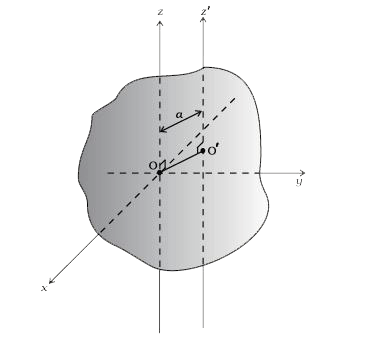
|
|
| 10. |
A horizontal force is applied on a body on a rough horizontal surface produces an acceleration ‘a’. If coefficient of friction between the body and surface which is mu is reduced to mu//3, the acceleration increases by 2 units. The value of 'mu'is |
|
Answer» 2/3g |
|
| 11. |
The onset of turbulence in a fluid is determined by Reynold number. given as .... |
|
Answer» `(RHO nu d) /(2 ETA) = Re` |
|
| 12. |
Explain Cartesian components of angular momentum of a particle. |
|
Answer» SOLUTION :By definition of angular momentum `VECL=vecrxxvecp` `=|(hati,hatj,hatk),(x,y,z),(P_(x),P_(y),P_(z))|` `=hati[yPz-zPy]+hatj[zPx-xPz]+hatk[xPy-yPx]....(1)` `THEREFORE vecl=l_(x)hati+l_(y)hatj+l_(z)hatk` Here `l_(x),l_(y)andl_(z)` are the components of `vecl` along X, Y and Z axis respectively. |
|
| 13. |
Two particles A and B are moving on a straight line and B is ahead of A. Their velocities are constant, then what will be effect on their relative velocities when A is ahead of B ? |
| Answer» SOLUTION :There will not be any EFFECT on RELATIVE VELOCITY. | |
| 14. |
What is the centripetal acceleration of a space vehicle moving round the earth, assuming its orbit to be circular ? What is the apparent weight of an astronaut ? |
|
Answer» |
|
| 16. |
A very small hole in an electric furnace is used for heating metals. The hole nearly acts as a black body. The area of the hole is 200mm^(2). To keep a metal at 727^(@)C, heat energy flowing through this hole per sec, in joules is (sigma=5.57xx10^(-8)Wm^(-2)k^(-4)) |
|
Answer» 22.68 |
|
| 17. |
If an object reaches a maximum vertical height of 23.0 m when thrown vertically upward on earth how would it travel on the moon where the acceleration due to gravity is about is about one sixth that on the earth ? Assume that initial velocity is the same. |
|
Answer» |
|
| 18. |
A carnot refrigerator absorbs heat from water at 0^(@)C and gives it to a room at 27^(@)C. Find the work done by the refrigerator and the coefficient of performance of the machine when it changes 2 kg of water at 0^(@)C to ice at 0^(@)C. Specific latent heat of ice =333 xx 10^(3) Jkg ^(-1)? |
|
Answer» Solution :L.H. of ICE `= L = 933 xx 10 ^(3) J Kg ^(-1)` Heat absorbed from 2 kg of water at `0^(@)C= Q_(2) = mL = 2 xx 333 xx 10 ^(3) J` `= 666 xx 10 ^(3) J` `T_(2) = 0^(@)C = 273 K, T_(1) = 27 + 273 = 300 K` Heat rejected `= Q_(1) = ?` `( Q _(1))/( Q _(2)) = (T_(1))/( T _(2)) , Q_(1) = (T_(1))/(T_(2)) xx Q_(2)` ` Q _(1) = (300)/( 273) xx 666 xx 10 ^(3) = 731. 86 xx 10 ^(3) J` Word DONE ` = W = Q_(1) - Q_(2) = 731. 86 xx 10 ^(3) - 666 xx 10 ^(3) J` ` = 65.87 xx 10 ^(3) J` COEFFICIENT ofperformance `= (Q_(2))/(Q_(1) - Q_(2))` ` = ( 666 xx 10 ^(3))/( 731. 86 xx 10 ^(3) - 666 xx 10 ^(3))` `= ( 666 xx 10 ^(3))/( 65. 86 xx 10 ^(3)) = 10. 11` |
|
| 19. |
A polyatomic gas (gamma = (4)/(3)) is compressed to (1)/(8)^(th) of its volume adiabatically. If its initially pressure is P_(0). Its new pressure will be |
|
Answer» `8P_(0)` `:. P((V_(0))/(8))^(4//3) = P_(0)(V_(0))^(4//3)` or`P = P_(0)(8)^(4//3) = P_(0)(2)^(4) = 16 P_(0)` |
|
| 20. |
The mass and diameter of a planet are twice that of the earth. What will be the time period of oscillation of a pendulum on this planet, if it is a seconds pendulum on earth. |
| Answer» Answer :D | |
| 21. |
A cylinder of fixed capacity 44.8 litres constains helium gas at standard temperature and pressure. What is the amount of heat needed to raise the temperature of the gas in the cylinder by 15^(@)C ? Given R=8.31 j mol e^(-1) K^(-1) . (For monoatomic gas, C_(v)=3 R//2) |
|
Answer» 265 J Therefore, cylinder of fixed CAPACITY 44.8 litre must contain 2 moles of helium at STP. For helium, `C_(V)=3/2R` (monatomic) `therefore` Heat needed to raise the temperature, Q= NUMBER of moles `xx` molar specific heat `xx` raise in temperature `=2xx3/2Rxx15=45R=45xx8.31J=373.95J` |
|
| 22. |
A metal cube of side 0.20 m is subjected to a shearing force of 4000 N. The top surface is displaced through 0.50 cm with respect to the bottom. Calculate the shear modulus of elasticity of the metal. |
|
Answer» Solution :Here , `L = 0.20 m, F = 4000 N, X = 0.50 cm = 0.005m and "Area" A = L^2 = 0.04 m^2` THEREFORE, Shear modulus `eta_(R ) = F/A xx L/x = (4000)/(0.4) xx (0.20)/(0.005) = 4 xx 10^(6) N m^(-2)`. |
|
| 23. |
A metallic wire of density d floats horizontal in water. The maximum radius of the wire so that the wire may not sink is (surface tension of water = T) |
|
Answer» `SQRT((2T)/(PIDG))` |
|
| 24. |
In the question number 10, the ratio of the velocity of the satellite at apogee and perigee is |
|
Answer» `1/2` |
|
| 25. |
Two objects of masses 4kg and 3kg are placed along X and Y axes respectively at a distance of 1m from the origin. An object of mass 1kg is kept at the origin of the co-ordinate system Calculate the resultant gravitational force attraction on the object at the origin. |
|
Answer» Solution :Force due to 4kg MASS on 1kg mass at the ORIGIN is `F_(1)= (Gxx4xx1)/1^2 = 4G` Foce due to 3kg mass on 1kg `F_(2) = (Gxx3xx1)/1^2 =3G` The resultant force is found by using parallel -gram law of vectors `F = SQRT(F_1^2+F_2^2+2F_1F_2cos THETA)` `sqrt((4G)^2+(3G)^(2)+2(4G)(3G)COS 90^@)= 5G` 
|
|
| 26. |
Consider a pendulum consisting of a massless string with a mass at one end. The mass is held with the string horizontal and then released. The mass swings down, and on its way back up, the string is cut at point P when it makes an angle of with theta the vertical. Find the angle for theta which horizontal range .R. is maximum. |
Answer» Solution :The SPEED at angle is given by CONSERVATION of energy. `(1)/(2)mv^(2)=mgh rArr (1)/(2) mv^(2)=mgl cos THETA` `v = sqrt(2gl cos theta)` When string is cut particle moves as a projectile with velocity component. `v_(x)= v cos theta v_(y)=v sin theta` The time of flight is `t=2((v_(y))/(g))` Range is, `R = v_(x)t = v_(x)((2v_(y))/(g))` `= (2v_(x)v_(y))/(g)=(2(v cos theta)(v sin theta))/(g)=(2 v^(2)sin theta cos theta)/(g)` `= (2 (2gl cos theta)sin theta cos theta)/(g)= 4l cos^(2) theta sin theta` DIFFERENTIATING .R. with respect to `.theta.` and equating it to zero we get `0=4l (-2 cos theta sin theta)sin theta + cos^(2)theta cos theta` or, `2 sin^(2)theta cos theta = cos^(3)theta`, or ` tan theta = 1//sqrt(2)` |
|
| 27. |
A plank rests symmetrically on two cylinders which are separated by a distance of 2l and rotate with uniform speed in opposite direction. If the plank is displaced a little and then released, show that the motion of the plank is simple harmonic. Calculate the period of oscillations of the peak. The co-efficient of friction between the plank and either cylinder is mu. |
|
Answer» |
|
| 28. |
The temperature of the system decraeses in the process of |
|
Answer» free EXPANSION |
|
| 29. |
Calculate the difference in temperature between the water at the top and bottom of Niagra falls of height 500 m assuming that the whole K.E. due to fall is converted into heat. Specific beat capacity of water 4200 Jkg ^(-1) K ^(-1). |
| Answer» SOLUTION :`Delta W = Delta Q, MGH = mcd T. dT = gh//c = 9.8 XX 500 //4200 = 1.169 K.` | |
| 30. |
A mass M attached to the end of a small flexible rope of diameter d=1 cm is raised vertically by winding the rope on a reel. If the reel is turned uniformly ay the rate of n=2 rps, what will be the tension T in the rope? Neglect inertia of the rope and slight lateral motion of the suspended mass. (Fig.5.25) |
|
Answer» |
|
| 31. |
When runing boy jumps on to a rotating table, the quantity that is conserved is |
|
Answer» Linear MOMENTUM |
|
| 32. |
Light from a massive star suffers ' gravitational red- shift 'i.e It'swavelength changes towards the red endto the gravitational attractionof the star. Obtain the formula for this gravitational red - shift using the simple consideration that a photon of frequency 'v' has energy 'hv'and mass (hv)/(c^(2)) . Estimate magnitude of the red - shift for light of wavelength 5000Åfrom a star of mass 10^(32) kg and radius 10^(6) km. (G = 6.67xx10^(-11)Nm^(2)kg^(-2),c=3.00xx10^(8)ms^(-1)) |
|
Answer» Solution :Given, `R=10^(6)km=10^(9)m` `lamda=5XX10^(-7)m` `M=10^(32)KG` `lamda^(-1)=(c+V)/(c) lamda` `Deltalamda=lamda^(1)-lamda=(c+v)/(c)lamda-lamda=(lamda/(c))v` but `1//2 mv^(2)=(GMm)/(r) "(m-mass of photon)"` `:. v = sqrt((2GM)/(r))` i.e., red shift `Deltalamda=(lamda/c)(sqrt((2GM)/r))=((5xx10^(-7))/(3xx10^(8)))sqrt((2xx6.67xx10^(-11)xx10^(32))/(10^(9)))` `=60.87xx10^(-10)m` `Deltax=60.87Å` |
|
| 33. |
The refractive index of the material of a double convex lens is 1.5 and its focal length is 5cm. If the radii of curvature are equal, the value of the radius of curvature is |
|
Answer» `5.0` |
|
| 34. |
A certain block weighs 15 N in air. But it weighs only 12 N completely in another liquid, it weighs 13 N. Calculate the relative density of (i) the block and (ii) the liquid. |
|
Answer» Solution :(i) RELATIVE density of body `=(W_("air"))/(W_("air")-W_("water"))` where `W_("air")=15N` (WEIGHT of the body in air) and `W_("water")=12N` (weight of the body in water) `:.R.D_(B)=(15N)/(15 N-12N)=5` (i) `R.D_(L)=("loss in weight in LIQUID")/("loss in weight in water")=(15-13)/(15-12)=2/3` |
|
| 35. |
Two rods X and Y identical dimesion but of differentmaterical are joined as shown in figure . Thelengthof each part is the same . If thetemperature of endA and F be maintained at100^(@)C and 20^(@)C respectively , then find the temperature of the junction B and E . Thethermalconducting of X is doublethat of Y. |
|
Answer» Solution :GIVEN `K_(x) = 2K_(y)` If AB = EF = Land A be the crosssectionalarea of the rods ,then `R_(x) = (L)/(K_(x)A) and R_(y) = (L)/(K_(y)A) i.e.,R_(y) = 2R_(x)` Letthe temperature of junctions B and E be `T_(1)` and `T_(2)`respectively. Thecorresponding thermalnetworkis SHOWN belowin figure.  For `AB , i =(100-T_(1))/(R_(x))""......(i) ` For `BCE, i_(I) = (T_(1) - T_(2))/(R_(y)) = (T_(1) - T_(2))/(4R_(x)) "".........(II)` For `BDE , (i-i_(1)) = (T_(1)- T_(2))/(2R_(x)) ""..........(iii)` and for `EF , i = (T_(2) -20)/(R_(y)) = (T_(2) - 20)/(2R_(x)) ""......(iv)` Adding Eqs. (ii) and (iii) `i = (3)/(4) ((T_(1) - T_(2)))/(R_(x)) "".....(v)` Equating Eqs.(i) and (iv) ` (100 - T_(1))/(R_(x)) = (T_(2) - 20)/(2R_(x)) "".....(vi) (or) 2T_(1) + T_(2) = 220` Equating Eqs. (i) and (iv) `(KA(T_(1) - T_(2)))/(L) (1)/(2) 7T_(1) - 3T_(2) = 400 ""....(vii)` Solving Eqs. (vi) and (vii) `T_(1) = 81.54^(@)C , T_(2) = 56.92^(@)C` |
|
| 36. |
The angular momentum of a body with mass (m) moment of inertia (I) and angular velocity (omega)" rad"//s is equal to |
| Answer» SOLUTION :M.I will DECREASE | |
| 37. |
A chain of length l and mass m is lumped over the hole in a horizontal plate and a short length hangs down the hole when the chain is at rest. If it is released from this position find the velocity when the last link of the chain leaves the hole. |
|
Answer» |
|
| 38. |
(A) : A null vector is a vector whose magnitude is zero and direction is arbitrary. ( R) : A null vector does not exist |
|
Answer» Both (A) and ( R) are TURE and ( R) is the CORRECT explanation of (A) |
|
| 39. |
What is the moment of inertia of solid sphere of density rho and radius R about its diameter ? |
|
Answer» `(105)/(176)R^(2)rho` `I=(176)/(105)R^(5)rho""(because pi=(22)/(7))` |
|
| 40. |
Two cars, each moving with speed u on the same horizontal straight road , are approaching each other Wind blows along the road with velocity w . One of these cars blows a whistle of frequencyf_(1) . An observer in the other car hears the frequency of the whistle to bef_(2) .The speed of sound in still air is v. Correct statement (s) is / are : |
|
Answer» If WIND blows from OBSERVER to the source , ` f_(2) GT f_(1)` |
|
| 41. |
Define shearing stress and write its formula. |
|
Answer» SOLUTION :The ratio of tangential component of FORCE to the cross section to the AREA of cross section is known as shearing stress, `sigma _(t) = (F_(B))/(A’)` where, `F_(t) =` tangential component of force to the cross section area. A = Area of cross sectional. |
|
| 42. |
The joule xx second is the unit of |
|
Answer» energy `:. ["Work"]["Time"]= [ML^(2)T^(-2)][T]= [ML^(2)T(-1)]` `[ "Angular momentum" ]= [ML^(2)T^(-1)]` |
|
| 43. |
A 1.5 kg block placed on a frictless orizontal floor is pulled by a force F Direction of the force is unchanged and its magnitude is incrcresaed with time according to the equation F =0.5t n where t denotes time in second . Which of the following is /are correct for subsequunt motion after t=0 s? [g=10m//s^(2)] |
|
Answer» The block LEAVES the FLOR at the instant t=50s. |
|
| 44. |
Six forces lying in a plane and forming angles of 60^(@) relative to one another are applied to the center of a homogenous sphere with a mass m = 6 kg. These forces are radially outward and consecutively 1N, 2N, 3N, 4N, 5N and 6N. The acceleration of the sphere is |
|
Answer» ZERO |
|
| 45. |
Add 2.536xx10^(2)cm " to "1.415xx10^(3)cm (with regard to significant figures). |
| Answer» SOLUTION :`1.668xx10^(3)CM` | |
| 46. |
A pump can raise 100 L of water per minute to a height of 10 m . What should be the power of the pump ? |
|
Answer» Solution :Mass of 100L OFWATER ,m=`100xx10^3 g=100kg` Potential ENERGY by the water PER mitute, V`=mgh =100xx9.8xx10=9800J` `THEREFORE` Power of thepump =`(9800)/(60) =163.3 J*s^(-1) =163.3W`. |
|
| 47. |
By improving experimental techniques, selecting better instruments and removing personal bias as far as possible, the erros can be minimised |
|
Answer» RANDOM errors |
|
| 48. |
A: Two wire A and B having equal cross sections made from the same material. The length of A is twice to the length of B, hence the increase in length of A is twice to the increase in length of B for a given same weight. R: Increase in length of wire proportional to its length for a given same length. |
|
Answer» Both are true and the reason is the correct explanation of the ASSERTION. |
|
| 50. |
A closed pipe is suddenly opened and changed to an open pipe of same length . The fundamental frequency of the resulting open pipe is less than that of 3rd hoarmonic of the earlier closed pipe by 55Hz. Then , the value of fundamental frequency of the closed pipe is |
|
Answer» `165Hz` |
|