

Saved Bookmarks
This section includes 7 InterviewSolutions, each offering curated multiple-choice questions to sharpen your Current Affairs knowledge and support exam preparation. Choose a topic below to get started.
| 1. |
'A point on a rotating disc is not considered to be simple harmonic''. Why? |
| Answer» SOLUTION :It is not to and FRO. | |
| 2. |
Underline the correct alternative : When a conservative force does positive work on a body, the potential energy of the body increases/decreases/remains unaltered. |
| Answer» SOLUTION :DECREASE | |
| 3. |
A cylindrical tube, open at both ends has a fundamental frequency f in air. The tube is dipped vertically in water so that half of it is in water. The fundamental frequency of the air column is now …………. . |
|
Answer» F/2 |
|
| 4. |
The molar specific heat capacity of a solid, at extremely low temperature varies as :s = c_(1)T + c_(2) T^(3) where c_(1) and c_(2) are constants and T is temperature in Kelvin. Find the amount of heat extracted from a body of 5 moles when its temperature falls from 10K to 5K. |
|
Answer» |
|
| 5. |
If the work done is competely recoverable than the force is |
|
Answer» conservative |
|
| 6. |
The figure show a uniform isosceles triangular plate of mass M and base L. The abgle at the apex is 90^(@). The apex lies at the origin and the base is parallel to x-axis The moment of inertia of the plate about the x-axis is |
|
Answer» `("ML"^(2))/(8)` |
|
| 7. |
The figure show a uniform isosceles triangular plate of mass M and base L. The abgle at the apex is 90^(@). The apex lies at the origin and the base is parallel to x-axis The moment of inertia of the plate about the y-axis is |
|
Answer» `("ML"^(2))/(12)` |
|
| 8. |
The figure show a uniform isosceles triangular plate of mass M and base L. The abgle at the apex is 90^(@). The apex lies at the origin and the base is parallel to x-axis The moment of inertia of the about its base and about the Z-axis |
|
Answer» `("ML"^(2))/(18),("ML"^(2))/(6)` |
|
| 9. |
The nature of a physical quantity is described by its dimensions.Check, the correctness of the equation v = v0+atby the method of dimensional analysis. |
| Answer» SOLUTION :`V=v_0+at[v]=[M^0LT^-1],[V_0]=[M^0LT^-1],[at]=[M^0LT^-2][T]=[M^0LT^-1]` | |
| 10. |
The position of a transverse wave travelling in medium along positive x-axis is shown in figure at time t=0. Speed of waveis v=200 m/s Equation of the wave is (in SI unit) |
|
Answer» `y=0.04 sin 2 pi (5xx-10^(3)t)` |
|
| 11. |
Two solid steel cylinders A and B of same temperature (higher than the surrounding temperature) are of same length and of radii r and 2r, respectively. Only radiation considered, if the rate of all of temperature of A is k, then the rate of fall of temperature B would bne |
|
Answer» `GT K` |
|
| 12. |
If two springs A and B with spring constants 2k and k, are stretched separately by same suspended weight, then the ratio between the work done in stretching A and B is |
|
Answer» `1:2` For spring `B, mg = k_B x_B` SINCE both the springs A and B are suspended by same weight, therefore, `k_Ax_A = k_Bx_B " or " (k_A)/(k_B) = (x_B)/(x_A) ""…(i)` `:.` Ratio of work done in stretching A and B is `(W_A)/(W_B) = (1/2k_A x_A^2)/(1/2 k_B x_B^2) = (k_A)/(k_B) ((x_A)/(x_B))^(2) = (k_A)/(k_B) ((k_B)/(k_A))^(2) ""` (USING (i)) `= (k_B)/(k_A) = (k)/(2k) = 1/2` . |
|
| 13. |
A metallic rod of length1m is rigidly clamped at its midpoint. Longitudinal stationary waves are set up in the rod in such a way that there are two nodes on either side of the mid - point and those of constituent waves in the rod . ( Y = 2 xx 10^(11) N//m^(2) and rho = 8 xx 10^(3) kg// m^(3)) |
|
Answer» Solution :As found in case of strings , in case of RODS also the clamped point behaves as a node while the free end ANTINODE . The SITUATION is shown in FIG . 7.63. Because the distance between two consecutives nodes is `(lambda//2)` while between a node and antinide is `lambda//4` , hence ` 4 xx [ (lambda)/( 2)] + 2 [(lambda)/( 4)] = Lor lambda = ( 2 xx 1)/( 5) = 0.4 m` Further , it is given that ` Y = sqrt((Y)/( rho)) = sqrt(( 2 xx 10^(11))/( 8 xx 10^(3))) = 5000 m//s` Hence , from ` v = n lambda`, ` n = (v)/( lambda) = (5000)/( 0.4) = 12500 Hz` Now if incident and reflected WAVES along the rod are `y_(1) = A sin ( omega t - kx) and y _(2) = A sin ( omega t + k x + phi )` Hence , from ` v = n lambda` , ` n = (v)/( lambda) = ( 5000)/(0.4) = 12500 Hz` Now if incident and reflected waves along the rod are `y_(1) = A sin ( omega t - kx)and y_(2) = A sin ( omega t + kx + phi)` The resultant wave will be ` y = y_(1) + y_(2) A [ sin ( omega t - kx) + sin ( omega t + kx + phi)]` `= 2 A cos ( kx + (phi)/( 2)) sin ( omega t + ( phi)/(2))` Because there is an antinode at the free end of the rod , henceamplitude is maximum at ` x = 0` . So ` Cos (k xx 0 + (phi)/(2)) = "Maximum" = 1 i.e., phi = 0` And `A_(max) = 2 A = 2 xx 10^(-6) m` (given) ` y = 2 xx 10^(-6) cos kx sin omega t` ` y = 2 xx 10^(-6) cos [ ( 2pi x )/( lambda)]sin ( 2 pi nt)` Putting values of `lambda and n` , we get ` y = 2 xx 10^(-6) cos 5 pi x sin 25000 pi t` Now , because for a point ` 2cm` from the midpoint ` x = (0.50 +- 0.02)`, hence `y = 2 xx 10^(-6) cos 5 pi ( 0.5 +- 0.02) sin 25000 pi t` 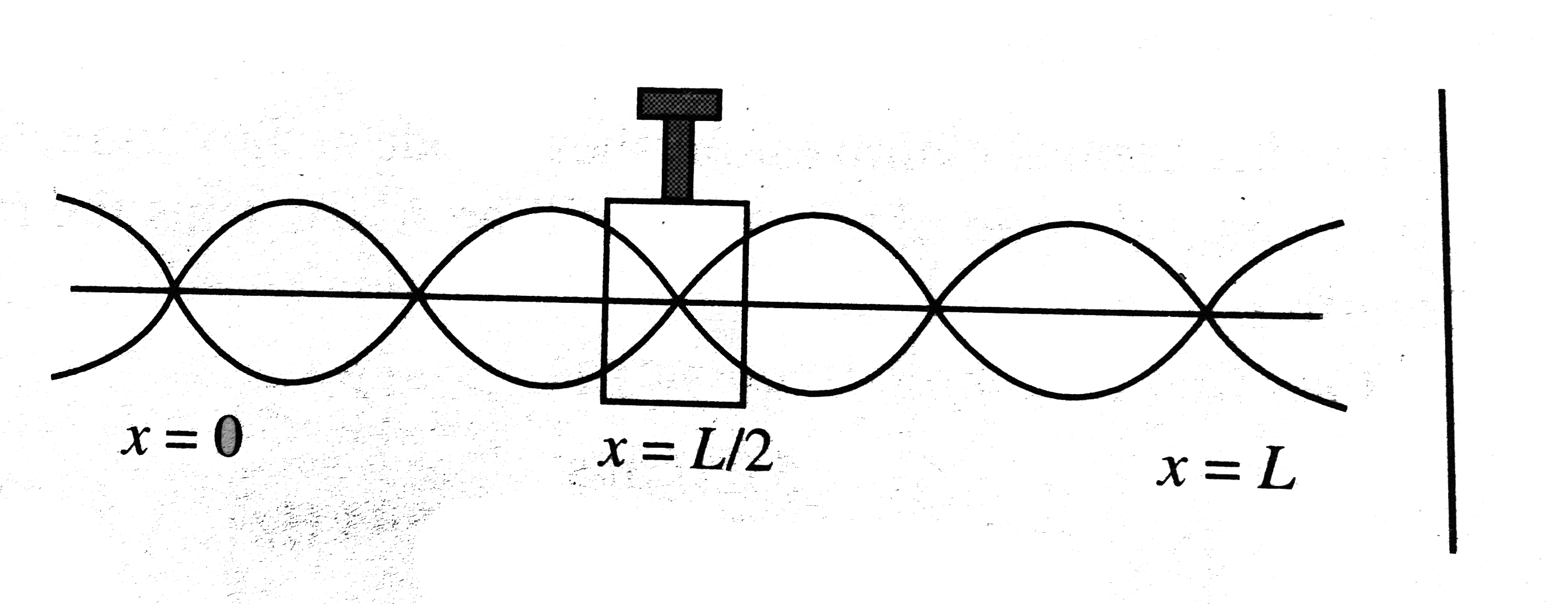
|
|
| 14. |
M.I of a uniform horizontal solid cylinder of mass M about an axis passing through its edge and perpendicular to the axis of cylinder when its length is 6 times of its radius R is |
|
Answer» `(39)/(4)MR^(2)` |
|
| 15. |
Describe classification of waves in detail with examples. |
|
Answer» Solution :All types of waves can be classified into following three categories. (1) Mechanical Waves : "The waves which require an elastic medium for their propagation, are called mechanical waves. For example : String waves, spring waves, water waves, sound waves seismic waves (propagating on the ground during earthquake) are all mechanical waves. Here waves propagate because of elasticity property of medium. (2) Electromagnetic Waves OR Non-mechanical Waves : "The waves which do not require any medium for their propagation, are called non-mechanical waves. They are also called electromagnetic waves (because during their propagation, electric and magnetic fields oscillate periodically in mutually perpendicular directions in a plane perpendicular to direction of propagation of WAVE)". For example, radiowaves, infrared light waves, visible light waves, ultraviolet light waves, X-ray and gamma rays are the examples of electromagnetic or nonmechanical waves. They can propagate in vacuum also. The light emitted from stars very far from us (hundreds of light years away from us) reaches to us after passing through vacuum in the inter - stellar space. All types of electromagnetic waves have same speed in vacuum with a value`c =2.99 792458 xx 10 ^(8) m//s` (Which is a well known physical constant known as velocity of light in vacuum) (3) Matter Waves : It has been proved experimentally that, "When a fundamental particle of mass m, moves with a velocity v, its MOTION can be described very well by a wave of wavelength `LAMDA = (h)/(mv)` (Where h = Planck.s constant `=6.625 xx 10 ^(-34) (Js)."` Such waves are called "Matter Waves". (These waves were predicted by Louis De Broglie and so they are also known as De-Broglie waves). Matter waves represent the motion of atom (smallest part of an element), molecule (smallest part of a compound, fundamental particles like electron, proton and neutron (which take part in the constitution of any matter). They interact and show their effect, quite similar to those shown by mechanical or non-mechanical waves. They have been employed in many devices, from basic to modern technology, for example stream of fast MOVING electrons is employed in electron microscope (which gives an image with magnification and clarity, GREATER than that produced by any light). |
|
| 16. |
A system can be taken from the initial state P_(1),V_(1) to the final state p_(2),V_(2) by two different methods. Let DeltaQ and DeltaW represent the heat given to the system and the work done by the system. Which of the following must be the same in both the methods? |
|
Answer» `DELTAQ` |
|
| 17. |
(A): A undamped springp-mass system is simplest free vibration system.(R): It has three degrees of freedom. |
|
Answer» Both (A) and ( R) are TRUE and (R ) is the CORRECT EXPLANATION of (A) |
|
| 19. |
Dimensional formula for a physical quantity X is M^(-1) L^3T^(-2) The errors in measuring the quantities M, L and T respectively are 2% 3% and 4%. Find the maximum percentage error that occurs in measuring the quantity X. |
|
Answer» |
|
| 20. |
Science is ever dynamic. There is no final theory in science and no unquestioned authority amongst scientists. Comment |
| Answer» SOLUTION :REFER to ART. 1 (a) 2. | |
| 21. |
One gm mol of a diatomic gas(gamma=1.4)iscompressed adiabatically so that its temper ature rises from 27^(@)C to 127^(@)C. The work done will be |
|
Answer» 2077.5 joules |
|
| 22. |
The volume and mass of a hydrogen gas balloon are 1000 L and 1 kg respectively. The density of the material of a block is 91.3g*L^(-1) and the density of air is 1.3g*L^(-1). Find the maximum volume of the block that can be raised by the bolloon? |
|
Answer» |
|
| 23. |
Two cars are moving in the direction with a speed of 30 "km h"^(-1) . They are separated from each other by 5 km. Third car moving in the opposite direction meets the two cards after an interval of 4 minutes. What is the speed of the third car? |
|
Answer» `30 "km H"^(-1)` |
|
| 24. |
A wheel which is initially at rest is subjected to a constant angular acceleration about its axis. It rotates through an angle of 15^(0) in time t secs. The increase in angle through which it rotates in the next 20 secs is |
|
Answer» `90^(0)` |
|
| 25. |
Among the following , the liquid having negative coefficient of cubical expansion between 273K and 277K is |
|
Answer» ETHYLENE Glycol |
|
| 26. |
A particle of mass 10 g executes a linear SHM of amplitude 5 cm with a period of 2s. Find the P.E. and K.E.1//6 s after it has passed through the mean position. |
|
Answer» Solution :Mean of the particle`m= 10g = 10 xx 10(-3)= 1 xx 10^(-2) kg` Time PERIOD `T= 2s, OMEGA= (2pi)/(T)= (2pi)/(2)= pi "rad"//s` Amplitude `A= 5cm = 5 xx 10^(-2)m` `K.E= (1)/(2)mA^(2)omega^(2)cos^(2)omegat` when `t= (1)/(6)s` `K.E= (1)/(2) xx 1 xx 10^(-2) xx (5 xx 10^(-2))^(2)` `(pi^(2))cos^(2)((pi)/(6))= (25 xx 10^(-6))/(2)xx pi^(2) xx ((sqrt(3))/(2))^(2)= (75)/(8) xx pi^(2) xx 10^(-6) J= 9.255 xx 10^(-5)J` `P.E.= (1)/(2) mA^(2)omega^(2)SIN^(2)omegat= (1)/(2) xx 1 xx 10^(-2) xx (5 xx 10^(-2))^(2) pi^(2)sin^(2)((pi)/(6))= (25 xx 10^(-6))/(2)xx pi^(2) xx ((1)/(2))^(2)= (25)/(8) xx pi^(2) xx 10^(-6)J= 3.085 xx 10^(-5)J` |
|
| 27. |
A coin is sliding down on a smooth hemi-spherical surface of radius R. The height from the bottom, where it looses contact with the surface is: |
|
Answer» `R//3` |
|
| 28. |
Assertion : Moon has no atmosphere. Reason : The escape velocity for moon is less than that for earth. |
|
Answer» If both assertion and reason are true and reason is the correct explanation of assertion |
|
| 29. |
The internal energy of a gas contained in a beaker is U, if the box starts moving with velocity V, then internal energy of the gas will be. |
|
Answer» U only |
|
| 30. |
Find the PE of three objects of masses 1kg, 2 ks and 3 kg placed at the three vertices of anequilateral triangle of side 20 cm. |
| Answer» Answer :B | |
| 31. |
The question given below consist ofan assertion and the reason . Use the following key to choose appropriate answer: Reason : When magnitude of acceleration is constant, then speed of particle may remain constant . |
|
Answer» If both ASSERTION and REASON are CORRECT and reason is a correct explanation of the assertion |
|
| 32. |
Two particles each of mass m seperated by a distance d and move in a uniform circle under the action of their mutual force of attraction. The speed of each particle is |
|
Answer» `sqrt((GM)/d)` |
|
| 33. |
Number of significant digits in 0.0342............. |
|
Answer» 1 |
|
| 34. |
Two equal masses M and N are suspended from the ends of two separate weightless springs having spring constants k_(1)andk_(2). If the maximum velocities of the two masses for their vertical oscillations are the same, what is the ratio of the amplitudes of vibration of M and N? |
|
Answer» SOLUTION :If angular frequency = `omega` and AMPLITUDE = A, then maximum velocity = `omegaA`. So for the TWO given masses, `omega_(1)A_(1)=omega_(2)A_(2)` or, `A_(1)/A_(2)=omega_(2)/omega_(1)=((2pi)/T_(2))/((2pi)/T_(1))=T_(1)/T_(2)=(2pisqrt(m_(1)/k_(1)))/(2pisqrt(m_(2)/k_(2)))` or, \`A_(1)/A_(2)=SQRT(k_(2)/k_(1))" "[becausem_(1)=m_(2)=m]`. |
|
| 35. |
A gas container 1 mol of O_2 gas (specific molar mass 32) at pressure p and temperature T. In a similar container one mol of He gas (specific molar mass 4) is kept at temperature 2T. What is the pressure of this He gas? |
| Answer» SOLUTION :Since number of moles and VOLUME are the same for both the GASES, using pV=nRT, it can be said that the pressure is directly proportional to the absolute temperature .Since temperature of the second container is double,pressure will also be double i.e., 2p. | |
| 36. |
A wheel rotates with a constant acceleration of 2.0 rad/s^(2). If the wheel starts from rest, the number of revolutions it makes in first ten seconds is |
|
Answer» 8 No. of revolutions = `(theta)/(2 PI) = (100)/(2pi) = 16` |
|
| 37. |
Keeping the angle of projection constant, if the velocity of projection is doubled, the horizontal range |
|
Answer» GETS doubled |
|
| 38. |
Masses 1 kg and 3 kg move towards each other, due to their mutual attraction , no other external force acts on them. When their velocity of approach is 2 mcdot s^(-1) , the velocity of the centre of mass is 0.5 mcdot s^(-1). What will be the velocity of the centre of mass of this system when the velocity of approach is 3 mcdot s^(-1). |
| Answer» Solution :The TWO masses may be considered to be CONSTITUENTS of a single system, and there is no external force acting on the system. As per the first law of motion. The velocity of the system REMAINS constant. Velocity of a system is the velocity of its CENTRE of mass. So the velocity of the centre of mass will continue to be 0.5 m`cdot s^(-1)`. | |
| 39. |
In the following equation, x, t and Frepresent displacement, time and force respectively, F= a+bt+ (1)/(c+ d. x)+ Asin(omegat+theta) The dimensional formula for b//A is |
|
Answer» `[T^(-1)]` |
|
| 40. |
How mush force is exerted on our body at atmospheric pressure ? |
| Answer» Solution :The pressure exerted on area of `1cm^(2)` of earth surface is 1kgs . Average area of contact surface for HUMAN body is `2m^(2)`.Hence ,FORCE exerted on whole body is `2xx10^(5)` N, but blood pressure in body is SLIGHTLY higher than this pressure .So the pressureof armosphere is balanced .As a result, we cannot experienced this force. | |
| 41. |
The radius of a disc is 1.2 cm . Its area according to the idea of significant figures is |
|
Answer» `4.5216 CM^(2)` |
|
| 42. |
The angle of minimum deviation for a 75^@ prism of dense glass is found to be 45^@ when in air and 15^@ when immersed in certain liquid. The refractive index of the liquid is |
|
Answer» `SQRT3/2` |
|
| 43. |
A capillary tube of radius 0.25mm is submerged vertically in water so that 25mm of its length is outside water. The radius of curvature of the meniscus will be (T = 7.5 xx 10^(-3) N/m) |
|
Answer» 0.2 MM |
|
| 44. |
For a satellite to orbit around the earth, which of the following must be true ? (a) It must be above the equator at some time (b) It cannot pass over the poles at any time (c) Itsheight above the surface cannot exceed 36,000 km (d) Its period of rotation must be gt 2pisqrt(R//g) |
|
Answer» only B & C are TRUE |
|
| 45. |
How much will be the weight of the object at the centre of the Earth? |
|
Answer» Solution :According to VARIATION of acceleration due to gravity with DEPTH, `g_(d)=g(1-(d)/(R))` Here, d = R `g_(d)=g(1-(R)/(R))` `rArrg_(d)=0` |
|
| 46. |
Explain how the definition of work in physics is different from general perception. |
| Answer» Solution :The term work is used in diverse contexts in DAILY life. It refers to both physical as WELL as mental work. In fact, any activity can generally be called as work. But in Physics, the term work is treated as a physical QUANTITY with a precise definition Work is said to be DONE by the force when the force applied on a body DISPLACES it | |
| 47. |
Examine Tables 6.1-6.3 and express The energy required to break on bond in DNA in eV. |
|
Answer» Solution :Energy required to break one bond of DNA is `(10^(-20)J)/(1.6xx10^(-19)J"/"EV) CONG 0.06 eV` Note `0.1 eV= 100 meV` (100 millielectron volt). |
|
| 48. |
Select the correct statement from the following statement ,For retarded motion, the . . . . . . |
|
Answer» SLOPE of velcoity - time graph is zero. |
|
| 49. |
A mass M is hung from one end of an elastic thread. When the mass is pulled downwards slightly and released, it performs vertical oscillations. If an additional mass m is attached to the mass M, then the time period of the SHM changes in the ratio 5 : 4. Determine the ratio between m and M. |
|
Answer» |
|
| 50. |
A massless conical flask filled with a liquid is kept on a tbale in a vacuum. The force exerted by the liquid on the base of the flask is W_(1).The force exerted by the flask on the table is W_(2). a. W_(1)=W_(2) b. W_(1)gtW_(2) c. W_(1)ltW_(2) d. The force exerted by the liquid on the walls of the flask is (W_(1)-W_(2)) |
|
Answer» a and C are correct |
|