

Saved Bookmarks
This section includes 7 InterviewSolutions, each offering curated multiple-choice questions to sharpen your Current Affairs knowledge and support exam preparation. Choose a topic below to get started.
| 1. |
If the radius of the earth is 6400km, the depth at which the acceleration due to gravity will be 5% less than the value on the surface of the earth is |
|
Answer» 320KM |
|
| 2. |
If the velocity is vecv=2hati+t^(2)hatj-9hatk then the magntidue of acceleration at t=0.5s is |
|
Answer» `1ms^(-2)` at `t=0.5simpliesa=2(0.5)=1ms^(-2)` |
|
| 3. |
Two cylinders A and B, fitted with pistons,contain equal amounts of an ideal diatomic gas at 300K. The piston of A is free to move, while that of B is held fixed. The same amount of heat is given to the gas is each cylinder. If the rise in temperature of the gas in A is 30K, than the rise in temperature of the gas in B is |
|
Answer» 30K |
|
| 4. |
Two metal spheres of same material and each of radius r are in contact with each other. The gravitational force of attraction between the sphere is proportional to |
|
Answer» SOLUTION :`F=(Gm_1m_2)/((2R)^2)=(G({:(4),(3):}pir^3d)({:(4),(3):}pir^3d))/(4r^2)` `F = Kr^4"" F propr^4` 
|
|
| 5. |
When two bodies are saparated by certain distance, the gravitational force between then is F. If distance is increased by 100% then gravitational force becomes - |
| Answer» Answer :A | |
| 6. |
During acceleration of a bicycle the direction of force of static friction exerted by the ground on the wheels is |
|
Answer» against the direction of MOTION of the front wheel and along the direction of motion of the REAR wheel |
|
| 7. |
A uniform solid spherical ball is rolling down a smooth inclined plane from a height h. The velocity attained by the ball when it reaches the bottom of the inclined plane is v. If ball when it reaches the bottom of the inclined plane is v. If the ball is now thrown vertically upwards with the same velocity v, the maximum height to which the ball will rise is |
|
Answer» `(5h)/(8)` `I=(2)/(5)MR^(2)and v=Romega` (along the diameter) Where, R is radius of spherical ball, So, `K_("total")=(1)/(2)((2)/(5)mR^(2))omega^(2)+(1)/(2)mR^(2)omega^(2)` `=(7)/(10)mR^(2)omega^(2),K=(7)/(10)mv^(2)` Potential energy = Kinetic energy `mgh=(7)/(10)mv^(2)rArrv^(2)=(10)/(7)GH`....(i) For vertical projection `v^(2)=u^(2)+2gh'rArr(10)/(7)gh=0+2gh'rArrh'=(5)/(7)h`. |
|
| 8. |
An ideal diatomic gas is taken through a process in which the pressure and the volume vary as P = aV^b . If the specific heat capacity in the process is zero, then (-5b) is equal to ______ |
|
Answer» |
|
| 9. |
Equal temperature difference exists between the ends of two metallic rods 1 and 2 of equal length. Their thermal conductivities are K_(1)and K_(2) and cross sectional areas are resepctively 2 A_(1) and A_(2) .The condition for equal rate of heat transfer will be |
|
Answer» `K_(1) A_(2) = K_(2) A_(1)` |
|
| 10. |
Soap helps in cleaning the clothes because |
|
Answer» it reduces the surface tension of solution |
|
| 11. |
The following velocity-time graph represents a particle moving in the positive x-direction . Analyse itsmotion from 0 to 7s . Calculate the displacement covered and distance travelled by the particle from 0 to 2s |
|
Answer» Solution :GIVEN : t = 2s Formula : Area of triangle ` = (1)/(2) xx l xx b` = displacement In the graph 0 to 2s is divided into 2 triangle , Case I :t = 0 to 1 . 5 s Area ` =(1)/(2) xx (1.5) xx 2 = 1.5` Case II : t = 1 . 5 to 2s Area ` =(1)/(2) xx (0.5) xx 1 = (0.5)/(2)` = 0 . 25 `:.`Distance= 1.5 + 0 . 25 = 1.75 m Displacement= 0 . 25 - 1.5 = - 1.25 m |
|
| 12. |
Four particles each of mass 'm' are located at the four corners of a sqaure of side 'a'. If the system is revolving in a uniform circle due to there is mutual force if attraction, then the angular velocity of each particle is |
|
Answer» `sqrt((Gm(2sqrt(2)+1))/(a^(3)))` |
|
| 13. |
The period of oscillation of a liquid in a U. Tube is one to be T_1The first liquid is replaced by another are of higher density. Will there be any change in the period ? |
| Answer» Solution :No. Because the period of OSCILLATION of a LIQUID in a U-tube is independent of the DENSITY of the liquid. | |
| 14. |
Asin sound can beats be observed by two light sources ? |
|
Answer» |
|
| 15. |
A particle is fired vertically upwards from the urface of earth and reaches a height 6400 km. Find the initial velocity of the particle if R = 6400 km and g at the surface of earth is 10 m//s^2. |
|
Answer» SOLUTION :`1/2m upsilon^2=(MGH)/([1+(h//R)])` here h=R=6400 km and g=10 `m//s^2` so `upsilon^2=gh`, i.e., `upsilon =sqrt(10xx6400xx10^3)`= 8 km/s |
|
| 16. |
If vec(A)= 2hat(i) + 3hat(j) and vec(B)= 2hat(j) + 3hat(k) the component of bar(B) "along " bar(A) is |
|
Answer» 6 |
|
| 17. |
Which is the strongest force of all the basic forces in nature ? |
| Answer» Solution :Among all basic forces STRONG NUCLEAR forces are the STRONGEST forces. | |
| 18. |
Harshit and Akanksha both can run at speed vand walk at speed u(u lt v). They together start on a journey to a place that is at a distance equal to L. Akanksha walks half of the distance and runs the second half. Harshit walks for half of his travel time and runs in the other half. |
|
Answer» Who wins |
|
| 19. |
A ray of incident at 50^@ on the middle of one of the two mirros arranged at an angle of 60^@ between them. The ray then touches the second mirror, get reflectedback to the first mirror, making an angle of incidence of |
| Answer» Answer :C | |
| 20. |
A mass of 200kg is resting on a rough inclined plane of angle 30^(@). If the coefficient of friction is1//sqrt(3) , find the greatest and the least force acting parallel to the plane which can just maintain the mass in equilibrium. |
|
Answer» |
|
| 21. |
The gravitational field in a region is given by vecE= (5hati+12hatj)N"/"kg. If a particle of mass 2kg is moved from the origin to the point (12m, 5m) in this region, the change in gravitational potential energy is |
| Answer» ANSWER :B | |
| 22. |
Avogadro number is the number of molecules in |
|
Answer» ONE LITRE of a GAS at NTP |
|
| 23. |
Consider the following statements A and B. Identify the correct choice in the given answers.(A) In a one - dimensional perfectly elastic collision between two moving bodies of equal masses, the bodies eachange their velocities after the collision.(B) If a lighter body at rest suffers head - on and perfectly elastic collision with a very heavy body moving with a certain velocity, after the collision both travel with same velocity. |
|
Answer» A and B are CORRECT |
|
| 24. |
A motor of efficiency 80% draws water from a well of depth 20m and fills a tank of dimensions 4m xx 3m x 2m in 5 minutes. If the tank is at a height of 10m above ground, the power of the motor is |
|
Answer» 0.3kW |
|
| 25. |
What provides the centripetal force (i) to satellite revolving round the earth and (ii) for the electrons going round the nucleus. |
| Answer» Solution :(i) GRAVITATIONAL pull of the EARTH on the satellite (ii) the electrostatic force of ATTRACTION between the proton and the ELECTRON. | |
| 26. |
Average density of earth is |
|
Answer» is directly PROPORTIONAL to g |
|
| 27. |
A stone is tied to an elastic string of negligible mass and spring constant k. The unstretched length of the string is L and has negligible mass. The other end of the string is fixed to a nail at a point P. Initially the stone is at the same level as the point P. The stone is dropped vertically from point P. (a) Find the distance 'y' from the top when the mass comes to rest for an instant, for the first time.(b) What is the maximum velocity attained by the stone in this drop ? (c) What shall be the nature of the motion after the stone has reached its lowest point ? |
Answer» Solution :Consider the diagram, the stone is dropped from point P. 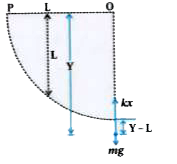 Stone is in free fall upto length L. After that elasticity of string exerted force for SHM. Suppose, stone is at rest at instantaneous distance .y.. Loss in potential energy of stone = Gain in elastic potential energy in string. `mgy = 1/2 k (y-L) ^(2)` `therefore mgy = 1/2 ky ^(2) -kyL + 1/2 kL^(2)` `implies1/2 ky ^(2) - (kL +mg) + 1/2 kL ^(2) =0` `y = ((kL + mg) pm sqrt ((kL +mg) ^(2) -k^(2) L ^(2)))/( k )` `therefore y = ((k L +mg ) pm sqrt ( 2 mg k L + m ^(2) g ^(2)))/( k )` `therefore y = ((k L + mg ) + sqrt (2m k L + m^(2) g ^(2)))/( k )` (Taking .+. sign only) (b) In SHM, the maximum velocity is ATTAINED when the body PASSES, through the "equilibrium positon". Means, at that time the instantaneous acceleration is zero. That is `mg - kx =0,` where x is the extension from L, `therefore mg = kx` If V is the velocity, then `1/2 mv ^(2) + 1/2 kx ^(2) = mg ( L +x)` (From the law of conservation of energy) `1/2 mv ^(2) = mg (L+x) -1/2 kx ^(2)` Now `mg = kx implies x = (mg )/(k)` `therefore 1/2 mv ^(2) =mg (L + (mg )/(k)) -1/2 k (m ^(2) g ^(2))/( k)= mgL + (m^(2) g ^(2))/(k ) - 1/2 ( m ^(2) g ^(2))/(k)` `1/2 mv ^(2) = mgL + 1/2 (m ^(2) g ^(2))/( k)` `therefore v ^(2) =2gL + (mg ^(2))/( k )` `v = (2 gL + (mg ^(2))/( k )) ^(1//2)` (c) When stone is at the lowest point Q, means at instantaneous distance Y from P from where the stone is dropped, then equation of motion of the stone is, `(MD ^(2)y )/( dt ^(2)) = mg - k (y -L)` `implies (d ^(2) y )/( dt ^(2)) + k/m (y-L) -g =0` Put another variable, `z = k/m (y-L) -g` `therefore ( d ^(2) z )/( dt ^(2)) + k/m z=0` This is second dervative equation which indicates SHM. Comparing this equation with `(d ^(2) z )/(dt ^(2)) + omega ^(2) =0` Angular frequency `omega = sqrt ((k)/(m))` Equation simplify as under, `z = A cos (omega t + phi),` where `omega sqrt((k )/(m))` `y = (L + (mg )/(k))+A. cos (omega t + phi)` Hence, stone will execute SHM with angular frequency `omega = sqrt ((k)/(m))` about the point `y _(0) = L+ (mg)/(k)` |
|
| 28. |
WHICH OF THE FOLLOWING FUNCTIONS OF X AND T REPRESENTS A PROGRESSIVE WAVE ? |
|
Answer» Y=SIN (4T-3X) |
|
| 29. |
Find the resultant force of the following forces which act upon a particle . (a) 30 N due east , (b) 20 N due north , (c) 50 N due west , (d) 40 N due south . |
|
Answer» Solution :From FIGURE, Resultant FORCE , `vec(F) = vec(F)_(1)+ vec(F)_(2) + vec(F)_(3) + vec(F)_(4)` `= 30 hat(i) + 20 hat(j) - 50 hat(i) - 40 hat(j)` `= - 20 hat(i) - 20 hat(j)` `:. |vec(F)| = SQRT((-20)^(2) + (-20)^(2))` `= 20 sqrt(2)` `tan phi = (20)/(20) = 1` (or) `phi = 45^(@)` |
|
| 30. |
A trolley of mass 300 kg carrying sandbag of 25 kg is moving uniformly with a speed of 27 km/h on a frictionless track. After a while, sand starts leaking out of a hole on the floor of the trolley at the rate of 0.05kg s^(-1). What is the speed of the trolley after the entire sand bag is empty? |
| Answer» Solution :`=27 KMH^(-1)` (no change in SPEED) | |
| 31. |
In an experiment a sphere of aluminum of mass 0.20 kg is heated upto 15°C. Immediately, it is put into water o e, F is applied at the two ends of a long thin .steel rod. It is heated, simultaneously, such that its temperature increases by Delta T. The net change in its length is zero. Let l be the length of the rod, A its area of cross-section, Y is Young's modulus, and alpha its coefficient of linear expansion. Then, F is equal to: |
|
Answer» `( AY)/( alpha DELTA T)` |
|
| 32. |
A balloon rises up (initial velocity is zero) with constant net acceleration of After 2 seconds a body drops from the balloon. After further 2 seconds match the Column-I with Column-II (g=10m//s^(2)) {:("Column-I","Column-II"),("A) Height of body from the ground","P)Zero"),("B) Speed of the body","Q) 10 SI units"),("C) Displacement of the body in 2s after it drops from the ballon","R) 40 SI units"),("D) Acceleration of the body","S) 20 SI units"):} |
|
Answer» |
|
| 33. |
The motion of a top is an example for |
|
Answer» CENTRIPETAL force |
|
| 34. |
A body projected vertically up with a velocity of 20ms^(-1) returns to the ground with a velocity of 18ms^(-1). The maximum height attained by the body is (g=10ms^(-2)) |
|
Answer» 12.1 m |
|
| 35. |
What is non inertial frame of reference? Explain with example. |
| Answer» Solution :A FRAME of reference which is accelerating with RESPECT to an INERTIAL frame of reference and is CALLED non intertial. Nowton's laws cannot be applied to the non-internal frame of reference. | |
| 36. |
A tank, closed tightly with a lid, is completely filled with water and is rigidly fixed on a car. The car moves with a constant acceleration of 20cm*s^(-2). Determine the pressure at a point 10 cm below the lid and at a distance of 10 cm from the front wall of the tank. |
Answer» Solution :LET us consider a vertical disc of unit area KEPT at a depth H from the upper surface of the tank. The disc is at a distance x from the front wall of the car and its width is dx. Let the pressures at distances x and (x + dx) be p and (p + dp) respectively.  `therefore" "p+dp-p=rho*dx*a` [`rho` = density of the liquid, `rhodx` = mass of the liquid DISPLACED by the disc, and a = acceleration of the car] or, `dp=arhodx` `therefore" "intdp=arhointdx` or, `p=arhox+c" "`[c = integration constant] Now, if x = 0, then p = `hrhog`. `therefore" "hrhog=c` `therefore" "p=arhox+hrhog=rho(ax+hg)` `therefore` The pressure at a point 10 cm below the lid and at a distances of 10 cm from the front wall of the tank, `p=1(20xx10+10xx980)=200+9800` `= 10000dyn*cm^(-2)` |
|
| 37. |
Zero error of an instrument is a…………. |
|
Answer» SYSTEMATIC ERROR |
|
| 38. |
The graph between period oscillation (T) and mass attached (m) to a spring will be |
|
Answer»
|
|
| 39. |
Two particle of masses m_(1).m_(2) moves with initial velocities u_(1) and u_(2) . On collision one of the particles get excited to higher level afterabsorbingenergy epsilon .If final velocitiesofparticles be v_(1) and v_(2) then we must have : |
|
Answer» `1/2m_(1)u_(1)^(2) +1/2 m_(2)u_(2)^(2) =1/2m_(1)v_(1)^(2)+1/2m_(2)v_(2)^(2)-epsilon` `K.E_("INTIAL")=K.E_("FINAL") +` Excitation energy `1/2 m_(1)u_(1)^(2)+1/2m_(2)u_(2)^(2)-epsilon =1/2m_(1)v_(1)^(2)+1/2m_(2)v_(2)^(2)` |
|
| 40. |
Which quantity remains constant in an adiabatic process ? |
|
Answer» Pressure |
|
| 41. |
A stone of mass 0.3 kg tied to the end of a string in a horizontal plane in whirled round in a circle of radius 1 m withp. speed of 40 rev/min. What is the tension in the string ? What is the maximum speed with which the stone can be whirled around if the string can withstand a maximum tension of 200 N ? |
|
Answer» |
|
| 42. |
A shell is projected from a level ground with a velocity u at angle Q to the horizontal. When the shell is at the highest point it explodes into two equal fragments. One of the fragments retraces its path to the point of projection. At what distance from the point of projection does the other fragment fall ? |
|
Answer» |
|
| 43. |
Our universe is always expanding. The rate at which galaxies are receding from each other is given by Hubble’s law (discovered in 1929 by E. Hubble). The law states that the rate of separation of two galaxies is directly proportional to their separation. It means relative speed of separation of two galaxies, presently at separation r is given by v = Hr H is a constant known as Hubble’sparameter. Currently accepted value of H is 2.32 ×x 10 ^(–18) s^(–1) (a) Express the value of H in unit of (Km.s^(-1))/("Mega light year") (b)Find time required for separation between two galaxies to change from r to 2r. |
|
Answer» |
|
| 44. |
Two bodies begin a free fall from the same height at a time interval of Ns. If vertical separation between the two bodies is Lm after n seconds from the start of the first body, then n is equal to |
|
Answer» `SQRT(NN)` |
|
| 45. |
In the given system, when the ball of mass m is released, it will swing down the dotted circular are. A nail is located at a distance d below the point of suspension as shown in figure. (a) How fast will it reach the lowest point in its swing? (b) Show that d must be at least 0.6 l, if the ball is to swing completely around a circle centered along the nail. (c) If d = 0.6 l, find the change in tension in the string just after it touches the nail. |
|
Answer» Solution :From A to B : loss in GPE = Gain in KE mgl = 1/2 mv^(2) `RIGHTARROW v = sqrt(2gl)` (b) Radius of the circle centered at nail = L - d. To complete the circle centered at nail , the speed at the bottom MUST be at LEAST = `sqrt(5g(l -d)` `therefore, sqrt(2gl) = sqrt(5g(l -d) Rightarrow 5l - 5d = 2l` `Rightarrow d = 0.6 l` (c) Just before touching the nail, the ball is moving in a circle of radius l. `Rightarrow Tension - mg + (mv)6(2) /l = mg + 2mg = 3mg` Just after touching the nail, the ball is moving in a circle of radius (l - d). `Rightarrow Tension = mg + (mv)^(2) /(l-d) = mg + (m+(2gl)/(0.4 l) Rightarrow Tension = 6 mg` Hence the tension in the string changes from 3mg to 6 mg instantly as it touches the nail. |
|
| 46. |
The distance of two planets from the sun are 10^(13)m and 10^(12)m respectively. The ratio of time period of the planets is ........ |
|
Answer» `sqrt10` |
|
| 47. |
A projectile has initially the same horizontal velocity as it would acquire if it had moved from rest with uniform acceleration of 3ms^(-2)for 0.5 minutes. If the maximum height reached by it is 80m then the angle of projection is |
|
Answer» `tan^(-1)(3)` |
|
| 48. |
Vector vec(A) s 2cm long and is 60^(@) above the x-axis in the first quadrant, vector vec(B) is 2 cm long and is 60^(@) below the x-axis is the fourth quadrant. Find vec(A) + vec(B). |
Answer» SOLUTION : `VEC(R) = vec(A) + vec(B)` `vec(R) = 2 cos 60^(@)HAT(i) + 2 sin 60hat(j) + 2 cos 60 hat(i) - 2 sin 60 hat(j)` `vec(R) = 4 cos 60 hat(i) = 2hat(i)` `therefore 2cm`, along x-axis |
|
| 49. |
When a car is moving on a circular track the centripetal force is due to |
|
Answer» GRAVITATIONAL FORCE |
|
| 50. |
A ball of mass m moving at a speed y makes a head on collision with an identical ball at rest. The kinetic energy of the balls after the collision is 3/4th of the original. Find the co-efficient of restitution |
Answer» Solution : `v_(1). =((1 + E )/( 2 ) ) V and v _(2) . =((1 -e )/( 2) ) v and K _(f) = 3/4 K _(i) (or) (1)/(2) mv _(1) ^(2) + (1)/(2) mv _(2) ^(.2) = (3)/(4) ((1)/(2/( mv ^(2))` Substituting the values of `v _(1). v _(2).` we GET `((1+e)/( 2 )) ^(2) + (1-e )/(2) ^(2) = 3/4` or `(1+e) ^(2) + (1-e) ^(2)=3 or 2 + 2e ^(2) = 3 (or) e ^(2) = 1/2 IMPLIES e = (1)/(sqrt2)` |
|


