

Saved Bookmarks
This section includes 7 InterviewSolutions, each offering curated multiple-choice questions to sharpen your Current Affairs knowledge and support exam preparation. Choose a topic below to get started.
| 1. |
The amplitude of vibration of a particle is given by a_(m)= (a_(0))/(aw^(2)-bw+c) where a_(0), a,b and c are positive. The condition for a simple resonant frequency |
| Answer» Answer :A | |
| 2. |
Ten one-rupee coins are put on top of each other on a table.Each coin has a mass m. Give the magnitude and direction of (a) the force on the7th coin (counted from the bottom) due to all the coins on its top, (b) the force on the 7th coin by the eighth coin, (c) the reaction of the 6th coin on the 7th coin |
|
Answer» Solution : Letmass ofeachcoin = m Noofcoin =10  (a ) Forceactingon `7^(TH)`coindue toremainingcoinaboveit . Therewill be3coinabove`7^(th)`COIN= weightof 3 coins Letmass ofeachcoin = m Noofcoin =10 ( B)forceactingon `7^(th) ` coindue to`8^(th)`coin =weightof `8^(th)` + weight2coinaboveit . =mg +2 mg Letmass ofeachcoin = m Noofcoin =10 (c )THEREACTIONOF the `6^(th)`coin on the `7^(th)` coin =-(forceactingon the `6^(th)` coin) ` =- (4 mg N` |
|
| 3. |
A gun of mass 10 Kg fires four bullets per second. The mass of each bullet is 20 g and the velocity of the bullet when it leaves the gun is 300 ms^(-1). The force required to hold the gun while firing is |
| Answer» ANSWER :C | |
| 4. |
Geo-stationary satellite is at …... height from surface of Earth. |
|
Answer» 16000 km `:. (GMm)/r^2 + momega^2 r =0` `r^3 = (GM)/((2PI)^2) xx T^2` `G = 6.67 xx 10^(-11) Nm^(2) kg^(-2)` mass of earth `M = 5.8 xx 10^(24) kg` Time period `T = 24 xx 3600` second and Radius of earth `R_e = 6400 km ` `r = 42260 km ` `H = r- R_e = 42260 - 6400` `= 35860 km ~~ 3600 km` |
|
| 5. |
When the body is disturbed, the potential energy remains same, then the body is in |
|
Answer» STABLE EQUILIBRIUM |
|
| 6. |
A body of 200g begins to fall from a height where its potential energy is 80J. Its velocity at a point where kinetic and potential energies are equal to |
|
Answer» `10 sqrt8 m//s` |
|
| 7. |
A copper rod of 88cm and an aluminimum rod of unknown length have their increase in length independent of increase in temperature. The length of aluminium rod is: (alpha_(Cu) =1.7 xx 10^(-5) K^(-1) and alpha_(Al)= 2.2 xx 10^(-5) K^(-1)) |
|
Answer» 68cm `l_(Cu) alpha_(Cu) Delta T= l_(Al) alpha_(Al) DELTAT` `l_(Al) = (l_(Cu)) (alpha_(Cu))/(alpha_(Al))= (88 XX 1.7 xx 10^(-5))/(2.2 xx 10^(-5))= 68cm` |
|
| 8. |
A seconds pendulum oscillates with an amplitude of 0.4 m.If themass of the pendulum is 0.2 kg find (i) KE at the mean position (ii) PE at the extreme positon, (iii) PE at the displacement 0.2 m and (iv) KE at the displacement 0.2 m |
|
Answer» Solution :Time period of seconds pendulum `T=2s` Angular frequency `omega=(2pi)/T=(2pi)/2=pi"rad"s^(-1)` Amplitude of the pendulum A=0.4m, masssof the pendulum =m 0.2 KG (i) K.E at the MEAN positon `=K.E_("MAX")` `=1/2m omega^(2)A^(2)=1/2xx0.2xxpi^(2)XX(0.4)^(2)=0.1578J` (II) P.E at the extreme position `=P.E_("max")` `=1/2m^(2)omega^(2)A^(2)=1/2xx0.2xxpi^(2)xx(0.4)^(2)=0.1578J` (iii) P.E at the displacement0.2 m `=1/2xxm^(2)omega^(2)y^(2)=1/2xx0.2xxpi^(2)xx(0.2)^(2)=0.03944J` (iv) K.E at the displacement 0.2 `m=1/2xxm^(2)omega^(2)(A^(2)-y^(2))` `=1/2xx0.2xxpi^(2)((0.4)^(2)-(0.2)^(2))=0.11832J` |
|
| 9. |
Three different objects of masses m_(1), m_(2) and m_(3) are allowed to fall from rest and from the same point O along three different frictionless paths. The speeds of three objects, on reaching the ground, will be in the ratio of |
|
Answer» `m_(1) :m_(2) : m_(3)` |
|
| 10. |
Two bodies of masses M and m were initially at infinite distance from each other and they started approaching each other due to their mutural force of gravitation. Prove that their velocity of approach becomes sqrt((2G)/r(M+m)) when they are at a distance of r from each other. |
|
Answer» Solution :At infinite distance from each other , both the bodies did not have any potential energy . ALSO, their velocities were zero. HENCE initial momentum of both the bodies=0 . Total initial energy = kinetic energy + potential energy =0+0=0. At a distance r from each other , let the velocity of the body of MASS m be v and the that of mass M be V. Hence, their velocity of approach c =v+V As the velocities v and V are in opposite directions, the total momentum at this stage = mv-MV Hence, from the law of conservation of momentum 0=mv-MV or , V=`m/Mv` `therefore c=v+V=v+ m/Vv=v(1+m/M)` Hence , the kinetic energy of the bodies when they are at a distance r from each other `=1/2 mv^2+1/2MV^2=1/2mv^2+1/2M*(m^2)/(M^2)*v^2` `=1/2mv^2(1+m/M) =1/2m*(v^2(1+m/M)^2)/(1+m/M) =1/2 m*(c^2)/((M+m)/M)` `=1/2 *(Mmc^2)/(M+m)` Also, potential energyat a distance r (due to gravitation) `=-(GMM)/r` Hence , from the law of conservation of energy , `0=1/2 (mMc^2)/(M+m)-(GMm)/r or c^2=(2G)/r(M+m)` `therefore c= sqrt((2G)/r(M+m))`. |
|
| 11. |
A freely falling body covers ________ of total distance in 3rd second. |
|
Answer» `8%` |
|
| 12. |
The magnitudes of the gravitational fields at distances r_1 and r_2 from the centre of a uniform sphere of radius R and mass M are F_1 and F_2 respectively then (a)F_1/F_2=r_1/r_2 if r_1 lt R and r_2 lt R (b)F_1/F_2=(r_2/r_1)^2 if r_1 gt R and r_2 gt R (c)F_1/F_2=r_1/r_2 if r_1 gt R and r_2 gt R (d)F_1/F_2=(r_1/r_2)^2 if r_1 lt R and r_2 lt R |
|
Answer» only a and B are TRUE |
|
| 13. |
Two moles of an ideal monoatomic get at 27^(@)C occupies a volume of V. If the gas is expanded adiabatically to the volume 2V, then the work done by the gas will be (gamma=5//3) |
|
Answer» `-2767.32` J |
|
| 14. |
A progrssive wave travels in a medium M_(1) and enters into another medium M_(2) in which its speed decreased to 75%. What is the ratio of the amplitude of the (a). Reflected and the incident waves , and (b). Transmitted and the incident waves ? |
|
Answer» Solution :Let `A_(i) , A_(r) and A_(t) ` be the amplitudes of the incidents , REFLECTED , and transmitted waves . GIVEN TAT , velocity in the medium refracted is `75%` of that in the initial medium. `v_(2) = (3)/(4) v_(1)` From Eqs. `(viii) and ( ix)` (a) `(A_(r))/(A_(i)) = ( v_(2) - v_(1))/( v_(2) + v_(1)) = (v_(2)/(v_(1)) -1)/((v_(2))/(v_(1)) + 1) = ((3)/(4) - 1)/((3)/(4) + 1) = -(1)/(7)` i.e., the required ratio is `|(A_(r))/(A_(i))| = 1 : 7` (B) `(A_(t))/( A_(i)) = ( 2 v_(2))/( v_(2) + v_(1)) = ( 2 v_(2)//v_(1))/(( v_(2))/(v_(1)) + 1) = (2 (3//4))/((3)/(4) + 1) = (6)/(7)` i.e., the required ratio is `|(A_(t))/( A_(i))| = 6 : 7` |
|
| 15. |
Show that the scalarproduct of two vectorsobeysthe lawof commutative. |
|
Answer» Solution :If `theta `is the ANGLEBETWEEN `vec(A) and vec(B)` then scalarproduct `vec(A).vec(B) = AB cos theta` ` = BA cos theta"" [ :. AB = BA ] ` ` :.Vec(A) .vec(B) = vec(B) .vec(A) ` This SIMPLY meansthat the orderof VECTORS in the SCALAR productdoes not matter . |
|
| 16. |
The flow ofwater of river at banks is slow than at middle of river .Explain . |
| Answer» Solution :There are adhesive force EXERTED between water and banks .Hence , VELOCITY of flow DECREASES .At MIDDLE of river there are less adhesive forces exerted and hence EXIST more velocity . | |
| 17. |
A rod of weight W is supported by two parallel knife edges A and B is in equilibrium in a horizontal position. The knives are at a dist once d from each other. The centre of mass of the rod is at distance x from A. The normal reaction on A is |
|
Answer» `(W(d-X))/(d)` |
|
| 18. |
Roofs of the huts are blown up during stormy days. Why? |
| Answer» Solution :The velocity of the WIND is high above the ROOF. So the pressure SLOW. But the pressure below the roof is atmospheric pressure which is high. So the roof is BLOWN up | |
| 19. |
The specific heat of a substance varies as (3t^(2)+t)xx10^(-3)cal//g""^(@)C. What is the amount of heat required to raise the temperature of 1 kg of substance from 10^(@)C" to "20^(@)C ? |
|
Answer» Solution :For small change in temperature dt, heat REQUIRED, `dQ=MSDT" "thereforeQ=int_(t_(1))^(t_(2))msdt` Given , m = 1000 g, s = `(3t^(2)+t)` `thereforeQ=int_(10)^(20)1000(3t^(2)+t)xx10^(-3)dt` = `|t^(3)+t^(2)/2|_(10)^(20)=(20^(3)+20^(2)/2)-(10^(3)+10^(2)/2)=8200-1050` = 7150 CAL |
|
| 20. |
For Boyles law to hold good the gas should be |
|
Answer» PERFECT and at CONSTANT temperature but VARIABLE mass |
|
| 21. |
A metal wire of length 2.5m and area of cross section 1.5xx10^(-6) m^2is stretched through 2 mm. Calculate the work done during stretching. Y = 1.25xx10^(11) Nm^-2 |
|
Answer» 0.15J |
|
| 22. |
Consider two processes on a system as shownin figure. The volumes in the initial states are the same in the two processes and the volumes in the final states are also the same. Let DeltaW_(1) and DeltaW_(2)be the work by the system in the processes A and B respectively. |
|
Answer» `DeltaW_(1) gt DeltaW_(2)` |
|
| 23. |
Given that T stands for time period nd 1 stands for the length of simple pendulum. If g is the acceleration due to gravity, then which of the following statements about the relation T^(2)=(l)/(g) is correct ?(I) It is correct both dimensionally as well unmerically(II) It is neither dimensionally correct nor numerically (III) It is dimensionally correct but not numerically (IV) It is numerically correct but not dimensionally |
|
Answer» Only I is correct |
|
| 24. |
A wheel of radius 20 cm can rotate about its centre. A string is wrapped over its rim and is pulled by a force of 10N tangential to pulley. If the angular acceleration produced is 4 rad s^(-2) then the moment of inertia of the wheel in kg m^2 is |
|
Answer» 25 |
|
| 25. |
Two rigid bodies have same angular momentum about their axes of symmetry. If same torque is applied about their axes, the ratio of times after which they be stopped is |
|
Answer» `1:1` |
|
| 26. |
Statement 1: Electric field produced by changing magnetic field is nonconservative. Statement 2: For the electric field vec E induced by a changing magnetic field which has closed lines of force, oint vec E . vec(dl) =0 |
|
Answer» Statement-1 is TRUE, Statement-2: is true, Statement-2 is a CORRECT EXPLANATION for Statement-1. |
|
| 27. |
The emissivity of tungsten is approximately 0.35. A tungsten sphere 1 cm in radius is suspended within a large evacuated inclosure whose walls are at 300K. What power input is required to maintain the sphere at a temperature of 3000K? (sigma=5.67xx10^(-8)" in SI unit") |
|
Answer» 1020 W |
|
| 28. |
A particle of mass m is initially situated at point P inside a hemispherical surface of radius r as shown in the figure. A horizontal acceleration of magnitude a_o is suddenly produced acceleration on the particle in the horizontal direction. If gravitational acceleration is neglected, then time taken by the particle to touch the sphere again is |
|
Answer» `sqrt (4r SIN alpha/a_o)` since= s = `1/2 a_0t^(2)` or `2r cos alpha = 1/2 a_(0)t^(2)` `theefore`= `sqrt(4r cos alpha/a_0)` 
|
|
| 29. |
A mass attached to a spring is free to oscillate, with angular velocity omega in a horizontal plane without friction or dampong. It is pulled to a distance x_(0) and pushed towards the centre of with a velocity v_(0) at time t=0. Determine the amplitude of the resulting oscillations in terms of the parameters omega, x_(0) and v_(0). |
|
Answer» Solution :SHM ALONG x-axis is `x=Acos (omegat+varphi_(0))` and velocity `V=-A omega SIN (omega t+varphi_(0))` when `t=0,x=x_(0)` and `v=v_(0)` `:.x_(0)=acos (varphi_(0))`………1 and `V_(0)=-omega sin varphi_(0)` (or) `-(V_(0))/(omega)=A sin varphi_(0)`............2 SQUARING and adding 1 and 2 `x_(0)^(2)+(V_(0)^(2))/(omega^(2))=A^(2)cos^(2)varphi_(0)+A^(2)sin^(2)varphi_(0)` `A^(2)=x_(0)^(2)+(V_(0)^(2))/(omega^(2))""A=sqrt(x_(0)^(2)+(V_(0)^(2))/(omega^(2)))` |
|
| 30. |
A sky lab of mass 2 xx 10^3 kg is first launched from the surface of earth in a circular orbit of radius 2R (from the centre of earth) and then it is shifted from this circular orbit to another circular orbit of radius 3R. Calculate the minimum energy required (a) to place the lab in the first orbit (b) to shift the lab from first orbit to the second orbit. Given, R = 6400 Km and g = 10m//s^2. |
|
Answer» Solution :The energy of the sky lab on the surface of earth `E_S=KE+PE=0+(-(GMM)/R)=-(GMm)/R` And the energy of the sky lab in an orbit of radius r `E=1/2mv_0^2+ [-(GMm)/r]=(-GMm)/(2R)[as v_0=sqrt((GM)/r)]` (a) So the energy REQUIRED to place the lab from the surface of earth to the orbit of radius 2R, `E_l-E_S=-(GMm)/(2(2R)) -[-(GMm)/R]=3/4 (GMm)/R` i.e., `DeltaE=3/4 m/R XX gR^2 =3/4 mgR [ as g=(GM)/R^2]` i.e., `DeltaE=3/4 (2xx10^3xx10xx6.4xx10^6)=3/4(12.8xx10^10)=9.6xx10^10` J (b) As for II orbit r=3R , `E_(||)=-(GMm)/(2(3R)) =-(GMm)/(6R)` `THEREFORE E_(||)-E_| =-(GMm)/(6R) - (-(GMm)/(4R))=1/12 (GMm)/R` But as `g=(GM//R^2)`, i.e., GM=`gR^2` or `DeltaE=1/12 mgR = 1/12 (12.8xx10^10)=1.1xx10^10 J` |
|
| 31. |
A gas receives an amount of heat equal to 110 joules and performs 40 joules of work. The change in the internal energy of the gas is ………….. . |
|
Answer» 70 J |
|
| 32. |
Measurement of errors 35. The length of a rectangular plate is measured as 10 cm by a vernier scale of least count 0.01 cm and its breadth as 5 cm by the same scale. The percentage error in area is |
|
Answer» 0.001 |
|
| 33. |
Two bodies of masses 5kg and 3kg are moving towards each other with 2ms^(-1) and 4 ms^(-1) respectively. Then velocity of centre of mass is |
|
Answer» `0.25 MS^(-1)` TOWARDS 3KG |
|
| 34. |
Explain why sand is drier than clay. |
| Answer» Solution :DUE to pores, narrow capillaries are present in CLAY, water rises and is retained in them. It is not so in SAND. This is why sand is DRIER than clay. | |
| 35. |
Two small satellites move in circular orbits around the earth, at distances r and r + Ar from the centre of the earth. Their time periods of rotation are T and T + DeltaT. (Deltar lt lt r.DeltaT lt lt T) |
|
Answer» `DELTAT =3/2 T (DELTAR)/R` |
|
| 36. |
A block of mass 50kg is placed as a horizontal table. A spring balance is attached to it and is pulled by gradually increasing the force. When the body just moves, the reading of the spring balance is 50N. Find the coefficient of friction. |
|
Answer» |
|
| 37. |
A satellite orbits the earth at a height of 400 km above the surface. How much energy must be expended to rocket the satellite out of the gravitationalinfluence of earth? Mass of the satellite is 200 kg, mass of the earth = 6.0 x 10 kg, radius of the earth = 6.4 xx 10^6m, G = 6.67 xx 10^(-11) Nm^2 kg^(-2) |
|
Answer» SOLUTION : Total energy of ORBITING satellite at a height h ` =- (GMm)/((R+h)) + 1/2 mv^2 = - (GMm)/((R+h)) + 1/2 m (GM)/((R+h)) = (-GMm)/(2(R+h))` Energy expended to rocket the satellite out of the earth.sgravitationalfield. = -(total energy of the satellite) ` = (GMm)/(2(R+h)) = ((6.67 xx 10^(-11)) xx (6 xx 10^24) xx 200)/(2(6.4 xx 10^6 +4 xx 10^5)) = 5.9 xx 10^9 J` |
|
| 38. |
What is the effect of increase of pressure on melting point of ice? |
|
Answer» INCREASED |
|
| 39. |
A nurse measured the average heart beats of a patient and reported to the doctor in terms of time period as 0.8s. Express the heart beat of the patient in terms of number of beats measured per minute. |
|
Answer» Solution :LET the number of heart MEASURED be f. Since the time period is inversely proportional to the heart beat, then `f=(1)/(T)=(1)/(0.8)=1.25s^(-1)` One minute is 60 second, (1 second = `(1)/(60)` minute IMPLIES `1s^(-1)=60" min"^(-1)`) `f=1.25s^(-1)impliesf=1.25xx60" min"^(-1)=75` beats per minute. |
|
| 40. |
Water rises in two capillaries of same material up to heights of 40 and 60 mm the ratio of their radii is : |
|
Answer» `3:2` |
|
| 41. |
A Carnot.s engine is made lo work between 200^@C and 0^@C first and then between 0^@C and -200^@C . the ratio of efficiencies of the engine in the two cases is |
|
Answer» 1.73:1 |
|
| 42. |
Angle of contact of a liquid with a solid depends on: |
|
Answer» SOLID only |
|
| 43. |
If the resistance of a platinum thermometer at 0^(@)C, 100^(@)C and at the boiling point of sulphur (444.6^(@)C) be 3.6, 4.6 and 7.82 ohms respectively, calculate the true temperature at which the resistance of the thermometer is 6.6 ohms. |
|
Answer» |
|
| 44. |
A satellite is in elliptical orbit about the earth (radius =6400 km). At perigee it has an attitude of 1100 km and at the apogee its attitude is 4100 km. The major axis of the orbit is: |
Answer» SOLUTION : Given `S_1E = ` Perigee = 1100 km `S_2E` = Apogee = 4100 km From FIG. (b) Major axis `2A = S_1E_1 + 2R +S_2E_2` ` = 1100 +2 xx 6400 + 4100 = 18000 km ` |
|
| 45. |
Find the change in internal energy in joule, when 10 g of air is heated from 30^@ C to 40^@ C. |
|
Answer» SOLUTION :`(C_V~~ 0.172 kcal// kgK,J= 4200J // kcal) ` massof air`m=10 g = 10 XX 10^(-3)kg ` CHANGEIN temperature` =( 40-30) ~~ 10 K`specific heat at a constant volume `C_V` `= 0.172 k.cal//kg -k , J= 4200 J/kcal ` When gases are heated at constant volume then heat energy supplied is useful to INCREASE internal energy. ` therefore ` Change in internal energy =` dU= dU= mC_vdT ` ` dU= 10 xx 10^(-3) xx 0.172 xx 10^3 xx 10` `= 17.2cal= 72.24J` |
|
| 46. |
A steel rod 100 cm long is clamped at its middle. The fundamental frequency of longitudinal vibraions of the rod are givne to be 2.53kHz. What is the speed of sound in steel ? |
|
Answer» Solution :(1) For STATIONARY waves, `LAMDA _(n) = (2L)/(n) implies lamda_(1) =2L` =WAVELENGTH of first harmonci (2) Speed of sound wave, `v = F _(1) lamda _(1) = f _(1) xx 2L = 2.53 xx 10 ^(3) xx 2 xx 1 = 5060m//s` |
|
| 47. |
A drop of olive oil of radius 0.20mm spreads as a film on the water surface. Calculate the molecular size of the olive oil ifthe film is (a) circular, with a radius size of 10 cm (b) retangular, with size 20cm xx 10 cm. |
|
Answer» Solution :Radius of oil drop `=0.20mm` (a) THICKNESS of olive oil film `=("Volume of oil drop")/("Area of the film")` `=((4)/(3)pi xx(0.020)^(3) cm^(3))/(pi xx (10)^(2) cm^(2))` `=(4)/(3)xx(20)^(3)xx10^(-11) cm` `=1.067xx10^(-7)cm` ASSUMING that the film has one molecular thickness, molecular size of olive oil `=1.067xx10^(-7)cm`. (b) Thickness of olive oil film `=("Volume of oil drop")/("Area of the film")` `=((4)/(3)pixx(0.020)^(3)cm^(3))/((20xx10)cm^(2))` `=(4)/(3)pi xx ((20)^(3))/(2)xx10^(-11)cm` `=1.674xx10^(-7)cm` Molecular size of olive oil `=1.674xx10^(-7)cm`. |
|
| 48. |
A ball is allowed free to fall from height 'H' which rebounds back to maximum height 'h' (H). Take upward as the direction and initial position on origin |
|
Answer» It means velocity vs displacement graph is parabolic. Distance ALWAYS increases hence distance vs TIME graph is 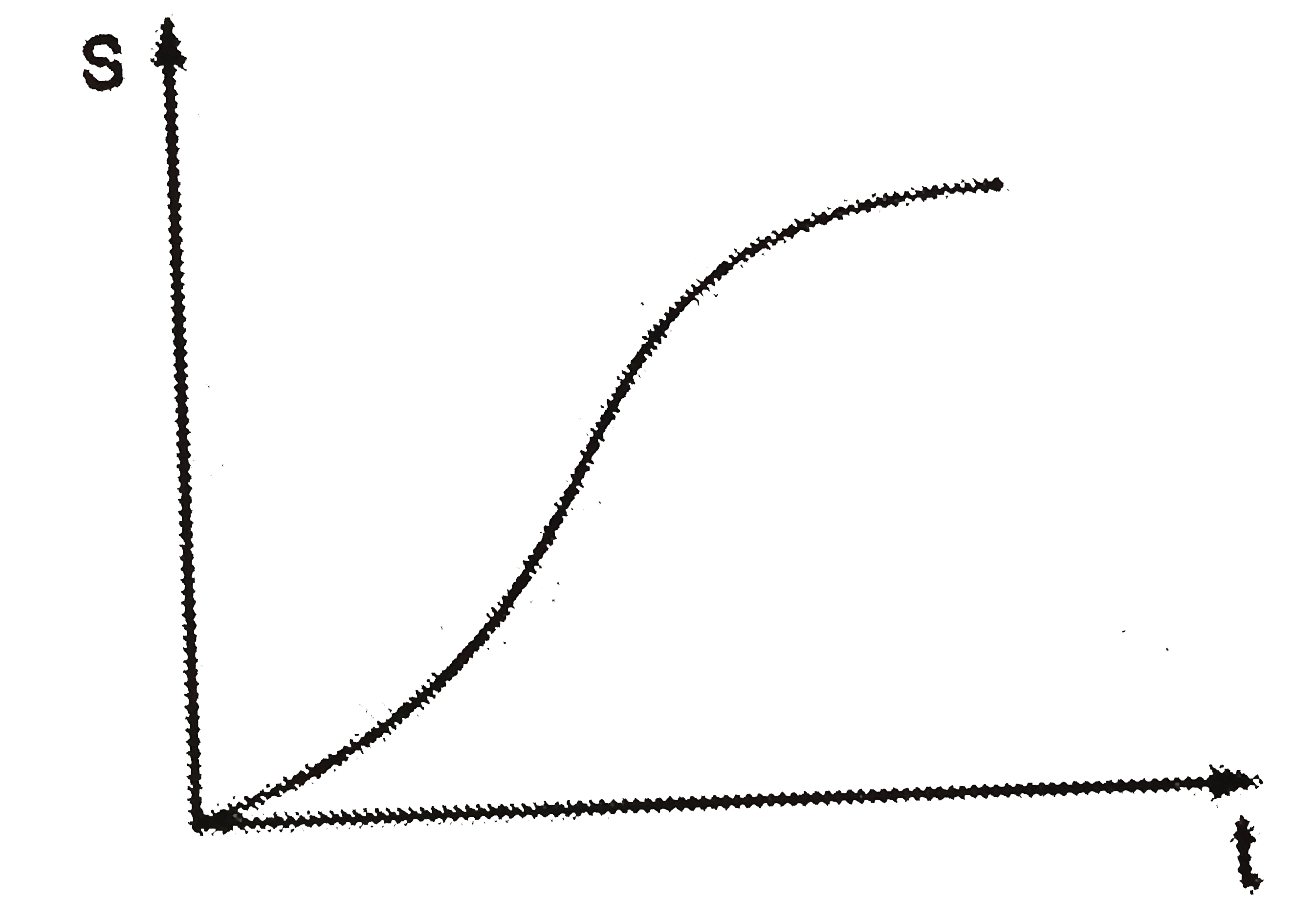
|
|
| 49. |
Three particles each of mass 'm' are located at the three vertices of an equilaterial triangle of side 'a'. If the system is revolving in a uniform circle due to their mutual force of attraction, then the angular velocity of each particle is |
|
Answer» `SQRT((Gm)/(3A^(3)))` |
|
| 50. |
A body of mass 1 kg is moving with velocity 30 ms^(-1) due north. It is acted on by a force of 10 N due east for 4 seconds. Find the velocity of the body after the force ceases to act. |
|
Answer» Solution :M = 1 kg, F = 10 N due east , t = 4s , u = 0. `a=(F)/(M)=(10)/(1)=10 ms^(-2)` due east. Final velocity due east at the END of 4 SECONDS, v = u + at `= 0+10(4)=40 ms^(-1)`. The body has initial velocity `30 ms^(-1)` due north. Which is not effected by applied force. At the end of 4 seconds, its velocity is `(40hat(i)+30hat(j))`. `V=sqrt((40)^(2)+(30)^(2))=50 ms^(-1)` Direction of resulant velocity : `tan alpha = (30)/(40)=(3)/(4)` The resultant velocity makes an angle `alpha = tan^(-1)((3)/(4))` North of east. |
|