Saved Bookmarks
This section includes 7 InterviewSolutions, each offering curated multiple-choice questions to sharpen your Current Affairs knowledge and support exam preparation. Choose a topic below to get started.
| 1. |
A body of mass 100 g is sliding from an inclined plane of inclination 30^@. If mu= 1.7, then the frictional force experienced is |
|
Answer» `(3.4)/(SQRT3) N` |
|
| 2. |
When the hands are brought closer to the body, the angular velocity of the ice dancer |
|
Answer» DECREASES |
|
| 3. |
A body is sliding down a rough inclined plane. The coefficient of friction between the body and the plane is 0.5. The ratio of the net force required for the body to slide down and the normal reaction on the body is 1:2. Then, the angle of the inclined plane is |
|
Answer» `15^@` |
|
| 4. |
A policeman in a car with a siren of frequency 8kHz is moving with uniform velocity 36km/h towards a tall building which reflects the sound waves . The speed of sound in air is 320 m s^(-1) . Calculate the frequency of the siren heard by the car drive |
|
Answer» |
|
| 5. |
A,B,C, and D are four trees, located at the vertices of a square (Fig. 5.117). Wind blows from A to B with uniform speed. The ratio of times of flight of a bird from A to B and from B to A is n. At what angle should the bird fly from the direction of wind flow, in order that it starts from A and (a) reaches C, (b) reaches D ? |
|
Answer» Solution :Let the velocity of bird w.r.t. air is `v` and the velocity of wind is `u`. The velocity of bird from `A` to `B`, `|vec v_(A B)| = v + u` Velocity of bird from `B` to `A`, `|vec v_(B A)| = v - u` `t_(A B) = (l)/(v + u), t_B A = (l)/(v - u)` `t_(A B)/(t_(B A)) = N rArr n = (v -u)/(v + u)` `(u)/(v) = (1 - n)/(1 + n)` ...(i) (a) MOTION of bird from `A to C` `vec v_("bird") = vec v_("bird, wind") + vec v_("wind") = vec v + vec u` From velocity diagram, we can use sine rule : `(u)/(sin theta) = (v)/(sin 45^@)` `rArr sin theta = (u)/(sqrt(2) v) = (1 - n)/(sqrt(2) (1 + n)` `sin (prop - 45^@) = (1 - n)/(sqrt(2)(1 + n)` `sin prop COS 45^@ - cos prop sin 45^@ = (1 - n)/(sqrt(2)(1 + n)` `sin prop - cos prop = (1 - n)/(1+ n)` SQUARING both sides, `1 - 2 sin prop cos prop = ((1 - n)/(1 + n))^2` `sin 2 prop = (4 n)/((1 + n)^2)` `rArr prop = (1)/(2) sin^-1 [(4 n)/((1 + n)^2)]` (b) For motion of bird from `A` to `D` : From vector diagram, it is CLEAR `sin theta' = (u)/(v) = (1 - n)/(1 + n)` `sin( prop - 90^@) = (1 - n)/(1 + n)` `cos prop = - ((1 - n))/(1 + n)` `prop = cos^-1 [(-(1 - n))/((1 + n))]`.  . (a)  . (b)  . |
|
| 6. |
Two ships A and B 10 km apart on a line running south to north. Ship A further north is streaming west at 20 km/h and ship B is streaming north at 20 km/h. Their distance of closest approach and how long do they take to reach it ? |
|
Answer» `5sqrt(2)KM`, 15 MIN |
|
| 7. |
In a car lift compressed air exerts a force FF_1 on a small piston having a radius of 5.0 cm, This pressure is transmitted to a second piston of radius 15cm [Fig.10.7]. If the mass of the car to be lifted is 1350 kg. calculate F_1 What is the pressure necessary to accomplish this task? |
|
Answer» Solution :Since pressure is TRANSMITTED UNDIMINISHED throughout the fluid, `F_1=A_1/A_2 F_2=(pi(5 TIMES 10^-2 m)^2)/(pi(15 times 10^-2 m)^2)(1350 kg times 9.8 ms^-2)` =1470 N `=1.5 times 10^3 N` The air pressure that will produce this force is `P=F_1/A_1=(1.5 times 10^3 N)/(pi(5 times 10^-2)^2 m)=1.9 times 10^5 Pa` This is almost double the ATMOSPHERIC pressure. Hydraulic brakes in automobiles also WORK on the same principle. When we apply a little force on the pedal with our foot the master piston. |
|
| 8. |
The gravitational field in a region is given by vecE =(5hati + 12hatj) N//kg. If a particle of mass 2kg is moved from the orgin to the point (12m,5m) in this region, the change in gravitational potential energy is: |
|
Answer» `-225 J` |
|
| 9. |
A tap supplies water at 10°c and another tap at 100°c. How much hot water must be taken so that we get 20kg of water at 35°c. |
|
Answer» 40/9 kg |
|
| 10. |
Give the values of some definite points on standard (Kelvin) scale. |
| Answer» SOLUTION :Only one point is definity on Kelvin scale and it is TRIPLE point of water and its value is 273.16 K or `0.01^(@)C`. | |
| 11. |
A ring performs pure rolling on a horizontal surface and its state at some instant of time is shown in figure. |
|
Answer» K.E. stored in the portion AB is same as K.E. stored in the portion CD In the above discussion we can understand that options (b) and (d) are CORRECT. |
|
| 12. |
If the pressure in a closed vessel is reduced by drawing out some gas, the mean free path of the molecules |
|
Answer» Is DECREASED |
|
| 13. |
A block of mass m is attached to the light spring of froce constant k and released when it is in its natural length. Find amplitude of subsequent oscillations. |
|
Answer» Solution :The maximum DISPLACEMENT of the spring in subsequent motion WIL be `(2MG)/k` The equilibrium position of the SYSTEM will occur at the extension of `(MG)/k` `:.` amplitude `=(2mg)/k-(mg)/k=(mg)/k` |
|
| 14. |
For a satellite to orbit around the earth, which of the following must be true ? (a) It must be above the equator at some time ( b) It cannot pass over the poles at any time (c) Its height above the surface cannot exceed 36,000 km (d) Its period of rotation must be gt 2pi sqrt(R//g) |
|
Answer» only B & C are true |
|
| 15. |
A car makes a displacement of 100 m towards east and then 200m towards north. Find the magnitude and direction of the resultant. |
|
Answer» `223.7m, tan^(-1)(2), N of E` |
|
| 16. |
As shown in figure, a liquid of density rho is standing in sealed container to a height h. The container contains compressed air at a gauge pressure of p.The horizontal outlet pipe has a cross-sectional area A at C and D. The cross-sectional area is A//2 at E. Find correct options: |
|
Answer» The velocity of liquid at C will be `[((P+rhogh))/(4rho)]^(1//2)` Apply BERNOULLI's theorem at A and C and E `(p+p_(0))+rhogh=p_(c)+rho(V_(c)^(2))/(2)` `=p_(0)+rho(V_(E)^(2))/(2)`….(2) `=p_(c)+p_(0)+rhogh_(1)`.(3) `A_(C)V_(C)=A_(E)V_(E),A_(C)V_(C)=((A_(C))/(2))V_(E)`.(4) from eq. (2) `(p_(0)+rhogh_(1))+rho(V_(C)^(2))/(2)=p_(0)+rho(2V_(C))^(2)` or `h_(1)=(7V_(C)^(2))/(2g)` for eq. (2), `(p+p_(0))+rhogh=(p_(0)+rhogh_(1))+rho(V_(C)^(2))/(2)` `p+rhogh=rhog((7V_(C)^(2))/(2g))+(rhoV_(C)^(2))/(2),V_(C)^(2)=((p+rhogh))/(4rho)` Discharge rate `=A_(C)V_(C)=A(((p+rhogh))/(4rho))^(1//2)` |
|
| 17. |
Two carnot engines A and B are operated in series. The first one A receives heat at 8 K and rejects toa reservoir at temperature TK. The second engine B receives the heat rejected by the first engine and in turn rejects to a heat reservoir at 2K. Calculate the temperature TK when the efficiencies of the two engines are equal. |
|
Answer» |
|
| 18. |
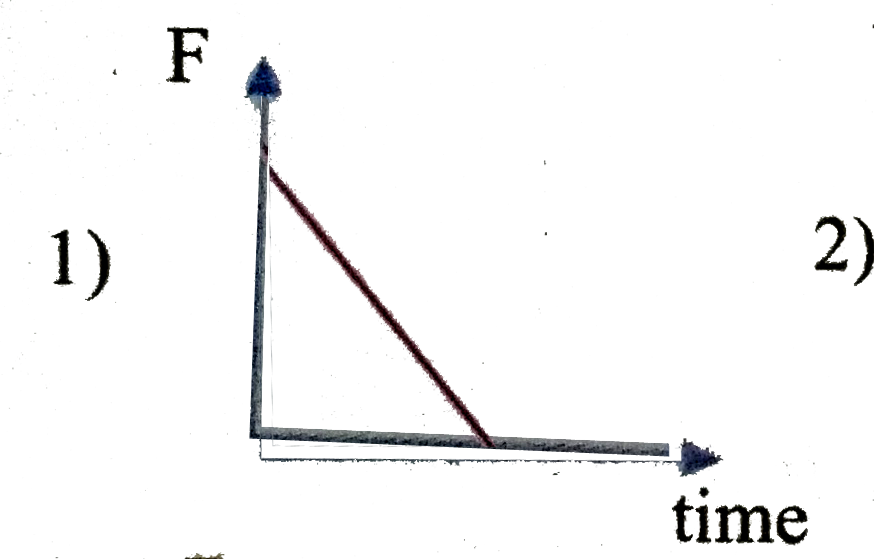
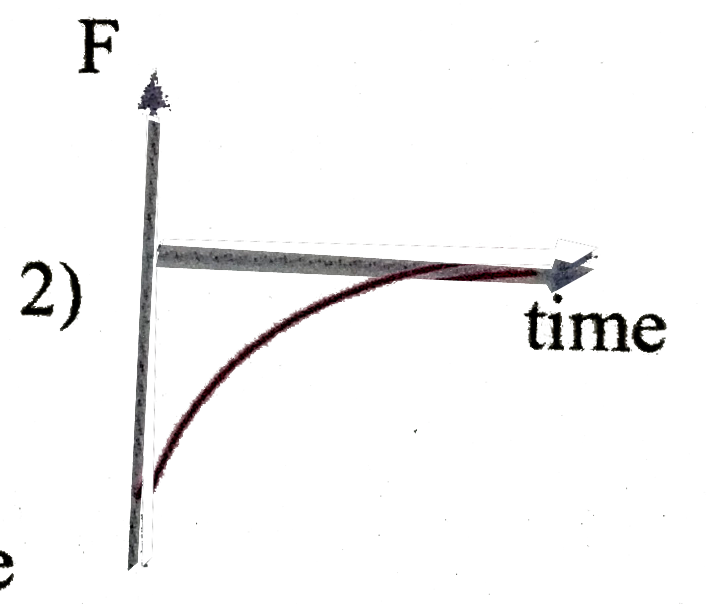
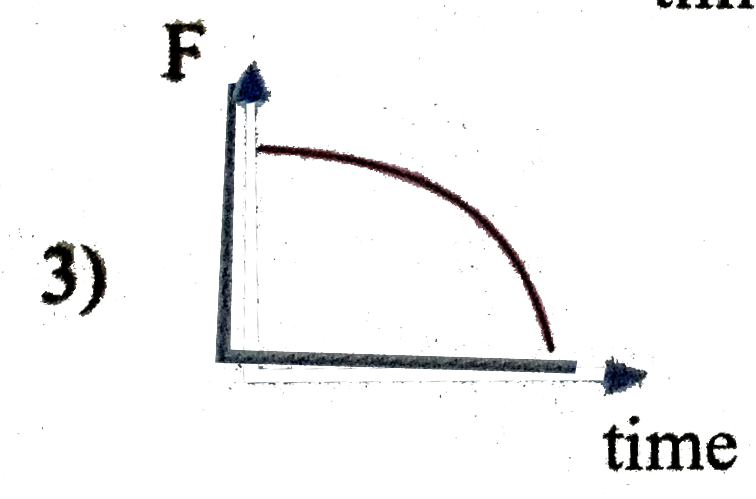
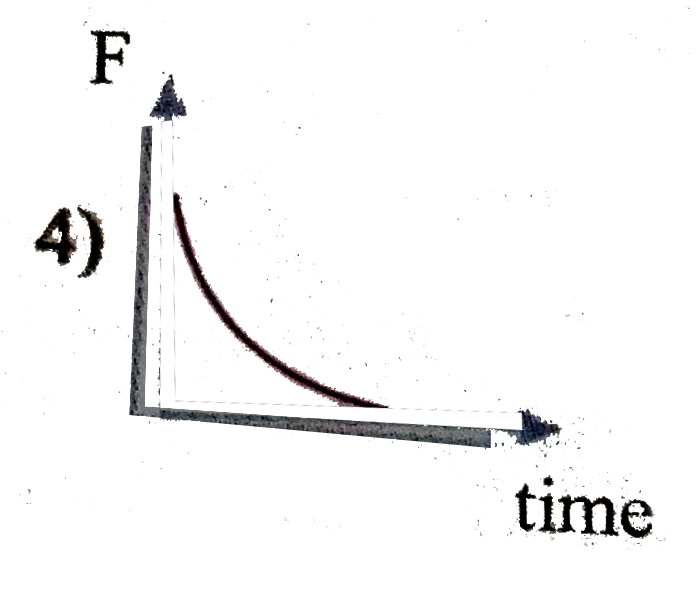
The kinetic energy (KE) versus time graph for a graph for a particle moving along a straight line is shown in the figure. The force vs time graph for the particle may be . |
|
Answer»
In this CASE, `P=Fv` Hence, `F = (P)/(V) = (K)/(sqrt((2Kt)/(m))) = (K')/(sqrt(t))` where `K^(1)` is ANOTHER constant. |
|
| 19. |
For a particle executing SHM. The kinetic energy 'K' is given by k=k_(0) Cos^(2)wt. the maximum value of KE is |
| Answer» Answer :A | |
| 20. |
The period of revolution of a satellite in an orbit becomes 8 times then what will be its radius of orbit? |
| Answer» SOLUTION :FOUR times `RARR`from `T prop r^(3/2 )` | |
| 21. |
Figure shows a weight of 30 kg suspended at one end of cord and a weight of 70 kg applied at other end of the cord passing over a pulley. Neglecting weight of rope and pulley. Find the acceleration of the system and tension in the cord (g=10 ms^(-2)) |
|
Answer» `2m//s^(2), 120 N` |
|
| 22. |
A solid cylinder of mass 10 kg is rolling perfectly on a plane of inclination 30^(@). Find the force of friction between the cylinder and the surface of the inclined plane. |
|
Answer» |
|
| 23. |
Which of the following graphs represent the behaviour of an ideal gas ? |
|
Answer»
|
|
| 24. |
A stretched rubber has ....... |
|
Answer» INCREASED kinetic energy |
|
| 25. |
In an elastic collision of two bodies, the quantities which do not change after the collision are………………….and…………………. |
| Answer» SOLUTION :Linear MOMENTUM and total energy of the SYSTEM of two bodies respectively. | |
| 26. |
Adjoining figure shows a wheel on which a point mass 'P' is fixed at top most position. Both has same mass = 0.1 kg. Instantaneously wheel is rolling without slipping on a fixed smooth horizontal surface suce that Normal Reaction between wheel and surface is 3N. What will be the normal reaction on wheel (in newton) when it completes half revolution. Take g=10m//s^(2) |
|
Answer» 1N |
|
| 27. |
A gas made of a mixture of 2 moles of oxygen and 4 moles of argon at temperature T. Calculate the energy of the gas in terms of RT. Neglect the vibrational modes. |
|
Answer» Solution :For two moles of diatomic nitrogen with no vibrational mode, `U_(1)=2xx5/2RT=5RT` For FOUR MOLE of MONATOMIC argon, `U_(2)=4xx3/2RT=6RT` Total ENERGY of the GAS, `U=U_(1)+U_(2)=5RT+6RT` U=11RT |
|
| 28. |
A container has two immiscible liquids P_(1)&P_(2), A capillary tube of radius r is inserted into the liquid so that its bottom reaches upto the denser liquid. The denser liquid in the capillary attains a height .h. from the interface of the liquids, which is equal to column length of lighter liquid. Assume angle of contact to the zero the surface tension of heavier liquid is |
|
Answer» Solution :APPLY excess PRESSURE concept `P_(A)=P_(C)=P_(O)+hP_(1)G=P_(B)` `P_(N)=P_(N)(-2T)/R=P_(0)(-2T)/R,P_(B)=P_(N)+hp_(2)g` 
|
|
| 29. |
During summers in India, one of the common practice to keep cool is to make ice balls of crushed ice, dip it in flavoured sugar syrup and sip it. For this a stick is inserted into crushed ice and is squeezed in the palm to make it into the ball. Equivalently in winter, in those areas where it snows, people make snow balls and throw around. Explain the for mation of ball out of crushed ice or snow in the light of P-T diagram of water. |
|
Answer» Solution :Refer to the P.T. DIAGRAM of WATER and double headed arrow. Increasing PRESSURE at `0^(@)C` and 1 atm takes ICE into LIQUID state and decreasing pressure in liquid state at `0^(@)C` and 1 atm takes water to ice state. When crushed ice is squeezed, some of it melts. filling up gap be tween ice flakes. Upon releasing pressure, this water freezes binding all ice flakes making the ball more stable. 
|
|
| 30. |
Black Hole is |
|
Answer» super surface of atmosphere |
|
| 31. |
White light is passed through a prism of angle 5^@ IF the refractive indices for red and blue colours are 1.641 and 1.659 respectively, calculate the angle of dispersion between them. |
|
Answer» SOLUTION :As for small ANGLE of prism `DELTA=(mu-1)A` `delta_b=(1.650-1) times 5^@=3.295^@` And `delta_T=(1.641-1) times 5^@=3.205^@` SO `theta=delta_b-delta_r=3.295^@-3.205^@=0.090^@` |
|
| 32. |
When a wire is stretched with a very large force,it breaks state Hooke's law for which part of the above graph is this applicable? |
| Answer» SOLUTION :Hooke.s LAW | |
| 33. |
What should be the volume of mercury in a glass flask of volume 150 cm^(3), so that the volume of air in the flask may remain same at all temperatures ? (The coefficient of linear expansion of glass is 8 x 10^(-6)//^(@)C and the coefficient of real expansion of mercury = 18 xx 10^(-5)//^(@)C) |
| Answer» SOLUTION :`20 CM^(3)` | |
| 34. |
Figure shows a snapshotof a sinusoidal travelling wave taken at t= 0.3 s.The wavelength is 7.5 cm and the amplitude is 2 cm. If the crest P was at x= 0at t = 0, write theequation of travelling wave. , |
|
Answer» `:. k=(2pi)/(lambda)=0.84 cm^(-1)` The wave has travelled a distance of `1.2 cm` in `0.3 s`. Hence, speed of the wave, `v=(1.2)/(0.3) = 4 cm//s` `:.` ANGULAR frequency `omega=(v)/(k)=3.36 rad//s` Since the wave is travelling along positive X-directionand crest (maximum displacement) is at `x = 0` at `t= 0` , we can write the wave equation as `y(x, t)=A cos (kx -OMEGAT)` or `y(x, t)= A cos (omegat -kx)`as`cos(- theta)= cos theta` Therefore, the desired equation is `y(x, t) = (2 cm) cos [(0.84 cm^(-1) x - (3.36 rad//s)t] cm` |
|
| 35. |
Consider a simple harmonic oscillator of mass 0.5kg, force constant 10N/m and amplitude 3cm. (a) What is the maximum speed ? (b) What is the speed when x=2? (c) If the oscillator is released from rest at x = A when t = 0, determine the position and velocity of the oscillator at t=2s. |
| Answer» SOLUTION :(a) `0.134 MS^(-1) , (B) 0.10 ms^(-1) , (C) -0.027 m, 0.062 ms^(-1)` | |
| 36. |
Explain the construction and working of an ideal lever and also explain the principle of moment of force. |
Answer» Solution :An ideal lever is a light ROD of negligible mass pivoted at the point along its length. This point is CALLED the fulcrum. The lever is a system in mechanical equilibrium.  Two forces `vec(F_(1)) and vec(F_(2))` parallel to each other and usually perpendicular to the lever, as shown here, act on the lever at distances `d_(1)andd_(2)` respectively from the fulcrum as shown in fig. Let `vecR` be the reaction of the support at the fulcrum. `vecR` is directed opposite to the forces `vec(F_(1))` and `vec(F_(2))`. The forces in upward direction are considered positive and the forces in downward direction are considered negative. For translational equilibrium `R-F_(1)-F_(2)=0....(1)` `therefore R=F_(1)+F_(2)` The lever force `F_(1)` is some weight to be LIFTED. It is called the load and its distance from the fulcrum `d_(1)` is called the load arm. Force `F_(2)` is the effort applied to lift the load, distance `d_(2)` of the effort from the fulcrum is the effort arm. For rotational equilibrium, sum of torque about a effort point should be ZERO and moment of force `tau=d xxF[because theta=90^(@), therefore sin90^(@)=1]` `therefore d_(1)F_(1)-d_(2)F_(2)=0` Here, the anticlockwise moment is considered as positive and the clockwise moment is considered as negative. So `d_(2)F_(2)` taken with negative. `therefore d_(1)F_(1)=d_(2)F_(2)` Means load arm `xx` load = effort arm `xx` effort The above equation expresses the principle of moment for a lever. The ratio `(F_(1))/(F_(2))` is called the mechanical advantage [M.A.] `therefore M.A.=(F_(1))/(F_(2))=(d_(2))/(d_(1)) [because d_(1)F_(1)=d_(2)F_(2)]` If the effort arm `d_(2)` is larger than the load arm, `[d_(2)gtd_(1)]` the mechanical advantage is greater than one. Means that a small effort can be used to lift a large load. The principle of moment holds even when the parallel force `vec(F_(1))andvec(F_(2))` are not perpendicular but act at some angle to the lever. |
|
| 37. |
Two blocks A and B of masses m& 2m respectively are held at rest such that the spring is in natural length. Find out the acceleratins of both the blocks just after release. |
|
Answer» ` G DARR , g darr` |
|
| 38. |
A simple pendulum, suspended from the roof of a car, is oscillating. What will be the time period of the pendulum when the car moves in a circular path at a constant speed? |
|
Answer» Solution :Two forces act on the pendulum bob when the car moves in a circular path at constant speed: (1) weight of the bob mg VERTICALLY downwards, (2) CENTRIFUGAL force in the bob `momega^(2)R` horizontally. (m = mass of bob, `omega` = angular velocity of bob, r = radius of the circular path) `therefore` Resultant effective force on the bob, `F=sqrt(m^(2)g^(2)+m^(2)omega^(2)r^(2))=msqrt(g^(2)+omega^(4)r^(2))` Hence, acceleration of the bob `a=F/m=sqrt(g^(2)+omega^(4)r^(2))` `therefore` Time period `T=2pisqrt(L/a)=2pisqrt(L/((g^(2)+omega^(4)r^(2))^(1//2)))` Alternative Method: When the car along with the point of suspension of the pendulum moves on a circular path horizontally, a freely falling body (along the vertical line through the point of suspension) is subjected to centripetal acceleration horizontally and acceleration due to gravity vertically. The centripetal acceleration is `omega^(2)r" "(omega` = angular velocity of point of suspension, r = radius of the circular path). `therefore` Acceleration of the body falling freely with RESPECT to the point of suspension = `sqrt(g^(2)+omega^(4)r^(2))` Hence, time period of OSCILLATION of the pendulum `T=2pisqrt(L/((g^(2)+omega^(4)r^(2))^(1//2)))` |
|
| 39. |
A particle of mass 10 g is kept on the surface of a uniform sphere of mass 100 kg and radius 10 cm.Find the work to be done against the gravitational force between them to take the particle far away from the sphere is (G=6.67xx10^(-11) Nm^2 kg^(-2)) |
|
Answer» `6.67xx10^(-10)J` |
|
| 40. |
If the external torque acting on the body zero, the component of ________ along the axis of rotation is constant. |
|
Answer» VELOCITY |
|
| 41. |
The gravitational field in a region is giveny by vecE = (2hati +3hatj) N/kg. The workdone by the field when the particle is moved on the line 3y+2x=5 |
|
Answer» SOLUTION :`vecE=2hati+3hatj` The FIELD is represented as Slope `m_1=Tan theta_1=3//2` The line 3y+2x=5 can be represented as Slope `m_2=Tan theta_2=-2//3` `m_1xxm_2=-1` Since, the direction of the field and displacement are perpendicular the WORKDONE by the field on the PARTICLE is zero. 
|
|
| 42. |
In Column-I equation describing the motion of a particle are given and in column - Il possible nature of motion {:("Column - I ","Column-II "),("A) "y= Ae^(-i(omega t + phi)), "P) SHM"),("B) " y= B sin (omega t + C cos omega t),"Q) Periodic "),("C) "y = A sin (omega t + kx),"R) Oscilator"),("D) " y = kx,"S) Rectiliner"):} |
|
Answer» |
|
| 43. |
On colliding in a closed container the gas molecules |
|
Answer» transfer MOMENTUM to the walls |
|
| 44. |
Two point size bodies of same mass are knoted to a horizontal string one at the end, and the other at the mid point of it. The string is rotated in horizontal plane with the other end as centre. If T is tension in the string between centre of circles and first body then the tension in the string between the two bodies is |
|
Answer» `(T)/(2)` |
|
| 45. |
Statement I : Coefficient of friction can be greater than unity. Statement II : Frictional force depends on normal reaction and ratio of force of friction and normal reaction cannot exceed unity. |
|
Answer» Statement I is true, statement II is true, statement II is a correct EXPLANATION for statement I. |
|
| 46. |
When the stem of a vibrating tuning fork is gently pressed on the surface of a table louder sound is heard. Why? |
| Answer» Solution :This is due to RESONANCE. The surface of the table is made to EXECUTE FORCED vibrations. | |
| 47. |
Three ships A, B & C are in in motion. The motion of A as seen by B is with speed v towards north - east. The motion of B as seen by C is with speed v towards the north- west. Then as seen by A, C will be moving towards |
|
Answer» North |
|
| 48. |
A body which weigh 100gm in air is found to weigh 50gm in a liquid at 10.5^(@)C and its weight in the same liquid is found to be 52gm at 75.5^(@)C. If the coefficient of cubical expansion of the body is 2.4 xx 10 ^(-4)//^(@)C, then calculate the coefficient of cubical expansion of liquid. |
| Answer» SOLUTION :`8.55 XX 10 ^(-4) //^(@)C` | |
| 49. |
A star 2.5 times the mass of the sun which collapsed to a radius of 12 km rotates with a speed of 1.5 rev. per second. (Extremely compact stars of this kind are known as neutron stars. Certain observed stellar objects called pulsars are believed to belong to this category). Will an object placed on its equator remain struck to its surface due to gravity ? (Mass of the sun = 2 xx10^30 kg). |
|
Answer» Solution :The object will remain struck to the surface of star due to GRAVITY, if the acceleration due to gravity is more than the centrifugal acceleration due to its rotation. Acceleration due to gravity,`g = (GM)/(R^2) = (6.67 xx 10^(-11) xx 2.5 xx 2 xx 10^30)/((12000)^2) = 2.3 xx 10^12 MS^(-2)` Centrifugal acceleration = `r omega^2 = r(2pi V)^2 = 12000 (2pi xx 1.5)^2 = 1.1 xx 10^6 ms^(-2)` SINCE `g GT r omega^2` , the body will remain struck with the surface of star. |
|
| 50. |
What happens to the change in internal energy of a gas during (b) adiabatic expansion expansion? |
| Answer» SOLUTION :For adiabatic EXPANSION, `DeltaQ=0`. So From first law, `-DeltaU=DeltaW`. During expansion `DeltaW` is positive and hence `DeltaU` must be NEGATIVE. That is, internal ENERGY of a gas decreases during adiabatic expansion. | |