

Saved Bookmarks
This section includes 7 InterviewSolutions, each offering curated multiple-choice questions to sharpen your Current Affairs knowledge and support exam preparation. Choose a topic below to get started.
| 1. |
Suppose, the torque acting on a body is given by tau = KL + xI//omegaWhere L = angular momentum, I= moment of inertia, omega= angular speed. The dimensional formula for Kxis same as that for |
|
Answer» `"TIME"^2` |
|
| 2. |
The focal length of a lens depends upon |
|
Answer» NATURE of the MATERIAL of LENS |
|
| 3. |
In case of an electromagnetic wave, the radiation pressure has the dimensions of |
| Answer» Solution :energy density | |
| 4. |
If the temperature is increased in semi-conductors such that the resistance incessantly falls, it is termed as. |
|
Answer»
 We have `(f_(L))/(V + v _(L)) = (f _(S))/( v + v _(S))` `therefore (f _(L))/( v + 0) = (f _(S))/( v -v _(S))` `therefore f _(L) = ((v)/(v - v _(S)) ) f _(S) ""...(1)`  We have `(f ._(L))/( v + v _(L)) = (f _(S))/( v + v _(S))` `therefore (f ._(L))/( v + 0) = (f _(S))/( v + v _(S))` `therefore f ._(L) = ((v)/( v + v _(S)) ) f _(S)""...(2)` Taking ratio of EQUATION (2) to equation (1) we get, `(f ._(L))/( f _(L)) = ((v - v _(S))/( v + v _(S)))` ` therefore f ._(L) = ((v - v _(S))/( v + v _(S))) f_(L)` `therefore f ._(L) lt f _(L)` Figure given in option (C) is correct. |
|
| 5. |
One mole of an ideal gas at an initial temperature to is taken through a process in which its pressure P varies with absolute temperature T is P=(2P_(0))/((1+T//T_(0)). Find its initial pressure and volume and find its temperature and volume when its pressure is half of the initial value. |
|
Answer» <P> |
|
| 6. |
Find the position of centre of mass of the system of 3 objects of masses 1kg, 2kg and 3kg located at the corner of an equilateral triangle of side 1m. Take 1 kg mass object at the origin and 2 kg along x-axis. |
Answer» Solution : `x_(cm)=(m_(1)x_(1)+m_(2)x_(2)+m_(3)x_(3))/(m_(1)+m_(2)+m_(3))` `impliesx_(cm)=(1xx0+2xx1+3xx(1)/(2))/(1+2+3)impliesx_(cm)=(7)/(12)m` `Y_(cm)=(m_(1)y_(1)+m_(2)y_(2)+m_(3)y_(3))/(m_(1)+m_(2)+m_(3))` `impliesY_(cm)=(1xx0+2xx0+3xx(sqrt(3))/(2))/(1+2+3)impliesY_(cm)=(sqrt(3))/(4)m` `:.` Co-ordinates of CENTRE of mass `(x_(cm),y_(cm))=((7)/(12)m,(sqrt(3))/(4)m)` |
|
| 7. |
Which of the following examples represent (nearly) simple harmonic motion and which represent periodic but not simple harmonic motion? |
|
Answer» the rotation of earth about its axis. |
|
| 8. |
A uniform rope of length L resting on a smooth horizontal floor is pulled at one end by a force F.The tension in the rope at a distance L/4 from the end where the force is applied is |
|
Answer» F/4 |
|
| 9. |
Two masses m and M are suspended together by a massless spring of force constant K'. When the masses are in equilibrium, M is removed with out disturbing the system. The amplitude of oscillation is |
|
Answer» `(MG)/(K)` |
|
| 10. |
Figure shows two wave opulses at t=0 travelling on a string i opposite directions with the same wave speed 50 cms^-1. Sketch the shape of the string at t=4ms, 6ms, 8ms and 12 ms. . |
|
Answer» `t=4ms=4xx10^-3s,` `s=vt=50xx10xx4xx10^-3` =2MM `t=8ms=8xx10^-3s` `s=vt=50xx10xx8xx10^-3` =4mm `t=6ms=6xx10^-3s,` `s=50xx10xx6xx10^-3` =3mm t=12ms `=12xx10^-3s, ` `s=50xx10xx2xx10^-3` `=6MM` The shape of the string at different times are shown in the figure. |
|
| 11. |
Find the value of 2.2+4.08+3.125+6.3755. |
|
Answer» Solution :Out of all the FOUR numbers `2.2`has got the LEAST number of DECIMAL PACES -one . Hence we should retain only two decimal places in the remaining numbers. Hence `4.08` remains as it is `3.125` is to be rounded off as `3.12` (as 2before 5 is even ) `6.3755` is to be rounded of as `6.38`(as 7 before 5 is odd). Now adding` 2.2+4.08+3.12+6.38=15.78`. FINALLY we should have only one decimal place and hence `15.78`is to be rounded off as `15.8.` |
|
| 12. |
The centre of mass of two particles with masses 2kg and 6kg located at (1, 1,1), (2, 2, 1) respectively has the coordinates |
|
Answer» `((7)/(4),(7)/(4),(7)/(4))` |
|
| 13. |
According to work-energy theorem, the work done by the net force on a particle is equal to the change in its |
|
Answer» kinetic ENERGY |
|
| 14. |
A ball of mass 'm' is thrown at an angle is 'theta' with the horizontal with an initial velocity 'u'.The change in its momentum during its flight in a time interval of 't' is |
|
Answer» mgt |
|
| 15. |
An experiment measures quantities a,b,c and then yis calculated as y= (ab^2)/(c^3) .The percentage errors in a.b.c are pm 1% , pm 3% and pm2% respectively. What is the percentage error in y? |
| Answer» ANSWER :A | |
| 16. |
Obtain an expression of total energy of satelliterevolving around the earth. |
|
Answer» Solution :`implies`SUPPOSE, a satellite of mass m revolves around the earth at a distance r from the centre of earth. Its orbital velocity is `v_0` `implies` Satellite is in gravitational field hence its potential energy , `V=(GM_(E)m)/r ""...(1)` `implies` Kinetic energy of satellite `K=1/2mv_0^2` `:. K=1/2m(sqrt((GM_E)/r))^2""( :. v_0=sqrt((GM_E)/r))` `:. K = (GM_Em)/(2r) ` where `r = R_(E)+h""...(2)` `implies` Total energy of satellite , E = V + K `E= - (GM_(E) m)/(2r) ""....(3)` `implies ` Negative sign indicates that satellite is in bound STATE to the gravitational field of earth. `implies` Kinetic energy and potential energy at infinity distance is zero. Hence total energy will be zero. To escape to INITIAL energy equal to total energy or greater than this positive energy is given to the satellite, OTHERWISE it rotating constantly in orbit. This indicates this satellite is in the bound state with gravitational field of earth. |
|
| 17. |
The rate of change of velocity is 1ms^(-2)when a force is applied on the body of mass 75 gm the force is |
|
Answer» 75 N `F= ma` ` = 75gm xx1 cm s^(-2) = 75xx 10^(-3) xx 1 = 75xx 10^(-3) = 0.075N` |
|
| 18. |
What happens to the wavelength of sound when the source of sound is at rest and the observer moving towards it ? |
|
Answer» Solution :The wavelength of SOUND REMAINS the same. i.e.,` lambda_(0)=lambda =v//f_(0)`. |
|
| 19. |
If a particle has moved from one position to another position, then : |
|
Answer» its DISTANCE is zero |
|
| 20. |
Statement I: A concept of pseudo forces is valid both for inertial as well as non-inertial frame of reference. Statement II: A frame accelerated with respect to an inertial frame is a non-inertial frame. |
|
Answer» STATEMENT I is true, statement II is true, statement II is a CORRECT explanation for statement I. |
|
| 21. |
If |vec(A )| = |vec(B)| andvec(A) !=+- vec(B) then angle between the vectors (vec(A) +vec(B)) and(vec(A)-vec(B)) is : |
| Answer» ANSWER :D | |
| 22. |
Two resistors of resistances R_1 = 100 pm 3 ohm and R_2 = 200 pm 4ohm are connected (a) in series , (b) in parrallel. Find the equivalent resistance of the (a) series combination , (b) parallel combination . Use for (a) the relation R = R_1 + R_2 andfor (b) 1/R = 1/(R_1) + 1/(R_2) and (DeltaR')/(R^(,2)) = (DeltaR_1)/(R_1^2) + (DeltaR_2)/(R_2^2) |
|
Answer» `300 Omega` |
|
| 23. |
A body of mass 60kg is pushed with just enough force to start it moving on a rough surface with mu_(s)= 0.5 and mu_(k) =0.4 and the force continues to act afterwards. The acceleration of the body is (in m//sec^(2)) |
|
Answer» 0.98 |
|
| 24. |
First list includes the name of object rolling down an inclined plane. Inclined plane makes an angle with the horizontal. Friction is sufficient enough for pure rolling Second list includes linear acceleration of object along the plane. Match the two lists. |
|
Answer» `{:(P,Q,R,S),(4,1,2,3):}` 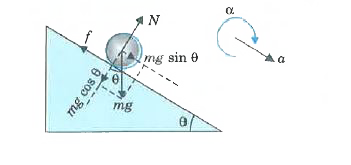 For pure rolling we can write angular acceleration `alpha=(a)/(r)`. Equation for the linear motion along the plane can be written as follows: `mg sin theta-f = ma "".....(i)` Equation for rotational motion about the centre of object can be written as follows: `fr=I alpha rArr fr=I(a)/(r)` `rArr =(Ia)/(r^(2)) "".....(ii)` SUBSTITUTING from equation (ii) in equation (i) we get `a=(mg sin theta)/(m+(I)/(r^(2))) ""...(iii)` We can use moment of inertia (I) according to nature of object. Ring: `a=(mg sin theta)/(m+m)=(1)/(2) g sin theta` Hollow sphere : `a=(mg sin theta)/(m+(2)/(3)m)=(3)/(5) g sin theta` DISCE `: a=(mg sin theta)/(m+(1)/(2))m)=(2)/(g) g sin theta` Solid sphere `: a=(mg sin theta/(m+(2)/(5) m)=(5)/(7) g sin theta` |
|
| 25. |
The mass of a litre of dry air at N.T.P is 1.293 g. Find the mass of 3 litres of air at 117^(@) C and a pressure of 4 atmospheres ? |
|
Answer» 10.86g |
|
| 26. |
If vec(a)_(1) and vec(a)_(2) are two collinear unit vectors and if |vec(a)_(1)+vec(a)_(2)|=sqrt(3), then the value of (vec(a)_(1)-vec(a)_(2)).(2vec(a)_(1)+vec(a)_(2)) is |
|
Answer» Solution :`a_(1)=a_(2)=1` and `a_(1)^(2)+a_(2)^(2)+2a_(1)a_(2)cos theta = (SQRT(3))^(2)=3` or `1+1+2cos theta=3` or `cos theta = 1//2` Now `(vec(a)_(1)vec(a)_(2)).(2vec(a)_(1)+vec(a)_(2))=2a_(1)^(2)-a_(2)^(2)-a_(1)a_(2)cos theta` `= 2-1-(1)/(2)=(1)/(2)` |
|
| 27. |
A plate of area 100cm^(2) is placed on the upper surface of castor oil 2mm thick. Taking the coefficient of viscosity to be 15.5 poise, calculate the horizontal force necessary to move the plate with a velocity of 3cm//s? |
|
Answer» SOLUTION :From `F=-etaA(DV)/(dx)` `F=-15.5xx100xx(-3)/(0.2)=232.5xx10^(2)` dyne `=232.5xx10^(-3)N` |
|
| 28. |
Distinguish between internal and external forces. |
Answer» SOLUTION :
|
|
| 29. |
one end of a thead of lengthh has a stone tied to it . Taking the other end as the centre, it is revolved in a vertical plane. When the stone reaches the lowest point of its path, it attains the speed u. when the thread is horizontal ,the speed of the stone is |
|
Answer» `SQRT(u^2-2gh)` |
|
| 30. |
If there were no gravity, which of the following will not be there for a fluid? |
|
Answer» viscosity |
|
| 31. |
The horizontal range of a projectile fired at an angle of 15° is 50 m. If it is fired with the same speed at an angle of 45°, its range will be |
|
Answer» 60 m |
|
| 32. |
The efficiency of a heat engine if the temperature of the source is 100^(@)C and sink is 27^(@)C is nearly |
|
Answer» 0.1 |
|
| 33. |
Two equal spheres A and B lie on a smooth horizontal circular groove at opposite ends of a diameter. At time t = 0.A is projected along the groove and it first impinges on B at time t = T, and again at time t = T_(1)Ife is the coefficient of restitution, find the ratio of T _(2) //T_(1). |
Answer» SOLUTION : `T _(1) = (pi R )/( u _(1)) ""...(1)` `(v _(2) - v _(1))/(u _(1)) = e implies v _(2) - v _(1) = EU _(1)` .A. makes `2^(nd)` impact with B when B travels a distance `2pi R` as SEEN by A after `1 ^(st)` impact. TIME taken to collide A and B again: `T _(2) - T _(1) = (2pi R )/( v _(2) - v _(1)) implies T _(2) - T _(1) = (2pi R )/( eu _(1)) ...(2)` `(2)div(1) implies(T _(2))/( T _(1)) = (2 + e )/( e)` |
|
| 34. |
A ball dropped on to the floor from a height of 40 m and rebounds to a height of 10 m. If the ball is in contact with the floor for 0.02 s, its average acceleration during contact is |
|
Answer» `1050m//s^(2)` |
|
| 35. |
The origin of the centripetal force can be |
|
Answer» GRAVITATIONAL FORCE |
|
| 36. |
Why are passengers thrown forward from therir seats when a speeding bus stops suddenly ? |
| Answer» Solution :This is DUE to INERTIA of MOTION. When the speeding bus STOPS suddenly,lower part of the body in CONTACT with the seat stops. But the upper part of the body tends to maintain its state of uniform motion. Hence the passengers are thrown forwards. | |
| 37. |
The radius of a sphere is 6.01 cm. Its volume to four significant figures is |
|
Answer» `909.7 "CM"^(3)` |
|
| 38. |
A ball of 200 g is at one end of a string of length 20 cm. It is revolved in a horizontal circle at an angular frequency of 6 rpm. Find (i) the angular velocity, (ii) the linear velocity, (iii) the centripetal acceleration, |
|
Answer» SOLUTION :(i) The angular VELOCITY, `omega = (2pi N)/(t) = (2pi xx 6)/(60) = (pi)/(5) = 0.6284 "rad s"^(-1)` (ii) The LINEAR velocity, `v = r omega` `= 0.20 xx 0.6284 = 0.1257 ms^(-1)` (iii) The CENTRIPETAL acceleration, `a_(c) = r omega^(2)` `= 0.20 xx (0.6284)^(2) = 0.0790 ms^(-2)`. |
|
| 39. |
A particle traversed half of the distance with a velocity of V_0. The remaining parts of the distance was covered with velocity V_1 for half of the time and with V_2 for other half of the time. Find the mean velocity of the particle averaged and the whole time of motion |
|
Answer» `(2v_(0)(v_(1)+v_(2)))/(v_(1)+v_(2)+2v_(0))` |
|
| 40. |
If the value of g on the surface of the moon is g/6, the time period of a pendulum on the surface of the moon w.r.t time period on the earth will be |
| Answer» Answer :A | |
| 41. |
Find the point at which the gravitational force acting on any mass is zero due to the earth and the moon system.The mass of the earth is approximately 81 times the mass of the moon and the distance between the earth and the moon is 3,85,000 km. (Such a point is called neutral point). |
| Answer» SOLUTION :The POINT is at a DISTANCE of 38,500 KM from the MOON | |
| 42. |
For the given vehicle, its stopping distance is proportional to .......... of the speed. |
| Answer» SOLUTION :SQUARE. | |
| 43. |
No work is done by a force on an object if (a) the force is always perpendicular to its velocity (b) the force is always perpendicular to its acceleration (c ) the object is stationary but the point of application of the force moves on the object (d) the object moves in such a way that the point of application of the force remains fixed |
|
Answer» B, C & d are correct |
|
| 44. |
A body is projected with the 24ms^(-1) making an angle 30^(@) with the horizontal. Find the angle made by the direction of the projectile with the horizontal at 2s from start is |
|
Answer» |
|
| 45. |
The pitch of a screw gauge is 1 mm and there are 100 divisions on the circular scale. In measuring the diameter of a sphere there are six divisions on the linear scale and forty divisions on circular scale coincides with the reference line. Find the diameter of the sphere. |
|
Answer» Solution :`L.C. = (1)/(100)= 0.01 mm` Linear SCALE reading 6(pitch) = 6 mm CIRCULAR scale reading `40 x× 0.01 = 0.4` mm Total reading = (6 + 0.4) = 6.4 mm |
|
| 46. |
C_p//C_vratio for a gas mixture consisting of 4g of helium and 32g of oxygen is N times 0.5. ThenN is equal to |
|
Answer» |
|
| 47. |
Obtain equations of motion for constant acceleration using method of calculus. |
|
Answer» SOLUTION :By definition `a=(d upsilon)/(dt)` `d upsilon = a dt` INTEGRATING both SIDES `int_(upsilon_(0))^(upsilon)d upsilon = int_(0)^(t) a dt` `= a int_(0)^(t) dt ""` (a is constant) `upsilon - upsilon_(0)=at` `upsilon=upsilon_(0)+at` Further,`upsilon = (dx)/(dt)` `dx = upsilon dt` Integrating both sides `int_(x_(0))^(x)dx=int_(0)^(t)upsilon dt` `=int_(0)^(t)(upsilon_(0)+at)dt` `x-x_(0)=upsilon_(0)t+(1)/(2)at^(2)` `x=x_(0)+upsilon_(0)t+(1)/(2)at^(2)` We can write `a=(d upsilon)/(dt)=(d upsilon)/(dx)(dx)/(dt)=upsilon (d upsilon)/(dx)` or `upsilon d upsilon = a dx` Integrating both sides, `int_(upsilon_(0))^(upsilon)upsilon d upsilon = int_(x_(0))^(x)a dx` `(upsilon^(2)-upsilon_(0)^(2))/(2)=a(x-x_(0))` `upsilon^(2)=upsilon_(0)^(2)+2a(x-x_(0))` The advantage of this method is that it can be used for motion with non-uniform acceleration ALSO. Now, we shall use these equations to some important cases. t |
|
| 48. |
The moment of inertia of a uniform semicircular disc of mass M and radius r about a line perpendicular to the plane of the disc through the centre is ……….. |
|
Answer» `(1)/(2)MR^(2)` `2I=(2Mr^(2))/(2)` `therefore I=(Mr^(2))/(2)` |
|
| 49. |
A solid cone of mass (m=1 kg) is placed on a plank of mass M =10 kg which is placed on a smooth horizontal plane. The coefficient of friction between cone and the plank is 1/4. If a horizontal force F is applied on the plank, then the maximum value of F for which the cone is in equilibrium with respect to plank if Fgtn where n is |
|
Answer» |
|
| 50. |
The ratios of lengthareas of cross-section and Young's moduliiof steel of that of brass wires shown in the figure are a,b and c respectively . The ratio of increase in the lengths of brass of that of steel wires is [Assume that the masses ofsteel and brass wires are negligible] |
|
Answer» `(4a)/(7BC)` |
|


