

Saved Bookmarks
This section includes 7 InterviewSolutions, each offering curated multiple-choice questions to sharpen your Current Affairs knowledge and support exam preparation. Choose a topic below to get started.
| 1. |
Time period (T) and amplitude (A) are same for two particles which undergo SHM along the same line starting from same time, At one particular instant, one particle is at phase (3pi)/2 and other is at phase zero, while moving in the same direction. Find the time at which they will cross each other: |
|
Answer» `4T//3` |
|
| 2. |
Center of mass may lie |
|
Answer» within the BODY |
|
| 3. |
A man with a bucket of water in his hand is standing inside a lift moving upwards. Write (i) whether the man does any work on the bucket of water |
| Answer» SOLUTION :As there is no displacement of the BUCKET with respect to the man , no WORK is done by the man no it. | |
| 4. |
Two different met.al rods of equal lengths and equal areas of cross -section have their ends kept at the same temperatures theta_(1) and theta_(2) .If k_(1) and K_(2) are their thermal conductivities, rho_(1) and rho_(2) their densities and s_(1) and s_(2) their specific haat. then the rate of flow of heat in the two rods will be the same if |
|
Answer» `(k_(1))/(k_(2)) = (rho_(1) s_(1))/(rho_(2) s_(2))` |
|
| 5. |
A beaker containing water is placed on the pan of a balance which shows a reading of M. A lump of sugar of mass mand volume V_(0), is now suspended by a thread (from an independent support) in such a way that it is completely immersed in water without touching the beaker and without any overflow of water. How will reading of the balance change as time passes by? |
|
Answer» SOLUTION :Immediately after the immersion, a thrust force B=PuoYo acts on the lump of sugar vertically upwards. In turn, according to Newton.s third law an equal and opposite thrust force acts on water vertically downwards. Therefore, the reading of balance will now be equal to `M+(B)/(g)=M=rhoH_(2)OV_(0)` Now, as the sugar DISSOLVES, the thrust force decreases. However, as dissolved sugar comes into solution, weight of the solution increases. Finally, when all the sugar is dissolved, thrust force becomes (M+m)g. So, reading of the balance CHANGES CONTINUOUSLY from`(M+rhoH_(2)OV_(0))` to (M+m) |
|
| 6. |
When a liquid moves steadily under come pressure through a horizontal tube, it moves in the form of cylindrical layers coaxial to the exds of the tube. The velocity of different layers is different. The velocity of the layer is maximum along the axis of the tube and it decreases as one moves towards the walls of the tube. According to Poiseuille, the rate of flow of liquid through a horizontal capillary tube varies as the relation V alpha (pr^(4))/(eta l) where l and rare the length and radius of the tube and p is the pressure different between the ends of the tube and is the constant of proportionality. Which of the following is correct: |
|
Answer» The unit of COEFFICIENT of viscosity is Pa-s. |
|
| 7. |
When the pressure of a gas is doubled under constant temperature the density becomes |
|
Answer» DOUBLE |
|
| 8. |
Neglecting friction and the mass of the pulleys, find the acceleration of the mass Q assuming that P=Q (Figure 5.20). |
|
Answer» |
|
| 9. |
In which of the following pairs of temperature scales, the size of a degree is identical? |
|
Answer» MERCURY scale and IDEAL GAS scale |
|
| 10. |
A particle moves in the x-y plane according to the equation, vecr=(hati+hatj)(A sin omegat+B cos omegat). Motion of the particle is : |
|
Answer» PERIODIC |
|
| 11. |
Due to thermal expansion with rise in temperature (a) Metallic scale reading becomes lesser than true value (b) Pendulum clock goes fast (c) A floating body sinks a little more (d) The weight of a body in a liquid increases |
|
Answer» only (a) is CORRECT |
|
| 12. |
If heat given to a system is 6 kcal and work done is 6kj, then calculate the change in internal energy. |
|
Answer» Solution :`DELTA Q = Delta U + Delta W` `:. Delta U = Delta Q - Delta W = (6 xx 1000 xx 4.2) - (6 xx 1000)` `= 6000(4.2-1) = 6000 xx 3.2 = 19.2 xx 1000 = 19.2 KJ` |
|
| 13. |
A man can jump 1.5m high on the earth. Calculate the approximate height he might be able to jump on a planet whose density is one-quarter that of the earth and whose radius is one-third of the earth's radius. |
|
Answer» no change |
|
| 14. |
If fundamental frequency of a given closed pipe is 50 Hz, then frequency for second overtone is….. |
|
Answer» SOLUTION : For closed pipe, frequency is `f _(n) =(2n -1) f _(1) ` For second OVERTONE we should taken n =3. Hence `f _(3) = 5f _(1) = 5 xx 50 = 250 Hz` |
|
| 15. |
The magnitude of the vector is |
|
Answer» `|VECA| = Ax^2 + Ay^2 + Az^2` |
|
| 16. |
If a black body is heated at a high temperature, it seems to be |
|
Answer» Blue |
|
| 17. |
A wheel has angular acceleration of 3" rad/s"^(2) and initial angular speed of 2.00 rad/s. In a time 2 sec. it has rotated through an angle……….rad of : |
|
Answer» 10 `theta=omega_(0)t+(1)/(2)alphat^(2)` Here initial angular SPEED `omega_(0)=2" RAD/s"` Angular acceleration `alpha=3` rad/s and time `t=2` `theta=(2xx2)+(1)/(2)(3)(2)^(2)` `=4+(1)/(2)xx3xx4` `therefore theta=10` rad |
|
| 18. |
Obtain the velocity of projected particle executing uniform circular motion. |
|
Answer» SOLUTION :The linear VELOCITY of a particle moving in a circular path of radius A with angular speed `omega` is the radius time to angular velocity. `THEREFORE v= A omega` The DIRECTION of linear velocity of a particle at time t is in the direction of tangent at a point on the circle at that time. According to figure, two matual components of linear velocity `A omega`, component `A omega SIN (omega t+ phi)` in X-axis direction, is the velocity of projection on X-axis of a particle at time t. `therefore v(t)= -A omega sin (omega t+phi)` Direction of v(t) is oppositre to X-axis and it is the isntantaneous velocity of particle executing SHM. 
|
|
| 19. |
"The dynamic friction is a little less than the limiting friction ". Why ? |
| Answer» Solution :Where the BODY is in MOTION chance of interlocking of IRREGULARITIES is reduced. | |
| 20. |
A person is in contact with inner wall of a vertical hollow cylinder of radius 2m without floor under his feet, remains in equilibrium without slipping down when the cylinder is rotated about it's own vertical axis. If the coefficient of static friction between person and wall of cylinder is 0.4, the minimum angular velocity of cylinder should be |
|
Answer» `1.5 rad//s` |
|
| 21. |
A particle 'P is moving in a circle of radius 'r' with uniform speed v. AB is the diameter of circle and 'C' is the centre. The angular velocity of P about A and C are in the ratio. |
|
Answer» `1:1` |
|
| 22. |
What will be the effect on the angle of contact of a liqud if the temperature increases? |
| Answer» Solution :With the increase in temperature, the surface TENSION of a liquid decreases. CONSEQUENTLY the ANGLE of CONTACT of a liquid increases with the increase in temperature. | |
| 23. |
(A) : Moment of inertia plays the same role in rotational motion, as mass plays in linear motion.(R ) : Moment of inertia depends only on mass of the body. |
|
Answer» Both (A) and (R ) are TRUE and (R ) is the correct EXPLANATION of (A) |
|
| 24. |
If the angle between force and displacement is obtuse, then the work done is |
|
Answer» positive |
|
| 25. |
Is the time variation of position, shown in the adjacent figure observed in nature ? |
Answer» Solution :No, a body cannot OCCUPY two DIFFERENT POSITIONS at the same instant of time.
|
|
| 26. |
Two circular rings of equal mass and radius are placed touching each other. The moment of inertia of the system abouttangential axis in the plane of system passing through point of contact of rings is |
|
Answer» `3mr^(2)` |
|
| 27. |
Which characteristic of SHM is given by the radius of a reference circle ? |
| Answer» Solution :The radius of the REFERENCE circle GIVES .AMPLITUDE. of SHM | |
| 28. |
The total weight of a loaded four wheeler is 10000 kg. All the wheels show an air pressure of 40 kg f/cm""^(2) each. If all wheels are identical and load is distributed equally on all the four wheels, then find the area of contact of each wheel with the road. |
|
Answer» |
|
| 29. |
The oscillation of a body on a smooth horizontal surface is represented by the equation, x=Acosomegat, where x = displacement at time t, omega = frequency of oscillation. Which one of the following graphs shows correctly the variation a with t ? Here, a = acceleration at time t and T = time period. |
|
Answer»
So, VELOCITY, `V=(DX)/(dt)=-Aomegasinomegat` and acceleration, `a=(dv)/(dt)=-Aomega^(2)COSOMEGAT` Now at t = 0, `a=-Aomega^(2)` ant at t = T, `a=-Aomega^(2)` |
|
| 30. |
A particle moves according to the equation t=sqrt(x)+3, where will be the particle come to the rest for the first time |
|
Answer» Solution :`X=(t-3)^(2)` `x=t^(2)-6t+9` `v=(dx)/(DT)=2t-6` `0=2t-6impliest=3s` |
|
| 31. |
Density remaining constant, if earth contract to half of its present radius, duration of the day would be (in minutes) |
|
Answer» 45 |
|
| 32. |
A cube of mass.m. and side .a. moving along with a constant speed v_0 as shown in figure. The magnitude of angular momentum of cube about z-axis would be: |
|
Answer» `(mv_(0)B)/2` |
|
| 33. |
Internal energy of n_1moles of hydrogen at temperature T is equal to the internal energy of n_2moles of helium at temperature 2T. Then the ratio n_1//n_2 is : |
|
Answer» `3/5` |
|
| 34. |
A bomb explodes in air when it has a horizontal speed of v, It breaks into two identical pieces of equal mass. If one goes vertically up at a speed of 4v, find the velocity of the other immediately after the explosion. |
|
Answer» |
|
| 35. |
What is the reason for floating of clouds in the sky? |
| Answer» Solution :The WATER particles of cloudsattain a terminal velocity while moving through AIR, Since the VELOCITYIS low they remain suspended in the sky. The terminal velocity is proportional to the square of the radius. For bigger drops, the terminal velocity BECOME high and so they FALL freely. | |
| 36. |
The diagram show a force-extension graph for a rubber band. Consider the following statementsa) It will be easier to compress this rubber than expand it b) Rubber does not return to its original length after it is stretched c) The rubber band will get heated if it is stretched and releasedWhich of these can be deduced from the graph |
|
Answer» C only |
|
| 37. |
The …………. Of a measurement is a measure of ………… the …………. Value is to the ………………. Of the quantity. |
|
Answer» |
|
| 38. |
A uniform rope of mass m and length L is pulled by applying force at one of the ends. Along a frictionless inclined plane of inclination theta with horizontal such that it moves with acceleration a. the tension in the rope at a distance x from the free end is |
|
Answer» `(MX)/L g SIN theta` |
|
| 39. |
Find the value of .g(i).at a height of 100 km (ii) at height 6400km from the surface of the earth. (Radius of the earth = 6400km , g on the surface of the earth = 9.8 ms^(-2) . |
|
Answer» Solution :Using `g_(h) = g(1-(2H)/R)` with h = 100km and R = 6400 KM , `g_(g)= 9.494m//s^2` II) using `g_(h)=(g)/(1+h/R)^2` with h R g = ` 2.45 ms^(-2)` |
|
| 40. |
(a) Find the moment of inertia of a sphere about a tangent to the sphere, given the moment of interia of the sphere about any of its diameter to be 2 MR^(2)//5, where M is the mass of the sphere and R is the radius of the sphere, (b) Given the moment of inertia of a disc of mass M and radius R about any of its diameter to be -(1)/(4)MR^(2), find the moment of inertia about an axis normal to the dise passing through a point on its edge. |
| Answer» SOLUTION :(a)`(7)/(5)MR^(2)` and (B)`(3)/(2)MR^(2)` | |
| 41. |
Imagine a light planet revolving around a very massive star in a circular orbit of radius 'r' with period of revolution T. On what power of 'r' will the square of time period depend on the gravitational force of attraction between the planet and the star is proportional to r^(-5//2) |
|
Answer» SOLUTION :The gravitaitonal force provides necessary centripetal force `(MV^(2))/(r) = (K)/(r^(5//2)) rarr V^(2) = (K)/(m r^(3//2))` So that `T = (2pir)/(V) = 2PI rsqrt((MR^(3//2))/(K))` So `T^(2) prop r^(7//2)` |
|
| 42. |
A cylindrical tube of uniform cross-sectional area A is fitted with two air tight frictionless postion. The pistons are connected to each other by a metallic wirte. Initially the pressure of the gas is p_(o) and temperature is T_(o), atmospheric pressure is also p_(o) Now the temperature of the gas is increased to 2T_(0), the tension in the wire will be |
|
Answer» `2p_(o)A` V= constant 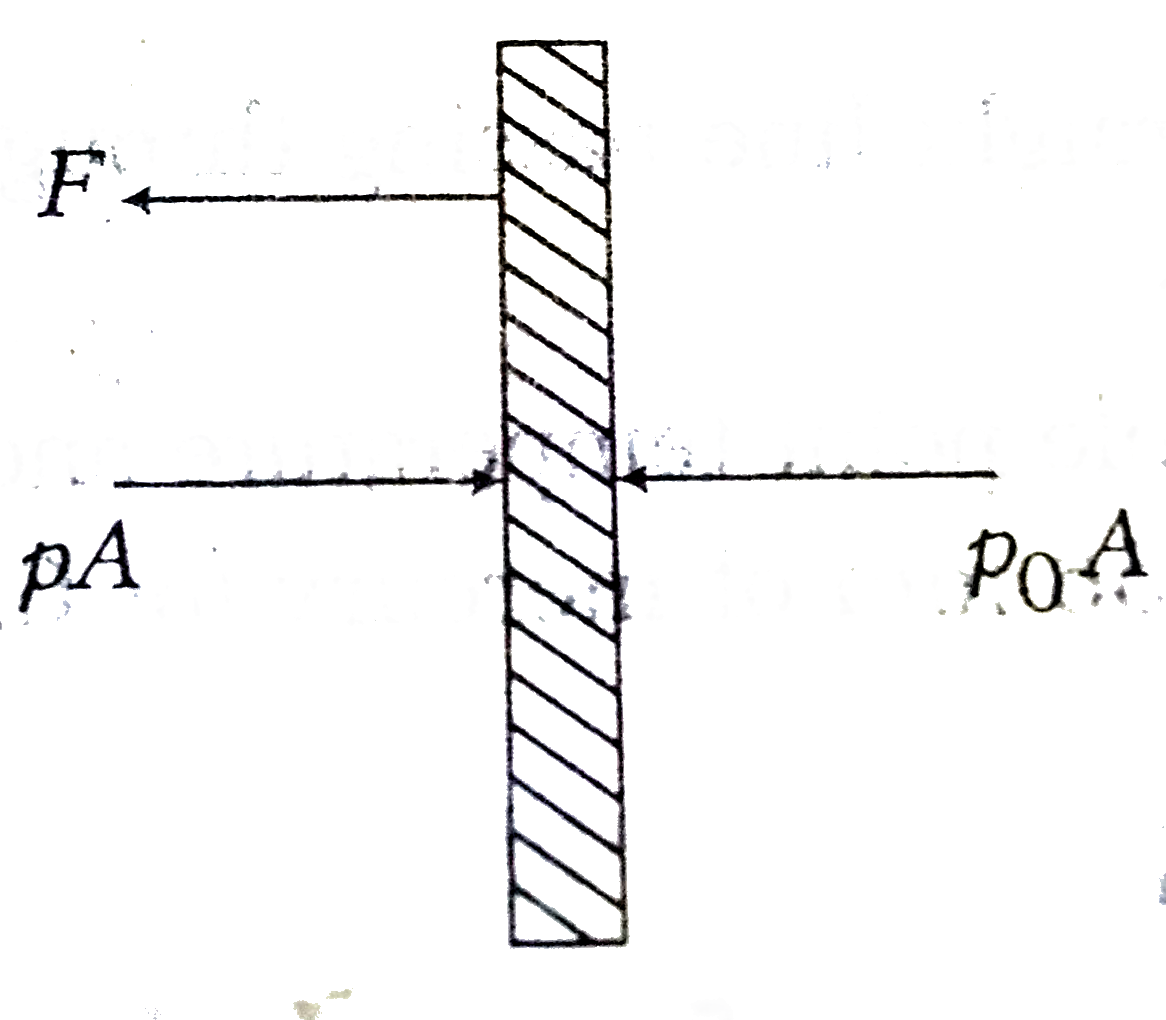 `therefore propTi.e.,` PRESSURE will be doubled, temperature is doubled `therefore""p=2p_(o)` Now let F be the tension in the wire. Then equilibrium of any one piston gives. `F=(p-p_(o))A=(2p_(o)-p_(o))A=p_(o)A` |
|
| 43. |
Block of mass 'm' is sliding up on the smooth incline plane, with some constant velocity. Now, on the block match the magnitude value of the forces on 'm' in the given directions take the components of all the forces in the given direction) {:("Column - I","Column -II"),("A) Net force component is horizontal direction ","P) zero"),("B) Net - force compnent in vertical direction", "Q) " mg sin theta cos theta),("C) Net force component along the incline plane ","R)" mg sin theta),("D) Net force component perpendicular to the incline plane ","S) " mg (1-cos^(2) theta)):} |
|
Answer» |
|
| 44. |
A particle of mass 10 g moves along a circle of radius 6.4 cm with a constant tangential acceleration. What is the magnitude of this acceleration if the kinetic energy of the particle becomes equal to 8 xx 10^(-4) J by the end of the second revolution after the beginning of the motion? |
|
Answer» `0.18 m//s^2` `R= 6.4 CM = 6.4 xx 10^(-2) m, K_f = 8 xx 10^(-4) J` `K_i = 0, a_t = ?` Using work energy theorem, Work done by all the force = Change in KE `W_("TANGENTIAL force") + W_("centripetal force") = K_f - K_i` `implies F_t xx s + 0 = K_f - 0 implies ma_t xx (2 xx 2pi R) = K_f` `implies a_t = (K_f)/(4 pi m) = (8 xx 10^(-4))/(4 xx 22/7 xx 6.4 xx 10^(-2) xx 10^(-2))` `= 0.99 ~~ 0.1 MS^(-2)`. |
|
| 45. |
Two wires A & B are identical in shape and size and are stretched by same magnitude of force. Then the extensions are found to be 0.2% and 0.3% respectively. Find the ratio of their Young's modulii |
|
Answer» `2:3` |
|
| 46. |
What is your observation when two sources are emitting sound with frequency 499 Hz and 501 Hz ? |
|
Answer» (A) Frequency of 500 Hz is HEARD with change in intensity take PLACE twice. `(f _(1) + f _(2))/(2) =(499 +501)/(2) =500 Hz` (Here intensity of resultant wave changes `f _(2) -f_(1)` times in `1S = (501 - 499 )=2 Hz)` |
|
| 47. |
Which of the following statements is correct in respect of a geostationary satellite |
|
Answer» It moves in a PLANE containing the GREENWICH meridian |
|
| 48. |
What is the pressure on a swimmer 10m below the surface of a lake? |
|
Answer» Solution :Here h=10M and `p=1000 kg m^-3` take `g=10 ms^-2` `P=P_a+pgh` `=1.01 times 10^5 Pa+1000 kg m^-3 times 10 ms^-2 times 10m` `approx 2 atm` This is a 100% increase in pressure from SURFACE LEVEL. At a depth of 1km, the increase in pressure is 100 atm Submarines are designed to withstand such ENORMOUS pressures. |
|
| 49. |
Two blocks A and B are connected to each other by a string and spring , the string passes over a frictionless pulley as shown in fig.1.16 Block B slides over the horizontal top surface of a stationary block C and the block A slides along the vertical side of C, both with the same uniform speed. the coefficient of friction between the surfaces of the blocks is 0.2. THe force constant of the spring is 1960 N.m^-1. IF the mass of the blockA is 2kg, calculate the mass of the block B and the energy stored in the spring. |
Answer» SOLUTION :Since the block A is DESCENDING with uniform VELOCITY, no normal REACTION acts on the block A due to the block C.  Considering the motion of the BLOCKS A and B. `T=m_Ag=mum_Bg` `thereforem_B=m_A/mu=2/0.2=10kg` IF the extension of the spring is x.m, then `T=kx,or,x=T/k=(m_Ag)/k=(2times9.8)/1960=1/100m` `therefore` Energy stored in the spring `=1/2kx^2=1/2times1960times(1/100)^2=0.098J` |
|


