

Saved Bookmarks
This section includes 7 InterviewSolutions, each offering curated multiple-choice questions to sharpen your Current Affairs knowledge and support exam preparation. Choose a topic below to get started.
| 1. |
What is the period of oscillation of a simple pendulum if its bob is made of ice ? |
| Answer» SOLUTION :In the CASE of an ice pendulum the period depends on the RADIUS of ice bob. As the ice melts radius DECREASES, So period decreases. But if the CENTRE of mass of ice remains constant then there will be no change in the period. | |
| 2. |
Calculate the work done by a force F=(hati+2hatj+3hatk)N to displace a body from positionA to position B. The position vector of A is r_(1)=(hati+3hatj+hatk)m and the position vector of B is r_(2)=(2hati+2hatj+3hatk)m |
| Answer» SOLUTION :(a) | |
| 3. |
Two blocks of masses m_(1)=5 kg and m_(2)=2 kg are connected by threads which pass over the pulleys as shown in the figure. The threads are massless and the pulleys are massless and smooth. The blocks can move only along the vertical direction T_(1) and T_(2) are the tensions in the string as shown. Now match the following: (Take g=10 m//s^(2)) {:(,"Column -I",,"Column -II"),("(a)",underset("acceleration of " m_(1) " with respect to ground")"Magnitude value of",,(p)500/19 "SI units"),("(b)",underset("acceleration of" m_(2) "with respect to ground")"Magnitude value of",,(q)250/19 "SI units"),("(c)","The value of tension" T_(1) ,,(r) 60/19 "SI units"),("(d)","The value of tension" T_(2),,(s) 40/19 "SI units"),(,,,"(t)None of the above"):} |
Answer» 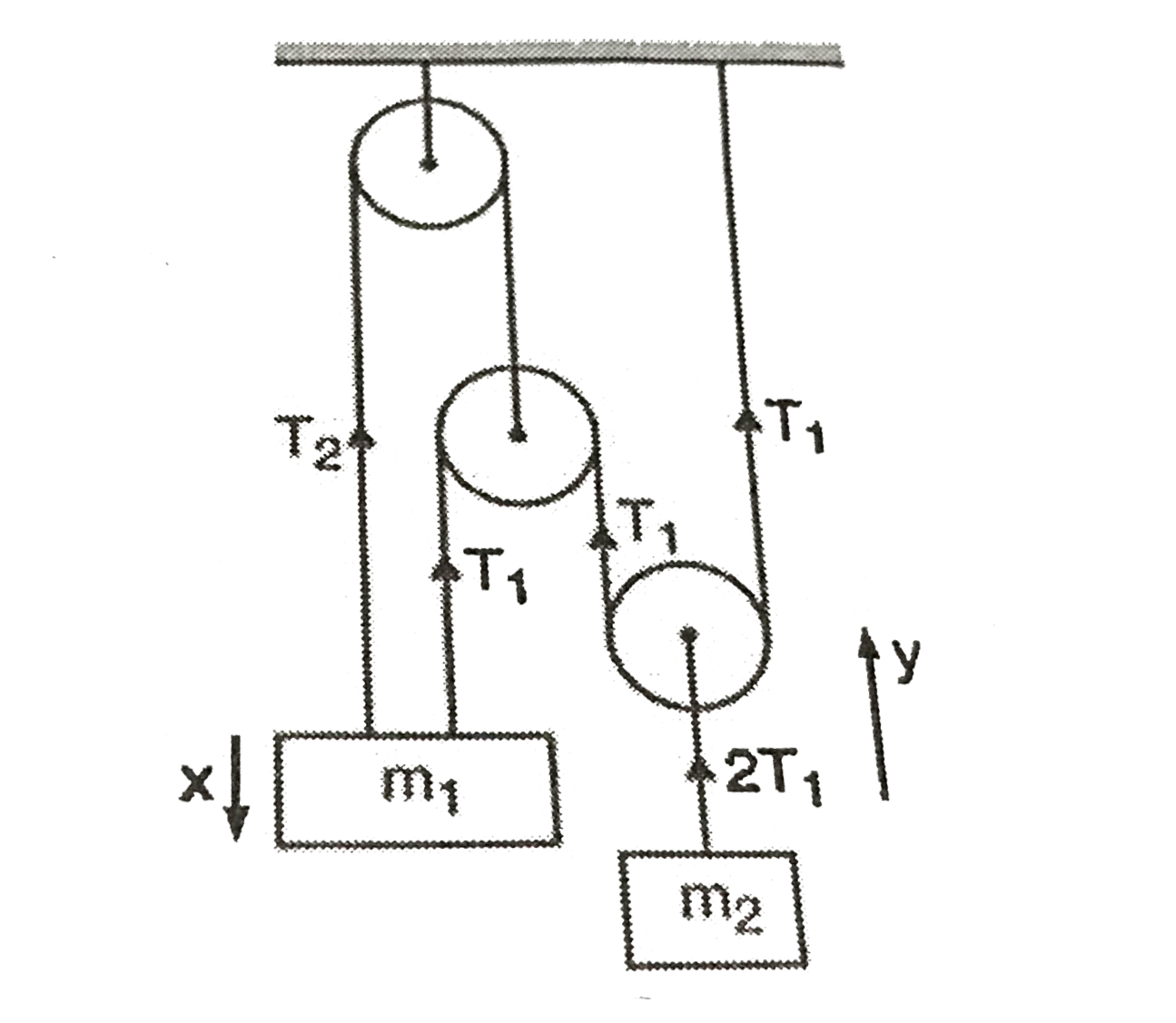 `T_(2)=2T_(1)` Now, `m_(1)g-T_(1)-T_(2)=m_(1)a_(1)` `2T_(1)-m_(2)g=m_(2)a_(2)` ...(ii) as `y=((3x)/2)` `2a_(2)=3a_(1)`….(iii) By solving we will GET the answer `a_(1)=(40/19)m//sec^(2)` |
|
| 4. |
The motion of a particle of mass m is given by x = 0 for t lt 0 s, x(t) = A sin 4pit for 0 lt t lt (1/4) s (A gt 0) andx =0 for t gt(1/4) s whichof the following statements is true ? |
|
Answer» The force at `t=(1/8)` on the particle is `-16 pi^(2)A-m` x= 0for `tle0 ` sec for0 `ltt lt (1)/(4)s` `v= (dx )/(dt )= 4 piA cos ( 4pit ) ` Att = `(1)/( 8)` sec `=-16 pi^(2)A SIN ((pi)/( 2))` Nowforce F = ma (t ) `=m[-16 pi^(2) A]` `=-16 pi^(2)Am` Now impulseof force CHANGEIN mometum `=(-16pi^(2) mA sin pi ) ^(1/4) = 0` Theimpulsechangein linearmomentuma `t=0` issameas at`t= (1)/(4) ` sec |
|
| 5. |
Give an example for scalar product of two vectors. |
| Answer» Solution :The workdone by a FORCE `vecF` to MOVE an object through a small dispacement `vec(DR)` then Workdone `W=vecF.vec(dr)orW=Fdrcostheta` | |
| 6. |
The centres of two identical small conducting sphere are 1 m apart. They carry charge of opposite kind and attract each other with a force F. when they connected by conducting thin wire they repel each other with a force F//3. The ratio of magnitude of charges carried by the spheres initially in n : 1. Find value of n |
|
Answer» |
|
| 7. |
Suppose earth.s orbital motion around the sun supposed to be in circular is suddenly stopped , what time will the earth take to fall into the sun |
| Answer» Answer :A | |
| 8. |
A ball A, moving with kinetic energy E, makes a head on collision with a stationary ball with mass n times that of A. the maximum potential energy stored in the system during the collision is |
|
Answer» `NE//(n+1)` |
|
| 9. |
A wheel which is initially at rest is subjected to a constant angular acceleration about its axis. It rotates through an angle of 15^@ in time t sec. The increase in angle through which it rotates in the next 2t sec is |
|
Answer» `90^(@)` |
|
| 10. |
If the piston of acontainerispushedfastinward.Willthe idealgasequationbe validin theintermediatestage ?Ifnot, Why ? |
| Answer» Solution :When the PISTON is COMPRESSED so quickly that there is no time to exchange heat to the surrounding, the temperature of the gas increases rapidly. In this intermediate stage the ideal gas equation be not valid. Because this equation can be RELATES the pressure, volume and temperature of thermodynamic system at equilibrium. | |
| 11. |
Detergents is added to water for removing dirt from clothes.Explain . |
| Answer» SOLUTION :When detergents added to the water , surface TENSION of water decreased and HENCE clothes wet more .Although ,molecules of detergent are hairpin shaped ,it tending to form water oil (dirt) interfaces and SEPARATING dirt so clothes washes better . | |
| 13. |
Can a body in linear motion be in equilibrium. |
| Answer» SOLUTION :YES ,providedthe vectorsum of theforcesacting uponthe BODYIS ZERO. | |
| 14. |
Consider a pendulum consisting of a nuscless string with a mass on the end. The mass is held with the string horizontal, and then released. The mass swings down, and on its way back up, the string is cut at point P when it makes an angle of theta with the vertical. Find theta if that mass covers maximum horizontal range. |
|
Answer» Solution :The speed at ANGLE `theta` is given by conservation of energy. `(1)/(2) mv^(2) = mgh rArr (1)/(2) mv^(2) = mg R COS theta v = sqrt(2 g R cos theta)` When string is cut PARTICLE MOVES as a projectile with velocity component. `v_(x) = v cos theta v_(y) = v sin theta` The time of flight is `t = 2 ((v_(y))/(g))` Range is, `x = v_(x) t = v_(x) ((2v_(y))/(g))` `= (2v_(x)v_(y))/(g) = (2(v cos theta) (v sin theta))/(g)` `= (2v^(2) sin theta cos theta)/(g) = (2 (2 g R cos theta)sin theta cos theta)/(g) = 4 R cos^(2) theta sin theta` Take the derivative of this FUNCTION and equate it to zero Thus we get `0 = 4R [(-2 cos theta sin theta) sin theta + cos^(2) theta cos theta]` (or) `2 sin^(2) theta cos theta = cos^(3) theta (or) tan theta = 1//sqrt(2)` 
|
|
| 15. |
Show that terminal velocity of a sphere falling through a viscous medium is proportional to the square of its radius. |
|
Answer» Solution :A SPHERICAL object of volume density. The apparent weight of the solid = VISCOUS drag force. Hence the object begins to move with a STEADY speed CALLED terminal speed. `6pietaav=4/3 PIA^(3) (rho-sigma)g"here"rho gt sigma` `therefore v=(2a^(2)g)/(9eta) (rho-sigma)` "Hence" v alpha a^(2)` |
|
| 16. |
Two SHM's are represented by the relations x= 4sin(80t+pi//2) and y= 2cos(60t+pi//2) The ratio of their time period is |
|
Answer» 2:1 |
|
| 17. |
Give the magnitude and direction of the net force acting on(a) a drop of rain falling down with a constant speed(b) a cork of mass 10 g floating on water(c ) a kite skillfully held stationary in the sky(d) a car moving with a constant velocity of 30 km/h on a rough road(e ) a high - speed electron in space far from all material objects, and free of electric and magnetic fields. |
|
Answer» Solution :(a) As the rain drop is falling with a constant SPEED, its acceleration a = 0. HENCE net force F = ma = 0. (b) As the cork is floating on water, its weight is being balanced by the upthrust (equal to weight of water displaced).Hence net force on the cork is zero. (c ) As the kite is held stationary, net force on the kite is zero, in accordance with Newton.s first law. (d) Force is being applied to OVERCOME the force of friction. But as velocity of the car is constant, its acceleration. a = 0. Hence net force on he car F = ma = 0. (E ) As no field (GRAVITATIONAL / electric / magnetic) is acting on the electron, net force on it is zero. |
|
| 18. |
Efficiency of a Carnot engine is 50% whentemperature of outlet is 500 K. In order to increase efficiency up to 60% keeping temperature of intake the same what is temperature of outlet |
|
Answer» 200 K |
|
| 19. |
A human body has a surface area of approximately 1 m^(2) . The normal body temperature is 10 K above the surrounding temperature T_(0). Take the room temperature to be T_(0)=300 K. For T_(0)=300 K, the value of sigma T_(0)^(4) =460 Wm^(-2) (wher sigma is Stefan-Boltzmann constant). What of the following option is/are correct ? |
|
Answer» The amount of energy radiated by the body in/SECOND is close to 60 joules. (a) `E=sigma A(T^(4)-T_(0)^(4)) =sigma (T^(4)-T_(0)^(4))``(.: A= 1m^(2))` `=sigma[(T_(0) + 10)^(4) - T_(0)^(4))] =sigma T_(0)^(4)[(1+(10)/(T_(0)))^(4) - 1]` `=sigma T_(0)^(4)[1 +(4xx10)/(T_(0)) + ... -1] ~~ sigma T_(0)^(4) xx(40)/(T_(0))` `460xx(40)/(300)=61.33 ~~ 60` joule Energy radiated in 1 second `~~ 60` joule [Thus option (a) is true ]. (b) When surrounding temperature reduces by a small amount `Delta T_(0)` , keeping the body temperature T constant, the amount of HEAT energy radiated per second per unit are is `E =sigma[T^(4) - T_(0)^(4)]` `dE =sigma[0 - 4T_(0)^(3) Delta T_(0)]``[But Delta T_(0) =-Delta T_(0)]` So `dE =sigma 4T_(0)^(3) Delta T`[Thus option (b) is true] (c) Since energy radiated per second from a body is directly proportional to the surface area of the body. By curbing, the surface area decreases, so energy radiation decreases. Thus option (c) is true. (d) When the body temperature rises, the peak in the spectorum of electromagnetic radiation emitted by the body shifts towards lower, wavelength side (ac cording to Wien's law). Thus option (d) is wrong. |
|
| 20. |
Two particles A and B are initially separated by a distance of 1.0 m and are at rest. The mass of A is 100 gm and that of B is 30.0 gm and they move under a constant mutual attractive force of 0.02 N .At what distance from the A's original position do the particles collide. |
|
Answer» |
|
| 21. |
For the system shown in the figure, mass of each block is m. Spring constant of the spring is k. There is no friction between the block and the table. Initially the spring is vertical and unstretched when the system is released to move. Find the velocity of the block on the table at the instant it breaks off the surface. (Take m = 0.32 kg, k = 40 Nm^(-1), l_(0) = 40 cm and g = 10 ms^(-2)) |
|
Answer» |
|
| 22. |
A body is struck to the front part of the truck. The coefficient of friction between the body and truck is mu. The minimum acceleration with which the truck should travel so that the body does not fall down is |
| Answer» Answer :C | |
| 23. |
One end of string of length / is connected to a particle of mass 'm' and the other end is connected to a small peg on a smooth horizontal table. If the particle moves in circle with speed 'v', the net force on the particle (directed towards centre) will be (T represents the tension in the string) |
|
Answer» `T+(mv^2)/(L)` |
|
| 24. |
Determine the volume contraction of a solid copper cube, 10 cm on an edge, when subjected to a hydraulic pressure of 7.0 xx 10 ^(6) Pa. (Bulk Modulus B=1.4xx 10 ^(11)) |
|
Answer» Solution :`B =- (PV)/(Delta V) IMPLIES Delta V =- (pV)/(B) = - (7xx 10 ^(6) xx L ^(3))/( 1.4 xx 10 ^(11))` `therefore Delta V =- (7 xx 10 ^(6) xx 10 ^(-3))/( 1.4 xx 10 ^(11)) = - 5 xx 10 ^(-8) m ^(3)` `therefore Delta V =- 0.05 xx 10 ^(-6) m ^(3) =- 0.05 cm ^(3)` Note : IF BULK modulus is taken as `B = 1.2 xx 10 ^(11) Nm^(-2)` then snawer of textbook will be `Delta V=0.058 cm ^(3)` |
|
| 25. |
A ladder 'AB' of weight 300N and length 5m is lying on a horizontal surface. Its centre of gravity is at a distance of '2m' from end A. A weight of 80N is attached at end B. The work done in raising the ladder to the vertical position with end 'A' in contact with the ground is, |
|
Answer» 500J |
|
| 26. |
A particle is projected from the origin in X-Y plane. Acceleration of particle in Y direction is alpha. If equation of path of the particle is y = ax - bx^(2), then find initial velocity of the particle. |
|
Answer» SOLUTION :`y = ax - bx^(2) ""y = x TAN THETA - (alpha x^(2))/(2U^(2) cos^(2) theta)` `tan theta = a` and `(alpha)/(2u^(2) cos^(2) theta) = b ""u = sqrt((alpha(1+a^(2)))/(2B))` |
|
| 27. |
When the temperature of a body increases |
|
Answer» DENSITY and MOMENT of INERTIA increases |
|
| 28. |
When a waves is travelling in a medium , in that process, the following is/are transporting from one particle to other |
|
Answer» energy |
|
| 29. |
Consider the following functon, (a) y=x^(2)+2 alpha, tx (b) y=(x+vt)^(2) Which among the above function can be characterized as a wave ? |
|
Answer» Solution :(a) `y=x^(2) + 2 alpha t x` It is not DESCRIBING wave. (b) `=y=(x+ vx)^(2)` It satisfies wave EQUATION: |
|
| 30. |
Which of the following quantities has S.I. unit Kgm^(2)A(-2)S(-3) |
|
Answer» RESISTANCE |
|
| 31. |
The moment of inertia of a rod about an axis passing through its centre and perpendicular to it is (1)/(12) ML^(2)(where, M is the mass and L the length of the rod.) The rod is bent in the middle so that the two halves make an angle of 30^(@). The moment of inertia of the bent rod about the same axis would be |
|
Answer» `(1)/(48) ML^(2)`  Moment of inertia of each part through its one end = `(1)/(3) ((M)/(2)) ((L)/(2))^(2)` Hencenet moment of inertia through its middle point O is `I = (1)/(3) ((M)/(2)) ((L)/(2))^(2) + (1)/(3) ((M)/(2)) ((L)/(2))^(2) = (1)/(3) [ (ML^(2))/(8) + (ML^(2))/(8)] = (ML^(2))/(12)` |
|
| 32. |
A sphere of mass 4 kg collides with a wall, at an angle of 30^(@) with the wall and rebounds in the direction making an angle of 60^(@) with its original direction of motion. Find the force on the wall if the ball remains in contact with the wall for 0.1s. The initial and final velocities are the same, equal to 1ms^(-1) |
Answer» Solution :Suppose `hatiandhatj` are the unit vector along axis X and Y respectively.  The MAGNITUDE of initial velocity `vec(v_(1))` and FINAL velocity `vec(v_(2))` are same `therefore |vec(v_(1))|=|vec(v_(2))|=V` The magnitude of `p=mv` `=4xx1` `therefore p=4Ns....(1)` x-component of initial momentum `vec(p_(1))` `vec(p_(1))=mvcos60^(@)hati` `therefore vec(p_(1))=(p)/(2)hatj` x-component of final momentum `vec(p_(2))` `vec(p_(2))=-mvcos60^(@)hati` `therefore vec(p_(2))=-(p)/(2)hatj` In above figure initial and final momentum are shown by `vec(AB) and vec(AC)`. Here `DELTAABC` is equilateral triangle Change in momentum of sphere is obtained by substraction of two vectors `therefore` from figure `vec(BC)=vec(AC)-vec(AB)` where `vec(AB)=vec(p_(1)),vec(AC)=vec(p_(2))` `therefore Deltavecp=vec(p_(2))-vec(p_(1))` `therefore Deltavecp=-(p)/(2)hati-(p)/(2)hatj` `therefore Deltavecp=-phati` `therefore Deltavecp=-4hatiNs` (from eqn. (1)) `therefore` From law of conservation of momentum change in momentum of wall `Deltavecp=4hati` `therefore` Force exerted on wall `vecF=(Deltavecp)/(Deltat)` `therefore vecF=(4hati)/(0.1)=40hatiN` So force of 40 N exerted on the wall in X-direction. |
|
| 33. |
Two bodies of masses m_(1)" and "m_(2) moving on the same direction with velocities u_(1)" and "u_(2) collide. The velocities after collision are V_(1)" and "V_(2). If each sphere loses the same amount of kinetic energy, then |
|
Answer» `u_(1)+u_(2)+V_(1)-V_(2)=0` |
|
| 34. |
Define elastic and inelastic collision. |
| Answer» Solution :In any collision, if the total KINETIC energy of the bodies before collision is equal to the total FINAL kinetic energy of the bodies after collision, then it is called as CLASTIC collision In any collision, if the total INITIAL kinetic energy of the bodies before collision is not equal to the total final kinetic energy of the bodies after collision, then it is called as inclastic collision | |
| 35. |
A car of mass m travelling at speed v moves on a horizontal track so that the centre of mass describes a circle of radius r . Show that the limiting speed beyond which the car will overturn is given by v^(2) = ("gra")/(h) where 2a is the separation of the inner and outer wheels and h is the height of the centre of mass above the ground . |
Answer» Solution :We consider the rear view of the CAR , centripetal force `(mv^(2))/(r)` to the left is provided by frictional force acting on the tyres. From the force diagram ,  Sum of forces in vertical direction , `R_(1) + R_(2) = "mg" ........... (i)` Sum of forces in horizontaldirection , `F_(1) + F_(2) = (mv^(2))/(r)` ........ (ii) Taking moments about the centre of mass G, `(F_(1) + F_(2) )h + R_(1)a = R_(2)a` `therefore "" F_(1) + F_(2) = (R_(2) - R_(1)) (a)/(h) "" ...... (iii)` Combining this with Eqn. (ii) to eliminate `F_(1) + F_(2)` gives `R_(2) - R_(1) = (hmv^(2))/(ar) "" ...... (iv)` We now have two simultaneous EQNS.(i) and (iv) , for `R_(1)` and `R_(2)` . Solving these by adding and subtracting , we find that `2R_(1) = mg - (hmv^(2))/(ar)` and `2R_(2) = mg + (hmv^(2))/(ar)` From these expressions it is clear that the inner wheels will leave the ground when `R_(1)` will become zero and the car begins to overturn , i .e.,`""mg = (hmv^(2))/(ar)` So , the LIMITING speed is given by `v^(2) = ("GRA")/(h)` as required Alternative solution : We choose the frame of refernce attached to the car , i.e., a FICTITIOUS centrifugal force of magnitude `mv^(2)//r` , acts through the centre of mass G and directed away from the centre of the circle . At the instant when the car begins to overturn , the force `R_(1)` and `F_(1)` are zero , so the only forces acting on the car are `R_(2) , F_(2)` the centrifugal force and the weight mg . If the resultant P of the centrifugal force and the weight passes outside the point of contact with the ground (the outer wheels) as shown in Fig . 7.66 (b) , the couple on the car will be clockwise , causing it to overturn . The critical condition , when overturning is just about to occur , happens when the resultant P passes through the contact point . By using similar triangles , we can see that the condition for overturning is thus `(mv^(2))/(r) + mg gt (a) /(h)` which gives `v^(2) gt ("gra")/(h)` as before . |
|
| 36. |
The fundamental physical quantities that have same dimensions in the dimensional formulae of torqueand angular momentum are |
|
Answer» MASS, time |
|
| 37. |
The net external torque on a system of particles about an axis is zero. Which of the following are compatible with it ? (a) The forces may be acting radially from a point on the axis(b) The forces may be acting on the axis of rotation (c ) The force may be acting parallel to the axis of rotation(d) The torque caused by some forces may be equal and opposite to that caused by other forces. |
|
Answer» a, B only |
|
| 38. |
Calculate the angular frequency of the system shown in figure. Friction is absent every where and the threads, spring and pulleys are massless. Given that m_A = m_B = m |
| Answer» SOLUTION :`1/pi SQRT((4K)/(5M))` | |
| 39. |
A metal wire of length l and cross-sectionalarea A has mass m. It is stretchedby an amount.e. by a load of mass M. If the wire breaks at the point of suspensiondue to the load then find the rise in temperatureof the wire? |
|
Answer» Solution :Strain energy `=(1)/(2) F.e =(1)/(2) (Mg) e` As thewire BREAKS strain energy stored in the wire appears in the form of HEAT. `therefore (1)/(2) (Mg)e=ms Deltat` [s = SPECIFIC heat of wire] `Deltat=((Mg)e)/(2ms)` |
|
| 40. |
Which of the following are not correct? |
|
Answer» The escape velocity for the Moon is `6 KM s^(-1)`. d. `v_(0)=sqrt((2GM)/R)=sqr((2G)/Mxx4/3piR^(3)rho)` or `v_(0)propsqrt(rho)` |
|
| 41. |
A spherical body of radius R is allowed to roll down on an incline with out slipping and it recheas with a speed v_(0) at the bottom. The incline is then made smooth bywaxing and the body is allowed top slide without rolling and now the speed attained is (5)/(4)v_(0) The radius of gyration of the body about an axis passing through the centre is |
|
Answer» `(4)/(3)R` |
|
| 42. |
A body is projected horizontally from the top of a towerof height 10 m with a velocity 10 m/s. Find its velocity after 1 second. |
|
Answer» |
|
| 43. |
The force acting on a particle makes an angle of 60^(@) with the positive x-axis. If the magnitude of the force is 10N what are its x and y-components? |
| Answer» Answer :A | |
| 44. |
Clarify the difference between stress and pressure. |
|
Answer» Solution :PRESSURE is force per UNIT area. Both pressure and STRESS having same dimensions but they are not a same physical quantity. When the force applied perpendicular to the SURFACE then the force produce per unit area is known as pressure. Stress is also a force per unit area but is different at every different area of the body. For example: As shown in figure, stress is on the cross-section but it is not on the side of the rod. 
|
|
| 45. |
A pan pizza cools from 91^(@)C " to "79^(@)C in 2 minutes, on a summer day, when the room temperature is 25^(@)C. How long will the pan pizza take to cool from 91^(@)C to 79^(@)C, on a winter day, when the room temperature is 5^(@)C? |
|
Answer» `(3)/(2)` minutes where `T_(s)` is the surrounding temperature. For the first case, `T_(1) = 91^(@)C, T_(2) = 79^(@)C, T_(s) = 25^(@)C, t=2` min `:. (91^(@)C - 79^(@)C)/(2 "min") = K ((91^(@)C + 79^(@)C)/(2) - 25^(@)C)` or `(12^(@)C)/(2"min") = K(60^(@)C)` ..(i) For the second case, `T_(1) = 91^(@)C, T_(2) = 79^(@)C, T_(s) = 5^(@)C, t=`? `:. (91^(@)C - 79^(@)C)/(t) =K ((91^(@)C + 79^(@)C)/(2) -5^(@)C)` or `(12^(@)C)/(t) = K (80^(@)C)` ...(II) Dividing eqn. (i) by eqn, (ii) we get `(t)/(2"min") = (60^(@)C)/(80^(@)C) or t= (3)/(4) (2"min")= (3)/(2)` min |
|
| 46. |
A car is moving along a circular track of radius 10sqrt(3)m with a constant speed of 36kmph. A plumb bob is suspended from the roof of the car by a light rigid rod of length Im. The angle made by the rod with the track is (g= 10ms^(-2) ) |
| Answer» ANSWER :D | |
| 47. |
A block of mass 20 kg is suspended from two light spring balances as shown in the figure. |
|
Answer» Both the scales will READ 10 kg |
|
| 48. |
A piston divides a closed gas cylinder into two parts. Initially the piston is kept pressed such that one part has a pressure P and volume 5V and the other part has pressure 8P and volume V, the piston is now left free. Find the new pressure and volume for the isothermal and adiabatic process. ( gamma= 1.5). |
|
Answer» Solution :Final pressure will be same on both sides. Let it be P., with VOLUME V., in the left side and (6V - V.) in the right side. (A) If the change is isothermal : For the gas enclosed in the left chamber : `P XX 5V = P.V...... (1)` while for the gas in the right chamber, `8P xx V = P(6V-V)` .......(2) Solving these for V. and P., we get `v = (30)/(13)V and P =( 13 )/(6) P and (6-V) =(48)/(13) V `  (B)If the change is adiabatic : For the gas in the left chamber. `P(5V.)=P(V) .............(3)` and for the gas in the right chamber, 8P(V). = P (6V-V) ..........(4) Dividing (4) by (3). `((6V-V^(+))/(V^(+)))^(3//2 ) = (8)/(5^(3//2 )or( 6V )/(V ),= 1+ (4)/(5)i.e., V^(+) =(10)/(3) V ` Substituting it in Eqn.`(3) P.=P ((5Vxx 3)/(10V )) = ( 3 sqrt(3))/( 2 sqrt(2)) P=1.84P` so `P.=1.84= (10)/(3)V and( 6V-V^(+)) =8/3 V .` |
|
| 49. |
An express train moving at 30 m/s reduces its speed to 10 m/s in a distance of 240 m. If the breaking force is increased by 12.5% in the beginning find the distance that it travels before coming to rest |
| Answer» Answer :B | |
| 50. |
Show that is e is electronic charge, h is Planck's constant, c is velocity of light and in_0 is electirc permittivity of free space, then e^2//"in"_0 hc is dimensionless. |
|
Answer» Solution :We know that electrostatic potential energy between two ELECTRONS separted by DISTANCE r `is U = (E e)/(4pi "in"_0r)` `:. Units of (e^2)/("in"_0) = U xr = (ML^2 T^(-2))L` Also, energy of a photon, `E = h v = (hc)/(lambda)` `:. Units of hc = E xx lambda = (ML^2 T^(-2))L` `Now = (e^2)/("in"_0hc) = (ML^2T^(-2))/((ML^2T^(-2))L) = [M^0 L^0 T^(0)]` i.e., the given quantity is dimensionless. |
|