Saved Bookmarks
This section includes 7 InterviewSolutions, each offering curated multiple-choice questions to sharpen your Current Affairs knowledge and support exam preparation. Choose a topic below to get started.
| 1. |
(x^2)/("mass") has dimensions of kinetic energy. Then x has the dimensions of |
|
Answer» Pressure |
|
| 2. |
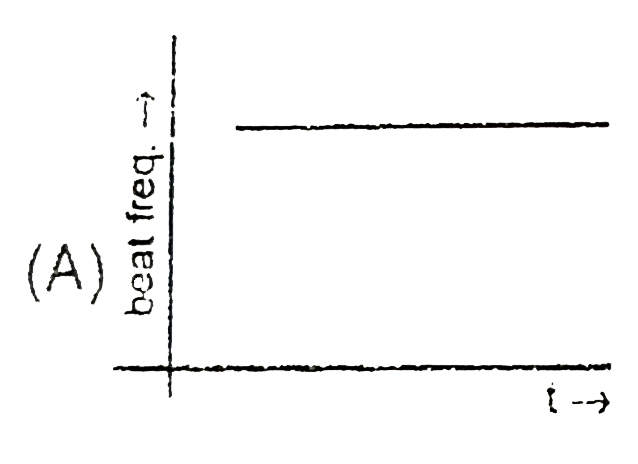
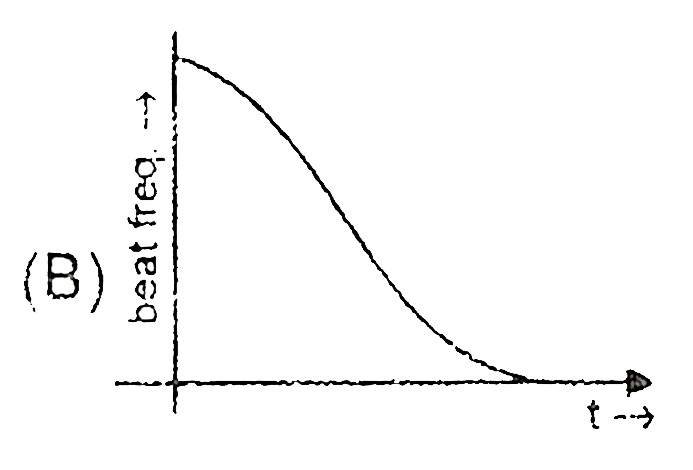
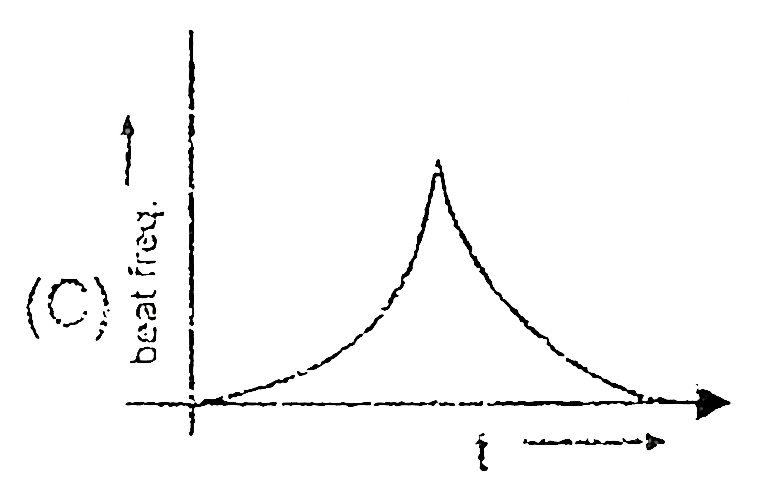
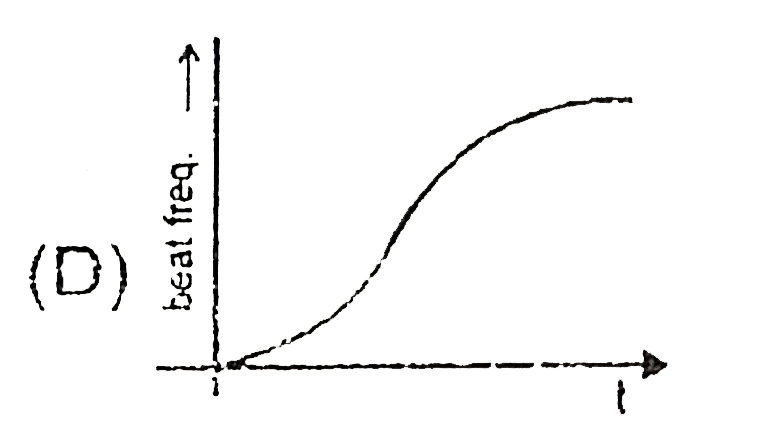
Two identical source moving parallel to each other at seperation 'd' are producing sounds of frequency 'f' and are moving with constant velocity v_(0). A stationary .observer 'O' is on the line of motion of one of the sources. Then the variation of beat frequency heard by O with time is best represented by: (as they come from large distance and go to a large distance) |
|
Answer»
|
|
| 3. |
The displacement of a particle varies according to relation x=4[cos pi t + sin pi t ]. The amplitude of the particle is |
| Answer» Answer :C | |
| 4. |
In the question number of 45, the equivalent thermal conductivity of the compound bar is |
|
Answer» `(K_(1)K_(2))/(K_(1)+K_(2))` Heat current through the compound bar of length `2L` is `H = (KA(T_(1) - T_(2)))/(2L)` At steady state, `H = H_(1) = H_(2)` `:. (KA(T_(1) - T_(2)))/(2L) = (K_(1)A(T_(1) - T_(0)))/(L) "…..."(ii)` Substituting the value of `T_(0)` Eq (i) in (ii), we GET `(K(T_(1)-T_(2)))/(2)= K_(1)[T_(1) - ((K_(1)T_(1) + K_(2)T_(2))/((K_(1)+K_(2))))] = (K_(1)K_(2)(T_(1)-T_(2)))/((K_(1)+K_(2)))` `rArr = (2K_(1)K_(2))/(K_(1)+K_(2))` |
|
| 5. |
The reverberation period T of a room on its volume V, its surface area A and velocity of sound C. If K is dimensions constant, then T = |
|
Answer» `(KV)/(CA)` |
|
| 6. |
A gun of mass M fires a bullet of mass m, with a Kinetic energy E. The total kinetic energy in the firing process is |
|
Answer» `[(m+M)/(M)]E` |
|
| 7. |
The positon of an object moving along x-axis is given by x(t) = (4.2 t ^(2) + 2.6) m, then find the velocity of particle at t =0s and t =3s, then find the average velocity of particle at t =0 sto t =3s. |
| Answer» Solution :`v (0) =0 MS ^(-1), v (3) = 25.2 ms ^(-1) and BAR v = 12.6 ms ^(-1)` | |
| 8. |
A tuning fork of frequency 270 resonates with an air column of length 31.2 cm. When the tube is rasied it resonates again when the length is 96.3 cm.Calcuate the velocity of sound in moist air in the tube. Reduce this velocity to STP if the pressure and temperature at the time of the experiment are 0.7 m of Hg and 30^(@)C, respectively. Saturated vapour pressure at 30^(@)C = 32 mm o fmercury. ["Hint "C_(n) = 2n (l_(2) - l_(1)) " and " C_(m) = C_(d) sqrt(((P)/(P - 0.385 f))) " and " (C)/(C_(0)) = sqrt((T)/(T_(0)))] |
|
Answer» |
|
| 9. |
A block of mass 10 kg pushed by a force F on a horizontal rough plane moves with an acceleration of 5ms^(-2). When force is doubled, its acceleration becomes 18 ms^(-2). Find the coefficient of friction between the block and rough horizontal plane. (g=10 ms^(-2)). |
|
Answer» Solution :On a ROUGH horizontal PLANE, acceleration of a block of mass .m. is given by `a=(P)/(m)-mu_(k)g ""`……(i) Initially, P = F , a = 5 `ms^(-2)` `5=(F)/(10)-mu_(k)(10) ""` ……..(II) `(because m = 10 kg)` When force is doubled i.e., P = 2 F , a = 18 `ms^(-2)`. `18=(2F)/(10)-mu_(k)(10) ""` ......(iii) MULTIPLYING EQ (ii) with 2 and subtracting from Eq. (iii) `8=mu_(k)(10)rArr mu_(k)=(8)/(10)=0.8` |
|
| 10. |
Kinetic energy and angular velocity of a rigid body are E and omega respectively. Now angular velocity of the body is increased by 2%. Find out kinetic energy. |
|
Answer» `1.03E` `omega.=1.02omega` `therefore E.=(1)/(2)I(omega.)^(2)=(1)/(2)I(1.02omega)^(2)` `therefore E.=1.04E` |
|
| 11. |
If the temperature of patient is 40^(@)C, his temperature on the Fahrenheit scale will be |
|
Answer» `72^(@)F` |
|
| 12. |
The frequency of an octave is 576.Find the 5th note of the major diatonic scale. |
|
Answer» |
|
| 13. |
A cannot engine extracts heat from water at0^(@)C and rejects it to room at 24.4^(@)C. The work required by the refrigerator for every 1 kg of water converted into ice (latent heat of ice = 336kj/kg) is |
| Answer» ANSWER :A | |
| 14. |
From certain height 'h' two bodies are projected horizontally each with velocity v. One body is projected towards North and the other body is projected towards east. Their separation on reaching the ground. |
|
Answer» `SQRT((2v^2h)/(G))` |
|
| 15. |
Why are the doors provided with handles near the outer edges far away from the hinges ? |
| Answer» SOLUTION :This makes the perpendicular distance of the line of action of FORCE from the axis of ROTATION MAXIMUM. | |
| 16. |
If the centre of mass of three particles of masses of 1 kg, 2 kg, 3 kg is at (2,2,2), then where should a fourth particle of mass 4 kg be placed so that the combined centre of mass may be at (0,0,0) ? |
|
Answer» Solution :Total mass of system of given three particles is `m_(1)` = 1+ 2 +3 = 6 kg All this mass can be assumed to be existing as a point mass at `(x_(1),y_(1),z_(1))=(2,2,2)`. Let SECOND mass `m_2 = 4` kg be located at a position with co-ordinates`(x_(2),y_(2),z_(2))` CM of the system will be at (0,0,0) `X_(cm) =(m_(1)x_(1) + m_(2)x_(2))/(m_(1) + m_(2)), 0= (6(2) + 4(x_(2)))/(6+4) rArr x_(2)=-3` Similarly `y_(2)=-3, z_(2)=-3` `therefore` 4 kg mass should be placed at `(-3,-3,-3)` |
|
| 17. |
A particle travels from point A to B on a circular path of radius 15//picm . If the arc length AB be 10 cm , find the displacement (Figure) |
|
Answer» Solution :Joining the initial (A) and final (B) positions of the body, the straight line AB is obtained which is its displacement (Figure) Weknow , `("Circumference") /("arc LENGTH")= (360^(@))/("Angle subtended by are at centre")` `:. (2pixx(15)/PI)/10=(360^(@))/(20)` `RARR 2 theta =120^(@)`.`rArr theta 60^(@)` Now from right angle `Delta ADO`, `AD=OA sin theta =(15/pi) sin 60^(@)=(15sqrt3)/(2pi)` `:. AB=2AD=(15sqrt3)/pi cm` along A to B  Note, Distance is scalar, but displacement is a vector quantiy. Distance `ge` displacement If a particle stars from a point and reaches the same point at the end of its journey, then displacement is zero. However distance covered is not zero . The magnitude of displacement cannot EXCEED the distance of a particle in motion . |
|
| 18. |
The planet mars has two moons.phobos and delmos. (i)phobos has a period 7 hours, 39 minutes and an orbital radius of 9.4xx10^3 km . Calculate the mass of mars. (ii)Assume that earthand mars move in circular orbits around the sun.with the martian orbit being 1.52 times the orbitalradius of the earth. What is the length of the martianyear in days ? |
|
Answer» Solution :(i)We know that `T^2=(4pi^2)/(GM_m)R^3` `M_m=(4pi^2)/G R^3/T^2 = (4xx(3.14)^2xx(9.4)^3xx10^8)/(6.67xx10^(-11) XX(459xx60)^2)` `M_m=(4xx(3.14)^2(9.4)^3xx10^18)/(6.67xx(4.59xx6)^2XX10^(-5))= 6.48xx10^23` kg . (ii)According to Kepler.s third LAW `T_M^2/T_E^2=R_(MS)^3/R_(ES)^3` where `R_(MS)` is the mars-sun distance and `R_(ES)` is the earth-sun distance. `therefore T_M=(1.52)^(3//2) xx365`=684 days. |
|
| 19. |
During adiabatic expansion of gas, volume increases by 5%. If gamma= 3/2 find the percentage changein pressure? |
|
Answer» `7.5%` |
|
| 20. |
The resultant R of two forces P and Q acting at an angle 0 (obtuse angle i.e.0lt 90^(0)) is given by |
|
Answer» <P> |
|
| 21. |
The maximum tension a rope can with stand is 60kgwt. The ratio of maximum accelerations with which two boys of masses 20kg and 30kg can climb up the rope |
|
Answer» `1:2` |
|
| 22. |
Assertion If in a projectile motion, we take air friction into consideration, then t_("ascent") lt t_("descent"). Reason During ascent, magnitude of retardation is greater than magnitude of acceleration during descent. |
|
Answer» If both ASSERATION and REASON are correct and Reason is the correct explanation of Assertion 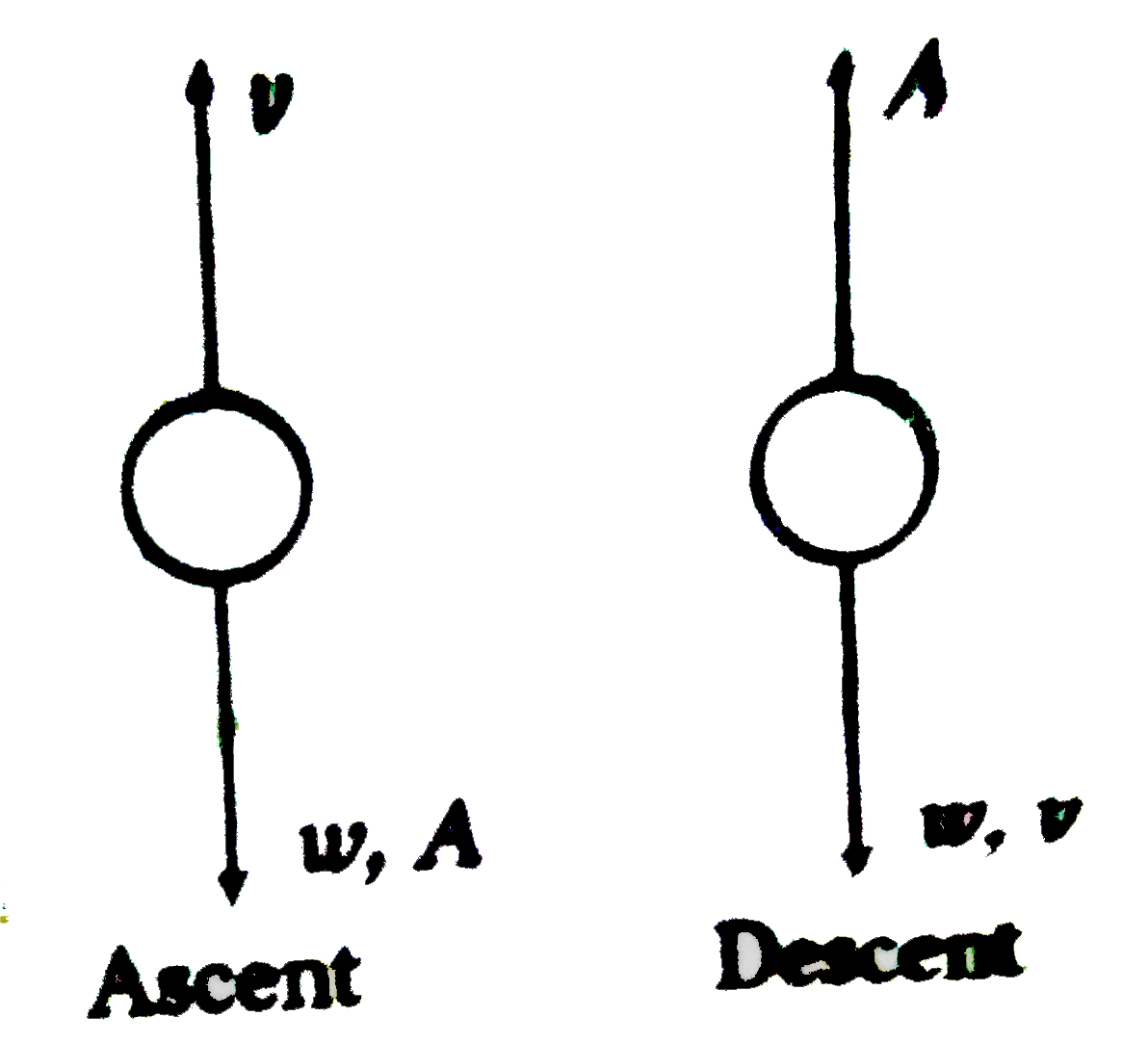
|
|
| 23. |
The distance coveredby a particle in time t is given by x=at+bt^(2)+ct^(3)+dt^(4). Calculate the dimensions of (a)/(b)" and "(c )/(d). |
| Answer» SOLUTION :`[T], [T]` | |
| 24. |
The current voltage relation of diode is given by I = (e^(1000V//T) - 1) mA, where the applied voltage V is in volts and the temperature T is in degree Kelvin. If a student makes an error measuring +-0.01 V while measuring the current of 5mA at 300K, what will be the error in the value of current in. |
|
Answer» `0.5 mA` `:.5mA=e^(1000V//T)mA-1mA` `:.6mA=e^(-1000V//T)mA` `:.dt=e^(1000V//T)mAxx(1000)/(T)DV` `=6mAxx(1000)/(300)xx0.01` `=6xx(10)/(300)` `=0.2 mA` |
|
| 25. |
What are stationary waves ? Explain the formation of stationary waves and also write down the characteristics of stationary waves. |
|
Answer» Solution :When the wave hits the rigid boundary it BOUNCES back to the original medium and can interfere with the original waves. A pattern is forme,d that are known as STANDING waves or waves staionary. Let us consider two harmonic progresive waves (formed by strings)that thave the same amplitude and same velocity but move in opposite DIRECTIONS. then the displacement of the first wave (incident wave) is `y_(1)=A sin (kx-omegat) ""....(1)` (waves move toward right) The dispacement of the second wave (refected wave) is `y_(2)=A sin (kx+omegat) ""...(2)` both will interfere each othe rby the principle of superpositon, the net displacement is `y=y_(1)+y_(2) ""....(3)` By substituting equation (1) and EQUAITON (2) in equantion (3), weget `y={{:(A sin (kx-omegat)),(+A sin (kx+omegat)):}"".....(4)` Using trigonometric identity, we rewrite equation (4) as `y(x,t)=2 A cos (omegat) sin (kx)""...(5)` This represents a stationary wave or standing wave, it is meant that this wave does not move either forward or backward, whereas progressive or travelling waves will move forward. In addition, the displacement of the paritcle in equation (5) can be written in more compact form, `y(x,t) =A' cos(omegat)` Where `A'=2A sin (kx)`. it is implied implying that the parituclar element of the string executes simplr harmonic motion with amplitudes equals to A. the maximum of this amplitude occurs at positins for which `sin (kx)=1` `rArr kx=(pi)/(2),(3pi)/(2),(5pi)/(2)....=m pi` Where m takes HALF integer of half integral values. The position of maximum amplitude is know in terms of wavelength, let us represent the anti-nodal positional as `x_(m)=((2m+1)/(2))(lambda)/(2) ""....(6)` where `m=0,1,2,` for m=0 we have maximum at `x_(0)=(lambda)/(2)` for m=1 we have maximum at `x_(1)=(3lambda)/(4)` for m=2 we have maximum at `x_(2)=(5lambda)/(4)` and so on. This distance between two successive antinodes can be computed by, `x_(m)-x_(m-1)=((2m+1)/(2))(lambda)/(2)-(((2m+1)+1)/(2))(lambda)/(2)` `=(lambda)/(2)` Similarly, the minimum of the amplitude A also occurs at some points in the space and these points can be determined by setting `sin (kx)=0` `rArr kx=0, pi , 2pi, 3pi, .... =npi` where n takes integer or integral values. It is noted that the elements at these points do not vibrate (not move) and the points are called node.s The `n^(th)` nodal positions is given by `x_(n)=n(lambda)/(2) ""...(7)` where `n=0,1,2,...` For n=0 we have minimum at `x_(0)=0` For n=1 we have minimum at `x_(1)=(lambda)/(2)` For n=2 we have minimum at `x_(2)=lambda` and so on. The distance between any two successsive nodes can be calculate as `x_(n)-x_(n-1)=n(lambda)/(2)-(n-1)(lambda)/(2)=(lambda)/(2)` |
|
| 26. |
A Carnot engine operates with source at 127^(@)C and sink at 27^(@)C. If the source supplies 40 kJ of heat energy the work done by the engine is |
|
Answer» Solution :The efficiency of a Carnot engine is `eta = 1 - (T_(2))/(T_(1))` Here, `T_(1) = 127^(@)C = 127 + 273 = 400 K` `T_(2) = 27^(@)C = 27 + 273 = 300 K` `:. eta = 1 - (300)/(400) = 1 - (3)/(4) = (1)/(4)` Also `eta = ("work done by engine")/("heat supplied by source") = (W)/(40 kJ)` `:. W = 40 eta = 40 xx (1)/(4) = 10 kJ` |
|
| 27. |
Explain the variation of g with altitude from the Earth's surface. |
|
Answer» Solution :Consider an object of MASS m at a height h from the surface of the EARTH. Acceleration experienced by the object due to Earth is `g.(GM)/((R_(E)+h)^(2)) , g. = (GM)/(R_(e)^(2) (1+h/(R_(e)))^(2))` `g. = (GM)/(R_(e)^(2)) (1+h/(R_(e)))^(-2)` If `h lt lt R_(e)`: We can use Binomial expension. Taking the terms up to first order `(1+x)^(n)=1+nx ` `[1+h/(R_(e))]^(-2) = [ 1-2 (h/(R_(e)))] ` Replacing this value and we get `g. = (GM)/(R_(e)^(2)) [ 1- (2h)/(R_(e))] ` ` g . = g (1-2 h/(R_(e)))` We find that `g. < g`. This means that as altitude h increase the acceleration due to GRAVITY g decreases. 
|
|
| 28. |
If v = 3 hat(i) + 4 hat(j) + 5 hat(k) is the instantaneous velocity of a body of mass 3.0 kg, calculate its kinetic energy. |
|
Answer» |
|
| 29. |
Assertion: If the amplitude of a simple harmonic oscillator is doubled, its total energy becomes double. Reason: The toal energy is directly proportional to the amplitude of vibration of the harmonic oscillator. |
|
Answer» If both assertion and reson are true and REASON is the correct explanation of assertion `E=(1)/(2)momega^(2)a^(2)` i.e., `E=propa^(2)` Therefore energy is directly proportional to the square of amplitude of vibration of harmonic oscillator. |
|
| 31. |
Length of a string tied to two rigid supports is 40 cm maximum length of a stationary wave produced on it is |
|
Answer» 20 |
|
| 32. |
Moment of inertia is constant for any rigid body. |
|
Answer» |
|
| 33. |
A particle moves along a horizontal circle with constant speed. If 'a' is its acceleration and 'E' is its kinetic energy(A)a is constant(B) E is constant(C ) a is variable(D) E is variable |
|
Answer» A and B are CORRECT |
|
| 34. |
Two moles of air, when heated through 10 K expands by an amount of 1.66xx10^(-3)m^(3) under a constant pressure of 10^(5) N//m^(2) . If C_(V)=20.81 J/mole K, then C_(P) is , |
|
Answer» `29.11 "J/mole K"` |
|
| 35. |
Ratio of diatance travelled by free falling object in first, second and third second time interval will be ….... . |
|
Answer» |
|
| 36. |
Find the relation between power and torque. |
|
Answer» Solution :Power delivered is the WORK DOEN PER UNIT time. If we difference the EXPRESSION for work done withrespect to time, we get the instantaneous power (P). `P=(dw)/(dt)=tau(d theta)/(dt) :. (dw=tau d theta)` `P=tau omega` |
|
| 37. |
One of the most efficient engine even developed operates between 1800 K and 600 K, Its actual efficiency is 40%. What percentage of its maximum possible efficiency is this? |
| Answer» Solution :`eta = 1800 - 600 //1800 = 0.666%` fraction `= (40//66.6) XX 100 = 60.06%` | |
| 38. |
The kinetic energy per gm mol for a diatomic gas at room temperature is |
|
Answer» 3RT |
|
| 39. |
A star behaves like a perfect Black body emitting radiant energy. The ratio of radiant energy emitted per sec by this star to that emitted by another star having 8 times the radius of the former but having Kelvin temperature one fourth of the former is |
|
Answer» `1:4` |
|
| 40. |
If mu, R and S represent coefficient of friction, normal reaction and distance moved, then the general expression for work against friction |
|
Answer» `MU` RS |
|
| 41. |
A small block oscillates back and forth on a smooth concave surface of radius R. Find the time period of small oscillation |
| Answer» SOLUTION :`2PI SQRT(R//g)` | |
| 42. |
Check whether the following vectors are orthogonal. (i) vecA=2hati+3hatjandvecB=4hati-5hatj (ii) vecC=5hati+2hatjandvecD=2hati+5hatj |
|
Answer» Solution :`vecA.vecB=8-15=-17ne0` Hence `vecAandvecB` are not orthogonal to each other. `vecC.vecD=10-10=0` Hence. `vecCandvecD` are orthogonal to cach other. t is also possible to geometrically show that the VECTORS C and D are orthogonal to each other. This is shown in the following figur.  In physics, the work done by a FORCE `vecF`to move an object through a SMALL displacement DI is defined as, `W=vecF.dvecr` `W=vecFdrcostheta` The work done is basically a scalar product between the force vector and the displacement vector. Apart from work done, there are other PHYSICAL quantities which are also defined through scalar products. |
|
| 43. |
A ballof mass .m. approaches a wall of mass .M. (gt gt m) with speed 4 m/salong the normal to tha wall. The speed of wall is 1 m/s towards the ball. The speedof the ball after an elactic collision with the wall is |
|
Answer» 5 m/s AWAY from the wall |
|
| 44. |
A body projected horizontally moves with the same horizontal velocity although it moves under gravity. Why? |
| Answer» SOLUTION :Because horizontal component of GRAVITY is ZERO along horizontal direction. | |
| 45. |
Water is flowing at a speed of 1.5ms^(-1)through a horizontal tube of cross-sectional area10^(-2) m^2 and you are trying to stop the flow by your palm. Assuming that the water stops immediately after hitting the palm, the minimum force that you must exert should be (density of water = 10^3kgm^(-3)). |
|
Answer» 15N |
|
| 46. |
Rain was falling on a non-windy day, vertically downwards at the rate of 12 m/s. Suddenly wind starts blowing at the rate of 4 m/s due North, with what speed the rain drops hit a man travelling due east at 3 m/s? |
|
Answer» 10 m/s |
|
| 47. |
A metal ball of surface area 200 cm^2 and temperature 527^(@) C is surrounded by a vessel at 27^(@) C. If the emissivity of the metal is 0.4,_ then the rate of loss of heat from the ball is( sigma = 5.67 xx 10^(-8) J//m^(2) - s - k^(4) ) |
|
Answer» 108 JOULES approx |
|
| 48. |
Estimate the fraction of molecular volume to the actual volume occupied by oxygen gas at STP. Take the diameter of an oxygen molecule to be 3 Å. |
| Answer» SOLUTION :`4 XX 10^(-4)` | |
| 49. |
Drops of water fall at regular intervals from the roof of a building of height H=16m, The first drop striking the ground at the same moment as the fifth drop detaches from the roof . Find the distance between the successive drops |
|
Answer» Solution :`H=16m,`timetaken by the first drop to touch the ground `t=sqrt((2H)/g` `=sqrt((2xx16)/(9.8))=sqrt(3.26)sec =1.8 sec ` Time interval between each drop `=t/(n-1)=(1.8)/(5-1)=(1.8)/4=0.45sec` For second drop `h_(2)=1/2,"gt"^(2)=1/2xx9.8xx1.35xx1.35=8.93cm` `d_(12)=16-8.93=7.06=7m` For `3^(RD)`drop`h_(3)=1/2xx9.8xx0.90xx0.90=3.97` `d_(23)=8.93-3.97=4.961=5m` For `4^(th)`drop`h_(4)=1/2xx9.8xx0.45xx0.45=0.9922` `d_(34)=3.97-0.9922=2.9778-0=0.9922=1m`. |
|
| 50. |
If mu_s is the coefficient of static friction, the maximum speed V_("max") with which a vehicle can negotiate an unbanked curved track having radius R and inclined at an anglethetawith respect to horizontal plane is |
|
Answer» `SQRT(Rgtantheta)` ` thereforef= ( mv^2) /(R )` As `f lemu_sN thereforev^2 le(mu_s RN )/(m)` ` orv^2lemu_sRg "" (:.N=mg)` ` thereforev_(MAX) = sqrt(mu_s Rg)` |
|