Saved Bookmarks
This section includes 7 InterviewSolutions, each offering curated multiple-choice questions to sharpen your Current Affairs knowledge and support exam preparation. Choose a topic below to get started.
| 1. |
A refrigerator is to maintain eatables kept inside at 9^(@)C. The coefficient of performance of the refrigerator if room temperature is 36^(@)C, is |
|
Answer» `10.4` `T_(2) = 9^(@)C = 9 + 273 = 282 K` The COEFFICIENT of performance of a REFRIGERATOR is `beta = (T_(2))/(T_(1) - T_(2)) = (282)/(309 - 282) = (282)/(27) = 10.4` |
|
| 2. |
Pressure coefficient of a gas is 1/273^@C^-1 Explain. |
| Answer» Solution :It MEANS that when the temperature increases `1^@C`, at CONSTANT volume the increase in PRESSURE of the gas of fixed mass per unit pressure at `0^@C` is equal to `1/273` of the original pressure of that`at^@C`. | |
| 3. |
Moment of inertia of a body is proportional to |
|
Answer» `OMEGA` |
|
| 4. |
A person throws balls upward in regular intervals of time of 2 s. What should be the speed of throwing of balls such that both balls remain in air ? |
|
Answer» less than `19.6 ms^(-1)` `THEREFORE h = v _(0) t + 1/2 at ^(2)` `therefore 0= v _(0) T -1.2 G T ^(2)` `therefore T= (2v _(0))/(g) ""…(1)` Regular intervals are of 2s. Suppose minimum three (means more than two) balls remain in air, for that time of flight of first ball should be greater than 4s, `therefore (2v _(0))/(g) gt 4` `therefore v _(0) gt (49)/(2)` `therefore v _(0) gt (4 xx 9.8)/(2)` `therefore v _(0) gt 19.6 ms^(-1)` THus, if `v _(0) gt 19.6 ms ^(-1)` so when the first ball is about to come in hand at that time second ball will be at MAXIMUM height and third ball will be about to be released. |
|
| 5. |
What should be the difference in pressure across the ends of a4 km long horizontal pipe line of diameter 8 cm to make water flow at the rate 20 litre/seta_("water")=10^(-2)MKS.Neglect all forces other than viscous force. [Hint : V=(piPr^(4))/(8hl)] |
|
Answer» Solution :`R=(d)/(2)=(8)/(2)=4cm=4XX10^(-2)m` `L=4km=4xx10^(3)m` `V=20(L)/(S)=20xx10^(-3)m^(3)//s` `eta=10^(-2)MKS,P=?` `V=(piPr^(4))/(8etal)` `P=(8etalV)/(pir^(4))` `P=(8XX10^(-2)xx4xx10^(3)xx20xx10^(-3))/(3.14xx(4xx10^(-2))^(4))=(50xx10^(5))/(6.28)` `thereforeP=7.96xx10^(5)Pa` |
|
| 6. |
A particle of mass M is placed at the centre of a uniform spherical shell of mass 2M and radius R. The gravitational potential on the surface of the shell is |
|
Answer» `-(GM)/(R)` |
|
| 7. |
Two cylinder A and B fitted with pistons contain equal number of moles of an ideal monoatomic gas at 400 K . The piston of A is free to move while that of B is held fixed . Same amount of heat energy is given to the gas in each cylinder . If the rise in temperature of the gas in A is 42 K, the rise in temperature of the gas in B is |
|
Answer» 21 K |
|
| 8. |
A man with a wrist watch in his hand falls from the top of a tower. Does the watch indicate correct time during the fall? |
| Answer» Solution :The working of a WRIST WATCH depends on the spring action. It has NOTHING to do with gravity. Hence, the wrist watch during the free FALL will INDICATE correct time | |
| 9. |
Consider a simple pendulum, having a bob attached to a string, that oscillates under the action of the force of gravity. Suppose that the period of oscillation of the simple pendulum depends on its length (l), mass of the bob (m) and acceleration due to gravity (g).Derive the expression for its time period using method of dimensions. |
|
Answer» Solution :`T prop l^(a0 g^(B) m^(c)` where `a,b,c,in Z` `:.T= kl^(a)g^(b) m^(c) ""...(1)` where k= DIMENSIONLESS constant CONSIDERING dimensions on both sides we have `[M^(0)L^(0)T^(1)]=[L^(1)]^(a)[L^(1)T^(-2)]^(b)[M^(1)]^(c)` `=M^(c)XXL^(a)xxL^(b)T^(-2b)` `=M^(c)xxL^(a+b)T^(-2b)` Comparing power of `M,c=0` Comparing power of `L,a+b=0` Comparing power of `T,-2b=1` `:. b=-(1)/(2)` and From `a+b=0` `a-(1)/(2)=0` `:.a=(1)/(2)` `:.` Put `a=(1)/(2),b=-(1)/(2),c=0` in equation (1), `T=Kl^((1)/(2))g^((1)/(2))` `=k((l)/(g))^((1)/(2))` `:.Tk= sqrt((l)/(g))` Value of `k=2pi` by experiment, `:.T=2pi sqrt((l)/(g))` |
|
| 10. |
A pulley fixed to the ceiling carried a thread with bodies of masses m_(1) and m_(2) attached to its ends. The mases of the pulley and the thread are negligible and friction is absent. Find the acceleration of the centre of mass of this system. |
|
Answer» SOLUTION :Let US assume that `m_(2)gtm_(1)`. We can see that the masses have equaland opposite acceleration of the same magnitude. `a=(m_(2)-m_(1))/(m_(2)+m_(1))g` and tension instring is `T=(2m_(1)m_(2)g)/(m_(2)+m_(1))` Taking downward direction as positive `a_(1)=-,a_(2)=+a` `a_(CM)=(m_(1)a_(1)+m_(2)a_(2))/(m_(1)+m_(2))=((m_(2)-m_(1))a)/(m_(2)+m_(1))` substituting for the value of a we have `a_(CM)=((m_(2)-m_(1))/(m_(2)+m_(1)))^(2) g` Alternative method: `a_(CM)=F_(ext)/(m_(1)+m_(2))=((m_(1)g+m_(2)g)-2T)/(m_(1)+m_(2))=g-(2T)/(m_(1)+m_(2))` `=g-(4m_(1)m_(2)g)/((m_(2)+m_(1))^(2))=((m_(2)-m_(1))/(m_(2)+m_(1)))^(2)g` (DOWNWARDS) |
|
| 11. |
When a conservative force does a positive work an a body, the P.E of the body………………….. |
| Answer» SOLUTION :DECREASES | |
| 12. |
A rod AC Of length l and mass m is kept on a horizontal smooth plane. It is free to rotate and move. A particle of same mass m moving on the plane with velocity v strikes rod point B making angle 37^(@) with the rod. The collision Is elastic. After collision |
|
Answer» The angular velocity of the ROD will be `(72V)/(55l)` |
|
| 13. |
A soap bubble of radius alpha hasbeen formed at normal temperature and pressure under isothermal process. Compute the work done. The surface tension of soap solution is sigma |
|
Answer» |
|
| 14. |
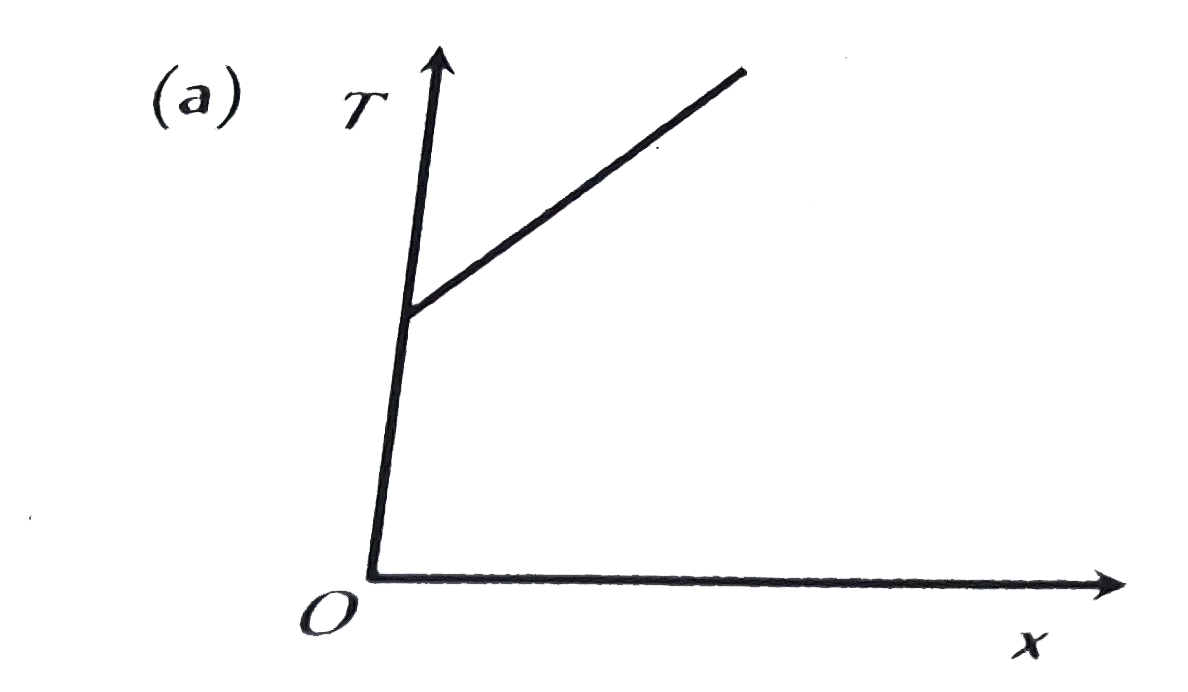
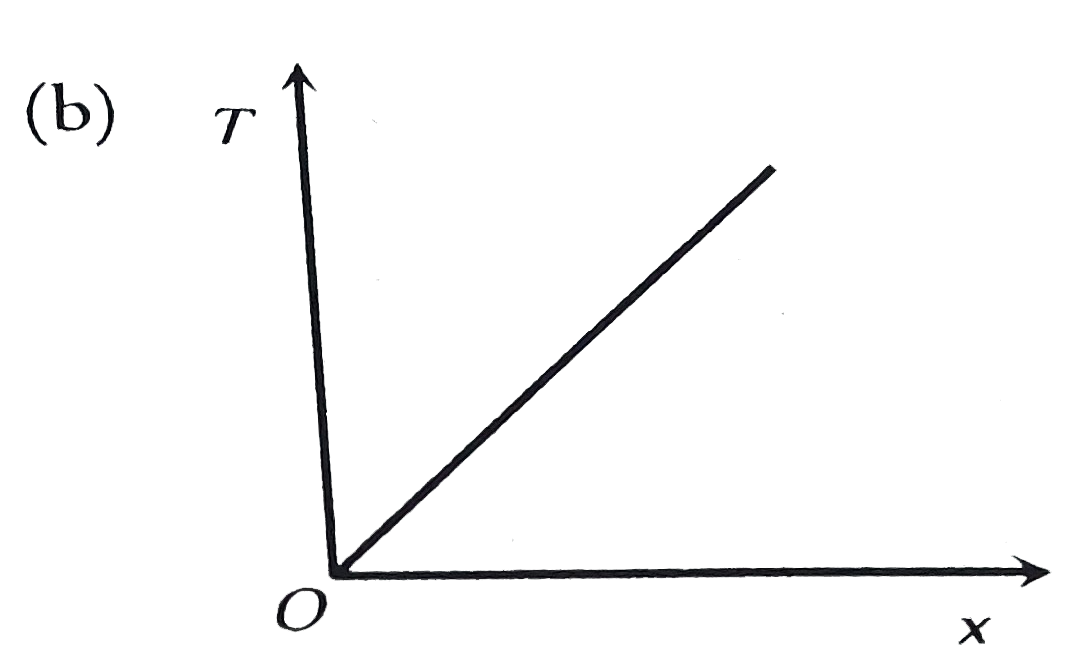
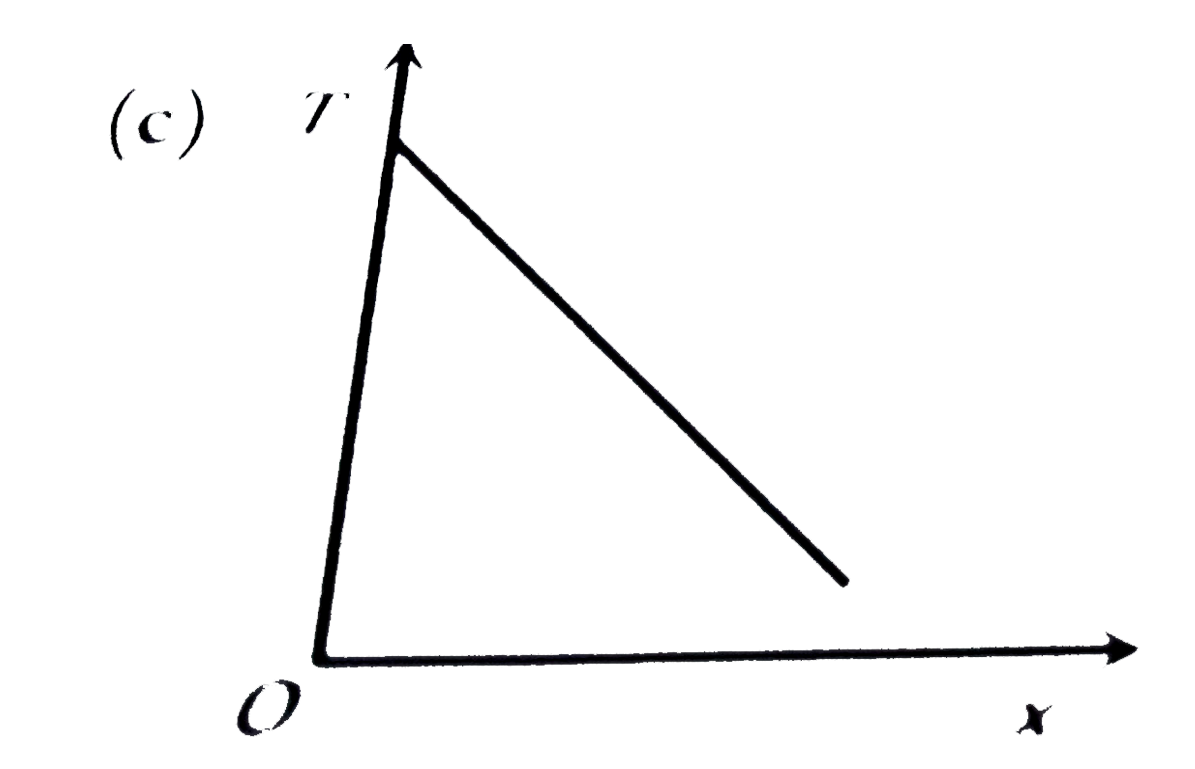
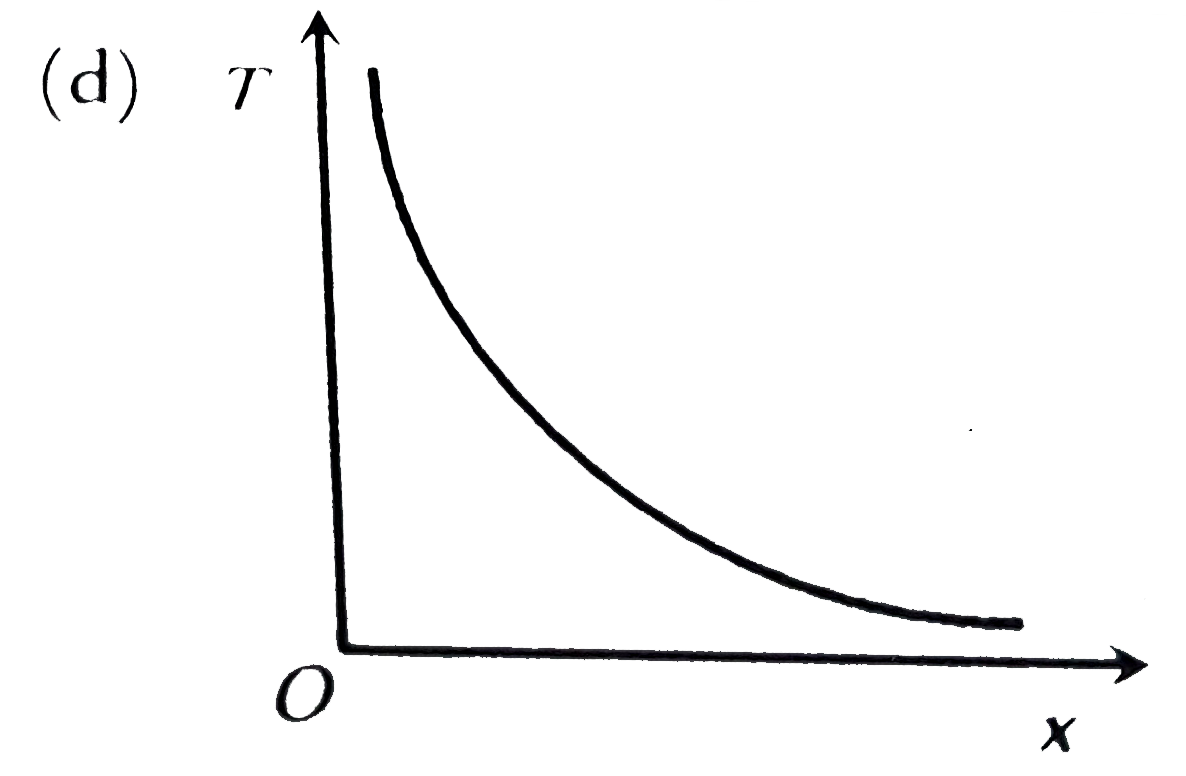
Starting from the centre of the earth having radius R, the variation of g (acceleration due to gravity) is shown by which one of the following graph ? |
|
Answer»
`:.g prop r "" ((GM_e)/R_e) ` is CONSTANT ) outside earth `g= (GM_e)/r^2 "" (r ge R_e)` `:.g prop 1/r^2` These both SITUATION is truly SHOWN in GRAPH (D) |
|
| 15. |
In a new system of units, value of speed of light (c = 3xx 10^(8) m"/"s), Universal gravitational constant (G= 6.67xx10^(-11)) and acceleration due to gravity (g= 9.8 m"/"s^(2)) are found to be unity. What are the units of mass, length and time in this new system of units? |
|
Answer» Solution :Let `M_(1), L_(1)" and "T_(1)` represent FUNDAMENTAL units in MKS system and `M_(2), L_(2)" and "T_(2)` represent the same in new system of units. Let us assume that `M_(2)=x M_(1), L_(2)=y L_(1)" and "T_(2)= z T_(1)`. Dimensional fourmula for speed of light is `LT^(-1)`. Let `n_(1)" and "n_(2)` be the values for speed of light in MKS and new system RESPECTIVELY. `n_(1)u_(1)= n_(2)u_(2)` `implies (n_1)[L_(1)T_(1)^(-1)](n_2)[L_(2)T_(2)^(-1)]` `implies (n_1)=(n_2)[(L_2)/(L_1)][(T_(2)^(-1))/(T_(1)^(-1))]` `implies (n_1)= (n_2)[(L_2)/(L_1)][(T_1)/(T_2)]` `implies (3xx10^(8))=(1)(y)(1/z)` `implies (y)/(z)=3xx10^(8)"""............."(i)` Dimensional FORMULA for Gravitatioal constant is `M^(-1)L^(3)T^(-2)`. Let `n_(1)" and "n_(2)` be the values for gravitational constant in MKS and new system respectively. `n_(1)u_(1)= n_(2)u_(2)` `implies (n_1)[M_(1)^(-1)L_(1^(3))T_(1)^(-2)]=(n_2)[M_(2)^(-1)L_(2)^(3)T_(2)^(-2)]` `implies (n_1)=(n_2)[(M_(2)^(-1))/(M_(1)^(-1))(L_(2)^(3))/(L_(1)^(3))(T_(2)^(-2))/(T_(1)^(-2))]` `implies (n_1)= (n_2)[(M_1)/(M_2)][(L_2)/(L_1)]^(3)[(T_1)/(T_2)]^(2)` `implies (6.67xx10^(-11))= (1)(1/x)(y^3)((1)/(z^2))` `implies (y^3)/(xz^2)=6.67xx10^(-11)""".........."(ii)` Dimensional fourmula for acceleration due to gravity `LT^(-2)`. Let `n_(1)" and "n_(2)` be the values for acceleration due to gravity in MKS and new system respectively. `n_(1)u_(1)= n_(2)u_(2)` `implies (n_1)[L_(1)T_(1)^(-2)]=(n_2)[L_(2)T_(2)^(-2)]` `implies (n_1)=(n_2)[(L_2)/(L_1)(T_(2)^(-2))/(T_(1)^(-2))]` `implies (n_1)= (n_2)[(L_2)/(L_1)][(T_1)/(T_2)]^(2)` `implies (9.8)= (1)(y)((1)/(z^2))` `implies (y)/(z^2)=9.8"""............"(iii)` On dividing equation (iii) from equation (i) we get the following : `z=(3xx10^(8))/(9.8)` `implies z=3.06xx10^(7)"""............"(iv)` Substituting the value of z from equation (iv) in equation (i) we get the following : `(y)/(3.06xx10(7))= 3xx10^(8)` `implies y= 9.18xx10^(15)"""............"(v)` Now substituting the values of y and z from equation (iv) and (v) in equation (ii) we get the following : `x=((9.18xx10^(15))^(3))/((6.67xx10^(-11))(3.06xx10^(7))^(2))` `implies =(773.62xx10^(45))/((6.67xx10^(-11))(9.364xx10^(14)))` `implies x= 12.4xx10^(42)"""............"(vi)` Now from results in equations (iv), (v) and (vi) we can describe the new system of units as follws : Unit of mass `=12.4xx10^(42)kg` Unit of length `=9.18xx10^(15)m` Unit of time `=3.06xx10^(7)s`. |
|
| 16. |
If two objects of masses m_(1) and m_(2)(m_(1), gt m_(2)) are moving with the same momentum then the kinetic energy will be greater for |
|
Answer» `m_(1)` |
|
| 17. |
A body of mass 'm' slides down a smooth inclined plane having an inclination of 45^(@) with the horizontal. It takes 2S to reach the bottom. If the body is placed on a similar plane having coefficient friction 0.5, The time taken for it to reach the bottom is |
|
Answer» 3.725 SEC |
|
| 18. |
In Column-I instrument and in Column-II their least count is given. Match them properly : {:("Column-I","Column-II"),("(1) Microscope","(a) 0.01 cm"),("(2) Micrometer screw gauge","(b) 0.001 cm"),(,"(c) 0.0001 cm"):} |
|
Answer» |
|
| 19. |
In an experiment using Regnault's method of determining specific heat capacity of a gas at constant pressue, a gas was stored in a reservoir of 50- litre capacity at 10^(@)C and 6 atmosphere pressure. The gas was heated to 100^(@)C and passed through a calorimeter at 10^(@)C. When the temperature rose to 30^(@)C the calorimeter was detached from the heating bath. The pressure of the reservoir was found to fall to 4 atmosheric pressure in the mean time. Calculate the specific heat capacity of the gas at constant pressure if the water equivalent of the calorimeter and its contents was 50g. Mass of 1 liter of gas at NTP =1.25xx10^(-3)kg |
|
Answer» |
|
| 20. |
Because of which property of the object it tries to oppose the change ? |
| Answer» SOLUTION :INERTIA | |
| 21. |
Three vectorsvec A, vec B andvec C add up to zero . Find which is false. |
|
Answer» (a)`(vec Axx vec B) XX vec C` is not zero unless ` vec B, vec c` are prallel (i):. ` vec B xx ( vec A+ vec B+ vec C) = vec B xx 0=0 ` or ` vec Bxx vec A + vec B+ vec Bxx vec C=0` or ` vec B xx vec A+ 0+ vec Bxx vec C=0` or ` vec A xx vec B= vec B xx vec C` :. ( vec Axx vec B) xx vec C =( vec Bxx vec C)xx vec C, It cannot be zero. If ` vec B || vec C`, then ` vec Bxx vec C =0`, then (vec Bxx vec C) xx vec C=0` ltBrgt Thus , option (a) is correct. (ii) ( vec Axx vec B) . ( vec Bxx vec C) . ( vec C=0` WHATEVER be the positions of ` vec A, vec B` and vec C` ` If ` vec B|| vec C`, the ` vec ` vec Bxx vec C =0`, the ( vec Bxx vec C) xx vec C=0` Thus, option (b) is false ( iii) ` (vec Axx vec B) = vec D= AB sin theta hat D`. The direction of ` hat D` is perpendicular to the plane cntaning ` vec A` and ` vec B`. ( vec A xx vec B) xx cvec C = vec D xx vec C`. Its direction is in the plane of ` vec A, vec B` and vec C`. Thus, option (c ) is correct. ( IV)If ` C^@ = A^2 + B^2`, the angle between ` vec A ` and vec B` is ` 90^@`. (vec A xx vec B).vec C= ( AB sin 90^@ hat D) . vec C= AB ( hat D. vec C) = ABC cos 8=90^@=0`. Thus, option (d) is fase . ( vec A xx vec B) xx cvec C = vec D xx vec C`. Its direction is in the plane of ` vec A, vec B` and vec C`. Thus, option (c ) is correct. ( iv)If ` C^@ = A^2 + B^2`, the angle between ` vec A ` and vec B` is ` 90^@`. |
|
| 22. |
The type of errors that can never be completely eliminated as |
|
Answer» DETERMINATE errors |
|
| 23. |
A ladder weighing W rests with one end against arough vertical wall and the other end on a rough floor. It is inclined at an angle of 45^(@) with the horizontal. Coefficient of friction of the ladder with the floor and the wall are mu and mu' respectively. Show that the minimum horizontal force that can move the base of the ladder towards the wall is (W(1+2mu-mumu'))/(2(1-mu')). |
|
Answer» Solution :A horizontal force F is applied at point B of the ladder AB Fig. such that the ladder is at the limiting stage of equilibrium. The figure shows the FORCES ACTING at this stage. At equilibrium the horizontal components give, F= R.+ `mu R ""cdots (1)` and the vertical components give, W +`mu.R.=R "" cdots (2)` `because ANGLEABO= 45^(@)`, we have OA =OB=2L (say). At equilibrium the moments of the forces about B give, WL +`mu.R..2L=R..2L` :. W =2R.(1-`mu`) or, `R. = (W)/(2(1-mu.))""cdots(3)` `:.` From (2) we get, R =W `[1+(mu.)/(2(1-mu.))] ""cdots(3)` and from (1) we get, `F=W [(1)/(2(1-mu.))+mu+(mu.mu)/(2(1-mu.))]` =`W((1+2mu-mumu.))/(2(1-mu.))` 
|
|
| 24. |
The pressure p and volume V of an ideal gas both increase in a process a) Such a process is not possible b) The work done by the system is positive c) The temperature of the system must increase d) Heat supplied to the gas is equal to the change in internal energy |
|
Answer» only a is CORRECT |
|
| 25. |
An ideal gas is heated from 20^(@)C" to "40^(@)C under constant pressure. The change in internal energy is |
|
Answer» zero under CONSTANT pressure |
|
| 26. |
Two moles of air, when heated through 10 K expand by an amount of 1.66 xx 10^(-3) m^3 under a constant pressure of 10^5 N//m^2. If C_v = 20.81 J/mole K, then C_p is, |
|
Answer» 29.11 J/mole K |
|
| 27. |
Three blocks with masses m, 2m and 3m are connected by strings as shown in the figure. After an upward force F is applied on block m, the masses move upward at constant speed v. What is the net force on the block of mass 2m |
|
Answer» SOLUTION :The speedof MASS isconstantso theaccelerationwill be zero . `F=ma ` `F = m XX 0 = 0` |
|
| 28. |
What is the power required to raise 450 L of water per minute through a height of 10 m vertically, and to eject it through a orifice of radius 4 cm |
|
Answer» |
|
| 29. |
(A) : Machine parts are jammed in winter. (R ) : The viscosity of lubricant used in machine parts increase at low temperature. |
|
Answer» Both (A) and (R ) are true and (R ) is the CORRECT EXPLANATION of (A) |
|
| 30. |
Dimensionless quantity is |
|
Answer» INTENSITY LEVEL of sound |
|
| 31. |
A source of sound of frequency f is approaching towards a wall with speed upsilon_(s) . Speed of sorce is upsilon . Three obseruers O_(1) , O_(2) and O_(3) are at different locations as shows . Find the beat frequency as obserued by three different obseruers. |
Answer» 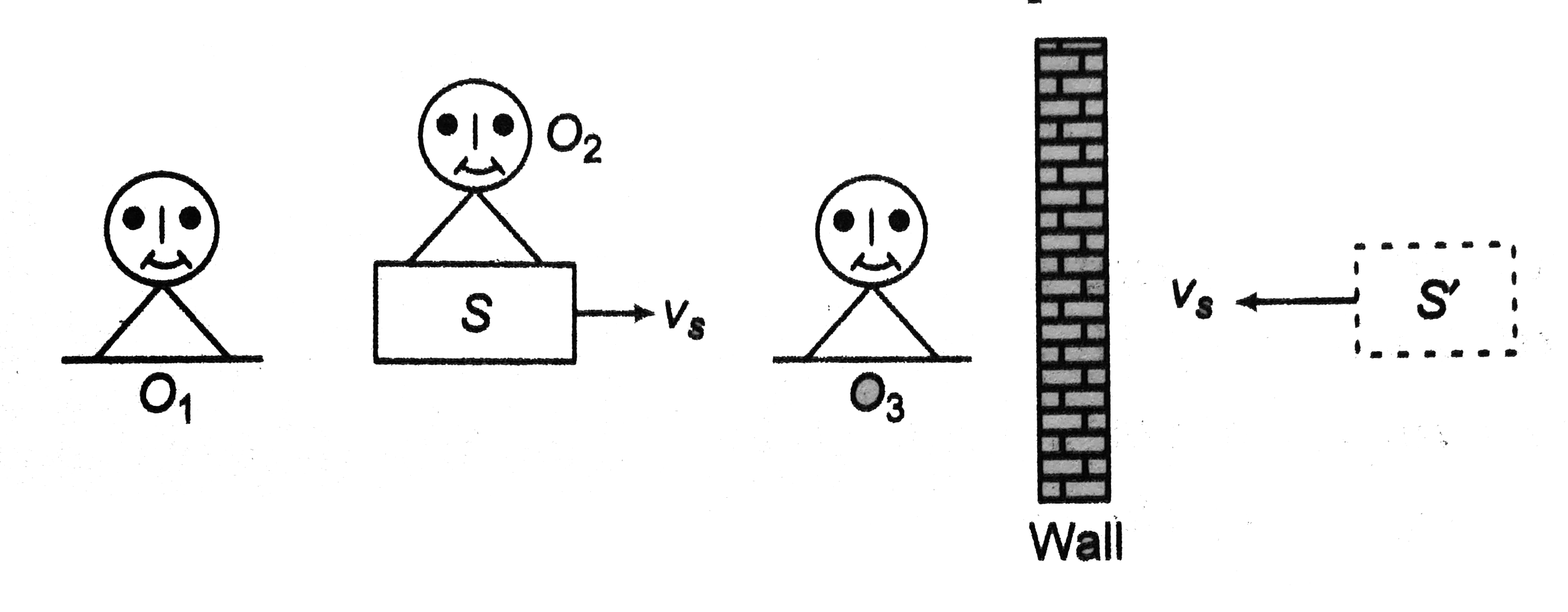   Observer `O_(1)S` is RECEDING from `O_(1)` and `S` ' i`((2upsilon_(s))/(upsilon- upsilon_(s))) f` approaching towards him. So, `f_(s')gtf_(s)` `f_(b) = f_(s') - f_(s)` = `f (upsilon/(upsilon - upsilon_(s)))- f(upsilon/(upsilon + upsilon_(s)))` = `((2 upsilon upsilon_(s))/(upsilon^(2) - upsilon_(s)^(2))) f` Observer `O_(2)``O_(2)` has no RELATIVE motion with `S` . Therefore, there will be no change in the frequency of direct sound from `S` . Further, `O_(2)` and `S` ' are approaching towards each other. Therefore, the frequency of reflected sound will increase. `f_(b) = f_(s') -f_(s)` = `f ((upsilon + upsilon_(02))/(upsilon - upsilon_(s))) - f` But `upsilon_(02) = upsilon_(s)` `:. f_(b) = f ((upsilon + upsilon_(s))/(upsilon - upsilon_(s))) - f` = `((2upsilon_(s))/(upsilon- upsilon_(s))) f` Observer `O_(3)S` and `s'` both approaching towards `O_(3)` . SO, both frequenceies will increase. But after the increease theyare equal . So, beat frequency will be zero. `f_(s) = f_(s')= f ((upsilon)/(upsilon - upsilon_(s)))` `:. f_(b) = f_(s) - f_(s') = 0` |
|
| 32. |
The diamensional formula of gravitational potential is .......... |
|
Answer» `M^1L^1T^(-1)` `= (M^(1) L^(2) T^(-2))/(M^(1) L^(0) T^(0))` ` = M^(0) L^(2) T^(-2)` |
|
| 33. |
A machine rated as 150W, changes the velocity of a 10 kg mass from 4ms^(-1) to 10 ms^(-1) in 4s. The efficiency of the machine nearly is |
| Answer» ANSWER :A | |
| 34. |
In a mechanical refrigerator, the low temperature coils are at a temperature of -23°C and the compressed gas in the condenser has a temperature of 27°C. The theoretical coefficient of performance is |
|
Answer» 5 |
|
| 35. |
The door of an almirah is 6m high, 1.5 m wide and weighs 8 kg. The door is supported by two hinges situted at a distance of 1m from the ends. Assuming forces exerted on hinges are equal, the magnitude of the force is (40+x)N where 'x' is (take g=9.8" m/s"^(2)) |
|
Answer» |
|
| 36. |
50 g of oxygen at N.T.P. is compressed adiabatically to a pressure of 5 atmosphere. Caluculate the work done on the gas, if gamma = 1.4 and R = 8.31 J mol^(-1) K^(-1) |
|
Answer» |
|
| 37. |
The opposite faces of a cubical block of iron of cross-section 4 xx 10^(-4) "m"^(2) are kept in contact with steam and melting ice. Calculating the amount of ice melted at the end of 5 minutes. Given K=0.2 cal cm ""^(-1) "s"^(-1)°"C"^(-1). |
|
Answer» |
|
| 38. |
A 5 kg body is rotated in vertical circle with a constant speed of 4 ms^(-1) using of length 1 m, when the tension in the string is 31 N, then the body will be |
|
Answer» at the lowest POINT |
|
| 39. |
The binding energy of a satellite of mass m in a orbit of radius r is (R = radius of earth, g = acceleration due to gravity) |
|
Answer» `(mgR^(2))/R` |
|
| 40. |
Heat is flowing through a conductor of length l from x = 0 to x = l . If its thermal resistance per unit length is uniform, which of the following graphs is correct |
|
Answer»
|
|
| 41. |
When water droplets merge to form a bigger drop |
|
Answer» ENERGY is liberated |
|
| 42. |
A bullet fired vertically up from the ground reaches a height 40 m in its path from the ground and it takes further time 2 seconds to reach the same point during descent. The total time of flight is (g=10ms^(-2)) |
|
Answer» 4 s |
|
| 43. |
The surface tension of a liquid is 80 dyne/cm. Its relative density is 0.8. If the angle of contact between the liquid and glass is 60^(@),find the height to which the liquid rises in a glass capillary tube of radius 1 mm. (Assume g=10ms^(-2)) |
|
Answer» Solution :Radius of the capillary tube r=1 mm = 0.1 cm density `rho=0.8` gm/c.c ACCELERATION due to gravity `g=10ms^(-2)=1000CM^(-2)` surface tension S=80 dynes /cm angle fo contact `theta=60^(@)` The heightof liqudi columnin capillary tube `H=(2S cos theta)/(r t rho)impliesh=(2xx80xxcos 60^(@))/(0.1xx1000xx0.8)=1cm` |
|
| 44. |
If vec(A)= 7hat(i) + 2hat(j) - 3hat(k) and vec(B) = hat(i) + hat(j) + 2c hat(k) are perpendicular vectors, the value of c is |
|
Answer» `-1.5` |
|
| 45. |
A sphere is rolled on a rough horizontal surface. It gradually slows down and stops.The force of friction tries to |
|
Answer» INCREASE the LINEAR velocity |
|
| 46. |
Total energy of SHM particle……. |
|
Answer» `propto X` |
|
| 47. |
In a barometer tube of 1 m long and 2cm^(2) cross-section, mercury stands at a height of 75cm of Hg. When a small amount of oxygen is introduced in the space above the mercury, the level falls by 10 cm. Find the mass of oxygen introduced. (Room tempetature = 27^(@)C, density of mercury = 13.6 gm/c c, g=10ms^(-2)) |
|
Answer» Solution :Volume of oxygen `V=2xx(100-65)xx10^(-6)=70xx10^(-6)m^(3)` Pressure of oxygen, `P=rhogh` = `(13.6xx10^(3))(10)(10xx10^(-2))=13,600Nm^(-2)` Temperature of oxygen T = 300 K, `therefore` MASS of oxygen, `m=(PVM)/(RT)=(13,600xx70xx10^(-6)xx32xx10^(-3))/(8.3xx300)=0.012gm` |
|
| 48. |
A particle is performing SHM in a path of length 8 cm time period 4sec. Find the time taken and phase when particle is 2cm mean position |
|
Answer» `1//3"SEC", 30^(@)` |
|
| 49. |
A man of 60kg mass is in a lift . Find the apparent weight of the man when the lift is moving (a) up with uniform acceleration 4ms^(-2) (b) down with uniform acceleration of 2ms^(-2). (g=10ms^(-2)) |
|
Answer» |
|
| 50. |
A satellite is launched into circular orbit of radius R around the earth while a second satellite is launched into an orbit of Radius 1.02R. The percentage change in the time periods of the two satellite is |
|
Answer» `0.7` |
|