

Saved Bookmarks
This section includes 7 InterviewSolutions, each offering curated multiple-choice questions to sharpen your Current Affairs knowledge and support exam preparation. Choose a topic below to get started.
| 1. |
When one end of a glass rod is heated its shape becomes spherical. It reason is |
|
Answer» Friction |
|
| 2. |
Draw v to tgraph for constant velocity and explain it. |
Answer» Solution :Suppose, there is an object moving with constant velocity u. Its velocity-time graph is as shown in figure. 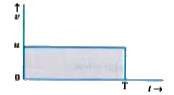 The `v gt t` curve is a straight line parallel to the time axis. The area under it between t = 0 and I = T is the area of the rectangle of height u and base T.Therefore, area = uXT = UT which is the displacement in this time interval. Note the dimensions of quantities on the two coordinate axes and it will give the proof. The area enclosed above t-axis is positive and the area enclosed below t-axis is negative, Note that the x-6, 0-t and a-t graphs shown in several figures in this chapter have SHARP kinks at some points implying that the functions are not differentiable at these points. In any realistic situation, the functions will be differentiable at all points and the graphs will be SMOOTH. What this means physically is that ACCELERATION and velocity cannot change VALUES ABRUPTLY at an instant. Changes are always continuous. |
|
| 3. |
A foot ball is kicked by a player with certain angle to the horizontal. Is there any point at which velocity is perpendicular to its acceleration? |
| Answer» Solution :YES. At its maximum height in the parabolic path vertical velocity is zero but DUE to HORIZONTAL component, velocity acts along HORIZONTALLY, but acceleration of the football acts vertically DOWNWARDS. | |
| 4. |
The displacement of particle with respect to time is s = 3^(t3) - 7t^(2) + 5t + 8 where s is in m and t is in s, then acceleration of particle at t = ls is |
|
Answer» `14 MS^(-2)` `therefore v = 9t ^(2) + 14 t +5` `and a = 18 t + 14` Now` t=1s` `a (1) = 18 +14` `therefore a (1) = 32 ms ^(-12` |
|
| 5. |
The acceleration due to gravity at a depth of 1600 km inside the earth. |
|
Answer» 0 |
|
| 6. |
In the question rumber 66, for what value of theta, shearing stress is maximum? |
|
Answer» `0^(@)` Shearing stress is maximum when`sin 2theta =1` `or SIN2THETA = sin 90^(@) or 2theta = 90^(@)` ` or theta = 45^(@)` |
|
| 7. |
Three rods of identical cross - sectional area and made from the same metal form the sides of an isosceles triangle ABC right angled at B. The points A and B are maintained at temperatures T and sqrt2T respectively in steady state. Assuming that only heat conduction takes place find the temperature at point C. |
|
Answer» SOLUTION :As `T_(B)gtT_(A)`, HEAT flows from B to A through both paths Rate of heat FLOW in BC = Rate of heat flow in CA `THEREFORE(KA(sqrt2T-T_(C)))/l=(KA(T_(C)-T))/(sqrt2l)` Solving this we get, `T_(C)=(3T)/(sqrt2+1)` |
|
| 8. |
Why does a cyclist bend inwards while riding along a curved track ? |
| Answer» Solution :By doing so, the HORIZONTAL component of the normal REACTION provides the sufficient centripetal FORCE for GOING along the curved TRACK . | |
| 9. |
(i) What is the science (physics concept) behind a stethoscope? What is the principle? (ii) How will you make a child to understand the, Intensity of light or sound From Density without using formulae. |
|
Answer» Solution :(i) The principle behind a stethoscope is multiple reflections of sound. It consists of a long tube made of rubber or metal. When sound pulses pass through one end of the tube, the pulses gets concentrated to other other end due to several reflections on the inner surface of the tube. Using this the doctor hears the patient's heart beats as concentrated rays. (II) Density means the closeness of the particles. As the particles are closely PACKED. Density is more. For example we say Dense forest, it means the trees are closelypacked so that even LIGHT cannot pass into. Density can be used for solid, liquid and gas. But intensity means closeness of the waves or lines of force. Where the waves or lines of force are closer TOGETHER. Intensity is more for example LASER is a hightly intesnsified beam we say. Because in single beam, it has more number of coherent waves, packed closer together. Intensity can be used for light or sound or heat or electric lines of force or magnetic lines of force. |
|
| 10. |
A system undergoes a cyclic process in which it absorbsQ_(1) heat and gives out Q_(2) heat. The efficiency of the process is eta and the work done is W. Which of the following is false |
|
Answer» `W=Q_(1)-Q_(2)` |
|
| 11. |
Two masses 8 kg and 12 kg are connected at the two ends of a lightinextensible string that goes over a frictionless pulley.Find the acceleration of the masses, and the tension in the string when the masses are released. |
|
Answer» SOLUTION :`T = 8 xx 10 = 8A, 12 xx 10 - T = 12a` i.e., `a = 2 ms^(-2) , T =96 N` |
|
| 12. |
A gas thermometer measures the temperature from the variation of pressure of a sample of gas. If the pressure measured a l the melting point o f lead is 2.20 times the pressure measured at the triple point of water find the melting point of lead. |
| Answer» Answer :A | |
| 13. |
If DeltaU and Delta W represent the increase in internal energy and work done by the system respectively in a thermodynamical process, which of the following is true? |
|
Answer» `DeltaU=-DeltaW` in an ADIABATIC PROCESS |
|
| 14. |
For what value of 'a' the block falls freely ? |
|
Answer» Solution :In the time the wedge moves a distance x TOWARDS left with acceleration a the block FALLS through a HEIGHT h with acceleration g `(x=(1)/(2)at^(2))/(h=(1)/(2)g t^(2))rArr (x)/(h)=(a)/(g)` `rArr cot theta = (a)/(g) ""a=g cot theta` |
|
| 15. |
There is 0.2 Kg of water at 25^(0)C in a calorimeter of heat capacity 62.8 J K^(-1). If the temperature of the calorimeter is to be raised to 50^(0)C, how much steam at 100°C is to be sent into it? (L_("steam") = 2.26 xx 10^(6)JKg^(-1), specific heat of water = 4186J Kg^(-1)) |
|
Answer» Solution :Heat capacity of the calorimeter (mass x SPECIFIC heat) `= 62.8 J K^(-1)` Mass of water `(m_(2)) = 0.2 KG` , Specific heat of water `(S_(2)) = 4186 J Kg^(-1)` Initial temperature `(t_(1)) = 25^(0)C` , Final temperature `(t_(2)) = 50^(0)C` Temperature of the steam `(t_(3)) = 100^(0)C` Heat gained by the calorimeter `= m_(1) s_(1) (t_(2) - t_(1)) = 62.8 xx 25 = 1570 J` Heat gained by the water `= m_(2)S_(2) (t_(2)-t_(1)) = 0.2 xx 4186 xx 25 = 20930 J` Heat lost by the steam `= m_(3) L + m_(3)S_(2)(t_(3)-t_(2)) = m_(3) [L + S_(2) (t_(3) - t_(2))]` `= m_(3) (2.26 xx 10^(6) + 4186 xx (100 - 50)] = m_(3) [2260000 + 209300]` `= m_(3) xx 2469300 J.` From the method of mixtures Heat lost by steam =Heat gained by the calorimeter + heat gained by the water `m_(3) xx 2469300 = 1570+ 20930= 22500 m_(3) = (22500)/(2469300)=0.009112 Kg` `therefore` Mass of steam required = 0.009112 Kg. |
|
| 16. |
A piece of uniform string hangs vertically so that its free end just touches horizontal surface of a table . The upper end of the string is now released . Show that at any instant during the falling of string , the total force on the surface is three times the weight of that part of string lying on the surface . |
|
Answer» Solution :LET m be the mass per unit length of string and X the length of string at any instant on the table . If differential length dx of string further falls in time dt, then velocityv of this element will be given by ` v^(2)=u^(2)+2gx` or `v^(2)=0+2gx`....(1) or `v^(2)=2gx`....(2) Net force on the surface of the table `F=(dp)/(dt)`+weight of string lying on the surface `=(m dx .v )/(dt)+mxg=mv(dx)/(dt) +mxg =mv^(2)+mgx` Using (1) , `F=m(2gx)+mgx=3(mx)G` But `mx=M^(1)= `weight of string lying on the table `:. F =3M^(1)g` 
|
|
| 17. |
Orginally the 'foot'of human being is taken as a unit of length. What condition prevents the use of human foot as a standard scientific fundamental (base) unit? |
| Answer» SOLUTION :INVARIABILITY. | |
| 18. |
There are two identical small holes on the opposite sides of a tank containing a liquid. The tank is open at the top. The difference in height between the two holes is h. As the liquid comes out of the two holes, the tank will experience a net horizontal force proportional to |
| Answer» ANSWER :B | |
| 19. |
Graph of specific heat at constant volume for a monoatomic gas as a function of temperatureis |
|
Answer»
|
|
| 20. |
Pendulum clock shows correct time at O^(@) C at a higher temperature the clock |
|
Answer» Loses TIME |
|
| 21. |
List the condition for the constructive interference totake place. |
|
Answer» Solution :`cos varphi=+1` `rArr varphi=0, 2pi, 4pi,.... 2N pi` where `n=0,1,2` This is the phase DIFFERENCE in which TWO WAVES overlap to give constructive interference. |
|
| 22. |
A point object moves along an arc of a circle of radius 'R'. Its velocity depends upon the distance covered 'S' as V=K sqrt(S) where 'K' is a constant. If 'theta' is the angle between the total acceleration and tangential acceleration, then |
|
Answer» `tan THETA= sqrt((S)/(R ))` |
|
| 23. |
Discuss the occurrence of binary (double) stars in a astronomy. |
Answer» Solution :If there are no external forces, the centre of mass of a double star moves LIKE a free particle, as shown in FIGURE (a).  The TRAJECTORIES of the two stars of equal mass are ALSO shown in the figure (a). They look complicated. If we go to the centre of mass frame, then we find that there the two stars are moving in a circle, about the centre of mass, which is at rest. The position of the stars have to be diametrically opposite to each other figure (b). In our frame of reference, the trajectories of the stars are a COMBINATION of (i) Uniform motion in a straight line of the centre of mass and (ii) Circular orbits of the stars about the centre of mass. |
|
| 24. |
Four vector bara, barb, barc and bard are lying in the same plane. The vectors bara and barb are equal in magnitude and inclined to each other at an angle of 120^(@). barc is the resultant of bara and barb. Further bara+barb+bard=0. If the angle between bara and bard is beta and the angle between bara and barc is alpha, find the correct relation between alpha and beta |
|
Answer» |
|
| 25. |
In an experiment, the values of refractive indices of glass were found to be 1.54, 1.53, 1.44, 1.54, 1.56 and 1.45 in successive measurements i) mean value of refractive index of glass ii) mean absolute error iii) relative error and iv) percentage error are respectively, |
|
Answer» 1.51, 0.04, 0.03,3% |
|
| 26. |
A mixture of n_(1)moles of monoatomicgas and n_(2)moles of diatomic gas has(C_(p))/(C_(v))=gamma=1.5 |
|
Answer» `n_(1)=n_(2)` |
|
| 27. |
A black body of mass .0.10 g is kept in a black enclosure or temperature 27^(@)C. The temperature of the body is 127^(@)Cand the area of the emittimg surface in 10^(-3) m^(2). If its specific heat capacity is 420 J kg^(-1)k^(-1) find the rate of cooling of the body . sigma = 5.67xx10^(-8)Wm^(-2)K^(-4). |
|
Answer» |
|
| 28. |
A force F is applied at the top of a ring of mass M and radius R placed on a rough horizontal surface. Friction is sufficient to prevent slipping. Find the frictional force acting on the ring. |
|
Answer» Solution :`ALPHA=(TAU)/(I)=(F(2R))/(2MR^(2))=(F)/(MR)` Now `F+f=Ma=MRalpha` = F or f=0 
|
|
| 29. |
The radius of a well is 7m. Water in it is at a depth of 20m and depth of water column is 10m. Work done in pumping out water completely from the well is (g=10ms^(-2)) |
|
Answer» `38.5 MJ` |
|
| 30. |
If the tension on a wire is removed at once, then …………… . |
|
Answer» it will break |
|
| 31. |
The linear momentum of a particle at time t is given by the equation P = x + yt^(2), where x and y are constants. The instantaneous force acting on the particle during its motion is ..... |
|
Answer» INVERSELY proportioal to `t^(2)` `:. , (dp)/(dt ) =0 +2yt` `:. , V = (3 xx 2 xx 0.6)/(10 + 20 + 0)` `F= 2yt`where2yconstant `F propt` |
|
| 32. |
What are the characteristics of a good cooling vessel ? |
| Answer» SOLUTION :A good cooking vessel should be MADE of material of low specific heat, HIGH coefficient of thermal CONDUCTIVITY and low coefficient of expanssion. | |
| 33. |
A blacksmith fixes iron ring on the rim of the wooden wheel of a bullock cart. The diameter of the rim and the ring are 5.243 m and 5.231 m respectivelyat 27^(@)C. To what temperature should the ring be heated so as to fit the rim of the wheel ? Coefficient of linear expansion of iron = 1.20 xx 10^(-5) K^(-1) |
|
Answer» SOLUTION :`d_(2)=d_(1)[1+alphaDeltat]` `5.243=5231[1+1.2xx10^(-5)(T-30)]` `[(5243)/(5231)-1]=1.2xx10^(-5)(T-300)` `T=191+300=491k=218^(@)`C |
|
| 34. |
A steel wire 2mm in diameter is just stretched between two rigid walls at 20°C. If the temperature falls to 10°C, find the tension in the wire. Linear coefficient of expansion of steel = 11 xx 10^(-6)//k and Y = 2 xx10^(11) N//m^(2) |
|
Answer» |
|
| 35. |
A body floats in a liquid fully submerged. If the body is pressed slightly downwards and then released, it will |
|
Answer» OSCILLATE up and down |
|
| 36. |
A spring balance has a scale that reads from 0 to 50 kg. The length of the scale is 20 cm. A body suspended from this spring, when displaced and released, oscillates with a period of 0.6s. What is the weight of the body? When 50 kg is put, the extension of spring is 20 cm. |
|
Answer» |
|
| 37. |
The resultant of two vectors P and Q. If the vector Q is reversed, then the resultant becomes S, then choose the correct option. |
|
Answer» <P>`R^(2)+S^(2)=2(P^(2)-Q^(2))` |
|
| 38. |
State Bernoulli's theorem. |
|
Answer» Solution :Bernoulli theorem: According to bernoulli the sum of pressure energy kinetic energy and ponteniel energey per unit mass of an incompressible, non viscous fluid in a streamlined flow remains a constatnt, Mathmatically, Proof: Let us consinder a flow of liquid through a pipe AB. Let V be the VOLUME Of the liquid when it enters A in a time t which is equal to the volume of the liquid leaving B in the same time . Lrt `a_(A),v_(A)` and `P_(2)` br the area of cross section of the TUBE, velocity of the liquid and pressure EXERTED by the liquid at A respetivily. Let the force exerted by the liquid ata is `F_(2)=P_(A) a_(A)` Distance travlled by theliquid in theyime t is `d=v_(A)t` Therefore the work done is `W=F_(2)d=P_(A)a_(A)v_(A)t` But `a_(A)v_(A)t=a_(A)d=V`, Volime of the liquid ENTERING at A. Thus the work done is the pressure energy (at A), `W=F_(A)d=P_(A)V` Pressure energy per unit volume at `A=("Pressure Energy")/("Volume")=(P_(A)V)/(V)=P_(A)` Since m is the mass of the liquid entering at A in a given time, therefore, pressure energy of the liquid at A is `EP_(A)=P_(A)V=xx(m/m)=m(P_(A))/(rho)` Due to the flow of liquid, the kinectic energy of the liquid at A, `KE_(A)=(1)/(2)mv_(A)^(2)` Therefore the total energey due to the flow of liquid at A, `E_(A)=EP_(A)+KE_(A)+PE_(A)` `E_(A)=m(P_(A))/(rho)+(1)/(2)mv_(A)^(2)+mg h_(A)` Similarly, let `a_(B), v_(B) and P_(B)` be the area of cross section of the tube , velocityof the liquidand pressure exerted by the liquid at B. Calculating the total energy at `F_(B)`, we get `E_(B)=m(P_(B))/(rho)+(1)/(2)mv_(B)^(2)+mg h_(B)``m(P_(A))/(rho)+(1)/(2)mV_(A)^(2)+mgh_(A)=m(P_(B))/(rho)+(1)/(2)mv_(B)^(2)+mgh_(B)` `m(P_(A))/(rho)+(1)/(2)mV_(A)^(2)+mgh_(A)=m(P_(B))/(rho)+(1)/(2)v_(B)^(2)+gh_(B)=`Constant Thus the above equation can be written as `(P)/(rhog)+(1)/(2)(v^(2))/(g)+h= `Constant  |
|
| 39. |
A rigid body rotates about a fixed axis with variable angular velocity equal to (a - bt) at time t where a and b are constants. The angle through which it rotates before it comes to rest is |
|
Answer» `(a^(2))/(b)` At time t = 0 , `omega = omega_(0) = a` `alpha = (d omega)/(dt) = (d )/(dt) "" (a- bt) = -b` `omega^(2) = omega_(0)^(2) + 2 alpha theta` If `omega` is zero , `THEREFORE 0 = omega_(0)^(2) + 2alpha theta or theta =- (omega_(0)^(2))/(2alpha) = (a^(2))/(2b)` |
|
| 40. |
Apebble of mass 0.05 kg is thrown vertically upwards.Give the direction and magnitude of the net force on the pebble, (a) during its upward motion, (b) during its downward motion, (c) at the highest point where it is momentarily at rest.Do your answers change if the pebble was thrown at an angle of 45^@with the horizontal direction?Ignore air resistance. |
| Answer» SOLUTION : The only force in each CASE is the force of gravity, (NEGLECTING effects of air) equal to 0.5 N vertically downward. The ANSWERS do not change, even if the motion of the pebble is not along the vertical. The pebble is not at rest at the highest POINT. It has a constant horizontal component of velocity throughout its motion. | |
| 41. |
Two satellites of masses m_(1) and m_(2) (m_(1) gt m_(2))are revolving the earth in circular orbits of radius r_(1) and r_2 (r_(1)gtr_2)respectively. Which of the following statement is true regarding their velocities v_1 and v_2. |
|
Answer» `v_1 =v_2` |
|
| 42. |
A flywheel of M.I. 6xx10^(-2)"kgm"^(2) is rotating with an angular velocity of "20 rad s"^(-1). The torque required to bring it to rest in 4s is |
|
Answer» `1.6` NM |
|
| 43. |
The temperature of 5 moles of a gas at constant volume is changed from 100^(@)C to 120^(@)C. The change in internal energy is 80 J. The total heat capacity of the gas at constant volume will be in J/K. |
|
Answer» 8 |
|
| 44. |
In a spherical charge distribution, volume charge density varies as rho=Cr^(-1) for r_(1) lt rlt r_(2) as shown. Here C is a positive constant. When a point charge q is kept at the centre of the sphere, the electric field strength in the region r_(1) lt r lt r_(2) will be a constant. For this find the value of C. |
| Answer» SOLUTION : `C=q/(2pir_1^2)` | |
| 45. |
Let T_(1)" and "T_(2) be the time periods of spring A and B when mass M is suspended from theend of the spring. If both springs are taken in series and the same mass M is suspended from the series combination, the time period is T, then |
|
Answer» `T= T_(1) +T_(2)` `THEREFORE k_(1)= (4pi^(2)M)/(T_(1)^(2))" and "k_(2)= (4pi^(2)M)/(T_(2)^(2))` For series combination, `(1)/(k)=(1)/(k_1)+(1)/(k_2)= (T_(1)^(2))/(4pi^(2)M)+(T_(2)^(2))/(4pi^(2)M)= (T_(1)^(2)+T_(2)^(2))/(4pi^(2)M)` `therefore k= (4pi^(2)M)/(T_(1)^(2)+T_(2)^(2))` `therefore T_(1)^(2)+ T_(2)^(2)= 4pi^(2) (M)/(k)` `therefore sqrt(T_(1)^(2)+T_(2)^(2))= 2pi sqrt((M)/(k))` is the resultant periodic time. |
|
| 46. |
A car is fittedwith a convex side view mirror of focal length 20cm. A second car 2.8cm behind the first car is overtaking the first car at relative speed of 15m//s. The speed of the image of the second car as seen in the mirror of the first one is |
|
Answer» `1/15 m//s` |
|
| 47. |
The ratio of the specific heats (C_(P))/(C_(v))=gamma in terms of degree of freedom (n) is given by: |
|
Answer» `(1+(2)/(N))` |
|
| 48. |
A U-tube having unequal arm-lengths has water in it. A tuning fork of frequency 440 Hz can set up the air in the shorter arm in its fundamental mode of vibration and the same tuning fork can set up the air in the longer arm in its first overtone vibration. Find the length of the air columns Neglect any end effect and assume that the speed of sound in air = 330 ms^-1 |
|
Answer» According to the data `440=(3xx300)/(4L_2)`………1 (FIRST over TONE) and `440=(3xx330)/(4L_1)` ………..2 (Fundamental) SOLVING equation we get, `L_2=56.3cm` `and L_1=18.8cm` |
|
| 49. |
A solid cylinder of mass 20 kg rotates about its axis with angular speed 100 rad s^(-1) The radius of the cylinder is 0.25 m. The kinetic energy associated with the rotation of the cylinder |
| Answer» ANSWER :A | |
| 50. |
A string wrapped around a cyliner of mass m and radius R. The end of the string is connected to block of same mass hanging vertically. No friction exists between the horizontal surface and cylinder. Acceleration of hanging mass is: |
| Answer» ANSWER :D | |


