

Saved Bookmarks
This section includes 7 InterviewSolutions, each offering curated multiple-choice questions to sharpen your Current Affairs knowledge and support exam preparation. Choose a topic below to get started.
| 1. |
Statement A : In translatory motion each point of the body experiences the same displacement as any other point as time goes on, so that the motion of any particle represents the motion of the whole body Statement B : In rotatory motion, all the particles in the rigid body moves in concentric circles about the axis or rotation. |
|
Answer» a is TRUE, B is FALSE |
|
| 2. |
Whichof the followng relationships between the acceleration a and the displacement x of a particle involve simple harmonic motion? a= 0.7x. |
|
Answer» Solution :There are two CONDITIONS for particle executes SHM. (i) Acceleration is directly proportional to displacement. Acceleration is always TOWARDS MEAN position `therefore " Acceleration " a= - omega^(2)x` `a= 0.7x` This given relation is not fit with `a= -omega^(2)x` hence it is not a SHM. |
|
| 3. |
The displacement x of a particle moving in one direction is given by t=sqrt(x)+3, where x in meter and t in sec. What is its displacement when its velocity is zero |
|
Answer» `3m//s` |
|
| 4. |
A simple pendulam of length l is suspended from the ceiling ofa moving lift. Find the time period of the pendulam when the lift is going up with accelerationF. [Hint: Bring the pendulam to rest by applying inertia force (D' Alembert's principle) and consider its motion in this condition.] |
|
Answer» |
|
| 5. |
If bodies at the equator of the earth are to be weightless, what should be its time period of rotation ? |
|
Answer» SOLUTION :The ACCELERATION due to gravity at LATITUDE `phi` is ` g_phi = g - R omega^2 cos^2 phi` For bodies to be weightless at equator then `g_phi` must be zero.`rArr 0 = g - R omega^2 [ because phi = 0^@]` ` rArr omega^2 = g/R rArr omega = sqrt(g/R) , ` But we know that , `omega = (2pi)/(T) , THEREFORE T = 2pi sqrt(R/g)` |
|
| 6. |
A string wrapped around a cyliner of mass m and radius R. The end of the string is connected to block of same mass hanging vertically. No friction exists between the horizontal surface and cylinder. Distance moved by cylinder during time taken by it to complete one rotation is: |
| Answer» ANSWER :B | |
| 7. |
A body is hanging from a horizontal branch of a tree. The tension in the arms will be maximum when the angle between the arms is |
|
Answer» `0^(0)` |
|
| 8. |
The system shown in the figure is released from rest. Mass of the block on the table is 4 kg and mass of the other block is 1 kg. Coefficient of kinetic friction between block and table is 0.12. Find the speed of 1 kg block after it has descended through a distance of 1m. |
|
Answer» |
|
| 9. |
A rigid ball of mass m strikes a rigid wall at 60^(@) and gets reflected without loss of speed as shown in the figure. The value of impulse imparted by the wll on the ball will be |
|
Answer» Solution :(a) Impulse is imparted due to CHANGE in perpendicular components of MOMENTUM of ball. `J=Deltap=mv_(s)-mv_(i)` `mv cos 60^(@)-(-mv cos60^(@))` `=2mv cos 60^(@)=2 mvxx(1)/(2)` |
|
| 10. |
In a stationary wave all the particles |
|
Answer» on EITHER SIDE of a node vibrate in the same PHASE |
|
| 11. |
Whichof the followng relationships between the acceleration a and the displacement x of a particle involve simple harmonic motion? a= - 10x |
|
Answer» Solution :There are two conditions for particle executes SHM. (i) Acceleration is directly PROPORTIONAL to displacement. Acceleration is always TOWARDS mean position `therefore " Acceleration " a= - omega^(2)x` `a= 10x` This GIVEN relation is fit with `a= -omega^(2)x` HENCE it indicates SHM. |
|
| 12. |
A block whose mass is 2kg is fastened to a spring. The spring has a spring constant of 100 Nm^(-1). The block is pulled to a distance x=10 cm from its equilibrium position at x=0 on a frictionless surface from rest at t=0. Calculate the kinetic, potential and total energies of the block when it is 5 cm away from the mean position. |
| Answer» SOLUTION :Kinetic ENERGY `=0.19J`, Potential energy `=0.0625 J`, Total energy `=0.25J`. | |
| 14. |
The position vector of a particle is vecr=4t^(2)hati+2thatj+3thatk. The acceleration of a particle is having only |
|
Answer» X-component `a=(d^(2)R)/(dt^(2))=8hatia` is having only X-component. |
|
| 15. |
If the temperature of a Black body increases by 50%then amount of radiation emitted by it in a given time interval will |
|
Answer» INCREASE by 800% |
|
| 16. |
Two different at constant. The relationship between volume V and the pressure P at a given temperature of same ideal gas are shown for masses m_1 and m_2 of the gas respectively. Then |
|
Answer» `m_1 GT m_2` |
|
| 17. |
On an X temperature scale, water freezes at -125.0^(@) X and boils at 375.0^(@) X. On a Y temperature scale. water freezes at -70.0^(@)Y and boils at -30.0^(@) Y. The value of temperature on X-scale equal to the temperature of 50.0° Y on Y-scale is . |
|
Answer» `455.0^(@) X` |
|
| 18. |
A box of mass 4 Kg is placed on a rough inclined plane of inclination 60^@ . Its downward motion can be prevented by applying an upward pull F. And it can be made to slide upwards by applying a force 3F. The coefficient of friction between the box and inclined plane is |
|
Answer» `(2)/(sqrt3)` |
|
| 19. |
When a particle is performing linear SHM its K.E. is two times its P.E. at a position A and its P.E. is two times its K.E. at another positon B. Find the ratio of K.E at A to K.E at B. |
|
Answer» SOLUTION :T E at A=K.E. at `A+P.E. ` at A. But K.E. at `A=2` (P.E. at A) P.E at `A=1/2` (K.E. at A) T.E at `A=K.E`. At`A+1/2` (K.E. at A) `=3/2` K.E. at A Similarly T.E. at B= K.E. at B+P.E at B But P.E at B=2 (K.E.at B) T.E. at B=K.E. at B+2(K.E. at B) =3 K.E at B. By the PRINCIPLE of conservation of ENERGY T.E. at A=T.E. at `B=3/2` K.E. atA=3 K.E `""` at `B=(K.E. "at"A)/(K.E. "at"B)=2/1` |
|
| 20. |
(A) : If the amplitude of a simple harmonic oscillator is doubled, its total energy becomes quadrupled. (R): The total energy is directly proportional to the amplitude of vibration of the harmonic oscillator. |
|
Answer» Both 'A' and 'R' are true and R' is the correct explanation of 'A' |
|
| 21. |
Due to flow of wind, only the range of the projectile is increased by 40% of its maximum height. The acceleration of the wind ( g acceleration due to gravity ) is |
|
Answer» `g/2` |
|
| 22. |
During head on elastic collision, two bodies of masses m_(1) and m_(2) completey exchange their velocities when |
|
Answer» `m_(1) lt lt m_(2)` |
|
| 23. |
Assertion: In the ideal case of zero damping, the amplitude of simpl harmonic motion at resonance is is infinite. Reason: All real sysmtems have some damping. |
|
Answer» If both assertion and RESON are TRUE and REASON is the CORRECT explanation of assertion |
|
| 24. |
Name the principle used to check the correctness of an equation. |
| Answer» SOLUTION :PRINCIPLE of HOMOGENEITY of DIMENSIONS. | |
| 25. |
A spherical black body with radius 12 cm radiates 450 W power at 500K,If the radius were halved and the temperature doubled,the power radiated in watt would be |
|
Answer» 225 |
|
| 26. |
A heavy uniform chain lies on horizontal table top. If the coefficient of friction between the chain and the table surface is 0.25, the maximum percentage of the length of the chain that can hang over one edge of the table is |
| Answer» Solution :`(L)/(L)XX100=(mu)/(mu+1)xx100` | |
| 27. |
Define acceleration. |
| Answer» SOLUTION :ACCELERATION of a particle is DEFINED as the rate of CHANGE of velocity or it can ALSO be defined as the ratio of change in velocity to the given interval of time. | |
| 28. |
The rain drops are spherical in shape due to ........... |
| Answer» Solution :surface tension | |
| 29. |
The equation of state for 5 g oxygen at a pressure P and temperature T, when occupying a volume V will be |
|
Answer» `PV` = 5/32 RT |
|
| 30. |
An object of mass m has angular acceleration alpha =0.2" rad s"^(-2). What is the angular displacement covered by the object after 3 second ? (Assume that the object started with angle zero with angular velocity). |
|
Answer» `theta=(1)/(2)xx0.2xx3^(2)=0.9` rad (or) `51^(@)54` |
|
| 31. |
The radius vector vecr =2i+5k and the angular velocity of a particle is w = 3i - 4k. Then the linear velocity of the particle is |
|
Answer» `15hati-8hatj+6hatk` |
|
| 32. |
The period of revolution of a surface satellite around a planaet of radius R is T. The period of another satellite around the same planet in an orbit of radius 3R is |
|
Answer» T |
|
| 33. |
In carbon monoxide molecule distance between carbon and oxygen atom is 1.1Å. If mass of carbon atom is 12 amu and oxgyen atom is 16 amu where does the centre of mass of molecule lie? |
|
Answer» at a distance of `6.3Å` from a carbon atom `vec(r_(1))=0hati+0hatj,vec(r_(2))=1.1hati+0hatj` `vecr=(m_(1)vec(r_(1))+m_(2)vec(r_(2)))/(m_(1)+m_(2))` `=(16xx1.1)/(28)hati=0.63hati` |
|
| 34. |
The centre of mass of a non uniform rod of length L whose mass per unit length lambda = (K x^(2))/(L), where K is a constant and x is the distance from one end is |
Answer» Solution :Let the x-axis be along the length of the rod and origin at one of its ends. As rod is along x-axis, for all points on it y and z CO - ORDINATES are zero. Centre of mass will be on the rod. Now CONSIDER an ELEMENT of rod of length dx at a distance x from the origin, then `dm = lambda dx = (Kx^(2))/(L)dx`, so, `X_(CM)=(int_(0)^(L)xdm)/(int_(0)^(L)dm)=(int_(0)^(L)x(kx^(2))/(L)dx)/(int_(0)^(L)(kx^(2))/(L)dx)=(int_(0)^(L)x^(3)dx)/(int_(0)^(L)x^(2)dx)=((l^(4))/(4))/((L^(3))/(3))=(3L)/(4)` |
|
| 35. |
The masses of spaceship is 1000 kg. It is to be launched from the earth's surface out into free space. The values of 'g' and 'R' (radicles of earth) are 10 m"/"s^(2) and 6400 km respectively. The required energy for this work will be : |
|
Answer» `6.4xx 10^(11) J` |
|
| 36. |
Assertion: A projectile that traverses a parabolic path show deviation from its idealised trajectory in the presence of air resistance. Reason: Air resistance affect the motion of the projectile. |
|
Answer» |
|
| 37. |
Bridges are declared unsafe after long use. Explain. |
| Answer» Solution :After LONG use, the bridge LOSES its elastic strength. It DEVELOPS large strains corresponding to the same usual VALUES of stress and the bridge MAY collapse | |
| 38. |
State the condition under which a force does not work. |
|
Answer» (ii) CONSERVATION force moves a body over a closed PATH. |
|
| 39. |
A metal rod of young's modulus Y and coefficient of thermal expansion alpha is held at its two ends such that its length remains invariant. If its temperature is raised by i.e, the linear stress developed in it is |
|
Answer» `( ALPHA t)/( Y)` |
|
| 40. |
A rigid bar of mass 15 kg is supported symmetrically by three each 2.0 m long. Those at each end is to copper and the middle one is of iron. Determine the ratios of their diameters if each is to have the same tension. |
|
Answer» 1.31 |
|
| 41. |
Explain steady flow . |
Answer» Solution :The flow of the fluid is said to be steady if at any given point ,the velocity of each passing fluid particle remains constant in time  This means that the velocity of any particle of the fluid remains the same which passing through a given point . For example , LET thevelocity of eachparticles passing through point P is `vecv_(p)` , the velocity of each particles passing through point Q is `vecv_(Q)`, the velocity of each particles passing through point Ris `vecv_(R)` . It is not NECESSARY that `vecv_(p)=vecv_(Q)=vecv_(R)`. When particle passing from one point to other, its velocity can be changed. If fluid has less velocity then its motion is said to be steady flow . For example , very slow motion of WATER STREAM , slow flowing WIND. |
|
| 42. |
A rope of rubber of density 1.5xx 10^(3) Kg//m^(3)and Young.s modulus 5 xx 10^(6) N//m^(2), 8m in length is hung from the ceiling of a room. Then the increase in length due to its own weight is |
| Answer» Answer :3 | |
| 43. |
When the state of a gas adiabatically changed from an equilibrium state A to another equilibrium state B, an amount of work 35 J is done on the system. If the gas is taken from state A to B via process in which the net heat absorbed by the system is 12 cal, then net work done by the system in the latter case is (1 cal = 4.19 J) |
|
Answer» 13.2 J |
|
| 44. |
A boatman wants to reach from one bank of a 2km wide river to a point on another bank , directly oppositeto the point from where he started . If he rows with a speed of 8 km/h , instill water and river flows at the rate of 14km//he, in which direction he should row ? |
Answer» Solution :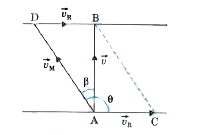 The boatman start from A and should reach B. The river FLOW is along DB, so he should row along AD. Here, `AvecD=vecv_(m)=8km//hr` Here , `AvecB` is the resultant of `AvecD and vecB`. `angle BAD=beta and angle DBA=90^(@)`n Since A and Bare directly opposite, `SIN beta=(DB)/(AD)=(v_(R))/(u_(m))=(4)/(8)=(1)/(2)` `rArr beta =30^(@)` `therefore theta=90^(@) +30^(@)=120^(@)` So, the boatman should row the boat in thedirection at an angleof `120^(@)` with river flow. |
|
| 45. |
Consider the situations given in the following figures and match Column-I and II . Take coefficient of kinetic friction as 1 and g = 10 m//s^(2): |
|
Answer» |
|
| 46. |
If the momentum of a body decreases by 30% its kinetic energy decreases by |
|
Answer» 0.6 |
|
| 47. |
Railway tracks are laid on large sized wooden, iron or cement sleepers. Why? |
| Answer» Solution :This spreads force due to the WEIGHT of the train on a larger AREA and hence reduces the PRESSURE CONSIDERABLY and in turn prevents yielding of the ground under the weight of the train. | |
| 48. |
Calculate the centrifugal force experienced by a man of 60 kg standing at Chennai. (Given: Latitude of Chennai is 13^@) |
|
Answer» Solution :The centrifugal FORCE is given by`F_c= m omega^2 R cos theta` The angular velocity `(omega)`of Earth = `(2pi)/(T)`where T is time period of the Earth (24 hours) `omega= (2pi)/(24 xx 60 xx 60) = (2pi)/(86400) = 7.268 xx 10^(-5) rad sec^(-1)` The radius of the Earth `R = 6400 KM = 6400 xx 10^3 m ` Latitude of Chennai = `13^@` `F_(cf) = 60 xx (7.268 xx 10^(-5) )^2 xx 6400 xx 10^3 xx cos (13^@) = 1.9678 N` A 60 kg man experiences centrifugal force of approximately 2 Newton. But due to Earth.s gravity a man of 60 kg experiences a force `= mg= 60xx 9.8 = 588 N` . This force is very MUCH larger than the centrifugal force. |
|
| 49. |
If there are no external forces, the centre of mass of a double star moves like a free particle. If we go to the centre of mass frame, then we find that the two starts are moving in a circle about the centre of mass, which is at rest. |
|
Answer» If both assertion and reason are true and reason is the correct explanation of assertion. (i) Uniform motion in a STRAIGHT LINE of the centre of MASS and. (ii) circular ORBITS of the starts about the centre of mass. |
|