

Saved Bookmarks
This section includes 7 InterviewSolutions, each offering curated multiple-choice questions to sharpen your Current Affairs knowledge and support exam preparation. Choose a topic below to get started.
| 1. |
By improving experimental techniques, selecting better instruments and removing personal bias as far as possible, The errors can be minimised |
|
Answer» RANDOM errors |
|
| 2. |
If pressure P, velocity v and time T are taken as the fundamental (base) quantities, find the dimensional formula of force. |
|
Answer» <P> Solution :Let force `= F =P^(a) V^(b) T^(c )``(F) = M^(1) L^(1) T^(-2) , (P) = M^(1) L^(-1) T^(-2)` `(V) = M^(0) L^(1) T^(-1) , (T) = M^(0) L^(0) T^(1)` `therefore MLT^(-2) = (ML^(-1) T^(-2) )^(a) (M^(0) L^(1) T^(-1) )^(b) (M^(0) L^(0) T^(1) )^(c)` `MLT^(-2) = M^(a) L^(-a+b) T^(-2a-b+c)` `therefore` COMPARING POWERS of M, L, T on both sides `a=1, -1 + b=1 therefore b=2 and -2a -b+ c = -2, -2 -2 -2 + c = -2 , c=2` `therefore` Force (F) `= PV^(2) T^(2)` |
|
| 3. |
If J is the angular momentum and E is the kinetic energy, then (J^(2))/(E ) has the dimensions of |
| Answer» Answer :A | |
| 4. |
The velocity, acceleration, and force in two system of units are related as under :(i) v'=(alpha^(2))/(beta)v(ii) a'=(alpha beta)a(iii) F'=((1)/(alpha beta))FAll the primed symbols belong to one system and unprimed ones belong to the other system. alpha and beta are dimensionless constants. Which of the following is/are correct ? |
|
Answer» LENGTH sdtandards of the two systems are related by `L'=((alpha^(3))/(beta^(3)))L` |
|
| 5. |
A bus starts moving with 1 ms^(-2) acceleration. A man 48 m away from bus starts moving with 10 ms to catch the bus, then man will reach to bus after ........ |
|
Answer» 5 seconds In `d = v _(0)t + 1/2 at ^(2) , v _(0) =0` `d = 1/2 at ^(2) ""…(1)` and distance covered by man, `48 +d =UT` `d = 10 t -48""…(2)` `therefore` From equation (1) and (2), `1/2 at^(2) = 10t -48` `1 xx t ^(2) =20t -96""[a=1]` `t ^(2) - 20 t + 96 =0` `therefore (t -12) (t-8) =0` `therefore t =12 s or t =8s` But 12 s is not GIVEN in options. Thus, answer `t=8s` |
|
| 6. |
A partical is projected up from a point at an angle theta whith the horizontal displacement, the graph among the following which does not represent the variation of kinrtic energy KE of the particle is, |
|
Answer»
|
|
| 7. |
A man jumping out of a slow moving bus falls forward. This due to_____ |
| Answer» SOLUTION :INERTIA of MOTION | |
| 8. |
A artificial satellite circulating about the earth. Is its circular motion a simple harmonic motion? |
| Answer» SOLUTION :No, motion of ARTIFICAL SATELLITE is CIRCULAR. Its motion is periodic motion. | |
| 9. |
A solid sphere of radius R is projected on a rough horizontal surface of coefficient of friction with linear Speed v_(0), at time to 0. It slips for some time, finally starts to roll with out slipping at time t =t_(0) .Find a) The linear velocity of its centre when pure rolling begins. b) The time t_(0) |
Answer» SOLUTION : a) The kinematics equations for the motion of the sphere at time t are `v=v_(0)`-at ,where a =`mug` `omega=alphat`,where `alpha=(mumgR)/((2)/(5)mR^(2))=(5a)/(2R)`,when pure rolling begins `v^(|)=omega^(|)R` (at t=`t_(0)`) `underset((v^(|)/(R)=(5a)/(2R)t_(0)))(V^(|)=V_(0)-at_(0))}implies(7V^(|))/(5)=V_(0)` or `V^(|)=(5V_(0))/(7)implies` REQUIRED linear velocity =`V^(|)=(5V_(0))/(7)` b)`v^(|)=v_(0)mugt_(0)impliesmugt_(0)=v_(0)-v^(|)=(2v_(0))/(7)impliest_(0)=(2v_(0))/(7 mug)` ALITER: The angular momentum of the sphere about the horizontal surface is conserved. `impliesL_("initial")`(at t=`t_(0)`) `impliesMv_(0)R=mv^(|)R+(2)/(5)mR^(2)omega^(I)=mv^(I)R^(2)xx(v^(I))/(R)=(7)/(5)mv^(I)RimpliesV^(I)=(5)/(7)v_(0)` |
|
| 10. |
Name the three conceptthat principle superposition of waves can explain. |
|
Answer» Solution :(i) Space (or spatial) INTERFERENCE (also known as Interference) (ii) Time (or TEMPORAL) Interference (also known as Beats) (III) Concept of stationary waves. |
|
| 11. |
Three masses 0.1 kg, 0.3 kg and 0.4 kg are suspended at the end of the spring. When the 0.4 kg is removed, the system oscillates with a period of '2' sec. When 0.3 kg mass is also removed, the system will oscillate with a period of |
| Answer» ANSWER :A | |
| 12. |
[("Permeability")/("Permittivity")] will have the dimensions of |
|
Answer» `M^(@)L^(@)T^(@)A^(@)` |
|
| 13. |
The displacement x of a particle at the instant when its velocity v is given by v=sqrt(3x+16). Find its acceleration and initial velocity |
|
Answer» Solution :`V=sqrt(3x+16)ORV^(2)=3x+16` or `v^(2)-16=3x` COMPARING with `v^(2)-u^(2)=2AS`, we GET, `u=4` units, `2a=3` or `a=1.5` units |
|
| 14. |
A 5.5 meter long string has a mass of 0.03.5 kg . If the tension in the string is 77 N, the speed of a wave on the string is : |
|
Answer» `165 ms^(-1)` `v= SQRT((T)/(m))` `= sqrt((77xx5.5)/(0.035))=110 m//s` |
|
| 15. |
Water flows through two identical tubes A and B. A volume V_(0) of water passes through the tube A and 2V_(0) through B in a given time. Which of the following may be correct? a. Flow in both the tubes are steady b. Flow in both the tubes are turbulent c. Flow is steady in A but turbulent in B d. Flow is steady in B but turbulent in A |
|
Answer» B and C are correct |
|
| 16. |
The density of a liquid of coefficient of cubical expansion gamma " is " rho " at" 0^(@) Cwhen the liquid is heated to a temp T. the change is density will be |
|
Answer» `(RHO GAMMA T )/(1 + gamma T )` |
|
| 17. |
The surface tension of soap water is 0.04Nm^(-1). The excess of pressure inside a soap water bubble of diameter 10 mm is |
|
Answer» 64Pa |
|
| 18. |
If the error in the measurement of radius of a sphere is 2%, the error in the determination of volume of the sphere is |
| Answer» Answer :C | |
| 19. |
State the nature of dependence of the terminal velocity of a body in a viscous medium with the coefficient of viscosity of the medium. |
| Answer» SOLUTION :INVERSELY PROPORTIONAL | |
| 20. |
The temperature inside a refrigerator is t_(2).^(@)C and the room temperature is t_(1).^(@)C. The amount of heat delivered to the room for each joule of electrical energy consumed ideally will be |
|
Answer» `t_(1)/(t_(1)-t_(2))` |
|
| 21. |
Two masses M_(1) and M_(2) are connected by light string, which passes over the top of a smooth plane inclined at 30^(@) to the horizontal, so that one mass rests on the plane and the other hangs vertically as shown in figure. It is found that M_(1), hanging vertically can draw M_(2) up the full length of the plane in half the time in which M_(2) hanging vertically draws M_(1) up. Find M_(1)//M_(2). Assume pulley to be smooth. Initially at time t = 0 smooth masses M_(1) = 15 kg and M_(2) = 10 kg are held at rest and then they released. if after one second. the string snaps, find the further time taken for the 15 kg mass to return to its original position on the plane. Take g = 10 m//s^(2) |
|
Answer» |
|
| 22. |
In Q.111, if A lies to the left of B, then : |
|
Answer» time taken by insect to TRAVEL form A to B and time taken by it to travel from B to A |
|
| 23. |
Find the numberof possible natural oscillations of air column in a pipe whose frequencies lie below 1250 Hz . The length of the pipe is 85 cm . The velocity of sound is 340m*s^(-1) . Considerthe following two cases: The pipe is closed from one end |
|
Answer» 2 |
|
| 24. |
In an industrial process 10 kg of water per hour is to be heated from 20^(@)C " to " 80^(@)CTo this steam at 150^@ C is passed from a boiler into a copper coil immersed in water.The steam condenses in the coil and is returned to the boiler as water at 90^@CHow many kilograms of steam is required per hour (specific heat of steam = 1"Cal"//gm^@C, Latent heat of vapourisation = 540cal/gm? |
| Answer» ANSWER :B | |
| 25. |
A liquid of density rho comes out with a velocity upsilon from a horizontal tube of area of cross - section A. The reaction force exerted by the liquid on the tube is F. a) Fpropupsilon b) Fpropupsilon^(2) c) FpropA d) Fproprho |
|
Answer» a and B are correct |
|
| 26. |
A uniform horizontal beam of light is incident upon a quarter cyclinder of radius R=5cm, and has a refractive index 2//sqrt3, A patch on the table at a distance x from the cylinder is unilluminated. Find the value of x? |
Answer» Solution :When the angle of incidence is `theta_c` x region will remain unilluminated. This is the limiting CASE.  When the angle of incidence is greater than critical agle TIR will place In this case, also x regio is unilluminated. When angle of incidence `THETA lt theta_c` then the incident ray will REFRACT and hence x region will be illuminated. So in limiting case: In `Delta PQR, cos theta_c= R/(R+x) sin theta_c= mu_r/mu_d=1/(2//sqrt3)=sqrt3/2` `therefore theta_c=60^@, R=5cm` (GIVEN) `IMPLIES cos 60=5/(5+x) implies 5+x=10 implies x=5cm` 
|
|
| 27. |
An ice cube of edge lcm melts in a gravity – free container. The approximate surface area of water formed is (n xx 12pi )^(1//n)cm. Find n |
|
Answer» |
|
| 28. |
A cube is arranged such that its length. Breadth and height are along X, Y and Z directions.One of its corners is situated at the origin. Length of each side of the cube is 25 cm. The components of electric field are E_(x) = 400 sqrt(2) N//C , E_(y) = 0 and E_(2) = 0respectively. Find the flux coming out of the cube at the right end. |
| Answer» SOLUTION :`25sqrt2 Nm^2//C` | |
| 29. |
A uniform circular disc of radius 50 cm at is free to turn about an axis which is perpendicular to its plane and passes through its centre. It is subjected to a torque which produces a constant angular acceleration of 2"rad"s^(-2). Its net acceleration is ms^(-2) at the end of 2.0 s is approximately. |
|
Answer» 6 ANGULAR accelerastion `alpha=2 "rad"s^(-2)` Initial angular velcocity `omega_(0)=0` `omega=omega_(0)+alphat` At the end of 2 sec, `omega=omega_(0)+alphat` `=0+2xx2=4"rad" s^(-1)` Radial acceleration `a_(r)=omega^(2)r` `a_(4)=(4)^(2)xx0.5=8ms^(-2)` Net acceleration `=sqrt(a_(4)^(2)+a_(t)^(2))` `=sqrt((8)^(2)+(1)^(2))=sqrt(65)` `=8ms^(-2)` |
|
| 30. |
A liquid rises to a height of 50 cm in a capillary tube of diameter 0.04mm. If density of liquid is 0.08 xx 10^3 kg m^(-3) angle of contact is 20°, the surface tension of the liquid is (cos 20^@= 0.94) |
|
Answer» `4.17(N )/(m ) ` |
|
| 31. |
1 L of oxygen at a pressure of 1 atm and 2 L of nitrogen at a pressure of 0.5 atm, are introduced into a vessel of volume 1 L. If there is no change in temperature, the final pressure of the mixture of gas (in atm) is |
| Answer» ANSWER :C | |
| 32. |
The ratio of the terminal velocities of two water drops, when they fall towards the earth's surface , is 4:9. The ratio of their radii is |
|
Answer» `4:9` |
|
| 33. |
Two sound waves trevelling in same direction can be represented as y_(1)=(0.02 mm)sin [(400 pi rad s^(-1))(x/(330 ms^(-1))-t)] And y_(2)=(0.02 mm)sin [(404 pi rad s^(-1))(x/(330 ms^(-1))-t)] The waves superimpose. (i) Find distance between two nearest points where an intensity maximum is recorded simultaneously. (ii) Find the time gap between two successive intensity maxima at a given point. |
|
Answer» (II) 0.5 s |
|
| 34. |
Boltzmann constant and Planck's constant differ in the dimensions of |
|
Answer» MASS and Time |
|
| 35. |
Why centripetal force cannot do work? |
| Answer» Solution :The centripetal FORCE canot do work on the OBJECT SINCE it is always perpendicular to the VELOCITY. | |
| 36. |
A body of mass m moving with velocity v collides head on with another body of mass 2m which is initially at rest. The ratio of K.E of colliding body before and after collision will be |
|
Answer» `1:1` After collision the MASS = m + 2m = 3m VELOCITY becomes ` V. =( (m_1 - m_2)/(m_1 + m_2) )v = (mv)/(3m)= v/3` KE AFTERCOLLISION ` = 1/2 m ( V/3)^2 = 1/9 (1/2 mv^2) ` ` (KE_("before"))/(KE_("after")) = (1/2 mv^2)/(1/9 (1/2 mv^2) ) = 9 : 1` |
|
| 37. |
Which of the following graphs shows the variation of acceleration due to gravity g with depth d from the surface of the Earth? |
|
Answer»
for `rltR` |
|
| 38. |
A drunkard walking in a narrow lane takes 5 steps forward and 3 steps backward, followed again by 5 steps forward and 3 steps backward, and so on. Each step is 1 m long and requires 1 s. Plot the x-t graph of his motion. Determine graphically and otherwise how long the drunkard takes to fall in a pit 13 m away from the start. |
Answer» Solution :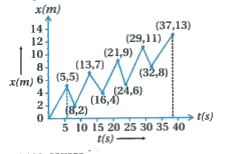 DISTANCE covered in each step =1 m Time TAKEN to cover each step =1 s Time taken to complete 5 step = 5 s Time taken to complete 5 forward STEPS and 3 backward steps = 8 s Effective distance covered `=5 -3=2` Similarly, effective distance covered in first 16 steps `=2 +2 = 4m` Total time taken for it = 16 is Similary, effective distance covered in first 24 steps, `= 2 + 2 + 2= 6M` Total time taken for it = 24 s Effective distance covered in first 32 steps, `= 2 + 2 + 2 + 2= 8m` Total time taken for it = 32 s Distance covered in first 37 steps Distance covered in 32 steps + distance covered in 5 steps. Thus, time taken to complete 13 m is 37 s. Hence , he will fall into pit in 37 s. |
|
| 39. |
A biconvex thin lens is prepared from glass of refractive index 3//2. The two building surfaces have equal radii of 25 cm each. One of the surface is silvered from outside to make it reflecting . Where should an object be placed before this lens so that the image coincides with the object. |
|
Answer» Solution :Here `R_1=+25 cm R_2=-25cm and mu=3//2` IMAGE coincides with OBJECT hence `u=v=-x` (say) `1/F=4/25`, by using `1/v+1/u=1/F, -1/x-1/x=4/25` x=12.5 cm Hence, the object should be PLACED at a distance 12.5 cm in front of the silvered lens. |
|
| 40. |
A bob of mass 100g tied at the end of a string of length 50cm is revolved in a vertical circle with a constant speed of 1ms^(-1). When the tension in the string is 0.7N, the angle made by the string with the vertical is (g= 10 ms^(-2)) |
|
Answer» `0^(@)` |
|
| 41. |
The efficiency of a carnot cycle is 1/6. If on reducing the temperature of the sink by 65^@C, theefficiency becomes 1/3. If final temperature of the sink is N times 65K then .N. is equal to |
|
Answer» |
|
| 42. |
A drop of water is enclosed between two pieces of glass. The drop assumes a circular shape of diameter 10cm. If the distance between two glass plates is 0.50mm, the normal force required to separate out the plates will be ( T = 72dyne /cm and theta =0^@) |
| Answer» Answer :A | |
| 43. |
The gran -molecular sp heat capacity of hydrogen at constant pressure =6.865 cal and volume =0.0224 cubic metre and coefficient of expansioin of hydrogen at constant pressure alpha=1/273.3 per kelvink. Calculate the value of J. ( 1 atmospheric pressure =1.013xx10^(5) newtons per square metre.) |
|
Answer» |
|
| 44. |
The velocity of falling rain drops attain limited veloity because of |
|
Answer» upthrust of air |
|
| 45. |
A wooden block sliding down from the top of a smooth inclined plane starting from rest takes t_(1), seconds to reach the bottom of the plane and attains velocity V_(1). Another block of twice the mass falling freely from the same height takes t_(2) sec. to reach the bottom of the plane and attains V_(2). If angle of inclination of the plane is 30^(@). |
|
Answer» `v_(1)=v_(2)` & `t_(1)=t_(2)` |
|
| 46. |
The work done in moving an object from origin to a point whose position vector is vec(r )=3hat(i)+3hat(j)-5hat(k) by a force vec(F)=2hat(i)-hat(j)-hat(k) is |
| Answer» Answer :B | |
| 47. |
A body is in equilibrium on a rough inclined plane undr its own weight. If the angle of inclination of the inclined plane is alpha and the angle of friction is lambda, then |
| Answer» SOLUTION :Angleof INCLINATION=- Angleof REPOSE. | |
| 48. |
A car moving at a constant speed of 36kmph moves north wards for 20 minutes then due to west with the same speed for 81/3 minutes . What is the average velocity of the car during this run in kmph |
|
Answer» |
|
| 49. |
A disc is at rest at the top of a rough incined plane. It rolls without slipping. At the bottom of inclined plane there is a vertical groove of radius .R.. In order to loop the groove the minimum height of incline required is |
|
Answer» `(15R)/(4)` |
|
| 50. |
Shown in the figure is a container whose top and botoom diameters are D and d respectively. At the bottom of the container, there is a capillary tube of outer radius b and inner radius a. The volume flow rate in the capillary is Q. If the capillary is removed the liquid comes out with a velocity of v_0. The density of the liquid is given as rho. Calculate the coefficient of viscosity eta. |
|
Answer» `P+P_0+1/2rhov_1^2+rhogH=1/2rhov_0^2+P_0` `impliesP+rhogH=1/2rho(v_0^2-v_1^2)` But ACCORDING to equation of continuity `v_1=(A_2v_0)/(A_1)` `:.P+rhogH=1/2rho[v_0^2-(A_2/A_1v_0)^2]` `P+rhogH=1/2rhov_0^2[1-(A_2/A_1)^2]` Here, `P+rhogH=DeltaP` According to Poisseuille's equation `Q=(pi(DeltaP)a^4)/(8etal)=ETA=(pi(DeltaP)a^4)/(8Ql)` `:. eta=(pi(P+rhogH)a^4)/(8Ql)=(pi)/(8Ql)xx1/2rhov_0^2[1-(A_2/A_1)^2]xxa^4` Where `A_2/A_1=d^2/D^2` `eta=(pi)/(8Ql)xx1/2rhov_0^2[1-d^4/D^4]xxa^4` |
|


