

Saved Bookmarks
This section includes 7 InterviewSolutions, each offering curated multiple-choice questions to sharpen your Current Affairs knowledge and support exam preparation. Choose a topic below to get started.
| 1. |
A small body of mass 100 g moving with a velocity 2 m/s is strikes a solid cylinder of mass 2 kg and radius 20 cm. The cylinder is initially at rest and is mounted on a fixed horizontal axle that passes through the centre of mass. The line of motion of the small body is at a perpendicular lar distance of 15 cm from the centre of the cylinder. The small body strikes the cylinder and adheres to its surface. What is the angular speed of the system just after the collision ? Assume there is no friction. |
| Answer» Solution :`MVR = IOMEGA = [(MR^(2)//2) + mr^(2)] omega, m =0.1 KG, r =0.15 m,v = 2m//s, M=2kg, R =0.2 m` SUBSTITUTING `w=0.365` rad/s | |
| 2. |
A monkey A (mass = 5kg) is climbing up a rope tied to a rigid support. The monkey B (mass = 2kg) is holding on to the tail of monkey A. If the tail can tolerate a maximum tension of 30N, what force should monkey A apply on the rope in order to carry monkey B with it? (g = 10 m//s^(2)). |
|
Answer» |
|
| 3. |
Range of Raynolds number are given in Column -I and types of flow are given in Column -II.Match them appropriately. |
|
Answer» |
|
| 4. |
In a tug of war the team that pushes harder against the groundwins why |
| Answer» SOLUTION :the tearmthatpushesharderagainst groundgetsgreater REACTIONAL FORCEAND thisleadthemto WIN. | |
| 5. |
A body is initially at rest. It under goes one - dimension motion with constant acceleration. The power delivered to it at time t is proportional to |
|
Answer» `t^(1//2)` |
|
| 6. |
N Moles of a diatomic gas in a cylinder are at a temperature T. Heat is supplied to the cylinder such that the temperature remains constant but n moles of the diatomic gas get converted into monoatomic gas. What is the change in the total kinetic energy of the gas? |
|
Answer» 0 |
|
| 7. |
A square metal plate of 10 cm side moves parallel to another plate with a velocity of 10 cm s^(-1), both plates immersed in water. If the viscous force is 200 dyne and viscosity of water is 0.01 poise. What is their distance apart ? |
|
Answer» SOLUTION :Here, `A = 10 xx 10 = 100cm^2 , dv = 10 cm s^(-1), eta = 0.01 "poise", F = 200` DYNE As `"" F = eta A (dv)/(DX)` `"" dx = (eta A dv)/(F) = (0.01 xx 100 xx 10)/(200) , dx = 0.05 cm` |
|
| 8. |
The internal energy of an ideal gas depends on |
|
Answer» expandedby addingmoremoleculesto it |
|
| 9. |
A block is released from rest at the top of an inclined plane which later curves into a circular track of radius r as shown in figure. The minimum height h from where it should be released so that it is able to complete the circle, is |
|
Answer» r `vgesqrt(gr)` 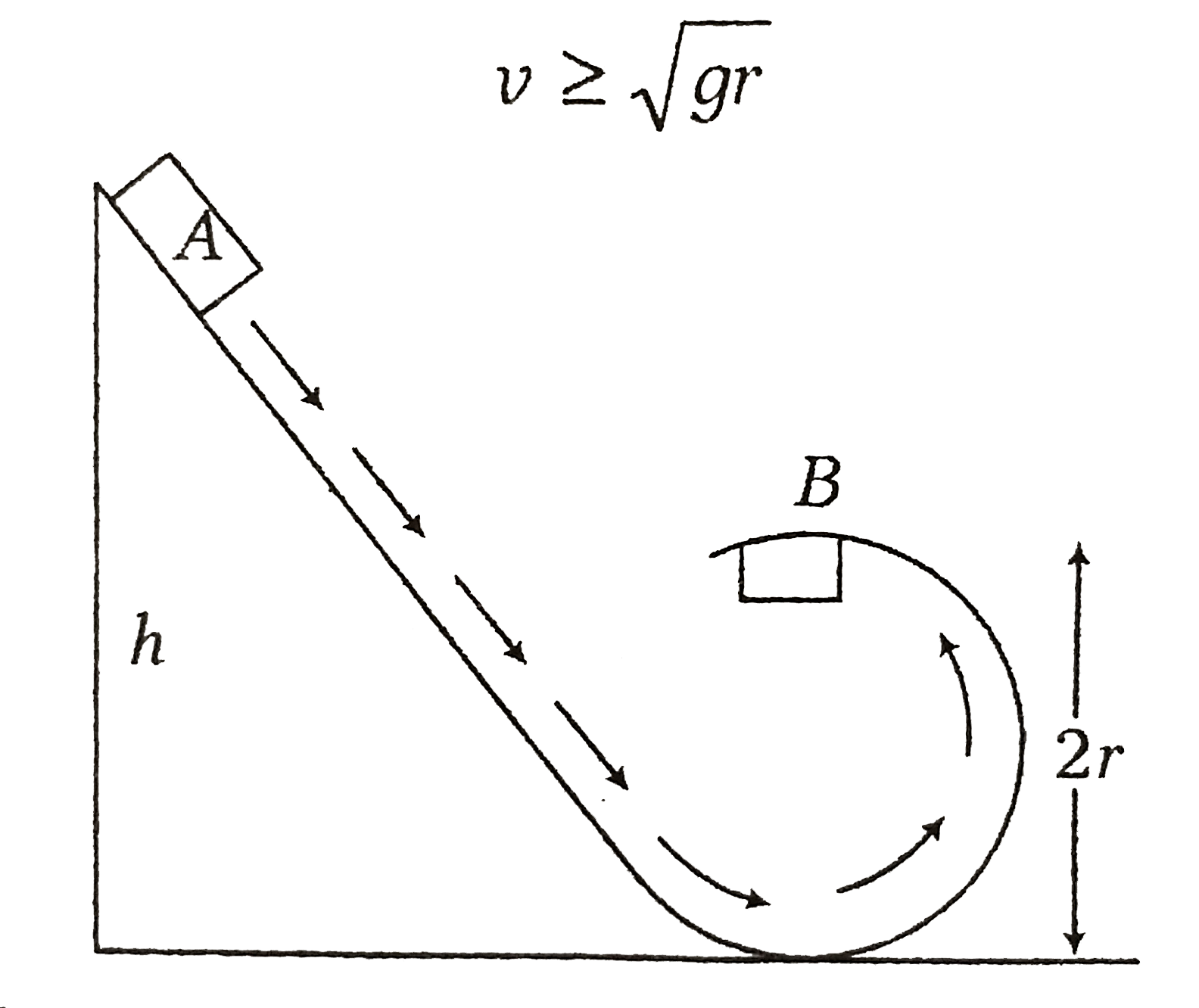 Applying LAW of conservation of mechanical energy between points Aand B, i.e., magnitude of change in kinetic energy equals the magnitude of change in potential energy. Applying LAW of conservation of mechanical energy between points Aand B, i.e., magnitude of change in kinetic energy equals the magnitude of change in potential energy. `rArr""(1)/(2)MV^(2)-0=MG(h-2r)` `(1)/(2)m(sqrt(gr))^(2)=mg(h-2r)rArrh=(5)/(2)r` Hence, h must be atleast EQUAL to `2.5` r. |
|
| 10. |
An object is projected with a velocity sqrt((8gR)/3) from earth. The velocity of the object, at the maximum height reached by it will be: |
|
Answer» `SQRT((2gR)/3)` |
|
| 11. |
A metal sphere of radius r and specific heat S is rotated about an axis passing through its centre at a speed of n rotations per second. It is suddenly stopped and 50% of its energy is used in increasing its temperature. Find the increase in temperature of the sphere? |
|
Answer» |
|
| 12. |
A stone is thrown vertically upward with a speed of 10.0ms^(-1) from the edge of a cliff 65 m high. What will be its speed just before hitting the bottom? |
|
Answer» `3.14m//s` |
|
| 13. |
A faulty thermometer has its fixed points marked as 3^(@) and 102^(@) . The temperature of a body as measured by the faulty thermometer is 80^(@). Find the correct temperature of the body on Celsius scale. |
|
Answer» `36.5^(@)C` |
|
| 14. |
The height y and horizontal distance x covered by a projectile in atime t seconds are given by the equations y = 8t - 5t^(2) and x = 6t. If x and y are measured in metres, the velocity of projection is |
| Answer» Answer :D | |
| 15. |
The angle of contact at the interface of water glass is 0^(@), Ethylalcohol -glass is 0^(@), mercury glass is 140^(@) and Methyliodide -glass is 30^(@). A glass capillary is put in a troug containing one of these four liquids. It is observed that the meniscus is convex. The liquid in the through is |
|
Answer» water |
|
| 16. |
A particle is droped under gravety from rest a height h and it travels a distance (9h)/(25)in the last second, the height h is (take g=9.8ms^(-2)) |
|
Answer» Solution :`(h)_(nth)=u+((2n+1))/2g"(or)"(9H)/(25)=0+((2n-1))/2g` `h=0+1/2gxx(n)^(2)` (1)//(2), we get `9/(25)=((2n-1))/n^(2)` `9n^(2)=50n-25` `9n^(2)-50n+25=0` After SOLVING `n=5s, 5/9s` `H=122.5m1.5m`. |
|
| 17. |
The angle with which a cyclist leans with the horizontal while turning a curved path of radius r with speed v is |
|
Answer» `THETA = TAN^(-1)" " (v^(2))/(RG)` |
|
| 18. |
(i) Show that (a) omega=omega_0+propt |
|
Answer» SOLUTION :For an UNIFORM angular acceleration `(domega)/(dt)=prop` is a constanti.e `domega=propdt` Integrating both the SIDES `intdomega=intpropdt` i.e `OMEGA=propt+C` where 'c' is a constantwhen `t=0,omega |
|
| 19. |
A bullet of mass 10 g is fired from a gun of mass 1 kg. If the recoil velocity is 5 ms^(-1), the muzzle speed is |
| Answer» Answer :D | |
| 20. |
A body is thrown vertically up with a velocity of 100m//s and another one is thrown 4 sec after the first one. How long after the first one is thrown will they meet? |
|
Answer» Solution :Let them MEET after t sec. `S_(1)=100t-(1)/(2)g t^(2)andS_(2)=100(t-4)-(1)/(2)g(t-4)^(2)` `therefore 100t-(1)/(2)g t^(2)=100(t-4)-(1)/(2)g(t-4)^(2)` `therefore 400=(1)/(2)g[t^(2)-(t-4)^(2)]=(1)/(2)g.4(2t-4)` `therefore 2t-4=(800)/(4g)=20," if "g=10m//s^(2) therefore t=12sec` |
|
| 21. |
One light year is defined as the distance travelled by light in one year. The speed of light is 3xx10^(8)m//s. Find the same in metre. |
|
Answer» `3XX10^(12)m` |
|
| 22. |
Water is falling down at the rate of 1.8 Kg per minute from a vertical tube. The radius at the bottom of the tube is 0.004 m and pressure around it is 0.76m of Hg. The diameter of the tube at a height of 0.5 m from the bottom is 0.005 m. find the pressure at that point. |
|
Answer» `0.724` m of Hg |
|
| 23. |
The unit of energy is |
|
Answer» joule-sec |
|
| 24. |
A cylindrical rod of mass 'm' length L and radius 'R' has two cords wound around it whose ends are attached to a rigid support. The rod is held horozontally with the two cords vertical. When the rod is released, the cords unwind and rod rotates. Find the tension in the cords as they unwound and determine the linear acceleration of the cylinder as it falls. |
Answer» SOLUTION :The rod rotates and translates while falling down.  `Mg-2T=Ma` (TRANSLATIONAL motion) `2TR=Ialpha` (ROTATIONAL motion) Since `I=(MR^(2))/(2)` and `alpha=(a)/(R )` on solving the above equation we get `a=(2G)/(3)` and `T=(Mg)/(6)` |
|
| 25. |
A bimetallic strip of thickness 2 cm consists of zinc and silver riveted together. The approxi-mate radius of curvature of the strip when heated through 50^(@) Cwill be : (linear expansivity of zinc and silver are 32 xx 10^(-6)//^(@) Cand 19 xx 10^(-6)//^(@) Crespectively ) |
|
Answer» 30.77 m |
|
| 26. |
Why Bernoulli's equationdoes not apply to unsteady or turbulent flow ? |
|
Answer» <P> SOLUTION :Bernoulli.s equation cannot be applied to turbulent flow because in these flow , velocity (V) and pressure (P)constantly changes with TIME. |
|
| 27. |
Find the potential energy of a system of four particles placed at the vertices of a square of side 1. Also obtain the potential at the centre of the square. |
|
Answer» Solution :Consider four masses each of mass m at the corners of a square of side 1. see fig. we have four mass pairs at DISTANCE 1 and two DIAGONAL pairs at distance `SQRT(2)l` HENCE, `U(r) = -(4)(Gm^(2))/(1) - 2(Gm^(2))/(sqrt(2)l)` `= -(2Gm^(2))/(1)(2+(1)/(sqrt(2))) = -5.41(Gm^(2))/(1)` The gravitational potential at the centre of the square `(r = sqrt(2)l//2)` is `V(r) = -4sqrt(2)(Gm)/(1)` 
|
|
| 28. |
The work done in moving an object from origin to a point whose position vector is vecr = 3hati + 2hatj - 5hatkby a force vecF = 2hati - hatj - hatk is |
|
Answer» 1 unit |
|
| 29. |
A man of mass 80 kg carrying a load of 20 kgwalks up a stair case in 20s. If the number of steps is 40 and which and height of each step are 20 cm and 15 cm respectively. The efficiency of the man is |
|
Answer» 0.2 |
|
| 30. |
Explain the uses of dimensional equations giving atleast one example in each case. |
| Answer» SOLUTION :1 (d). 6, 1(d). 7 & (d). 8 | |
| 31. |
A body executes SHM under the influence of one force and has time period 'T_1' seconds. The same body executes SHM with period 'T_2' seconds when under the influence of another force. When both forces act simultaneously and in the same direction then the time period of the same body is |
|
Answer» `(T_1 + T_2)` SEC |
|
| 32. |
A particle moves in the x-y plane according to the equation, vecr = (hati+ hatj)(A sin omegat+ Bcos omegat). Motion of the particle is: |
|
Answer» periodic |
|
| 33. |
Which of the following is the smallest unit of length? |
|
Answer» parsec |
|
| 34. |
The number of molecules of a gas in a container is doubled. What will be the effect on rms speed of the molecules of the gas? |
| Answer» SOLUTION :RMS SPEED remains the same because it DEPENDS only on the temperature. | |
| 36. |
A triangular wedge of mass M lies on a smooth horizontal table with half of its base projecting out of the edge of the table. A block of mass m is kept at the top of the smooth incline surface of the wedge and the system is let go. Find the maximumvalue of (M)/(m) for which the block will land on thetable. Take theta = 60^(@). |
|
Answer» |
|
| 37. |
How are science and arts similar ? |
| Answer» SOLUTION :Both are creactive and protray REALM of EXPERIENCE. | |
| 38. |
The velocity of a body revolving in a vertical circle of radius r at the lowest point sqrt(7gr). The ratio of maximum tensions in the string is |
| Answer» Answer :B | |
| 39. |
g_e and g_p denote the acceleration due ot gravity on the surface of earth and another planet whose mass and radius are twice that of the earth, then |
|
Answer» `g_v=g_e` |
|
| 40. |
A ball of mass 0.2 kg is thrown vertically upwards by applying a force by hand. If the hand moves 0.2 m while applying the force and the ball goes upto 2m height further, the magnitude of the force is, (g = 10 m//s^(2)) |
| Answer» Answer :D | |
| 41. |
A simple pendulum of length l is suspended to the ceiling of a lift moving upward with an acceleration of (g/6). Find the time period of its oscillation? |
| Answer» Solution :As lift is MOVING upwards , time period is given by T= `2pi SQRT(l/(g+a)) = 2pi sqrt((l)/(g+ g/6)) = 2pi sqrt((6L)/(7G))` | |
| 42. |
A particle 'A' starts moving frorri point A with constant velocity 4 m/s along x-axis. Another particle 'B' initially at rest starts moving along x-axis after (8/3), sec after the start of A, with acceleration varying a=4=(3-t) m//s^(2) Position where the two particles will meet for the second time is given by : |
|
Answer» `x=72m` |
|
| 43. |
A particle 'A' starts moving frorri point A with constant velocity 4 m/s along x-axis. Another particle 'B' initially at rest starts moving along x-axis after (8/3), sec after the start of A, with acceleration varying a=4=(3-t) m//s^(2) The two particles will meet twice in the due course of their motion. The time interval between these two successive meets will be : |
|
Answer» 6sec |
|
| 44. |
A particle 'A' starts moving frorri point A with constant velocity 4 m/s along x-axis. Another particle 'B' initially at rest starts moving along x-axis after (8/3), sec after the start of A, with acceleration varying a=4=(3-t) m//s^(2) Particle B will stop again at the position x equal to : |
|
Answer» 72m |
|
| 45. |
Find the magnitude of velocity of image of a point object O with respect to object, which is moving with velocity 2m/s in vertical direction as shown in the figure. The plane mirror that is inclined to horizontal at 45^(@) is alos moving horizontally with velocity 2m/s towards left. |
|
Answer» |
|
| 46. |
A particle 'A' starts moving frorri point A with constant velocity 4 m/s along x-axis. Another particle 'B' initially at rest starts moving along x-axis after (8/3), sec after the start of A, with acceleration varying a=4=(3-t) m//s^(2) Magnitude of the relative velocity of the two particles when they meet for the first time is : |
|
Answer» `16m//s` |
|
| 47. |
A particle 'A' starts moving frorri point A with constant velocity 4 m/s along x-axis. Another particle 'B' initially at rest starts moving along x-axis after (8/3), sec after the start of A, with acceleration varying a=4=(3-t) m//s^(2) Total distance traveled by the particle B when it meets the particle A for the second time is : |
|
Answer» `(304)/(3)m` |
|
| 48. |
A particle 'A' starts moving frorri point A with constant velocity 4 m/s along x-axis. Another particle 'B' initially at rest starts moving along x-axis after (8/3), sec after the start of A, with acceleration varying a=4=(3-t) m//s^(2) Magnitude of the relative velocity of the two particles when they meet for the second time is : |
|
Answer» 16m/s |
|
| 49. |
If E= energy, G= gravitational constant, I= impulse andM = mass, the dimension of (GIM^(2))/(E^(2)) is same as that of |
|
Answer» time `[(GIM^(2))/(E^(2))]= ([M^(-1)L^(3)T^(-2)][MLT^(-1)][M^(2)])/([ML^(2)T^(-2)]^(2))= [T]` |
|
| 50. |
In a dark room would you be able to tell whether a given note had been produced by a Piano or a Violin? |
| Answer» Solution :YES, INA darkroomwe caneasilyidentifya soundproducedby apianoora violinby usingthe KNOWLEDGE oftimberorqualityof SOUND. Thetwosourceseventhough havingthe sameintensityandfundamentalfrequencywill beassociated withdifferent NUMBEROF overtonesofdifferentrelative intensities. theseovertonescombineand producesoundswhichenblesus toidentifythem . | |