

Saved Bookmarks
This section includes 7 InterviewSolutions, each offering curated multiple-choice questions to sharpen your Current Affairs knowledge and support exam preparation. Choose a topic below to get started.
| 1. |
A uniform solid cyinder of radius R=15 cm rolls over a horizontal plane passing into an inclined plane forming an ange alpha=30^@ with the horizontal. Find the maximum value of the velocity v_(0) which still permits the cylinder to roll on the inclined plane section without a jump. (The sliding is asumed to be absent). |
|
Answer» <P> Solution :Initial ENERGY`E_(1)=1/2mv_(0)^(2)+1/2I_(cm)omega^(2)+mgR` 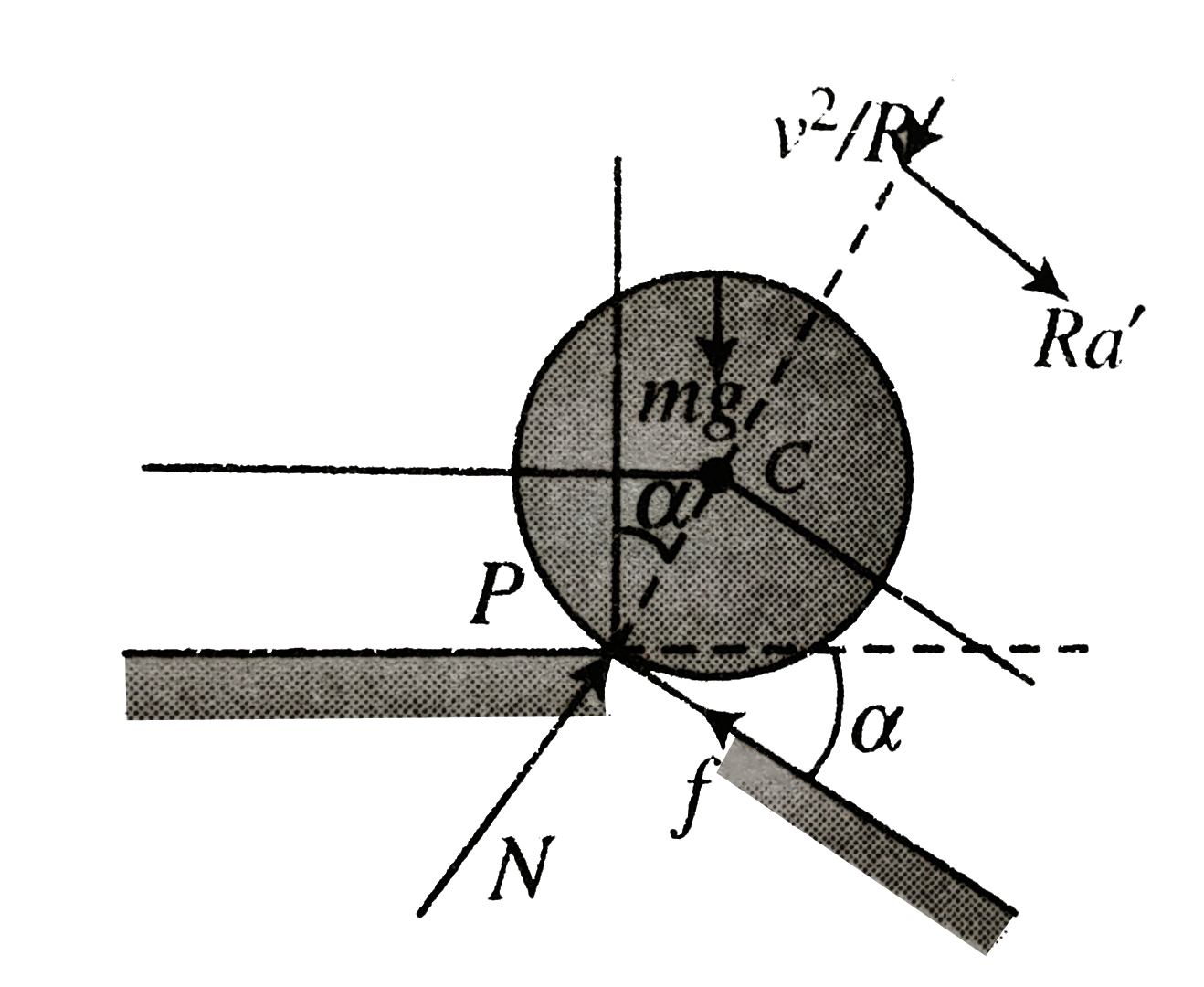 For rolling `(v_(0))/R=omega` `implies E_(1)=1/2mv_(0)^(2)+1/2.1/2mR^(2)v_(0)^(2).R^(2)+mgR` `=3/4mv_(0)^(2)+mgR` As it REACHES the edge `E_(2)=1/2I_(P)omega^('2)+mgRcosalpha` `E_(2)=1/2mv^(2)+1/2I_(cm)omega^('2)+mgRcosalpha` Here `omega'=v/R` `=3/4mv^(2)=mgRcosalpha` From `COE, 3/4 mv^(2)+mgRcosalpha=3/4mv_(0)^(2)+mgR` `implies mv^(2)=mv_(0)^(2)+4/3mgR(1-cosalpha)`.........i CONSIDER the `FBD` of the cyider when it is at the edge. Centre of mass of the cylinder describes circular motion about `P`.HENCE, `mgcosalpha-N=mv^(2)//R` `implies=mgcosalpha-mv^(2)//R` `=mgcosalpha- (mv_(0)^(2))/R-4/3mg+4/3mgcosalpha`, from i. For no jumping `Nge0` `implies 7/3 mgcosalpha-4/3mg-(mv_(0)^(2))/Rge0` `implies v_(0)lesqrt((7gR)/3cosalpha-4/3gR)` |
|
| 2. |
A constant force acting on a body of mass 3.0 kg changes its speed from 2.0 m s^(-1) to3.5 m s^(-1) in 25 s.The direction of the motion of the body remains unchanged.What is the magnitude and direction of the force ? |
|
Answer» Solution :`a = 1.5 //25 = 0.06 ms^(-2)` `F = 3 XX 0.06 = 0.18 N` in the direction of MOTION. |
|
| 3. |
A stone is tied to a rope is rotated in a vertical circle with uniform speed. If the diffeence between maximum and minimun tensions in the rope is 20N, mass of the stone in Kg is(g = 10m//s^2) |
|
Answer» 0.75 |
|
| 4. |
The time period of oscillation T of a small drop of liquid under surface tension depends upon the density rho, the radius r and surface tension sigma. Using dimensional analysis show that T prop sqrt((rhor^(3))/(sigma)) |
| Answer» Solution :`T=krho^(x)R^(y)sigma^(Z),[T]=[ML^(-3)]^(x)[L^(y)][MT^(-2)]^(z)`. SIMPLIFYING `x=1//2,y=3//2, z=-1//2`. | |
| 5. |
A ball is released in air above an incline plane inclined at an angle alpha to the horizontal. After falling vertically through a distance h it hits the incline and rebounds. The ball flies in air and then again makes an impact with the incline. This way the ball rebounds multiple times. Assume that collisions are elastic, i.e., the ball rebound without any loss in speed and in accordance to the law of reflection. (a) Distance between the points on the incline where the ball makes first and second impact is l_(1) and distance between points where the ball makes second and third impact is l_(2). Which is large l_(1) or l_(2)? (b) Calculate the distance between the points on the incline where the ball makes second and fifth impact. |
|
Answer» |
|
| 6. |
(A) : The maximum height of a projectile is 25 percent of maximum range. ( R) : The maximum height is independent of initial velocity of projectile. |
|
Answer» Both (A) and ( R) are TURE and ( R) is the correct explanation of (A) |
|
| 7. |
A gas obeys PV^(2) = constant in addition to PV = RT. If on heating, the temperature is doubled, the volume of the gas is |
| Answer» ANSWER :A | |
| 8. |
Mark the correct statements about the friction between two bodies. |
|
Answer» Static FRICTION is ALWAYS GREATER than the kinetic friction |
|
| 9. |
A piece of ice (heat capacity = 2100 J kg-1""^@C^(-1)and latent heat = 3.36xx10^(5)" J//kg"^(-1) ) of mass m grams is at -5""^@Cat atmospheric pressure it is given 420 J of heat so that the ice starts melting. Finally when the ice water mixture in in equilibrium, It is found that 1 gm of ice has melted. Assuming there is no other heat exchange in he process, the value of m is : |
|
Answer» |
|
| 10. |
Whe two sound sources of the same amplitude but of slightly different frequencies upsilon_(1) and upsilon_(2) are sounded simultaneously, the sound one hears has a frequency equal to |
|
Answer» `|upsilon_(1)-upsilon_(2)|` |
|
| 11. |
Two identical rods each of mement of inertia 'I' about a normal axis through centre are arranged in the fromof a cross. The M.I. of the system about an axis through centre and perpendicular to the plane of system is |
|
Answer» 2I |
|
| 12. |
Velocity and accleration of a particle at time t=0"are" vecu=(2hati+3hatj)m//s"and"veca=(4hatI+2hatj)m//s^(2)respectively. Find the velocity and displacement of the particle at t=2s. |
|
Answer» SOLUTION :Here , acceleration `veca=(4hati+2hatj)m//s^(2)`Is constant . So , we can apply `VECV=vecu+vecat"and"vecs=vecut+1/2vecat^(2)` Sustituting tha proper values, we get `vecv=(2hati+3hatj)+(2)(4hati+2hatj)=(10hati+7hatj)m//s`and `vecs=(2)(2hati+3hatj)+1/2(2)^(2)(4hati+2hatj)=(12hati+10hatj)m` THEREFORE , velocity and displacement of particle at `t=2s `are `(10hati+7hatj)m//s`and`(12hati+10hatj)m`respectively. |
|
| 13. |
A mass .M. is suspended from a light spring An additional mass .m. added displaces the pring further by a distance .x.. Now the combined mass will oscillate the spring with a period |
|
Answer» `T= 2PI SQRT((MG)/(x(M+m)))` |
|
| 14. |
A parachutist after bailing out falls 50 m ,whitout friction. When the parachute opens he decelerates downwards at 2ms ^(-2). He reaches the ground with a speed of3ms ^(-1). How long was the parachustintist in air ? At wht height did he ball out ? |
|
Answer» |
|
| 15. |
Assertion : The moment of Linear Momentum is called Angular momentum (L) i.e. L = r xx p = (mv) xx r = mvr if V = r omega then. L = mr^(2) omega (or) L = I omega Reason : For conservation of Angular momentum, Torque (Rotational force applied externally) must be zero. |
|
Answer» Assertion and REASON are CORRECT and Reason is correct EXPLANATION of Assertion |
|
| 16. |
Now consider the partition to be free to move without friction so that the pressure of gases in both compartments is the same.Then total work done by gases till the time they achieve equilibrium willl be |
| Answer» ANSWER :D | |
| 17. |
First law of thermodynamics is a special case of |
|
Answer» Boyle.s law |
|
| 18. |
Two slabs A& B having lengths 1_(1) and 1_(2), respectively, and same cross - section have thermal conductivities K_(1) and K_(2) respectively. They are placed in contact and a constant temperature difference is maintained across the combination. The ratio of the quantities of heat flowing through A and Bin a given time is |
|
Answer» `(K_1)/( 1_1 ) : ( K_2)/( 1_2)` |
|
| 19. |
A body A is projected upwards with velocity v_(1) . Another body B of same mass is projected at an angle of 45^(@). Both reach the same height. Calculate the ratio of their initial kinetic energies. |
|
Answer» Solution :As A and B attain the same HEIGHT therefore vertical component of initial velocity of B is equal to initial velocity of A `v_(2) COS 45^(@) = v_(1)` (or) `(v_(2))/(SQRT(2)) = v_(1)` `(k_(1))/(k_(2)) = (1/2 mv_(1)^(2))/(1/2 mv_(2)^(2)) = (v_(1)^(2))/(v_(2)^(2)) = ((1)/(sqrt(2)))^(2) = 1/2` |
|
| 20. |
A thermodynamic system is taken an initial state i with internal energy U_(i) = 100 J to the final state f along two different paths iaf and ibf, as shown in figure. The work done by the system along the paths af, ib and bf are W_(af) = 200 J, W_(ib) = 50 J and W_(bf) = 100 J respectively. The heat supplied to the system along the path iaf, ib and bf and Q_(iaf), Q_(ib) and Q_(bf) respectively. If the internal energy of the energy of the system in the state b is U_(b) = 200 J and Q_(iaf) = 500 J then find out the ratio of Q_(bf)//Q_(ib). |
|
Answer» |
|
| 21. |
What is the dimension of Reynolds number? |
| Answer» SOLUTION :`M^0L^0T^0` | |
| 22. |
Define isothermal process. Derive an expression for work done in isothermal . process. |
|
Answer» SOLUTION :The work done by the gas, `W=int_(V_(i))^(V_(f))P.DV` Writing PRESSURE in terms of volume and temperature `P=(muRT)/(V)` Substituting this value, we GET `W=int_(V_(i))^(V_(f))(muRT)/(V)dV=muRTint_(V_(i))^(V_(f))(dV)/(V)` By performing the integration in equation, we get `W=muRT ln ((V_(f))/(V_(i)))` |
|
| 23. |
A body is projected from a point with different angles of projections 20^(@), 35^(@), 45^(@), 60^(@) with the horizontal but with same initial speed. Their respective horizontal ranges are R_(1), R_(2), R_(3) and R_(4). Identify the correct order in which the horizontal ranges are arranged in increasing order |
|
Answer» `R_(1), R_(4), R_(2), R_(3)` |
|
| 24. |
A metal block of area 0.10m^(2) is connected toa 0.010 kg mass via a string that passes over an ideal pulley (considered massless and frictionless), as in fig. A liquid with a film thickness of 0.30 mm is placed betwee the block and the table. When released the block moves to theright with a constant speed of 0.085ms^(-1). Find the coefficient of viscosity of the liquid. |
|
Answer» Solution :The metal block moves to the right because other tension in the string. The tension T is equal in MAGNITUDE to the WEIGHT of the suspended mass m. Thus the shear FORCE F is Shear STRESS on the fluit `F//A=(9.8xx10^(-2))/0.10` `="stain rate"=v/t=(0.085ms^(-1))/(0.3xx10^(-3)m)` `eta=("stress")/("strainrate")=3.45xx10^(-3)` Pas |
|
| 25. |
Ram has been caught red handed doing notorious activities and is punished to run back and forth in a 20 m long corridor from room number 109 to the other end. Ram starts running from room number 109, touches the other end, returns and toushes the door of room number 109 and so on for 65 minutes continouslyafter which he drops down exhaustd. His speed is seen to be v=sqrt(100-X^(2))m//s where X is the distance (in m) from the centre of the corridor. how many times did he touch the other end during this time interval. (Take:pi3.14) |
|
Answer» |
|
| 26. |
A car moving on a traight road accelerates from a speed of 4.1 m/s to a speed of 6.9 m/s in 5.0s. What was its average acceleration? |
|
Answer» `0.56m//s^(2)` |
|
| 27. |
Calculate the minimum velocity with which a car driver must travel a flat cover of radius 150m and coefficient of friction 0.6 to avoid skidding |
|
Answer» SOLUTION :`30MS^(-1)` |
|
| 28. |
The ceiling of a long hall is 20 m high. What is the maximum horizontal distance that a ball thrown with a speed of 40 ms^(-1) can go without hitting the ceiling of the hall (g = 10 ms^(-2)) ? |
|
Answer» Solution :Here, `H = 20M, u = 40 MS^(-1)`. Suppose the ball is thrown at an angle `THETA` with the horizontal. Now, `H = (u^(2) sin^(2) theta)/(2g) rArr 20 = ((40)^(2) sin^(2) theta)/(2 xx 10)` or, `sin theta = 0.5 ""` or, `theta = 30^(@)` Now `R = (u^(2) sin 2 theta)/(g) = ((40)^(2) xx sin 120^(@))/(10)` `= ((40)^(2) xx 0.866)/(10) = 138.56 CM` |
|
| 29. |
A wound spring has |
|
Answer» no energy |
|
| 30. |
Define terminal velocity. |
|
Answer» Solution :Stoke.s law: When a BODY FALLS through a highly VISCOUS liquid, it drags the layer of the liquid immediately in contact with it. This results in a relative motion between the different layers of the liquid. As a result of this, the falling body experiences a viscous force F. Stoke performed many experiments on the motion of small spherical bodies in different fluids and concluded that the viscous force F acting on the spherical body depends on (i) COEFFICIENT of viscosity `eta` of the liquid (II) Radius a of the sphere and (iii) Velocity v of the spherical body. Dimensionally it can be proved that F = k `etaav` Experimentally Stoke found that k = `6pi :. F = 6pi etaav` This is Stoke.s law. Terminal velocity: Terminal velocity of a body is defined as the constant velocity acquired by a body while falling through a viscous liquid. |
|
| 31. |
How much heat energy in joules must be supplied to 14 gms of nitrogen at room temperature toraise its temperature by 40^@Cat constant pressure ? |
|
Answer» 50R |
|
| 32. |
Find the flux due to the electric field through the curved surface (R is radius of curvature). |
| Answer» Solution :(a)` PI R^(2)E` ,(b) ZERO (C)`2 pi R^(2) E` | |
| 33. |
Figure shows three blocks of mass m each hanging on a string passing over a pulley. Calculate the tension in the string connecting A to B and B to C ? |
|
Answer» Solution :NET pulling FORCE `= 2mg - mg = mg` Total mass `= m+m+m=3M` Acceleration, `a=(mg)/(3m)=(g)/(3)` Considering block A, `T_(1)-mg=ma` or `T_(1)=mg+ma` or `T_(1)=mg+m((g)/(3))` or `T_(1)=(4)/(3)mg`, Considering block C, `mg-T_(2)=ma`or `T_(2)=mg-ma` or `T_(2)=mg-(mg)/(3)=(2)/(3)mg`. 
|
|
| 34. |
Two particels are projected from the same point with the same speed at different angles theta_(1) and theta_(2) to the horizontal. If their repsective times of flights are T_(1) and T_(2) and horizontal ranges are same then theta_(1)+theta_(2) = 90^(@)""(b)T_(1)=T_(2) tan theta_(1) ( c) T_(1) = T_(2) tan theta_(2)""(d)T_(1) sin theta_(2) = T_(2)sin theta_(1) |
|
Answer» a, B, d are CORRECT |
|
| 35. |
Area enclosed by Frarr t graph for given body in 1 sec. interval is 100 Ns. What will be magnitude of force ? |
| Answer» SOLUTION :`F=(Delta p )/(Delta t )= (100)/( 1) = 100 N` | |
| 36. |
After perfectly inelastic collision between two identical particles moving with same speed in different directions, the speed of the particles become half the initial speed. Find the angle between the two before collision. |
|
Answer» Solution :LINEAR momentum remains conserved. Resultant initial momentum, `p=sqrt(p_(1)^(2)+p_(2)^(2)+2p_(1)p_(2)COSTHETA)` `{2M((v)/(2))}^(2)={mv}^(2)+{mv}^(2)+2{mv}{mv}costheta` `1=1+1+2xx1xx1costheta` `2costheta=1-2` `costheta=-(1)/(2)` Angle `theta=120^(@)` |
|
| 38. |
A cricket ball thrown across a field is at heights h_1 and h_2 from the point of projection at times t_1 and t_2 respectively after the throw. The ball is caught by a fielderat the same height as that of projection. Time of flight of the ball in this journey is |
|
Answer» `(h_1t_2^2-h_2t_1^2)/(h_1t_2-h_2t_1)` `THEREFORE (h_1+1/2"gt"_1^2)/(h_2+1/2"gt"_2^2)=(t_1)/(t_2) or, h_1t_2-h_2t_1=g/2 (t_1t_2^2-t_1t^2t_2)` So, time of flight is GIVEN by `T=(2usin theta)/(g)=2/g[(h_1+1/2"gt"_1^2)/(t_1)] =2/(t_1)[(h_1)/(g)+(t_1^2)/(2)]` `(h_1)/(t_1)xx((t_1t_2^2-t_1^2t_2)/(h_1t_2-h_2t_1))+t_1=(h_1t_2^2-h_2t_1^2)/(h_1t_2-h_2t_1)` |
|
| 39. |
If there are no heat losses, the heat released by the condensation x g of steam at 100^@Cinto water at 100^@Cconverts y g of ice at 0^@Cinto water at 100^@CThe ratio y/x. |
|
Answer» |
|
| 40. |
The moment of inertiaof a uniform cylinder of length l and radius R about its perpendicular bisector is l. What is the ratio (I)/(R ) such that moment of inertia is minimum ? |
|
Answer» `sqrt((3)/(2))` But M =` pi R^(2) L rho` [ `rho` = density of the material of the cylinder] or, `R^(2) = (M)/(pi rho l)` `therefore I = (Ml^(2))/(12) + (M^(2))/(4 pi rho l) "" or, (dl )/(dl) = (2 M l )/(12) - ( M^(2))/(4 pi rho ) ((1)/(l^(2)))` For the minimum value of `I`. `(dl)/(dl) = 0 ` Hence , `(2Ml)/(12) - (M^(2))/(4 pi rho) ((1)/(l^(2))) = 0 "" or, (I)/(R) = sqrt((3)/(2))` |
|
| 41. |
A Wheel of circumference C is at rest on the ground.When the wheel rolls forward through half a revolution ,then the displacement of point contact will be |
|
Answer» `C SQRT(1/pi^2+1/4)` |
|
| 42. |
Which of following statements are correct ? l (a) Centre of mass of a body always coincides with the centre of gravity of the body (b) Central of mass of a body is the point at which the total garvitational torque on the body is zero (c ) Couple on a body produces both trasnlational and rotation motion in a body (d) Mechinical advantage greater than one means that small efforts can be used to lift a large load |
| Answer» SOLUTION :If the gravitational field is non-uniform, then the CENTRE of MASS and centre of gravity will not coincide. | |
| 43. |
Find the maximum value of friction force between the blocks shown in the diagram if both are oscillating together with amplitude A on smooth horizontal surface. |
|
Answer» `M/(M+m)KA` |
|
| 44. |
The kinetic energy of a body is increased by 56%. The momentum is increased by about |
| Answer» ANSWER :A | |
| 45. |
Water falls from the top to the bottom of a waterfall. Why does the temperature at the bottom become slightly higher? |
| Answer» Solution :WATER at the top has a potential energy due to its height. During free fall, the potential energy is converted into KINETIC energy. On impact with the GROUND the kinetic energy of water is converted mainly into heat energy. The heat evolved increases the temperature of the water SLIGHTLY. | |
| 46. |
For a body falling with terminal velocity, the net force on it is |
|
Answer» BUOYANT force |
|
| 47. |
Which of the following sets can not enter into the list of fundamental quantities in any newly proposed system of units |
|
Answer» LENGTH, mass and VELOCITY |
|
| 48. |
An object of mass 5 kg is initially at rest on the surface. The surface has coefficient kinetic friction mu_s= 0.6. What initial velocity must be given to the object so that it travels 10 m before coming to rest? |
|
Answer» Solution :When the object moves on the surface it will EXPERIENCE THREE forces. (a) Downward gravitational force (MG) Upward normal force (N) (c) Frictional force opposite to the motion of the object. Since there is no motion along the vertical direction, magnitude of normal force is equivalent to the magnitude of gravitational force. N = mg Applying Newton.s second law along the x direction `mveca = - m_k mg hati` The acceleration is `a = -mu_s mghati` Note that the acceleration is along the x direction since the frictional force acts along the negative x direction. ` a = - mu_g k` Note that the acceleration is uniform during the entire motion. We can use Newton.s kinematic equation to find the final velocity. Along the x direction `v_2 = u_2 + 2as` Here v = final velocity and u =INITIAL velocity to be GIVEN to travel a distance s. In this problem s = 10 m Since the particle comes to rest, the final velocity v = 0 `0 = u^2 - 2mu_k gs rArr u= sqrt(2mu_kgs)` `u= sqrt(2 xx 0.6 xx 9.8 xx 10) = 10.8 ms^(-1)` |
|
| 49. |
Explain periodic function. |
|
Answer» Solution :The displacement can be represented by a mathematical functions of TIME. Periodic function are those functions which are used to represent periodic motion. One of the simplest periodic function is `f(t) =" A cos " omega t` The periodic time of this function is `T= (2PI)/(omega)` because, `omega t` is increased by an integral MULTIPLE of `2pi` radians, the value of the function remains the same. Thus, the function f(t) is periodic with period T. `therefore f(t) = f(t+T)` If we consider a sine function, `f(t) = Asin omega t` is a periodic function with the same period T. If we consider a sine and COSINE function with a linear combination, then `f(t) = A sin omega t+ B cos omega t` is also a periodic function with the same period T. If `A= D cos phi """......"(1)` `B= D sin phi """........"(2)` then `f(t) = D sin omega t cos phi + D cos omega t sin phi` `= D[sin omega t cos phi + cos omega t sin phi]` `=D[sin (omega t +phi)]` `f(t)= D sin (omega t+phi)` Where D and `phi` are constants. D is a resultant amplitude. Adding and squaring equation (1) and (2) `A^(2)+B^(2)= D^(2) cos^(2) phi + D^(2) sin^(2) phi` `= D^(2) [cos^(2) phi + sin^(2) phi]` `= D^(2)` `therefore = sqrt(A^(2)+B^(2))` and TAKING ratio of equation (2) and (1) `(B)/(A)= (D sin phi )/(D cos phi)` `(B)/(A)= tan phi` `therefore phi = tan^(-1) (B/A)`. |
|