

Saved Bookmarks
This section includes 7 InterviewSolutions, each offering curated multiple-choice questions to sharpen your Current Affairs knowledge and support exam preparation. Choose a topic below to get started.
| 1. |
4 mole of helium gas at temperatures of 300 K is taken in a cylinder. (i) What is the heat required to increase its temperature to 600 K, if it is heated at constant volume (ii) what is the heat required to raise the temperature of the gas at constant pressure to 600 K ? (iii) What is the work done by the gas during the process ? Given C _(v) = 12. 5J//mol K, C _(p) = 20. 8 J//mol K. |
|
Answer» Solution :(i) At constant volume, the quantity of heat required to raise the temperature of 4 moles gas 600 K is ` Q _(1) = n C _(v) dT` `= 4 xx 12.5 xx (600 - 300) = 15000 J` At constant volume the WORK done by the gas is `dW = PdV = 0` (ii) At constatn pressure the quantity of heat required to raise the temperature of 4 moles of gas to 600 K is `Q_(2) = n CpdT` `= 4 xx 20. 8 xx (600 - 300) = 24 960 J` Work done by the gas is `W = Q _(2) - Q _(1)` `= 24 9 60 - 15000 = 9960J` |
|
| 2. |
A block of mass 2kgfalls along a plane of inclination 60^@ . Coefficient of friction between the block andthe plane =sqrt(3/2). What force is to be applied on the block sothat it slides down (ii) moves up , without any acceleration ? If the velocity of the block in both cases is the same, find the ratio of the effective powers. |
|
Answer» |
|
| 3. |
Ratio of rate of fall of heat to rate of fail of temperature of a body of mass m and sp heat S is |
| Answer» ANSWER :A | |
| 4. |
Statement A : Shock absorbers reduce the magnitude of change in momentum. Statement B : Shock absorbers increase the time of action of impulsive force |
|
Answer» A & B are TRUE |
|
| 5. |
Particles of masses Igm, 2gm, 3gm and 4 gm are placed at x=1 cm x=2cm, x=3 cm, x=4cm respectively. Then X_(cm)= |
|
Answer» 1 cm |
|
| 6. |
Two soap bubbles of radii R_(1) and R_(2) kept in atmosphere are combined isothermally to form a big bubble of radius R. The expression for surface tension will be |
|
Answer» `(P_(0)(R^(3)+R_(1)^(3)+R_(2)^(3)))/(4(R^(2)+R_(1)^(2)+R_(2)^(2)))` `(P_(o)+(4T)/(R ))(4)/(3)piR^(3)=(P_(o)+(4T)/(R_(1)))(4)/(3)piR_(1)^(3)+(P_(o)+(4T)/(R_(2)))(4)/(3)piR_(2)^(3)` `P_(o)(R^(3)-R_(1)^(3)-R_(2)^(3))=4T(R_(1)^(2)+R_(2)^(2)-R^(2))` |
|
| 7. |
The pressure and temperature of an ideal gs in a closed vessel are 720 KPa and 40°C respectively. If (1//4^(th)) of the gas is released from the vessel and the temperature of the remaining gas is raised to 353°C. the final pressure of the gas is |
|
Answer» 1440 kPa |
|
| 8. |
Figureshows a man standing stationary with respect to a horizontal conveyor belt that is accelerating with 1 m s^(-2). What is the net force on the man? If the coefficient of static friction between the man’s shoes and the belt is 0.2, up to what acceleration of the belt can the man continue to be stationary relative to the belt ? (Mass of the man = 65 kg.) |
|
Answer» Solution :NET force ` = 65 KG xx 1 MS^(-2) = 65 N` `a_(max) = mu_s g = 2 ms^(2)` |
|
| 9. |
What is meant by the triple point of water? |
| Answer» SOLUTION :Triple POINT of water is the temperature at which saturated vapour, pure and melting ICE are all in EQUILIBRIUM. The triple point temperature of water is 273.16K. | |
| 10. |
Obtain an expression for the velocity of centre of mass for n particles of system. |
|
Answer» Solution :Consider a system of n particles. Let `vec(r_(1)),vec(r_(2)),vec(r_3),...vec(r_(n))` be the position vectors of the particles of MASSES `m_(1),m_(2),m_(3),m_(n)` respectively w.r.t. the origin of a co-ordinate system. If `vecR` is the position vector of centre of mass, then `vec(r)_(cm)or vecR=(m_(1)vec(r_(1))+m_(2)vec(r_(2))+...m_(n)vec(r_(n)))/(m_(1)+m_(2)+...m_(n))` `vec(R)=(m_(1)vec(r_(1))+m_(2)vec(r_(2))+...m_(n)vec(r_(n)))/(M)` `therefore MvecR=m_(1)vec(r_(1))+m_(2)vec(r_(2))+...m_(n)vec(r_(n))""...(1)` Assuming that the mass of the system does not change with time differentiating (1) w.r.t. time, `M(dvecR)/(DT)=m_(1)(dvec(r_(1)))/(dt)+m_(2)(dvec(r_(2)))/(dt)+...m_(n)(dvec(r_(n)))/(dt)` but `(dvecR)/(dt)=vecV` VELOCITY of centre of mass, `(dvec(r_(1)))/(dt),(dvec(r_(2)))/(dt),....,(dvec(r_(n)))/(dt)` respectively are the velocities `vec(v_(1)),vec(v_(2)),...vec(v_(n))` of n particle. `therefore MvecV=m_(1)vec(v_(1))+m_(2)vec(v_(2))+...m_(n)vec(v_(n))""...(2)` is the velocity of centre of mass for given system. This formula can be written as ALSO, `vecV=(m_(1)vec(v_(1))+m_(2)vec(v_(2))+...m_(n)vec(v_(n)))/(m_(1)+m_(2)+...m_(n))` |
|
| 11. |
A 1000kg piston encloses 32g of oxygen gas at a temperature of 27^@Cin a vertical cylinder of basearea of 4m^2 . The air pressure outside is 1xx10^5 Pa . The axis of the cylinder is vertical, and the piston can move in it without friction. If heat to be transferred to the gas to raise the piston by 20cm is 7 kilo joule/N where N is an integer. Then .N. is equal to. (R =25/3J//"mol" K) |
|
Answer» |
|
| 12. |
Which of the following is unit of permitivity of vaccum ? |
|
Answer» `(C^(2))/((Nm)^(2))` `F=(q^(2))/(4PI epsi_(0)d^(2))` `:. epsi_(0)=(q^(2))/(4pi Fd^(2))` `:.` Units of `epsi_(0)=(q^(2))/(Fd^(2)) [ :. 4pi` UNITLESS] `=(C^(2))/(Nm^(2))` |
|
| 13. |
Two cars started simultaneously towards each other from towns A and B which are 480 km apart. It look first car travelling from A to B 8 hours to cover the distance and second car travelling from B to A in 12 hours . Determine when do the cars meet after starting and at what distance from town A . Assuming that both the cars travelled with constant speed . |
|
Answer» Solution :VELOCITY of car from `A=(480)/8=60//hour` DISTANCE travelled from `A=60t`velocity of car from `B=(480)/(12)=40km//hour` Distance travelled from `B=42t` Let the two CARS meet at t hour then `60t+40t=480 KM` `:. T=(480)/(60+40)=4.8 =hours` the distance `s=v_(A)xxt=60xx4.8=288km`. |
|
| 14. |
Using a screw gauge the diameter of a wire is found to be, 1.51 mm, 1.53mm, 1.48 mm, 1.49 mm, 1.51mm, 1.54 mm. The true value of the diameter of the wire is (in mm) |
|
Answer» 1.49 |
|
| 15. |
Two masses 5 kg and 3 kg are suspended from the ends of an unstretchable light string passing over a frictionless pulley. When the masses are released, the thrust on the pulley is |
|
Answer» 80N |
|
| 16. |
The heat required to raise the temperature of body by 1 K is called ....... |
| Answer» SOLUTION :THERMAL CAPACITY | |
| 17. |
Define time period of simple harmonic motion. |
|
Answer» SOLUTION :TIME PERIOD: The time period is defined as the time TAKEN by a particle to complete one oscillation. It is usually denoted by T. For one complete revolution, the time taken is `t=T`, therefore, `omegaT=2piimpliesT=(2pi)/(omega)` |
|
| 18. |
Match the following for the given process: {:(column 1,Column2),((A) Process J rarr K,(p) W gt 0),((B) Process K rarr L,(Q) wlt0),((C) Process L rarr M,Qgt0),((D) Process M rarr J,Qlt0):} |
|
Answer» |
|
| 19. |
A container of large uniform cross-sectional areaA resting on a horizontal surface, holds two-immiscible, non-viscous & incompressible liquids of densities d & 2d, each of height H//2. The lower density liquid is open to the atmoshpere having pressure P_(0). A homogeneous solid cylinder of length L(L lt H//2) corss-sectional area A//5 is immersed such that it floats with its axis vertical at the liquid interface with the length L//4 in the denser liquid. Determine : (i) The density D of the solid & (ii) The total pressure at the bottom of the container. |
|
Answer» <P> |
|
| 20. |
Givethe magnitude and direction of the net force acting on a stone of mass 0.1 kg, (a) just after it is dropped from the window of a stationary train, (b) just after it is dropped from the window of a train running at a constant velocity of 36 km/h, (c ) just after it is dropped from the window of a train accelerating with 1 m s^(-2), (d) lying on the floor of a train which is accelerating with 1 m s^(-2) , the stone being at rest relative to the train. Neglect air resistance throughout. |
| Answer» Solution : (a) 1 N vertically downwards (B)same as in (a) (c) same as in (a),force at an instant DEPENDS on the situation at that instant, not on HISTORY. (d)0.1 N in the direction of motion of the train. | |
| 21. |
If gas molecules undergo inelastic collision with the wall of the container |
|
Answer» the temperature of the gas will decrease |
|
| 22. |
A wire of mass m and length l is bent in the form of a quarter circle. The moment of the inertia of the wire about an axis is passing through the centre of the quarter circle is approximately |
|
Answer» `0.6 ML^(2)` |
|
| 23. |
The steam point and the ice point of a mercuary thermometer are wrongly marked as 92^(@)Cand2^(@)C respectively. The correct temperature read by this thermometer is |
|
Answer» `2^(@) C` |
|
| 24. |
A long wire PQR is made by joining two wires PQ and QR of equal radii . Pq has length 4.8 m and mass 0.06 kg. QR has a length 2.56 m and mass 0.2 kg. The wire PQR is under a tension of 80 N . A sinusoidal wave pulse of amplitude 3.5cm is sent along the wire PQ from the end? No power is dissipated during the propagation of the wave - pulse . Calculate (a) The time taken by the wave pulse to reach the order end R of the wire , and (b) The amplitude of the reflected and transmitted wave pulses after the incident wave pulse crosses the joint Q. |
|
Answer» Solution :Given that `m_(1) = 0.06 kg, m_(2) = 0.2 kg` Let `m' ` be the mass PER unit LENGTH then `m'_(1) = 0.0125 kg//m , m'_(2) = 0.078125 kg//m` Wire `PQR` is under a TENSION of `80 N= T_(0).A` sinusoidal wave pulse is sent from `P`. (a) `v_(1)` = velocity of wave on `PQ` `= sqrt((T)/(m_(1))) = sqrt((80)/(0.0125)) = 80 m//s` `v_(2)` = velocity of wave on `QR` `sqrt((T)/(m_(2))) = sqrt((80)/( 0.078125)) =32m//s` Total time tken for wave pulse to reach from `P` to `R` ` = (PQ)/( v_(1)) + (QR) /(v_(2)) = (( 4.8)/( 80) + ( 2.56)/( 32)) s = 0.06 + 0.08 = 0.14 s` (b) Amplitude of reflected wave : `A_(r) = (( v_(2) - v_(1))/( v_(2) + v_(1))) A_(i)` ` = (( 32 - 80)/( 32 + 80)) 3.5 = - 1.5 CM` `A_(r) is -ve` , so reflected wave is inverted Amplitude of transmitted wave : `A_(t) = (( 2 v_(2))/( v_(2) + v_(1))) A_(i) = (( 2 xx 32)/( 32 + 80 )) 3.5 = 2 cm` |
|
| 25. |
ML^(-1)T^(-2) is the dimensional formula of |
|
Answer» MODULUS of Elasticity |
|
| 26. |
Two particles of masses m_1 and m_2 moving with velocities u_1 and u_2 , respectively and making an angle theta between them, collide with each other. After collision, the 1st particle travels in the initial direction of motion of the 2nd, and vice-verses. Find the velocities of the two particles aftercollision. Under what condition, would this collision be elastic ? |
Answer» Solution :SUPPOSE `v_1, v_2` are the VELOCITIES of the two particles, respectively, after collision . The particles before and after collision move as shown in Fig.1.44 .It also shows the chosen directions of the x and the y-axis.  For momentum conservation ALONG thex-axis,we get, `m_1u_1 cos""(theta)/(2)+m_2u_2 cos ""(theta)/(2) =m_1v_1 cos ""(theta)/(2) +m_2 v_2 cos ""(theta)/(2) or, m_1u_1+m_2u_2=m_1v_1+m_2v_2` .......(1) Similarly along the y-axis, we get, `-m_1u_1sin""(theta)/2+m_2u_2sin ""theta/2=m_1v_1sin ""theta/2-m_2v_2 sin""theta/2 or, -m_1u_1+m_2u_2=m_1v_1-m_2v_2`.....(2) Adding equations (1) and (2) , `2m_2u_2=2m_1v_1` `or, v_1=(m_2)/(m_1)u_1`.......(3) SUBTRACTING equation (2) from (1) , `2m_1u_1=2m_2v_2` `or, v_2=(m_1)/(m_2)u_1`.......(4) The kinetic energy before collision is, `K_1=1/2m_1u_1^2+1/2u_2^2` and that after collision is `K_2=1/2m_1v_1^2+1/2m_2v_2^2=1/2m_1((m_2)/(m_1)u_2)^2+1/2 m_2((m_1)/(m_2)u_1)^2` =`1/2 (m_2)/(m_1) m_2u_2^2+1/2(m_1)/(m_2) m_1u_1^2` Here `K_1ne K_2` , so the collision is inelastic, in GENERAL. Asa special case , it would be anelastic collision if `K_1=K_2` . It ispossible only when `m_1=m_2` , i.e., the two particles are of equal masses. |
|
| 27. |
The point mases each having a magnitude m are fixed at a separation l from each other. P is a point between the masses on the line joining them at a distance x from one of the masses. A graph is plotted for the gravitational potential V at P against. Among the following graphs, bet curve is |
|
Answer»
|
|
| 28. |
Aparticle of mass 0.1 kg moving with an initial speed v collides with another particle of same mass kept at rest. If after collision total energy becmes 0.2 j, then the minimum and maximum values of .v. are |
|
Answer» Solution :In case of perfectlycollision the velocity of COMBINED mass will be V/2 `thereforeKE= (1)/(2)(2m) ((v^(2))/(4))` `i.e.,(0.2)=(1)/(2)(0.2)((v^(2))/(4))rArrv=2sqrt(2)m//s` In case of perfectly elastic collision, FIRST particle stops and the second acquires the same velocity v `KE = (1)/(2)mv^(2)i.e, 0.2 (1)/(2)(0.1)v^(2)rArrv=2m//s` Therefore, minimum value of v is 2 m/s in case of perfectly elastic collision and maximum VALUEOF v is `2sqrt(2)` m/sin case of perfectly inelastic collision. |
|
| 29. |
Two satellites of earth. S_(1)and S_2 are moving in the same orbit. The mass of S_(1) is four times the mass of S_2. Which one of the following statements is true ? |
|
Answer» The POTENTIAL ENERGIES of earth satellites in the two cases are equal. |
|
| 30. |
A wire of cross sectional area 4xx10^(-4) m^2 modulus of rigidity 2xx10^(11) N//m^2 and length 1 m is stretched between two vertical rigid poles. A mass of 1kg is suspended at its middle. Calculate the angle it makes with horizontal. Given g = 10 ms^(-2) |
Answer» 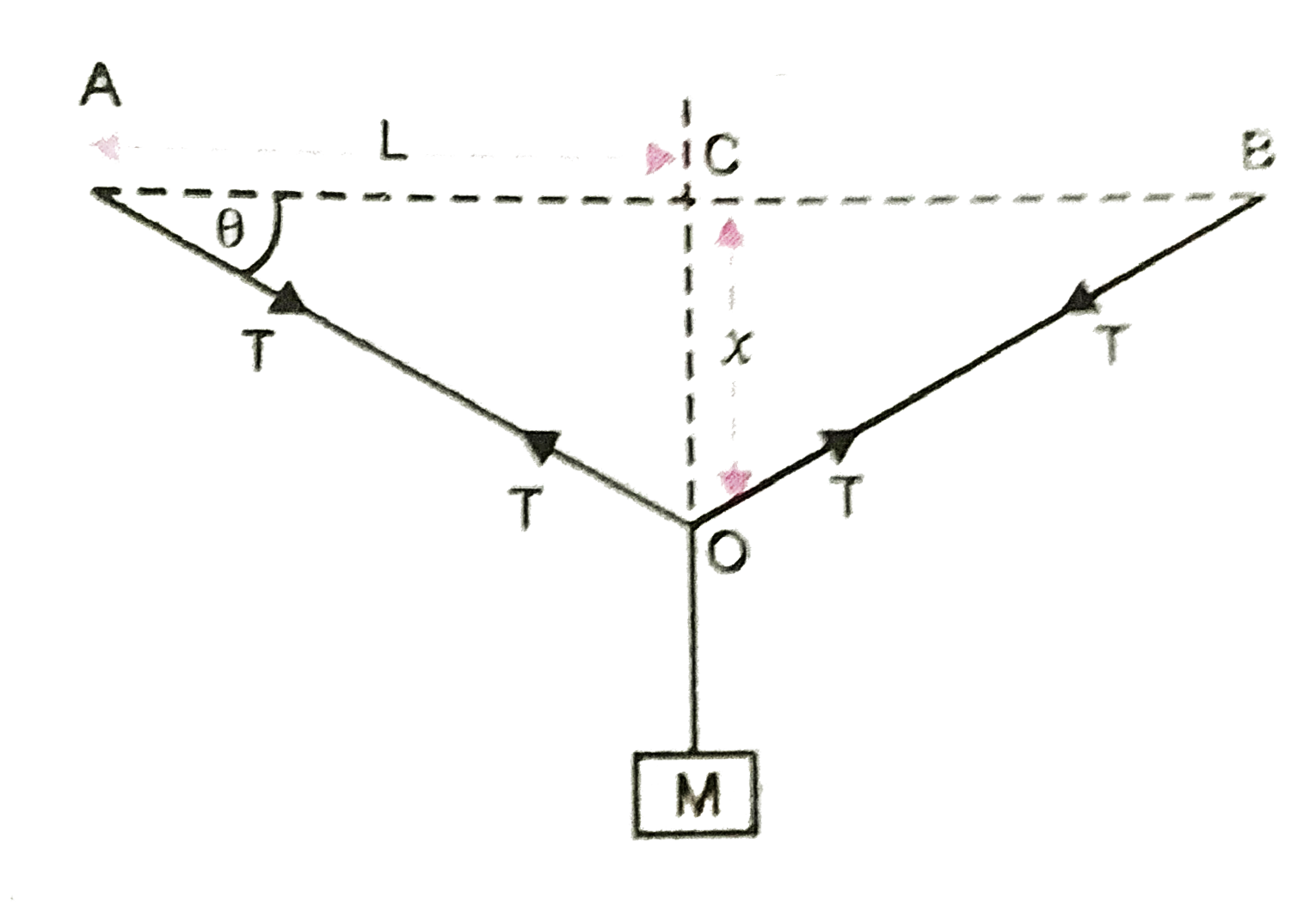 for equilibrium position of mass M, `Mg = 2T sin theta…… (i)` if `theta` is small, sin `theta ~~ theta = x//L….. (ii)` `As, T = (YA)/(L) DELTA L = (YA)/(L)[(L^2 + x^2)^(1//2)-L]` From (i) `Mg = (2YA x^2)/(2L^2) xx sin theta = YA theta^2 xx theta= YA theta^3` or `theta = ((Mg)/(YA))^(1//3) = [(1xx10)/(2xx 10^(11)xx4 xx10^(-4))]^(1//3)` `~~ 0.005 rad` |
|
| 31. |
Two identical container are open at the top and are connected at the bottom via a tube of negligible volume and a valve which is closed. Bith containers are filled initially to the same height 1.00m, one with water the other with mercury, as the drawing indicates. The valve is then opened. Water and mercury are immiscible. Determine the fluid level in the left container when equilibrium is re-established. |
|
Answer» |
|
| 32. |
Two metal spheres of densities in the ratio 3:2 and diameter in the ratio 1:2 are released from rest in two vertical liquid columns of coefficients of viscosity in the ratio 4:3. If the viscous force on them is same, then the ratio of their instantaneous velocities is |
|
Answer» `1:2` |
|
| 33. |
Match the items (physical quantity, unit and dimensions) given in three columns below, |
|
Answer» |
|
| 34. |
The angular velocities of three bodies in SHM are w_(1),w_(2),w_(3) with their respective amplitudes as A_(1)A_(2)A_(3). If all three bodies have same mass and velocity then |
|
Answer» `A_(1)w_(1)=A_(2)w_(2)=A_(3)w_(3)` |
|
| 35. |
Bodiesof largermass needgreatereffort to put them in motion. Why ? |
| Answer» SOLUTION : As F = ma so for given a, more force will be required to PUT a large mass in MOTION. | |
| 36. |
A gas is enclosed in a cylinder with a freely movable piston. The load on the piston is gradually decreased. The temperature of the gas can be changed by placing the cylinder in hot and cold heat reservoirs. The figure shown P-Vgraph of such a cylinder. What intermediate can be drawn the nature of change in the temperature of the gas ? " " |
| Answer» SOLUTION :We draw two isotherms representing constant TEMPERATURES `T_(1)` and `T_(2)`sucn that `T_(2)`passes through initial and final points 1 and 2 and `T_(1)`passes through certain intermediate POINT 3 . The curve closer to ORIGIN re[resents LOWER temperaturature. Hence the gas is heated in the section 1-3 and cooled in the section 1-2. | |
| 37. |
A man is trying to cross a river flowing at a speed of 5ms^(-1) to have least possible displacementby swimming at an angle of 143^(@) to the stream. The drift he suffers when he iscrossing the same river in least possible time is ( Width of river =1 km ) |
|
Answer» 160 m |
|
| 38. |
The second law of thermodynamics is a fundamental law of science. In this problem, we consider the thermodynamics of an ideal gas, phase transition, and chemical equilibrium. Three moles of CO_(2) gas expands isothermally (in thermal contact with the surroundings, temperature = 15.0^(@)C) against a fixed external pressure of 1.00 bar. The initial and final volumes of the gas are 10.0 L and 30.0L, respectively. Assuming CO_(2) to be an ideal gas, Delta_(sys)S is |
| Answer» SOLUTION :No. VAPOUR CONDENSES into SOLID. | |
| 40. |
One mole of an ideal gas undergoes an isothermal change at temperature .T. so that its volume v is doubled. R is the molar gas constant Work done by the gas during this change is |
|
Answer» RT In 4 |
|
| 41. |
For one resonance tube, a tuning fork produces resonance when air column in it has minimum length 50 cm. Now, next length of air column when resonance is produced again is |
|
Answer» 100 cm `(lamda)/(4) = L _(min) = 50 cm = ` minimum length of resonance tube (=minimum length of air column) `THEREFORE` Next possible length of resonance tube, `(3lamda)/(4) = 3 xx 50 = 150 cm` |
|
| 42. |
An object at an angle such that the horizontal range is 4 time of the maximum height. What is the angle of projection of the object? |
|
Answer» Maximum height `=(u^(2)sin^(2)theta)/(2g)` as given `(2u^(2)sinthetacostheta)/(g)=(4U^(2)sin^(2)theta)/(2g)` `2costheta=2sintheta` `tantheta=1` `:.theta=45^(@)` |
|
| 43. |
A boy throws n ball per second at regular time intervals. When the first ball reaches the maximum height he throws the second one vertically up. The maximum height reached by each ball is |
|
Answer» `(G)/(2(N-1)^(2))` |
|
| 44. |
Volume of a vessel is V and its temperature is T. Three gases are introduced inside the vessel. The initial pressure,volume and temperature of the three gases are respectively (p_1,V_1,T_1),(p_2,V_2,T_2) and (p_3,V_3,T_3) Find the final pressure. |
|
Answer» |
|
| 45. |
An aeroplane of mass M requires a speed v for take off. The length of runway is s and the coefficient of friction between the tyres and the ground is mu . Assuming that the plane accelerates uniformly during the take-off, the minimum force required by the engine of the plane for take off is |
|
Answer» `M((v^2)/(2s) + mug)` |
|
| 46. |
S_(1): Net torque on a system due to all internal force about any point is zero. S_(2): For rigid body undergoing fixed axis rotation, the direction of its angular acceleration and angular velocity S_(3): if net torque on a rigid body about its centre of mass is zero, the angular speed of the rigid body is always zero. S_(4): For a rigid body undergoing fixed axis rotation abouts its centre of mass, then net torque on rigid body about any point is same. |
|
Answer» TFFF `S_(2)`: if net torque on a rigid body is zero, its angular velocity will be constant. the constant may necessary down. `S_(3)`: If net torque on a rigid body is zero, its angular velocity will be constant. the constant may necessary not zero. `S_(4)`: since the CENTRE of mass is fixed, that is, at rest, hence net force on rigid body is zero. therefore torque on this rigid body anypoint is same. |
|
| 47. |
Choose the WRONG statement from the following statements. |
|
Answer» ELECTROMAGNETIC force is the farce between CHARGED particles. |
|
| 48. |
A solid sphere is in rolling motion. In rolling motion a body possesses translational kinetic energy (K_(t)) as well as rotational kinetic energy (K_(r )) simultaneously. The ratio K_(t):(K_(t)+K_(r )) for the sphere is |
|
Answer» `2:5` `(K_(t))/(K_(t)+K_(R))=((1)/(2)mv^(2))/((1)/(2)Iomega^(2)+(1)/(2)mv^(2))` `=((1)/(2)mv^(2))/((1)/(2)xx(2)/(5)mr^(2)xx(v^(2))/(r^(2))+(1)/(2)mv^(2))[becauseI=(2)/(5)mr^(2)andv=romega]` `=((1)/(2)mv^(2))/((1)/(5)mv^(2)+(1)/(2)mv^(2))` `=((1)/(2))/((1)/(5)+(1)/(2))` `=((1)/(2))/((7)/(10))=(5)/(7)` |
|
| 50. |
The value of acceleration due to gravity is maximum at |
|
Answer» poles |
|


