

Saved Bookmarks
This section includes 7 InterviewSolutions, each offering curated multiple-choice questions to sharpen your Current Affairs knowledge and support exam preparation. Choose a topic below to get started.
| 1. |
Using dimensional analysis obtain the value of density of water in S.I. In C.G.S system density of water is 1gm//cm^(3). |
|
Answer» `n_(2)+1gm//c.c. 1=n_(1)xx(1//1000),1000n_(2)=n_(1),1000gm//c.c.=1kg//m^(3)` |
|
| 2. |
A ball released from a height of 20m, hits the ground and rebounds to a height of 16m. The percentage loss of energy during collision is, |
|
Answer» 0.2 |
|
| 3. |
Reason of weightlessness in a satellite is |
|
Answer» zero gravity |
|
| 4. |
A uniform disc of mass m and radius R starts with velocity V0 on rough horizontal floor with a purely sliding motion at t=0 as shown. At t=t0, disc starts rolling without sliding. Then (Coefficient of frictions is mu) |
|
Answer» Net work done by FRICTIONAL force upto time `t LT t_(0)` is given by `(m mu"GT")/(2)(3mu"gt"-2V_(0))` |
|
| 5. |
Add 8.2 and 10.163 and round off the sum to two significant figures |
|
Answer» 18 |
|
| 6. |
A ray of light travelling in glass (mu=3//2) is incident on a horizontal glass air surface at the critical angle theta_(C). Ifa thin layer of water (mu=4//3) is now poured on the glass air surface, the ray of light emerge into airat the water air surface at an angle of pi//k, radians find the value of k. |
|
Answer» |
|
| 7. |
A sphere of mass 4 kg is attached to one end of a steel wire of length 1 m and radius 1 mm. It is whirled in a vertical circle with an angular velocity 10rad s^(-1). If the sphere is at the lowest point of its path, the elongation in the wire is ______ |
| Answer» Answer :3 | |
| 8. |
If vec(A) = vec(B) - vec( C) then determine the angle between vec(A) and vec(B) |
|
Answer» `theta = cos^(-1) [(A^(2) + B^(2) - C^(2))/(2AB)]` |
|
| 9. |
On which of the following scales of temperature, the temperature is never negative |
|
Answer» CELSIUS |
|
| 10. |
Horizontal component of a vector is represented as : |
|
Answer» `sin theta` |
|
| 11. |
A car of mass 1200 kg travelling with speed of 60 km/h on a straight road is ahead of a scooter travelling with speed of 60 km/h, then what will the speed of centre of mass of these vehicles?Mass of scooter is 80kg |
|
Answer» `60km//h` `v_(CM)=(m_(1)v_(1)+m_(2)v_(2))/(m_(1)+m_(2))` `=(1200xx60+80xx60)/(1200+80)` `=(72000+4800)/(1280)=(76800)/(1280)` `=60km//h` |
|
| 12. |
It is well known that a raindrop falls under the influence of the downward gravitational force and the opposing resistive force. The latter is known to be proportional to the speed of the drop but is otherwise undetermined. Consider a drop of mass 1.00g falling from a height 1.00km. It hits the ground with a speed of 50.0 ms^(-1). What is the work done by the gravitational force? |
|
Answer» Solution :The change in kinetic ENERGY of the drop is `triangleK= (1)/(2)mv^(2)-0` `=(1)/(2)xx10^(-3)xx50xx50 = 1.25 J` where we have assumed that the drop is initially at rest. Assuming that G is a constant with a value `10 m"/"s^(2)`, the work done by the gravitational force is, `W_(g)= mgh` `=10^(-3)xx10xx10^(3)= 10.0 J`. |
|
| 13. |
A mussless right angled triangle is spended with its right angle comer. A mass of 100kg is suspended from another comer ll which subtiends an angle 53^(@). Find the mass that should be suspended from other comer so that (hypolemic) remains horizontal. |
|
Answer» SOLUTION :From the principle of woments, `10xxgxx x_(1)-mxxg xx x_(2)` `100 cos53^(@)-mxxcos 37^(@)` Where, `x_(1) and x_(2)` are the ARM lengths. The right angle triangle with angles `37^(@).53^(@)` 53 and is a special triangle which has the respective SIDES in the ratio, 3:45 us SHOWN in the diagram. Substituting the values in equation (1)  `100xx cos53^(@)= m xx cos 37^(@)` `100xx(3)/(5)=mxx(4)/(5)` `m=100xx(3)/(4)` `m=75 g` 
|
|
| 14. |
In the figure shown, the pulley, strings and springs are mass less. The block is moved to right by a distance x_(0) from the position where the two springs are relaxed. The block is released from this position. (a) Find the acceleration of the block immediately after it is released.(b) Find tension (T_(0)) in the support holding the pulley to the wall, immediately after the block is released. Assume no friction . |
|
Answer» (B) `(4k_(1)k_(2)x_(0))/(k_(1) + k_(2))` |
|
| 15. |
For a gas, the different between the two specific heats is 4150J Kg^(-1) K_(-1) and the ratio of specific heats is 1.4 . What is the specific heat of the gas at constant volume in J Kg^(-1) K_(-1)? |
|
Answer» 8475 |
|
| 16. |
Along the direction of propagation of one wave of frequency 120 Hz, phase difference between two particles separated by 1 m distance is 90^(@). Find velocity of this wave. |
|
Answer» `180 m//s` `therefore Delta phi = (2pi f )/(V ) (Delta c ) ""(because v= f lamda )` `therefore (PI)/(2) = (2 pi xx 120)/(v) (1)` `therefore v = 480 m//s` |
|
| 17. |
In the previous problem (3), the magnitude of the momentum transferred during the hit is |
|
Answer» <P>zero As provedin ABOVESOLUTION `Delta p =-[ 0.9 HAT(j )+ 1.2 hat(j )]` Magnitude=`|Delta p |= sqrt ((0.9)^(2) + (1.2)^(2))` `= 1.5kg m//s` |
|
| 18. |
A steel rail of length 5 m and area of cross section 40 cm^2is prevented from expanding along its length while the temperature rises by 10^@C . If coefficient of linear expansion and Young's modulus of steel are 1.2 xx 10^5K^1and 2 xx 10^11 Nm^2respectively, the force developed in the rail is approximately: |
|
Answer» `2 xx 10^7 N` |
|
| 19. |
(A) When external forces are involved, momentum of the system is not conserved. (B) When stationary bomb explodes, energy released is converted to K.E of fragments (C ) When rubber ball hits the wall, its kinetic energy is not conserved |
|
Answer» A and C are true |
|
| 20. |
A body cools form 50^(0)C to 40^(0)C in 6 minutes. When its surroundings temperature is 30^(0)C, what will be its temperature 12 min after the start of the experiment? Surrounding temperature remains the same ? |
| Answer» SOLUTION :`35^(@)C` | |
| 21. |
One end of an ideal spring of unstreched length l_(0)=10. Is fixed on a frictionless horizontal table. The other end has a small particle of mass 0.1 kg attached to it. The particle is projected with a velocity v_(0)=9.9 m/s perpendicular to the spring In themotion of the particle, maximum elogation of spring is l_(0)=10 The velocity of particle at this instant in m/s is : |
|
Answer» 10 |
|
| 22. |
If 16 gm of oxygen and x gm of hydrogen has the same volume at the same temperature and pressure, then.find the value of x. |
|
Answer» Solution :PV = `(m)/(M) RT` Since from the given data, pressure, VOLUME and temperature are constant , `(m)/(M) ` constant `therefore (m_(1))/(M_(1))= (m_(2))/(M_(2)) ` where `M_(1) and M_(2)` are the molecular WEIGHTS of OXYGEN and hydrogen `(16)/(32) = (x)/(2)` `rArr x = 1 ` gm |
|
| 23. |
Identify the correct answer. When a wire is stretched to double its length a) Stress = Young's modulus b) Strain = 1 c) Radius is halved d) Y = 2x elastic deformation energy |
| Answer» Answer :C | |
| 24. |
A ball is proejcted horizontally from the top of a building 19.6 m high. If the line joining the point of projection to the point where it hits the ground makes an angle of 45^(@)to the horizontal, the initial velocity of the ball is |
|
Answer» `4.9ms^(-1)` |
|
| 25. |
An object is thrown in vertically upward direction. The time to reach maximum height is ……….. |
|
Answer» `(g)/(v_(0))` ` THEREFORE` From `v =v_(0) + ` at, we get,` 0 = v _(0) - g t` `therefore t = (v _(0))/(g)` |
|
| 26. |
A small bead of mass m moving with velocity v gets threaded on a stationary semicircular ring of mass m and radius R kept on a horizontal table. The ring can greely rotate about its centre. The bead comes to rest relative to the ring. What will be the final angular velocity of the system v/cR. Where 'c' is |
|
Answer» |
|
| 27. |
A body is moving along the +ve X-axis with uniform acceleration of -4ms^2 . Its velocity at x = 0 is 10 ms^(-1). The time taken by the body to reach a point at x = 12m is |
|
Answer» (2S, 3S) |
|
| 28. |
The change in momentum per unit time of a body represents |
|
Answer» impulse |
|
| 29. |
If vec(F) = hat(i) + 2hat(j) + hat(k) and vec(V) = 4hat(i) - hat(j) + 7hat(k) find vec(F).vec(V) |
|
Answer» 6W |
|
| 30. |
(I) Area of a Parallelogram in vectors is |vecAxxvecB|=|vecA||vecB|sin theta (II) Area of a Triangle in vectors is 1//2(vecA xx vecB) Which statement is in correct? |
|
Answer» I only |
|
| 31. |
Hailstorms are observed to strike the surface of a frozen lakein a direction making an angle 30^(@) to the vertical and to rebound at an angle of 45^(@) to the vertical. Assuming the contact to be, smooth find the coefficient of restitution. |
Answer» Solution :we know that `tan alpha = (tan THETA)/( e) , tan 45 ^(@) = (tan 30^(@))/( 3) implies e = (1)/(SQRT3) =0.577` 
|
|
| 32. |
A horizontal platform is rotating with uniform angular velocity around the vertical axis passing through its centre. At some instant of time a viscous fluid of mass m is dropped a the centre and is allowed to spread out and finally fall. The angular velocity during this period ........... |
|
Answer» decreases CONTINUOUSLY When viscous fluid of mass m is DROPPED and start spreading out then its moment of inertia increases and angular velocity decreases. But when it start FALLING then its moment of inertia again starts decreasing and angular velocity increases |
|
| 33. |
A small lead sphere is made to execute shm inside a concave dish of radius of curvature 1 m. What is its period ? |
|
Answer» |
|
| 34. |
A 2 cm cube o some substance has its upper face displaced by 0.15cm due to a tangential force of 0.3 N Calculate the rigidity modulus of the substance. |
|
Answer» `1 XX 10^4 N//m^2` |
|
| 35. |
Figure shows an arrangement of pulleys and two blocks. All surfaces are frictionless . All pulleys and strings are massless. All string are smooth and massless. Normal reaction between A and ground is : |
|
Answer» `mg` `mg-2T=(ma)/(2)` `mg-4ma=(ma)/(2)` `mg=(9ma)/(2)` `a=(2G)/(9)` `T=(4mg)/(9)` `N_(1)=ma=(2ma)/(9)` `N_(2)=mg+2T` `N_(2)=mg+2T` `=mg+(8mg)/(9)=(17mg)/(9)`. 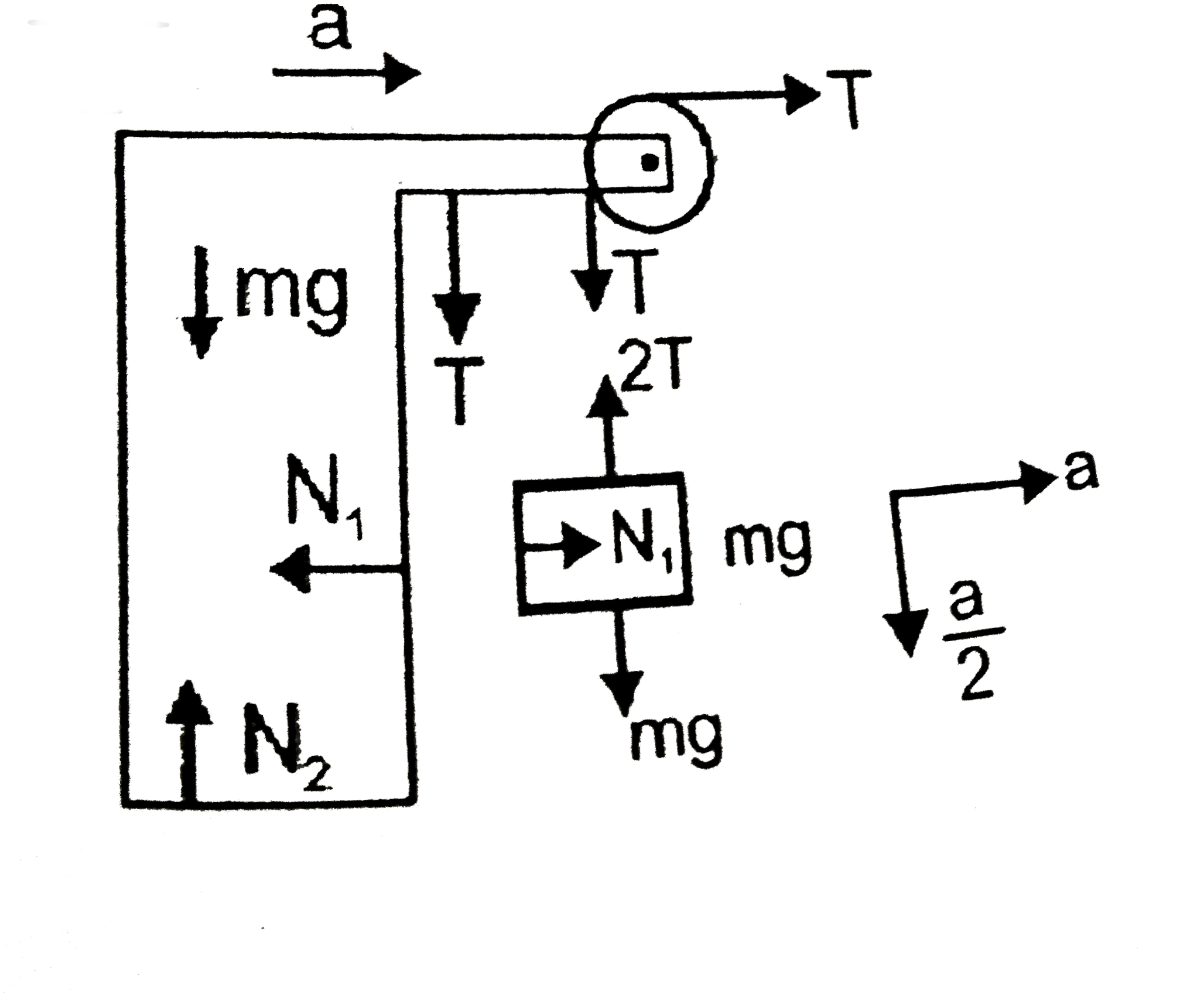
|
|
| 36. |
In the upper part of the atmosphere the kinetic temperature of air is of the order of 1000 K, even then one feels severe cold there. Why? |
|
Answer» Solution :(i) As we go up in the atmosphere, the NUMBER of air molecule per unit volume decreases. (ii) The QUANTITY of heat per unit volume or the heat density is low. (iii) But the translational K.E per molecule is quite large. As the temperature is the measure of K.E, so temperature is HIGH in the upper atmosphere but one FEELS cold due to low heat density. (iv) Accumulate to the law of equipartition of energy average energy of each molecule = `(5)/(2)K_(B)T`. (v) `therefore` Internal energy of one molecule of the GAS. `U=(5)/(2)k_(B)TxxN_(A)=(5)/(2)RT` `C_(v)=(dU)/(dt)=(5)/(2)R,C_(p)=C_(r)+R=(5)/(2)R+R=R((5)/(2)+1)` `gamma=(C_(p))/(C_(v))=(((5)/(2)+1)R)/((5)/(2)R)=1+(2)/(5)` `therefore gamma=1+(2)/(5)` |
|
| 37. |
A hollow sphere filled with water and one small hole at bottom is hung by a long thread and made to oscillates. The effect on the period of oscillation as water slowly flows out of the hole at bottom……… |
|
Answer» decreases continuously |
|
| 38. |
''Lamp black and platinum black are used as perfect black body one for absorption of heat radiation.'' Why? |
| Answer» Solution :They ABSORB RADIATIONS of all WAVELENGTHS. But when HEATED they do not emit radiations of all wavelength. | |
| 39. |
Figure shows an arrangement of pulleys and two blocks. All surfaces are frictionless . All pulleys and strings are massless. All string are smooth and massless. Normal reaction between A and B is : |
|
Answer» `mg` `mg-2T=(ma)/(2)` `mg-4ma=(ma)/(2)` `mg=(9ma)/(2)` `a=(2g)/(9)` `T=(4mg)/(9)` `N_(1)=ma=(2ma)/(9)` `N_(2)=mg+2T` `N_(2)=mg+2T` `=mg+(8mg)/(9)=(17mg)/(9)`. 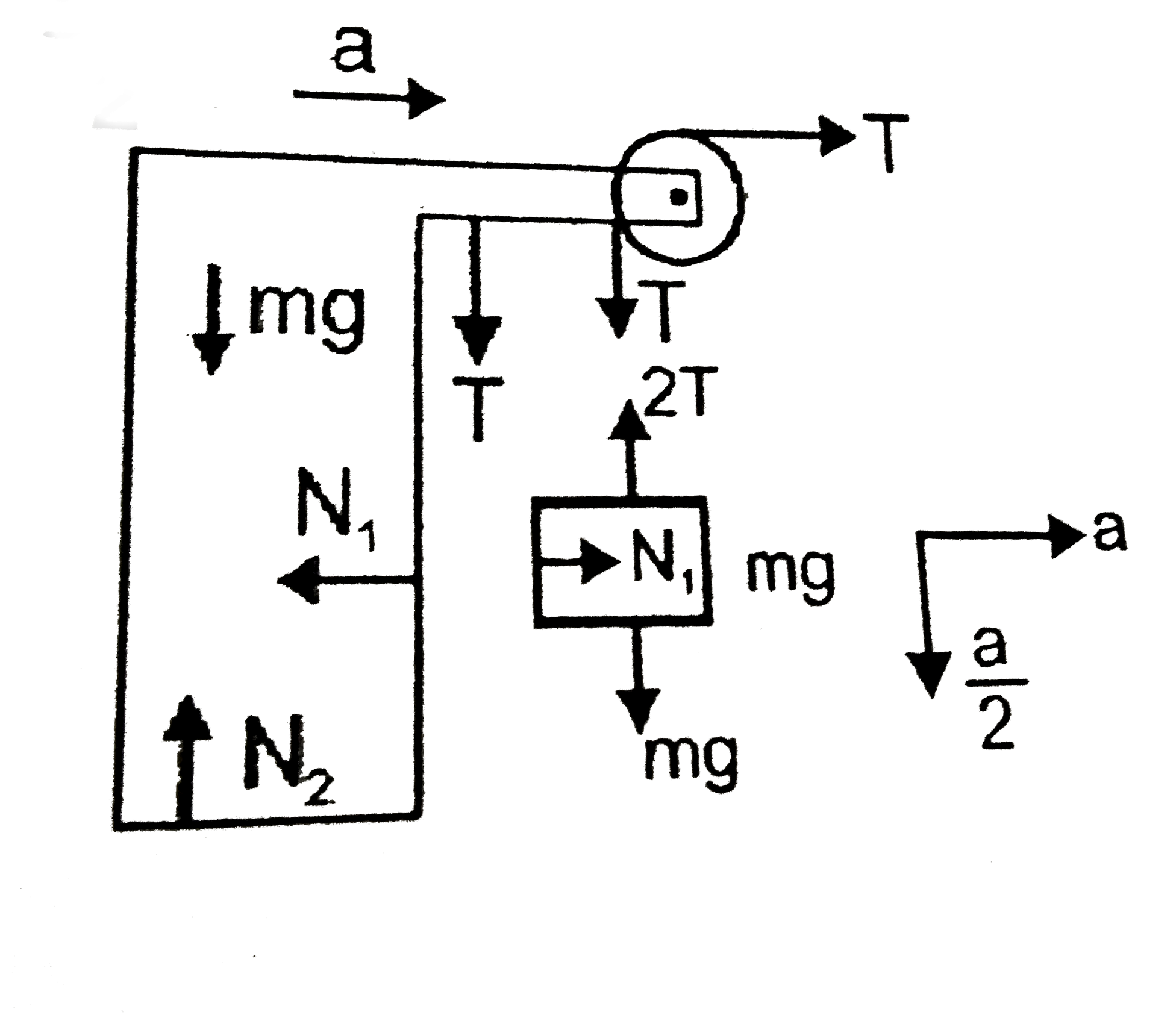
|
|
| 40. |
The ratio of the velocity of sound in a monatomic gas to that in a triatomic gas having same molar mass , under similar conditions of temperature and pressure , is …………. |
|
Answer» 1.12 |
|
| 41. |
A spring balance has a scale that reads from 0 to 50 kg. The length of the scale is 20 cm. A body suspended from this balance, when displaced and released, oscillates with a period of 0.6 s. What is the weight of the body ? |
|
Answer» Solution :Maximum displacement of the spring `trianglel = 20 cm = 0.2 m` Time period `T = 0.6 s, g = 9.8 ms^(-2)` Maximum force exerted on the spring `F= mg` `= 50xx 9.8= 490N` Now, force CONSTANT `k= (F)/(triangle l)` `therefore k = (490)/(0.2)= 2450 Nm^(-1)` But time period `T= 2pi SQRT((m)/(k))` `therefore (T^(2)k)/(4PI^(2))= m` `therefore ((0.6)^(2)xx2450)/(4xx(3.14)^(2))=m` `therefore m= 22.36 kg`. Weight of the body = mg `22.36xx 9.8 = 219.1N = 22.36 kgf`. |
|
| 42. |
What is the effect of decrease of presure on the fusion and boiling point of CO_(2)? |
| Answer» SOLUTION :Both DECREASE, with decrease in PRESSURE. | |
| 43. |
The difference in length of an iron rod and a copper rod at 50^(@)C is 2 cm. This difference remains the same also at 450^(@)C. What are the lengths of the rods at 0^(@)C? Given, alpha for iron =12 times 10^(-6@)C^(-1) and alpha for copper =17 times 10^(-6@)C^(-1). |
|
Answer» Solution :Let x and y be the lengths of the iron and the copper RODS at `50^(@)C` respectively. Sincethe difference in lengths of the two rods remains the same for any RISE in TEMPERATURE, both the rods will have the same expansion. Increase in length of the iron rod `"" =x times 12 times 10^(-6)(450-50)=x times 12 times 10^(-6) times 400` Increase in length of the copper rod `""=y times 17 times 10^(-6)(450-50)=y times 17 times 10^(-6) times 400` According to the question, `"" x times 12 times 10^(-6) times 400=y times 17 times 10^(-6) times 400` or,`"" 12x = 17y` or, `x=17/12y` `because "" x gt y` `therefore " " x-y=2 " or, " x=2+y` or, `"" 2+y=17/12y " or, " 5y=24 " or, " y=4.8cm` `therefore "" x=2+4.8=6.8cm` Now, suppose the lengths of the iron and the copper rods are `x_(0) " and " y_(0)` respectively at `0^(@)C.` `therefore "" 6.8=x_(0){1+12 times 10^(-6) times 50} " or, " x_(0)=6.796cm` `therefore "" 4.8=y_(0)(1+17 times 10^(-6) times 50} " or, " y_(0)=4.796cm` Hence, lengths of the iron and the copper rods at `0^(@)C` are 6.796 CM and 4.796 cm respectively. |
|
| 44. |
When two moles of a gas is heated from 0^(@)Cto10^(@)C at constant volume, its internal energy changes by 420J. The molar specific heat of the gas at constant volume |
|
Answer» `5.75"J K"^(-1)"mole"^(-1)` |
|
| 45. |
(A): Displacement of a body is the signed sum of the area under velocity-time graph. (R) : Displacement is a vector quantity. |
|
Answer» Both (A) and (R) are true and (R) is the correct EXPLANATION of (A) |
|
| 46. |
A body when projected vertically up , covers a total distance D, During the time of tis flight t. If there were no gravity , find the distance covered by it during the same time |
|
Answer» Solution :The displacement of the body during the time t as it attains the point of projection `RARR S = 0 ` `rArr v_(0)t-1/2"gt"^(2)=0` `rArr t=(2v_(0))/g` DRING the same time t, the body moves in ABSENCE of gravity through a distance `D.=v_(0)t,` because in absence of gravety g=0 `rArr D. =v_(0)((2v_(0))/g)=(2v_(0)^(2))/g` In presence of gravity the total distance COVERED is `=D=2H=2(v_(0)^(2))/(2g)=(v_(0)^(2))/g (1)-:(2)rArr D.=2D` |
|
| 47. |
A uniform rod of mass 15 kg is held stationary with the of a light string as shown in figure. The tension in the string is 10^(x)"N". Where 's' is |
|
Answer» |
|
| 48. |
The graph between the displacement x and time t for a particle moving in a straight line is shown in figure. During the interval OA, AB, BC and CD, the acceleration of the particles is |
|
Answer» OA- +, AB- 0, BC- +, CD- + |
|
| 49. |
When arrow is released from bow , then from which source arrow get kinetic energy ? |
| Answer» SOLUTION :Potential energy of a stertched STRING is CONVERTED into KINETIC energy . | |