

Saved Bookmarks
This section includes 7 InterviewSolutions, each offering curated multiple-choice questions to sharpen your Current Affairs knowledge and support exam preparation. Choose a topic below to get started.
| 1. |
A bimetallic strip is formed out of identical strips one of copper and the other of brass. The coefficients of linear expansion of the two metals are alpha_(c) " and " alpha_(B). On heating the temperature of the strip goes up by DeltaT and the strip bends to form an arc of radius of curvature R. Then R is |
|
Answer» proportional to `DeltaT` |
|
| 2. |
The coffecients of thermal expansion in solids are mainly coffecient of volume expansion (gama) . What is the ratio of alpha , beta and gama ? |
| Answer» SOLUTION :0.043090277777778 | |
| 3. |
The force of buoyancy is equal to |
|
Answer» weight of the BODY |
|
| 4. |
If the surface tension of solution of soap in water is 35 dynes/cm, calculate the work done to form one air bubble of diameter 14 mm with that solution. |
|
Answer» Solution :Surface tension T = 35 dynes `cm^(-1)=0.035Nm^(-1)` RADIUS of the bubble (r ) = `(14mm)/2=7mm=7xx10^(-3)m` Total surface area of the bubble formed `A=2xx4pir^(2)` `rArrA=2xx4xx22/7xx(7xx10^(-3))^(2)=1.232xx10^(-3)m^(2)` Work DONE to FORM the SOAP bubble W = A(T) `rArrW=1.232xx10^(-3)xx0.035J,W=4.312xx10^(-5)J` |
|
| 5. |
A bodyinitially at rest and sliding along a frictionlss track from a height h (as shown in the figure ) jut completes a vertical circle of diameter AB = D .the height h is equal to ………. |
|
Answer» `5/4 `D Potential energy is converted into kinetic energy . `mgh= 1/2 mv_(A)^(2)` ` :. H = ((v_Delta)^(2))/(2G)` ` = (5gR)/(2g)` ` = (5D)/(2xx2)` ` :. h =5/4D ` |
|
| 6. |
If the brake is applied in the moving bus suddenly, passengers move forward is an example for |
|
Answer» INERTIA of MOTION |
|
| 7. |
A hollow sphere of radius 2 cm is attached to an 18 cm long thread to make a pendulum. Find the time period of oscillation of this pendulum . How does it differ fro the time period calculated using the formula for a simple pendulum? |
|
Answer» `momega(0.2)(1-costheta)+1/2Iomega^2=C`……….1 Againg I=2/3m(0.02)^2+m(0.2)^2` `=2/3m(0.0004)+m(0.4)` `=m[0.0008+0.12]` `=m(0.1208)/3)` where lrarr moent of inertia about the POINT of suspension A. From equation differenting and putting the value of l in equation 1 ils `d/(dt)[MG(0.2)(1-costheta)+1/20.1203/3momega^2]` `d/(dt) (c)` `rarr mg(0.2)sintheta(dtheta)/(dt)+1/2(0.1208/3)m^2omega(domega)/(dt)=0` `rarr 2sintheta=0.1208/3 alpha` `[because g=10m/s^2]` `alpha/theta=6/0.1208` `=omega^2=58` `rarr omega=7.63` So, `T=(2pi)/3` `=0.89sec` For simple PENDULUM `T=2pi sqrt(0.19/10) `=0.86sec` `% more =(0.89-0.86)/0.89=0.3% `:.` It is about 0.3% larger than the calculated value. |
|
| 8. |
A body is moving along z-axis of a coordinate system under the effect of a constant force F= (2veci+3hatj+vhatk)N. Find the work done by the force in moving the body a distance of 2 m along z-axis |
|
Answer» `W=vecF.vecS=2J` |
|
| 9. |
A platinum resistance thermometer has a resistance 11 ohms at the ice point, 15.247 ohms at the steam point and 28.887 ohms at the sulphur point (444.6^(@)C). Find the first and second temperature coefficient of platinum. |
|
Answer» |
|
| 10. |
H calories of heat is required to increase the temperature of one mole of monoatomis gas from 20^(@)C" to "30^(@)C at const. volume. The quantity of heat required to increase the temperature of 2 moles of a diatomic gas from 20^(@)C" to "25^(@)C is at constant volume is |
|
Answer» `(4H)/3` |
|
| 11. |
Earth revolves round the sun (say in a circular path under the action of the force exerted by the sunon the earth. Is the sun doing any work ? Explain . |
| Answer» Solution :Centripetal FORCE (Which is provided by GRAVITATIONAL pull of the SUN in this case) that acts on a body in a circular motion is perpendicular to the displacement of thebody at EVERY POINT of its motion, and hence does not do any work. Component of this force in the direction of the displacement `=F cos 90^@=0` (F =applied force). So, gravitational pull of the sun does not do any work for the revolution of the earth as the force acts perpendicular to earth.s direction of displacement . | |
| 12. |
A mass of 3kg is suspended by a rope of length 2m from the ceiling. A force of 40 N in the horizonal direction is applied at midpoint P of the rope as shown. What is the angle the rope makes with the vertical in equilibrium and the tension in part of string attached to the ceiling? (Neglect the mass of the rope, g=10m//s^(2)) |
|
Answer» Solution :Resolving the tension `T_(1)` into two mutually perpendicular components, we have `T_(1)cos theta=W=30N""T_(1)sin theta=40N` `THEREFORE tan theta=(4)/(3)(or)theta=tan^(-1)((4)/(3))=53^(@)` 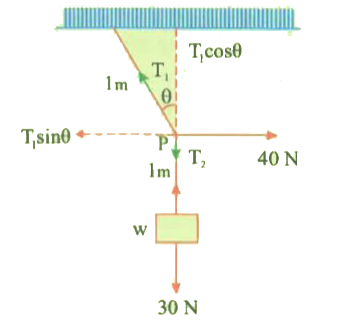 The tension in part of STRING attached to the ceiling `T_(1)=sqrt(W^(2)+F^(2))=sqrt(30^(2)+40^(2))=50N` |
|
| 13. |
A ray of light falls normally on an equilateral prism of refractive index mu=sqrt(3). Match of the following table. |
|
Answer» <P> |
|
| 14. |
Proper inflation of typres of vehicles saves fuel given reason |
| Answer» SOLUTION :WHENTHE tyresis properlyinflated the AREA ofcontact betweenthe tyre and THEGROUND is REDUCED. Thisreduces rollingfrictionConsequently the automobilecoversgreaterdistancefor thesamequantityof fuelconsumed. | |
| 15. |
How is the frequency of oscillation relatedwith the frequency of change in the K.E. and P.E. of the body in S.H.M ? |
| Answer» SOLUTION :P.E. OR K.E. completes two vibrations in a TIME during with S.H.M. completes one VIBRATION or the frequency of R.E or K.E is double than that of S.H.M. | |
| 16. |
The correct option regarding orbital velocity is /are : |
|
Answer» Orbital VELOCITY `v prop (1)/(sqrt(R))` for different orbit |
|
| 17. |
The escape velocity for a body projected vertically upwards from the surface of earth is 11 kms^(-1). If the same body is projected at an angle of 45^(@) with the vertical, the escape velocity will be |
|
Answer» `11sqrt(2)KMS^(-1)` |
|
| 18. |
A high pressure tyre rolls more easily than a low pressure tyre because |
|
Answer» FRICTION is LESS in high inflated TYRE |
|
| 19. |
Four small spheres each of radius 't' and mass 'm' are placed with their centres at the four corners of a square of side 'L'. The M.I. of the system about a diagonal of the square is |
|
Answer» `(8mr^(2))/(5)+mL^(2)` |
|
| 20. |
A rope of negligible mass can support a load of M kg. Prove that the mass of the greatest load which can be raised is equal to(M )/(1+ (2h)/(g t^2))kg, where g is the acceleration due to gravity andh is the height through which the said load rises from rest with uniform acceleration in time t. |
Answer» SOLUTION :Since the rope can support a load of M kg, the maximum tension the rope can withstand is given by T = Mg (figure a). Now, if a mass m is raised by the rope with a uniform ACCELERATION a as shown in figure (b), then the net  Upward force on the mass m = (T" - mg) where T. is the tension in the string. Then, from Newton.s second law of motion, ` T. = mg =ma ORT. =m(G+a)` FORTHE greatestvalueof m ` T.=T thereforem (g +a) = Mg ` ` thereforem ( Mg)/(g+a) = (M )/(1 +a//g)` Now, from the equation of motion, `s=ut + 1/2 at^2` Weget,`h= 0+1/2a t^2or a = (2h)/(t^2)` fromequation(i )`m=(M )/(1 +(2h)/(g t^2) ) kg .` |
|
| 21. |
A wire can be broken by 400 kg.wt. The load required to break the wire of double the thickness of the same material will be |
| Answer» Answer :2 | |
| 22. |
If P is X-ray unit and Q is micron, then P/Q= |
| Answer» Answer :B | |
| 23. |
In the above problem for figure - 2 the acceleration of the block B is g/x . Then 'x' is |
|
Answer» |
|
| 24. |
A vertical frictionless semicircular track of radius 1m fixed on the edge og a movable trolley (figure). Initially, the system is rest and a mass m is kept at the top of the track. The trolly starts moving to the right with a uniform horizontal acceleration a=2g//9 . The mass slides down the track, eventually losing contact with it and dropping to the floor 1.3m below the trolly. This 1.3m is from the point where mass loses contact. (g=10m//s^(2)) (a) Calculate the angle theta at which it loses contact with the trolly and (b) the time taken by the mass to drop on the floor, after losing contact. |
|
Answer» From work energy theorem, `KE` of particle relative to track =Work done by FORCE of gravity+work done by pseudo force :. `(1)/(2)mv_(r)^(2)=mg(1-costheta)+m((2g)/(9))sintheta` opr `v_(r)^(2=2g(1-costheta)+(4g)/(9)sintheta` Particle leaves contact with the track where `N=0` 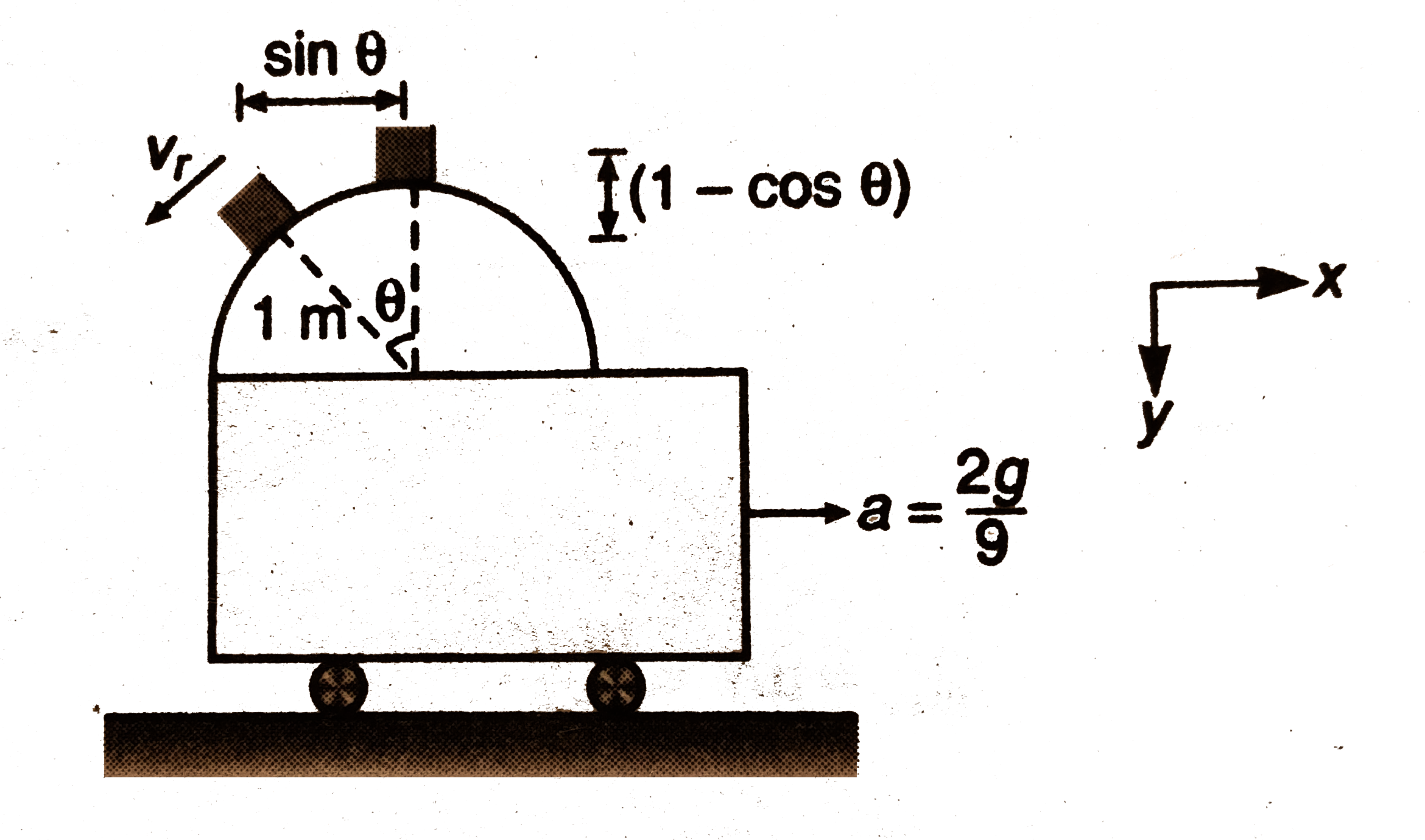 or `mgcostheta-m((2g)/(9))sintheta=mv_(r)^(2)` or `gcostheta-(2g)/(9)sintheta=2g(1-costheta)+(4g)/(9)sintheta` or `3costheta-(6)/(9)sintheta2` Solving this, we get `theta~~37^(@)` (b) From Eq. (i) we have, `v_(r)=SQRT(2g(1-cos theta)+(4g)/9 sin theta)` or `v_(r)=2.58 m//s at theta=37^(@)` Vertical component of its velocity is `v_(y)=v_(r) sin theta` `=2.58xx3/5` `=1.55 m//s` Now, `1.3=1.55t+5T^(2)( :' s=ut+1/2 GT^(2))` or `5t^(2)+1.55t-1.3=0` or `t=0.38 s` |
|
| 25. |
(A) : Time taken by the bomb to reach the ground from a moving aeroplane depends on height of aeroplane only ( R) Horizontal component of velocity of bomb reamins constant and vertical components of velocity of bomb changes due to gravity |
|
Answer» Both (A) and ( R) are TURE and ( R) is the correct explanation of (A) |
|
| 26. |
A rocket vurns 50g of fuel per secondejecting it as a gas with a velocity of 5xx10^(5) cm s^(-1). What force is exerted by the gas on the rocket? |
|
Answer» Solution :We are to CALCULATE the upward thurst on the rocket. Upword THRUST `=v_(r)(Deltam)/(Deltat), Now , (Deltam)/(Deltat)=50 gs^(-1)` `v_(r)=5XX10^(5) cms^(-1)` `:."upwards thrust"= 5xx10^(5) cm s^(-1)xx50 gs^(-1)=250xx10^(5) ` dyne=250N |
|
| 27. |
Find the result of mixing 100 g of ice at -12°C with 50g of water at 92°C . |
| Answer» SOLUTION :50G ICE MELTS | |
| 28. |
The vibrations of a string of length 60 cm fixed at both ends are represented by the equation y = 4 sin (( pi x)/(15)) cos ( 96 pi t) wherex and y are in cm and t in second . ii. Where are the nodes located along the strings ? iii. What is the velocity of the particle atx = 7.5 cm at t = 0.25 s? iv. Write down the equations of component waves whose superposition gives the above waves . |
|
Answer» Solution :The given EQUATION for standing waves in the string is ` y = 4 sin ((pi X)/(15)) cos (96 pi t)`(i) i. The amplitude of the waves is given by ` A = 4 sin ( pi x)/(15)`(ii) Therefore , the maximum displacement or amplitude at ` x = 5 cm` is `A = 4 sin ( pi xx 5)/(15) = 4 sin (pi)/( 3)` ` = 4 sin 60^(@) = 4 xx ( sqrt( 3))/(2) = 2 sqrt(3) = 2xx 1.732 = 3.464 cm` ii. The position of zero displacement or nodes are given by `sin (pi x)/(15) = 0 or (pi x)/( 15) = r pi ( where r = 0 , 1 , 2, 3,...)` `rArr x = 15 r rArr x = 0, 0.15 cm , 0.30 cm , ....` iii. Differentiating Eq. (i) with respect to `t` , we get velocity of particle ` u = (DY)/(dt) = - 4 xx 96 pi sin ((pi x)/( 15)) sin (96 pi t)` Substituting ` x = 7.5 cm and t = 0.25 s`. `u = - 384 pi sin (( pi xx 7.5)/(15)) sin (96 pi xx 0.25)` ` = - 384 ( pi//2) sin (24 pi) = 0` Using the relation ` 2 sin A cos B = sin ( A + B) + sin ( A - B)` Equation (i) may be expressed as ` y = 2 [ sin {(pi x)/(15) + ( 96 pi t)} + 2 sin { (pi x)/(15) - (96 pi t)}]` ` = 2 sin {pi x)/(15) + 96 pi t + 2 sin {(pi x)/(15) - 96 pi t} = y_(1) + y_(2)` Therefore , the component waves are given by `{:(y_(1) = 2sin (96pit +(pix)/15)),(y_(2)=-2sin(96pit -(pix)/15)):}` |
|
| 29. |
An engine pumps water from a tank at the rate of 10 kg per second and ejects from a nozzle 7 m above the surface of the tank with a velocity of 20 m/s. What is the output power of the engine? |
|
Answer» Solution :Let P, and P, be the PRESSURE, w, and v, the VELOCITIES, at the surface of the tank and the nozzle respectively. By Bernoulli.s theorem, `P_1 +H_1 rhog +(1)/(2)v_1^(2) rho = P_2 +H_2rho g +(1)/(2)v_2^(2) rho ` `""P_1 - P_2 = rho g (H_2 -H_1)+(1)/(2)rho ( v_2^(2) -v_1^(2)) ` `H_2 -H_1 =7 m ` `v_1 =0, v_2 = 20 m//s` ` P_1 -P_2 = rho xx 9.8 xx 7 +(1)/(2) rho ( 20^(2) -0) ` ` "" =208.6 rho` Rate of DISCHARGE of water ` =(10)/( rho)` Rate of doing WORK ` = (P_1 -P_2)xx (10)/(rho )` ` ""=208.6 rho xx (10)/(rho)` ` ""=2086 J//s` i.e. , Output power of the engine = 2086 WATT |
|
| 30. |
A particle with restoring force proportional to displacement and resisting force proportional to velocity is subjected to a force Fsin omegat. The amplitued of particle is maximum for frequency omega=omega_(1) while the energy is maximum for the frequency omega = omega_(2), then (where omega_(0) = natural freqrency of oscillation of particle) |
|
Answer» `omega_(1)=omega_(0) "and" omega_(2) !=omega_(0)` |
|
| 31. |
When one end of a tube of radius r is immersed vertically in a liquid of density rho, surface tension S, the rise of liquid in the tube is h and angle of contact is theta . If the tube is broken and its length is made h' (lt h), then find the value of height of rise of liquid in the tube and angle of contact. |
|
Answer» Solution :When a capillary tube is broken at a height `H' ( LT h)`, the height of LIQUID COLUMN in the tube will be h' but the angle of contact `theta'` will CHANGE As `h=(2S cos theta)/(r rho g)` or ` (h)/(cos theta) = (2S)/(r rho g) `= a constant `:. h/(cos theta)=(h')/(cos theta') or cos theta' = (h')/(h) cos theta` or `theta' = cos ^(-1) ((h')/(h) cos theta)`. |
|
| 32. |
The angular frequency of a spring block system is omega_(0). This system is suspended from the ceiling of an elevator moving downwardswith a constant speed V_(0). Ther block is at rest relative to the elevator. Lift is suddenly stopped. Assuming the downwards as a positive direction, choose the wrong statement: |
|
Answer» The amplitude of the block is `(v_(0))/(omega_(0))` |
|
| 33. |
Two particles are seen to collide and move jointly together after the collision. During such a collision, for the total system |
|
Answer» both the MECHANICAL ENERGY and the linear MOMENTUM are conserved |
|
| 34. |
A body is sliding down an inclined plane forming an angle 30^(@) with the horizontal. If the coefficient of friction is 0.3 then acceleration of the body is |
|
Answer» `1.25 MS^(-2)` |
|
| 35. |
The respective number of significant figures for the number 13.013, 0.0003 and 9.1xx10^(-3) are respectively: |
|
Answer» 5, 1, 2 |
|
| 36. |
Mass of a uniform rod of length 10 m is 10 kg . The rod is placed over knife edges A and B. One end of the rod is resting on the knife edge A and the other end is 2 m outside the knife edge B. A 30-kg weight is now suspended 2 m away from the end A. Find the magnitude of the normal forces on the knife edges. |
|
Answer» SOLUTION :Let `R_(1)` and `R_(2)` be the normal forces at knife edges A and B respectively Fig. The WEIGHT of the of the rod, `10 kg xx9.8 "m.s"^(-2)` =99 N, is acting at O, the mid-point of the rod. From the conditions of EQUILIBRIUM, `R_(1) +R_(2)=(30+10)xx9.8=392 N` Taking moments about the point A, `R_(2)xxAB = 30xx9.8 xxAD+10xx9.8xxAO` or, `" " R_(2) xx8 = 294 xx2+98xx5` `:. R_(2)=134.75 `N `:. R_(1) = 392 -134.75 = 257.25 `N. 
|
|
| 37. |
which of the following measurements is most precise ? |
|
Answer» 5.00 mm |
|
| 38. |
What is the phase difference between the velocity and displacement of a paticle executing SHM? |
|
Answer» Solution :`90^(@)"" v(t) = -A omega COS (omega t + PHI)` For positive x velocity is positive and for NEGATIVE x velocity is negative. |
|
| 39. |
Two discs of same moment of inertia rotating about their regular axis passing through - centre and perpendicular to the plane of disc with angular velocities omega_(1) and omega_(2). They are brought into contact face to face coinciding the axis of rotation. The expression for loss of energy during this process is |
|
Answer» `(I)/(8)(omega_(1)-omega_(2))^(2)` |
|
| 40. |
An ice block of (4pi )/(3) cm^3 is placed in an artificial satellite. When ice melts into water then its surface area will be, if the densities of ice and water are assumed to be same |
|
Answer» `(4 PI )/(3) cm^2 ` |
|
| 41. |
Two physical quantities are having the same dimensions. Should their units be necessarily the same? Give an example supporting your answer. |
| Answer» SOLUTION :No TORQUE (NM) and WORK(J). | |
| 42. |
In the above problem angle made by velocity vector with x axis after 4 seconds is tan^(-1) |
|
Answer» 3 |
|
| 43. |
When 200ml of water is subjected to a pressure of 2 xx 10^6 Pa. The decrease in its volume is 0.2ml. The compressibility of water is |
|
Answer» `5 XX 10^(-8) m^2 N^(-1)` |
|
| 44. |
Physics is a branch of ……….. Which deals with the study of …………. |
|
Answer» |
|
| 45. |
A person brings a mass of 1kg from infinity to a point A. Inifially the mass was at rest but it moves at a speed of 2 m"/"s as it reaches A. The work done by the person on the mass is -3J. The potential at A is |
|
Answer» `-3 J"/"kg` |
|
| 46. |
If the force acting on a body is inverely proportional to its speed, then the kinetic energy of the body is |
|
Answer» CONSTANT |
|
| 47. |
Frequency is the most fundamental property of a wave. why? |
| Answer» Solution :When a WAVE TRAVELS from one medium to other , its wavelength as well as VELOCITY may change. but ferquency does not change. This is the REASON why ferquency is the fundamental property of a wave. | |
| 48. |
In all the four situations depicted in Column-I, a ball of mass m is connected to a string. In each case, find the tension in the string and match the appropriate entries in Column-II. {:((A) (##VMC_PHY_XI_WOR_BOK_01_C04_E03_050_Q01##) "Conical pendulum", (P)T= mg cos theta),((B)(##VMC_PHY_XI_WOR_BOK_01_C04_E03_050_Q02##)"Pendulum is swinging. Angular positionis the extreme position". "T is tension in extreme position", (Q) T cos theta = mg) ,((C) (##VMC_PHY_XI_WOR_BOK_01_C04_E03_050_Q03##) "The car is moving with constant acceleration." "The ball is at rest with respect to car",(R) "Speed of ball with respect to ground is constant"),((D) (##VMC_PHY_XI_WOR_BOK_01_C04_E03_050_Q04##) "The car is moving with constant velocity"." The ball is at rest with respect to car", (S) "Velocity of ball with respect to ground is changing continuously"):} |
|
Answer» Solution : Moment of inertia of the cylinder about its own axis `=1/2 MR^(2)` `=1/2 xx 10 xx 0.2^(2) = 0.2 kg m^(2)` TORQUE APPLIED `= TAU =Fr = 200 xx 0.2 = 40 Nm` `alpha = tau/I = 40/(0.2) = 200 "rad"//s^(2)` |
|
| 49. |
For an enclosure maintained at 2000 K, the maximum radiation occurs at wavelength lambda_(m). If the temperature is raised to 3000 K, the peak will shift to (K)/(3)xx lambda_(m). Then K is equal to ……………… |
|
Answer» |
|
| 50. |
Rain is falling vertically with a speed of 30 ms^(-1). A woman rides a bicycle with a speed of 12 ms^(-1) in east to west direction.In which dirction she should hold her umbrella ? |
|
Answer» At an ANGLE of `TAN^(-1)((2)/(5))` with the vertical TOWARDS the east. |
|